Brain structural
connectivity and
functional default
mode network in
deafness
Karolyne Dell Ducas Senra, Antonio Carlos da S. Senra Filho, Antonio Carlos dos Santos
Department of Computing and Mathematics
Medicine School of Ribeirao Preto
Institute of Psychiatry, Psychology and Neuroscience
University of Sao Paulo, Brazil
King’s College London, UK
Brief introduction
Deafness
Defined as an auditory impairment which reduce the capacity of hearing
sounds below a specific threshold.
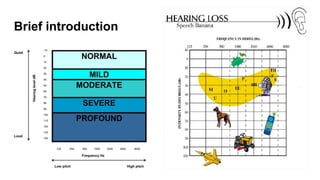
Hearing loss classification: mild, moderate, severe and profound
Low High
Brief introduction
Brief introduction
Etiology:
Hereditary, diseases and infections, intense noise exposure, ototoxic medicines,
aging and others…
Classification according to when the deafness occurred:
pre-lingual
post-lingual
Obstacle to the social development in relation to the family and community [1]
Sign Language
There are several studies showing that the sign language naturally developed as a
common communication method in groups of deaf individuals and presents the
same linguistics properties as the oral communication [2].
Examples of sign languages: American Sign Language (ASL), British Sign
Language (BSL) and Brazilian Sign Language (LIBRAS)
MRI and deafness
Basically, functional MRI has been widely used to the study of language and
motion processing, regarding the brain adaptation with the sign language
communication [3,4].
Figure: Example of activations in
motion-related areas for one deaf and
one hearing participant. Adapted from
[3].
More insights...
Since the usage of sign language will affect significative changes in the
cortical activation in many different brain areas, what could be expected in the
general brain organization?
Hypothesis: Resting state functional network (Default Mode Network) and
global structural connectivity could also present changes in deaf signers.
Resting state networks Adapted from [5]
Brain structural connectivity
Functional connectivity reflects structural
connectivity in the DMN.
a DMN.
b DTI fiber tractography in a single subject
demonstrates the cingulum bundle (blue
tracts) connecting the PCC/RSC to the
MPFC. The yellow tracts connect the bilateral
MTL to the PCC/RSC.
c Schematic representation of the structural
and functional connections between these
three nodes of the DMN.
Adapted from [6].
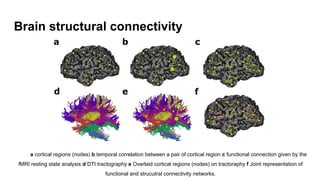
Brain structural connectivity
a cortical regions (nodes) b temporal correlation between a pair of cortical region c functional connection given by the
fMRI resting state analysis d DTI tractography e Overlaid cortical regions (nodes) on tractoraphy f Joint representation of
functional and strucutral connectivity networks.
Material and Methods
● 20 deaf individuals (12 males/ 8 females), right-handed, with congenital deafness
manifested until 3 years old, profound hearing loss in both ears, aged 18 to 45 years and
minimum high school scholarly level.
● Matched control group (retrospectively obtained from local research database)
Imaging protocol:
● T1 imaging protocol: pulse gradient-echo, TR /TE = 970/4 ms, flip angle of 12°, matrix
size of 256 x 256 mm, FOV = 256 mm, 1x1x1 mm voxel resolution.
● fMRI imaging protocol: 8 channels coil, EPI, 200 volumes, TR/TE = 2000/30 ms, 29
trans-axial slices of 4 mm in z-axis acquisition order, 1,83 x 1,83 mm in-plane resolution,
FOV = 240 x 240 mm.
● DTI imaging protocol: 32 gradient direction, 72 axial slices, FOV = 256 x 256 mm,
matrix size of 128x128, 2x2x2 isotropic voxel resolution, TR/TE = 8391/65 ms e b-factor
= 1000 mm/s2.
3 Tesla (Philips Achieva) MRI scanner from Universitary Hospital (USP, Brazil)
Image processing and analysis
● fMRI:
○ DMN network obtained from multidimensional ICA method
○ Parameters: FWHM filter of 8 mm, linear affine registration to MNI152 2 mm,
temporal correction in z-axis acquisition, fixed 30 ICA independent components.
○ Metrics: Spatial correlation group comparison (Deaf x Hearing)
● DTI:
○ Probabilistic tractography (PROBTRACKX e BEDPOSTX)
○ Global structural connectivity matrix (weighted connected matrix with 10% of
maximum fiber density threshold)
○ Parameters: eddy current correction (FSL-EDDY), affine registration with MNI152
2mm, maximum of 2 crossing fiber estimative, and 5000 permutation.
○ Metrics: statistical evaluation of node degree, local fiber density level, global
efficiency and transitivity.
Results
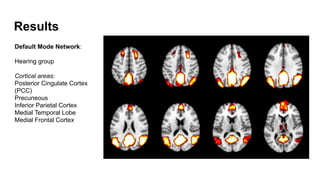
Default Mode Network:
Hearing group
Cortical areas:
Posterior Cingulate Cortex
(PCC)
Precuneous
Inferior Parietal Cortex
Medial Temporal Lobe
Medial Frontal Cortex
Results
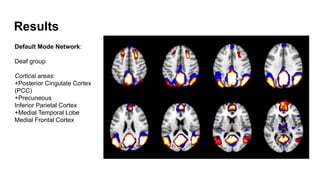
Default Mode Network:
Deaf group
Cortical areas:
+Posterior Cingulate Cortex
(PCC)
+Precuneous
Inferior Parietal Cortex
+Medial Temporal Lobe
Medial Frontal Cortex
Results
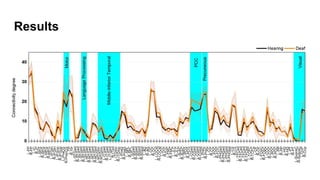
Global efficiency and
Transitivity:
Represents global network
organization regarding
integration and segregation
connectivity patterns [7]
Small-world network
Results
Discussion and Conclusion
DMN
There are a tendency to show an increased activation on PCC, Precuneous and medial
temporal lobes.
Brain structural connectivity
The transitivity and global efficiency indexes are expected to maintain the same level on
both groups.
The node degree profile and fiber density evaluation have an initial insight about the
neuronal adaptation in brain areas such as PCC, Precuneous (p<0.05) and, less intensive, in
Motor areas (p=0.063).
Although the study is in a preliminary stage, these initial results shows further insights
about neuronal plasticity related to the sign language interpretation in functional/structural
brain networks.
References
[1] R. Calderon and M. Greenberg, “Social and emotional development of deaf children,” Oxford Handb. Deaf Stud,
2003.
[2] L. Petitto, “Are signed languages‘ real’ languages,” Evid. from Am. Sign Lang. Lang., 1994.
[3] D. Bavelier, C. Brozinsky, A. Tomann, T. Mitchell, H. Neville, and G. Liu, “Impact of early deafness and early exposure
to sign language on the cerebral organization for motion processing.,” 2001.
[4] H. J. Neville, D. Bavelier, D. Corina, J. Rauschecker, A. Karni, A. Lalwani, A. Braun, V. Clark, P. Jezzard, and R. Turner,
“Cerebral organization for language in deaf and hearing subjects: Biological constraints and effects of experience,”
Proc. Natl. Acad. Sci., vol. 95, no. 3, pp. 922–929, Feb. 1998.
[5] M. P. van den Heuvel and H. E. Hulshoff Pol, “Exploring the brain network: A review on resting-state fMRI
functional connectivity,” Eur. Neuropsychopharmacol., vol. 20, no. 8, pp. 519–534, 2010.
[6] J. S. Damoiseaux and M. D. Greicius, “Greater than the sum of its parts: a review of studies combining structural
connectivity and resting-state functional connectivity.,” Brain Struct. Funct., vol. 213, no. 6, pp. 525–533, 2009.
[7] M. Rubinov and O. Sporns, “Complex network measures of brain connectivity: Uses and interpretations,”
Neuroimage, vol. 52, no. 3, pp. 1059–1069, 2010.

Brain structural connectivity and functional default mode network in deafness

  • 1.
    Brain structural connectivity and functionaldefault mode network in deafness Karolyne Dell Ducas Senra, Antonio Carlos da S. Senra Filho, Antonio Carlos dos Santos Department of Computing and Mathematics Medicine School of Ribeirao Preto Institute of Psychiatry, Psychology and Neuroscience University of Sao Paulo, Brazil King’s College London, UK
  • 2.
    Brief introduction Deafness Defined asan auditory impairment which reduce the capacity of hearing sounds below a specific threshold. Hearing loss classification: mild, moderate, severe and profound Low High
  • 3.
  • 4.
    Brief introduction Etiology: Hereditary, diseasesand infections, intense noise exposure, ototoxic medicines, aging and others… Classification according to when the deafness occurred: pre-lingual post-lingual Obstacle to the social development in relation to the family and community [1]
  • 5.
    Sign Language There areseveral studies showing that the sign language naturally developed as a common communication method in groups of deaf individuals and presents the same linguistics properties as the oral communication [2]. Examples of sign languages: American Sign Language (ASL), British Sign Language (BSL) and Brazilian Sign Language (LIBRAS)
  • 6.
    MRI and deafness Basically,functional MRI has been widely used to the study of language and motion processing, regarding the brain adaptation with the sign language communication [3,4]. Figure: Example of activations in motion-related areas for one deaf and one hearing participant. Adapted from [3].
  • 7.
    More insights... Since theusage of sign language will affect significative changes in the cortical activation in many different brain areas, what could be expected in the general brain organization? Hypothesis: Resting state functional network (Default Mode Network) and global structural connectivity could also present changes in deaf signers.
  • 8.
    Resting state networksAdapted from [5]
  • 9.
    Resting state networksAdapted from [5]
  • 10.
    Brain structural connectivity Functionalconnectivity reflects structural connectivity in the DMN. a DMN. b DTI fiber tractography in a single subject demonstrates the cingulum bundle (blue tracts) connecting the PCC/RSC to the MPFC. The yellow tracts connect the bilateral MTL to the PCC/RSC. c Schematic representation of the structural and functional connections between these three nodes of the DMN. Adapted from [6].
  • 11.
    Brain structural connectivity acortical regions (nodes) b temporal correlation between a pair of cortical region c functional connection given by the fMRI resting state analysis d DTI tractography e Overlaid cortical regions (nodes) on tractoraphy f Joint representation of functional and strucutral connectivity networks.
  • 12.
    Material and Methods ●20 deaf individuals (12 males/ 8 females), right-handed, with congenital deafness manifested until 3 years old, profound hearing loss in both ears, aged 18 to 45 years and minimum high school scholarly level. ● Matched control group (retrospectively obtained from local research database) Imaging protocol: ● T1 imaging protocol: pulse gradient-echo, TR /TE = 970/4 ms, flip angle of 12°, matrix size of 256 x 256 mm, FOV = 256 mm, 1x1x1 mm voxel resolution. ● fMRI imaging protocol: 8 channels coil, EPI, 200 volumes, TR/TE = 2000/30 ms, 29 trans-axial slices of 4 mm in z-axis acquisition order, 1,83 x 1,83 mm in-plane resolution, FOV = 240 x 240 mm. ● DTI imaging protocol: 32 gradient direction, 72 axial slices, FOV = 256 x 256 mm, matrix size of 128x128, 2x2x2 isotropic voxel resolution, TR/TE = 8391/65 ms e b-factor = 1000 mm/s2. 3 Tesla (Philips Achieva) MRI scanner from Universitary Hospital (USP, Brazil)
  • 13.
    Image processing andanalysis ● fMRI: ○ DMN network obtained from multidimensional ICA method ○ Parameters: FWHM filter of 8 mm, linear affine registration to MNI152 2 mm, temporal correction in z-axis acquisition, fixed 30 ICA independent components. ○ Metrics: Spatial correlation group comparison (Deaf x Hearing) ● DTI: ○ Probabilistic tractography (PROBTRACKX e BEDPOSTX) ○ Global structural connectivity matrix (weighted connected matrix with 10% of maximum fiber density threshold) ○ Parameters: eddy current correction (FSL-EDDY), affine registration with MNI152 2mm, maximum of 2 crossing fiber estimative, and 5000 permutation. ○ Metrics: statistical evaluation of node degree, local fiber density level, global efficiency and transitivity.
  • 14.
    Results Default Mode Network: Hearinggroup Cortical areas: Posterior Cingulate Cortex (PCC) Precuneous Inferior Parietal Cortex Medial Temporal Lobe Medial Frontal Cortex
  • 15.
    Results Default Mode Network: Deafgroup Cortical areas: +Posterior Cingulate Cortex (PCC) +Precuneous Inferior Parietal Cortex +Medial Temporal Lobe Medial Frontal Cortex
  • 16.
    Results Global efficiency and Transitivity: Representsglobal network organization regarding integration and segregation connectivity patterns [7] Small-world network
  • 17.
  • 18.
    Discussion and Conclusion DMN Thereare a tendency to show an increased activation on PCC, Precuneous and medial temporal lobes. Brain structural connectivity The transitivity and global efficiency indexes are expected to maintain the same level on both groups. The node degree profile and fiber density evaluation have an initial insight about the neuronal adaptation in brain areas such as PCC, Precuneous (p<0.05) and, less intensive, in Motor areas (p=0.063). Although the study is in a preliminary stage, these initial results shows further insights about neuronal plasticity related to the sign language interpretation in functional/structural brain networks.
  • 19.
    References [1] R. Calderonand M. Greenberg, “Social and emotional development of deaf children,” Oxford Handb. Deaf Stud, 2003. [2] L. Petitto, “Are signed languages‘ real’ languages,” Evid. from Am. Sign Lang. Lang., 1994. [3] D. Bavelier, C. Brozinsky, A. Tomann, T. Mitchell, H. Neville, and G. Liu, “Impact of early deafness and early exposure to sign language on the cerebral organization for motion processing.,” 2001. [4] H. J. Neville, D. Bavelier, D. Corina, J. Rauschecker, A. Karni, A. Lalwani, A. Braun, V. Clark, P. Jezzard, and R. Turner, “Cerebral organization for language in deaf and hearing subjects: Biological constraints and effects of experience,” Proc. Natl. Acad. Sci., vol. 95, no. 3, pp. 922–929, Feb. 1998. [5] M. P. van den Heuvel and H. E. Hulshoff Pol, “Exploring the brain network: A review on resting-state fMRI functional connectivity,” Eur. Neuropsychopharmacol., vol. 20, no. 8, pp. 519–534, 2010. [6] J. S. Damoiseaux and M. D. Greicius, “Greater than the sum of its parts: a review of studies combining structural connectivity and resting-state functional connectivity.,” Brain Struct. Funct., vol. 213, no. 6, pp. 525–533, 2009. [7] M. Rubinov and O. Sporns, “Complex network measures of brain connectivity: Uses and interpretations,” Neuroimage, vol. 52, no. 3, pp. 1059–1069, 2010.