Brain Development
Nicole A. Gonzalez
PSY- 354
Kristin Swanson
April 26, 2015.
Vocabulary
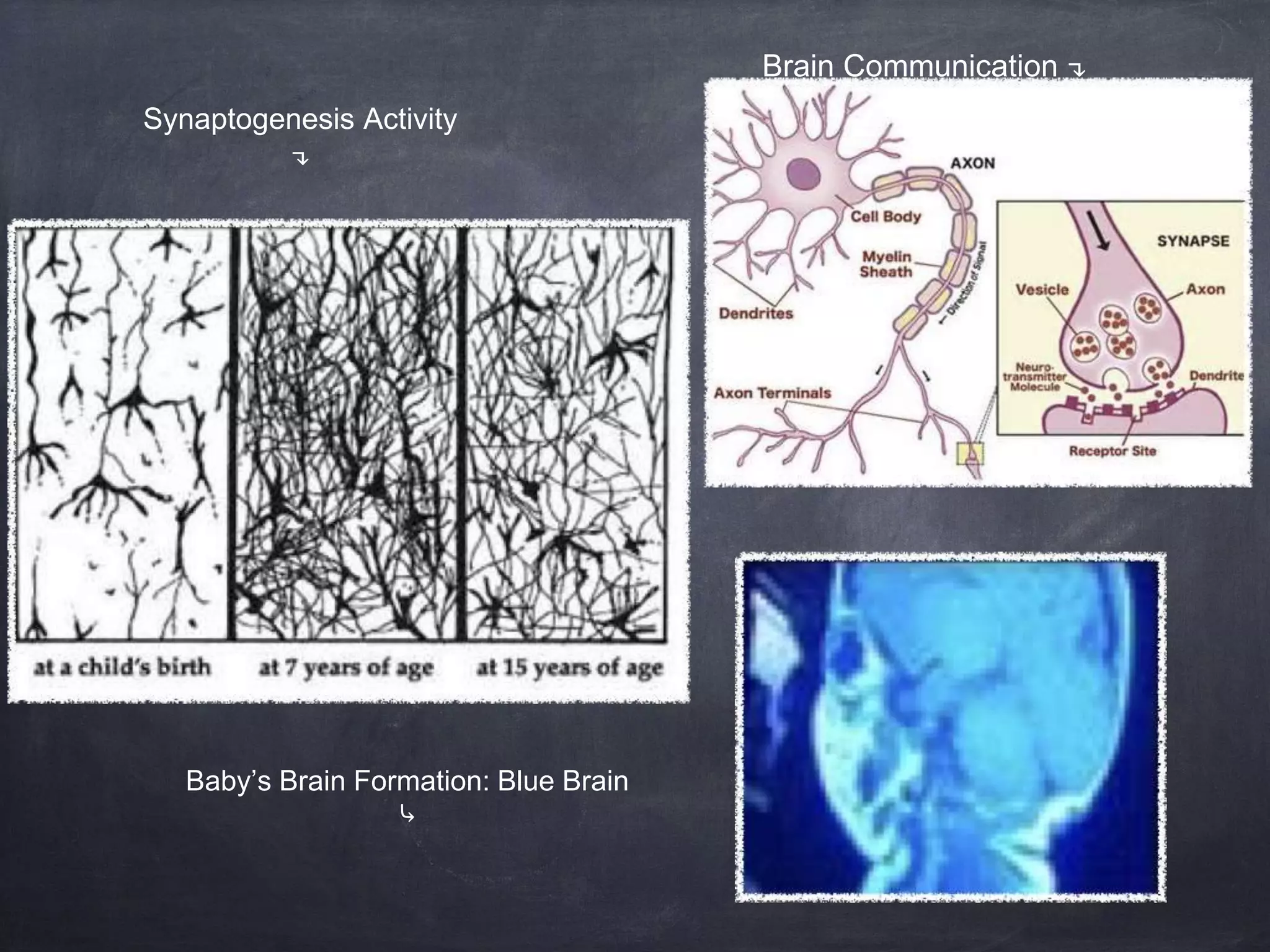
Axons: Neuron that sends information to other neurons.
Neurons: Cell in the Brain in the nervous system that transmits information.
Glial Cell: Cell in the brain that provides structural or functional support for, and in some cases
direction to, one or more neurons.
Genetic Code Script: The instructions on a gene that influences the growth of a protein and
furthermore a information encoded will be transmitted through cells, which is later transcript to
biological traits.
Synapses: Junction between two neurons that allows transition of the message.
Neurotransmitter: A chemical substance that is in the Brain.
Cortex: The outer level of the Brain.
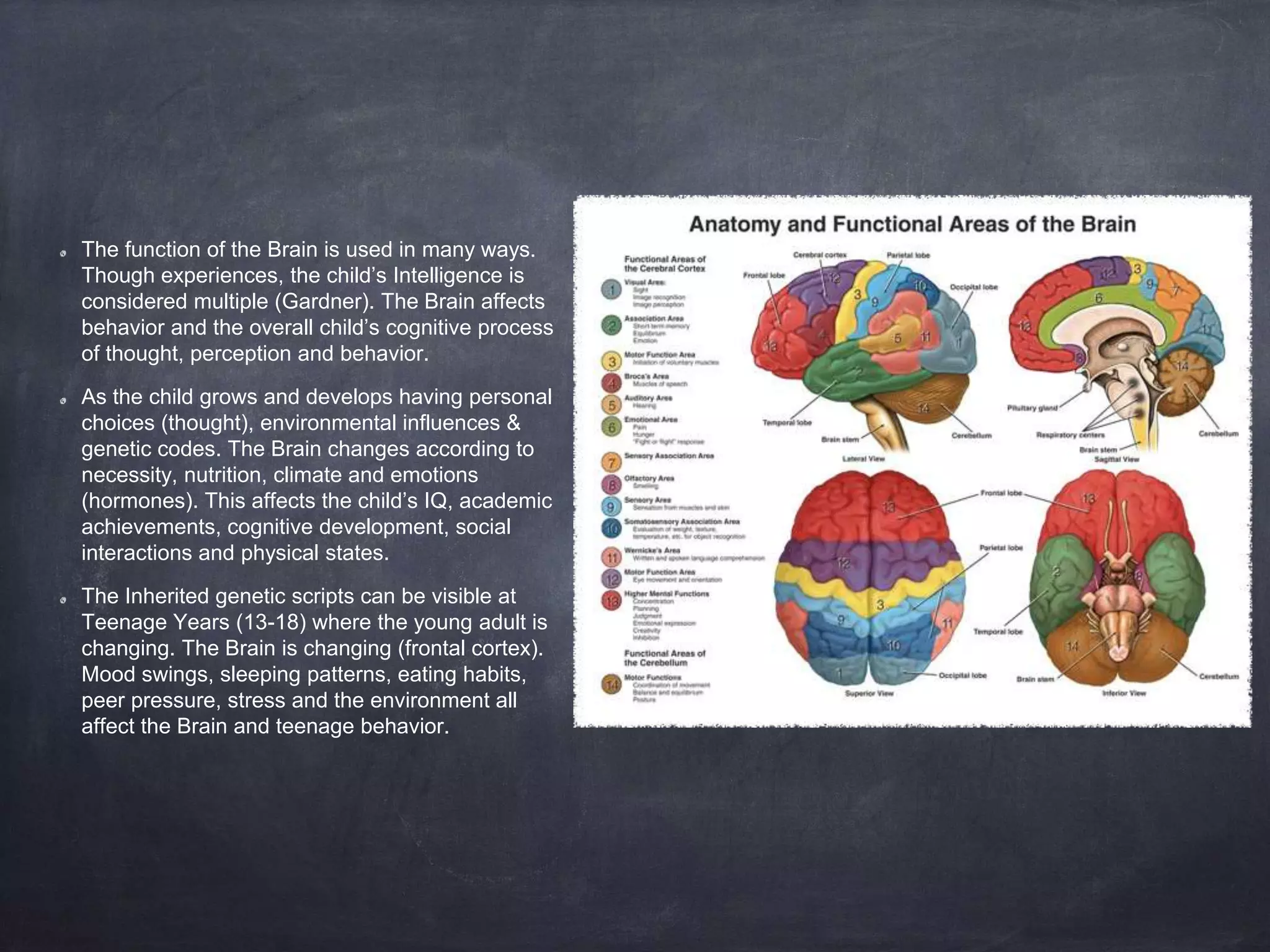
Synaptogenesis: A process in brain development whereby many new synapses appear during the
first few years of life.
Myelination: Growth of a fatty sheath around the axon of neurons, enabling faster transmitters of
electrical impulses.
Scheme: Organized group of thoughts uses repeatedly.
Teratogen: Potentially harmful substance that can cause damaging effects during prenatal
development.
Normal Development of
the Brain
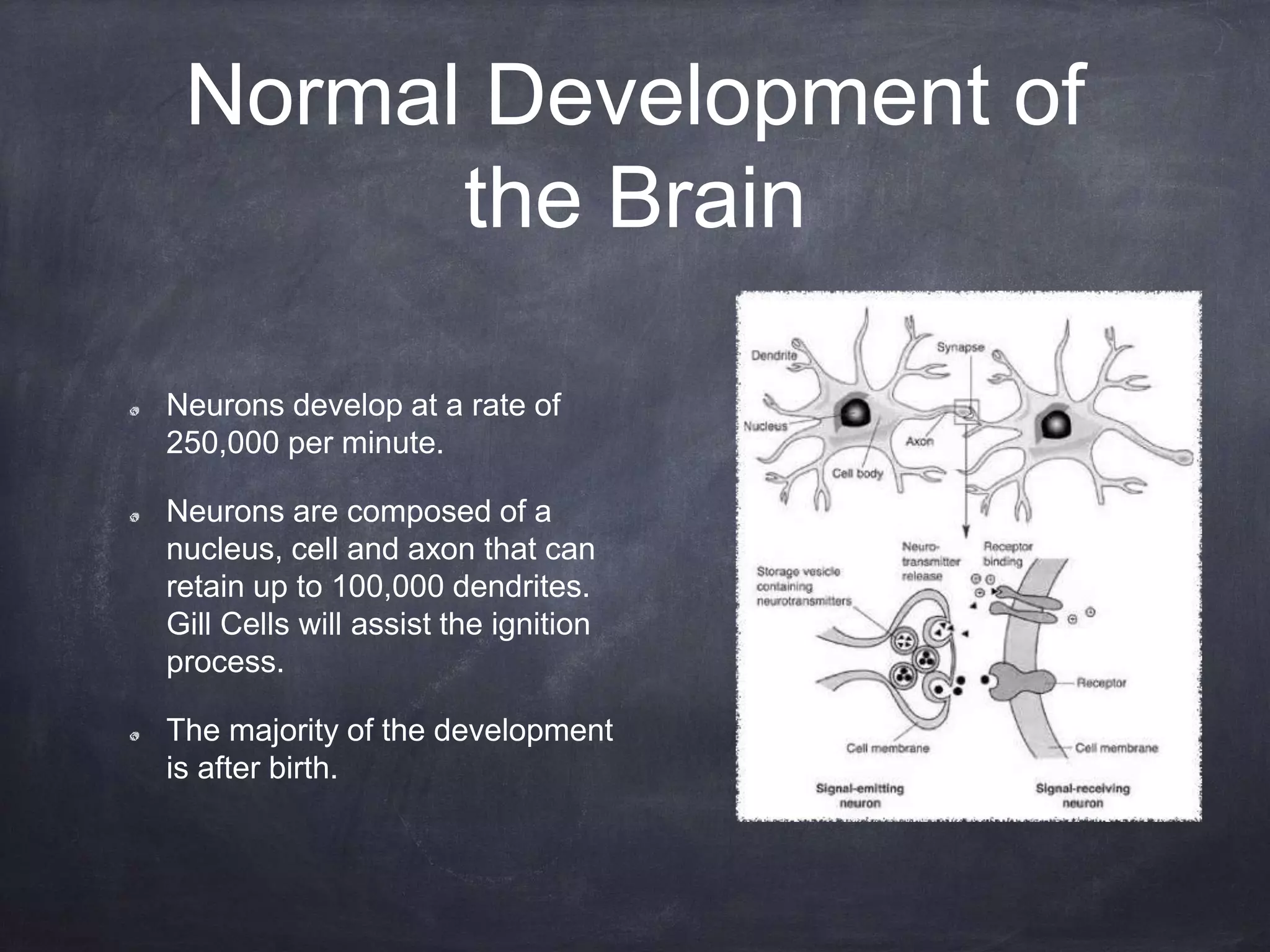
Neurons develop at a rate of
250,000 per minute.
Neurons are composed of a
nucleus, cell and axon that can
retain up to 100,000 dendrites.
Gill Cells will assist the ignition
process.
The majority of the development
is after birth.
A Babies Brain!
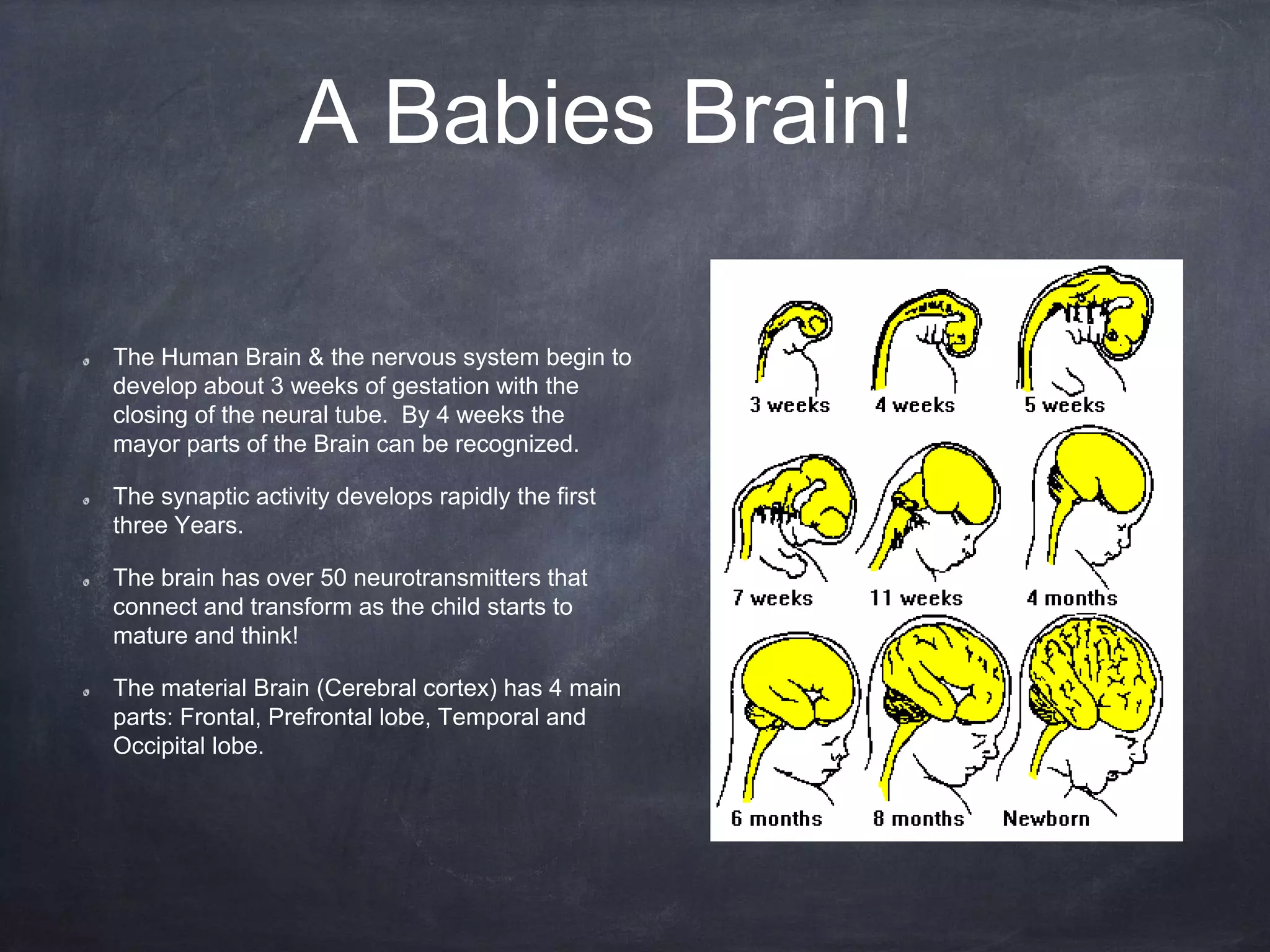
The Human Brain & the nervous system begin to
develop about 3 weeks of gestation with the
closing of the neural tube. By 4 weeks the
mayor parts of the Brain can be recognized.
The synaptic activity develops rapidly the first
three Years.
The brain has over 50 neurotransmitters that
connect and transform as the child starts to
mature and think!
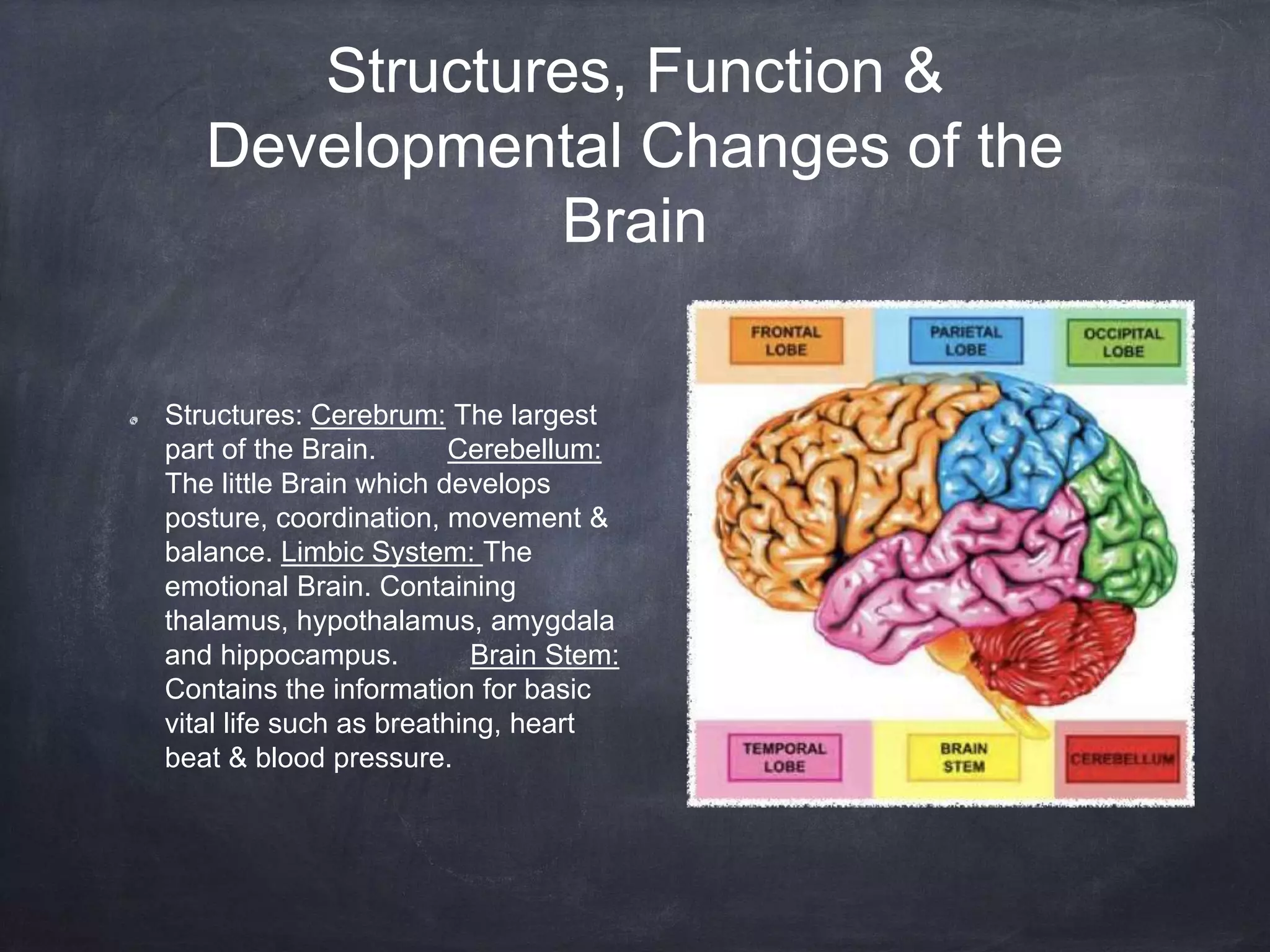
The material Brain (Cerebral cortex) has 4 main
parts: Frontal, Prefrontal lobe, Temporal and
Occipital lobe.
Structures, Function &
Developmental Changes of the
Brain
Structures: Cerebrum: The largest
part of the Brain. Cerebellum:
The little Brain which develops
posture, coordination, movement &
balance. Limbic System: The
emotional Brain. Containing
thalamus, hypothalamus, amygdala
and hippocampus. Brain Stem:
Contains the information for basic
vital life such as breathing, heart
beat & blood pressure.
12 weeks before birth the Baby can listen, move, see and feel. The brain is still developing.
The function of the brain in infants 0-1 years of age include: babies first steps, smiling, waving, crawling
jumping & babbling. During this stage the child develops love, trust and safety.
At Two, the child begins to think independently. All of the synaptogenesis and neurons are multiplying and
forming a smarter more developed child. Some functions include: language acquisition, physical
development and socialization.
At Three, the child is seeking answers. The left side of the Brain is developing because of language
(word) acquisition, thought, socialization, experiences and rituals.
At Four, the child tends to be more energetic. The Brain continues to develop thought the child’s lifetime.
Skills like logic (language), reasoning, abstract thoughts (Art), patterns, mind representations (Math),
balance (PY.ED), fine and gross motor development (writing).
At Five, gender, self reliance, character, concept of friendship, morale, active play, interest and initiative is
seen. The Brain functions like a computer that retains information through synaptogenesis, themes and
equilibration. ( Julie, Law PH.D., 2012)
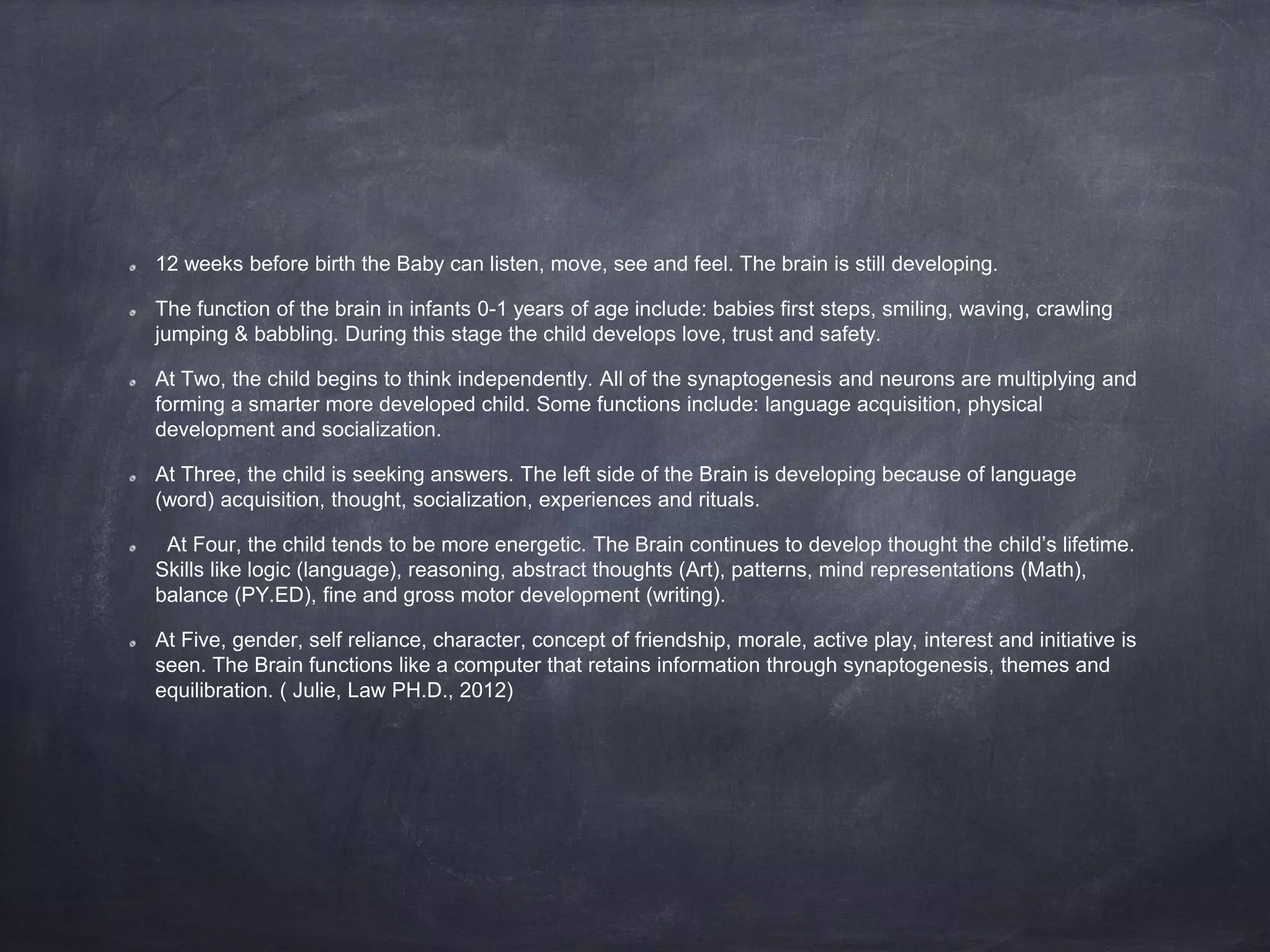
The function of the Brain is used in many ways.
Though experiences, the child’s Intelligence is
considered multiple (Gardner). The Brain affects
behavior and the overall child’s cognitive process
of thought, perception and behavior.
As the child grows and develops having personal
choices (thought), environmental influences &
genetic codes. The Brain changes according to
necessity, nutrition, climate and emotions
(hormones). This affects the child’s IQ, academic
achievements, cognitive development, social
interactions and physical states.
The Inherited genetic scripts can be visible at
Teenage Years (13-18) where the young adult is
changing. The Brain is changing (frontal cortex).
Mood swings, sleeping patterns, eating habits,
peer pressure, stress and the environment all
affect the Brain and teenage behavior.
Synaptogenesis Activity
↴
Baby’s Brain Formation: Blue Brain
⤷
Brain Communication ↴
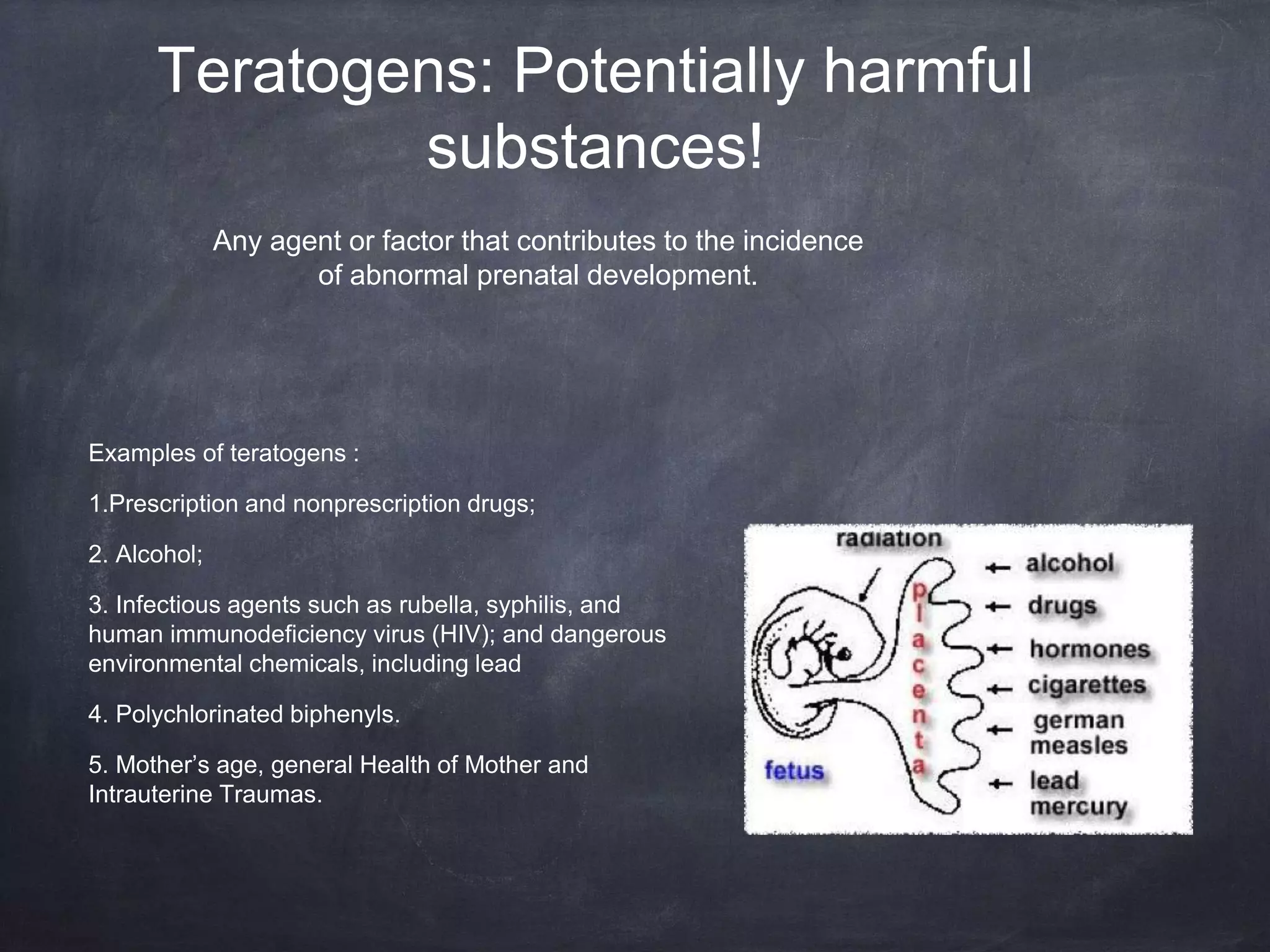
Teratogens: Potentially harmful
substances!
Examples of teratogens :
1.Prescription and nonprescription drugs;
2. Alcohol;
3. Infectious agents such as rubella, syphilis, and
human immunodeficiency virus (HIV); and dangerous
environmental chemicals, including lead
4. Polychlorinated biphenyls.
5. Mother’s age, general Health of Mother and
Intrauterine Traumas.
Any agent or factor that contributes to the incidence
of abnormal prenatal development.
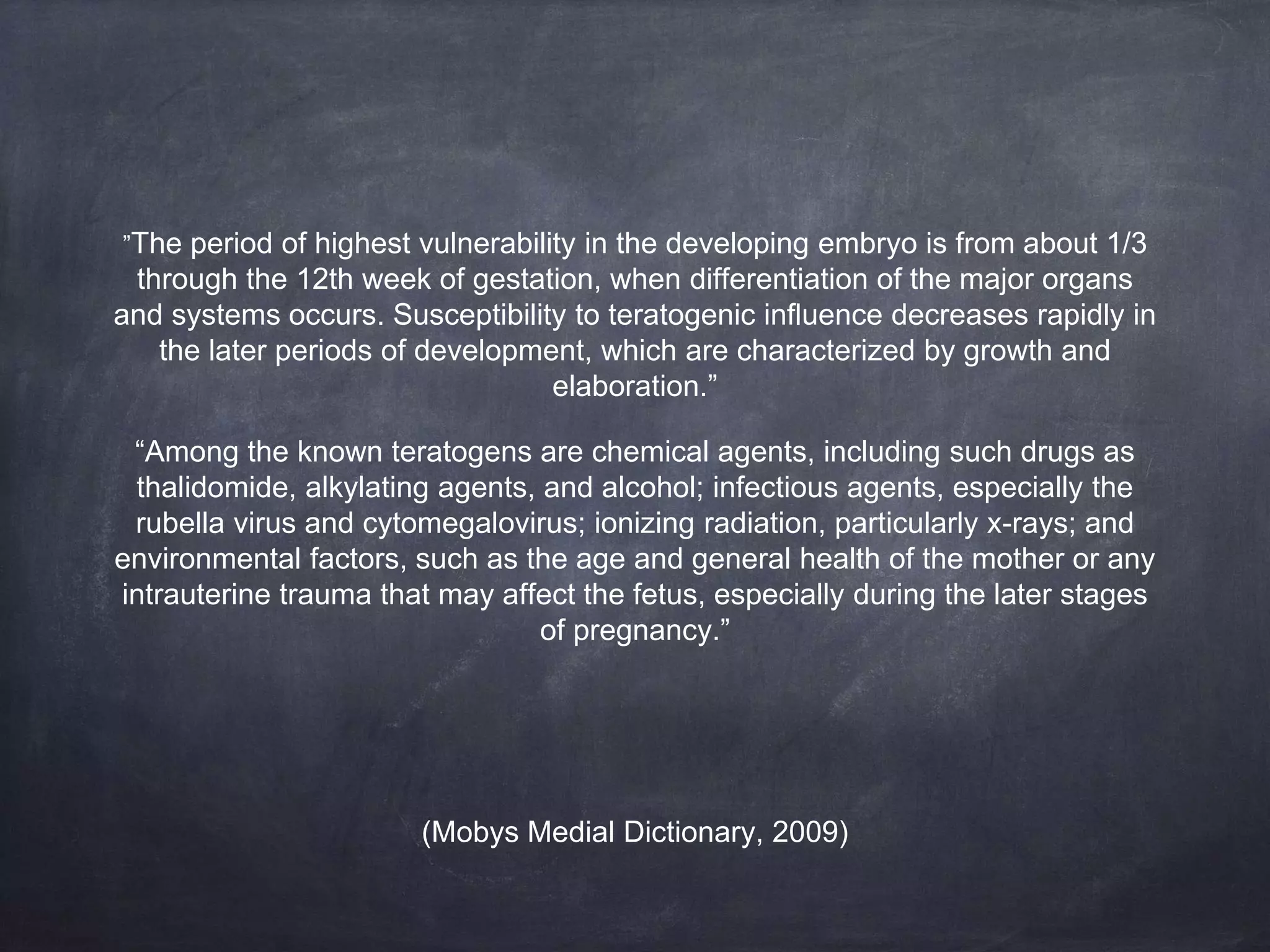
(Mobys Medial Dictionary, 2009)
”The period of highest vulnerability in the developing embryo is from about 1/3
through the 12th week of gestation, when differentiation of the major organs
and systems occurs. Susceptibility to teratogenic influence decreases rapidly in
the later periods of development, which are characterized by growth and
elaboration.”
“Among the known teratogens are chemical agents, including such drugs as
thalidomide, alkylating agents, and alcohol; infectious agents, especially the
rubella virus and cytomegalovirus; ionizing radiation, particularly x-rays; and
environmental factors, such as the age and general health of the mother or any
intrauterine trauma that may affect the fetus, especially during the later stages
of pregnancy.”
Influence on Development of
Teratogens in Children
When a threshold effect (small amount that becomes dangerous) occurs the substance
will be harmful and can contribute to side effects in cognitive, social and motor.
Physical development is influenced by the impact of this harmful substance.
The environment on which the child is raised in will affect the development.
An increase of decrease of nutrition can also influence the child once born.
Teratogens can impede cognitive development and result in future impairments for the
child, this is called behavioral teratogens.
References:
Julie Law, PHD. (2012) Child Development 3-5 Years Old Website located at:
http://humanservices.ucdavis.edu/resource/uploadfiles/Child%20Development%203-5.pdf Retrieved:
April 26, 2015.
McDevitt Teresa & Ormrod Jeanne Ellis. (2013) Child Development and Education, Fifth
EditionPublished by Pearson Education, Inc.
Mosby's Medical Dictionary, 8th edition. (2009). Retrieved April 25 2015 from http://medical-
dictionary.thefreedictionary.com
Pevzner Holly (2013) Brain Development in Children. Website located at: Retrieved: April 24, 2015.
Society for Neuroscience (2012) Induction: The Making of a NeuronWebsite located at:
http://www.brainfacts.org/brain-basics Retrieved: April 25, 2015.
The Secret Life of the Brain (2001) Public Broadcasting System Website located at:
http://www.pbs.org/wnet/brain/index.html Retrieved: April 24, 2015.
The Urban Child’s Institute (2015) Website Located at: http://www.urbanchildinstitute.org/why-0-
3/baby-and-brain Retrieved: April 26, 2016.

Brain Development

  • 1.
    Brain Development Nicole A.Gonzalez PSY- 354 Kristin Swanson April 26, 2015.
  • 2.
    Vocabulary Axons: Neuron thatsends information to other neurons. Neurons: Cell in the Brain in the nervous system that transmits information. Glial Cell: Cell in the brain that provides structural or functional support for, and in some cases direction to, one or more neurons. Genetic Code Script: The instructions on a gene that influences the growth of a protein and furthermore a information encoded will be transmitted through cells, which is later transcript to biological traits. Synapses: Junction between two neurons that allows transition of the message. Neurotransmitter: A chemical substance that is in the Brain. Cortex: The outer level of the Brain. Synaptogenesis: A process in brain development whereby many new synapses appear during the first few years of life. Myelination: Growth of a fatty sheath around the axon of neurons, enabling faster transmitters of electrical impulses. Scheme: Organized group of thoughts uses repeatedly. Teratogen: Potentially harmful substance that can cause damaging effects during prenatal development.
  • 3.
    Normal Development of theBrain Neurons develop at a rate of 250,000 per minute. Neurons are composed of a nucleus, cell and axon that can retain up to 100,000 dendrites. Gill Cells will assist the ignition process. The majority of the development is after birth.
  • 4.
    A Babies Brain! TheHuman Brain & the nervous system begin to develop about 3 weeks of gestation with the closing of the neural tube. By 4 weeks the mayor parts of the Brain can be recognized. The synaptic activity develops rapidly the first three Years. The brain has over 50 neurotransmitters that connect and transform as the child starts to mature and think! The material Brain (Cerebral cortex) has 4 main parts: Frontal, Prefrontal lobe, Temporal and Occipital lobe.
  • 5.
    Structures, Function & DevelopmentalChanges of the Brain Structures: Cerebrum: The largest part of the Brain. Cerebellum: The little Brain which develops posture, coordination, movement & balance. Limbic System: The emotional Brain. Containing thalamus, hypothalamus, amygdala and hippocampus. Brain Stem: Contains the information for basic vital life such as breathing, heart beat & blood pressure.
  • 6.
    12 weeks beforebirth the Baby can listen, move, see and feel. The brain is still developing. The function of the brain in infants 0-1 years of age include: babies first steps, smiling, waving, crawling jumping & babbling. During this stage the child develops love, trust and safety. At Two, the child begins to think independently. All of the synaptogenesis and neurons are multiplying and forming a smarter more developed child. Some functions include: language acquisition, physical development and socialization. At Three, the child is seeking answers. The left side of the Brain is developing because of language (word) acquisition, thought, socialization, experiences and rituals. At Four, the child tends to be more energetic. The Brain continues to develop thought the child’s lifetime. Skills like logic (language), reasoning, abstract thoughts (Art), patterns, mind representations (Math), balance (PY.ED), fine and gross motor development (writing). At Five, gender, self reliance, character, concept of friendship, morale, active play, interest and initiative is seen. The Brain functions like a computer that retains information through synaptogenesis, themes and equilibration. ( Julie, Law PH.D., 2012)
  • 7.
    The function ofthe Brain is used in many ways. Though experiences, the child’s Intelligence is considered multiple (Gardner). The Brain affects behavior and the overall child’s cognitive process of thought, perception and behavior. As the child grows and develops having personal choices (thought), environmental influences & genetic codes. The Brain changes according to necessity, nutrition, climate and emotions (hormones). This affects the child’s IQ, academic achievements, cognitive development, social interactions and physical states. The Inherited genetic scripts can be visible at Teenage Years (13-18) where the young adult is changing. The Brain is changing (frontal cortex). Mood swings, sleeping patterns, eating habits, peer pressure, stress and the environment all affect the Brain and teenage behavior.
  • 8.
    Synaptogenesis Activity ↴ Baby’s BrainFormation: Blue Brain ⤷ Brain Communication ↴
  • 9.
    Teratogens: Potentially harmful substances! Examplesof teratogens : 1.Prescription and nonprescription drugs; 2. Alcohol; 3. Infectious agents such as rubella, syphilis, and human immunodeficiency virus (HIV); and dangerous environmental chemicals, including lead 4. Polychlorinated biphenyls. 5. Mother’s age, general Health of Mother and Intrauterine Traumas. Any agent or factor that contributes to the incidence of abnormal prenatal development.
  • 10.
    (Mobys Medial Dictionary,2009) ”The period of highest vulnerability in the developing embryo is from about 1/3 through the 12th week of gestation, when differentiation of the major organs and systems occurs. Susceptibility to teratogenic influence decreases rapidly in the later periods of development, which are characterized by growth and elaboration.” “Among the known teratogens are chemical agents, including such drugs as thalidomide, alkylating agents, and alcohol; infectious agents, especially the rubella virus and cytomegalovirus; ionizing radiation, particularly x-rays; and environmental factors, such as the age and general health of the mother or any intrauterine trauma that may affect the fetus, especially during the later stages of pregnancy.”
  • 11.
    Influence on Developmentof Teratogens in Children When a threshold effect (small amount that becomes dangerous) occurs the substance will be harmful and can contribute to side effects in cognitive, social and motor. Physical development is influenced by the impact of this harmful substance. The environment on which the child is raised in will affect the development. An increase of decrease of nutrition can also influence the child once born. Teratogens can impede cognitive development and result in future impairments for the child, this is called behavioral teratogens.
  • 12.
    References: Julie Law, PHD.(2012) Child Development 3-5 Years Old Website located at: http://humanservices.ucdavis.edu/resource/uploadfiles/Child%20Development%203-5.pdf Retrieved: April 26, 2015. McDevitt Teresa & Ormrod Jeanne Ellis. (2013) Child Development and Education, Fifth EditionPublished by Pearson Education, Inc. Mosby's Medical Dictionary, 8th edition. (2009). Retrieved April 25 2015 from http://medical- dictionary.thefreedictionary.com Pevzner Holly (2013) Brain Development in Children. Website located at: Retrieved: April 24, 2015. Society for Neuroscience (2012) Induction: The Making of a NeuronWebsite located at: http://www.brainfacts.org/brain-basics Retrieved: April 25, 2015. The Secret Life of the Brain (2001) Public Broadcasting System Website located at: http://www.pbs.org/wnet/brain/index.html Retrieved: April 24, 2015. The Urban Child’s Institute (2015) Website Located at: http://www.urbanchildinstitute.org/why-0- 3/baby-and-brain Retrieved: April 26, 2016.