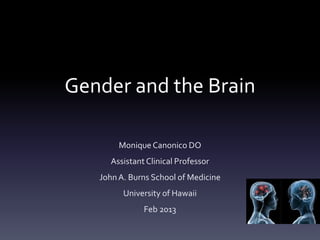
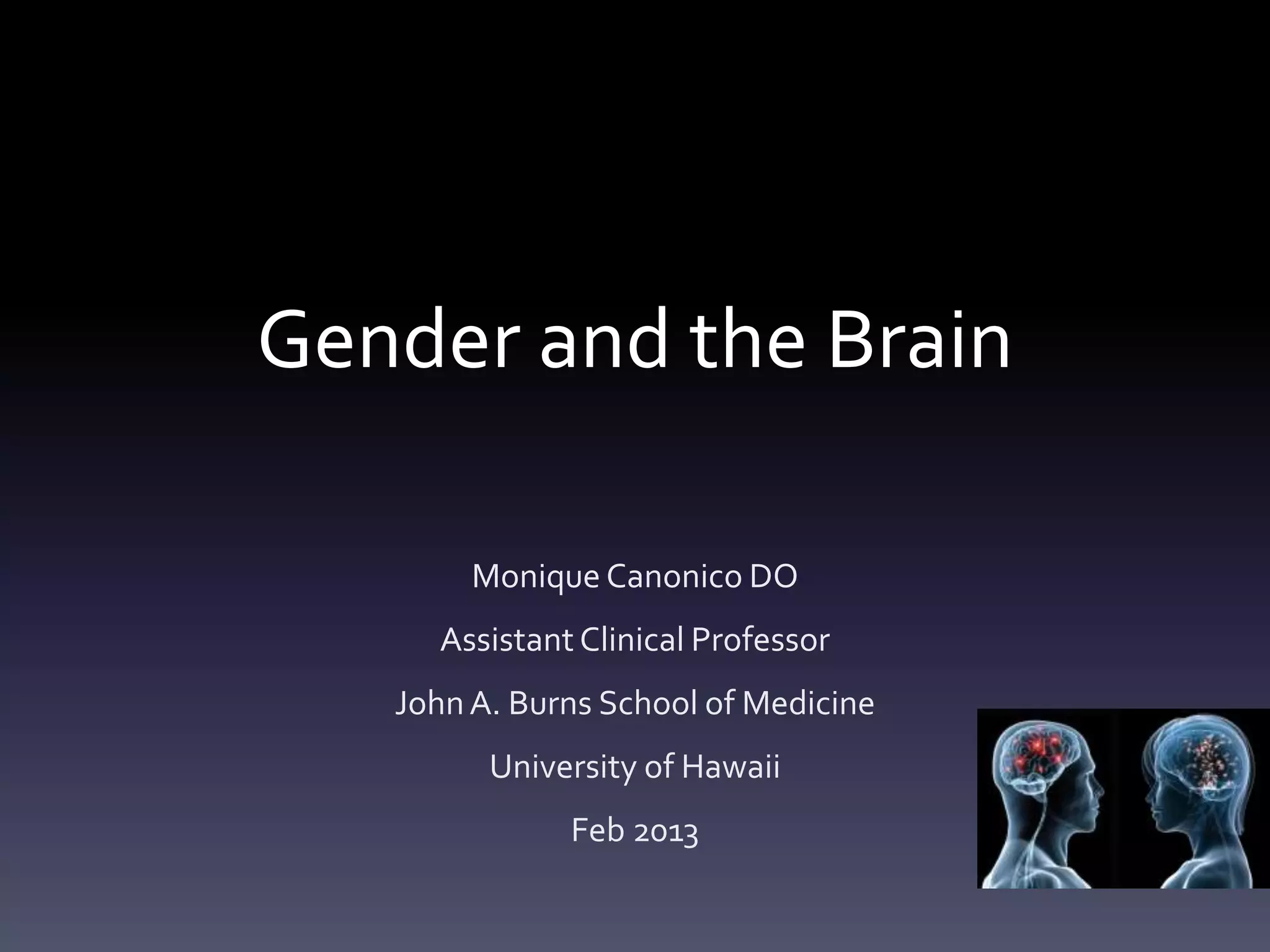
Gender and the Brain
Monique Canonico DO
Assistant Clinical Professor
JohnA. Burns School of Medicine
University of Hawaii
Feb 2013
Overview
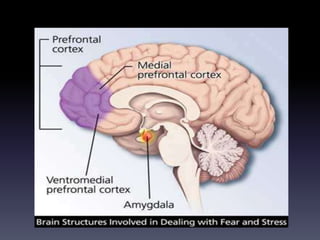
• Prefrontal cortex
• “pruning”
• Gender differences in anatomy
• Gender differences in neurochemistry
• Gender differences in learning
• How to maximize learning potential in
your daughter or son
The Latest Brain Research
• The prefrontal cortex
• pruning
At the time of puberty…
• A massive pruning of brain connections
occurs
• usually between age 12 and 16.5
The Pruning (cont.)
• The synaptic pruning represents the huge
transformation of the adolescent brain.
• Many neurons and the connections between
them are cut, leading to improved efficiency
The Pruning (cont..)
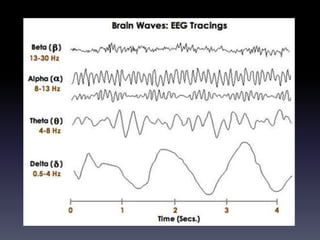
• 2009:Researchers at UC Davis study brain waves of 67
Adolescents
• Delta waves occur in the deepest part of non REM sleep
• It is believed that the nonREM sleep is the recuperative
phase of sleep, in which the parts of the brain (that are
more active during waking), “recuperate”
• There was a 60 % drop in delta waves
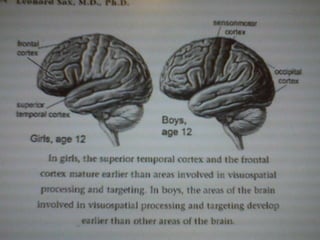
Adolescents’ brains undergo a
substantial “pruning” or reduction in
gray matter volume during
adolescence, which happens about
two years earlier in girls, compared
to boys.
History of Gender Research
• 1960s~focus on gender bias against females in
schools
• 1970s and 80s~research focused on how career
expectations were still along gender lines
• 1990 on~research is on the underperformances
of boys in the school system
Boys:The History, the Present,
andWhyTCS is onTrack
• Boys would learn skills etc from
relativethese boys then found themselves
in boxlike classroom
• For most boys in public schools gone were the
classic academic models of verbal debate
between young thinkers
Brain Cells CommunicateThrough
Neurochemicals
• Many differences between male and female
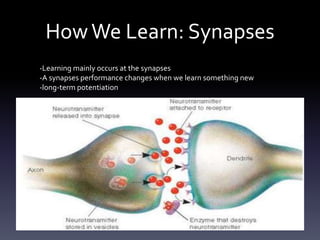
HowWe Learn: Synapses
-Learning mainly occurs at the synapses
-A synapses performance changes when we learn something new
-long-term potentiation
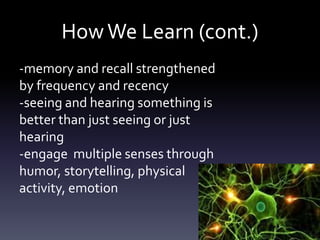
HowWe Learn (cont.)
-memory and recall strengthened
by frequency and recency
-seeing and hearing something is
better than just seeing or just
hearing
-engage multiple senses through
humor, storytelling, physical
activity, emotion
Differences
BOYS
• Have less serotonin
• Need reality checks to
make them reassess and to
be challenged
• Prefer nonfiction
GIRLS
• Have more serotonin
• Need encouragement to
build them up.
• Prefer fiction
23
Learning Differences
Some male learning characteristics are
• More areas in the brain for spatial reasoning
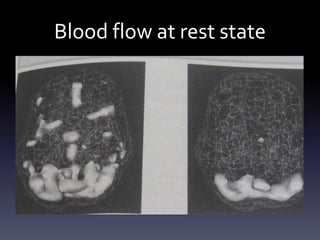
• . Male brain enters a rest state several times a day. Often during these
rest states in order to stay alert boys may fidget or act out.
• Are seen as more aggressive and impulsive than girls
• Engage in “aggression nurturance” or rough housing and insults with
other males
• Take more time than girls to transition between activities and/or topics
• Feel less compelled to comply with the orders of teachers
Biology
• Using PET and MRI we are learning better ways to teach boys and
girls
• Boys have more dopamine (which increases impulsive behavior)
• Boys have more blood flow to the cerebellum
• Girls have stronger connections in their temporal lobes and more
oxytocin and estrogen(these chemicals have a direct affect on
words)
• Overall girls have 15% more blood flow to the brain
25
Learning Differences
• A study done by Pomerantz, Alterman and Saxon
(2002) stated that girls will feel that they are
disappointing a parent and/or teacher. Girls place
more emphasis on pleasing others.
• Girls are more critical of their performance in school
even though it has been reported that they do very
well in academics. Boys seem to overestimate their
ability to achieve.
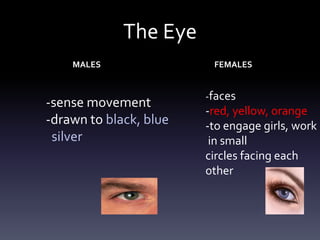
The Eye
MALES FEMALES
-sense movement
-drawn to black, blue
silver
-faces
-red, yellow, orange
-to engage girls, work
in small
circles facing each
other
Gender Differences in Psychiatric
Disorders
MALES
• Schizophrenia
• Antisocial behavior
• Alcoholics
• Drug addiction
FEMALES
• Depression 2:1
• Anxiety
• Anorexics
Brain Under Stress
MALES
• Withdraw
• Don’t recall details
FEMALES
• Nurture children
• Remember details vividly
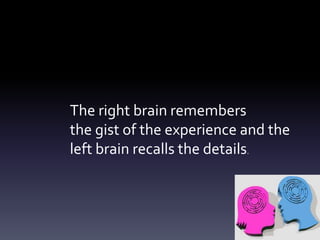
The right brain remembers
the gist of the experience and the
left brain recalls the details.
Communication
• Womens’ hemispheres have a thicker
connection
• Women use both hemispheres when
speaking. Males use primarily one
Negotiating Status
BOYS
• By elementary schools boys
start to use verbal skills ; to
find their status in a large
group
• High status males give orders
• Independent behavior: prized
GIRLS
• Different strategy to
maintain their hierarchy
• Girls talk/ secrets/ reach
consensus of who is in
charge
• More indirect otherwise
labeled “bossy”
Data in the Classroom
• Facts: boys and girls process emotions
differently
• Girls may excel at language
• Boys may excel at math/science
• Close performance gapsingle gender
classes ?
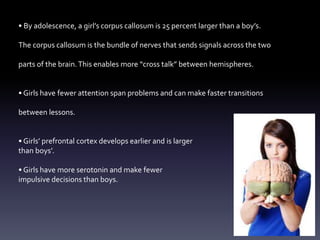
• By adolescence, a girl’s corpus callosum is 25 percent larger than a boy’s.
The corpus callosum is the bundle of nerves that sends signals across the two
parts of the brain.This enables more “cross talk” between hemispheres.
• Girls have fewer attention span problems and can make faster transitions
between lessons.
• Girls’ prefrontal cortex develops earlier and is larger
than boys’.
• Girls have more serotonin and make fewer
impulsive decisions than boys.
Autonomic Nervous System
BOYS
• More alert standing,
moving
• Best at rm temp 69 degrees
• Stress increases blood flow
to the brain and helps boys
stay focused
GIRLS
• More alert when seated
• Best at rm temp 75 degrees
• Stress increases blood flow
to gut
Blood flow at rest state
40
Conclusion
It is obvious that there are several differences in female and
male students. It does seem that a solution would be to
separate the genders in order to individualize the classroom
environment.
Boys:• Get the majority of Ds and Fs in most schools
• Make up 70% of the discipline problems
• Are ~ 1 yr to 1.5 yrs behind girls in
reading/writing, according to the US Dept of
Education
• Over 80% of schoolchildren
on Ritalin (or similar) are boys
Parents
• Be cognizant of your child’s strengths and weaknesses
• Read brain based literature
• Help child balance sedentary pursuits with active
• Encourage child to stick with certain courses even if
it’s not their strong one
• Encourage child to take risks/challenges
To Encourage Girls
• Form working groups to promote negotiating skills and
leadership
• Verbally encourage the hidden high energy of “quiet girls”
• Manipulatives to teach math
• Don’t assume they not are interested in technical stuff
• Call on both and girls equally
• High expectations
• Reject stereotypes
Girls: Middle School
• Spend 30% more more time studying than
boys; don’t necessarily learn more
• Self esteem may decline
• May feel not as good science/math
• Parents’ goal: select proper academic path
Girls: Middle School
• Relationships become so important; don’t
cringe at the melodrama NORMAL
• girls are used to be being praised for their
compliance but need to be praised for their
independence of thought
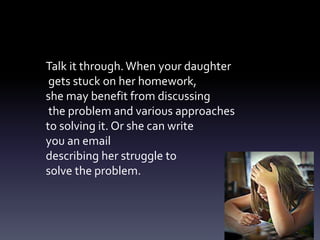
Talk it through.When your daughter
gets stuck on her homework,
she may benefit from discussing
the problem and various approaches
to solving it. Or she can write
you an email
describing her struggle to
solve the problem.
To Encourage Boys
• Let boys nurture each other with healthy aggression
• Make lessons kinesthetic
• Recognize and accept the high energy level of boys
• Allow opportunities for competition
• Incorporate technology
To Encourage Boys
• Higher testosterone leads boys to seek
COMPETITION
• -worksheet? “beat the clock” with kitchen timer
• -football/basketballlearn math facts
• Spelling words? Have him in a physical position
while thinking
To Encourage Boys
• Give them soft objects to squeeze in their
hand constantly (not disruptively) to ward off
the rest state
Practical Suggestions
• Vision trumps all senses
• Humans learn best through pictures not
written or spoken words
• Using a white board to study may help
• Teachers could use computer animations
Practical Suggestions (cont.)
• “temporal contiguity principle”-students learn
better when presented items simultaneously
rather than successively
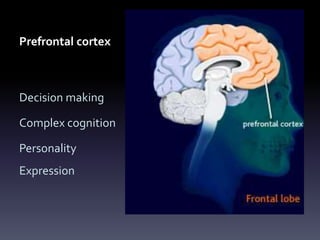
Prefrontal cortex
Decision making
Complex cognition
Personality
Expression
Suggestions (cont.)
• Exercise boosts brain power
• Limit screen time
• Get enough sleep
• Is your child getting enough water and protein?
• Chess
• To help with math bank account/responsible for
their own $
Suggestions (cont.)
• Quizlet.com
• Let the boys and girls who need it move
around the classroom while reading, learning
or doing computer. At Gurian institute pilot
schools: physical movement is a universal
strategy to help less motivated students
Review
• Prefrontal cortex
Prefrontal cortex
Decision making
Complex cognition
Personality
expression
Review (cont.)
• Pruning
• Boys: more intense rest state-->part of his
brain shuts down
• Girls: compliance is great encourage
independent thought
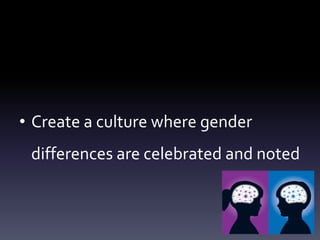
• Create a culture where gender
differences are celebrated and noted
A loving heart is the
beginning of all knowledge.
-Thomas Carlyle
Bibliography
• Gurian,M.,The Minds of Boys. San Francisco: Jossy-Bass,
2005.
• Gurian, M., Girls and Boys Learn Differently.Wiley.2000.
• Gurian,M.,The Wonder of Girls. NewYork. 2003.
• Kalat, J., Developmental Psychology.
• Medina J., Brain Rules . Seattle: Pear Press, 2008.
• Sanes, D., Development of the Nervous System
Further investigation
• http://www.sharpbrains.com/ (brain
innovation research)
• www.ted.com Sarah-Jayne Blakemore:The
mysterious workings of the adolescent brain
Gender and the brain

Gender and the brain

  • 1.
    Gender and theBrain Monique Canonico DO Assistant Clinical Professor JohnA. Burns School of Medicine University of Hawaii Feb 2013
  • 2.
    Overview • Prefrontal cortex •“pruning” • Gender differences in anatomy • Gender differences in neurochemistry • Gender differences in learning • How to maximize learning potential in your daughter or son
  • 3.
    The Latest BrainResearch • The prefrontal cortex • pruning
  • 5.
    At the timeof puberty… • A massive pruning of brain connections occurs • usually between age 12 and 16.5
  • 6.
    The Pruning (cont.) •The synaptic pruning represents the huge transformation of the adolescent brain. • Many neurons and the connections between them are cut, leading to improved efficiency
  • 7.
    The Pruning (cont..) •2009:Researchers at UC Davis study brain waves of 67 Adolescents • Delta waves occur in the deepest part of non REM sleep • It is believed that the nonREM sleep is the recuperative phase of sleep, in which the parts of the brain (that are more active during waking), “recuperate” • There was a 60 % drop in delta waves
  • 12.
    Adolescents’ brains undergoa substantial “pruning” or reduction in gray matter volume during adolescence, which happens about two years earlier in girls, compared to boys.
  • 13.
    History of GenderResearch • 1960s~focus on gender bias against females in schools • 1970s and 80s~research focused on how career expectations were still along gender lines • 1990 on~research is on the underperformances of boys in the school system
  • 14.
    Boys:The History, thePresent, andWhyTCS is onTrack • Boys would learn skills etc from relativethese boys then found themselves in boxlike classroom • For most boys in public schools gone were the classic academic models of verbal debate between young thinkers
  • 19.
    Brain Cells CommunicateThrough Neurochemicals •Many differences between male and female
  • 20.
    HowWe Learn: Synapses -Learningmainly occurs at the synapses -A synapses performance changes when we learn something new -long-term potentiation
  • 21.
    HowWe Learn (cont.) -memoryand recall strengthened by frequency and recency -seeing and hearing something is better than just seeing or just hearing -engage multiple senses through humor, storytelling, physical activity, emotion
  • 22.
    Differences BOYS • Have lessserotonin • Need reality checks to make them reassess and to be challenged • Prefer nonfiction GIRLS • Have more serotonin • Need encouragement to build them up. • Prefer fiction
  • 23.
    23 Learning Differences Some malelearning characteristics are • More areas in the brain for spatial reasoning • . Male brain enters a rest state several times a day. Often during these rest states in order to stay alert boys may fidget or act out. • Are seen as more aggressive and impulsive than girls • Engage in “aggression nurturance” or rough housing and insults with other males • Take more time than girls to transition between activities and/or topics • Feel less compelled to comply with the orders of teachers
  • 24.
    Biology • Using PETand MRI we are learning better ways to teach boys and girls • Boys have more dopamine (which increases impulsive behavior) • Boys have more blood flow to the cerebellum • Girls have stronger connections in their temporal lobes and more oxytocin and estrogen(these chemicals have a direct affect on words) • Overall girls have 15% more blood flow to the brain
  • 25.
    25 Learning Differences • Astudy done by Pomerantz, Alterman and Saxon (2002) stated that girls will feel that they are disappointing a parent and/or teacher. Girls place more emphasis on pleasing others. • Girls are more critical of their performance in school even though it has been reported that they do very well in academics. Boys seem to overestimate their ability to achieve.
  • 26.
    The Eye MALES FEMALES -sensemovement -drawn to black, blue silver -faces -red, yellow, orange -to engage girls, work in small circles facing each other
  • 27.
    Gender Differences inPsychiatric Disorders MALES • Schizophrenia • Antisocial behavior • Alcoholics • Drug addiction FEMALES • Depression 2:1 • Anxiety • Anorexics
  • 28.
    Brain Under Stress MALES •Withdraw • Don’t recall details FEMALES • Nurture children • Remember details vividly
  • 29.
    The right brainremembers the gist of the experience and the left brain recalls the details.
  • 30.
    Communication • Womens’ hemisphereshave a thicker connection • Women use both hemispheres when speaking. Males use primarily one
  • 31.
    Negotiating Status BOYS • Byelementary schools boys start to use verbal skills ; to find their status in a large group • High status males give orders • Independent behavior: prized GIRLS • Different strategy to maintain their hierarchy • Girls talk/ secrets/ reach consensus of who is in charge • More indirect otherwise labeled “bossy”
  • 32.
    Data in theClassroom • Facts: boys and girls process emotions differently • Girls may excel at language • Boys may excel at math/science • Close performance gapsingle gender classes ?
  • 35.
    • By adolescence,a girl’s corpus callosum is 25 percent larger than a boy’s. The corpus callosum is the bundle of nerves that sends signals across the two parts of the brain.This enables more “cross talk” between hemispheres. • Girls have fewer attention span problems and can make faster transitions between lessons. • Girls’ prefrontal cortex develops earlier and is larger than boys’. • Girls have more serotonin and make fewer impulsive decisions than boys.
  • 38.
    Autonomic Nervous System BOYS •More alert standing, moving • Best at rm temp 69 degrees • Stress increases blood flow to the brain and helps boys stay focused GIRLS • More alert when seated • Best at rm temp 75 degrees • Stress increases blood flow to gut
  • 39.
    Blood flow atrest state
  • 40.
    40 Conclusion It is obviousthat there are several differences in female and male students. It does seem that a solution would be to separate the genders in order to individualize the classroom environment.
  • 41.
    Boys:• Get themajority of Ds and Fs in most schools • Make up 70% of the discipline problems • Are ~ 1 yr to 1.5 yrs behind girls in reading/writing, according to the US Dept of Education • Over 80% of schoolchildren on Ritalin (or similar) are boys
  • 43.
    Parents • Be cognizantof your child’s strengths and weaknesses • Read brain based literature • Help child balance sedentary pursuits with active • Encourage child to stick with certain courses even if it’s not their strong one • Encourage child to take risks/challenges
  • 44.
    To Encourage Girls •Form working groups to promote negotiating skills and leadership • Verbally encourage the hidden high energy of “quiet girls” • Manipulatives to teach math • Don’t assume they not are interested in technical stuff • Call on both and girls equally • High expectations • Reject stereotypes
  • 45.
    Girls: Middle School •Spend 30% more more time studying than boys; don’t necessarily learn more • Self esteem may decline • May feel not as good science/math • Parents’ goal: select proper academic path
  • 46.
    Girls: Middle School •Relationships become so important; don’t cringe at the melodrama NORMAL • girls are used to be being praised for their compliance but need to be praised for their independence of thought
  • 47.
    Talk it through.Whenyour daughter gets stuck on her homework, she may benefit from discussing the problem and various approaches to solving it. Or she can write you an email describing her struggle to solve the problem.
  • 48.
    To Encourage Boys •Let boys nurture each other with healthy aggression • Make lessons kinesthetic • Recognize and accept the high energy level of boys • Allow opportunities for competition • Incorporate technology
  • 49.
    To Encourage Boys •Higher testosterone leads boys to seek COMPETITION • -worksheet? “beat the clock” with kitchen timer • -football/basketballlearn math facts • Spelling words? Have him in a physical position while thinking
  • 50.
    To Encourage Boys •Give them soft objects to squeeze in their hand constantly (not disruptively) to ward off the rest state
  • 51.
    Practical Suggestions • Visiontrumps all senses • Humans learn best through pictures not written or spoken words • Using a white board to study may help • Teachers could use computer animations
  • 52.
    Practical Suggestions (cont.) •“temporal contiguity principle”-students learn better when presented items simultaneously rather than successively
  • 53.
    Prefrontal cortex Decision making Complexcognition Personality Expression
  • 54.
    Suggestions (cont.) • Exerciseboosts brain power • Limit screen time • Get enough sleep • Is your child getting enough water and protein? • Chess • To help with math bank account/responsible for their own $
  • 55.
    Suggestions (cont.) • Quizlet.com •Let the boys and girls who need it move around the classroom while reading, learning or doing computer. At Gurian institute pilot schools: physical movement is a universal strategy to help less motivated students
  • 56.
  • 57.
    Prefrontal cortex Decision making Complexcognition Personality expression
  • 59.
    Review (cont.) • Pruning •Boys: more intense rest state-->part of his brain shuts down • Girls: compliance is great encourage independent thought
  • 60.
    • Create aculture where gender differences are celebrated and noted
  • 61.
    A loving heartis the beginning of all knowledge. -Thomas Carlyle
  • 62.
    Bibliography • Gurian,M.,The Mindsof Boys. San Francisco: Jossy-Bass, 2005. • Gurian, M., Girls and Boys Learn Differently.Wiley.2000. • Gurian,M.,The Wonder of Girls. NewYork. 2003. • Kalat, J., Developmental Psychology. • Medina J., Brain Rules . Seattle: Pear Press, 2008. • Sanes, D., Development of the Nervous System
  • 63.
    Further investigation • http://www.sharpbrains.com/(brain innovation research) • www.ted.com Sarah-Jayne Blakemore:The mysterious workings of the adolescent brain

Editor's Notes

  • #5 15 yrs ago it was assumed that the vast majority of brain development took place in the first 2 yrs of life. We know now that a dramatic change takes place in adolescence. This involves the prefrontal cortex. The pfc is the region of the brain involved in decision making planning social interaction and self awareness. What happens in the pfc? Pruning
  • #7 Children have twice the numbers of “wires”. Using light and serial electron microscopy researchers at Harvard recently revealed this pruning process.
  • #8 Delta waves are pools of neurons oscillating in unison The scientists suspect that the decline in delta activity reflects the huge transformation in the brain known as 'synaptic pruning' that occurs in adolescence. Many neurons and the connections between them are removed, leading to improvements in brain efficiency. In their latest paper the researchers go further, showing that there is strong correlation between physical signs of puberty and the delta wave decline. "The kids who went through pubertal maturation earlier were the kids who showed the earliest declines
  • #9 Delta waves are pools of neurons oscillating in unison
  • #12 The prefrontal cortex moderates risk taking
  • #14 History of Gender Research Research beginning in the 1960’s focused a great deal on bias against females in school and in the workforce. (Edina Report. 2002 , Carol Gilligan. In a Different Voice, 1982.). During the 1970’s through the early 1990’s, gender research primarily focused on girls in the field of education and that “career expectations and subject choices were structured along traditional gender lines, to the disadvantage of females.” (Edina Report citing Sharpe, Deem Sharma & Meigham, Griffin, and Gilligan) (AAUW Report: How Schools Shortchange Girls, 1992). Beginning in the late 1990’s to the present, research on gender has gradually shifted its focus from females to males. Specifically while much of the research addresses gender issues and ways to improve and raise the performance and development for both girls and boys, the primary focus is underperformance of boys in the educational system.
  • #15 History of Public Education  the boys would learning farming, or hunting, or fixing machinery, or devising a new invention for everyone in there tribePrior to the middle of the 19th century, the vast majority of people were educated in a tutorial context, meaning they were taught knowledge or a trade one-on-one or in a small group. In some learning centers, such as Paris, larger groups of students would gather to hear learned men read out of relatively scarce books, and the content would be discussed.1 In other places, such as Connecticut, there were schools run by the government in place long before this practice became widespread. However, this was an exception, not the rule. Most people were either educated by a tutor, or uneducated America, it is easy to trace the beginnings of full public schools to the Industrial Revolution. With the outbreak of factories, owners needed cheap workers. Children provided a large supply of those workers. However, these schools were not made to educate the children to their fullest ability. The factories funded the schools, and intentionally set them up so that children learned to work in the large groups that factories needed. In addition, the whole purpose of the curriculum was to influence children into taking factory jobs. Even the very first fully public schools in America were extremely flawed. It is important to note that in America schools had existed before the advent of full public schools. Harvard University had been built years ago. High schools such as the Boston Latin School and the American Academy, established in 1635 and 1751, respectively, provided secondary education with larger, though not extremely large, student bodies. However, these curriculums were specialized, hard, and expensive. Only the wealthiest attended them. Grammar dialectic rhetoric It is in the dialectic that the emphasis in cognitive skills shifts from the concrete to the analytical The rhetoric stage moves more into abstract though processes
  • #16 To start off with So lets review how we become male or female. 400 million sperm fall over themselves attempting to find the egg during human fertilization.
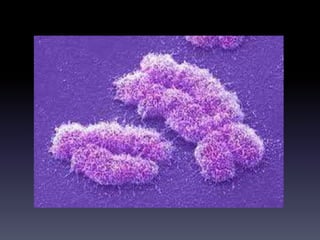
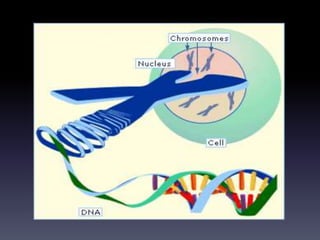
  • #18 You recall the chromosomes from biology class, those writhing strings of dna packed I the the nucleus that contain the information necessary to build a human.23 come from mom and 23 com from dad.A least one of them has to be an x chromosome
  • #19 Xx-girl xy? Male X chromosome carries ~ 1500 genes and the y chromosome ~ 100 As of 2005 the human genome was sequenced and we now know the function of many of those 1500 genes on the x chromosome. Many of those genes govern brain function
  • #20 Serotonin regulation is particularly dramatic. Serotonin The most typical psychological term for functions carried out by the prefrontal cortex area is executive function. Executive function relates to abilities to differentiate among conflicting thoughts, determine good and bad, better and best, same and different, future consequences of current activities, working toward a defined goal, prediction of outcomes, expectation based on actions, and social "control" (the ability to suppress urges that, if not suppressed, could lead to socially unacceptable outcomes).lated emotion and mood (Prozac works on this neurotransmitter
  • #21 the brain is an enormously complex network of billions of neurons connected by more than 90,000 miles of fibers This intricate architecture allows us to absorb information quickly and efficiently. Learning mainly takes place at synapses, the junctions between neurons where information is relayed. A synapse’s performance changes when we learn something new, obeying the principle that “cells that fire together, wire together.” The process that we understand best is called long-term potentiation, in which repeatedly stimulating two neurons at the same time fortifies the link between them. After a strong connection is established between these neurons, stimulating the first neuron will more likely excite the second. So how does learning happen?  Through a network of neurons, sensory information is transmitted by synapses (along the neural pathway and stored temporarily in short-term memory, a volatile region of the brain that acts like a receiving center for the flood of sensory information we encounter in our daily lives. 
  • #22 When learning new things, memory and recall are strengthened by frequency and recency.  The more we practice and rehearse something new and the more recently we have practiced, the easier it is for our brain to transmit these experiences efficiently and store them for ready access later.  Another recent study at the Martinos Center for Biomedical Imaging, Department of Radiology, Massachusetts General Hospital and Harvard Medical School found that the structural core of the brain receives sensory information from different regions and then assembles bits of data into a complete picture that becomes a memory of an event.  This memory is strengthened by multiple sensory inputs.  For example, if we both see and hear something, we are more likely to remember it than if we only hear it.  
  • #25 Biological and Brain Based Using Positron Emission Tomography (PET) , Magnetic Resonance Imaging (MRI), and other advances of modern science, brain based theorists suggest there is a disconnect between teaching practices and the needs of male and female brains. The cerebellum helps to control movement These facts taken together are thought to account to boys’ tendency to learn less well while sitting Girls have greater blood flow to the brain and can recharge and reorient neural focus without defined rest states where as boys *
  • #26 As stated before boys do not necessarily concern themselves with pleasing others.
  • #27 Is organized differently Boys like to work at oblique anglesHave more type M ganglion cells in their visual system which m stands for mvt
  • #28 Mental health professionals have known for years the sex based differences in psychiatric disorders. For ex f are more likely to get depressed than males, a figure that shows up just after puberty and remains constant for the next 50 yrs
  • #31 Little girls use their more sophisticated verbal skills to speak to one another, with good eye contact Boys rarely face each other and favor oblique angles and less eye contact
  • #32 The males give orders, verbally or even physically . The leaders maintain their fiefdom and issue orders and make certain they are carried out. Other strong members challenge, the males learn quickly to deflect The difference between genders at this age can be summarized as this: Boys might say do this Girls on the other might say lets do this WATER STORY
  • #33 Girls excel at language; boys withdraw At math and science the boys excelled but used their familiar “top each other, competitive style” attempting to establish their hierarchy based on aptitude. Experimentation is occurring for single gender classes based on subjects; girls learn together for language and math Boys learn together for those subjects. Create a culture where gender differences are celebrated and noted
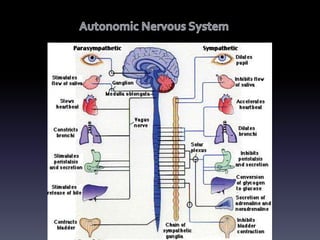
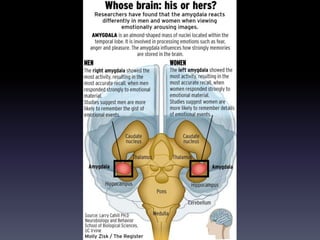
  • #34 Amygdala being the almond shaped mass of nuclei in the temporal lobe
  • #38 The autonomic nervous system (ANS or visceral nervous system or involuntary nervous system) is the part of the peripheral nervous system that acts as a control system functioning largely below the level of consciousness, and controls visceral functions.[1] The ANS affects heart rate, digestion, respiratory rate, salivation, perspiration, pupillary dilation, micturition (urination), and sexual arousal. Most autonomous functions are involuntary b
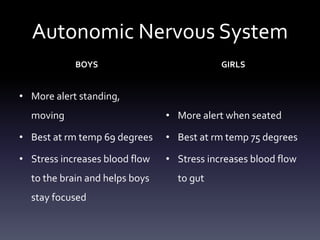
  • #39 During threat or stress blood flow increases to the gut leading to a feeling of anxiousness or nervousness in girls
  • #40 Boys do better when focusing on one deep task for a long period of time They do less well when moved quickly from task to task The male brain renews and recharges itself between tasks by moving to what is known as he rest sate The boy in the back of the classroom with the drooping eyes or dazed look may have entered the male neural rest state Blood flow for females even at rest state is higher so they do not go into the rest states … a girl can be bored with a lesson and still keep her eyes open and take notes Man TV Grandpa fishing boat the recent findings regarding gender differences and began to devise a new parenting plan. For instance, researchers have found that boys’ and girls’ brains have different “rest states.” That is, when a male’s brain get bored, some of his functioning shuts down and interferes with his ability to listen and learn. -
  • #41 . The separation of the sexes would not mirror the real world in which males and females have to work together. In a way the classroom is preparation for what students would encounter in the real world. Educators need to be aware of each child’s individual needs and encourage students that they need not follow stereotyped roles and also not reinforce these roles
  • #43 Standardized testing is in blue and classroom grades in red
  • #45 Legoes for your 5 year old girl!!!!!
  • #46 And may focus on reading foreign language arts -with a lot of science and math
  • #52 Vision is by far the most dominant sense utilizing 50 % of the brain’s resources pictures help transfer information Our sense of vision and smell are fighting for evolutionary control. And vision is winning 60 percent of of smell related genes have been decommissioned The reason for this is simple: the visual cortex and olfactory cortex take up a lot of real estate and it the crowded zero sum world something has to give the visual sense is extremely important to the learning experience
  • #54 So if Ito review with you our part of our neuroanatomy lesson from this evening, I would remind you that the prefrontal cortex deals mainly in executive function and helps in complex planning tasks such as good vs better, bad vs good, and social control and The most typical psychological term for functions carried out by the prefrontal cortex area is executive function. Executive function relates to abilities to differentiate among conflicting thoughts, determine good and bad, better and best, same and different, future consequences of current activities, working toward a defined goal, prediction of outcomes, expectation based on actions, and social "control" (the ability to suppress urges that, if not suppressed, could lead to socially unacceptable outcomes).
  • #55 Exercise gets blood into the brain bringing glucose and oxygen to soak up toxic electrons . It also stimulates protein that keeps neurons connecting Some have suggested that recess twice a day can boost brain power, which occurs at tcs
  • #58 So if Ito review with you our part of our neuroanatomy lesson from this evening, I would remind you that the prefrontal cortex deals mainly in executive function and helps in complex planning tasks such as good vs better, bad vs good, and social control and The most typical psychological term for functions carried out by the prefrontal cortex area is executive function. Executive function relates to abilities to differentiate among conflicting thoughts, determine good and bad, better and best, same and different, future consequences of current activities, working toward a defined goal, prediction of outcomes, expectation based on actions, and social "control" (the ability to suppress urges that, if not suppressed, could lead to socially unacceptable outcomes).
  • #60 Rest state: recent findings regarding gender differences and began to devise a new parenting plan. For instance, researchers have found that boys’ and girls’ brains have different “rest states.” That is, when a male’s brain get bored, some of his functioning shuts down and interferes with his ability to listen and learn. -
  • #61 Not ignored or marginalized
  • #62 What a sacred task entrusted to us by God to recognize not only gender differences but the gifts of each child Many of these gifts cannot be measured by standardized tests or even school room test. By understanding better how the the brains of boys and girls operate we can all make the difference