ROLE OF RADIATION THERAPY IN THE MANAGEMENT OF BONE TUMORS. PROF. R. MOHAN RAM MD., DMRT HEAD OF THE DEPARTMENT OF RADIATION ONCOLOGY, BIR&O, MADRAS MEDICAL COLLEGE.
INTRODUCTION Radiation therapy is generally not considered as a primary modality in the management of the osteosarcoma, but there is ample historic and growing modern evidence that these  tumors are responsive to radiation as well. Surgical resection remains the main stay in the management of primary bone tumors.
Multi modality treatment approach includes RT in, Primary bone tumors of the  axial skeleton and facial bones  -  functional and cosmesis preservation .  Ewing's sarcoma and peripheral primitive  neuroectodermal tumors of bone can be treated by definitive radiation.
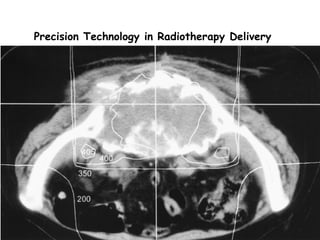
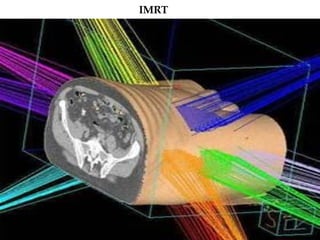
Three-dimensional conformal radiation techniques using multiple fields, multileaf collimation, and intensity-modulated IMRT beams are useful aids to optimize the homogeneity of the dose within the target volume while sparing adjacent normal structures allowing treatment of previously inaccessible areas. Techniques of radiation delivery
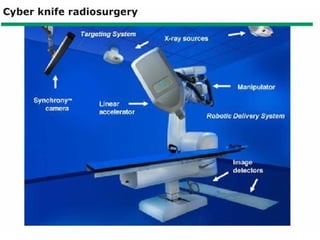
Precision Technology in Radiotherapy Delivery
BRACHYTHERAPY Technologic enhancements now also permit full three-dimensional planning for brachytherapy with dose-volume histograms and other tools. Real application of brachytherapy to the treatment of primary bone tumors is awaited, although some very preliminary experience in recurrent disease is available using high dose-rate perioperative approaches
CHARGED PARTICLE BEAM THERAPY Proton Neutron Helium Carbon ion
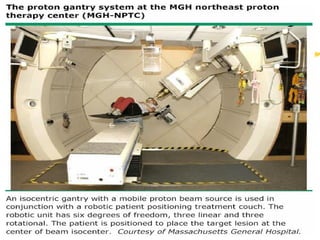
In proton beam irradiation ,  high-doses of radiation can be made to conform precisely to the target by the high-energy release at the end of proton beam's range.  This provides improved dose distribution in deep locations compared to photon irradiation. It is available only at a handful of sites, although an increasing number of treatment units will be available in the future.  CHARGED PARTICLE BEAM THERAPY
Neutron radiotherapy  has been emphasized by certain groups because of  overcoming hypoxic radioresistance:  lower oxygen enhancement ratio  compared to x-rays and the consequent attractive possibility of  overcoming the biologic phenomenon of limited curability  of malignancy due to hypoxia with x-rays.  Lack of cell cycle / phase sensitivity.
 
OSTEOSARCOMA Neoadjuvant chemotherapy followed by surgery and adjuvant chemotherapy is the current standard of care for osteogenic sarcoma. Irradiation has not been considered part of the primary management of OS for nearly 20 years.
RT is used in, Patients with tumor in inaccessible sites. Pelvis Axial skeleton. Facial bones Elderly patients refusing surgery. Patients who require palliation. Dose : 66-70 Gy in 1.8-2Gy/#. EBRT using high energy Mega voltage photon beams. IMRT – in axial tumors. Brachytherapy – in mandible OS.  CURRENT ROLE OF RT IN MANAGEMENT OF OSTEOSARCOMA
Post op RT –  Not indicated when surgery is complete with negative margins in accessible sites. Indicated, where negative margin could not be possible. 1 Dose : 50 – 60 Gy/1.8-2Gy/#. ref :  DeLaney et al – MGH data Pre op RT – no role.  Extracorporeal irradiation.  Palliative RT.
FACIAL BONES OS of the facial bones appear to have a different biology compared to those located elsewhere –lower tendency to metastasize and hence have better prognosis. Dose : 350cGy/10#.
EXPERIMENTAL IN-SITU RADIOTHERAPY IN EXTREMITY SARCOMAS IN PATIENTS WHO REFUSED AMPUTATION AFTER NEO-ADJUVANT CHEMOTHERAPY. Radical fractionated RT - 60 Gy was given For patients who responded well to chemotherapy by imaging and fall in Alk. Phos levels. They responded to RT as well. Achieved a 5 year survival of 90 %. Study by Blokhin cancer research centre, Moscow
For metastatic bony sarcomas Unresectable tumors at axial sites. Advanced inoperable lesions of extremities. Dose :  EBRT 30Gy/300cGy/#/10#s/2weeks. 20Gy/400cGy/#/5#s. Bone seeking targeted radionuclide therapy. PALLIATIVE RT
89 Strontium: Administered as strontium chloride, usually 4 mCi intravenously. Strontium is incorporated in to the inorganic matrix of bone with increased uptake in metastatic tumor.  Response within 2 weeks and is sustained for up to 6 months. One third of patients remained totally pain free.  Re-treatment is safe.  The main disadvantage is the cost which is very high.  Toxicity is less.  RADIONUCLIDE THERAPY
32 Phosphorus:   7 to 40 mCi in fractionated doses usually.  The main advantage is cost – less compared with other isotopes and readily available. The disadvantage is the reported incidences of pan cytopenia, induction of Leukemia as the bone marrow dose is high the range of skeletal absorbed dose is 25-63 rad / mCi. Response rate is 70-80%. 153 samarium – EDTMP: Response occurs within 2 weeks of administration, sustained between 4 –  40 weeks. Response rate is 60 – 80 %
DOSE AND VOLUME CONSIDERATIONS FOR DEFINITIVE RT (surgically inaccessible sites) Treatment volume : shrinking fields :  Initial field : initial tumor volume (MRI) +  generous margin  (2-3cm) for microscopic extent +  2 cm  in total for patient movement. (45-50 Gy) Boost field : residual tumor volume at the time of RT + 2 cm ( up to 70 Gy ). Extremity fields should be planned with a strip of un-irradiated tissue out of the beam to allow for lymphatic and venous return and to decrease morbidity.
EXTRACORPOREAL BONE IRRADIATION. Extracorporeal bone irradiation has been used with success where custom prosthesis or allograft could not be used. Hong et al, Australia reported 16 patients with primary bone tumors between 1996-2000. All patients had en-bloc resection of the affected bone after neoadjuvant chemotherapy.  50Gy single dose was delivered to the resected specimen and reimplanted using appropriate internal fixation. No local recurrence or graft failure at 19 months follow-up. One patient had amputation due to chronic osteomylitis. Among the 10 patients, functional outcome at 18 mo follow-up was good to excellent.
CHONDROSARCOMA Dedifferentiated chondrosarcoma is treated as osteosarcoma Mesenchymal chondrosarcoma is treated as Ewing's sarcoma For low grade histology's treatment is with surgery/RT. Indications for RT: Inaccessible tumor Where clear margins are not achievable.  Recurrence Dose : 50-70 Gy/ 200cGY/#/5days/week. 5 year survival – RT alone – low grade 48%   high grade 22%. PRINCESS MARGARET EXPERIENCE : 85 % local recurrence after surgery alone. LC – 50 % after curative RT. 25 % were disease free at 15 years. 50 – 55 Gy in 180-200 cGy/#
Massachusetts General Hospital published results of 519 patients treated with proton therapy. 5 yr Local Control  73 % for chordoma 98 % for chondrosarcoma Dose – 66-83 CGE (cobalt gray equivalent) Proton beam therapy- chordoma and chondrosarcoma
Because complete surgery is rarely possible, Post op RT , dose of 50 – 70 Gy is indicated. Surgery + RT - DFS  --  6.6 years Surgery alone  - DFS  --  4.1 years Proton therapy gives promising results. CHORDOMA
 
GIANT CELL TUMOR OF BONE The standard treatment  Curettage, cryosurgery  Radiotherapy can be given in unresectable sites. GCT is not radio resistant.  At Princess Margaret Hospital, local control was achieved in 13 of 14 patients  with GCT treated with one course of megavoltage radiation.  The disease in 12 patients was controlled for longer than 5 years  There was no malignant transformation .
Dose :  EBRT : 35-55 Gy in conventional daily fractions. Local control rates:  range from 75% to 85% in more recent series. Giant Cell Tumor Of Bone contd…
Rare Tumors MFH of bone treatment similar to osteosarcoma. Fibrosarcoma  primary arm -   surgery.  RT in inoperable or post op residue.  Dose : 66-70Gy. Malignant hemangio endothelioma  surgery + RT 50 – 60 Gy. Lymphoma  40 Gy to the entire bone + 5 Gy boost to the original tumor + systemic chemo.
EWING’S SARCOMA INDICATIONS FOR RT:  After induction chemotherapy DEFINITIVE RADIATION THERAPY Tumors where Resection is Impossible or where only an intra-lesional resection is achievable Patient with poor Surgical risk Patient refusing surgery SURGERY IS THE PREFERRED ARM  where wide or marginal resection is possible
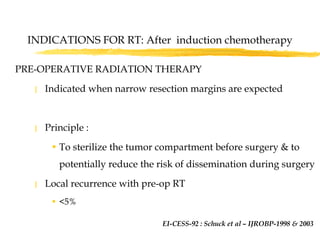
INDICATIONS FOR RT: After  induction chemotherapy PRE-OPERATIVE RADIATION THERAPY Indicated when narrow resection margins are expected Principle :  To sterilize the tumor compartment before surgery & to potentially reduce the risk of dissemination during surgery Local recurrence with pre-op RT  <5%  EI-CESS-92 : Schuck et al – IJROBP-1998 & 2003
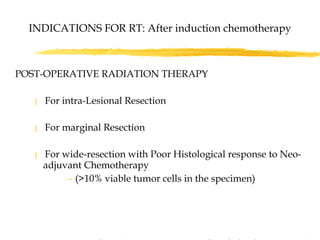
POST-OPERATIVE RADIATION THERAPY  For intra-Lesional Resection For marginal Resection For wide-resection with Poor Histological response to Neo-adjuvant Chemotherapy  (>10% viable tumor cells in the specimen)   Based on CESS-81, CESS-86, EICESS-92 Studies : Schuck et al,IJROBP-1998 & 2003   INDICATIONS FOR RT: After induction chemotherapy
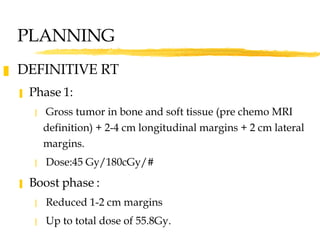
PLANNING DEFINITIVE RT Phase 1:  Gross tumor in bone and soft tissue (pre chemo MRI definition) + 2-4 cm longitudinal margins + 2 cm lateral margins. Dose:45 Gy/180cGy/# Boost phase :  Reduced 1-2 cm margins Up to total dose of 55.8Gy.
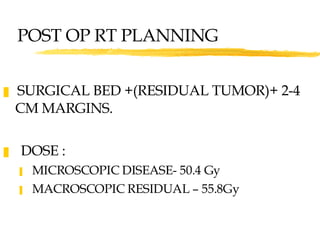
POST OP RT PLANNING SURGICAL BED +(RESIDUAL TUMOR)+ 2-4  CM MARGINS. DOSE :  MICROSCOPIC DISEASE- 50.4 Gy MACROSCOPIC RESIDUAL – 55.8Gy
PALLIATIVE RT  PAIN PALLIATION – ADVANCED DISEASE. ISOLATED BONE SECONDARIES.
MULTIPLE MYELOMA Indications for RT Plasmacytomas :  As primary treatment in localized presentations (solitary plasmacytomas of bone and extramedullary plasmacytomas) Multiple Myeloma: For palliation of pain from bone lesions of multiple Myeloma, RT is the best arm, though Chemotherapy takes care of systemic disease. For prevention of pathologic fractures in weight-bearing bones For relief of spinal cord compression or nerve root compression
Solitary Plasmacytomas Of Bone And  Extramedullary Plasmacytomas   Dose 50 Gy/200cGy/#  Field to sufficiently cover the primary  tumor, all its extensions, and the regional  lymph nodes with a 2- to 3-cm margin.
Disseminated Myeloma Dose : 2250 cGy / 225-cGy fractions, 5 days per week 10#s. In general, patients with rapidly advancing disease receive lower doses.
SECONDARY BONE METASTASIS Goal:  The goal is to prevent or relieve symptoms especially pain and compression and to improve quality of remaining life. Dose schedules used in bone mets: Localized irradiation: 30Gy / 10 #. 20Gy / 4-5#. 800 cGy / single fraction. Hemi body irradiation: Previously hemi body irradiation is used for disseminated bony lesions. It has been given up because of associated complications and improper maintenance of aseptic measures.
Radionuclide therapy Is presently used for disseminated bony metastases for long term pain relief. Radionuclide in practice: 89 strontium 153 Samarium – EDTMP 32 phosphorus.
Pain Response rates (EBRT) 41% of patients – attains at least 50% pain relief at one month.  The goal of freedom from symptoms until death is reported for few long-term survivors (about 10%).
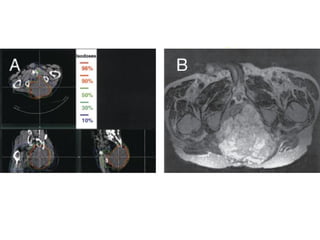
IMRT
 
 
THANK YOU

RT in Bone Tumors

  • 1.
    ROLE OF RADIATIONTHERAPY IN THE MANAGEMENT OF BONE TUMORS. PROF. R. MOHAN RAM MD., DMRT HEAD OF THE DEPARTMENT OF RADIATION ONCOLOGY, BIR&O, MADRAS MEDICAL COLLEGE.
  • 2.
    INTRODUCTION Radiation therapyis generally not considered as a primary modality in the management of the osteosarcoma, but there is ample historic and growing modern evidence that these tumors are responsive to radiation as well. Surgical resection remains the main stay in the management of primary bone tumors.
  • 3.
    Multi modality treatmentapproach includes RT in, Primary bone tumors of the axial skeleton and facial bones - functional and cosmesis preservation . Ewing's sarcoma and peripheral primitive neuroectodermal tumors of bone can be treated by definitive radiation.
  • 4.
    Three-dimensional conformal radiationtechniques using multiple fields, multileaf collimation, and intensity-modulated IMRT beams are useful aids to optimize the homogeneity of the dose within the target volume while sparing adjacent normal structures allowing treatment of previously inaccessible areas. Techniques of radiation delivery
  • 5.
    Precision Technology inRadiotherapy Delivery
  • 6.
    BRACHYTHERAPY Technologic enhancementsnow also permit full three-dimensional planning for brachytherapy with dose-volume histograms and other tools. Real application of brachytherapy to the treatment of primary bone tumors is awaited, although some very preliminary experience in recurrent disease is available using high dose-rate perioperative approaches
  • 7.
    CHARGED PARTICLE BEAMTHERAPY Proton Neutron Helium Carbon ion
  • 8.
    In proton beamirradiation , high-doses of radiation can be made to conform precisely to the target by the high-energy release at the end of proton beam's range. This provides improved dose distribution in deep locations compared to photon irradiation. It is available only at a handful of sites, although an increasing number of treatment units will be available in the future. CHARGED PARTICLE BEAM THERAPY
  • 9.
    Neutron radiotherapy has been emphasized by certain groups because of overcoming hypoxic radioresistance: lower oxygen enhancement ratio compared to x-rays and the consequent attractive possibility of overcoming the biologic phenomenon of limited curability of malignancy due to hypoxia with x-rays. Lack of cell cycle / phase sensitivity.
  • 10.
  • 11.
    OSTEOSARCOMA Neoadjuvant chemotherapyfollowed by surgery and adjuvant chemotherapy is the current standard of care for osteogenic sarcoma. Irradiation has not been considered part of the primary management of OS for nearly 20 years.
  • 12.
    RT is usedin, Patients with tumor in inaccessible sites. Pelvis Axial skeleton. Facial bones Elderly patients refusing surgery. Patients who require palliation. Dose : 66-70 Gy in 1.8-2Gy/#. EBRT using high energy Mega voltage photon beams. IMRT – in axial tumors. Brachytherapy – in mandible OS. CURRENT ROLE OF RT IN MANAGEMENT OF OSTEOSARCOMA
  • 13.
    Post op RT– Not indicated when surgery is complete with negative margins in accessible sites. Indicated, where negative margin could not be possible. 1 Dose : 50 – 60 Gy/1.8-2Gy/#. ref : DeLaney et al – MGH data Pre op RT – no role. Extracorporeal irradiation. Palliative RT.
  • 14.
    FACIAL BONES OSof the facial bones appear to have a different biology compared to those located elsewhere –lower tendency to metastasize and hence have better prognosis. Dose : 350cGy/10#.
  • 15.
    EXPERIMENTAL IN-SITU RADIOTHERAPYIN EXTREMITY SARCOMAS IN PATIENTS WHO REFUSED AMPUTATION AFTER NEO-ADJUVANT CHEMOTHERAPY. Radical fractionated RT - 60 Gy was given For patients who responded well to chemotherapy by imaging and fall in Alk. Phos levels. They responded to RT as well. Achieved a 5 year survival of 90 %. Study by Blokhin cancer research centre, Moscow
  • 16.
    For metastatic bonysarcomas Unresectable tumors at axial sites. Advanced inoperable lesions of extremities. Dose : EBRT 30Gy/300cGy/#/10#s/2weeks. 20Gy/400cGy/#/5#s. Bone seeking targeted radionuclide therapy. PALLIATIVE RT
  • 17.
    89 Strontium: Administeredas strontium chloride, usually 4 mCi intravenously. Strontium is incorporated in to the inorganic matrix of bone with increased uptake in metastatic tumor. Response within 2 weeks and is sustained for up to 6 months. One third of patients remained totally pain free. Re-treatment is safe. The main disadvantage is the cost which is very high. Toxicity is less. RADIONUCLIDE THERAPY
  • 18.
    32 Phosphorus: 7 to 40 mCi in fractionated doses usually. The main advantage is cost – less compared with other isotopes and readily available. The disadvantage is the reported incidences of pan cytopenia, induction of Leukemia as the bone marrow dose is high the range of skeletal absorbed dose is 25-63 rad / mCi. Response rate is 70-80%. 153 samarium – EDTMP: Response occurs within 2 weeks of administration, sustained between 4 – 40 weeks. Response rate is 60 – 80 %
  • 19.
    DOSE AND VOLUMECONSIDERATIONS FOR DEFINITIVE RT (surgically inaccessible sites) Treatment volume : shrinking fields : Initial field : initial tumor volume (MRI) + generous margin (2-3cm) for microscopic extent + 2 cm in total for patient movement. (45-50 Gy) Boost field : residual tumor volume at the time of RT + 2 cm ( up to 70 Gy ). Extremity fields should be planned with a strip of un-irradiated tissue out of the beam to allow for lymphatic and venous return and to decrease morbidity.
  • 20.
    EXTRACORPOREAL BONE IRRADIATION.Extracorporeal bone irradiation has been used with success where custom prosthesis or allograft could not be used. Hong et al, Australia reported 16 patients with primary bone tumors between 1996-2000. All patients had en-bloc resection of the affected bone after neoadjuvant chemotherapy. 50Gy single dose was delivered to the resected specimen and reimplanted using appropriate internal fixation. No local recurrence or graft failure at 19 months follow-up. One patient had amputation due to chronic osteomylitis. Among the 10 patients, functional outcome at 18 mo follow-up was good to excellent.
  • 21.
    CHONDROSARCOMA Dedifferentiated chondrosarcomais treated as osteosarcoma Mesenchymal chondrosarcoma is treated as Ewing's sarcoma For low grade histology's treatment is with surgery/RT. Indications for RT: Inaccessible tumor Where clear margins are not achievable. Recurrence Dose : 50-70 Gy/ 200cGY/#/5days/week. 5 year survival – RT alone – low grade 48% high grade 22%. PRINCESS MARGARET EXPERIENCE : 85 % local recurrence after surgery alone. LC – 50 % after curative RT. 25 % were disease free at 15 years. 50 – 55 Gy in 180-200 cGy/#
  • 22.
    Massachusetts General Hospitalpublished results of 519 patients treated with proton therapy. 5 yr Local Control 73 % for chordoma 98 % for chondrosarcoma Dose – 66-83 CGE (cobalt gray equivalent) Proton beam therapy- chordoma and chondrosarcoma
  • 23.
    Because complete surgeryis rarely possible, Post op RT , dose of 50 – 70 Gy is indicated. Surgery + RT - DFS -- 6.6 years Surgery alone - DFS -- 4.1 years Proton therapy gives promising results. CHORDOMA
  • 24.
  • 25.
    GIANT CELL TUMOROF BONE The standard treatment Curettage, cryosurgery Radiotherapy can be given in unresectable sites. GCT is not radio resistant. At Princess Margaret Hospital, local control was achieved in 13 of 14 patients with GCT treated with one course of megavoltage radiation. The disease in 12 patients was controlled for longer than 5 years There was no malignant transformation .
  • 26.
    Dose : EBRT : 35-55 Gy in conventional daily fractions. Local control rates: range from 75% to 85% in more recent series. Giant Cell Tumor Of Bone contd…
  • 27.
    Rare Tumors MFHof bone treatment similar to osteosarcoma. Fibrosarcoma primary arm - surgery. RT in inoperable or post op residue. Dose : 66-70Gy. Malignant hemangio endothelioma surgery + RT 50 – 60 Gy. Lymphoma 40 Gy to the entire bone + 5 Gy boost to the original tumor + systemic chemo.
  • 28.
    EWING’S SARCOMA INDICATIONSFOR RT: After induction chemotherapy DEFINITIVE RADIATION THERAPY Tumors where Resection is Impossible or where only an intra-lesional resection is achievable Patient with poor Surgical risk Patient refusing surgery SURGERY IS THE PREFERRED ARM where wide or marginal resection is possible
  • 29.
    INDICATIONS FOR RT:After induction chemotherapy PRE-OPERATIVE RADIATION THERAPY Indicated when narrow resection margins are expected Principle : To sterilize the tumor compartment before surgery & to potentially reduce the risk of dissemination during surgery Local recurrence with pre-op RT <5% EI-CESS-92 : Schuck et al – IJROBP-1998 & 2003
  • 30.
    POST-OPERATIVE RADIATION THERAPY For intra-Lesional Resection For marginal Resection For wide-resection with Poor Histological response to Neo-adjuvant Chemotherapy (>10% viable tumor cells in the specimen) Based on CESS-81, CESS-86, EICESS-92 Studies : Schuck et al,IJROBP-1998 & 2003 INDICATIONS FOR RT: After induction chemotherapy
  • 31.
    PLANNING DEFINITIVE RTPhase 1: Gross tumor in bone and soft tissue (pre chemo MRI definition) + 2-4 cm longitudinal margins + 2 cm lateral margins. Dose:45 Gy/180cGy/# Boost phase : Reduced 1-2 cm margins Up to total dose of 55.8Gy.
  • 32.
    POST OP RTPLANNING SURGICAL BED +(RESIDUAL TUMOR)+ 2-4 CM MARGINS. DOSE : MICROSCOPIC DISEASE- 50.4 Gy MACROSCOPIC RESIDUAL – 55.8Gy
  • 33.
    PALLIATIVE RT PAIN PALLIATION – ADVANCED DISEASE. ISOLATED BONE SECONDARIES.
  • 34.
    MULTIPLE MYELOMA Indicationsfor RT Plasmacytomas : As primary treatment in localized presentations (solitary plasmacytomas of bone and extramedullary plasmacytomas) Multiple Myeloma: For palliation of pain from bone lesions of multiple Myeloma, RT is the best arm, though Chemotherapy takes care of systemic disease. For prevention of pathologic fractures in weight-bearing bones For relief of spinal cord compression or nerve root compression
  • 35.
    Solitary Plasmacytomas OfBone And Extramedullary Plasmacytomas Dose 50 Gy/200cGy/# Field to sufficiently cover the primary tumor, all its extensions, and the regional lymph nodes with a 2- to 3-cm margin.
  • 36.
    Disseminated Myeloma Dose: 2250 cGy / 225-cGy fractions, 5 days per week 10#s. In general, patients with rapidly advancing disease receive lower doses.
  • 37.
    SECONDARY BONE METASTASISGoal: The goal is to prevent or relieve symptoms especially pain and compression and to improve quality of remaining life. Dose schedules used in bone mets: Localized irradiation: 30Gy / 10 #. 20Gy / 4-5#. 800 cGy / single fraction. Hemi body irradiation: Previously hemi body irradiation is used for disseminated bony lesions. It has been given up because of associated complications and improper maintenance of aseptic measures.
  • 38.
    Radionuclide therapy Ispresently used for disseminated bony metastases for long term pain relief. Radionuclide in practice: 89 strontium 153 Samarium – EDTMP 32 phosphorus.
  • 39.
    Pain Response rates(EBRT) 41% of patients – attains at least 50% pain relief at one month. The goal of freedom from symptoms until death is reported for few long-term survivors (about 10%).
  • 40.
  • 41.
  • 42.
  • 43.