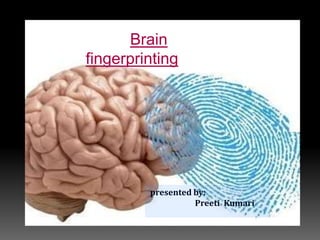
Brain
fingerprinting
presented by:
Preeti Kumari
Contents
1. Introduction
2. Quick overview of technique
3. Main Technique behind Brain Fingerprinting
4. Features
5. Instruments Required
6. Analysis Procedure
7. Different phases of Brain Fingerprinting
8. Applications in various fields
9. Advantages & disadvantages
10. Conclusion & future work
11. References
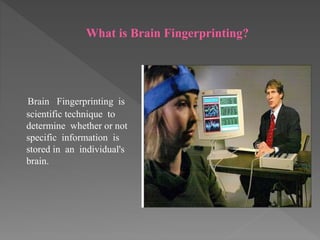
What is Brain Fingerprinting?
Brain Fingerprinting is
scientific technique to
determine whether or not
specific information is
stored in an individual's
brain.
Quick Overview
 Invented By Dr Lawrence A. Farwell.
 It’s a patented technique of proven accuracy in US government
tests.
 Ruled Admissible in one US Court as scientific evidence.
 It has a record of 100% Accuracy.
Technique
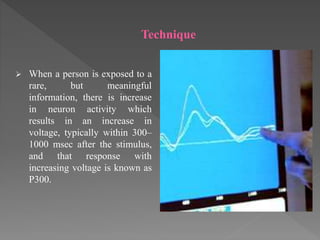
 When a person is exposed to a
rare, but meaningful
information, there is increase
in neuron activity which
results in an increase in
voltage, typically within 300–
1000 msec after the stimulus,
and that response with
increasing voltage is known as
P300.
The discovery of the P300-MERMER
In the initial brain fingerprinting research, Farwell and Donchin used
the P300 event-related brain potential (Farwell and Donchin 1986;
1988b; 1991; Farwell 1992a). Later Farwell discovered that the
P300 can be considered to be part of a larger response he called a
memory and encoding related multifaceted electroencephalographic
response or P300-MERMER
This pattern occurs within less than
a second after the stimulus
presentation, and can be readily
detected using appropriate amplifiers
and a computerized signal-detection
algorithm.
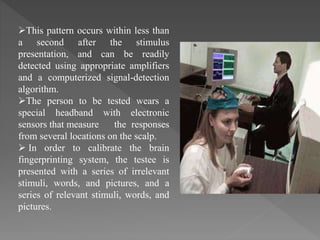
The person to be tested wears a
special headband with electronic
sensors that measure the responses
from several locations on the scalp.
 In order to calibrate the brain
fingerprinting system, the testee is
presented with a series of irrelevant
stimuli, words, and pictures, and a
series of relevant stimuli, words, and
pictures.
 The test subject's brain response to these two different types
of stimuli allow the testor to determine if the measured brain
responses to test stimuli, called probes, are more similar to the
relevant or irrelevant responses.
 The entire Brain Fingerprinting system is under computer
control, including presentation of the stimuli, recording of
electrical brain activity, a mathematical data analysis
algorithm that compares the responses to the three types of
stimuli and produces a determination of "information absent"
or "information present.
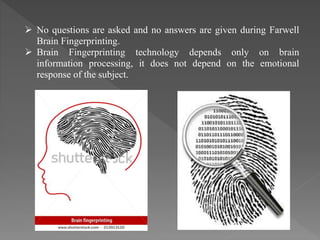
 No questions are asked and no answers are given during Farwell
Brain Fingerprinting.
 Brain Fingerprinting technology depends only on brain
information processing, it does not depend on the emotional
response of the subject.
Instrumental requirements:
• Personal Computer
• A Data acquisition board
• A Graphics Card for driving two monitors from one PC
• A four-channel EEG amplifier system.
• Software developed by the Brain Fingerprinting laboratories for
the data acquisition and analysis.
Analysis procedure
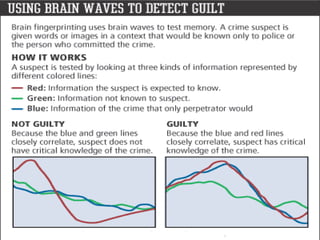
When brain fingerprinting test is done on any suspect then this type of
graph appears on the analyzer screen, by seeing these waves is comes to
the conclusion that whether the information is present in the person
mind or not. This graph shows three lines red, blue and green. Red line
indicates the information that suspect is expected to know. Green line
shows information that is not known to the suspect and the blue line
indicated the information of the crime that only suspect would know. In
this graph green line and the blue line are closely correlate with each
other that means the related information is not present in the suspect
brain. Information is not present in figure of not guilty.
Four phases of Farwell brain fingerprinting
Farwell Brain fingerprinting works similarly, except that the
evidence collected both at the crime scene and on the person of the
suspect (that is, in the brain as revealed by electrical brain
responses) is informational evidence rather than physical evidence.
There are four stages to Farwell brain fingerprinting, which are
similar to the steps in fingerprinting and DNA fingerprinting:
1. Brain fingerprinting crime scene evidence collection.
2. Brain fingerprinting brain evidence collection.
3. Brain fingerprinting computer evidence analysis.
4. Brain fingerprinting scientific result.
 Brain fingerprinting can be used to make life easier and can aid
mankind in many ways. Key fields where brain fingerprinting can
be used are:
Advertising
 What specific information do people retain from
advertising?
 What specific elements in an ad campaign have the most
impact?
 How effective is the product branding strategy?
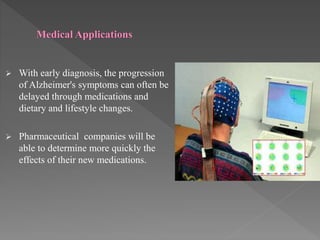
Medical Applications
 With early diagnosis, the progression
of Alzheimer's symptoms can often be
delayed through medications and
dietary and lifestyle changes.
 Pharmaceutical companies will be
able to determine more quickly the
effects of their new medications.
Counter terrorism
 Aid in determining who has participated in terrorist acts, directly
or indirectly.
 Help to identify people who have knowledge or training in
banking, finance or communications and who are associated with
terrorist teams and acts.
 Identify criminals quickly and scientifically.
 Reduces evasion of justice.
Advantages
1) The record stored in the brain of the perpetrator is often a rich source of
information that can be connected to the crime scene. Except in rare
cases where the crime has been recorded on video, the record stored in
the brain is generally the most comprehensive available record of the
crime, even though it is not perfect.
2) Identify criminals quickly and scientifically.
3) Record of 100% accuracy.
4) Identify terrorists and members of gangs, criminal and intelligence
organizations.
5) Reduce expenditure of money and other resources in law enforcement.
6) Reduce evasion of justice.
7) Access criminal evidence in the brain.
8) Human Rights Oriented.
Disadvantages
1) It detects information processing brain responses that reveal what
information is stored in the subjects brain. It does not detect how that
information got there, be it a witness or a perpetrator.
2) It detects only information, and not intent. The fact that the suspect
knows the uncontested facts of the circumstance does not tell us which
part of the intent is correct.
3) It is not applicable for general screening,
4) It does not detect lies. It simply detects information.
5) In the probe stimuli. Like all forensic science techniques, brain
fingerprinting depends on the evidence-gathering process which lies
outside the realm of science to provide the evidence to be scientifically
tested.
6) It’s not a substitute for effective investigation on the part of the
investigator or for common sense and good judgment on the part of the
judge and jury.
Conclusion and future scope
Brain Fingerprinting is a revolutionary new scientific technology for
solving crimes, identifying perpetrators, and exonerating innocent
suspects, with a record of 100% accuracy in research with US
government agencies, actual criminal cases, and other applications. The
technology investigators fulfill an urgent need for governments, law
enforcement agencies, corporations, crime victims, and falsely accused
innocent suspects.
References
1. Ashwini v. Sharma ,dr. Ganesh s. Sable,(2013) “brain
fingerprinting” , Journal of information, knowledge and research in
electronics and communication,ISSN: 0975 – 6779, volume – 02,
issue - 02
2. Allen, JJ, Mertens, R(2009) “Limitations to the detection of
deception: true and false recollection are poorly distinguished using
an eventrelated potential procedure”, Social Neuroscience 4(6),
473-90.
3. Basar-Eroglu C, Basar E, Demiralp T, Schumann M (1992) “P300-
response: possible psychophysiological correlates in delta and theta
frequency channels”, A review International Journal of
Psychophysiology, 13, 2, 161-79.
4. Daubert v. Merrell Dow Pharmaceuticals, Inc. 509 U.S. 579, 594
(1993).
5. Farwell LA and Smith SS. Using Brain MERMER Testing To
Detect Concealed Knowledge Despite Efforts Referenv
Thank you

Brain fingerprinting

  • 1.
  • 2.
    Contents 1. Introduction 2. Quickoverview of technique 3. Main Technique behind Brain Fingerprinting 4. Features 5. Instruments Required 6. Analysis Procedure 7. Different phases of Brain Fingerprinting 8. Applications in various fields 9. Advantages & disadvantages 10. Conclusion & future work 11. References
  • 3.
    What is BrainFingerprinting? Brain Fingerprinting is scientific technique to determine whether or not specific information is stored in an individual's brain.
  • 4.
    Quick Overview  InventedBy Dr Lawrence A. Farwell.  It’s a patented technique of proven accuracy in US government tests.  Ruled Admissible in one US Court as scientific evidence.  It has a record of 100% Accuracy.
  • 5.
    Technique  When aperson is exposed to a rare, but meaningful information, there is increase in neuron activity which results in an increase in voltage, typically within 300– 1000 msec after the stimulus, and that response with increasing voltage is known as P300.
  • 6.
    The discovery ofthe P300-MERMER In the initial brain fingerprinting research, Farwell and Donchin used the P300 event-related brain potential (Farwell and Donchin 1986; 1988b; 1991; Farwell 1992a). Later Farwell discovered that the P300 can be considered to be part of a larger response he called a memory and encoding related multifaceted electroencephalographic response or P300-MERMER
  • 7.
    This pattern occurswithin less than a second after the stimulus presentation, and can be readily detected using appropriate amplifiers and a computerized signal-detection algorithm. The person to be tested wears a special headband with electronic sensors that measure the responses from several locations on the scalp.  In order to calibrate the brain fingerprinting system, the testee is presented with a series of irrelevant stimuli, words, and pictures, and a series of relevant stimuli, words, and pictures.
  • 8.
     The testsubject's brain response to these two different types of stimuli allow the testor to determine if the measured brain responses to test stimuli, called probes, are more similar to the relevant or irrelevant responses.  The entire Brain Fingerprinting system is under computer control, including presentation of the stimuli, recording of electrical brain activity, a mathematical data analysis algorithm that compares the responses to the three types of stimuli and produces a determination of "information absent" or "information present.
  • 9.
     No questionsare asked and no answers are given during Farwell Brain Fingerprinting.  Brain Fingerprinting technology depends only on brain information processing, it does not depend on the emotional response of the subject.
  • 10.
    Instrumental requirements: • PersonalComputer • A Data acquisition board • A Graphics Card for driving two monitors from one PC • A four-channel EEG amplifier system. • Software developed by the Brain Fingerprinting laboratories for the data acquisition and analysis.
  • 11.
    Analysis procedure When brainfingerprinting test is done on any suspect then this type of graph appears on the analyzer screen, by seeing these waves is comes to the conclusion that whether the information is present in the person mind or not. This graph shows three lines red, blue and green. Red line indicates the information that suspect is expected to know. Green line shows information that is not known to the suspect and the blue line indicated the information of the crime that only suspect would know. In this graph green line and the blue line are closely correlate with each other that means the related information is not present in the suspect brain. Information is not present in figure of not guilty.
  • 13.
    Four phases ofFarwell brain fingerprinting Farwell Brain fingerprinting works similarly, except that the evidence collected both at the crime scene and on the person of the suspect (that is, in the brain as revealed by electrical brain responses) is informational evidence rather than physical evidence. There are four stages to Farwell brain fingerprinting, which are similar to the steps in fingerprinting and DNA fingerprinting: 1. Brain fingerprinting crime scene evidence collection. 2. Brain fingerprinting brain evidence collection. 3. Brain fingerprinting computer evidence analysis. 4. Brain fingerprinting scientific result.
  • 14.
     Brain fingerprintingcan be used to make life easier and can aid mankind in many ways. Key fields where brain fingerprinting can be used are:
  • 15.
    Advertising  What specificinformation do people retain from advertising?  What specific elements in an ad campaign have the most impact?  How effective is the product branding strategy?
  • 16.
    Medical Applications  Withearly diagnosis, the progression of Alzheimer's symptoms can often be delayed through medications and dietary and lifestyle changes.  Pharmaceutical companies will be able to determine more quickly the effects of their new medications.
  • 17.
    Counter terrorism  Aidin determining who has participated in terrorist acts, directly or indirectly.  Help to identify people who have knowledge or training in banking, finance or communications and who are associated with terrorist teams and acts.  Identify criminals quickly and scientifically.  Reduces evasion of justice.
  • 19.
    Advantages 1) The recordstored in the brain of the perpetrator is often a rich source of information that can be connected to the crime scene. Except in rare cases where the crime has been recorded on video, the record stored in the brain is generally the most comprehensive available record of the crime, even though it is not perfect. 2) Identify criminals quickly and scientifically. 3) Record of 100% accuracy. 4) Identify terrorists and members of gangs, criminal and intelligence organizations. 5) Reduce expenditure of money and other resources in law enforcement. 6) Reduce evasion of justice. 7) Access criminal evidence in the brain. 8) Human Rights Oriented.
  • 20.
    Disadvantages 1) It detectsinformation processing brain responses that reveal what information is stored in the subjects brain. It does not detect how that information got there, be it a witness or a perpetrator. 2) It detects only information, and not intent. The fact that the suspect knows the uncontested facts of the circumstance does not tell us which part of the intent is correct. 3) It is not applicable for general screening, 4) It does not detect lies. It simply detects information. 5) In the probe stimuli. Like all forensic science techniques, brain fingerprinting depends on the evidence-gathering process which lies outside the realm of science to provide the evidence to be scientifically tested. 6) It’s not a substitute for effective investigation on the part of the investigator or for common sense and good judgment on the part of the judge and jury.
  • 21.
    Conclusion and futurescope Brain Fingerprinting is a revolutionary new scientific technology for solving crimes, identifying perpetrators, and exonerating innocent suspects, with a record of 100% accuracy in research with US government agencies, actual criminal cases, and other applications. The technology investigators fulfill an urgent need for governments, law enforcement agencies, corporations, crime victims, and falsely accused innocent suspects.
  • 22.
    References 1. Ashwini v.Sharma ,dr. Ganesh s. Sable,(2013) “brain fingerprinting” , Journal of information, knowledge and research in electronics and communication,ISSN: 0975 – 6779, volume – 02, issue - 02 2. Allen, JJ, Mertens, R(2009) “Limitations to the detection of deception: true and false recollection are poorly distinguished using an eventrelated potential procedure”, Social Neuroscience 4(6), 473-90. 3. Basar-Eroglu C, Basar E, Demiralp T, Schumann M (1992) “P300- response: possible psychophysiological correlates in delta and theta frequency channels”, A review International Journal of Psychophysiology, 13, 2, 161-79. 4. Daubert v. Merrell Dow Pharmaceuticals, Inc. 509 U.S. 579, 594 (1993). 5. Farwell LA and Smith SS. Using Brain MERMER Testing To Detect Concealed Knowledge Despite Efforts Referenv
  • 23.

Editor's Notes

  • #12 In this graph since blue and red lines which indicated that the information is expected to know by the suspect and the information that only the suspect would know are correlated with each other that shows the information is present in the suspect brain. This is how analyzes is done in brain fingerprinting. The whole procedure of brain fingerprinting consists of four phases.
  • #14 In fingerprinting and DNA fingerprinting, evidence is recognized and collected at the crime scene, and preserved properly until a suspect is apprehended, is scientifically compared with evidence on the person of the suspect to detect a match that would place the suspect at the crime scene.
  • #20 1.The primary advantage of brain fingerprinting is that in most crimes very few such features can be found. In some crimes none are available. 9. Fingerprints and DNA, though accurate and highly useful, can only be collected in approximately 1% of all criminal cases brain is always there.