PRESENTATION
         ON
BRAIN FINGERPRINTING
What is Brain Fingerprinting?

Brain fingerprinting is a computer based
technique for determining a certain information
stored in the brain by measuring brain waves.

Brain fingerprinting is a Technique used to
identify a terrorist or other dangerous person by
measuring the “brain print” of that particular
person..
Quick Overview


  • Invented By Dr Lawrence A. Farwell.
  • It’s a patented technique of proven accuracy
    in US government tests.
  • Ruled Admissible in one US Court as
    scientific evidence.
  • It has a record of 100% Accuracy.
TECHNIQUE
Types of Stimuli Used
Probes
  o Life-experience related
  o Relevant to the investigated event -recognizable and
      noteworthy only for the subjects who had participated in
      the event (MERMER)
  o Indistinguishable from the Irrelevants for a subject who
      is not knowledgeable about the situation under
      investigation
Targets
  o Push a button to indicate known image
  o Since the relatively rare Targets are singled out in the
      task being performed, the Targets are noteworthy for the
      subject, and each Target stimulus elicits a MERMER
  Irrelevant Stimuli
  o information relevant to the crime that the suspect claims
      to have no knowledge of
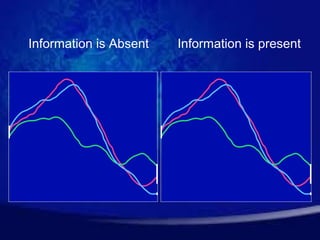
Information is Absent   Information is present
Instrumental requirements
•Personal Computer
•A Data acquisition board
•A Graphics card for driving two monitors
from one PC
• A four-channel EEG amplifier system
•Software     developed   by     the  Brain
Fingerprinting    Laboratories    for  data
acquisition and analysis.
How it works ?
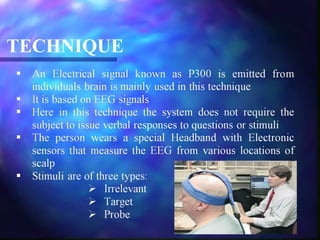
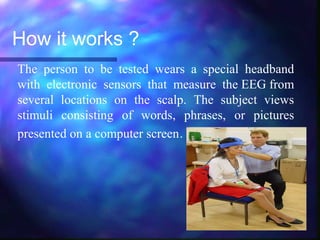
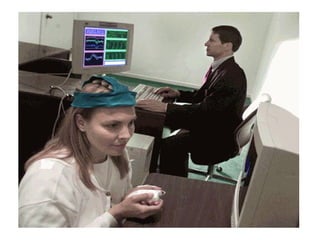
The person to be tested wears a special headband
with electronic sensors that measure the EEG from
several locations on the scalp. The subject views
stimuli consisting of words, phrases, or pictures
presented on a computer screen.
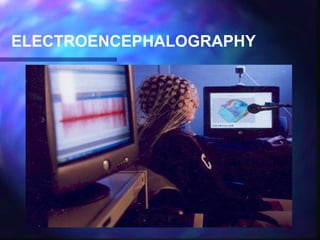
ELECTROENCEPHALOGRAPHY
Electroencephalography:
Electroencephalography         (EEG)     is    the
measurement of electrical activity produced by
the brain as recorded from electrodes placed on
the scalp.
Scalp EEG is collected from tens to hundreds
of electrodes positioned on different locations at
the surface of the head.
EEG signals(in the range of milli volts) are
amplified and digitalized for later processing.
Brain Fingerprinting in India
 Brain Fingerprinting in India The Gujarat government has
constituted an eight-member 'ethics committee' headed by a
high court judge, to monitor and establish newly acquired
techniques of crime detection. The technique being perused
by this committee at this juncture is the use of BRAIN
FINGERPRINTING on the accused an suspects in India.

Anand Yagnik, an advocate at the Gujarat High Court and
a member of this committee said : The ethical
considerations to be kept in mind while conducting new
techniques of crime detection like the brain fingerprinting.
Phases of brain fingerprintig

  Crime scene Evidence Collection

  Brain Evidence Collection
  Computer Evidence Analysis
  Scientific Result
Comparisons with other
technologies
  • Fingerprints and DNA are available in only 1%
    of crimes. The brain and the evidence
    recorded in it are always there.
  • No questions are asked and no answers are
    given during Farwell Brain Fingerprinting.
  • Brain Fingerprinting technology depends only
    on brain information processing, it does not
    depend on the emotional response of the
    subject.
Other Applications
       There are several other areas in which Brain
    fingerprinting can be used to make life easier and
    can aid mankind in many ways. Key fields where
    brain fingerprinting can be used are:
  • Counter terrorism
  • Criminal justice
  • Medical
  • Advertising
Conclusion
  • It would be inappropriate to generalize the
    results of the present research because of the
    small sample of subjects.
  • But the 100% accuracy and high confidence
    level of the results, however, provide further
    support for results from previous research
    using brain MERMER testing.
References

http://www.brainwavescience.com/SeattlePI.php
http://en.wikipedia.org/wiki/Brain_fingerprinting
http://www.seminarprojects.com/Thread-brain-
finger-printing
http://www.brainwavescience.com/SeattlePI.php
http://en.wikipedia.org/wiki/Brain_fingerprinting
http :www.brainwavescience.com/SeattlePI.php
 http://en.wikipedia.org/wiki/Brain_fingerprinting
Brain Fingerprinting

Brain Fingerprinting

  • 1.
    PRESENTATION ON BRAIN FINGERPRINTING
  • 2.
    What is BrainFingerprinting? Brain fingerprinting is a computer based technique for determining a certain information stored in the brain by measuring brain waves. Brain fingerprinting is a Technique used to identify a terrorist or other dangerous person by measuring the “brain print” of that particular person..
  • 3.
    Quick Overview • Invented By Dr Lawrence A. Farwell. • It’s a patented technique of proven accuracy in US government tests. • Ruled Admissible in one US Court as scientific evidence. • It has a record of 100% Accuracy.
  • 4.
  • 5.
    Types of StimuliUsed Probes o Life-experience related o Relevant to the investigated event -recognizable and noteworthy only for the subjects who had participated in the event (MERMER) o Indistinguishable from the Irrelevants for a subject who is not knowledgeable about the situation under investigation Targets o Push a button to indicate known image o Since the relatively rare Targets are singled out in the task being performed, the Targets are noteworthy for the subject, and each Target stimulus elicits a MERMER Irrelevant Stimuli o information relevant to the crime that the suspect claims to have no knowledge of
  • 6.
    Information is Absent Information is present
  • 7.
    Instrumental requirements •Personal Computer •AData acquisition board •A Graphics card for driving two monitors from one PC • A four-channel EEG amplifier system •Software developed by the Brain Fingerprinting Laboratories for data acquisition and analysis.
  • 8.
    How it works? The person to be tested wears a special headband with electronic sensors that measure the EEG from several locations on the scalp. The subject views stimuli consisting of words, phrases, or pictures presented on a computer screen.
  • 10.
  • 11.
    Electroencephalography: Electroencephalography (EEG) is the measurement of electrical activity produced by the brain as recorded from electrodes placed on the scalp. Scalp EEG is collected from tens to hundreds of electrodes positioned on different locations at the surface of the head. EEG signals(in the range of milli volts) are amplified and digitalized for later processing.
  • 12.
    Brain Fingerprinting inIndia  Brain Fingerprinting in India The Gujarat government has constituted an eight-member 'ethics committee' headed by a high court judge, to monitor and establish newly acquired techniques of crime detection. The technique being perused by this committee at this juncture is the use of BRAIN FINGERPRINTING on the accused an suspects in India. Anand Yagnik, an advocate at the Gujarat High Court and a member of this committee said : The ethical considerations to be kept in mind while conducting new techniques of crime detection like the brain fingerprinting.
  • 13.
    Phases of brainfingerprintig  Crime scene Evidence Collection  Brain Evidence Collection  Computer Evidence Analysis  Scientific Result
  • 14.
    Comparisons with other technologies • Fingerprints and DNA are available in only 1% of crimes. The brain and the evidence recorded in it are always there. • No questions are asked and no answers are given during Farwell Brain Fingerprinting. • Brain Fingerprinting technology depends only on brain information processing, it does not depend on the emotional response of the subject.
  • 15.
    Other Applications There are several other areas in which Brain fingerprinting can be used to make life easier and can aid mankind in many ways. Key fields where brain fingerprinting can be used are: • Counter terrorism • Criminal justice • Medical • Advertising
  • 16.
    Conclusion •It would be inappropriate to generalize the results of the present research because of the small sample of subjects. • But the 100% accuracy and high confidence level of the results, however, provide further support for results from previous research using brain MERMER testing.
  • 17.