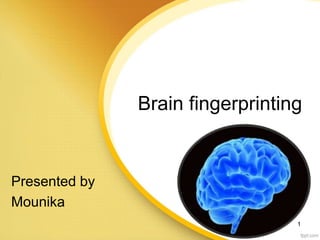
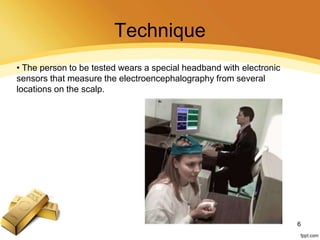
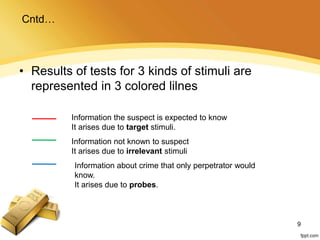
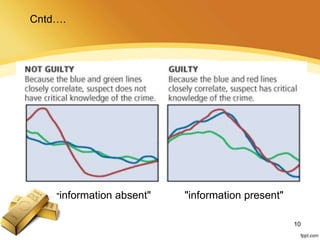
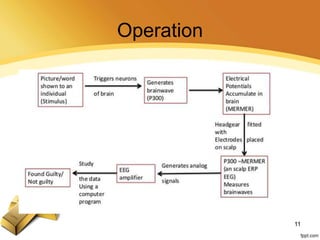
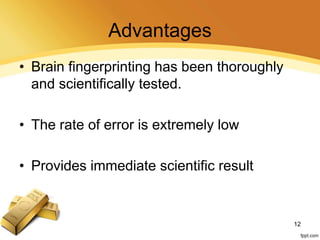
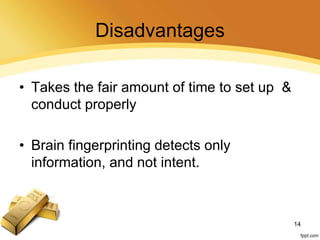
Brain fingerprinting is an investigative technique developed by Dr. Lawrence Farwell that uses electroencephalography (EEG) to measure brain wave responses to stimuli related to a crime. The technique presents the test subject with target stimuli relevant to the crime, irrelevant stimuli with no relation, and probe stimuli known only to the perpetrator. If the brain produces a specific brain wave response, P300 MERMER, to the probe stimuli, it suggests the subject has information about the crime in their brain. Brain fingerprinting provides a scientific means to identify perpetrators and exonerate innocent suspects with a low error rate and immediate results. However, it does not determine intent and requires time to properly conduct.