Brain Death
Dr. Krishn Undaviya
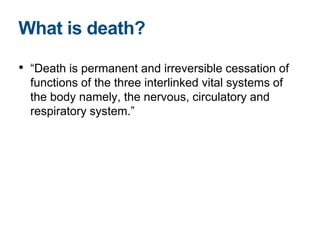
• “Death is permanent and irreversible cessation of
functions of the three interlinked vital systems of
the body namely, the nervous, circulatory and
respiratory system.”
What is death?
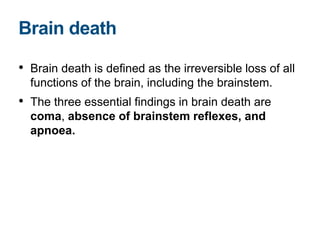
• Brain death is defined as the irreversible loss of all
functions of the brain, including the brainstem.
• The three essential findings in brain death are
coma, absence of brainstem reflexes, and
apnoea.
Brain death
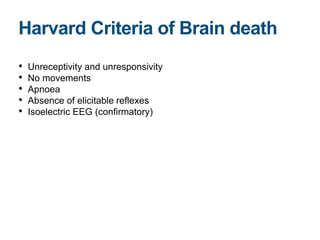
• Unreceptivity and unresponsivity
• No movements
• Apnoea
• Absence of elicitable reflexes
• Isoelectric EEG (confirmatory)
Harvard Criteria of Brain death
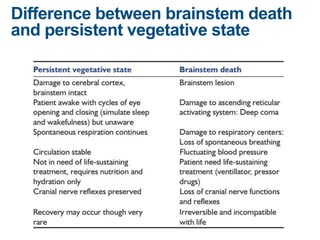
Difference between brainstem death
and persistent vegetative state
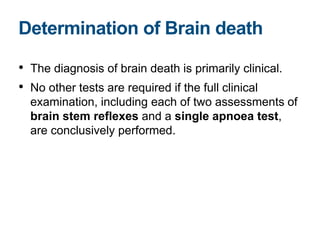
• The diagnosis of brain death is primarily clinical.
• No other tests are required if the full clinical
examination, including each of two assessments of
brain stem reflexes and a single apnoea test,
are conclusively performed.
Determination of Brain death
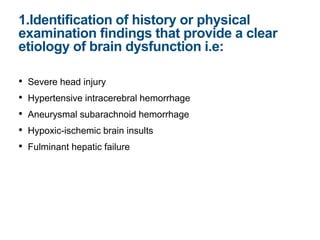
• Severe head injury
• Hypertensive intracerebral hemorrhage
• Aneurysmal subarachnoid hemorrhage
• Hypoxic-ischemic brain insults
• Fulminant hepatic failure
1.Identification of history or physical
examination findings that provide a clear
etiology of brain dysfunction i.e:
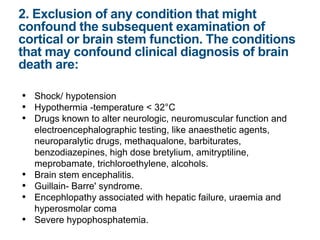
• Shock/ hypotension
• Hypothermia -temperature < 32°C
• Drugs known to alter neurologic, neuromuscular function and
electroencephalographic testing, like anaesthetic agents,
neuroparalytic drugs, methaqualone, barbiturates,
benzodiazepines, high dose bretylium, amitryptiline,
meprobamate, trichloroethylene, alcohols.
• Brain stem encephalitis.
• Guillain- Barre' syndrome.
• Encephlopathy associated with hepatic failure, uraemia and
hyperosmolar coma
• Severe hypophosphatemia.
2. Exclusion of any condition that might
confound the subsequent examination of
cortical or brain stem function. The conditions
that may confound clinical diagnosis of brain
death are:
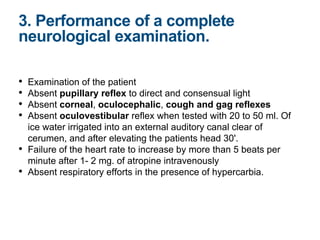
• Examination of the patient
• Absent pupillary reflex to direct and consensual light
• Absent corneal, oculocephalic, cough and gag reflexes
• Absent oculovestibular reflex when tested with 20 to 50 ml. Of
ice water irrigated into an external auditory canal clear of
cerumen, and after elevating the patients head 30'.
• Failure of the heart rate to increase by more than 5 beats per
minute after 1- 2 mg. of atropine intravenously
• Absent respiratory efforts in the presence of hypercarbia.
3. Performance of a complete
neurological examination.
• CN II: Loss of pupillary reflex (light reflex): Pupils should be fixed in
mid-size or dilated (4 to 9 mm) and not reactive to light.
• CN III, IV, VI: Loss of pupillary light reflex as mentioned above (CN III).
For cranial nerves IV and VI as well as VIII, the oculocephalic reflex can
be tested by holding a patient's eyelids open and turning their head
from side to side. A positive oculocephalic reflex is present when the
eyes reflexively look in the position opposite to that of the direction the
head is turning. When the oculocephalic reflex is absent, the eyes will
turn in the same direction in which the head is turning (Doll's eyes).
• CN V, VII: Loss of corneal reflex determined by using a cotton swab, or
drops of water/normal saline.
• CN VIII: Loss of oculovestibular reflex (Caloric test). Irrigation of each
ear by 50 to 60 ml of ice water won't move the eyes towards the
irrigated side within 1 minute of the test performed.
• CN IX: Loss of gag reflex confirmed after stimulation of bilateral
posterior pharyngeal membranes.
• CN X: Loss of cough reflex confirmed after tracheal suctioning.
Assessment of brainstem reflex
• The apnea test is used to examine the brain's ability to drive
pulmonary function in response to the rise of carbon dioxide.
• During the test, oxygen should be supplemented using a cannula
connected to the endotracheal tube at 6 L/min, a T-piece at 12
L/min, or using continuous positive airway pressure (CPAP) of 5
to 10 cm H2O.
• In the case of the loss of respiratory drive, CO2 is expected to
rise 5 mmHg every minute in the first 2 minutes, then by 2 mmHg
every minute thereafter.
• Repeat arterial blood gas (ABG) after 8 to 10 minutes
showing CO2 of 60 mmHg or the rise of CO2 by more than 20
mmHg above baseline is consistent with brain death.
Apnoea Test
• After the first clinical exam, the patient should be observed for a
defined period of time for clinical manifestations that are
inconsistent with the diagnosis of brain death.
• Most experts agree that a 6 hour observation period is sufficient
and reasonable in adults and children over the age of 1 year.
• Longer intervals are advisable in young children.
Interval Observation Period
Potential Brain Dead
Donor (PBDD)
A potential organ donor is defined by the
presence of either brainstem death or a
catastrophic and irreversible brain injury that
leads to fulfilling the brainstem death criteria.
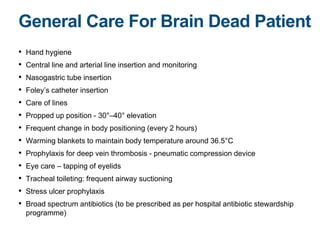
• Hand hygiene
• Central line and arterial line insertion and monitoring
• Nasogastric tube insertion
• Foley’s catheter insertion
• Care of lines
• Propped up position - 30°–40° elevation
• Frequent change in body positioning (every 2 hours)
• Warming blankets to maintain body temperature around 36.5°C
• Prophylaxis for deep vein thrombosis - pneumatic compression device
• Eye care – tapping of eyelids
• Tracheal toileting: frequent airway suctioning
• Stress ulcer prophylaxis
• Broad spectrum antibiotics (to be prescribed as per hospital antibiotic stewardship
programme)
General Care For Brain Dead Patient
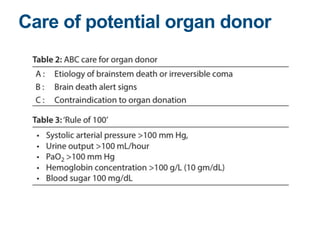
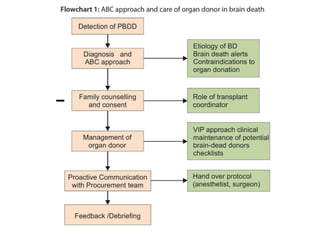
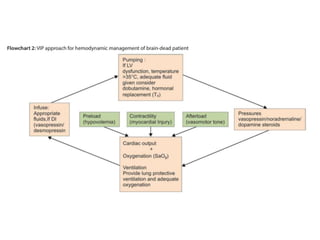
Care of potential organ donor
Thank you

Brain death & Potential Brain Dead Donor (PBDD)

  • 1.
  • 2.
    • “Death ispermanent and irreversible cessation of functions of the three interlinked vital systems of the body namely, the nervous, circulatory and respiratory system.” What is death?
  • 3.
    • Brain deathis defined as the irreversible loss of all functions of the brain, including the brainstem. • The three essential findings in brain death are coma, absence of brainstem reflexes, and apnoea. Brain death
  • 4.
    • Unreceptivity andunresponsivity • No movements • Apnoea • Absence of elicitable reflexes • Isoelectric EEG (confirmatory) Harvard Criteria of Brain death
  • 5.
    Difference between brainstemdeath and persistent vegetative state
  • 6.
    • The diagnosisof brain death is primarily clinical. • No other tests are required if the full clinical examination, including each of two assessments of brain stem reflexes and a single apnoea test, are conclusively performed. Determination of Brain death
  • 7.
    • Severe headinjury • Hypertensive intracerebral hemorrhage • Aneurysmal subarachnoid hemorrhage • Hypoxic-ischemic brain insults • Fulminant hepatic failure 1.Identification of history or physical examination findings that provide a clear etiology of brain dysfunction i.e:
  • 8.
    • Shock/ hypotension •Hypothermia -temperature < 32°C • Drugs known to alter neurologic, neuromuscular function and electroencephalographic testing, like anaesthetic agents, neuroparalytic drugs, methaqualone, barbiturates, benzodiazepines, high dose bretylium, amitryptiline, meprobamate, trichloroethylene, alcohols. • Brain stem encephalitis. • Guillain- Barre' syndrome. • Encephlopathy associated with hepatic failure, uraemia and hyperosmolar coma • Severe hypophosphatemia. 2. Exclusion of any condition that might confound the subsequent examination of cortical or brain stem function. The conditions that may confound clinical diagnosis of brain death are:
  • 9.
    • Examination ofthe patient • Absent pupillary reflex to direct and consensual light • Absent corneal, oculocephalic, cough and gag reflexes • Absent oculovestibular reflex when tested with 20 to 50 ml. Of ice water irrigated into an external auditory canal clear of cerumen, and after elevating the patients head 30'. • Failure of the heart rate to increase by more than 5 beats per minute after 1- 2 mg. of atropine intravenously • Absent respiratory efforts in the presence of hypercarbia. 3. Performance of a complete neurological examination.
  • 10.
    • CN II:Loss of pupillary reflex (light reflex): Pupils should be fixed in mid-size or dilated (4 to 9 mm) and not reactive to light. • CN III, IV, VI: Loss of pupillary light reflex as mentioned above (CN III). For cranial nerves IV and VI as well as VIII, the oculocephalic reflex can be tested by holding a patient's eyelids open and turning their head from side to side. A positive oculocephalic reflex is present when the eyes reflexively look in the position opposite to that of the direction the head is turning. When the oculocephalic reflex is absent, the eyes will turn in the same direction in which the head is turning (Doll's eyes). • CN V, VII: Loss of corneal reflex determined by using a cotton swab, or drops of water/normal saline. • CN VIII: Loss of oculovestibular reflex (Caloric test). Irrigation of each ear by 50 to 60 ml of ice water won't move the eyes towards the irrigated side within 1 minute of the test performed. • CN IX: Loss of gag reflex confirmed after stimulation of bilateral posterior pharyngeal membranes. • CN X: Loss of cough reflex confirmed after tracheal suctioning. Assessment of brainstem reflex
  • 11.
    • The apneatest is used to examine the brain's ability to drive pulmonary function in response to the rise of carbon dioxide. • During the test, oxygen should be supplemented using a cannula connected to the endotracheal tube at 6 L/min, a T-piece at 12 L/min, or using continuous positive airway pressure (CPAP) of 5 to 10 cm H2O. • In the case of the loss of respiratory drive, CO2 is expected to rise 5 mmHg every minute in the first 2 minutes, then by 2 mmHg every minute thereafter. • Repeat arterial blood gas (ABG) after 8 to 10 minutes showing CO2 of 60 mmHg or the rise of CO2 by more than 20 mmHg above baseline is consistent with brain death. Apnoea Test
  • 12.
    • After thefirst clinical exam, the patient should be observed for a defined period of time for clinical manifestations that are inconsistent with the diagnosis of brain death. • Most experts agree that a 6 hour observation period is sufficient and reasonable in adults and children over the age of 1 year. • Longer intervals are advisable in young children. Interval Observation Period
  • 13.
    Potential Brain Dead Donor(PBDD) A potential organ donor is defined by the presence of either brainstem death or a catastrophic and irreversible brain injury that leads to fulfilling the brainstem death criteria.
  • 15.
    • Hand hygiene •Central line and arterial line insertion and monitoring • Nasogastric tube insertion • Foley’s catheter insertion • Care of lines • Propped up position - 30°–40° elevation • Frequent change in body positioning (every 2 hours) • Warming blankets to maintain body temperature around 36.5°C • Prophylaxis for deep vein thrombosis - pneumatic compression device • Eye care – tapping of eyelids • Tracheal toileting: frequent airway suctioning • Stress ulcer prophylaxis • Broad spectrum antibiotics (to be prescribed as per hospital antibiotic stewardship programme) General Care For Brain Dead Patient
  • 16.
    Care of potentialorgan donor
  • 19.