Brittany Smith
Chelsea Green
Jessica Cureton
Megan Lambert
 Understanding of how our brain works and
the purposeful engagement in brain based
strategies to maximize learning.
 Also known as “brain-friendly teaching”
 New information is best learned by the
brain through brain-based learning.
The brain seeks and process information.
The brain is geared for figuring things out
and takes the new information it gains and
organizes it based on its schema.
The brain is social.
Social interaction is necessary for the brain,
so it is important that you as a
teacher provide social activities to support
the brain.
The brain is emotional.
The brain reacts to and remembers things that
produce emotion. If you link your information to some
kind of emotion your students have, they will be more
likely to retain the information.
The brain needs
nourishment.
The brain needs glucose and oxygen in order to function
properly so it is important to encourage movement within
your activities so your students can retain the proper
amounts of these two things throughout the day.
The brain needs safety.
It is vital that the brain feels safe in the classroom. Building
relationships, incorporating group work, and implementing
routines are things you can do help the brain feel safe in
the classroom.
Write the question directed in
the center of the butcher
paper (only ONE question  )
Questions:
Table 1: By knowing that the brain responds more effectively to
information that evokes emotion, how can you use this in your
future classroom?
Table 2: Why do you think it is necessary to provide students with
socially interactive lessons?
Table 3: In what ways can you make sure that your classroom
reinforces the feeling of safety?
•What did you enjoy about this activity?
•Did this activity successfully engage thinking?
•Which of the 5 main principles of brain-based
teaching –social engagement, emotional
engagement, safety, nourishment, and procession
of information– were incorporated into this activity?
 Chalk Talk
 This supports the all five of the principles.
 3-2-1 Bridge
 This supports the social, informational, emotional,
and safety principles.
 Round Robin & Rally Robin
 This supports the social, informational, and safety
principles.
 Take Off /Touch Down
 This supports all five of the principles.
 Mix-Pair Share
 This supports the social, informational, and safety
principles.
Neuroplasticity- Brain changes
and adapts
Teacher expectations
need to be flexible
Memories of class are often reconstructed
Repeat and review for student retention
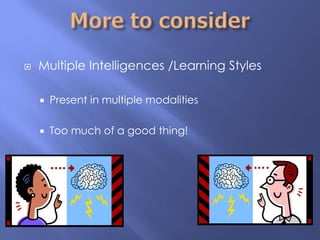
 Multiple Intelligences /Learning Styles
 Present in multiple modalities
 Too much of a good thing!
Strategies that can be used in the
classroom for brain based learning.
When teaching science, especially for the 4-8
level, you have to get students involved with
the different topics and subjects.
When students get involved and participate
the material gets drilled into their heads to
where they can remember it.
With brain based learning, this involves getting
the students to work their brains and have them
think rather than their brain sit there the whole
45 minutes to an hour and hear the teacher talk
the whole time. The strategies given and about
to be given can help in any classroom, but for
me, I’m going to incorporate it with the science
classroom.
Talking- students don’t learn a whole lot
by just sitting and listening. Though this is
helpful at times, talking about the material
can help students internalize what they’ve
learned. In a science classroom, discussion
should be a big part of the class. When
students talk about the organ systems (for
example), they will be able to get a better
understanding of it from their peers.
So…
giving them that time to talk and share will
help each and every one of them get their
points across and learn the right material.
Visuals: This is another strategy that I find could
work excellent in a science class, or any other. As
teachers, we need to give students as many
visuals as possible because sight is one of the
strongest senses. Visuals help students learn a lot
by seeing and touching.
Going back to the organ systems example from
before, I would group students up and give them
each a poster of a specific type of organ system,
and have them discuss and look over it. Then, after
they have looked at the posters, I would show
them a video that goes more in depth about how
each one of them works.
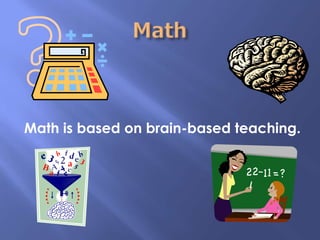
Math is based on brain-based teaching.
The first step of learning math is by using
actual objects.
The second step of learning math is
by using pictorial examples.
The third step is by using just the brain to
work out the math.
Students with disabilities &
English Language Learners (ELL’s).
 Important for all educators (IDEA 2004)
 Still a lot to research, but here’s what we
see…
While expectations should be kept high,
educators should recognize that these
students will need additional supports in order
to succeed in the general classroom
environment
 NOT special education, but these students
face some of the same challenges
 Begins again at Kindergarten level for
reading and writing
 Accents
Being aware of brain differences assists
educators in creating a safe and productive
learning environment for all.
•Finding books that are on level and interesting
•Linking vocabulary words with actions (ex: dingy;
dinghy)
•Reading groups
•Response Notebooks
• Making crafts that go along with the book being
read
• Role playing scenes from books
• Predicting, Making Connections, Inferring,
Synthesizing, Analyzing
• Solving Words, Monitoring and Correcting,
Searching for and Using Information, Summarizing,
Maintaining Fluency, Adjusting
• Brain based learning is active learning. It makes the
students more engaged in the material, which results
in greater memory pattern creation, which results in
greater retention.
With all that’s been said, brain based learning
stimulates the student’s continual interest in
learning. The teaching approach and the
safe environment challenge the students
more academically, which results in superior
understanding of the teaching the material.

Brain based teaching

  • 1.
  • 2.
     Understanding ofhow our brain works and the purposeful engagement in brain based strategies to maximize learning.  Also known as “brain-friendly teaching”  New information is best learned by the brain through brain-based learning.
  • 4.
    The brain seeksand process information. The brain is geared for figuring things out and takes the new information it gains and organizes it based on its schema.
  • 5.
    The brain issocial. Social interaction is necessary for the brain, so it is important that you as a teacher provide social activities to support the brain.
  • 6.
    The brain isemotional. The brain reacts to and remembers things that produce emotion. If you link your information to some kind of emotion your students have, they will be more likely to retain the information.
  • 7.
    The brain needs nourishment. Thebrain needs glucose and oxygen in order to function properly so it is important to encourage movement within your activities so your students can retain the proper amounts of these two things throughout the day.
  • 8.
    The brain needssafety. It is vital that the brain feels safe in the classroom. Building relationships, incorporating group work, and implementing routines are things you can do help the brain feel safe in the classroom.
  • 9.
    Write the questiondirected in the center of the butcher paper (only ONE question  )
  • 10.
    Questions: Table 1: Byknowing that the brain responds more effectively to information that evokes emotion, how can you use this in your future classroom? Table 2: Why do you think it is necessary to provide students with socially interactive lessons? Table 3: In what ways can you make sure that your classroom reinforces the feeling of safety?
  • 11.
    •What did youenjoy about this activity? •Did this activity successfully engage thinking? •Which of the 5 main principles of brain-based teaching –social engagement, emotional engagement, safety, nourishment, and procession of information– were incorporated into this activity?
  • 12.
     Chalk Talk This supports the all five of the principles.  3-2-1 Bridge  This supports the social, informational, emotional, and safety principles.  Round Robin & Rally Robin  This supports the social, informational, and safety principles.  Take Off /Touch Down  This supports all five of the principles.  Mix-Pair Share  This supports the social, informational, and safety principles.
  • 13.
    Neuroplasticity- Brain changes andadapts Teacher expectations need to be flexible
  • 14.
    Memories of classare often reconstructed Repeat and review for student retention
  • 15.
     Multiple Intelligences/Learning Styles  Present in multiple modalities  Too much of a good thing!
  • 16.
    Strategies that canbe used in the classroom for brain based learning.
  • 17.
    When teaching science,especially for the 4-8 level, you have to get students involved with the different topics and subjects. When students get involved and participate the material gets drilled into their heads to where they can remember it.
  • 18.
    With brain basedlearning, this involves getting the students to work their brains and have them think rather than their brain sit there the whole 45 minutes to an hour and hear the teacher talk the whole time. The strategies given and about to be given can help in any classroom, but for me, I’m going to incorporate it with the science classroom.
  • 19.
    Talking- students don’tlearn a whole lot by just sitting and listening. Though this is helpful at times, talking about the material can help students internalize what they’ve learned. In a science classroom, discussion should be a big part of the class. When students talk about the organ systems (for example), they will be able to get a better understanding of it from their peers.
  • 20.
    So… giving them thattime to talk and share will help each and every one of them get their points across and learn the right material.
  • 21.
    Visuals: This isanother strategy that I find could work excellent in a science class, or any other. As teachers, we need to give students as many visuals as possible because sight is one of the strongest senses. Visuals help students learn a lot by seeing and touching.
  • 22.
    Going back tothe organ systems example from before, I would group students up and give them each a poster of a specific type of organ system, and have them discuss and look over it. Then, after they have looked at the posters, I would show them a video that goes more in depth about how each one of them works.
  • 23.
    Math is basedon brain-based teaching.
  • 24.
    The first stepof learning math is by using actual objects.
  • 25.
    The second stepof learning math is by using pictorial examples.
  • 26.
    The third stepis by using just the brain to work out the math.
  • 27.
    Students with disabilities& English Language Learners (ELL’s).
  • 28.
     Important forall educators (IDEA 2004)  Still a lot to research, but here’s what we see…
  • 29.
    While expectations shouldbe kept high, educators should recognize that these students will need additional supports in order to succeed in the general classroom environment
  • 30.
     NOT specialeducation, but these students face some of the same challenges  Begins again at Kindergarten level for reading and writing  Accents
  • 31.
    Being aware ofbrain differences assists educators in creating a safe and productive learning environment for all.
  • 32.
    •Finding books thatare on level and interesting •Linking vocabulary words with actions (ex: dingy; dinghy) •Reading groups •Response Notebooks
  • 33.
    • Making craftsthat go along with the book being read • Role playing scenes from books • Predicting, Making Connections, Inferring, Synthesizing, Analyzing • Solving Words, Monitoring and Correcting, Searching for and Using Information, Summarizing, Maintaining Fluency, Adjusting
  • 34.
    • Brain basedlearning is active learning. It makes the students more engaged in the material, which results in greater memory pattern creation, which results in greater retention.
  • 35.
    With all that’sbeen said, brain based learning stimulates the student’s continual interest in learning. The teaching approach and the safe environment challenge the students more academically, which results in superior understanding of the teaching the material.