Brain and Craniofacial Trauma Lt. Colonel Brenda Sowards, RN
Head Trauma 50-99% of moderate head trauma victims have permanent injury. Motor Vehicle Crashes are primary cause. Falls for elderly and children High velocity missiles/blast injuries 30% have at least one significant concurrent injury.
 
Pathophysiology Primary brain injury Direct Trauma Involves bleeding, tearing, shearing, neuron damage Secondary brain injury Hypoxia, hypercapnea, hypotension, hyperglycemia, hypoglycemia, increased intracranial pressure, swelling, seizures
Head Injuries Scalp Lacerations Skull Fractures Concussions Contusions Intracranial Bleeding Cerebral Edema
Scalp Lacerations Rich blood supply Can cause hypovolemic shock Often deeper brain injury has occurred Direct pressure to control bleeding Do not apply excessive pressure Complete neurological exam
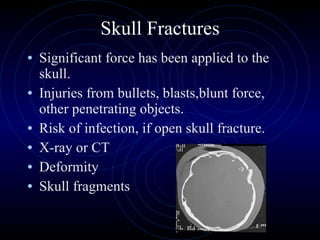
Skull Fractures Significant force has been applied to the skull. Injuries from bullets, blasts,blunt force, other penetrating objects. Risk of infection, if open skull fracture. X-ray or CT Deformity Skull fragments
Skull Fractures Raccoon Eyes Indicates maxilofacial fractures around eyes Ecchymosis (Black eyes) Visual Acuity Eye bulges out (Exopthalmos) Eye sinks in (Enopthalmos)
Skull Fractures Battle’s sign Associated with basilar skull fracture Blood accumulation behind one or both ears (forms bruising 12-24 hours later) Hemotympanum CSF drainage from ears or nose (never pack) Check extraocular movements
Concussion Temporary loss of brain function May result in loss of consciousness Confusion Amnesia Dizzyness Weakness
Concussion Coup- same side injury Contra-coup-opposite side injury Contusions may occur as the brain scrapes the inside of the skull Bleeding, permanent injury, swelling, amnesia, unconsciousness
Intracranial Bleeding Epidural Hematoma Subdural Hematoma Intracerebral Hemorrhage
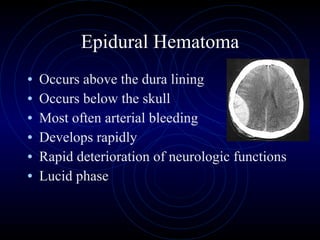
Epidural Hematoma Occurs above the dura lining   Occurs below the skull   Most often arterial bleeding   Develops rapidly Rapid deterioration of neurologic functions Lucid phase
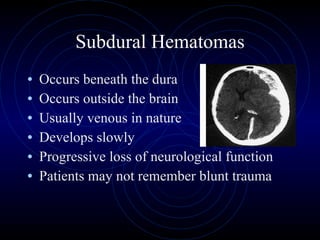
Subdural Hematomas Occurs beneath the dura Occurs outside the brain Usually venous in nature Develops slowly Progressive loss of neurological function Patients may not remember blunt trauma
Intracranial Hemorrhage Bleeding occurs within the brain itself Caused by tearing, shearing of blood vessels Spinal Taps contraindicated due to increased swelling
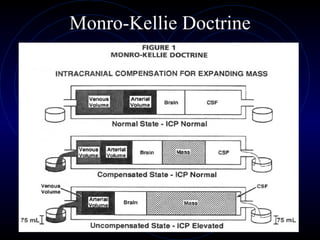
Cerebral Edema Most common complication of head injury Aggravated by low oxygen levels Seizures increase oxygen consumption Causes increased intracranial pressure Normal ICP 10-15 mm
Cerebral Ischemia Headache Nausea and vomiting Amnesia for events before or after injury Altered level of consciousness Restlessness, drowsiness Changes in speech Loss of judgement
Intracranial Pressure Cerebral Perfusion Pressure (CPP) Mean Arterial Pressure (MAP) Autoregulation
Autoregulation An increase in mean arterial pressure leads to vasoconstriction of cerebral vessels. A decrease in mean arterial pressure leads to vasodilation of cerebral vessels. Hypoxia and Hypovolemia are the main causes of secondary brain injury.
Intracranial Pressure Cerebral perfusion must be adequate to prevent secondary brain injury. Prevention starts by treating shock. Keep mean arterial pressure between 60 and 180 mm Hg. One episode of hypotension significantly increases morbidity and mortality.  Position patient to facilitate venous drainage.
Monro-Kellie Doctrine
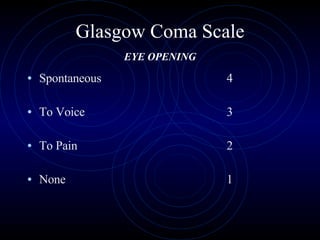
Glasgow Coma Scale EYE OPENING Spontaneous To Voice To Pain None 4 3 2 1
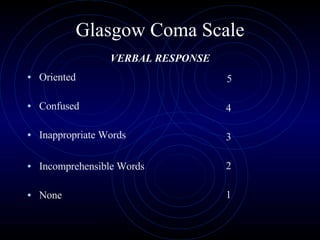
Glasgow Coma Scale VERBAL RESPONSE Oriented Confused Inappropriate Words Incomprehensible Words None 5 4 3 2 1
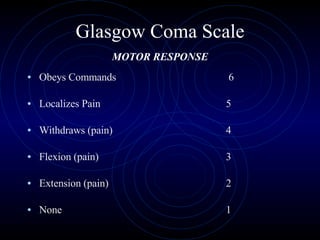
Glasgow Coma Scale MOTOR RESPONSE Obeys Commands Localizes Pain Withdraws (pain) Flexion (pain) Extension (pain) None 6 5 4 3 2 1
Glasgow Coma Scale Predicts mortality Measures level of consciousness Motor component most sensitive subset Indicates improvement or deterioration GCS of 9-15 indicates mild to moderate injury GCS of 3-8 indicates severe head injury
Pupil Assessment Size  Light Response Equal Compare
Posturing Decorticate- hands turn inward toward  Decerebrate-hands turn outward Happens prior to herniation syndrome.
Treatment Prevent secondary injury Airway-oxygen and intubation if GCS < 8 Treat shock-normotensive Hyperventilation is only indicated if patient shows signs of impending herniation Control bleeding from other injuries RAPID transport if possible
Treatment Continual assessment-pupils & GCS Treat seizures-increased oxygen consumption of the brain Watch for respiratory pattern changes-may indicate your patient is worsening.
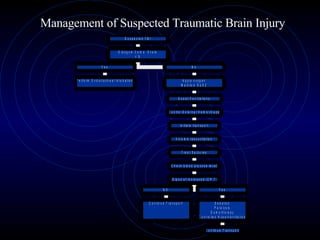
Management of Suspected Traumatic Brain Injury
QUESTIONS ?

Brain And Craniofacial Trauma Brenda

  • 1.
    Brain and CraniofacialTrauma Lt. Colonel Brenda Sowards, RN
  • 2.
    Head Trauma 50-99%of moderate head trauma victims have permanent injury. Motor Vehicle Crashes are primary cause. Falls for elderly and children High velocity missiles/blast injuries 30% have at least one significant concurrent injury.
  • 3.
  • 4.
    Pathophysiology Primary braininjury Direct Trauma Involves bleeding, tearing, shearing, neuron damage Secondary brain injury Hypoxia, hypercapnea, hypotension, hyperglycemia, hypoglycemia, increased intracranial pressure, swelling, seizures
  • 5.
    Head Injuries ScalpLacerations Skull Fractures Concussions Contusions Intracranial Bleeding Cerebral Edema
  • 6.
    Scalp Lacerations Richblood supply Can cause hypovolemic shock Often deeper brain injury has occurred Direct pressure to control bleeding Do not apply excessive pressure Complete neurological exam
  • 7.
    Skull Fractures Significantforce has been applied to the skull. Injuries from bullets, blasts,blunt force, other penetrating objects. Risk of infection, if open skull fracture. X-ray or CT Deformity Skull fragments
  • 8.
    Skull Fractures RaccoonEyes Indicates maxilofacial fractures around eyes Ecchymosis (Black eyes) Visual Acuity Eye bulges out (Exopthalmos) Eye sinks in (Enopthalmos)
  • 9.
    Skull Fractures Battle’ssign Associated with basilar skull fracture Blood accumulation behind one or both ears (forms bruising 12-24 hours later) Hemotympanum CSF drainage from ears or nose (never pack) Check extraocular movements
  • 10.
    Concussion Temporary lossof brain function May result in loss of consciousness Confusion Amnesia Dizzyness Weakness
  • 11.
    Concussion Coup- sameside injury Contra-coup-opposite side injury Contusions may occur as the brain scrapes the inside of the skull Bleeding, permanent injury, swelling, amnesia, unconsciousness
  • 12.
    Intracranial Bleeding EpiduralHematoma Subdural Hematoma Intracerebral Hemorrhage
  • 13.
    Epidural Hematoma Occursabove the dura lining Occurs below the skull Most often arterial bleeding Develops rapidly Rapid deterioration of neurologic functions Lucid phase
  • 14.
    Subdural Hematomas Occursbeneath the dura Occurs outside the brain Usually venous in nature Develops slowly Progressive loss of neurological function Patients may not remember blunt trauma
  • 15.
    Intracranial Hemorrhage Bleedingoccurs within the brain itself Caused by tearing, shearing of blood vessels Spinal Taps contraindicated due to increased swelling
  • 16.
    Cerebral Edema Mostcommon complication of head injury Aggravated by low oxygen levels Seizures increase oxygen consumption Causes increased intracranial pressure Normal ICP 10-15 mm
  • 17.
    Cerebral Ischemia HeadacheNausea and vomiting Amnesia for events before or after injury Altered level of consciousness Restlessness, drowsiness Changes in speech Loss of judgement
  • 18.
    Intracranial Pressure CerebralPerfusion Pressure (CPP) Mean Arterial Pressure (MAP) Autoregulation
  • 19.
    Autoregulation An increasein mean arterial pressure leads to vasoconstriction of cerebral vessels. A decrease in mean arterial pressure leads to vasodilation of cerebral vessels. Hypoxia and Hypovolemia are the main causes of secondary brain injury.
  • 20.
    Intracranial Pressure Cerebralperfusion must be adequate to prevent secondary brain injury. Prevention starts by treating shock. Keep mean arterial pressure between 60 and 180 mm Hg. One episode of hypotension significantly increases morbidity and mortality. Position patient to facilitate venous drainage.
  • 21.
  • 22.
    Glasgow Coma ScaleEYE OPENING Spontaneous To Voice To Pain None 4 3 2 1
  • 23.
    Glasgow Coma ScaleVERBAL RESPONSE Oriented Confused Inappropriate Words Incomprehensible Words None 5 4 3 2 1
  • 24.
    Glasgow Coma ScaleMOTOR RESPONSE Obeys Commands Localizes Pain Withdraws (pain) Flexion (pain) Extension (pain) None 6 5 4 3 2 1
  • 25.
    Glasgow Coma ScalePredicts mortality Measures level of consciousness Motor component most sensitive subset Indicates improvement or deterioration GCS of 9-15 indicates mild to moderate injury GCS of 3-8 indicates severe head injury
  • 26.
    Pupil Assessment Size Light Response Equal Compare
  • 27.
    Posturing Decorticate- handsturn inward toward Decerebrate-hands turn outward Happens prior to herniation syndrome.
  • 28.
    Treatment Prevent secondaryinjury Airway-oxygen and intubation if GCS < 8 Treat shock-normotensive Hyperventilation is only indicated if patient shows signs of impending herniation Control bleeding from other injuries RAPID transport if possible
  • 29.
    Treatment Continual assessment-pupils& GCS Treat seizures-increased oxygen consumption of the brain Watch for respiratory pattern changes-may indicate your patient is worsening.
  • 30.
    Management of SuspectedTraumatic Brain Injury
  • 31.