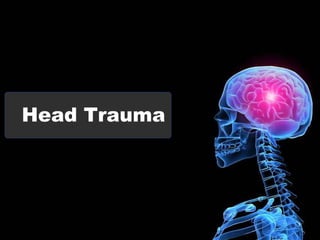
Head Trauma
Traumatic brain injury 
is defined as damage to the brain resulting from 
external mechanical force, such as rapid acceleration 
or deceleration, impact, blast waves, or penetration by 
a projectile. Traumatic brain injury
Demographics of Head 
Trauma Woldwide
• TBI is a major cause of death and disability 
worldwide, especially in children and young adults. 
• Males sustain traumatic brain injuries more 
frequently than do females , However, when matched 
for severity of injury, women appear to fare more 
poorly than men. 
• TBI is present in 85% of traumatically injured 
children, either alone or with other injuries. 
• The greatest number of TBIs occur in people aged 
15–24 Because TBI is more common in young 
people, its costs to society are high due to the loss 
of productive years to death and disability. 
• The highest rates of death and hospitalization 
due to TBI are in people over age 65. 
• The incidence of fall-related TBI in First 
World countries is increasing as the 
population ages; thus the median age 
of people with head injuries has 
increased.
Almost 1.24 million 
people worldwide die every 
year as a result of a road 
traffic accident and 20 
million to 50 million more 
people suffer non-fatal 
injuries, with many incurring 
a disability as a result of their 
injury, the World Health 
Organisation has said: 
Without action, road traffic 
crashes are expected to 
result in the deaths of about 
1.9 million people a year 
worldwide by 2020.
• A study at Al Ain Hospital found the most 
common cause of head injury was a road traffic 
collision (67.1 per cent), followed by falls (11.9 per 
cent) as the second-most common. 
• Researchers examined data collected over three 
years from the hospital’s trauma registry and 
focused on patients with a head injury who had 
died at the hospital or were treated there for 
more than 24 hours. 
• “With an estimated mortality rate of 37 per 100,000 
of the population, this makes the road traffic 
accident mortality rates in the UAE one of the 
highest in the world,” said Dr Ashraf Hefny, a 
specialist surgeon at Al Rahba Hospital in Abu 
Dhabi and the co-author of the study.
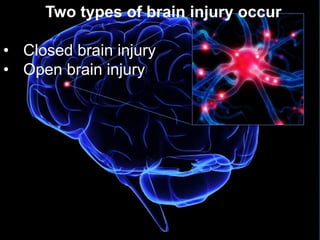
Two types of brain injury occur 
• Closed brain injury 
• Open brain injury
Closed Head Injury 
• Resulting from falls, motor vehicle 
crashes,… etc. 
• Focal damage and diffuse damage to axons 
• Effects tend to be broad (diffuse) 
• No penetration to the skull
Open Head Injury 
• Results from bullet wounds, etc. 
• Largely focal damage 
• Penetration of the skull 
• Effects can be just as serious
Closed-head injuries: 
• are a type of traumatic brain injury in which the skull and 
dura mater remain intact. 
• Closed-head injuries are the leading cause of death in 
children under 4 years old and the most common cause 
of physical disability and cognitive impairment in young 
people. 
• account for about 75% of the estimated 17 million brain 
injuries that occur annually in the United States. 
• Brain injuries such as closed-head injuries may result in 
lifelong physical, cognitive, or psychological impairment 
and, thus, are of utmost concern with regards to public 
health.
Causes of Closed-head injuries: 
• are caused primarily by vehicular accidents, falls, acts of 
violence, and sports injuries. 
• Falls account for 35.2% of brain injuries in the United 
States, with rates highest for children ages 0–4 years and 
adults ages 75 years and older. 
• Boys aged 0–4 years have the highest rates of brain 
injury related hospital visits, hospitalizations, and deaths 
combined. 
• Multiple mild traumatic brain injuries sustained over a 
short period of time (hours to weeks), often seen with 
sports-related injuries, can result in major neurological 
or cognitive deficits or fatality. 
• Closed-head injuries can range from mild injuries to 
debilitating traumatic brain injuries and can lead to 
severe brain damage or death.
Closed-head injuries can range from mild injuries to debilitating traumatic 
brain injuries and can lead to severe brain damage or death. 
Common closed-head injuries include: 
• Concussion – a head injury resulting in temporary dysfunction of normal brain 
function. Almost half of the total concussions reported each year are sports-related 
. 
• Intracranial hematoma – a condition in which a blood vessel ruptures causing 
a pool of blood to form around the brain (subdural hematoma) or between the 
brain and the skull (epidural hematoma). Intracranial hematoma causes an 
increase in pressure on the brain and requires immediate medical attention. 
• Cerebral contusion – a bruise to the brain tissue as a result of trauma. 
• Diffuse axonal injury – an injury to the axon of the neuron. These injuries are 
frequently seen in car accidents and cause permanent damage to the brain. 
Severe diffuse axonal injuries often lead to comas or vegetative states.
Opened head injuries : 
• open head injury refers to a trauma to the head where the skull gets 
punctured. 
• They can occur in car crashes, sports accidents, workplace 
accidents, or gunshot or knife wounds that create a skull fracture. 
• If the object exits in a different location than where it entered, as in a 
gunshot wound, it’s known as a perforating open head injury. 
• An open head wound would create a more serious brain injury than a 
closed head wound. 
• Because there is an open wound, open head injury victims may suffer 
from infection and contamination.
Causes of opened head injuries : 
• The top three causes are….. 
 car accident 
 firearms 
 falls
Skull Fractures 
Open head injuries differ depending on the type of skull fracture, of which there 
are four: 
 Linear Skull Fracture : 
Linear skull fracture, or a crack in the skull, accounts for about 69 percent of all 
open head injuries. Because the injury does not penetrate brain tissue, most 
linear skull fractures are minor and require little treatment. Nonetheless, it is 
important to seek immediate medical attention after any traumatic brain injury, 
including a linear skull fracture. 
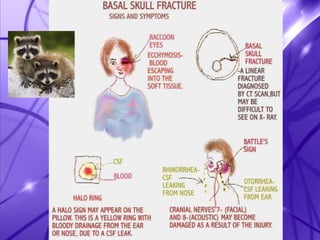
 Basilar Fracture and Diastatic Fracture : 
Typically seen in newborns and older infants, diastatic fractures occur when 
the skull's suture lines (areas where the bones fuse together during childhood) 
are widened.
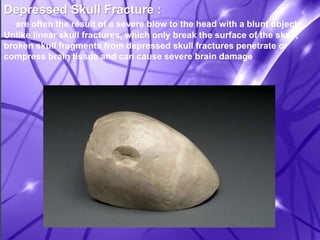
Depressed Skull Fracture : 
are often the result of a severe blow to the head with a blunt object. 
Unlike linear skull fractures, which only break the surface of the skull, 
broken skull fragments from depressed skull fractures penetrate or 
compress brain tissue and can cause severe brain damage
Open Head Injury Complications 
Most open head injuries expose the brain to the outside environment, leaving 
victims extremely susceptible to infection. If left untreated, infection can cause 
permanent brain damage or death. 
The most common type of infection resulting from open head injuries is 
meningitis caused by bacteria or viruses, meningitis is usually treated with 
aggressive antibiotics and drugs that reduce brain swelling (corticosteroids). 
In addition to meningitis, open head injury can leave the brain vulnerable to other 
complications, including: 
 Seizures 
 Dementia 
 Paralysis 
 Coma 
 Death 
All traumatic brain injury victims also risk suffering from intracranial hematoma, 
or bleeding in the head or brain.
Symptoms 
If symptoms of a head injury are seen after an accident, medical care is necessary 
to diagnose and treat the injury. Without medical attention, injuries can progress 
and cause further brain damage, disability, or death. 
Common symptoms : 
Because the brain swelling that produces these symptoms is often a slow 
process, these symptoms may not surface for days to weeks after the injury. 
Common symptoms of a closed-head injury include: 
 Insomnia 
 Memory Problems 
 Poor concentration 
 Depression 
 Anxiety 
 Irritability 
 Headache 
 Dizziness 
 Fatigue 
 Noise/light intolerance
Severe Injury Symptoms: 
Severe head injuries can lead to permanent vegetative states or death, therefore 
being able to recognize symptoms and get medical attention is very important. 
Symptoms of a severe closed-head injury include: 
 Coma 
 Seizures 
 loss of consciousness
Secondary Symptoms: 
Secondary symptoms are symptoms that surface during rehabilitation from the 
injury including social competence issues, depression, personality changes, 
cognitive disabilities, anxiety, and changes in sensory perception. 
More than 50% of patients who suffer from a traumatic brain injury will develop 
psychiatric disturbances Although precise rates of anxiety after brain injury are 
unknown. 
A 30-year follow-up study of 60 patients found 8.3% of patients developed a panic 
disorder, 1.7% developed an anxiety disorder, and 8.3% developed a specific 
phobia. 
Patients recovering from a closed-head or traumatic brain injury often suffer from 
decreased self-esteem and depression. This effect is often attributed to difficulties 
re-entering society and frustration with the rehabilitation process. 
Patients who have suffered head injuries also show higher levels of 
unemployment, which can lead to the development of secondary symptoms.
Glasgow Coma Scale 
 The Glasgow Coma Scale is commonly used to assess the severity of 
traumatic brain injuries, including closed-head injuries. 
 The scale tests a patient’s eye, verbal, and motor responses. 
 The scale goes up to fifteen points; with fifteen being the most mild injury, 
less than eight being a severe brain injury, and three being a vegetative state.
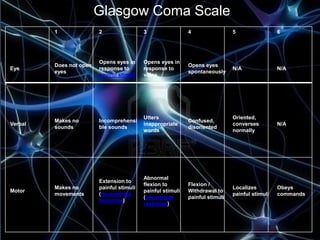
Glasgow Coma Scale 
1 2 3 4 5 6 
Eye 
Does not open 
eyes 
Opens eyes in 
response to 
painful stimuli 
Opens eyes in 
response to 
voice 
Opens eyes 
spontaneously 
N/A N/A 
Verbal 
Makes no 
sounds 
Incomprehensi 
ble sounds 
Utters 
inappropriate 
words 
Confused, 
disoriented 
Oriented, 
converses 
normally 
N/A 
Motor 
Makes no 
movements 
Extension to 
painful stimuli 
(decerebrate 
response) 
Abnormal 
flexion to 
painful stimuli 
(decorticate 
response) 
Flexion / 
Withdrawal to 
painful stimuli 
Localizes 
painful stimuli 
Obeys 
commands
Generally, brain injury is classified as: 
 Severe, with GCS < 9. 
 Moderate, GCS 9–12 (controversial). 
 Minor, GCS ≥ 13.
Diagnosis 
 After sufficient information has been obtained regarding patient history, 
appropriate physical and neurologic examinations are performed. 
 The neurologic assessment begins with ascertaining the GCS score. 
 Brainstem examination – Pupillary examination, ocular movement 
examination, corneal reflex, gag reflex 
 Motor examination 
 Sensory examination 
 Reflex examination 
 Anatomical imaging with MRI is very sensitive and accurate in 
diagnosing cerebral pathology in TBI patients. However, conventional 
CT (which is more available and cost effective, requires shorter imaging 
time and is easier to perform on patients who are on ventilator support, 
in traction, or agitated) is the initial imaging modality of choice during 
the first 24 h after the injury .
 CT is also superior in evaluating bones and detecting acute 
subarachnoid or acute parenchymal hemorrhage. 
 CT can miss small amounts of blood . 
 CT findings may lag behind actual intracranial damage, so that 
examinations performed within 3 h of trauma may underestimate injury.
Laboratory studies 
 CT scans should be repeated after a normal admission . 
Sodium  levels: Alterations in serum sodium levels occur in as many as 50% of 
Forty-eight to 72 h after injury, MRI is generally considered to be 
comatose patients with head injuries; hyponatremia may be due to the syndrome 
superior to CT. Although CT is better at detecting bony pathology and 
of inappropriate antidiuretic hormone (SIADH) or cerebral salt wasting; elevated 
sodium certain levels types in head of early injury bleeds. 
indicate simple dehydration or diabetes insipidus 
 MRI is superior to CT in detecting axonal injury, small areas of 
Magnesium levels: These are depleted in the acute phases of minor and severe 
head injuries 
contusion, and subtle neuronal damage. 
Coagulation  Moreover, studies: MRI is Including better at prothrombin imaging the time brainstem, (PT), activated basal partial 
ganglia, and 
thromboplastin time (aPTT), and platelet count; these are important to exclude a 
coagulopathy 
thalami. However, although the greater sensitivity of MRI is helpful in 
the subacute and chronic settings. 
 In the acute stage, CT is more sensitive than MRI, as the clot signal can 
Blood alcohol levels and drug screens: May help to explain subnormal levels of 
consciousness and cognition in some patients with head trauma 
be indistinguishable from brain parenchyma on MRI. After the first few 
hours, the hemoglobin in the contusion loses its oxygen to become 
deoxyhemoglobin, which is still not well visualized on T1-weighted 
MRI, but the concentration of red blood cells and fibrin can cause low 
signal on T2-weighted images. Over the next several days, as the 
contusion liquefies and the deoxyhemoglobin oxidizes to 
methemoglobin that is strongly paramagnetic, the contusion becomes 
more easily visualized on MRI. 
Renal function tests and creatine kinase levels: To help exclude rhabdomyolysis if 
a crush injury has occurred or marked rigidity is present 
Neuron-specific enolase and protein S-100 B: Elevated serum levels may correlate 
with persistent cognitive impairment at 6 months in patients with severe or mild 
head injuries.
Angiography 
 Once a common diagnostic study in persons with acute head injury, 
angiography is rarely used in the evaluation of acute head injury 
today. However, conventional angiography has been the screening 
and diagnostic modality of choice for identifying blunt 
cerebrovascular injuries (BCVI) in trauma patients .
Head Trauma Treatment & Management 
Mild head injury 
 Most head injuries are mild head injuries. 
 Most people presenting with mild head injuries will not have any progression 
of their head injury; however, up to 3% of mild head injuries progress to more 
serious injuries. 
 Mild head injuries may be separated into low-risk and moderate-risk groups. 
Patients with mild-to-moderate headaches, dizziness, and nausea are 
considered to have low-risk injuries. Many of these patients require only 
minimal observation after they are assessed carefully, and many do not require 
radiographic evaluation. These patients may be discharged if a reliable 
individual can monitor them. 
 After a mild head injury, those displaying persistent emesis, severe headache, 
anterograde amnesia, loss of consciousness, or signs of intoxication by drugs 
or alcohol are considered to have a moderate-risk head injury. These patients 
should be evaluated with a head CT scan. Patients with moderate-risk mild 
head injuries can be discharged if their CT scan findings reveal no pathology, 
their intoxication is cleared, and they have been observed for at least 8 hours.
Moderate and severe head injury 
 The initial resuscitation of a patient with a head injury is of critical 
importance to prevent hypoxia and hypotension. 
 The results of the CT scan help determine the next step. If a surgical 
lesion is present, arrangements are made for immediate transport to 
the operating room. Fewer than 10% of patients with TBI have an initial 
surgical lesion. 
 If no surgical lesion is present on the CT scan image, The first phase of 
treatment is to institute general measures intravenous fluids are 
administered to maintain the patient in a state of euvolemia or mild 
hypervolemia . 
 Fluid restriction decreases intravascular volume and, therefore, 
decreases cardiac output. A decrease in cardiac output often results in 
decreased cerebral flow, which results in decreased brain perfusion 
and may cause an increase in cerebral edema and ICP. Thus, fluid 
restriction is contraindicated in patients with TBI.
 Another supportive measure used to treat patients with head injuries is 
elevation of the head. 
 When the head of the bed is elevated to 20-30°, the venous outflow from the 
brain is improved, thus helping to reduce ICP. If a patient is hypovolemic, 
elevation of the head may cause a drop in cardiac output and CBF; therefore, 
the head of the bed is not elevated in hypovolemic patients. 
 Sedation 
 The use of anticonvulsants in patients with TBI is a controversial issue. No 
evidence exists that the use of anticonvulsants decreases the incidence of late-onset 
seizures in patients with either closed head injury or TBI. Therefore, the 
prophylactic use of anticonvulsants is not recommended for more than 7 days 
following TBI and is considered optional in the first week following TBI. 
 ICP monitoring is indicated for any patient with a GCS score less than 9, any 
patient with a head injury who requires prolonged deep sedation or 
pharmacologic relaxants for a systemic condition, or any patient with an acute 
head injury who is undergoing extended general anesthesia for a 
nonneurosurgical procedure. 
 . ICP may be monitored by means of an intraparenchymal monitor, an 
intraventricular monitor (ventriculostomy), or an epidural monitor.
 In adults, the reference range of ICP is 0-15 mm Hg. 
 Maintaining ICP within the reference range is part of an approach 
designed to optimize both CBF and the metabolic state of the brain. 
 Diuretics are powerful in their ability to decrease brain volume and, 
therefore, to decrease ICP. Mannitol, an osmotic diuretic, is the most 
common diuretic used. 
 Surgery: 
 Removing clotted blood (hematomas). 
 Repairing skull fractures. 
 Opening a window in the skull. 
 Rehabilitation 
Patients may need to relearn basic skills, such as walking or talking. 
The goal is to improve their abilities to perform daily activities.
Prevention 
 Always wear a seat belt in a motor vehicle. Small children should 
always sit in the back seat of a car and be secured in child safety seats 
or booster seats that are appropriate for their size and weight. 
 Don't drive under the influence of drugs, including prescription 
medications that can impair the ability to drive. 
 Wear a helmet while riding a bicycle, skateboard, motorcycle..etc 
 Remove hazards in the home that may contribute falling.
Thank you 
Dr Sahar Sasi

Head Trauma

  • 1.
  • 2.
    Traumatic brain injury Traumatic brain injury is defined as damage to the brain resulting from external mechanical force, such as rapid acceleration or deceleration, impact, blast waves, or penetration by a projectile. Traumatic brain injury
  • 3.
    Demographics of Head Trauma Woldwide
  • 4.
    • TBI isa major cause of death and disability worldwide, especially in children and young adults. • Males sustain traumatic brain injuries more frequently than do females , However, when matched for severity of injury, women appear to fare more poorly than men. • TBI is present in 85% of traumatically injured children, either alone or with other injuries. • The greatest number of TBIs occur in people aged 15–24 Because TBI is more common in young people, its costs to society are high due to the loss of productive years to death and disability. • The highest rates of death and hospitalization due to TBI are in people over age 65. • The incidence of fall-related TBI in First World countries is increasing as the population ages; thus the median age of people with head injuries has increased.
  • 5.
    Almost 1.24 million people worldwide die every year as a result of a road traffic accident and 20 million to 50 million more people suffer non-fatal injuries, with many incurring a disability as a result of their injury, the World Health Organisation has said: Without action, road traffic crashes are expected to result in the deaths of about 1.9 million people a year worldwide by 2020.
  • 6.
    • A studyat Al Ain Hospital found the most common cause of head injury was a road traffic collision (67.1 per cent), followed by falls (11.9 per cent) as the second-most common. • Researchers examined data collected over three years from the hospital’s trauma registry and focused on patients with a head injury who had died at the hospital or were treated there for more than 24 hours. • “With an estimated mortality rate of 37 per 100,000 of the population, this makes the road traffic accident mortality rates in the UAE one of the highest in the world,” said Dr Ashraf Hefny, a specialist surgeon at Al Rahba Hospital in Abu Dhabi and the co-author of the study.
  • 7.
    Two types ofbrain injury occur • Closed brain injury • Open brain injury
  • 8.
    Closed Head Injury • Resulting from falls, motor vehicle crashes,… etc. • Focal damage and diffuse damage to axons • Effects tend to be broad (diffuse) • No penetration to the skull
  • 9.
    Open Head Injury • Results from bullet wounds, etc. • Largely focal damage • Penetration of the skull • Effects can be just as serious
  • 10.
    Closed-head injuries: •are a type of traumatic brain injury in which the skull and dura mater remain intact. • Closed-head injuries are the leading cause of death in children under 4 years old and the most common cause of physical disability and cognitive impairment in young people. • account for about 75% of the estimated 17 million brain injuries that occur annually in the United States. • Brain injuries such as closed-head injuries may result in lifelong physical, cognitive, or psychological impairment and, thus, are of utmost concern with regards to public health.
  • 11.
    Causes of Closed-headinjuries: • are caused primarily by vehicular accidents, falls, acts of violence, and sports injuries. • Falls account for 35.2% of brain injuries in the United States, with rates highest for children ages 0–4 years and adults ages 75 years and older. • Boys aged 0–4 years have the highest rates of brain injury related hospital visits, hospitalizations, and deaths combined. • Multiple mild traumatic brain injuries sustained over a short period of time (hours to weeks), often seen with sports-related injuries, can result in major neurological or cognitive deficits or fatality. • Closed-head injuries can range from mild injuries to debilitating traumatic brain injuries and can lead to severe brain damage or death.
  • 12.
    Closed-head injuries canrange from mild injuries to debilitating traumatic brain injuries and can lead to severe brain damage or death. Common closed-head injuries include: • Concussion – a head injury resulting in temporary dysfunction of normal brain function. Almost half of the total concussions reported each year are sports-related . • Intracranial hematoma – a condition in which a blood vessel ruptures causing a pool of blood to form around the brain (subdural hematoma) or between the brain and the skull (epidural hematoma). Intracranial hematoma causes an increase in pressure on the brain and requires immediate medical attention. • Cerebral contusion – a bruise to the brain tissue as a result of trauma. • Diffuse axonal injury – an injury to the axon of the neuron. These injuries are frequently seen in car accidents and cause permanent damage to the brain. Severe diffuse axonal injuries often lead to comas or vegetative states.
  • 13.
    Opened head injuries: • open head injury refers to a trauma to the head where the skull gets punctured. • They can occur in car crashes, sports accidents, workplace accidents, or gunshot or knife wounds that create a skull fracture. • If the object exits in a different location than where it entered, as in a gunshot wound, it’s known as a perforating open head injury. • An open head wound would create a more serious brain injury than a closed head wound. • Because there is an open wound, open head injury victims may suffer from infection and contamination.
  • 14.
    Causes of openedhead injuries : • The top three causes are…..  car accident  firearms  falls
  • 15.
    Skull Fractures Openhead injuries differ depending on the type of skull fracture, of which there are four:  Linear Skull Fracture : Linear skull fracture, or a crack in the skull, accounts for about 69 percent of all open head injuries. Because the injury does not penetrate brain tissue, most linear skull fractures are minor and require little treatment. Nonetheless, it is important to seek immediate medical attention after any traumatic brain injury, including a linear skull fracture.  Basilar Fracture and Diastatic Fracture : Typically seen in newborns and older infants, diastatic fractures occur when the skull's suture lines (areas where the bones fuse together during childhood) are widened.
  • 17.
    Depressed Skull Fracture: are often the result of a severe blow to the head with a blunt object. Unlike linear skull fractures, which only break the surface of the skull, broken skull fragments from depressed skull fractures penetrate or compress brain tissue and can cause severe brain damage
  • 18.
    Open Head InjuryComplications Most open head injuries expose the brain to the outside environment, leaving victims extremely susceptible to infection. If left untreated, infection can cause permanent brain damage or death. The most common type of infection resulting from open head injuries is meningitis caused by bacteria or viruses, meningitis is usually treated with aggressive antibiotics and drugs that reduce brain swelling (corticosteroids). In addition to meningitis, open head injury can leave the brain vulnerable to other complications, including:  Seizures  Dementia  Paralysis  Coma  Death All traumatic brain injury victims also risk suffering from intracranial hematoma, or bleeding in the head or brain.
  • 19.
    Symptoms If symptomsof a head injury are seen after an accident, medical care is necessary to diagnose and treat the injury. Without medical attention, injuries can progress and cause further brain damage, disability, or death. Common symptoms : Because the brain swelling that produces these symptoms is often a slow process, these symptoms may not surface for days to weeks after the injury. Common symptoms of a closed-head injury include:  Insomnia  Memory Problems  Poor concentration  Depression  Anxiety  Irritability  Headache  Dizziness  Fatigue  Noise/light intolerance
  • 20.
    Severe Injury Symptoms: Severe head injuries can lead to permanent vegetative states or death, therefore being able to recognize symptoms and get medical attention is very important. Symptoms of a severe closed-head injury include:  Coma  Seizures  loss of consciousness
  • 21.
    Secondary Symptoms: Secondarysymptoms are symptoms that surface during rehabilitation from the injury including social competence issues, depression, personality changes, cognitive disabilities, anxiety, and changes in sensory perception. More than 50% of patients who suffer from a traumatic brain injury will develop psychiatric disturbances Although precise rates of anxiety after brain injury are unknown. A 30-year follow-up study of 60 patients found 8.3% of patients developed a panic disorder, 1.7% developed an anxiety disorder, and 8.3% developed a specific phobia. Patients recovering from a closed-head or traumatic brain injury often suffer from decreased self-esteem and depression. This effect is often attributed to difficulties re-entering society and frustration with the rehabilitation process. Patients who have suffered head injuries also show higher levels of unemployment, which can lead to the development of secondary symptoms.
  • 22.
    Glasgow Coma Scale  The Glasgow Coma Scale is commonly used to assess the severity of traumatic brain injuries, including closed-head injuries.  The scale tests a patient’s eye, verbal, and motor responses.  The scale goes up to fifteen points; with fifteen being the most mild injury, less than eight being a severe brain injury, and three being a vegetative state.
  • 23.
    Glasgow Coma Scale 1 2 3 4 5 6 Eye Does not open eyes Opens eyes in response to painful stimuli Opens eyes in response to voice Opens eyes spontaneously N/A N/A Verbal Makes no sounds Incomprehensi ble sounds Utters inappropriate words Confused, disoriented Oriented, converses normally N/A Motor Makes no movements Extension to painful stimuli (decerebrate response) Abnormal flexion to painful stimuli (decorticate response) Flexion / Withdrawal to painful stimuli Localizes painful stimuli Obeys commands
  • 24.
    Generally, brain injuryis classified as:  Severe, with GCS < 9.  Moderate, GCS 9–12 (controversial).  Minor, GCS ≥ 13.
  • 25.
    Diagnosis  Aftersufficient information has been obtained regarding patient history, appropriate physical and neurologic examinations are performed.  The neurologic assessment begins with ascertaining the GCS score.  Brainstem examination – Pupillary examination, ocular movement examination, corneal reflex, gag reflex  Motor examination  Sensory examination  Reflex examination  Anatomical imaging with MRI is very sensitive and accurate in diagnosing cerebral pathology in TBI patients. However, conventional CT (which is more available and cost effective, requires shorter imaging time and is easier to perform on patients who are on ventilator support, in traction, or agitated) is the initial imaging modality of choice during the first 24 h after the injury .
  • 26.
     CT isalso superior in evaluating bones and detecting acute subarachnoid or acute parenchymal hemorrhage.  CT can miss small amounts of blood .  CT findings may lag behind actual intracranial damage, so that examinations performed within 3 h of trauma may underestimate injury.
  • 27.
    Laboratory studies CT scans should be repeated after a normal admission . Sodium  levels: Alterations in serum sodium levels occur in as many as 50% of Forty-eight to 72 h after injury, MRI is generally considered to be comatose patients with head injuries; hyponatremia may be due to the syndrome superior to CT. Although CT is better at detecting bony pathology and of inappropriate antidiuretic hormone (SIADH) or cerebral salt wasting; elevated sodium certain levels types in head of early injury bleeds. indicate simple dehydration or diabetes insipidus  MRI is superior to CT in detecting axonal injury, small areas of Magnesium levels: These are depleted in the acute phases of minor and severe head injuries contusion, and subtle neuronal damage. Coagulation  Moreover, studies: MRI is Including better at prothrombin imaging the time brainstem, (PT), activated basal partial ganglia, and thromboplastin time (aPTT), and platelet count; these are important to exclude a coagulopathy thalami. However, although the greater sensitivity of MRI is helpful in the subacute and chronic settings.  In the acute stage, CT is more sensitive than MRI, as the clot signal can Blood alcohol levels and drug screens: May help to explain subnormal levels of consciousness and cognition in some patients with head trauma be indistinguishable from brain parenchyma on MRI. After the first few hours, the hemoglobin in the contusion loses its oxygen to become deoxyhemoglobin, which is still not well visualized on T1-weighted MRI, but the concentration of red blood cells and fibrin can cause low signal on T2-weighted images. Over the next several days, as the contusion liquefies and the deoxyhemoglobin oxidizes to methemoglobin that is strongly paramagnetic, the contusion becomes more easily visualized on MRI. Renal function tests and creatine kinase levels: To help exclude rhabdomyolysis if a crush injury has occurred or marked rigidity is present Neuron-specific enolase and protein S-100 B: Elevated serum levels may correlate with persistent cognitive impairment at 6 months in patients with severe or mild head injuries.
  • 28.
    Angiography  Oncea common diagnostic study in persons with acute head injury, angiography is rarely used in the evaluation of acute head injury today. However, conventional angiography has been the screening and diagnostic modality of choice for identifying blunt cerebrovascular injuries (BCVI) in trauma patients .
  • 29.
    Head Trauma Treatment& Management Mild head injury  Most head injuries are mild head injuries.  Most people presenting with mild head injuries will not have any progression of their head injury; however, up to 3% of mild head injuries progress to more serious injuries.  Mild head injuries may be separated into low-risk and moderate-risk groups. Patients with mild-to-moderate headaches, dizziness, and nausea are considered to have low-risk injuries. Many of these patients require only minimal observation after they are assessed carefully, and many do not require radiographic evaluation. These patients may be discharged if a reliable individual can monitor them.  After a mild head injury, those displaying persistent emesis, severe headache, anterograde amnesia, loss of consciousness, or signs of intoxication by drugs or alcohol are considered to have a moderate-risk head injury. These patients should be evaluated with a head CT scan. Patients with moderate-risk mild head injuries can be discharged if their CT scan findings reveal no pathology, their intoxication is cleared, and they have been observed for at least 8 hours.
  • 30.
    Moderate and severehead injury  The initial resuscitation of a patient with a head injury is of critical importance to prevent hypoxia and hypotension.  The results of the CT scan help determine the next step. If a surgical lesion is present, arrangements are made for immediate transport to the operating room. Fewer than 10% of patients with TBI have an initial surgical lesion.  If no surgical lesion is present on the CT scan image, The first phase of treatment is to institute general measures intravenous fluids are administered to maintain the patient in a state of euvolemia or mild hypervolemia .  Fluid restriction decreases intravascular volume and, therefore, decreases cardiac output. A decrease in cardiac output often results in decreased cerebral flow, which results in decreased brain perfusion and may cause an increase in cerebral edema and ICP. Thus, fluid restriction is contraindicated in patients with TBI.
  • 31.
     Another supportivemeasure used to treat patients with head injuries is elevation of the head.  When the head of the bed is elevated to 20-30°, the venous outflow from the brain is improved, thus helping to reduce ICP. If a patient is hypovolemic, elevation of the head may cause a drop in cardiac output and CBF; therefore, the head of the bed is not elevated in hypovolemic patients.  Sedation  The use of anticonvulsants in patients with TBI is a controversial issue. No evidence exists that the use of anticonvulsants decreases the incidence of late-onset seizures in patients with either closed head injury or TBI. Therefore, the prophylactic use of anticonvulsants is not recommended for more than 7 days following TBI and is considered optional in the first week following TBI.  ICP monitoring is indicated for any patient with a GCS score less than 9, any patient with a head injury who requires prolonged deep sedation or pharmacologic relaxants for a systemic condition, or any patient with an acute head injury who is undergoing extended general anesthesia for a nonneurosurgical procedure.  . ICP may be monitored by means of an intraparenchymal monitor, an intraventricular monitor (ventriculostomy), or an epidural monitor.
  • 32.
     In adults,the reference range of ICP is 0-15 mm Hg.  Maintaining ICP within the reference range is part of an approach designed to optimize both CBF and the metabolic state of the brain.  Diuretics are powerful in their ability to decrease brain volume and, therefore, to decrease ICP. Mannitol, an osmotic diuretic, is the most common diuretic used.  Surgery:  Removing clotted blood (hematomas).  Repairing skull fractures.  Opening a window in the skull.  Rehabilitation Patients may need to relearn basic skills, such as walking or talking. The goal is to improve their abilities to perform daily activities.
  • 33.
    Prevention  Alwayswear a seat belt in a motor vehicle. Small children should always sit in the back seat of a car and be secured in child safety seats or booster seats that are appropriate for their size and weight.  Don't drive under the influence of drugs, including prescription medications that can impair the ability to drive.  Wear a helmet while riding a bicycle, skateboard, motorcycle..etc  Remove hazards in the home that may contribute falling.
  • 34.
    Thank you DrSahar Sasi