By: Mohamed Rabea Zain Al
Abdeen
BDS 2019, faculty oƒ
Dentistry
Al azhar university (Assuit)
Bracket prescription
and hybridization
Content
:1. History
2. Straight wire appliance
3. Orderbends of
orthodontics
4. Six keys of normal
occlusion
5. Work of Andrew
6. Work of Ruth
7. Work of MBT
8. MBT versatility
9. Hyberdization
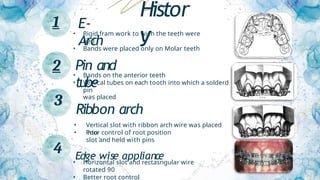
E-
Arch
1
• Rigid fram work to wich the teeth were
tied .
• Bands were placed only on Molar teeth
Pin and
tube
2
3
• Bands on the anterior teeth
• Vertical tubes on each tooth into which a solderd
pin
was placed
Ribbon arch
• Vertical slot with ribbon arch wire was placed
into
slot and held with pins
• Poor control of root position
`
Edge wise appliance
4
• Horizontal slot and rectasngular wire
rotated 90
• Better root control
Histor
y
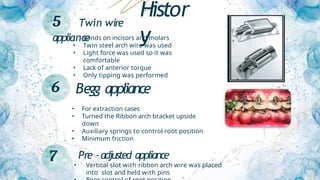
5 Twin wire
appliance
• Bands on incisors and molars
• Twin steel arch wire was used
• Light force was used so it was
comfortable
• Lack of anterior torque
• Only tipping was performed
6 Begg appliance
• For extraction cases
• Turned the Ribbon arch bracket upside
down
• Auxiliary springs to control root position
• Minimum friction
7 Pre –adjusted appliance
• Vertical slot with ribbon arch wire was placed
into slot and held with pins
Histor
y
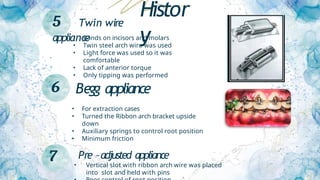
5 Twin wire
appliance
• Bands on incisors and molars
• Twin steel arch wire was used
• Light force was used so it was
comfortable
• Lack of anterior torque
• Only tipping was performed
6 Begg appliance
• For extraction cases
• Turned the Ribbon arch bracket upside
down
• Auxiliary springs to control root position
• Minimum friction
7 Pre –adjusted appliance
• Vertical slot with ribbon arch wire was placed
into slot and held with pins
Histor
y
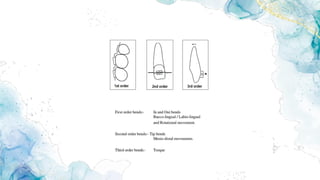
Order Bends
: • First order bends:- In and Out bends (Bucco-
lingual / Labio-lingual) (Rotational movement)
• Second order bends:- Tip bends (Mesiodistal
movements)
• Third order bends:- Torque
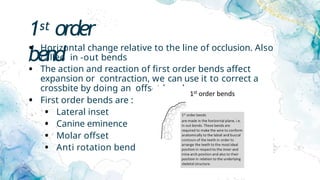
1st order
bend
• Horizontal change relative to the line of occlusion. Also
called in -out bends
• The action and reaction of first order bends affect
expansion or contraction, we can use it to correct a
crossbite by doing an offset bend
• First order bends are :
• Lateral inset
• Canine eminence
• Molar offset
• Anti rotation bend
1st order
bend
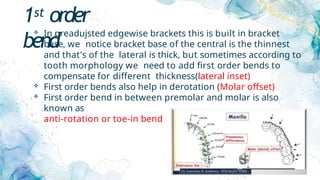
 In preadujsted edgewise brackets this is built in bracket
base, we notice bracket base of the central is the thinnest
and that's of the lateral is thick, but sometimes according to
tooth morphology we need to add first order bends to
compensate for different thickness(lateral inset)
 First order bends also help in derotation (Molar offset)
 First order bend in between premolar and molar is also
known as
anti-rotation or toe-in bend
Second order
Bend:
• Bends in the occluso-gingival direction to maintain the
final angulation of teeth.
• Represent a vertical change
• In the incisal area, second order bends (artistic bends)
provide the ideal angulation to these teeth.
• In posterior region, second order bends maintain the
distal tipping of the pre-molars and
molars( anchorage)
Second order
Bend
• Second order bends can be used as :
• aid in paralleling roots adjacent to extraction
spaces.
• one method of setting up posterior anchorage.
• As a mean of artistically positioning teeth.
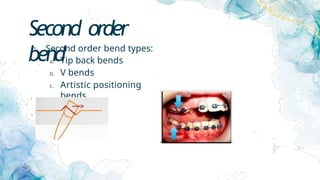
Second order
bend
• Second order bend types:
a. Tip back bends
b. V bends
c. Artistic positioning
bends
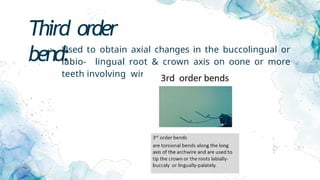
Third order
bend:
• Used to obtain axial changes in the buccolingual or
labio- lingual root & crown axis on oone or more
teeth involving wire twisting
Andrews six keys of normal
occlusion
• Observed in a study of 120 casts of non-
orthodontic patients with normal occlusion:
1. Molar relationship
2. Crown angulations
3. Crown inclination
4. No Rotations
5. Tight contact
6. Occlusal plan (curve of spee)
Key 1 molar
relationship
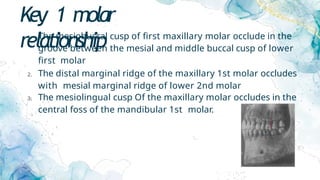
1. The mesiobuccal cusp of first maxillary molar occlude in the
groove between the mesial and middle buccal cusp of lower
first molar
2. The distal marginal ridge of the maxillary 1st molar occludes
with mesial marginal ridge of lower 2nd molar
3. The mesiolingual cusp Of the maxillary molar occludes in the
central foss of the mandibular 1st molar.
KEY 2: Crown
angulation :
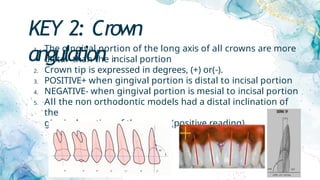
1. The gingival portion of the long axis of all crowns are more
distal than the incisal portion
2. Crown tip is expressed in degrees, (+) or(-).
3. POSITIVE+ when gingival portion is distal to incisal portion
4. NEGATIVE- when gingival portion is mesial to incisal portion
5. All the non orthodontic models had a distal inclination of
the
gingival portion of the crown.(positive reading)
KEY 3- Crown
inclination
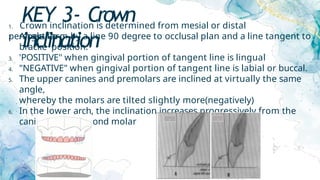
1. Crown inclination is determined from mesial or distal
perspective
2. Angle form by a line 90 degree to occlusal plan and a line tangent to
bracke position.
3. 'POSITIVE" when gingival portion of tangent line is lingual
4. "NEGATIVE" when gingival portion of tangent line is labial or buccal.
5. The upper canines and premolars are inclined at virtually the same
angle,
whereby the molars are tilted slightly more(negatively)
6. In the lower arch, the inclination increases progressively from the
canine to the second molar
Tip and
torque :
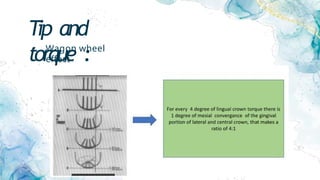
• Wagon wheel
effect :
Key 4- No
rotation :
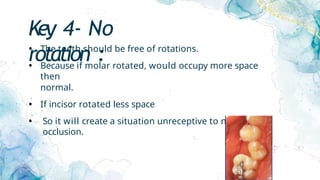
• The teeth should be free of rotations.
• Because if molar rotated, would occupy more space
then
normal.
• If incisor rotated less space
• So it will create a situation unreceptive to normal
occlusion.
Key 5 tight contact – no
spacing :
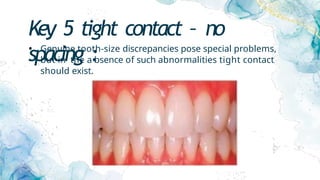
• Genuine tooth-size discrepancies pose special problems,
but in the a bsence of such abnormalities tight contact
should exist.
Key 6 -occlusal
plan :
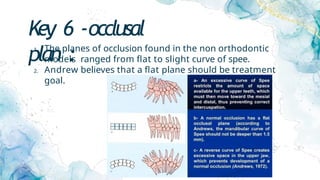
1. The planes of occlusion found in the non orthodontic
models ranged from flat to slight curve of spee.
2. Andrew believes that a flat plane should be treatment
goal.
Pre adjusted
appliance
Was dwsigned to achieve high quality
orthodontic results with minimal wire
bending
Charactristics of pre adjusted
appliance
• Variation in Bracket base
thickness:
1. Canine bracket base should be thin to bring the
labial surface close to the arch wire.
2. The bracket base for lateral incisors should be
quite thick
3. For the central incisor the base is intermediate .
4. For mandibular arch intermediate thickness is used
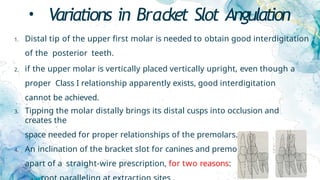
• Variations in Bracket Slot Angulation
1. Distal tip of the upper first molar is needed to obtain good interdigitation
of the posterior teeth.
2. if the upper molar is vertically placed vertically upright, even though a
proper Class I relationship apparently exists, good interdigitation
cannot be achieved.
3. Tipping the molar distally brings its distal cusps into occlusion and
creates the
space needed for proper relationships of the premolars.
4. An inclination of the bracket slot for canines and premolars is
apart of a straight-wire prescription, for two reasons:
Bracket
prescriptions
 For all prescriptions, the prominence values (in-out first order
bend) are
the same and so the only variables within a prescription are :
 Angulation
 Inclination
 Offset(counter – rotation)
 Prominence
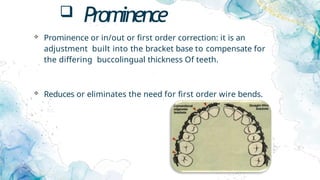
 Prominence or in/out or first order correction: it is an
adjustment built into the bracket base to compensate for
the differing buccolingual thickness Of teeth.
 Reduces or eliminates the need for first order wire bends.
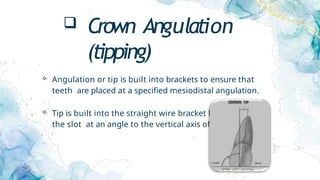
 Crown Angulation
(tipping)
 Angulation or tip is built into brackets to ensure that
teeth are placed at a specified mesiodistal angulation.
 Tip is built into the straight wire bracket by cutting
the slot at an angle to the vertical axis of the bracket.
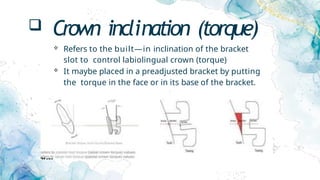
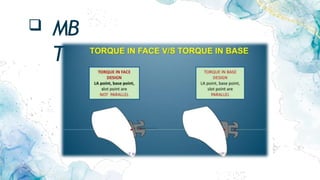
 Crown inclination (torque)
 Refers to the built—in inclination of the bracket
slot to control labiolingual crown (torque)
 It maybe placed in a preadjusted bracket by putting
the torque in the face or in its base of the bracket.
 Offset (counter- rotation)
 Offset (also known as counter-rotation in translation
series brackets) is built into upper buccal tube
assemblies, premolar, canine, incisor brackets and
lower molar tubes in translation series prescriptions
to counteract the tendency Of teeth to tip into the
extraction space during space closure.
 This rotational correction tends to rotate teeth mesially
anterior to the extraction site and distally distal to it
Generations of pre adjusted
appliance
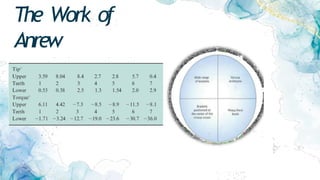
The Work of
Anrew
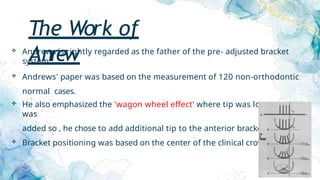
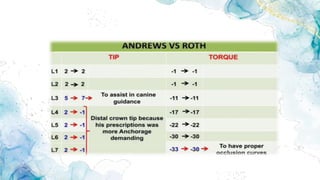
 Andrews is rightly regarded as the father of the pre- adjusted bracket
system.
 Andrews' paper was based on the measurement of 120 non-orthodontic
normal cases.
 He also emphasized the 'wagon wheel effect' where tip was lost as torque
was
added so , he chose to add additional tip to the anterior brackets.
 Bracket positioning was based on the center of the clinical crown.
The Work of
Anrew
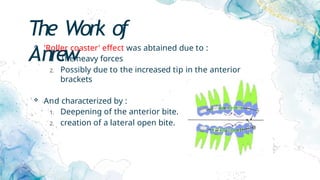
 'Roller coaster' effect was abtained due to :
1. The heavy forces
2. Possibly due to the increased tip in the anterior
brackets
 And characterized by :
1. Deepening of the anterior bite.
2. creation of a lateral open bite.
The Work of
Anrew
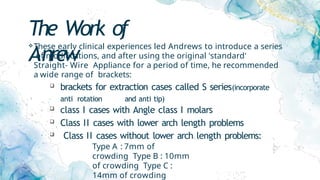
These early clinical experiences led Andrews to introduce a series
of modifications, and after using the original 'standard'
Straight- Wire Appliance for a period of time, he recommended
a wide range of brackets:
 brackets for extraction cases called S series(incorporate
anti rotation and anti tip)
 class I cases with Angle class I molars
 Class II cases with lower arch length problems
 Class II cases without lower arch length problems:
Type A : 7mm of
crowding Type B : 10mm
of crowding Type C :
14mm of crowding
The Work of
Anrew
The work of
Roth:
 Roth was anxious to avoid the inventory difficulties of a multiple
bracket system
 He therefore recommended a single appliance system, consisting
primarily of minimum extraction series brackets, which he felt
would
allow him to manage both extraction and non-extraction cases.
 This has been described as the second generation of pre- adjusted
brackets
 The Roth treatment approach emphasized the use of articulators.
 This approach was used to aid in establishing correct condyle
position
The work of
Roth :
 His purpose was to produce over correction of the teeth
position.
 He proposed increasing the tip for the canine bracket to
facilitate canine guidance.
 He added distal crown tip on the lower buccal segment for
anchorage demanding .
 In addition to have more tip and torqu in the anterior region
, he
also intended to increase upper molar torque to prevent the
palatal cusp dropping .
What made Roth to modify Andrews SW
appliance ?
1. Inventory problems:
 To treat many cases clinicians have to buy many series
of kits
2. Anchorage loss :
 When mesially angulated brackets are placed on the
posterior teeth ,the teeth tend to tip mesially and
migrate forward leeding to anchorage loss
3. Problem in finishing
 To achieve desired tooth positions with the standard
SWA,
it was necessary to finish the mechanotherapyphase
oftreatment byplacing compensating and reverse
curve in the upper and lower arch wire
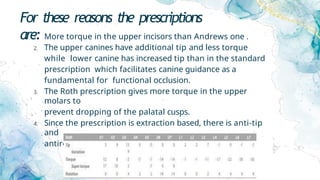
For these reasons the prescriptions
are:
1. More torque in the upper incisors than Andrews one .
2. The upper canines have additional tip and less torque
while lower canine has increased tip than in the standard
prescription which facilitates canine guidance as a
fundamental for functional occlusion.
3. The Roth prescription gives more torque in the upper
molars to
prevent dropping of the palatal cusps.
4. Since the prescription is extraction based, there is anti-tip
and
antirotation built into the buccal segment brackets.
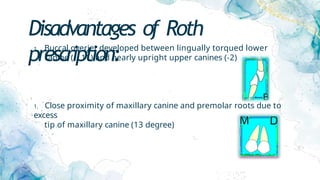
Disadvantages of Roth
prescription:
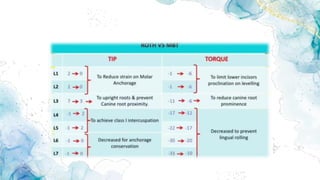
1. Buccal overjet developed between lingually torqued lower
canine (- 11) and nearly upright upper canines (-2)
1. Close proximity of maxillary canine and premolar roots due to
excess
tip of maxillary canine (13 degree)
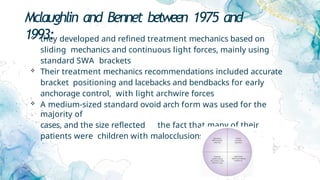
Mclaughlin and Bennet between 1975 and
1993:
 they developed and refined treatment mechanics based on
sliding mechanics and continuous light forces, mainly using
standard SWA brackets
 Their treatment mechanics recommendations included accurate
bracket positioning and lacebacks and bendbacks for early
anchorage control, with light archwire forces
 A medium-sized standard ovoid arch form was used for the
majority of
cases, and the size reflected the fact that many of their
patients were children with malocclusions.
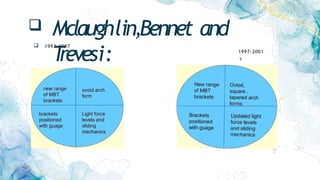
 Mclaughlin,Bennet and
T
revesi:
 1993-1997
1997-2001

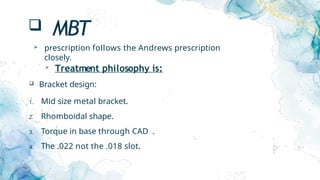
 MBT
 prescription follows the Andrews prescription
closely.
 Treatment philosophy is:
 Bracket design:
1. Mid size metal bracket.
2. Rhomboidal shape.
3. Torque in base through CAD .
4. The .022 not the .018 slot.
 MB
T
 MBT
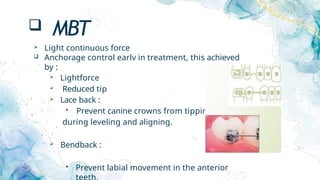
 Light continuous force
 Anchorage control earlv in treatment, this achieved
by :
 Lightforce
 Reduced tip
 Lace back :
 Prevent canine crowns from tipping
during leveling and aligning.
 Bendback :
 Prevent labial movement in the anterior
teeth.
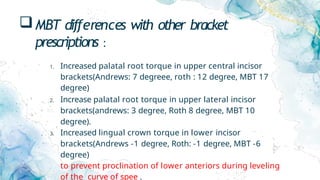
MBT differences with other bracket
prescriptions :
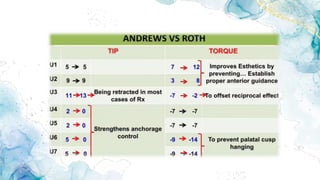
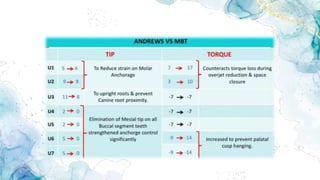
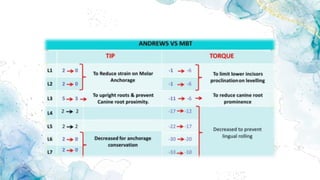
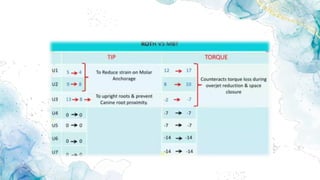
1. Increased palatal root torque in upper central incisor
brackets(Andrews: 7 degreee, roth : 12 degree, MBT 17
degree)
2. Increase palatal root torque in upper lateral incisor
brackets(andrews: 3 degree, Roth 8 degree, MBT 10
degree).
3. Increased lingual crown torque in lower incisor
brackets(Andrews -1 degree, Roth: -1 degree, MBT -6
degree)
to prevent proclination of lower anteriors during leveling
of the curve of spee .
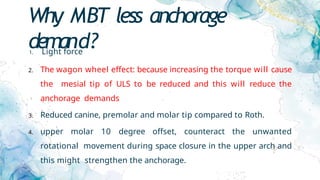
Why MBT less anchorage
demand?
1. Light force
2. The wagon wheel effect: because increasing the torque will cause
the mesial tip of ULS to be reduced and this will reduce the
anchorage demands
3. Reduced canine, premolar and molar tip compared to Roth.
4. upper molar 10 degree offset, counteract the unwanted
rotational movement during space closure in the upper arch and
this might strengthen the anchorage.
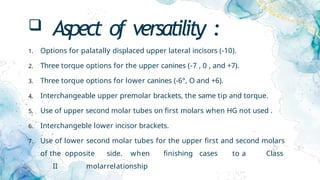
 Aspect of versatility :
1. Options for palatally displaced upper lateral incisors (-10).
2. Three torque options for the upper canines (-7 , 0 , and +7).
3. Three torque options for lower canines (-6°, O and +6).
4. Interchangeable upper premolar brackets, the same tip and torque.
5. Use of upper second molar tubes on first molars when HG not used .
6. Interchangeble lower incisor brackets.
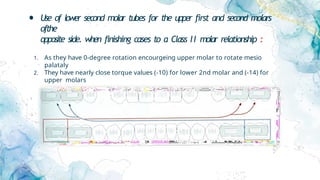
7. Use of lower second molar tubes for the upper first and second molars
of the opposite side. when finishing cases to a Class
II molarrelationship
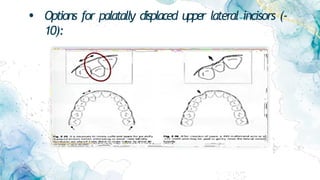
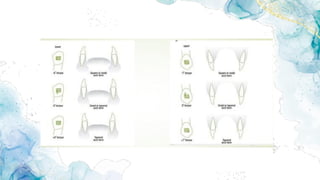
• Options for palatally displaced upper lateral incisors (-
10):
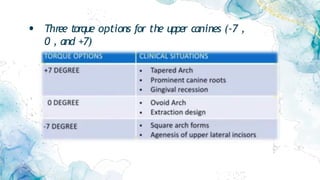
• Three torque options for the upper canines (-7 ,
0 , and +7)
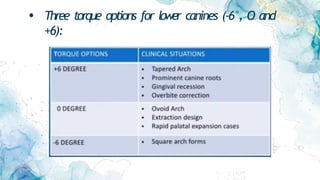
• Three torque options for lower canines (-6°, O and
+6):
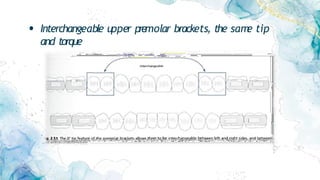
• Interchangeable upper premolar brackets, the sam
e tip
and torque
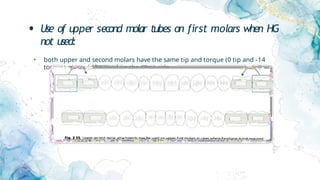
• Use of upper second molar tubes on first molars when HG
not used:
• both upper and second molars have the same tip and torque (0 tip and -14
torque) so could be used on the same side.
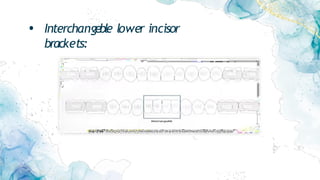
• Interchangeble lower incisor
brackets:
• Use of lower second molar tubes for the upper first and second molars
ofthe
opposite side. when finishing cases to a Class II molar relationship :
1. As they have 0-degree rotation encourgeing upper molar to rotate mesio
palataly
2. They have nearly close torque values (-10) for lower 2nd molar and (-14) for
upper molars
Hybridyzatio
n
 Hybrid bracket
prescrirption :
1. Flibbing
2. Switching
3. Swapping
4. Blending
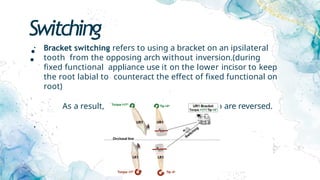
Switching
:
• Bracket switching refers to using a bracket on an ipsilateral
tooth from the opposing arch without inversion.(during
fixed functional appliance use it on the lower incisor to keep
the root labial to counteract the effect of fixed functional on
root)
As a result, the built-in torque and the tip are reversed.
•
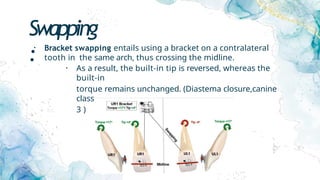
Swapping
:
• Bracket swapping entails using a bracket on a contralateral
tooth in the same arch, thus crossing the midline.
• As a result, the built-in tip is reversed, whereas the
built-in
torque remains unchanged. (Diastema closure,canine
class
3 )
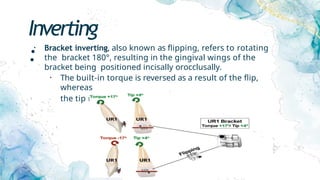
Inverting
:
• Bracket inverting, also known as flipping, refers to rotating
the bracket 180°, resulting in the gingival wings of the
bracket being positioned incisally orocclusally.
• The built-in torque is reversed as a result of the flip,
whereas
the tip remains unchanged. (canine versatility)
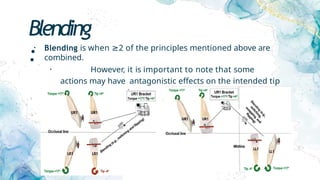
Blending
:
• Blending is when 2
≥ of the principles mentioned above are
combined.
• However, it is important to note that some
actions may have antagonistic effects on the intended tip
or torque expressions.
Bracket
variations:
1. Class II division 1 malocclusion with lateral incisors
palatally displaced;
2. Absent lateral incisor: space closure;
3. Class III malocclusions: canine angulation;
4. palatally displaced canine: labial movement;
5. Absent upper central incisors: space closure;
6. Class III: incisor inclination.
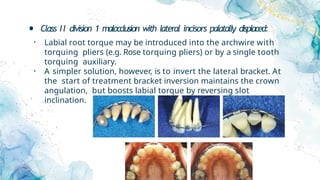
• Class II division 1 malocclusion with lateral incisors palatally displaced:
• Labial root torque may be introduced into the archwire with
torquing pliers (e.g. Rose torquing pliers) or by a single tooth
torquing auxiliary.
• A simpler solution, however, is to invert the lateral bracket. At
the start of treatment bracket inversion maintains the crown
angulation, but boosts labial torque by reversing slot
inclination.
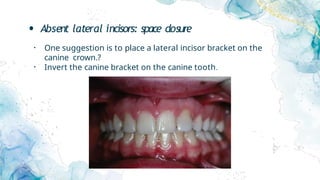
• Absent lateral incisors: space closure
• One suggestion is to place a lateral incisor bracket on the
canine crown.?
• Invert the canine bracket on the canine tooth.
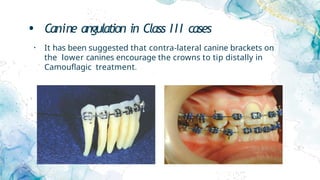
• Canine angulation in Class III cases
• It has been suggested that contra-lateral canine brackets on
the lower canines encourage the crowns to tip distally in
Camouflagic treatment.
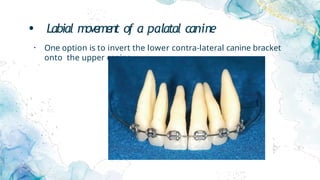
• Labial movement of a palatal canine
• One option is to invert the lower contra-lateral canine bracket
onto the upper canine.
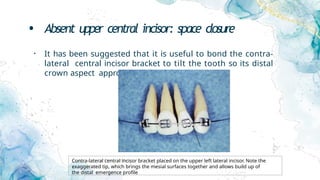
• Absent upper central incisor: space closure
• It has been suggested that it is useful to bond the contra-
lateral central incisor bracket to tilt the tooth so its distal
crown aspect approaches vertical.
Contra-lateral central incisor bracket placed on the upper left lateral incisor. Note the
exaggerated tip, which brings the mesial surfaces together and allows build up of
the distal emergence profile
Incisor inclination in Class III
malocclusions:
• When Class III malocclusions are treated orthodontically the
upper incisors tend to be proclined as the malocclusion is
camouflaged. Subtelny and Catania advocated the use of
labial root torque and tying the archwire forward to advance
‘A’ point and boost anteroposterior arch length.
• The possibility exists to invert incisor brackets and use these
to provide labial root torque, which may be useful in some
selected cases.
T
ake home
message…
1. During fixed appliance treatment : switch the upper incisor bracket
to the lower incisor.
2. Blocked in upper lateral incisors: flip the lateral incisor bracket .
3. Lingual inclined upper canine : invert the lower contra-lateral canine
bracket onto the upper canine.
4. Canine angulation in class 3 cases: swapping for both Brackets.
5. Missed upper lateral incisor : Invert the canine bracket on the canine tooth.
6. Midline diastema : swapping for both Brackets.
7. Missed upper central incisor: bond the contra-lateral central incisor
bracket on lateral incisor.
References.
.
1. Systemized Orthodontic Treatment Mechanics text book
2. Almuzian M, Khan H, El-Bokle D. The hybrid setup of the labial fixed orthodontic appliance.
AJO-DO Clinical Companion. 2022;2:136-44.
3. Thickett E, Taylor N, Hodge T. Choosing a pre-adjusted orthodontic appliance prescription for
anterior teeth. J.Orthod. 2007;34:95-100.
Thank
you..

Bracket prescription and hybirdization.pptx

  • 1.
    By: Mohamed RabeaZain Al Abdeen BDS 2019, faculty oƒ Dentistry Al azhar university (Assuit) Bracket prescription and hybridization
  • 2.
    Content :1. History 2. Straightwire appliance 3. Orderbends of orthodontics 4. Six keys of normal occlusion 5. Work of Andrew 6. Work of Ruth 7. Work of MBT 8. MBT versatility 9. Hyberdization
  • 3.
    E- Arch 1 • Rigid framwork to wich the teeth were tied . • Bands were placed only on Molar teeth Pin and tube 2 3 • Bands on the anterior teeth • Vertical tubes on each tooth into which a solderd pin was placed Ribbon arch • Vertical slot with ribbon arch wire was placed into slot and held with pins • Poor control of root position ` Edge wise appliance 4 • Horizontal slot and rectasngular wire rotated 90 • Better root control Histor y
  • 4.
    5 Twin wire appliance •Bands on incisors and molars • Twin steel arch wire was used • Light force was used so it was comfortable • Lack of anterior torque • Only tipping was performed 6 Begg appliance • For extraction cases • Turned the Ribbon arch bracket upside down • Auxiliary springs to control root position • Minimum friction 7 Pre –adjusted appliance • Vertical slot with ribbon arch wire was placed into slot and held with pins Histor y
  • 5.
    5 Twin wire appliance •Bands on incisors and molars • Twin steel arch wire was used • Light force was used so it was comfortable • Lack of anterior torque • Only tipping was performed 6 Begg appliance • For extraction cases • Turned the Ribbon arch bracket upside down • Auxiliary springs to control root position • Minimum friction 7 Pre –adjusted appliance • Vertical slot with ribbon arch wire was placed into slot and held with pins Histor y
  • 6.
    Order Bends : •First order bends:- In and Out bends (Bucco- lingual / Labio-lingual) (Rotational movement) • Second order bends:- Tip bends (Mesiodistal movements) • Third order bends:- Torque
  • 7.
    1st order bend • Horizontalchange relative to the line of occlusion. Also called in -out bends • The action and reaction of first order bends affect expansion or contraction, we can use it to correct a crossbite by doing an offset bend • First order bends are : • Lateral inset • Canine eminence • Molar offset • Anti rotation bend
  • 8.
    1st order bend  Inpreadujsted edgewise brackets this is built in bracket base, we notice bracket base of the central is the thinnest and that's of the lateral is thick, but sometimes according to tooth morphology we need to add first order bends to compensate for different thickness(lateral inset)  First order bends also help in derotation (Molar offset)  First order bend in between premolar and molar is also known as anti-rotation or toe-in bend
  • 9.
    Second order Bend: • Bendsin the occluso-gingival direction to maintain the final angulation of teeth. • Represent a vertical change • In the incisal area, second order bends (artistic bends) provide the ideal angulation to these teeth. • In posterior region, second order bends maintain the distal tipping of the pre-molars and molars( anchorage)
  • 10.
    Second order Bend • Secondorder bends can be used as : • aid in paralleling roots adjacent to extraction spaces. • one method of setting up posterior anchorage. • As a mean of artistically positioning teeth.
  • 11.
    Second order bend • Secondorder bend types: a. Tip back bends b. V bends c. Artistic positioning bends
  • 12.
    Third order bend: • Usedto obtain axial changes in the buccolingual or labio- lingual root & crown axis on oone or more teeth involving wire twisting
  • 14.
    Andrews six keysof normal occlusion • Observed in a study of 120 casts of non- orthodontic patients with normal occlusion: 1. Molar relationship 2. Crown angulations 3. Crown inclination 4. No Rotations 5. Tight contact 6. Occlusal plan (curve of spee)
  • 15.
    Key 1 molar relationship 1.The mesiobuccal cusp of first maxillary molar occlude in the groove between the mesial and middle buccal cusp of lower first molar 2. The distal marginal ridge of the maxillary 1st molar occludes with mesial marginal ridge of lower 2nd molar 3. The mesiolingual cusp Of the maxillary molar occludes in the central foss of the mandibular 1st molar.
  • 16.
    KEY 2: Crown angulation: 1. The gingival portion of the long axis of all crowns are more distal than the incisal portion 2. Crown tip is expressed in degrees, (+) or(-). 3. POSITIVE+ when gingival portion is distal to incisal portion 4. NEGATIVE- when gingival portion is mesial to incisal portion 5. All the non orthodontic models had a distal inclination of the gingival portion of the crown.(positive reading)
  • 17.
    KEY 3- Crown inclination 1.Crown inclination is determined from mesial or distal perspective 2. Angle form by a line 90 degree to occlusal plan and a line tangent to bracke position. 3. 'POSITIVE" when gingival portion of tangent line is lingual 4. "NEGATIVE" when gingival portion of tangent line is labial or buccal. 5. The upper canines and premolars are inclined at virtually the same angle, whereby the molars are tilted slightly more(negatively) 6. In the lower arch, the inclination increases progressively from the canine to the second molar
  • 18.
    Tip and torque : •Wagon wheel effect :
  • 19.
    Key 4- No rotation: • The teeth should be free of rotations. • Because if molar rotated, would occupy more space then normal. • If incisor rotated less space • So it will create a situation unreceptive to normal occlusion.
  • 20.
    Key 5 tightcontact – no spacing : • Genuine tooth-size discrepancies pose special problems, but in the a bsence of such abnormalities tight contact should exist.
  • 21.
    Key 6 -occlusal plan: 1. The planes of occlusion found in the non orthodontic models ranged from flat to slight curve of spee. 2. Andrew believes that a flat plane should be treatment goal.
  • 22.
    Pre adjusted appliance Was dwsignedto achieve high quality orthodontic results with minimal wire bending
  • 23.
    Charactristics of preadjusted appliance
  • 24.
    • Variation inBracket base thickness: 1. Canine bracket base should be thin to bring the labial surface close to the arch wire. 2. The bracket base for lateral incisors should be quite thick 3. For the central incisor the base is intermediate . 4. For mandibular arch intermediate thickness is used
  • 25.
    • Variations inBracket Slot Angulation 1. Distal tip of the upper first molar is needed to obtain good interdigitation of the posterior teeth. 2. if the upper molar is vertically placed vertically upright, even though a proper Class I relationship apparently exists, good interdigitation cannot be achieved. 3. Tipping the molar distally brings its distal cusps into occlusion and creates the space needed for proper relationships of the premolars. 4. An inclination of the bracket slot for canines and premolars is apart of a straight-wire prescription, for two reasons:
  • 26.
    Bracket prescriptions  For allprescriptions, the prominence values (in-out first order bend) are the same and so the only variables within a prescription are :  Angulation  Inclination  Offset(counter – rotation)
  • 27.
     Prominence  Prominenceor in/out or first order correction: it is an adjustment built into the bracket base to compensate for the differing buccolingual thickness Of teeth.  Reduces or eliminates the need for first order wire bends.
  • 28.
     Crown Angulation (tipping) Angulation or tip is built into brackets to ensure that teeth are placed at a specified mesiodistal angulation.  Tip is built into the straight wire bracket by cutting the slot at an angle to the vertical axis of the bracket.
  • 29.
     Crown inclination(torque)  Refers to the built—in inclination of the bracket slot to control labiolingual crown (torque)  It maybe placed in a preadjusted bracket by putting the torque in the face or in its base of the bracket.
  • 30.
     Offset (counter-rotation)  Offset (also known as counter-rotation in translation series brackets) is built into upper buccal tube assemblies, premolar, canine, incisor brackets and lower molar tubes in translation series prescriptions to counteract the tendency Of teeth to tip into the extraction space during space closure.  This rotational correction tends to rotate teeth mesially anterior to the extraction site and distally distal to it
  • 31.
    Generations of preadjusted appliance
  • 32.
    The Work of Anrew Andrews is rightly regarded as the father of the pre- adjusted bracket system.  Andrews' paper was based on the measurement of 120 non-orthodontic normal cases.  He also emphasized the 'wagon wheel effect' where tip was lost as torque was added so , he chose to add additional tip to the anterior brackets.  Bracket positioning was based on the center of the clinical crown.
  • 33.
    The Work of Anrew 'Roller coaster' effect was abtained due to : 1. The heavy forces 2. Possibly due to the increased tip in the anterior brackets  And characterized by : 1. Deepening of the anterior bite. 2. creation of a lateral open bite.
  • 34.
    The Work of Anrew Theseearly clinical experiences led Andrews to introduce a series of modifications, and after using the original 'standard' Straight- Wire Appliance for a period of time, he recommended a wide range of brackets:  brackets for extraction cases called S series(incorporate anti rotation and anti tip)  class I cases with Angle class I molars  Class II cases with lower arch length problems  Class II cases without lower arch length problems: Type A : 7mm of crowding Type B : 10mm of crowding Type C : 14mm of crowding
  • 35.
  • 36.
    The work of Roth: Roth was anxious to avoid the inventory difficulties of a multiple bracket system  He therefore recommended a single appliance system, consisting primarily of minimum extraction series brackets, which he felt would allow him to manage both extraction and non-extraction cases.  This has been described as the second generation of pre- adjusted brackets  The Roth treatment approach emphasized the use of articulators.  This approach was used to aid in establishing correct condyle position
  • 37.
    The work of Roth:  His purpose was to produce over correction of the teeth position.  He proposed increasing the tip for the canine bracket to facilitate canine guidance.  He added distal crown tip on the lower buccal segment for anchorage demanding .  In addition to have more tip and torqu in the anterior region , he also intended to increase upper molar torque to prevent the palatal cusp dropping .
  • 38.
    What made Rothto modify Andrews SW appliance ? 1. Inventory problems:  To treat many cases clinicians have to buy many series of kits 2. Anchorage loss :  When mesially angulated brackets are placed on the posterior teeth ,the teeth tend to tip mesially and migrate forward leeding to anchorage loss 3. Problem in finishing  To achieve desired tooth positions with the standard SWA, it was necessary to finish the mechanotherapyphase oftreatment byplacing compensating and reverse curve in the upper and lower arch wire
  • 39.
    For these reasonsthe prescriptions are: 1. More torque in the upper incisors than Andrews one . 2. The upper canines have additional tip and less torque while lower canine has increased tip than in the standard prescription which facilitates canine guidance as a fundamental for functional occlusion. 3. The Roth prescription gives more torque in the upper molars to prevent dropping of the palatal cusps. 4. Since the prescription is extraction based, there is anti-tip and antirotation built into the buccal segment brackets.
  • 40.
    Disadvantages of Roth prescription: 1.Buccal overjet developed between lingually torqued lower canine (- 11) and nearly upright upper canines (-2) 1. Close proximity of maxillary canine and premolar roots due to excess tip of maxillary canine (13 degree)
  • 43.
    Mclaughlin and Bennetbetween 1975 and 1993:  they developed and refined treatment mechanics based on sliding mechanics and continuous light forces, mainly using standard SWA brackets  Their treatment mechanics recommendations included accurate bracket positioning and lacebacks and bendbacks for early anchorage control, with light archwire forces  A medium-sized standard ovoid arch form was used for the majority of cases, and the size reflected the fact that many of their patients were children with malocclusions.
  • 44.
  • 45.
     MBT  prescriptionfollows the Andrews prescription closely.  Treatment philosophy is:  Bracket design: 1. Mid size metal bracket. 2. Rhomboidal shape. 3. Torque in base through CAD . 4. The .022 not the .018 slot.
  • 46.
  • 47.
     MBT  Lightcontinuous force  Anchorage control earlv in treatment, this achieved by :  Lightforce  Reduced tip  Lace back :  Prevent canine crowns from tipping during leveling and aligning.  Bendback :  Prevent labial movement in the anterior teeth.
  • 48.
    MBT differences withother bracket prescriptions : 1. Increased palatal root torque in upper central incisor brackets(Andrews: 7 degreee, roth : 12 degree, MBT 17 degree) 2. Increase palatal root torque in upper lateral incisor brackets(andrews: 3 degree, Roth 8 degree, MBT 10 degree). 3. Increased lingual crown torque in lower incisor brackets(Andrews -1 degree, Roth: -1 degree, MBT -6 degree) to prevent proclination of lower anteriors during leveling of the curve of spee .
  • 53.
    Why MBT lessanchorage demand? 1. Light force 2. The wagon wheel effect: because increasing the torque will cause the mesial tip of ULS to be reduced and this will reduce the anchorage demands 3. Reduced canine, premolar and molar tip compared to Roth. 4. upper molar 10 degree offset, counteract the unwanted rotational movement during space closure in the upper arch and this might strengthen the anchorage.
  • 54.
     Aspect ofversatility : 1. Options for palatally displaced upper lateral incisors (-10). 2. Three torque options for the upper canines (-7 , 0 , and +7). 3. Three torque options for lower canines (-6°, O and +6). 4. Interchangeable upper premolar brackets, the same tip and torque. 5. Use of upper second molar tubes on first molars when HG not used . 6. Interchangeble lower incisor brackets. 7. Use of lower second molar tubes for the upper first and second molars of the opposite side. when finishing cases to a Class II molarrelationship
  • 55.
    • Options forpalatally displaced upper lateral incisors (- 10):
  • 56.
    • Three torqueoptions for the upper canines (-7 , 0 , and +7)
  • 57.
    • Three torqueoptions for lower canines (-6°, O and +6):
  • 59.
    • Interchangeable upperpremolar brackets, the sam e tip and torque
  • 60.
    • Use ofupper second molar tubes on first molars when HG not used: • both upper and second molars have the same tip and torque (0 tip and -14 torque) so could be used on the same side.
  • 61.
    • Interchangeble lowerincisor brackets:
  • 62.
    • Use oflower second molar tubes for the upper first and second molars ofthe opposite side. when finishing cases to a Class II molar relationship : 1. As they have 0-degree rotation encourgeing upper molar to rotate mesio palataly 2. They have nearly close torque values (-10) for lower 2nd molar and (-14) for upper molars
  • 63.
  • 64.
     Hybrid bracket prescrirption: 1. Flibbing 2. Switching 3. Swapping 4. Blending
  • 65.
    Switching : • Bracket switchingrefers to using a bracket on an ipsilateral tooth from the opposing arch without inversion.(during fixed functional appliance use it on the lower incisor to keep the root labial to counteract the effect of fixed functional on root) As a result, the built-in torque and the tip are reversed. •
  • 66.
    Swapping : • Bracket swappingentails using a bracket on a contralateral tooth in the same arch, thus crossing the midline. • As a result, the built-in tip is reversed, whereas the built-in torque remains unchanged. (Diastema closure,canine class 3 )
  • 67.
    Inverting : • Bracket inverting,also known as flipping, refers to rotating the bracket 180°, resulting in the gingival wings of the bracket being positioned incisally orocclusally. • The built-in torque is reversed as a result of the flip, whereas the tip remains unchanged. (canine versatility)
  • 68.
    Blending : • Blending iswhen 2 ≥ of the principles mentioned above are combined. • However, it is important to note that some actions may have antagonistic effects on the intended tip or torque expressions.
  • 69.
    Bracket variations: 1. Class IIdivision 1 malocclusion with lateral incisors palatally displaced; 2. Absent lateral incisor: space closure; 3. Class III malocclusions: canine angulation; 4. palatally displaced canine: labial movement; 5. Absent upper central incisors: space closure; 6. Class III: incisor inclination.
  • 70.
    • Class IIdivision 1 malocclusion with lateral incisors palatally displaced: • Labial root torque may be introduced into the archwire with torquing pliers (e.g. Rose torquing pliers) or by a single tooth torquing auxiliary. • A simpler solution, however, is to invert the lateral bracket. At the start of treatment bracket inversion maintains the crown angulation, but boosts labial torque by reversing slot inclination.
  • 71.
    • Absent lateralincisors: space closure • One suggestion is to place a lateral incisor bracket on the canine crown.? • Invert the canine bracket on the canine tooth.
  • 72.
    • Canine angulationin Class III cases • It has been suggested that contra-lateral canine brackets on the lower canines encourage the crowns to tip distally in Camouflagic treatment.
  • 73.
    • Labial movementof a palatal canine • One option is to invert the lower contra-lateral canine bracket onto the upper canine.
  • 74.
    • Absent uppercentral incisor: space closure • It has been suggested that it is useful to bond the contra- lateral central incisor bracket to tilt the tooth so its distal crown aspect approaches vertical. Contra-lateral central incisor bracket placed on the upper left lateral incisor. Note the exaggerated tip, which brings the mesial surfaces together and allows build up of the distal emergence profile
  • 75.
    Incisor inclination inClass III malocclusions: • When Class III malocclusions are treated orthodontically the upper incisors tend to be proclined as the malocclusion is camouflaged. Subtelny and Catania advocated the use of labial root torque and tying the archwire forward to advance ‘A’ point and boost anteroposterior arch length. • The possibility exists to invert incisor brackets and use these to provide labial root torque, which may be useful in some selected cases.
  • 76.
    T ake home message… 1. Duringfixed appliance treatment : switch the upper incisor bracket to the lower incisor. 2. Blocked in upper lateral incisors: flip the lateral incisor bracket . 3. Lingual inclined upper canine : invert the lower contra-lateral canine bracket onto the upper canine. 4. Canine angulation in class 3 cases: swapping for both Brackets. 5. Missed upper lateral incisor : Invert the canine bracket on the canine tooth. 6. Midline diastema : swapping for both Brackets. 7. Missed upper central incisor: bond the contra-lateral central incisor bracket on lateral incisor.
  • 77.
    References. . 1. Systemized OrthodonticTreatment Mechanics text book 2. Almuzian M, Khan H, El-Bokle D. The hybrid setup of the labial fixed orthodontic appliance. AJO-DO Clinical Companion. 2022;2:136-44. 3. Thickett E, Taylor N, Hodge T. Choosing a pre-adjusted orthodontic appliance prescription for anterior teeth. J.Orthod. 2007;34:95-100.
  • 78.