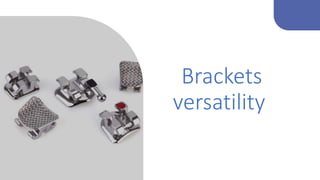
Brackets
versatility
Brackets versatility
• It's the range of bracket prescription manipulation or the play
concept (how the bracket play to get the movement we need)
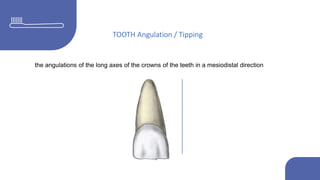
TOOTH Angulation / Tipping
the angulations of the long axes of the crowns of the teeth in a mesiodistal direction
TOOTH Angulation / Tipping
the angulations of the long axes of the crowns of the teeth in a mesiodistal
direction
Mesial tip : + value
TOOTH Angulation / Tipping
the angulations of the long axes of the crowns of the teeth in a mesiodistal direction
Distal tip : - value
Tooth Angulation/Tipping
• The long axis of the clinical
crown is measured from a
line at 90 degrees to the
occlusal plane
90
º
-
11
º
-
9º
-
5º
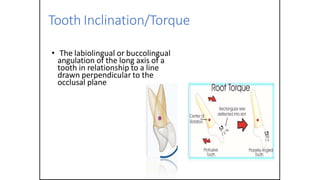
Tooth Inclination/Torque
is the force that gives the operator control over the movement of the roots of the
teeth.
Tooth Inclination/Torque
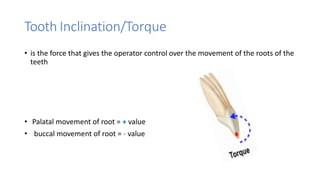
• is the force that gives the operator control over the movement of the roots of the
teeth
• Palatal movement of root = + value
• buccal movement of root = - value
Tooth Inclination/Torque
• The labiolingual or
buccolingual angulation of the
long axis of a tooth in
relationship to a line drawn
perpendicular to the occlusal
plane
90
º
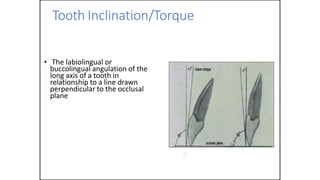
Tooth Inclination/Torque
• The labiolingual or buccolingual
angulation of the long axis of a
tooth in relationship to a line
drawn perpendicular to the
occlusal plane
Edgewise Appliance
🞅These brackets were attached to bands and were
made of soft gold
🞅Complex wire bending was required to
control tooth position in all three planes
🞅This was time consuming process and needed
considerable skills from the orthodontist
Pre-adjusted edgewise
First generation (Andrew)/SWA
• The pre-adjusted edgewise brackets have tip, torque, in and out bends built within
the brackets
First generation (Andrew)/SWA
• The pre-adjusted edgewise brackets have tip, torque, in and out bends
built within the brackets
First generation (Andrew)/SWA
• It was proposed that this appliance does not require wire bending during
treatment hence the name straight wire appliance (SWA) was given to it .
• Andrew developed different brackets for different skeletal patterns and for
extraction and non-extraction cases , results in large no. of brackets
• Is not a wide range system (no Max. Versatility )
First generation (Andrew)/SWA
• Roller-coaster effect  due to excessive force and use of elastic retraction
mechanics  Deeping of anterior bite with creation of lateral open bite .
SECOND GENERATION /ROTH
• Roth devised one set of brackets applicable for most cases ( small
inventory) .
• His arch form was wider than Andrews' in order to avoid damage to canine Tips
during treatment and to assist in obtaining good protrusive function.
• Over correction, especially in torque of brackets to accommodate
relapse and diminution of force .
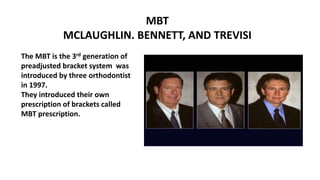
MBT
MCLAUGHLIN. BENNETT, AND TREVISI
The MBT is the 3rd generation of
preadjusted bracket system was
introduced by three orthodontist
in 1997.
They introduced their own
prescription of brackets called
MBT prescription.
MBT
MBT prescription was based on following principles:
• Light continuous force
To provide faster movement with less root
resorption and less adverse effect, still the
optimal tooth movement of fixed
appliance is the light continuous force.
MBT
• Lacebacks and bendbacks
Limits incisor proclination during
alignment by controlling mesial tip of
canines and provide better anchorage
control
MBT
• Sliding mechanics on a 0.019”x0.025”
SS wire in 0.022”x0.028” slot bracket
insure wider range of torque degree with
less friction and good anchorage.
MBT
• Use of specific arch form close to
patient natural arch form
three different arch forms
were advocated, these were tapered,
ovoid and square arch form for better
finishing and less extractions
tapered square
ovoid
MBT
• Bracket selection
in specific malocclusions and alteration of
prescription in some specific clinical
problem.
and can be used to save
chairside time in the finishing stages of
treatment.
MBT
• Bracket positioning
at specific height on the teeth taking
guidance from bracket
positioning charts and using specific
bracket positioning gauges .
MBT
• Using curves in the wire to level curve
of spee
The MBT bracket system adujst the
occlusal level and curve of spee
ROTH OR MBT
Differences between Roth & MBT
•difference in Tip
•difference in torque
Decreased tip in the upper canine brackets
(Andrews: 11 degrees, Roth: 13 degrees, and MBT: 8 degrees)
• it creats a significant drain on anchorage
• it increase tendency of bite deepning during aligment stage
Disadvantage of added anterior tip
it brought canine root apex too close to premoler root in some cases
Difference in torque
MBT
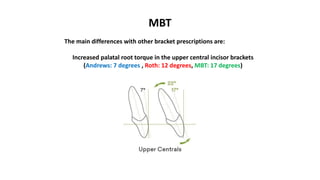
The main differences with other bracket prescriptions are:
Increased palatal root torque in the upper central incisor brackets
(Andrews: 7 degrees , Roth: 12 degrees, MBT: 17 degrees)
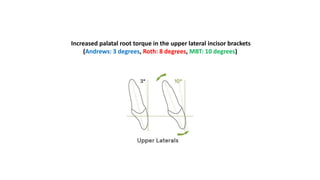
Increased palatal root torque in the upper lateral incisor brackets
(Andrews: 3 degrees, Roth: 8 degrees, MBT: 10 degrees)
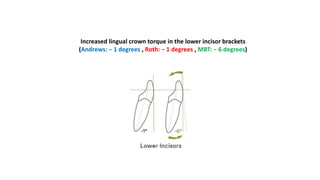
Increased lingual crown torque in the lower incisor brackets
(Andrews: − 1 degrees , Roth: − 1 degrees , MBT: − 6 degrees)
Difference in torque
indication of MBT appliance
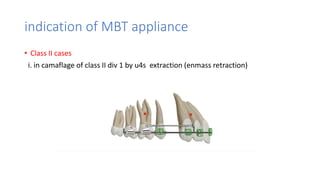
• Class II cases
i. in camaflage of class II div 1 by u4s extraction (enmass retraction)
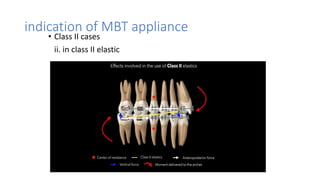
ii. in class II elastics
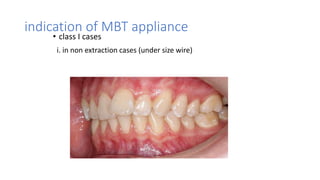
• class I cases
i. in non extraction cases (under size wire)
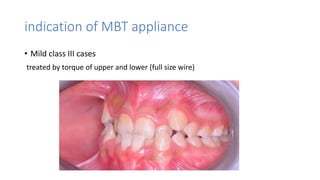
• Mild class III cases
treated by torque of upper and lower (full size wire)
indication of MBT appliance
• Class II cases
i. in camaflage of class II div 1 by u4s extraction (enmass retraction)
indication of MBT appliance
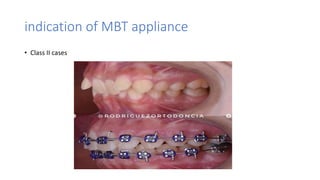
• Class II cases
indication of MBT appliance
• Class II cases
ii. in class II elastic
indication of MBT appliance
• class I cases
i. in non extraction cases (under size wire)
indication of MBT appliance
• Mild class III cases
treated by torque of upper and lower (full size wire)
indication of Roth appliance
• In class I cases
i. spacing treated by loss of anchorage
ii.crowding treated by extraction
• In class III
i.retroclined upper incisors
ii.class III elastics
• posterior cross bite
• dosn’t deal well with class II
• posterior cross bite
Bracket Alteration
1. Bracket inverting
Also known as flipping, refers to rotating the bracket 180°.
Flipping reverses the torque but doesn’t alter the tip.
Flipping a bracket 180° or switching it between the right and
left sides of the arch can be useful in altering the prescription
for biomechanical purposes.
Case Scenario
Class II Div. I with Palatally Displaced Lateral Incisor
Standard Bracket
MBT
Torque
+ ve 10
Palatal Root Torque
Standard Bracket
MBT
Torque
+ ve 10
Palatal Root Torque
Flipped Bracket
MBT
Torque
- ve 10
Labial Root Torque
Standard Bracket
MBT
Torque
+ ve 10
Palatal Root Torque
Flipped Bracket
MBT
Torque
- ve 10
Labial Root Torque
Standard Bracket
MBT
Torque
+ ve 10
Palatal Root Torque
Flipped Bracket
MBT
Torque
- ve 10
Labial Root Torque
Standard Bracket
MBT
Torque
+ ve 10
Palatal Root Torque
2. Bracket switching
Applying a bracket without
inversion to the ipsilateral tooth of
the opposing arch
3. Bracket swapping
• Crossing the midline by placing
a bracket on the opposing tooth
in the same arch.
• Swapping bracket between right
and left sides alter the tip but
doesn’t affect torque.
Case Scenario
Canine Angulation in Class III Camouflage
Lower Canine Distal Tipping
Right Lower Canine Bracket
MBT Bracket Tip +3
Roth Bracket Tip +7
Andrew Bracket Tip +5
Swapping upper left incisor brackets within the same arch reverses
tip but doesn’t alter torque
4. Blending.
Combining more than two of the
previously described principles.
In summary
Moving brackets across the occlusal line
reverses tip and torque
Crossing the midline reverses tip
Whereas flipping the bracket reverses
the intended torque expression
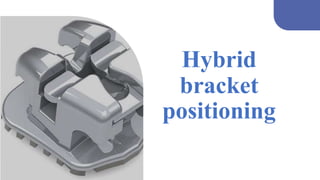
Hybrid
bracket
positioning
Axial positioning
It is the angle or inclination of the bracket
relative to the tooth's long axis.
(Andrews proposed using the facial axis of the clinical
crown as a reference for axial positioning of bracket)
Improper bracket axial position will cause an
increase or decrease in the positive or negative tip
some clinical scenarios hybrid axial positioning can be used to
compensate for an insuffcien built-in prescription
Mesiodistal position
The mesiodistal position refers to the placement of the bracket along
the tooth's width
Andrews proposed that brackets be placed on the mid developmental ridges
of the teeth for proper mesiodistal alignment
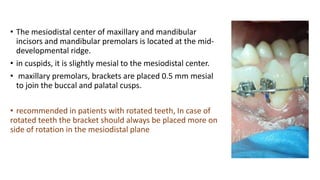
• The mesiodistal center of maxillary and mandibular
incisors and mandibular premolars is located at the mid-
developmental ridge.
• in cuspids, it is slightly mesial to the mesiodistal center.
• maxillary premolars, brackets are placed 0.5 mm mesial
to join the buccal and palatal cusps.
• recommended in patients with rotated teeth, In case of
rotated teeth the bracket should always be placed more on
side of rotation in the mesiodistal plane
Vertical positioning
• The vertical position refers to the height of the bracket on the
tooth
• brackets’ vertical positioning allows more variations than mesiodistal
and axial positioning.
• When changing the vertical position of the bracket, it is important to
consider the principle of the positive-negative torque zone that
results in different torque expressions when the vertical position of
the same bracket is altered
Positive-negative torque zone
Brackets positioned the maximum convergence of
the crown
• Gingivally positioned brackets on on maxillary incisors, maxillary
canines,mandibular canines, and all posterior teeth produce an
exaggerated buccal or labial root torque expression due to their
curved facial surfaces in the occlusogingival direction
• changing the vertical position of a mandibular incisor bracket
minimally affects torque as these teeth have fat or nearly fat
labial surfaces
• Incisally positioned brackets or occlusally, further away from the
center of rotation, torque is expressed as a crown movement
rather than a root movement and vice versa
Hybrid bracket
system
• A hybrid bracket system combines ligation bracket systems (self-
ligation and conventional ligation) and brackets with different
slot sizes (0.022-in and 0.018-in) and slot widths.
A combination of anterior active self-ligating brackets (ASLB) or
conventional brackets with posterior passive self-ligating
brackets (PSLB) has been claimed to reduce alignment time,
improve incisor torque control and sliding mechanics.
The concept of a hybrid or differential bracket slot was introduced by
Schudy anterior 0.016 £ 0.022-in slot brackets and posterior 0.022 £
0.028-in slot brackets.
Another modifcation was proposed by Gianelly employing 0.018-in slot
incisor brackets and 0.022-in slot canine/premolar brackets along with
0.018 £ 0.022-in working archwire.
Gianelly’s bidimensional bracket system was intended to optimize anterior
anchorage during the closure of extraction spaces in minimal anchorage
patients. However, there was reduced torque control of the posterior
teeth.
• Because the width of a bracket impacts its base surface area, and as a result, its shear
bond strength, profft et al have advocated that the width of the bracket be about half
the width of the tooth
• The width of a bracket also impacts the mechanical interaction at the slot/wire
interface the wider the bracket, the longer the moment arm, and the smaller the
contact angle WHICH IS provide better rotational and mesiodistal control of root
position and reduced frictional resistance during sliding.
In contrast, increased bracket width reduces the interbracket distance, increasing
archwire stiffness and reducing its range, potentially resulting in slower alignment and
torque expression
In conclusion…
 there is no differencebetween 0.018-in and 0.022-in slot brackets. However,
combining the two slot sizes may offer better torque control during incisor
retraction.
 There is some evidence that combining anterior ASLB and posterior PSLB reduces
the duration of the alignment phase, improves incisor torque control, and
facilitates sliding mechanics.
 There is no single bracket prescription that is appropriate for all clinical situations.
Therefore, alteration of the built-in prescription is recommended.
 Hybrid vertical positioning infuences torque expression.
customized CAD/CAM
orthodontic brackets
Thank you
CAD/CAM in orthodontic
Uses
• documentation
• study casts
• analysis of a dental malocclusion
• smile designing
• treatment planning
• fabrication of orthodontic appliances . Including
brackets
• Customized brackets with patient-specific teeth morphology and torque by analyzing the
slot location
3D digital scan combined with 3D x-ray and clinical photographs
Simulation of the upper and lower dental arch
Customized brackets with patient-specific tooth
morphology and torque
• Less number of TTT appointment.
• TTT of complex cases such multiple missing teeth, or
dentofacial deformities.
• generate different three- dimensional (3D) digital
models then choose the best treatment option.
Advantages
• High cost
• Technique sensitive
• discrepancies remain between the virtual
plan and the final outcome
disadvantages
Thank you

Brackets _versatility _ final (new).pptx

  • 1.
  • 2.
    Brackets versatility • It'sthe range of bracket prescription manipulation or the play concept (how the bracket play to get the movement we need)
  • 3.
    TOOTH Angulation /Tipping the angulations of the long axes of the crowns of the teeth in a mesiodistal direction
  • 4.
    TOOTH Angulation /Tipping the angulations of the long axes of the crowns of the teeth in a mesiodistal direction Mesial tip : + value
  • 5.
    TOOTH Angulation /Tipping the angulations of the long axes of the crowns of the teeth in a mesiodistal direction Distal tip : - value
  • 6.
    Tooth Angulation/Tipping • Thelong axis of the clinical crown is measured from a line at 90 degrees to the occlusal plane 90 º - 11 º - 9º - 5º
  • 7.
    Tooth Inclination/Torque is theforce that gives the operator control over the movement of the roots of the teeth.
  • 8.
    Tooth Inclination/Torque • isthe force that gives the operator control over the movement of the roots of the teeth • Palatal movement of root = + value • buccal movement of root = - value
  • 9.
    Tooth Inclination/Torque • Thelabiolingual or buccolingual angulation of the long axis of a tooth in relationship to a line drawn perpendicular to the occlusal plane 90 º
  • 10.
    Tooth Inclination/Torque • Thelabiolingual or buccolingual angulation of the long axis of a tooth in relationship to a line drawn perpendicular to the occlusal plane
  • 11.
    Edgewise Appliance 🞅These bracketswere attached to bands and were made of soft gold 🞅Complex wire bending was required to control tooth position in all three planes 🞅This was time consuming process and needed considerable skills from the orthodontist
  • 12.
  • 13.
    First generation (Andrew)/SWA •The pre-adjusted edgewise brackets have tip, torque, in and out bends built within the brackets
  • 14.
    First generation (Andrew)/SWA •The pre-adjusted edgewise brackets have tip, torque, in and out bends built within the brackets
  • 15.
    First generation (Andrew)/SWA •It was proposed that this appliance does not require wire bending during treatment hence the name straight wire appliance (SWA) was given to it . • Andrew developed different brackets for different skeletal patterns and for extraction and non-extraction cases , results in large no. of brackets • Is not a wide range system (no Max. Versatility )
  • 16.
    First generation (Andrew)/SWA •Roller-coaster effect  due to excessive force and use of elastic retraction mechanics  Deeping of anterior bite with creation of lateral open bite .
  • 17.
    SECOND GENERATION /ROTH •Roth devised one set of brackets applicable for most cases ( small inventory) . • His arch form was wider than Andrews' in order to avoid damage to canine Tips during treatment and to assist in obtaining good protrusive function. • Over correction, especially in torque of brackets to accommodate relapse and diminution of force .
  • 18.
    MBT MCLAUGHLIN. BENNETT, ANDTREVISI The MBT is the 3rd generation of preadjusted bracket system was introduced by three orthodontist in 1997. They introduced their own prescription of brackets called MBT prescription.
  • 19.
    MBT MBT prescription wasbased on following principles: • Light continuous force To provide faster movement with less root resorption and less adverse effect, still the optimal tooth movement of fixed appliance is the light continuous force.
  • 20.
    MBT • Lacebacks andbendbacks Limits incisor proclination during alignment by controlling mesial tip of canines and provide better anchorage control
  • 21.
    MBT • Sliding mechanicson a 0.019”x0.025” SS wire in 0.022”x0.028” slot bracket insure wider range of torque degree with less friction and good anchorage.
  • 22.
    MBT • Use ofspecific arch form close to patient natural arch form three different arch forms were advocated, these were tapered, ovoid and square arch form for better finishing and less extractions tapered square ovoid
  • 23.
    MBT • Bracket selection inspecific malocclusions and alteration of prescription in some specific clinical problem. and can be used to save chairside time in the finishing stages of treatment.
  • 24.
    MBT • Bracket positioning atspecific height on the teeth taking guidance from bracket positioning charts and using specific bracket positioning gauges .
  • 25.
    MBT • Using curvesin the wire to level curve of spee The MBT bracket system adujst the occlusal level and curve of spee
  • 26.
  • 27.
    Differences between Roth& MBT •difference in Tip •difference in torque
  • 28.
    Decreased tip inthe upper canine brackets (Andrews: 11 degrees, Roth: 13 degrees, and MBT: 8 degrees)
  • 30.
    • it creatsa significant drain on anchorage • it increase tendency of bite deepning during aligment stage Disadvantage of added anterior tip
  • 31.
    Disadvantage of addedanterior tip it brought canine root apex too close to premoler root in some cases
  • 32.
  • 33.
    MBT The main differenceswith other bracket prescriptions are: Increased palatal root torque in the upper central incisor brackets (Andrews: 7 degrees , Roth: 12 degrees, MBT: 17 degrees)
  • 34.
    Increased palatal roottorque in the upper lateral incisor brackets (Andrews: 3 degrees, Roth: 8 degrees, MBT: 10 degrees)
  • 35.
    Increased lingual crowntorque in the lower incisor brackets (Andrews: − 1 degrees , Roth: − 1 degrees , MBT: − 6 degrees)
  • 36.
  • 37.
    indication of MBTappliance • Class II cases i. in camaflage of class II div 1 by u4s extraction (enmass retraction) ii. in class II elastics • class I cases i. in non extraction cases (under size wire) • Mild class III cases treated by torque of upper and lower (full size wire)
  • 38.
    indication of MBTappliance • Class II cases i. in camaflage of class II div 1 by u4s extraction (enmass retraction)
  • 39.
    indication of MBTappliance • Class II cases
  • 40.
    indication of MBTappliance • Class II cases ii. in class II elastic
  • 41.
    indication of MBTappliance • class I cases i. in non extraction cases (under size wire)
  • 42.
    indication of MBTappliance • Mild class III cases treated by torque of upper and lower (full size wire)
  • 43.
    indication of Rothappliance • In class I cases i. spacing treated by loss of anchorage ii.crowding treated by extraction • In class III i.retroclined upper incisors ii.class III elastics • posterior cross bite • dosn’t deal well with class II
  • 44.
  • 46.
  • 47.
    1. Bracket inverting Alsoknown as flipping, refers to rotating the bracket 180°. Flipping reverses the torque but doesn’t alter the tip. Flipping a bracket 180° or switching it between the right and left sides of the arch can be useful in altering the prescription for biomechanical purposes.
  • 49.
    Case Scenario Class IIDiv. I with Palatally Displaced Lateral Incisor Standard Bracket MBT Torque + ve 10 Palatal Root Torque
  • 50.
    Standard Bracket MBT Torque + ve10 Palatal Root Torque
  • 51.
    Flipped Bracket MBT Torque - ve10 Labial Root Torque Standard Bracket MBT Torque + ve 10 Palatal Root Torque
  • 52.
    Flipped Bracket MBT Torque - ve10 Labial Root Torque Standard Bracket MBT Torque + ve 10 Palatal Root Torque
  • 53.
    Flipped Bracket MBT Torque - ve10 Labial Root Torque Standard Bracket MBT Torque + ve 10 Palatal Root Torque
  • 54.
    2. Bracket switching Applyinga bracket without inversion to the ipsilateral tooth of the opposing arch
  • 56.
    3. Bracket swapping •Crossing the midline by placing a bracket on the opposing tooth in the same arch. • Swapping bracket between right and left sides alter the tip but doesn’t affect torque.
  • 57.
    Case Scenario Canine Angulationin Class III Camouflage Lower Canine Distal Tipping
  • 58.
    Lower Canine DistalTipping Right Lower Canine Bracket
  • 59.
    MBT Bracket Tip+3 Roth Bracket Tip +7 Andrew Bracket Tip +5
  • 61.
    Swapping upper leftincisor brackets within the same arch reverses tip but doesn’t alter torque
  • 62.
    4. Blending. Combining morethan two of the previously described principles.
  • 64.
    In summary Moving bracketsacross the occlusal line reverses tip and torque Crossing the midline reverses tip Whereas flipping the bracket reverses the intended torque expression
  • 66.
  • 68.
    Axial positioning It isthe angle or inclination of the bracket relative to the tooth's long axis. (Andrews proposed using the facial axis of the clinical crown as a reference for axial positioning of bracket) Improper bracket axial position will cause an increase or decrease in the positive or negative tip
  • 69.
    some clinical scenarioshybrid axial positioning can be used to compensate for an insuffcien built-in prescription
  • 70.
    Mesiodistal position The mesiodistalposition refers to the placement of the bracket along the tooth's width Andrews proposed that brackets be placed on the mid developmental ridges of the teeth for proper mesiodistal alignment
  • 71.
    • The mesiodistalcenter of maxillary and mandibular incisors and mandibular premolars is located at the mid- developmental ridge. • in cuspids, it is slightly mesial to the mesiodistal center. • maxillary premolars, brackets are placed 0.5 mm mesial to join the buccal and palatal cusps. • recommended in patients with rotated teeth, In case of rotated teeth the bracket should always be placed more on side of rotation in the mesiodistal plane
  • 72.
    Vertical positioning • Thevertical position refers to the height of the bracket on the tooth • brackets’ vertical positioning allows more variations than mesiodistal and axial positioning. • When changing the vertical position of the bracket, it is important to consider the principle of the positive-negative torque zone that results in different torque expressions when the vertical position of the same bracket is altered
  • 73.
    Positive-negative torque zone Bracketspositioned the maximum convergence of the crown
  • 75.
    • Gingivally positionedbrackets on on maxillary incisors, maxillary canines,mandibular canines, and all posterior teeth produce an exaggerated buccal or labial root torque expression due to their curved facial surfaces in the occlusogingival direction • changing the vertical position of a mandibular incisor bracket minimally affects torque as these teeth have fat or nearly fat labial surfaces • Incisally positioned brackets or occlusally, further away from the center of rotation, torque is expressed as a crown movement rather than a root movement and vice versa
  • 77.
  • 78.
    • A hybridbracket system combines ligation bracket systems (self- ligation and conventional ligation) and brackets with different slot sizes (0.022-in and 0.018-in) and slot widths. A combination of anterior active self-ligating brackets (ASLB) or conventional brackets with posterior passive self-ligating brackets (PSLB) has been claimed to reduce alignment time, improve incisor torque control and sliding mechanics.
  • 79.
    The concept ofa hybrid or differential bracket slot was introduced by Schudy anterior 0.016 £ 0.022-in slot brackets and posterior 0.022 £ 0.028-in slot brackets. Another modifcation was proposed by Gianelly employing 0.018-in slot incisor brackets and 0.022-in slot canine/premolar brackets along with 0.018 £ 0.022-in working archwire. Gianelly’s bidimensional bracket system was intended to optimize anterior anchorage during the closure of extraction spaces in minimal anchorage patients. However, there was reduced torque control of the posterior teeth.
  • 80.
    • Because thewidth of a bracket impacts its base surface area, and as a result, its shear bond strength, profft et al have advocated that the width of the bracket be about half the width of the tooth • The width of a bracket also impacts the mechanical interaction at the slot/wire interface the wider the bracket, the longer the moment arm, and the smaller the contact angle WHICH IS provide better rotational and mesiodistal control of root position and reduced frictional resistance during sliding. In contrast, increased bracket width reduces the interbracket distance, increasing archwire stiffness and reducing its range, potentially resulting in slower alignment and torque expression
  • 81.
    In conclusion…  thereis no differencebetween 0.018-in and 0.022-in slot brackets. However, combining the two slot sizes may offer better torque control during incisor retraction.  There is some evidence that combining anterior ASLB and posterior PSLB reduces the duration of the alignment phase, improves incisor torque control, and facilitates sliding mechanics.  There is no single bracket prescription that is appropriate for all clinical situations. Therefore, alteration of the built-in prescription is recommended.  Hybrid vertical positioning infuences torque expression.
  • 82.
  • 83.
    CAD/CAM in orthodontic Uses •documentation • study casts • analysis of a dental malocclusion • smile designing • treatment planning • fabrication of orthodontic appliances . Including brackets • Customized brackets with patient-specific teeth morphology and torque by analyzing the slot location
  • 84.
    3D digital scancombined with 3D x-ray and clinical photographs
  • 85.
    Simulation of theupper and lower dental arch
  • 86.
    Customized brackets withpatient-specific tooth morphology and torque
  • 87.
    • Less numberof TTT appointment. • TTT of complex cases such multiple missing teeth, or dentofacial deformities. • generate different three- dimensional (3D) digital models then choose the best treatment option. Advantages • High cost • Technique sensitive • discrepancies remain between the virtual plan and the final outcome disadvantages
  • 88.