Elastics in Orthodontics-II
Guided by-Dr. Jeevan M. Khatri sir
(Professor & HOD)
Dept. of Orthodontics and Dentofacial Orthopaedics
Presented by-Krutika A. Patankar (3rd YR MDS)
1
Content
• Overview
• Colour coding
• Force level
• Types of elastics
• Biomechanics of elastics
• Synchronous class II elastics
• Asynchronous class II elastics
• Non rigid arches with third order play
• Elastic Redundancy
• Pre-stretching of elastics
• Fluoridated elastic chain
• Conclusion
2
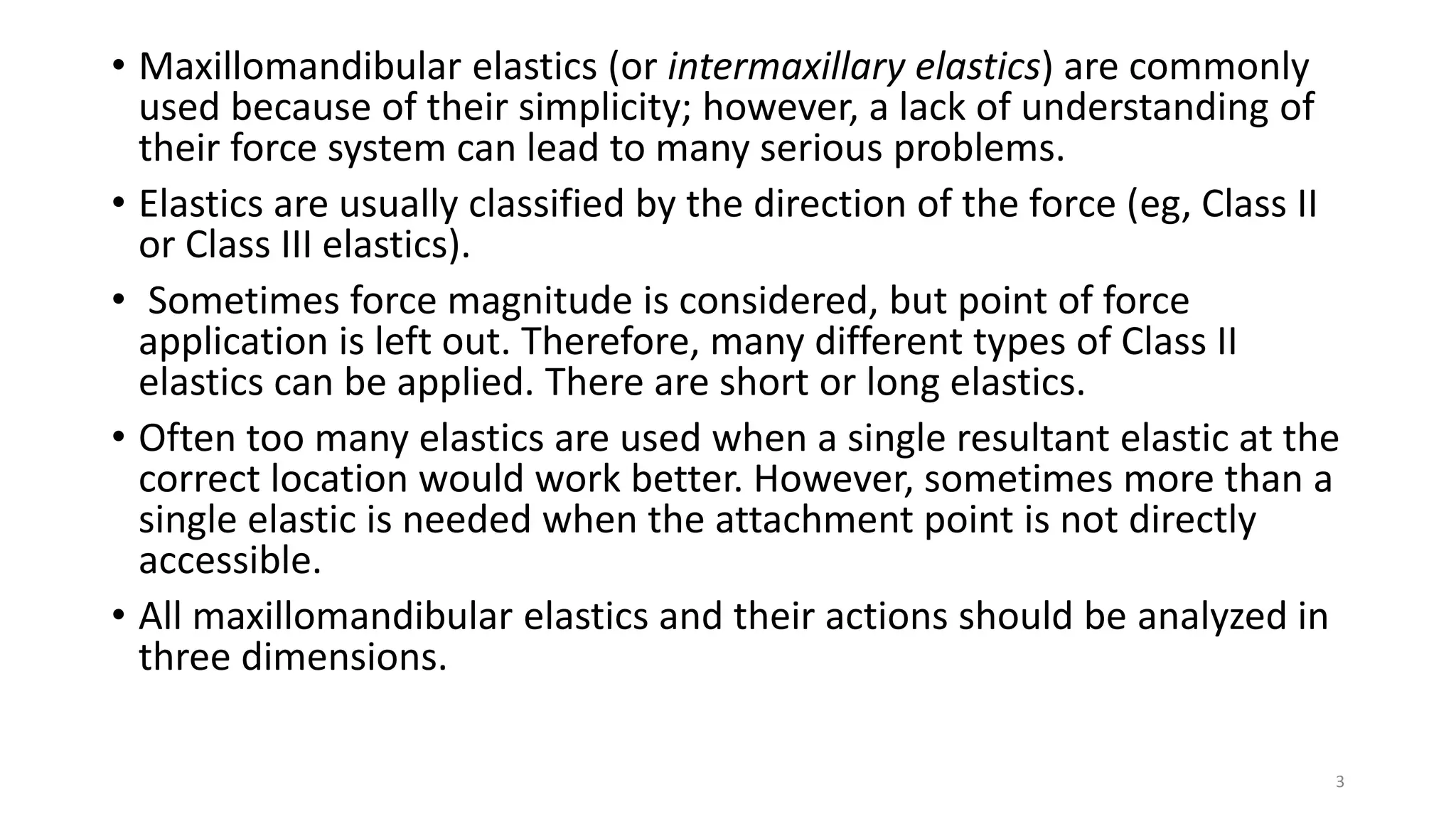
• Maxillomandibular elastics (or intermaxillary elastics) are commonly
used because of their simplicity; however, a lack of understanding of
their force system can lead to many serious problems.
• Elastics are usually classified by the direction of the force (eg, Class II
or Class III elastics).
• Sometimes force magnitude is considered, but point of force
application is left out. Therefore, many different types of Class II
elastics can be applied. There are short or long elastics.
• Often too many elastics are used when a single resultant elastic at the
correct location would work better. However, sometimes more than a
single elastic is needed when the attachment point is not directly
accessible.
• All maxillomandibular elastics and their actions should be analyzed in
three dimensions.
3
Elastics according to colour coding
4
Force level for different tooth movement.
• En-mass movement (non extraction) – class 2 / 3 elastics = 5-6 ounces
142-170g
• En-mass movement (extraction) – class 2 / 3 elastics = 4-5 ounces /
113-142g
• Anterior elastics – box elastic for anterior openbite = 1-2 ounces / 28-
57g
• Posterior box elastics = 6 ounces / 170g
• The difference in force levels required for non-extraction Vs extraction
cases has been attributed to the greater number of teeth / units in
non-extraction cases, requiring greater force levels for en mass
movement.
5
TP Orthodontics
(3.5 oz)
6
Carriere Motion 3D
7
• A recent study found that 1/4” / 6.4mm elastics covered a wider
range of force levels compared to 3/16 / 4.8mm elastics.
• Conclusion: 1/4” / 6.4mm and /16 / 4.8mm fulfil most clinical
situations, except for box elastics
8
Two main types of Class II elastics are used
• Short Class II elastics
• Long Class II elastics
9
6 vector components are observed
10
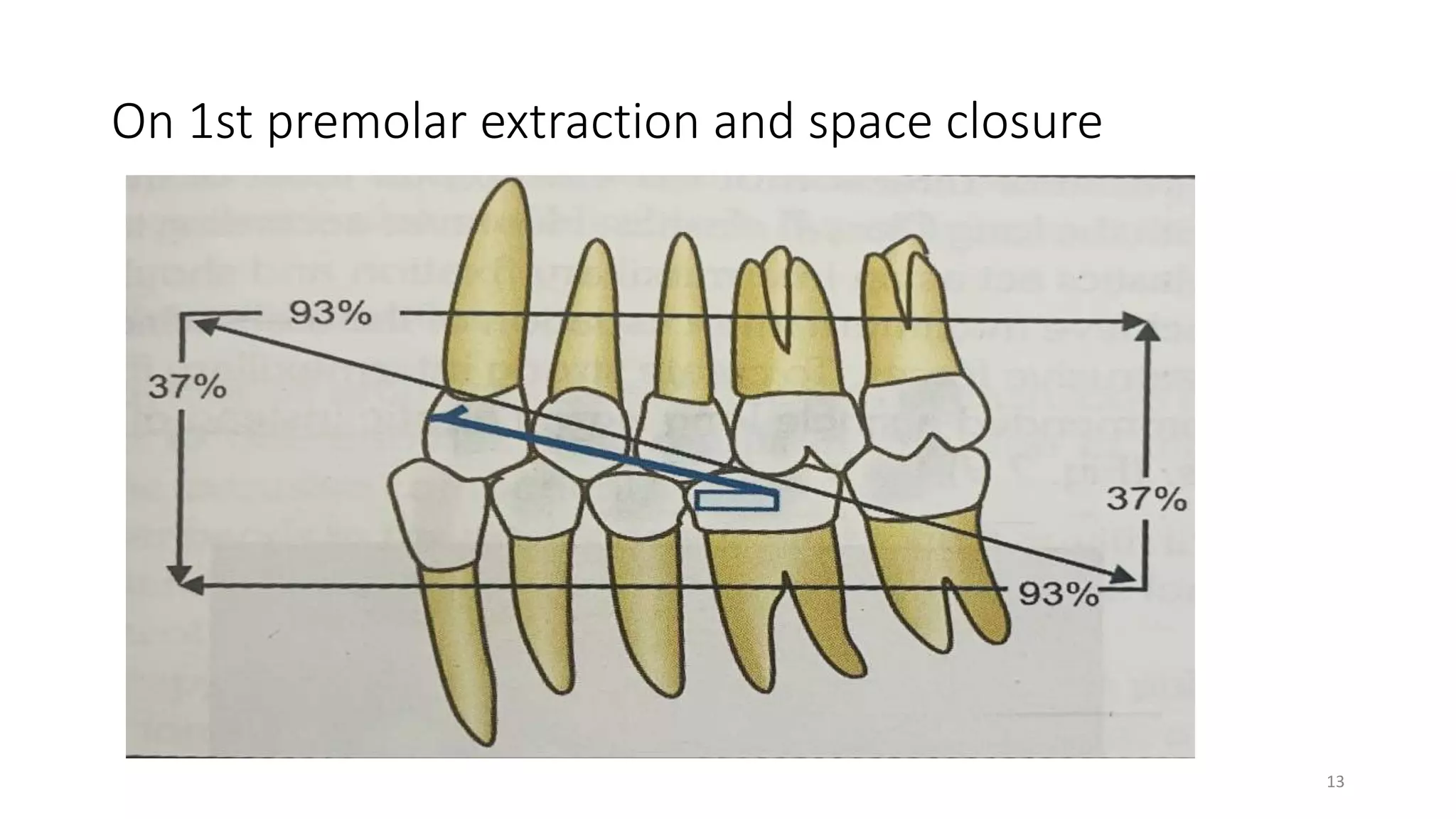
• Traditionally it is attached from upper canine to lower first molar
• Thurow (1970) suggested from upper canine to lower 2nd molar
• Alexander (1986) suggested from distal wing of upper laterals to
lower 2nd molar.
• According to Thurow (1977 )-from upper canine to lower 1stmolar:
H:96%, V:27%
11
If it is stretched from upper canine to lower 2nd
molar: H: 97%, V:20%
12
On 1st premolar extraction and space closure
13
• Thus to get the maximum distal driving force with minimum vertical
force, elastics should be applied from farthest distal point i.e. distal of
mandibular 2nd molar.
• This type of stress distribution (Horizontal and Vertical) for a given
movement is independent of the force magnitude but directly related
to direction of force application.
• The vertical components extrudes the teeth, tips the occlusal plane,
thereby causing a rotational opening of the mandible
• The horizontal components bring the teeth to a better A-P relation
but are unstable due to abnormal location of the teeth in the alveolar
bone.
14
Synchronous Class II Elastics
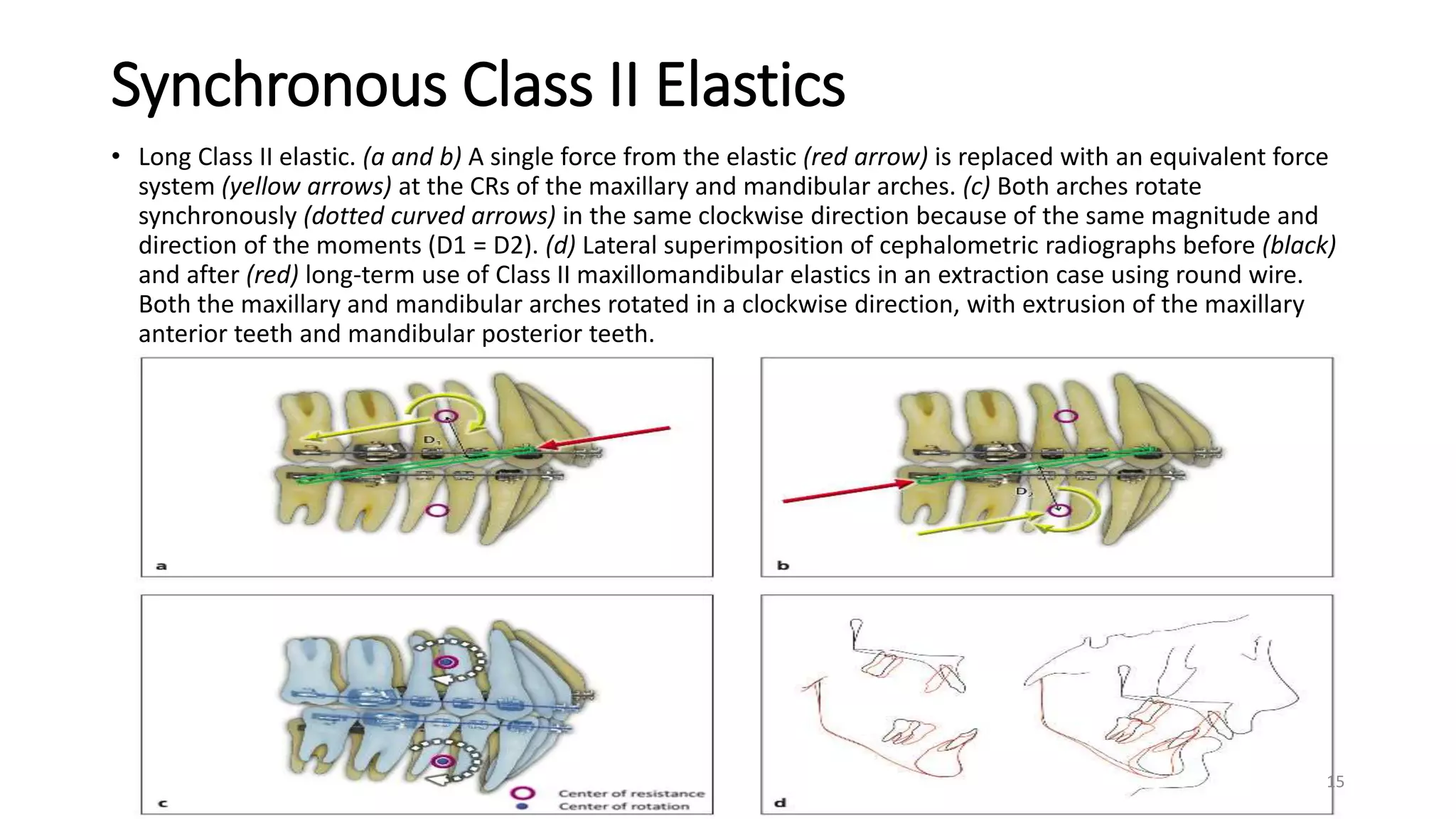
• Long Class II elastic. (a and b) A single force from the elastic (red arrow) is replaced with an equivalent force
system (yellow arrows) at the CRs of the maxillary and mandibular arches. (c) Both arches rotate
synchronously (dotted curved arrows) in the same clockwise direction because of the same magnitude and
direction of the moments (D1 = D2). (d) Lateral superimposition of cephalometric radiographs before (black)
and after (red) long-term use of Class II maxillomandibular elastics in an extraction case using round wire.
Both the maxillary and mandibular arches rotated in a clockwise direction, with extrusion of the maxillary
anterior teeth and mandibular posterior teeth.
15
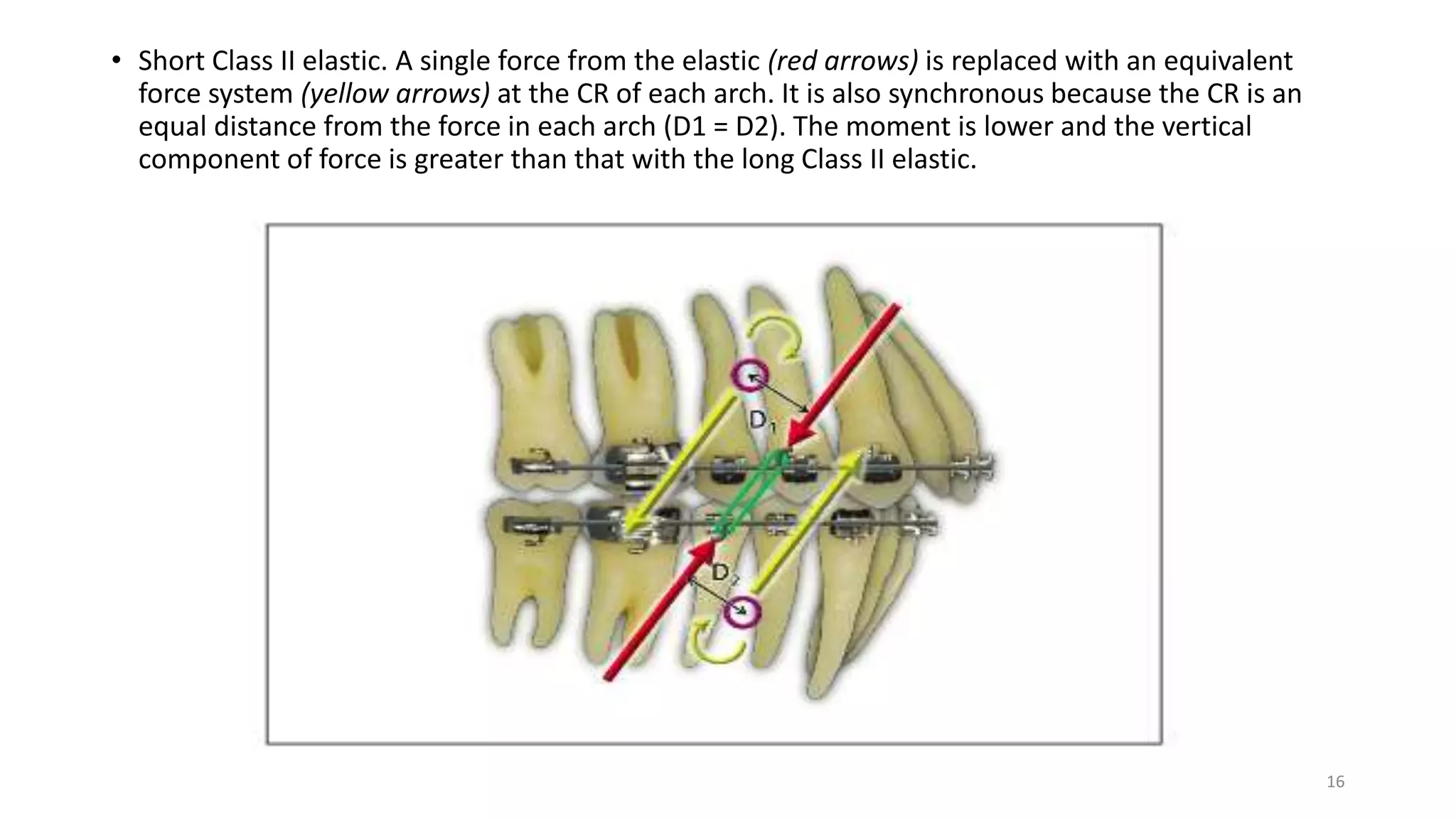
• Short Class II elastic. A single force from the elastic (red arrows) is replaced with an equivalent
force system (yellow arrows) at the CR of each arch. It is also synchronous because the CR is an
equal distance from the force in each arch (D1 = D2). The moment is lower and the vertical
component of force is greater than that with the long Class II elastic.
16
Asynchronous Class II Elastics
• Short Class II elastic placed anteriorly. (a and b) A single force from
the elastic (red arrow) is replaced with an equivalent force system
(yellow arrows) at the CR of the maxillary arch.
17
(c) The moment in respect to the CR will be different for each arch;
therefore, only the maxillary arch rotates asynchronously.
18
• Short Class II elastic placed posteriorly. (a and b) A single force from
the elastic (red arrow) is replaced with an equivalent force system
(yellow arrows) at the CR of the mandibular arch.
19
• (c) The moment in respect to the CR will be different for each arch;
therefore, only the mandibular arch rotates asynchronously.
20
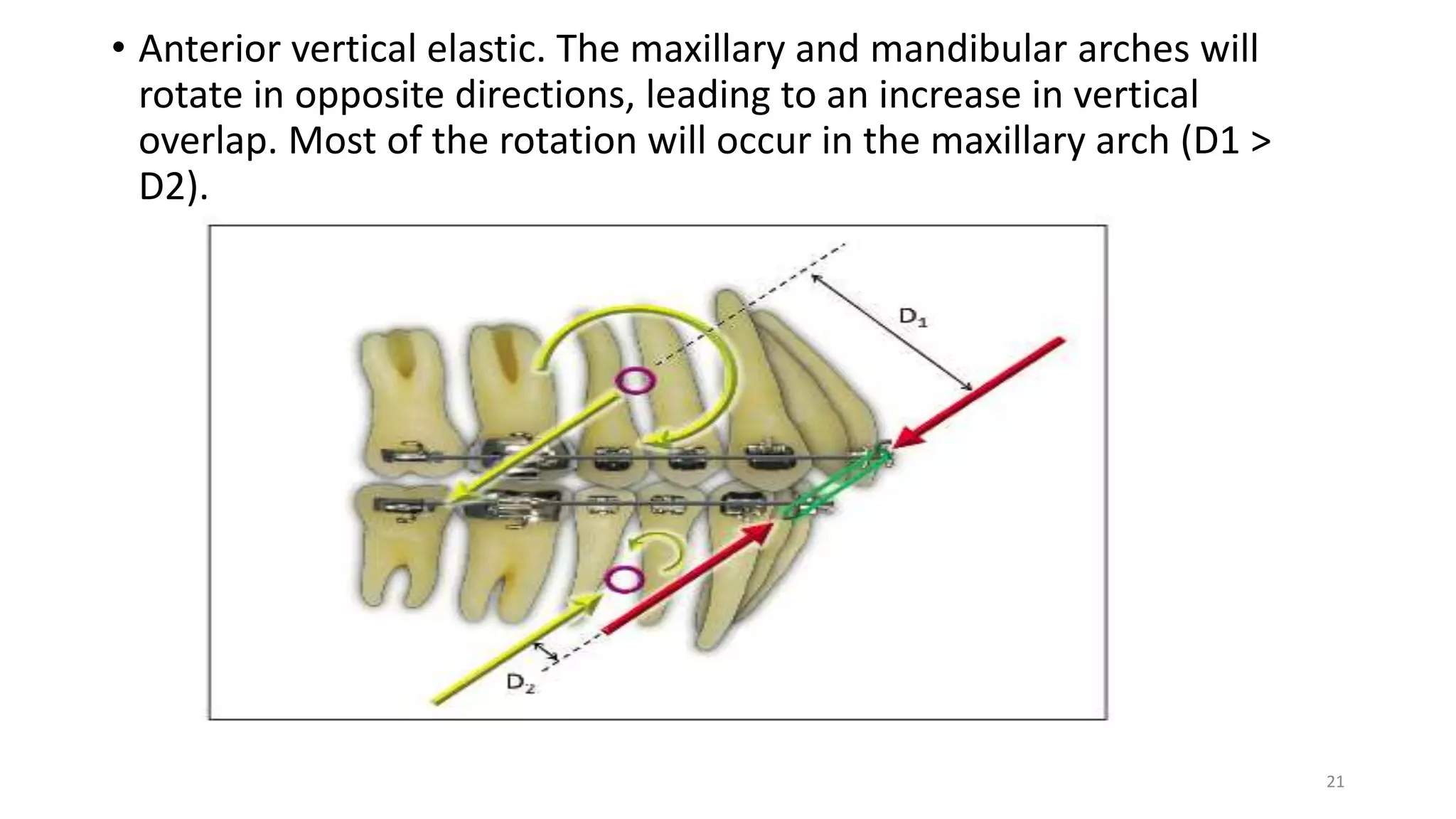
• Anterior vertical elastic. The maxillary and mandibular arches will
rotate in opposite directions, leading to an increase in vertical
overlap. Most of the rotation will occur in the maxillary arch (D1 >
D2).
21
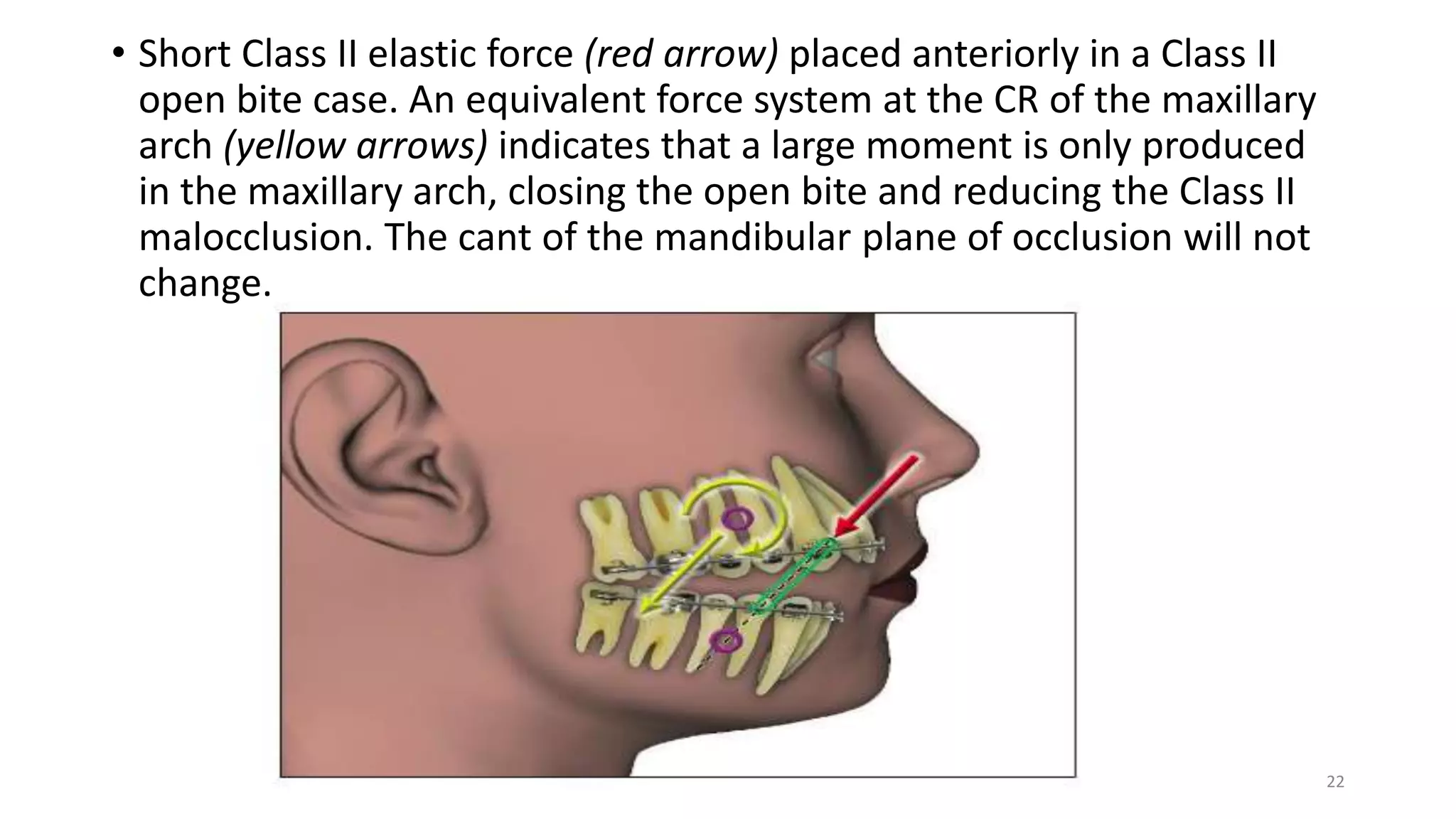
• Short Class II elastic force (red arrow) placed anteriorly in a Class II
open bite case. An equivalent force system at the CR of the maxillary
arch (yellow arrows) indicates that a large moment is only produced
in the maxillary arch, closing the open bite and reducing the Class II
malocclusion. The cant of the mandibular plane of occlusion will not
change.
22
• Short Class III elastic placed anteriorly in a Class III open bite case. (a)
The single force (red arrow) is through the CR of the maxillary arch.
(b) An equivalent force system at the CR of the mandibular arch
(yellow arrows) has a large moment, closing the open bite and
reducing the Class III malocclusion. The cant of the maxillary plane of
occlusion will not change.
23
• Short Class II elastic placed posteriorly in a Class II deep bite case. (a) The single
force (red arrow) is through the CR of the maxillary arch. (b) An equivalent force
system at the CR of the mandibular arch (yellow arrows) produces a large
moment, opening the bite and reducing the vertical overlap. The cant of the
maxillary occlusal plane will not change.
24
Nonrigid Arches with Third-Order Play
• If round wires are used, one might expect a similar response;
however, incisors could change their axial inclinations. There would
be less change in the cants of the occlusal planes with full rigidity of
wires and teeth. Furthermore, with a round wire without third-order
control, maxillary molars can tip to the buccal, and mandibular molars
can tip to the lingual, resulting in a crossbite (also known as a scissor
bite).
25
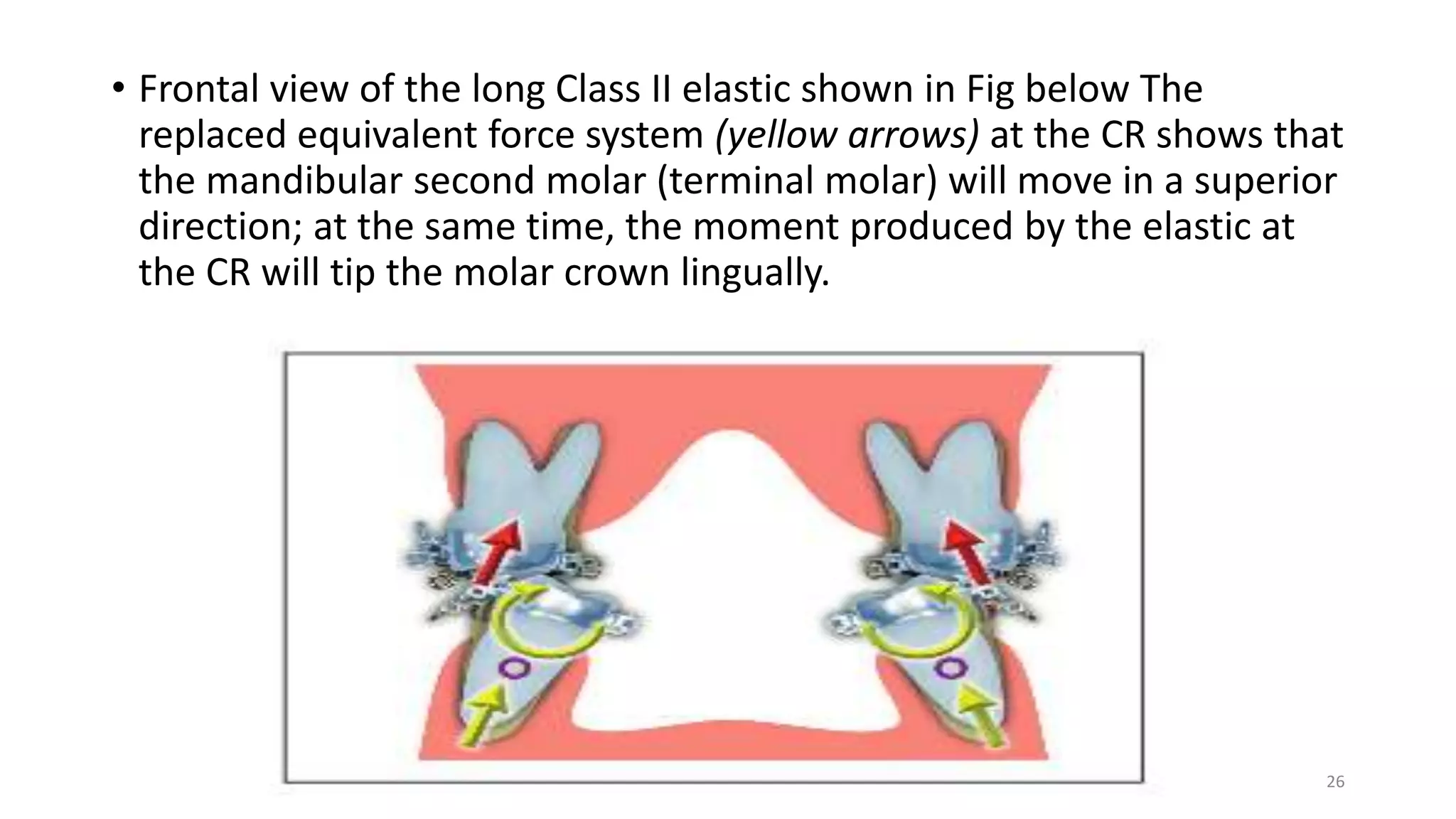
• Frontal view of the long Class II elastic shown in Fig below The
replaced equivalent force system (yellow arrows) at the CR shows that
the mandibular second molar (terminal molar) will move in a superior
direction; at the same time, the moment produced by the elastic at
the CR will tip the molar crown lingually.
26
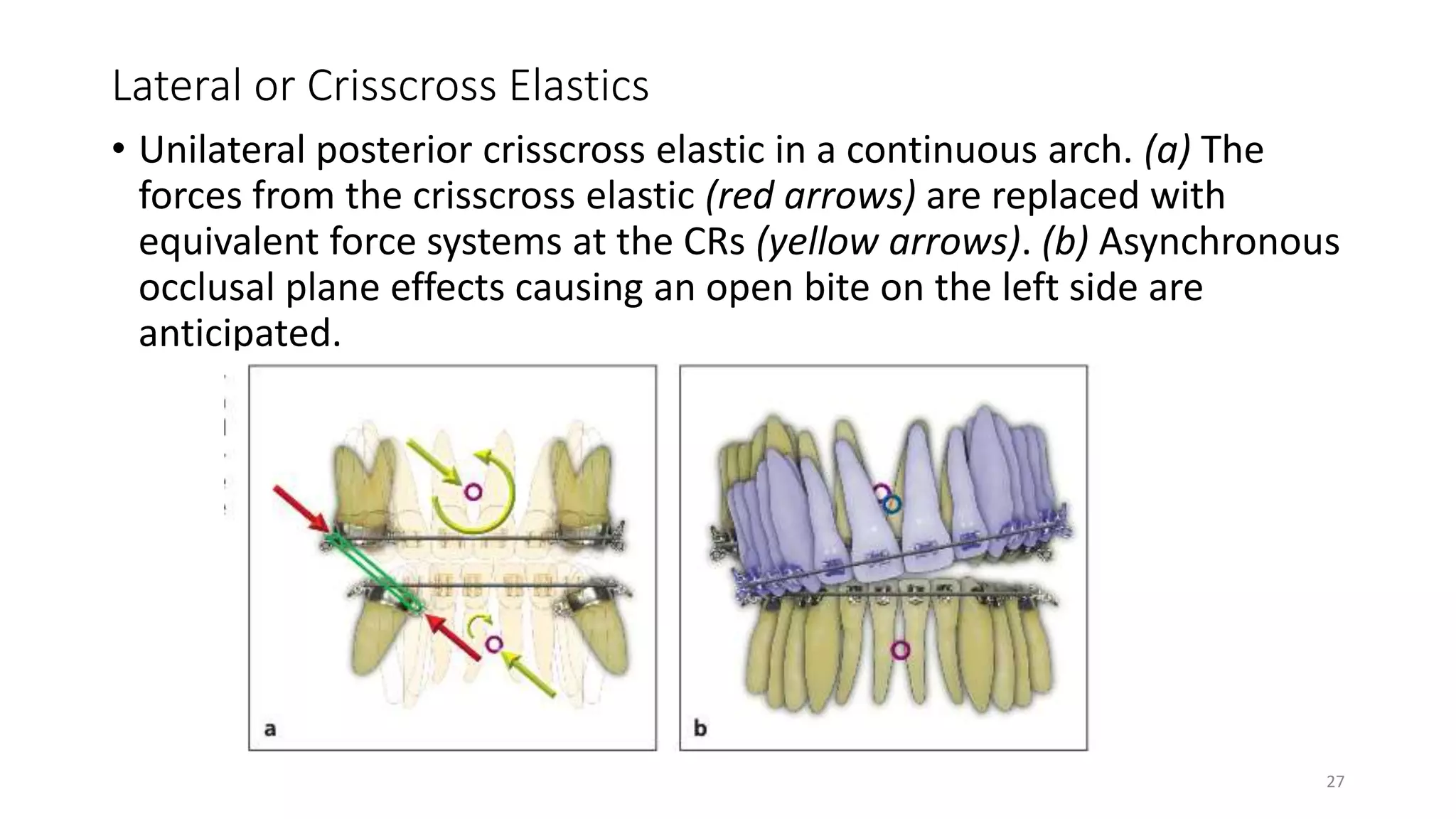
Lateral or Crisscross Elastics
• Unilateral posterior crisscross elastic in a continuous arch. (a) The
forces from the crisscross elastic (red arrows) are replaced with
equivalent force systems at the CRs (yellow arrows). (b) Asynchronous
occlusal plane effects causing an open bite on the left side are
anticipated.
27
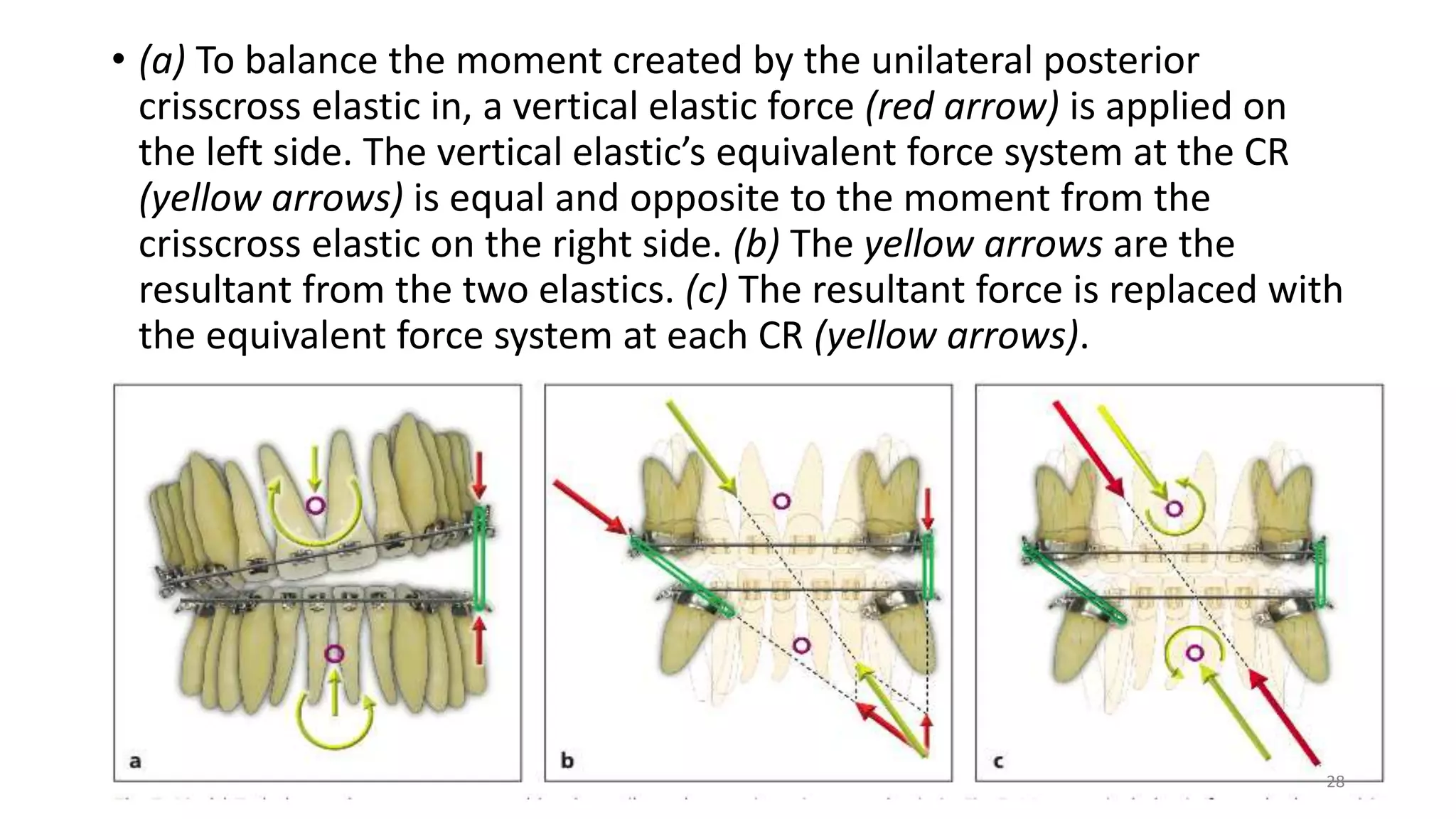
• (a) To balance the moment created by the unilateral posterior
crisscross elastic in, a vertical elastic force (red arrow) is applied on
the left side. The vertical elastic’s equivalent force system at the CR
(yellow arrows) is equal and opposite to the moment from the
crisscross elastic on the right side. (b) The yellow arrows are the
resultant from the two elastics. (c) The resultant force is replaced with
the equivalent force system at each CR (yellow arrows).
28
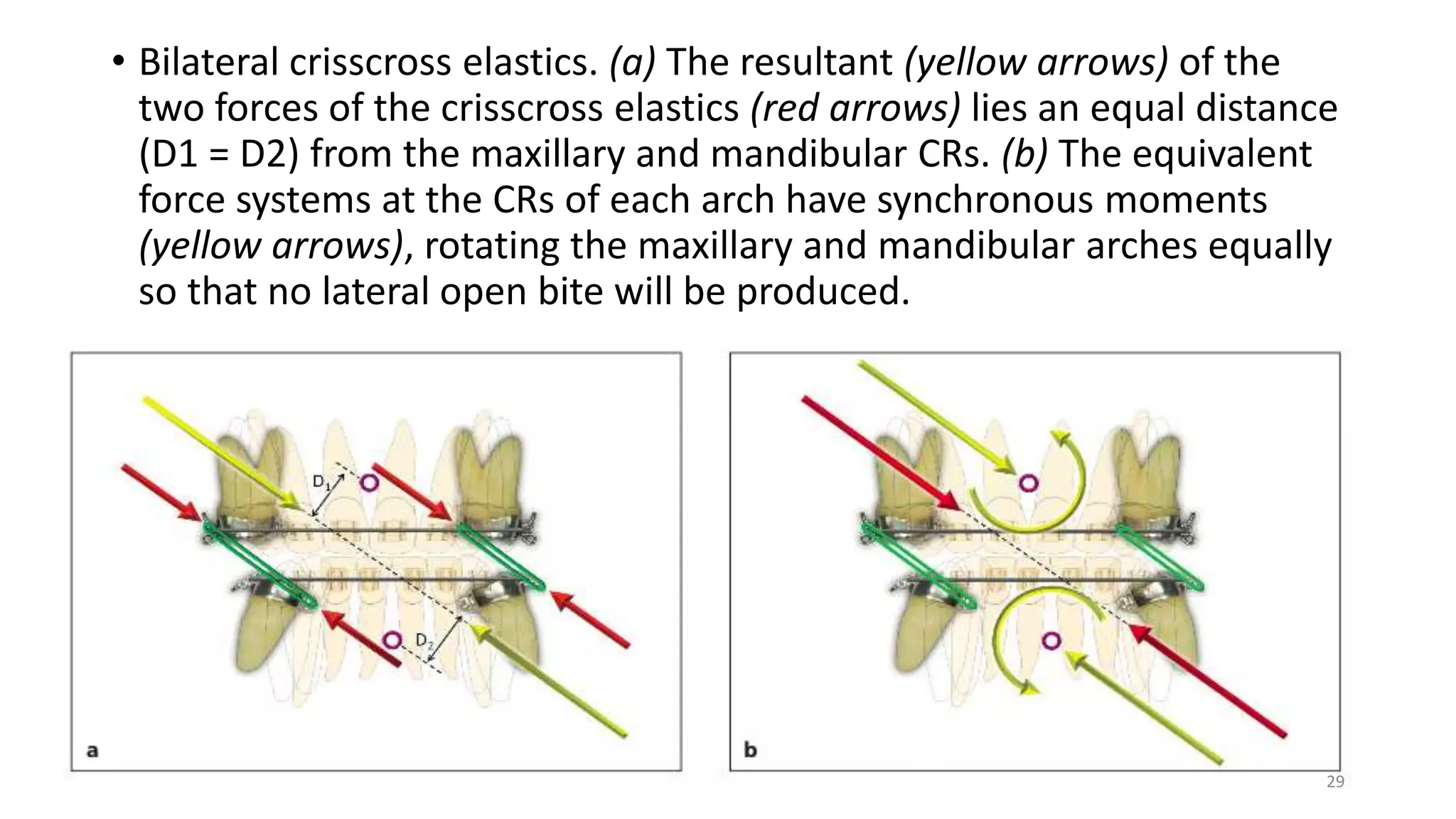
• Bilateral crisscross elastics. (a) The resultant (yellow arrows) of the
two forces of the crisscross elastics (red arrows) lies an equal distance
(D1 = D2) from the maxillary and mandibular CRs. (b) The equivalent
force systems at the CRs of each arch have synchronous moments
(yellow arrows), rotating the maxillary and mandibular arches equally
so that no lateral open bite will be produced.
29
• Ant criss -cross elastics for midline correction
30
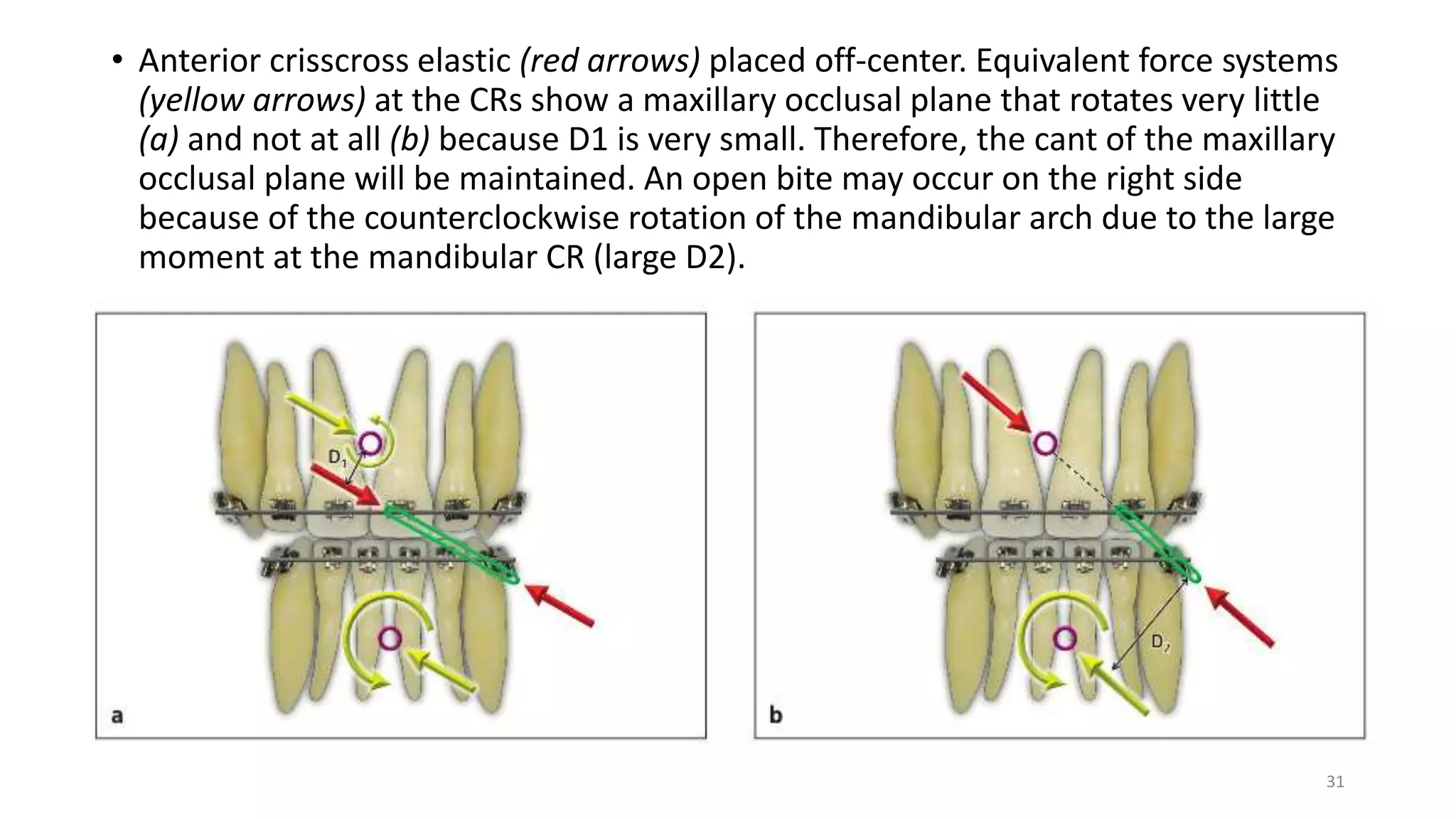
• Anterior crisscross elastic (red arrows) placed off-center. Equivalent force systems
(yellow arrows) at the CRs show a maxillary occlusal plane that rotates very little
(a) and not at all (b) because D1 is very small. Therefore, the cant of the maxillary
occlusal plane will be maintained. An open bite may occur on the right side
because of the counterclockwise rotation of the mandibular arch due to the large
moment at the mandibular CR (large D2).
31
Vertical elastics
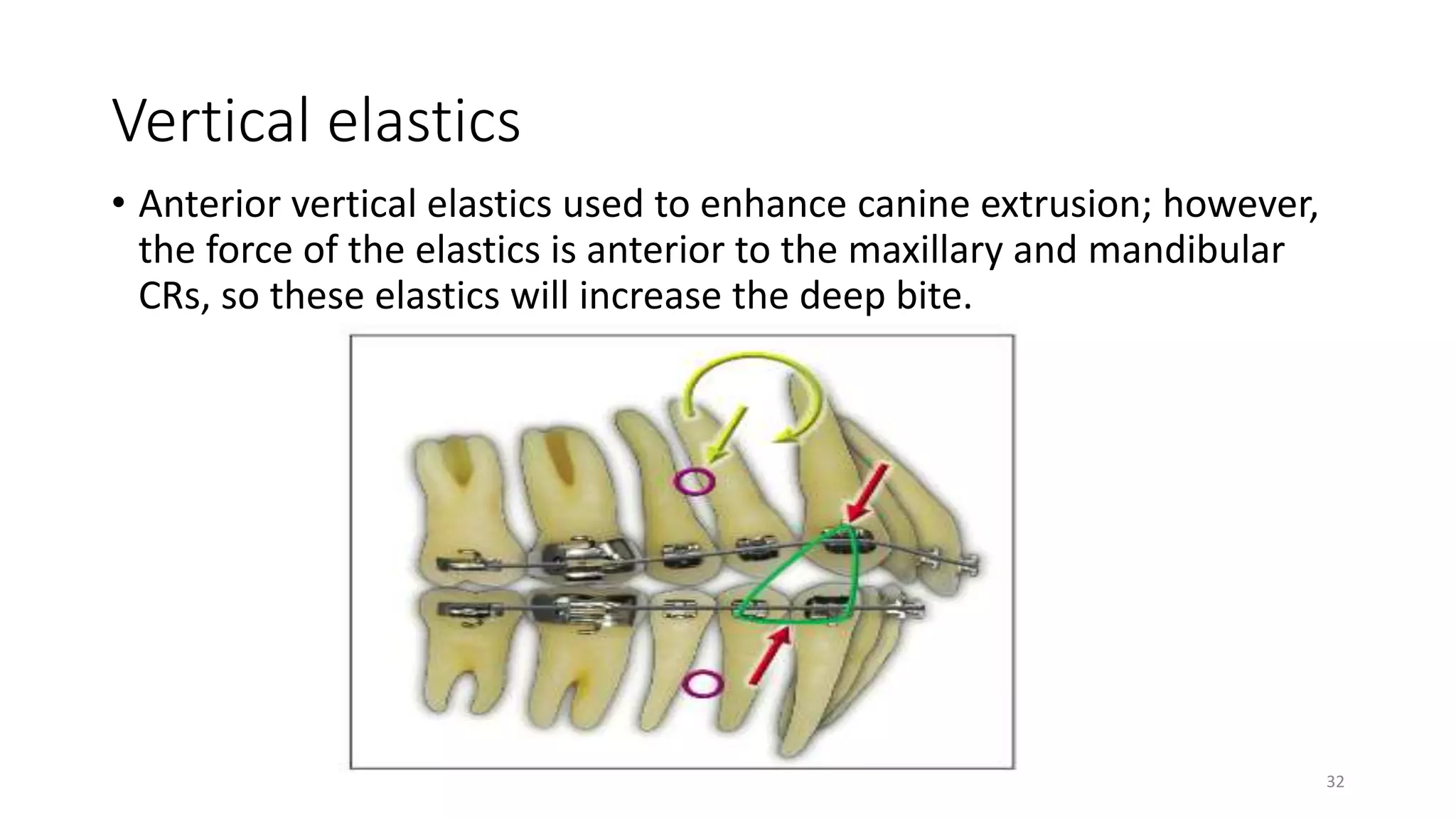
• Anterior vertical elastics used to enhance canine extrusion; however,
the force of the elastics is anterior to the maxillary and mandibular
CRs, so these elastics will increase the deep bite.
32
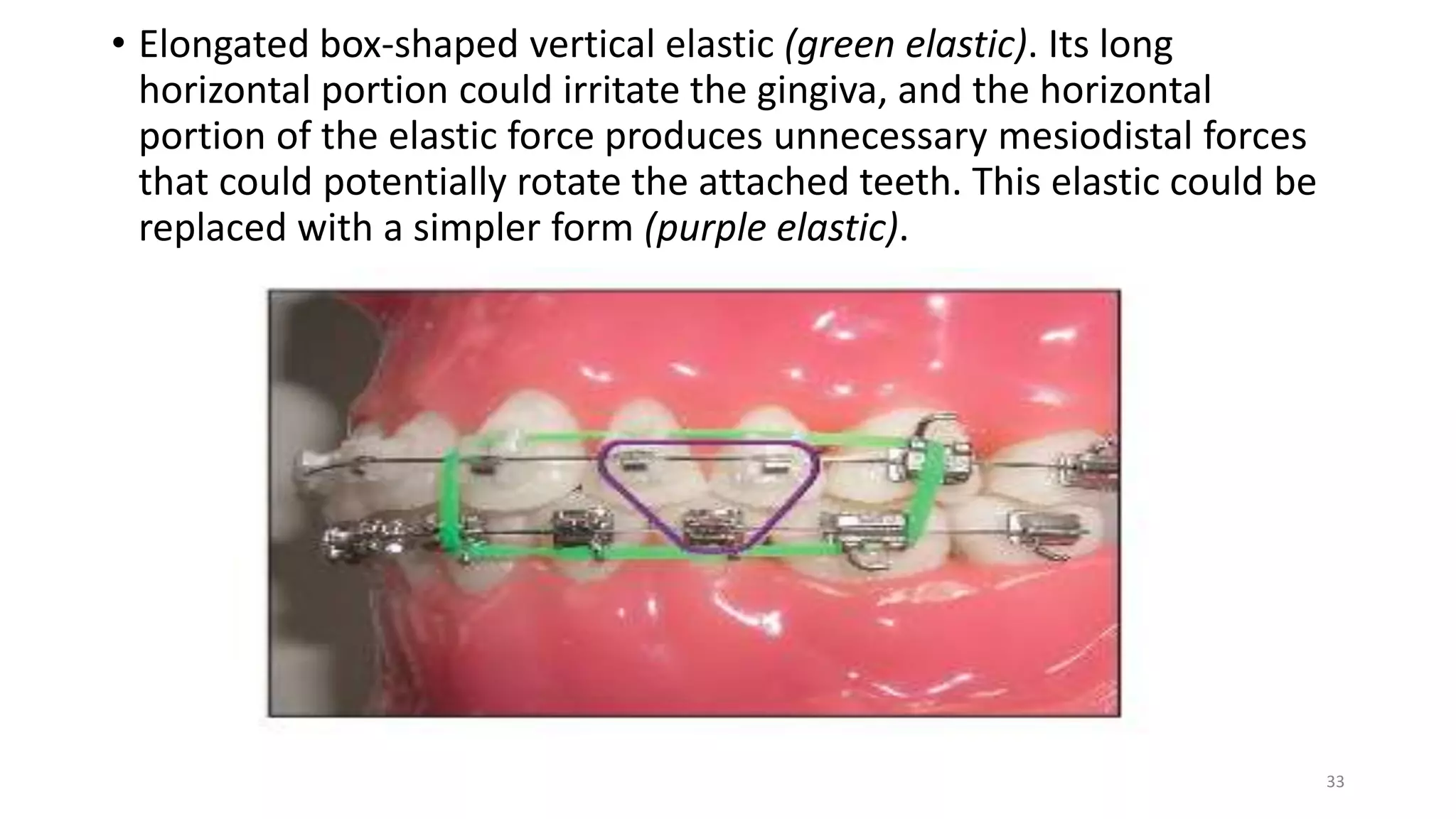
• Elongated box-shaped vertical elastic (green elastic). Its long
horizontal portion could irritate the gingiva, and the horizontal
portion of the elastic force produces unnecessary mesiodistal forces
that could potentially rotate the attached teeth. This elastic could be
replaced with a simpler form (purple elastic).
33
Elastic Redundancy
• Orthodontic patients are sometimes seen wearing many elastics in a
complicated manner.
• It is therefore desirable to simplify the use of maxillomandibular
elastics, both for the orthodontist, so he or she can better understand
the force system, and for the patient, so he or she can more easily
insert them.
• Multiple elastics can challenge patient compliance. It would be
simpler to use only one elastic that acts as the resultant of the many
elastic forces.
• The best approach is to first determine what type of arch movement
(translation and rotation around the CR) is required and then to
establish the line of action of the elastic to achieve that goal.
34
• Pre stretching of elastics
• J. Young and J. L. Sandrik suggested in 1979 that the chains should be
pre-stretched by manufacturers or operator, which would decrease
the force loss of the elastic polymer.
• Allen. K. Wong suggested in 1976 that the elastomeric materials need
to pre-stretched 1/ 3rd of their length to pre stress the molecular
polymer chain. This procedure will increase the length of a material. If
the material is over stretched a slow set will occur but will go back to
original state in time. If the material is over stretched to near breaking
point, over and over again permanent plastic deformation will occur.
These means that the initial force may come to an effect during an
pre stretched process. So when it is in use it will give more stable
force.
35
• Fluoride release from orthodontic elastic chain
• Plaque accumulation around the fixed orthodontic appliance will cause
dental and periodontal decease. Decalcification can be avoided by
mechanical removal of plaque or by topical fluoride application or with a
mechanical sealant layer
• Controlled fluoride release device (CFRD) have been in use since 1980’s. in
such device a co-polymer membrane allows a reservoir of fluoride ions to
migrate into oral environment rate. The permanent study was designed to
a stannous fluoride release from a fluoride impregnated elastic power
chain.
• The delivery of stannous fluoride by means of power chain would
presumably reduce count and inhibit demineralization.(An average of
0.025mg of fluoride is necessary for reminerilization).But this protection is
only temporary and of a continued exposure needs, the elastic should be
replaced at weekly intervals. The force degradation property will be higher
with the fluorinated elastic chain.
36
Controlled fluoride release device (CFRD)
37
• Conclusion
• Elastics are one of the most versatile material available to the
orthodontist .
• Its an invaluable tool of the orthodontist armamentarium.
• An Orthodontist who does not exploit these materials to the fullest is
not doing justice to the patient.
• As a matter of fact it is all but impossible to practice in this branch of
dentistry without this material.
• It is a simple yet imprecise appliance which can be used for many
purposes in Orthodontic practice.
38
Reference
• Adams CD, Meikle MC, Norwick KW, Turpin DL. Dentofacial remodeling produced by intermaxillary
forces in Macaca mu- latta. Arch Oral Biol 1972;17:1519–1535.
• Dermaut LR, Beerden L. The effects of Class II elastic force on a dry skull measured by holographic
interferometry. Am J Or- thod 1981;79:296–304.
• Hanes RA. Bony profile changes resulting from cervical trac- tion compared with those resulting
from intermaxillary elas- tics. Am J Orthod 1959;45:353–364.
• Kim KH, Chung CH, Choy K, Lee JS, Vanarsdall RL. Effects of prestretching on force degradation of
synthetic elastomeric chains. Am J Orthod Dentofacial Orthop 2005;128:477–482.
• Kuster R, Ingervall B, Bürgin W. Laboratory and intra-oral tests of the degradation of elastic chains.
Eur J Orthod 1986;8:202–208.
• Reddy P, Kharbanda OP, Duggal R, Parkash H. Skeletal and dental changes with nonextraction Begg
mechanotherapy in patients with Class II division 1 malocclusion. Am J Orthod Dentofacial Orthop
2000;118:641–648.
39
Thank you
40

Elastics in Orthodontics-II

  • 1.
    Elastics in Orthodontics-II Guidedby-Dr. Jeevan M. Khatri sir (Professor & HOD) Dept. of Orthodontics and Dentofacial Orthopaedics Presented by-Krutika A. Patankar (3rd YR MDS) 1
  • 2.
    Content • Overview • Colourcoding • Force level • Types of elastics • Biomechanics of elastics • Synchronous class II elastics • Asynchronous class II elastics • Non rigid arches with third order play • Elastic Redundancy • Pre-stretching of elastics • Fluoridated elastic chain • Conclusion 2
  • 3.
    • Maxillomandibular elastics(or intermaxillary elastics) are commonly used because of their simplicity; however, a lack of understanding of their force system can lead to many serious problems. • Elastics are usually classified by the direction of the force (eg, Class II or Class III elastics). • Sometimes force magnitude is considered, but point of force application is left out. Therefore, many different types of Class II elastics can be applied. There are short or long elastics. • Often too many elastics are used when a single resultant elastic at the correct location would work better. However, sometimes more than a single elastic is needed when the attachment point is not directly accessible. • All maxillomandibular elastics and their actions should be analyzed in three dimensions. 3
  • 4.
    Elastics according tocolour coding 4
  • 5.
    Force level fordifferent tooth movement. • En-mass movement (non extraction) – class 2 / 3 elastics = 5-6 ounces 142-170g • En-mass movement (extraction) – class 2 / 3 elastics = 4-5 ounces / 113-142g • Anterior elastics – box elastic for anterior openbite = 1-2 ounces / 28- 57g • Posterior box elastics = 6 ounces / 170g • The difference in force levels required for non-extraction Vs extraction cases has been attributed to the greater number of teeth / units in non-extraction cases, requiring greater force levels for en mass movement. 5
  • 6.
  • 7.
  • 8.
    • A recentstudy found that 1/4” / 6.4mm elastics covered a wider range of force levels compared to 3/16 / 4.8mm elastics. • Conclusion: 1/4” / 6.4mm and /16 / 4.8mm fulfil most clinical situations, except for box elastics 8
  • 9.
    Two main typesof Class II elastics are used • Short Class II elastics • Long Class II elastics 9
  • 10.
    6 vector componentsare observed 10
  • 11.
    • Traditionally itis attached from upper canine to lower first molar • Thurow (1970) suggested from upper canine to lower 2nd molar • Alexander (1986) suggested from distal wing of upper laterals to lower 2nd molar. • According to Thurow (1977 )-from upper canine to lower 1stmolar: H:96%, V:27% 11
  • 12.
    If it isstretched from upper canine to lower 2nd molar: H: 97%, V:20% 12
  • 13.
    On 1st premolarextraction and space closure 13
  • 14.
    • Thus toget the maximum distal driving force with minimum vertical force, elastics should be applied from farthest distal point i.e. distal of mandibular 2nd molar. • This type of stress distribution (Horizontal and Vertical) for a given movement is independent of the force magnitude but directly related to direction of force application. • The vertical components extrudes the teeth, tips the occlusal plane, thereby causing a rotational opening of the mandible • The horizontal components bring the teeth to a better A-P relation but are unstable due to abnormal location of the teeth in the alveolar bone. 14
  • 15.
    Synchronous Class IIElastics • Long Class II elastic. (a and b) A single force from the elastic (red arrow) is replaced with an equivalent force system (yellow arrows) at the CRs of the maxillary and mandibular arches. (c) Both arches rotate synchronously (dotted curved arrows) in the same clockwise direction because of the same magnitude and direction of the moments (D1 = D2). (d) Lateral superimposition of cephalometric radiographs before (black) and after (red) long-term use of Class II maxillomandibular elastics in an extraction case using round wire. Both the maxillary and mandibular arches rotated in a clockwise direction, with extrusion of the maxillary anterior teeth and mandibular posterior teeth. 15
  • 16.
    • Short ClassII elastic. A single force from the elastic (red arrows) is replaced with an equivalent force system (yellow arrows) at the CR of each arch. It is also synchronous because the CR is an equal distance from the force in each arch (D1 = D2). The moment is lower and the vertical component of force is greater than that with the long Class II elastic. 16
  • 17.
    Asynchronous Class IIElastics • Short Class II elastic placed anteriorly. (a and b) A single force from the elastic (red arrow) is replaced with an equivalent force system (yellow arrows) at the CR of the maxillary arch. 17
  • 18.
    (c) The momentin respect to the CR will be different for each arch; therefore, only the maxillary arch rotates asynchronously. 18
  • 19.
    • Short ClassII elastic placed posteriorly. (a and b) A single force from the elastic (red arrow) is replaced with an equivalent force system (yellow arrows) at the CR of the mandibular arch. 19
  • 20.
    • (c) Themoment in respect to the CR will be different for each arch; therefore, only the mandibular arch rotates asynchronously. 20
  • 21.
    • Anterior verticalelastic. The maxillary and mandibular arches will rotate in opposite directions, leading to an increase in vertical overlap. Most of the rotation will occur in the maxillary arch (D1 > D2). 21
  • 22.
    • Short ClassII elastic force (red arrow) placed anteriorly in a Class II open bite case. An equivalent force system at the CR of the maxillary arch (yellow arrows) indicates that a large moment is only produced in the maxillary arch, closing the open bite and reducing the Class II malocclusion. The cant of the mandibular plane of occlusion will not change. 22
  • 23.
    • Short ClassIII elastic placed anteriorly in a Class III open bite case. (a) The single force (red arrow) is through the CR of the maxillary arch. (b) An equivalent force system at the CR of the mandibular arch (yellow arrows) has a large moment, closing the open bite and reducing the Class III malocclusion. The cant of the maxillary plane of occlusion will not change. 23
  • 24.
    • Short ClassII elastic placed posteriorly in a Class II deep bite case. (a) The single force (red arrow) is through the CR of the maxillary arch. (b) An equivalent force system at the CR of the mandibular arch (yellow arrows) produces a large moment, opening the bite and reducing the vertical overlap. The cant of the maxillary occlusal plane will not change. 24
  • 25.
    Nonrigid Arches withThird-Order Play • If round wires are used, one might expect a similar response; however, incisors could change their axial inclinations. There would be less change in the cants of the occlusal planes with full rigidity of wires and teeth. Furthermore, with a round wire without third-order control, maxillary molars can tip to the buccal, and mandibular molars can tip to the lingual, resulting in a crossbite (also known as a scissor bite). 25
  • 26.
    • Frontal viewof the long Class II elastic shown in Fig below The replaced equivalent force system (yellow arrows) at the CR shows that the mandibular second molar (terminal molar) will move in a superior direction; at the same time, the moment produced by the elastic at the CR will tip the molar crown lingually. 26
  • 27.
    Lateral or CrisscrossElastics • Unilateral posterior crisscross elastic in a continuous arch. (a) The forces from the crisscross elastic (red arrows) are replaced with equivalent force systems at the CRs (yellow arrows). (b) Asynchronous occlusal plane effects causing an open bite on the left side are anticipated. 27
  • 28.
    • (a) Tobalance the moment created by the unilateral posterior crisscross elastic in, a vertical elastic force (red arrow) is applied on the left side. The vertical elastic’s equivalent force system at the CR (yellow arrows) is equal and opposite to the moment from the crisscross elastic on the right side. (b) The yellow arrows are the resultant from the two elastics. (c) The resultant force is replaced with the equivalent force system at each CR (yellow arrows). 28
  • 29.
    • Bilateral crisscrosselastics. (a) The resultant (yellow arrows) of the two forces of the crisscross elastics (red arrows) lies an equal distance (D1 = D2) from the maxillary and mandibular CRs. (b) The equivalent force systems at the CRs of each arch have synchronous moments (yellow arrows), rotating the maxillary and mandibular arches equally so that no lateral open bite will be produced. 29
  • 30.
    • Ant criss-cross elastics for midline correction 30
  • 31.
    • Anterior crisscrosselastic (red arrows) placed off-center. Equivalent force systems (yellow arrows) at the CRs show a maxillary occlusal plane that rotates very little (a) and not at all (b) because D1 is very small. Therefore, the cant of the maxillary occlusal plane will be maintained. An open bite may occur on the right side because of the counterclockwise rotation of the mandibular arch due to the large moment at the mandibular CR (large D2). 31
  • 32.
    Vertical elastics • Anteriorvertical elastics used to enhance canine extrusion; however, the force of the elastics is anterior to the maxillary and mandibular CRs, so these elastics will increase the deep bite. 32
  • 33.
    • Elongated box-shapedvertical elastic (green elastic). Its long horizontal portion could irritate the gingiva, and the horizontal portion of the elastic force produces unnecessary mesiodistal forces that could potentially rotate the attached teeth. This elastic could be replaced with a simpler form (purple elastic). 33
  • 34.
    Elastic Redundancy • Orthodonticpatients are sometimes seen wearing many elastics in a complicated manner. • It is therefore desirable to simplify the use of maxillomandibular elastics, both for the orthodontist, so he or she can better understand the force system, and for the patient, so he or she can more easily insert them. • Multiple elastics can challenge patient compliance. It would be simpler to use only one elastic that acts as the resultant of the many elastic forces. • The best approach is to first determine what type of arch movement (translation and rotation around the CR) is required and then to establish the line of action of the elastic to achieve that goal. 34
  • 35.
    • Pre stretchingof elastics • J. Young and J. L. Sandrik suggested in 1979 that the chains should be pre-stretched by manufacturers or operator, which would decrease the force loss of the elastic polymer. • Allen. K. Wong suggested in 1976 that the elastomeric materials need to pre-stretched 1/ 3rd of their length to pre stress the molecular polymer chain. This procedure will increase the length of a material. If the material is over stretched a slow set will occur but will go back to original state in time. If the material is over stretched to near breaking point, over and over again permanent plastic deformation will occur. These means that the initial force may come to an effect during an pre stretched process. So when it is in use it will give more stable force. 35
  • 36.
    • Fluoride releasefrom orthodontic elastic chain • Plaque accumulation around the fixed orthodontic appliance will cause dental and periodontal decease. Decalcification can be avoided by mechanical removal of plaque or by topical fluoride application or with a mechanical sealant layer • Controlled fluoride release device (CFRD) have been in use since 1980’s. in such device a co-polymer membrane allows a reservoir of fluoride ions to migrate into oral environment rate. The permanent study was designed to a stannous fluoride release from a fluoride impregnated elastic power chain. • The delivery of stannous fluoride by means of power chain would presumably reduce count and inhibit demineralization.(An average of 0.025mg of fluoride is necessary for reminerilization).But this protection is only temporary and of a continued exposure needs, the elastic should be replaced at weekly intervals. The force degradation property will be higher with the fluorinated elastic chain. 36
  • 37.
  • 38.
    • Conclusion • Elasticsare one of the most versatile material available to the orthodontist . • Its an invaluable tool of the orthodontist armamentarium. • An Orthodontist who does not exploit these materials to the fullest is not doing justice to the patient. • As a matter of fact it is all but impossible to practice in this branch of dentistry without this material. • It is a simple yet imprecise appliance which can be used for many purposes in Orthodontic practice. 38
  • 39.
    Reference • Adams CD,Meikle MC, Norwick KW, Turpin DL. Dentofacial remodeling produced by intermaxillary forces in Macaca mu- latta. Arch Oral Biol 1972;17:1519–1535. • Dermaut LR, Beerden L. The effects of Class II elastic force on a dry skull measured by holographic interferometry. Am J Or- thod 1981;79:296–304. • Hanes RA. Bony profile changes resulting from cervical trac- tion compared with those resulting from intermaxillary elas- tics. Am J Orthod 1959;45:353–364. • Kim KH, Chung CH, Choy K, Lee JS, Vanarsdall RL. Effects of prestretching on force degradation of synthetic elastomeric chains. Am J Orthod Dentofacial Orthop 2005;128:477–482. • Kuster R, Ingervall B, Bürgin W. Laboratory and intra-oral tests of the degradation of elastic chains. Eur J Orthod 1986;8:202–208. • Reddy P, Kharbanda OP, Duggal R, Parkash H. Skeletal and dental changes with nonextraction Begg mechanotherapy in patients with Class II division 1 malocclusion. Am J Orthod Dentofacial Orthop 2000;118:641–648. 39
  • 40.