Linux Kernel 
Development 
Greg Kroah-Hartman 
gregkh@linuxfoundation.org 
github.com/gregkh/kernel-development
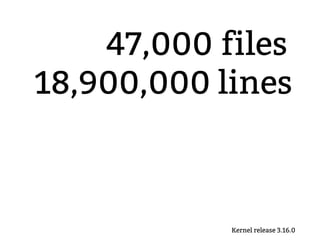
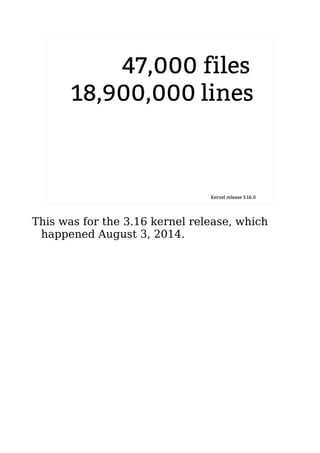
47,000 files 
18,900,000 lines 
Kernel release 3.16.0
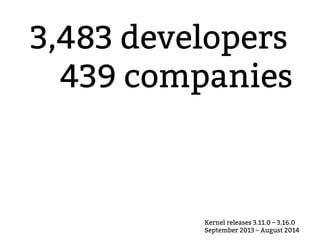
3,483 developers 
439 companies 
Kernel releases 3.11.0 – 3.16.0 
September 2013 – August 2014
8,700 lines added 
3,880 lines removed 
1,900 lines modified 
Kernel releases 3.11.0 – 3.16.0 
September 2013 – August 2014
8,700 lines added 
3,880 lines removed 
1,900 lines modified 
Every day 
Kernel releases 3.11.0 – 3.16.0 
September 2013 – August 2014
7.6 changes per hour 
Kernel releases 3.11.0 – 3.16.0 
September 2013 – August 2014
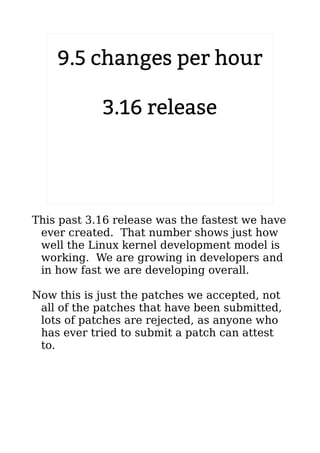
9.5 changes per hour 
3.16 release 
2.6.20 to 2.6.24-rc8
How we stay sane 
Time based releases 
Incremental changes 
2.6.20 to 2.6.24-rc8
New release every 
2½ months 
Kernel releases 3.10.0 – 3.14.0
“Longterm kernels” 
One picked per year 
Maintained for two years 
3.10 3.14 
2.6.20 to 2.6.24-rc8
commit ecf85e481a716cfe07406439fdc7ba9526bbfaeb 
Author: Robert Jarzmik <robert.jarzmik@free.fr> 
AuthorDate: Tue Apr 21 20:33:10 2009 -0700 
Commit: Greg Kroah-Hartman <gregkh@suse.de> 
CommitDate: Thu Apr 23 14:15:31 2009 -0700 
USB: otg: Fix bug on remove path without transceiver 
In the case where a gadget driver is removed while no 
transceiver was found at probe time, a bug in 
otg_put_transceiver() will trigger. 
Signed-off-by: Robert Jarzmik <robert.jarzmik@free.fr> 
Acked-by: David Brownell <dbrownell@users.sourceforge.net> 
Signed-off-by: Greg Kroah-Hartman <gregkh@suse.de> 
--- a/drivers/usb/otg/otg.c 
+++ b/drivers/usb/otg/otg.c 
@@ -43,7 +43,8 @@ EXPORT_SYMBOL(otg_get_transceiver); 
void otg_put_transceiver(struct otg_transceiver *x) 
{ 
- put_device(x->dev); 
+ if (x) 
+ put_device(x->dev); 
}
Developer's Certificate of Origin 
(a) I created this change; or 
(b) Based this on a previous work with a 
compatible license; or 
(c) Provided to me by (a), (b), or (c) and not 
modified 
(d) This contribution is public.
Top developers by quantity 
H. Hartley Sweeten 1459 
Sachin Kamat 1288 
Jingoo Han 1167 
Laurent Pinchart 820 
Alex Deucher 642 
Daniel Vetter 633 
Lars-Peter Clausen 566 
Mark Brown 537 
Jes Sorensen 530 
Ville Syrjälä 527 
Kernel releases 3.11.0 – 3.16.0
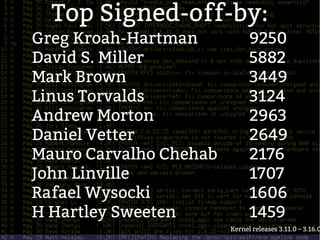
Top Signed-off-by: 
Greg Kroah-Hartman 9250 
David S. Miller 5882 
Mark Brown 3449 
Linus Torvalds 3124 
Andrew Morton 2963 
Daniel Vetter 2649 
Mauro Carvalho Chehab 2176 
John Linville 1707 
Rafael Wysocki 1606 
H Hartley Sweeten 1459 
Kernel releases 3.11.0 – 3.16.0
Who is funding this work? 
1. Intel 10.6% 
2. “Amateurs” 10.1% 
3. Red Hat 8.4% 
4. Linaro 6.3% 
5. Unknown Individuals 5.6% 
6. Samsung 4.5% 
7. IBM 3.3% 
8. SuSE 3.0% 
9. Texas Instruments 2.5% 
10. Consultants 2.5% 
Kernel releases 3.11.0 – 3.16.0
Who is funding this work? 
11. Google 2.0% 
12. Vision Engraving 2.0% 
13. Renesas 2.0% 
14. Freescale 1.7% 
15. Free Electrons 1.6% 
16. FOSS OPFW 1.4% 
17. Oracle 1.2% 
18. AMD 1.2% 
19. Nvidia 1.2% 
20. Huawei 1.2% 
Kernel releases 3.10.0 – 3.14.0
“Working upstream 
saves time and money” 
Dan Frye – VP Open Systems, IBM 
Dirk Hohndel – Chief Technologist, Intel 
2.6.20 to 2.6.24-rc8
Getting involved 
Run the kernel.org release on your machine 
2.6.20 to 2.6.24-rc8
Getting involved 
2.6.20 to 2.6.24-rc8
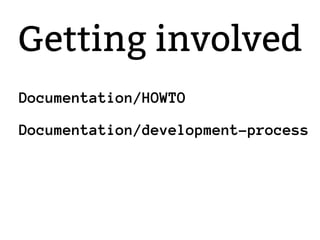
Getting involved 
Documentation/HOWTO 
Documentation/development-process 
2.6.20 to 2.6.24-rc8
Getting involved 
2.6.20 to 2.6.24-rc8 
kernelnewbies.org
Getting involved 
Google “write your first kernel patch” 
2.6.20 to 2.6.24-rc8
Getting involved 
kernelnewbies.org/KernelJanitors/Todo 
2.6.20 to 2.6.24-rc8
Getting involved 
http://eudyptula-challenge.org/ 
2.6.20 to 2.6.24-rc8 
Eudyptula Challenge 
(little penguin)
Getting involved 
Linux Driver Project 
drivers/staging/*/TODO 
2.6.20 to 2.6.24-rc8
github.com/gregkh/kernel-development
Linux Kernel 
Development 
Greg Kroah-Hartman 
gregkh@linuxfoundation.org 
github.com/gregkh/kernel-development 
I'm going to discuss the how fast the kernel is 
moving, how we do it all, and how you can 
get involved.
47,000 files 
18,900,000 lines 
Kernel release 3.16.0 
This was for the 3.16 kernel release, which 
happened August 3, 2014.
3,483 developers 
439 companies 
Kernel releases 3.11.0 – 3.16.0 
September 2013 – August 2014 
This makes the Linux kernel the largest 
contributed body of software out there that 
we know of. 
This is just the number of companies that we 
know about, there are more that we do not, 
and as the responses to our inquiries come 
in, this number will go up. 
Have surpassed 400 companies for 2 years 
now.
8,700 lines added 
3,880 lines removed 
1,900 lines modified 
Kernel releases 3.11.0 – 3.16.0 
September 2013 – August 2014
8,700 lines added 
3,880 lines removed 
1,900 lines modified 
Every day 
Kernel releases 3.11.0 – 3.16.0 
September 2013 – August 2014
7.6 changes per hour 
Kernel releases 3.11.0 – 3.16.0 
September 2013 – August 2014 
This is 24 hours a day, 7 days a week, for a full 
year. 
We went this fast the year before this as well, 
this is an amazing rate of change. 
Interesting note, all of these changes are all 
through the whole kernel. 
For example, the core kernel is only 5% of the 
code, and 5% of the change was to the core 
kernel. Drivers are 55%, and 55% was done 
to them, it's completely proportional all 
across the whole kernel.
9.5 changes per hour 
3.16 release 
2.6.20 to 2.6.24-rc8 
This past 3.16 release was the fastest we have 
ever created. That number shows just how 
well the Linux kernel development model is 
working. We are growing in developers and 
in how fast we are developing overall. 
Now this is just the patches we accepted, not 
all of the patches that have been submitted, 
lots of patches are rejected, as anyone who 
has ever tried to submit a patch can attest 
to.
How we stay sane 
Time based releases 
Incremental changes 
2.6.20 to 2.6.24-rc8
New release every 
2½ months 
Kernel releases 3.10.0 – 3.14.0 
67 days to be exact, very regular experience.
How a kernel is developed. 
Linus releases a stable kernel 
- 2 week merge window from subsystem 
maintainers 
- rc1 is released 
- bugfixes only now 
- 2 weeks later, rc2 
- bugfixes and regressions 
- 2 weeks later,rc3 
And so on until all major bugfixes and 
regressions are resolved and then the cycle 
starts over again.
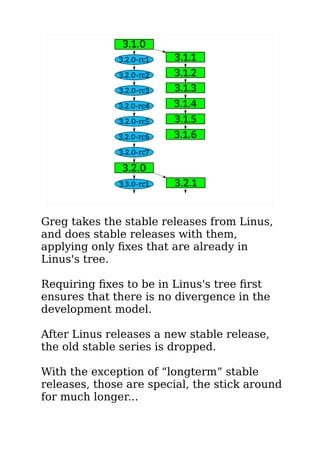
Greg takes the stable releases from Linus, 
and does stable releases with them, 
applying only fixes that are already in 
Linus's tree. 
Requiring fixes to be in Linus's tree first 
ensures that there is no divergence in the 
development model. 
After Linus releases a new stable release, 
the old stable series is dropped. 
With the exception of “longterm” stable 
releases, those are special, the stick around 
for much longer...
“Longterm kernels” 
One picked per year 
Maintained for two years 
3.10 3.14 
2.6.20 to 2.6.24-rc8 
I pick one kernel release per year to maintain for 
longer than one release cycle. This kernel I will 
maintain for at least 2 years. 
This means there are 2 longterm kernels being 
maintained at the same time. 
3.4 and 3.10 are the longterm kernel releases I am 
maintaining. 
3.4 will stop being maintained in October. 
Ben Hutchings is maintaining the 3.2 kernel as a 
longterm kernel for the Debian project. 
The LTSI project is based on the longterm kernels.
Like mentioned before, we have almost 3000 
individual contributors. They all create a 
patch, a single change to the Linux kernel. 
This change could be something small, like a 
spelling correction, or something larger, like 
a whole new driver. 
Every patch that is created only does one 
thing, and it can not break the build, 
complex changes to the kernel get broken 
up into smaller pieces.
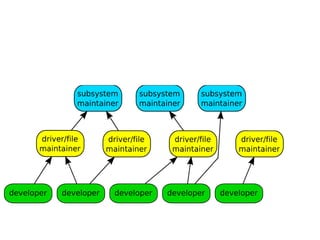
The developers send their patch to the 
maintainer of the file(s) that they have 
modified. 
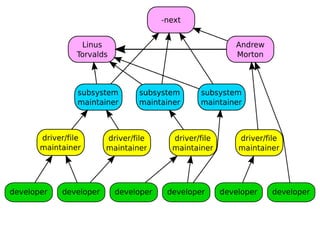
We have about 700 different 
driver/file/subsystem maintainers
commit ecf85e481a716cfe07406439fdc7ba9526bbfaeb 
Author: Robert Jarzmik <robert.jarzmik@free.fr> 
AuthorDate: Tue Apr 21 20:33:10 2009 -0700 
Commit: Greg Kroah-Hartman <gregkh@suse.de> 
CommitDate: Thu Apr 23 14:15:31 2009 -0700 
USB: otg: Fix bug on remove path without transceiver 
In the case where a gadget driver is removed while no 
transceiver was found at probe time, a bug in 
otg_put_transceiver() will trigger. 
Signed-off-by: Robert Jarzmik <robert.jarzmik@free.fr> 
Acked-by: David Brownell <dbrownell@users.sourceforge.net> 
Signed-off-by: Greg Kroah-Hartman <gregkh@suse.de> 
--- a/drivers/usb/otg/otg.c 
+++ b/drivers/usb/otg/otg.c 
@@ -43,7 +43,8 @@ EXPORT_SYMBOL(otg_get_transceiver); 
void otg_put_transceiver(struct otg_transceiver *x) 
{ 
- put_device(x->dev); 
+ if (x) 
+ put_device(x->dev); 
} 
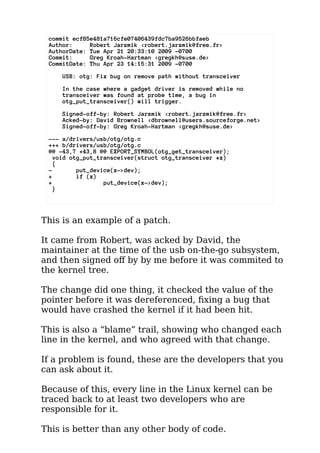
This is an example of a patch. 
It came from Robert, was acked by David, the 
maintainer at the time of the usb on-the-go subsystem, 
and then signed off by by me before it was commited to 
the kernel tree. 
The change did one thing, it checked the value of the 
pointer before it was dereferenced, fixing a bug that 
would have crashed the kernel if it had been hit. 
This is also a “blame” trail, showing who changed each 
line in the kernel, and who agreed with that change. 
If a problem is found, these are the developers that you 
can ask about it. 
Because of this, every line in the Linux kernel can be 
traced back to at least two developers who are 
responsible for it. 
This is better than any other body of code.
Developer's Certificate of Origin 
(a) I created this change; or 
(b) Based this on a previous work with a 
compatible license; or 
(c) Provided to me by (a), (b), or (c) and not 
modified 
(d) This contribution is public. 
This is what “Signed-off-by:” means. 
All contributions to the Linux kernel have to 
agree to this, and every single patch has at 
least one signed-off-by line, usually all have 
at least two. 
This is also a “blame” trail, showing who 
changed each line in the kernel, and who 
agreed with that change. 
If a problem is found, this is the developers 
that you can ask about it. 
Because of this, every line in the Linux 
kernel can be traced back to at least two 
developers who are responsible for it. 
This is better than any other body of code.
After reviewing the code, and adding their 
own signed-off-by to the patch, the 
file/driver maintainer sends the patch to the 
subsystem maintainer responsible for that 
portion of the kernel. 
We have around 150 subsystem maintainers
Linux-next gets created every night from all 
of the different subsystem trees and build 
tested on a wide range of different 
platforms. 
We have about 150 different trees in the 
linux-next release. 
Andrew Morton picks up patches that cross 
subsystems, or are missed by others, and 
releases his -mm kernels every few weeks. 
This includes the linux-next release at that 
time.
Every 3 months, when the merge window 
opens up, everything gets sent to Linus from 
the subsystem maintainers and Andrew 
Morton. 
The merge window is 2 weeks long, and 
thousands of patches get merged in that 
short time. 
All of the patches merged to Linus should 
have been in the linux-next release, but that 
isn't always the case for various reasons. 
Linux-next can not just be sent to Linus as 
there are things in there that sometimes are 
not good enough to be merged just yet, it is 
up to the individual subsystem maintainer to 
decide what to merge.
Top developers by quantity 
H. Hartley Sweeten 1459 
Sachin Kamat 1288 
Jingoo Han 1167 
Laurent Pinchart 820 
Alex Deucher 642 
Daniel Vetter 633 
Lars-Peter Clausen 566 
Mark Brown 537 
Jes Sorensen 530 
Ville Syrjälä 527 
Kernel releases 3.11.0 – 3.16.0 
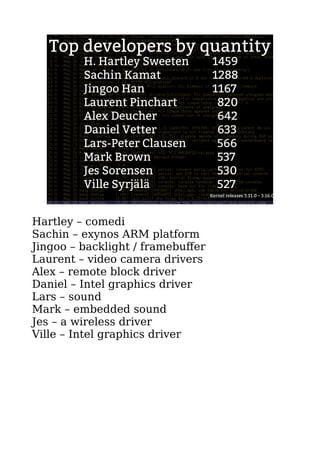
Hartley – comedi 
Sachin – exynos ARM platform 
Jingoo – backlight / framebuffer 
Laurent – video camera drivers 
Alex – remote block driver 
Daniel – Intel graphics driver 
Lars – sound 
Mark – embedded sound 
Jes – a wireless driver 
Ville – Intel graphics driver
Top Signed-off-by: 
Greg Kroah-Hartman 9250 
David S. Miller 5882 
Mark Brown 3449 
Linus Torvalds 3124 
Andrew Morton 2963 
Daniel Vetter 2649 
Mauro Carvalho Chehab 2176 
John Linville 1707 
Rafael Wysocki 1606 
H Hartley Sweeten 1459 
Kernel releases 3.11.0 – 3.16.0 
Greg – driver core, usb, staging 
David – networking 
Mark – embedded sound 
Linus – everything 
Andrew – everything 
Daniel – Intel graphics 
Mauro – v4l 
John – wireless networking 
Rafael – ACPI / power management 
Hartley – comedi data acquisition
Who is funding this work? 
1. Intel 10.6% 
2. “Amateurs” 10.1% 
3. Red Hat 8.4% 
4. Linaro 6.3% 
5. Unknown Individuals 5.6% 
6. Samsung 4.5% 
7. IBM 3.3% 
8. SuSE 3.0% 
9. Texas Instruments 2.5% 
10. Consultants 2.5% 
Kernel releases 3.11.0 – 3.16.0 
So you can view this as either 17% is done by 
non-affiliated people, or 83% is done by 
companies. 
Now to be fair, if you show any skill in kernel 
development you are instantly hired. 
Why this all matters: If your company relies 
on Linux, and it depends on the future of 
Linux supporting your needs, then you 
either trust these other companies are 
developing Linux in ways that will benefit 
you, or you need to get involved to make 
sure Linux works properly for your 
workloads and needs.
Who is funding this work? 
11. Google 2.0% 
12. Vision Engraving 2.0% 
13. Renesas 2.0% 
14. Freescale 1.7% 
15. Free Electrons 1.6% 
16. FOSS OPFW 1.4% 
17. Oracle 1.2% 
18. AMD 1.2% 
19. Nvidia 1.2% 
20. Huawei 1.2% 
Kernel releases 3.10.0 – 3.14.0 
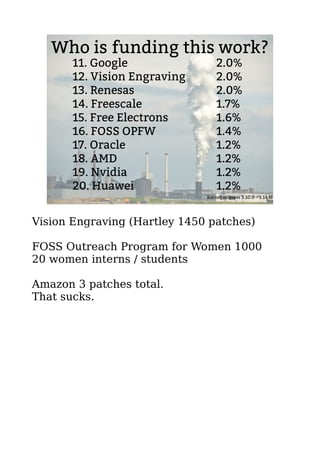
Vision Engraving (Hartley 1450 patches) 
FOSS Outreach Program for Women 1000 
20 women interns / students 
Amazon 3 patches total. 
That sucks.
“Working upstream 
saves time and money” 
Dan Frye – VP Open Systems, IBM 
Dirk Hohndel – Chief Technologist, Intel 
2.6.20 to 2.6.24-rc8
Getting involved 
2.6.20 to 2.6.24-rc8 
10,900 per Run the kernel.org release on your machine
Getting involved 
2.6.20 to 2.6.24-rc8 
10,900 per This book tells you how to build and install a kernel 
on your machine. 
Free online
Getting involved 
Documentation/HOWTO 
Documentation/development-process 
2.6.20 to 2.6.24-rc8 
These documents in the kernel source 
directory are the best place to start if you 
want to understand how the development 
process works, and how to get involved. 
The HOWTO file has links to almost 
everything else you ever wanted..
Getting involved 
2.6.20 to 2.6.24-rc8 
kernelnewbies.org 
http://www.kernelnewbies.org
Getting involved 
Google “write your first kernel patch” 
2.6.20 to 2.6.24-rc8 
This is a video of a talk I gave at FOSDEM, 
going through the steps, showing exactly 
how to create, build, and send a kernel 
patch.
Getting involved 
kernelnewbies.org/KernelJanitors/Todo 
2.6.20 to 2.6.24-rc8 
So you know how to create a patch, but 
what should you do? The kernel janitors has 
a great list of tasks to start with in cleaning 
up the kernel and making easy patches to be 
accepted.
Getting involved 
http://eudyptula-challenge.org/ 
2.6.20 to 2.6.24-rc8 
Eudyptula Challenge 
(little penguin) 
Google “Linux kernel challenge” to find the 
site, if you can't remember Eudyptula. 
It is a series of programming challenges, all 
run through email that starts out with a 
“Hello World” kernel module, and gets more 
complex from there. Over 4000 people are 
currently taking the challenge, and is a lot 
of fun if you don't know where to start out. 
You need knowledge of C, but that's about it.
Getting involved 
Linux Driver Project 
drivers/staging/*/TODO 
2.6.20 to 2.6.24-rc8 
The staging tree also needs a lot of help, here 
are lists of things to do in the kernel for the 
drivers to be able to move out of the staging 
area. 
Please always work off of the linux-next tree if 
you want to do these tasks, as sometimes 
they are already done by others by the time 
you see them in Linus's tree.
github.com/gregkh/kernel-development 
Obligatory Penguin Picture
Kernel Recipes 2014 - The Linux Kernel, how fast it is developed and how we stay sane doing it.

Kernel Recipes 2014 - The Linux Kernel, how fast it is developed and how we stay sane doing it.

  • 1.
    Linux Kernel Development Greg Kroah-Hartman gregkh@linuxfoundation.org github.com/gregkh/kernel-development
  • 2.
    47,000 files 18,900,000lines Kernel release 3.16.0
  • 3.
    3,483 developers 439companies Kernel releases 3.11.0 – 3.16.0 September 2013 – August 2014
  • 4.
    8,700 lines added 3,880 lines removed 1,900 lines modified Kernel releases 3.11.0 – 3.16.0 September 2013 – August 2014
  • 5.
    8,700 lines added 3,880 lines removed 1,900 lines modified Every day Kernel releases 3.11.0 – 3.16.0 September 2013 – August 2014
  • 6.
    7.6 changes perhour Kernel releases 3.11.0 – 3.16.0 September 2013 – August 2014
  • 7.
    9.5 changes perhour 3.16 release 2.6.20 to 2.6.24-rc8
  • 8.
    How we staysane Time based releases Incremental changes 2.6.20 to 2.6.24-rc8
  • 9.
    New release every 2½ months Kernel releases 3.10.0 – 3.14.0
  • 12.
    “Longterm kernels” Onepicked per year Maintained for two years 3.10 3.14 2.6.20 to 2.6.24-rc8
  • 15.
    commit ecf85e481a716cfe07406439fdc7ba9526bbfaeb Author:Robert Jarzmik <robert.jarzmik@free.fr> AuthorDate: Tue Apr 21 20:33:10 2009 -0700 Commit: Greg Kroah-Hartman <gregkh@suse.de> CommitDate: Thu Apr 23 14:15:31 2009 -0700 USB: otg: Fix bug on remove path without transceiver In the case where a gadget driver is removed while no transceiver was found at probe time, a bug in otg_put_transceiver() will trigger. Signed-off-by: Robert Jarzmik <robert.jarzmik@free.fr> Acked-by: David Brownell <dbrownell@users.sourceforge.net> Signed-off-by: Greg Kroah-Hartman <gregkh@suse.de> --- a/drivers/usb/otg/otg.c +++ b/drivers/usb/otg/otg.c @@ -43,7 +43,8 @@ EXPORT_SYMBOL(otg_get_transceiver); void otg_put_transceiver(struct otg_transceiver *x) { - put_device(x->dev); + if (x) + put_device(x->dev); }
  • 16.
    Developer's Certificate ofOrigin (a) I created this change; or (b) Based this on a previous work with a compatible license; or (c) Provided to me by (a), (b), or (c) and not modified (d) This contribution is public.
  • 20.
    Top developers byquantity H. Hartley Sweeten 1459 Sachin Kamat 1288 Jingoo Han 1167 Laurent Pinchart 820 Alex Deucher 642 Daniel Vetter 633 Lars-Peter Clausen 566 Mark Brown 537 Jes Sorensen 530 Ville Syrjälä 527 Kernel releases 3.11.0 – 3.16.0
  • 21.
    Top Signed-off-by: GregKroah-Hartman 9250 David S. Miller 5882 Mark Brown 3449 Linus Torvalds 3124 Andrew Morton 2963 Daniel Vetter 2649 Mauro Carvalho Chehab 2176 John Linville 1707 Rafael Wysocki 1606 H Hartley Sweeten 1459 Kernel releases 3.11.0 – 3.16.0
  • 22.
    Who is fundingthis work? 1. Intel 10.6% 2. “Amateurs” 10.1% 3. Red Hat 8.4% 4. Linaro 6.3% 5. Unknown Individuals 5.6% 6. Samsung 4.5% 7. IBM 3.3% 8. SuSE 3.0% 9. Texas Instruments 2.5% 10. Consultants 2.5% Kernel releases 3.11.0 – 3.16.0
  • 23.
    Who is fundingthis work? 11. Google 2.0% 12. Vision Engraving 2.0% 13. Renesas 2.0% 14. Freescale 1.7% 15. Free Electrons 1.6% 16. FOSS OPFW 1.4% 17. Oracle 1.2% 18. AMD 1.2% 19. Nvidia 1.2% 20. Huawei 1.2% Kernel releases 3.10.0 – 3.14.0
  • 24.
    “Working upstream savestime and money” Dan Frye – VP Open Systems, IBM Dirk Hohndel – Chief Technologist, Intel 2.6.20 to 2.6.24-rc8
  • 25.
    Getting involved Runthe kernel.org release on your machine 2.6.20 to 2.6.24-rc8
  • 26.
  • 27.
    Getting involved Documentation/HOWTO Documentation/development-process 2.6.20 to 2.6.24-rc8
  • 28.
    Getting involved 2.6.20to 2.6.24-rc8 kernelnewbies.org
  • 29.
    Getting involved Google“write your first kernel patch” 2.6.20 to 2.6.24-rc8
  • 30.
  • 31.
    Getting involved http://eudyptula-challenge.org/ 2.6.20 to 2.6.24-rc8 Eudyptula Challenge (little penguin)
  • 32.
    Getting involved LinuxDriver Project drivers/staging/*/TODO 2.6.20 to 2.6.24-rc8
  • 33.
  • 35.
    Linux Kernel Development Greg Kroah-Hartman gregkh@linuxfoundation.org github.com/gregkh/kernel-development I'm going to discuss the how fast the kernel is moving, how we do it all, and how you can get involved.
  • 36.
    47,000 files 18,900,000lines Kernel release 3.16.0 This was for the 3.16 kernel release, which happened August 3, 2014.
  • 37.
    3,483 developers 439companies Kernel releases 3.11.0 – 3.16.0 September 2013 – August 2014 This makes the Linux kernel the largest contributed body of software out there that we know of. This is just the number of companies that we know about, there are more that we do not, and as the responses to our inquiries come in, this number will go up. Have surpassed 400 companies for 2 years now.
  • 38.
    8,700 lines added 3,880 lines removed 1,900 lines modified Kernel releases 3.11.0 – 3.16.0 September 2013 – August 2014
  • 39.
    8,700 lines added 3,880 lines removed 1,900 lines modified Every day Kernel releases 3.11.0 – 3.16.0 September 2013 – August 2014
  • 40.
    7.6 changes perhour Kernel releases 3.11.0 – 3.16.0 September 2013 – August 2014 This is 24 hours a day, 7 days a week, for a full year. We went this fast the year before this as well, this is an amazing rate of change. Interesting note, all of these changes are all through the whole kernel. For example, the core kernel is only 5% of the code, and 5% of the change was to the core kernel. Drivers are 55%, and 55% was done to them, it's completely proportional all across the whole kernel.
  • 41.
    9.5 changes perhour 3.16 release 2.6.20 to 2.6.24-rc8 This past 3.16 release was the fastest we have ever created. That number shows just how well the Linux kernel development model is working. We are growing in developers and in how fast we are developing overall. Now this is just the patches we accepted, not all of the patches that have been submitted, lots of patches are rejected, as anyone who has ever tried to submit a patch can attest to.
  • 42.
    How we staysane Time based releases Incremental changes 2.6.20 to 2.6.24-rc8
  • 43.
    New release every 2½ months Kernel releases 3.10.0 – 3.14.0 67 days to be exact, very regular experience.
  • 44.
    How a kernelis developed. Linus releases a stable kernel - 2 week merge window from subsystem maintainers - rc1 is released - bugfixes only now - 2 weeks later, rc2 - bugfixes and regressions - 2 weeks later,rc3 And so on until all major bugfixes and regressions are resolved and then the cycle starts over again.
  • 45.
    Greg takes thestable releases from Linus, and does stable releases with them, applying only fixes that are already in Linus's tree. Requiring fixes to be in Linus's tree first ensures that there is no divergence in the development model. After Linus releases a new stable release, the old stable series is dropped. With the exception of “longterm” stable releases, those are special, the stick around for much longer...
  • 46.
    “Longterm kernels” Onepicked per year Maintained for two years 3.10 3.14 2.6.20 to 2.6.24-rc8 I pick one kernel release per year to maintain for longer than one release cycle. This kernel I will maintain for at least 2 years. This means there are 2 longterm kernels being maintained at the same time. 3.4 and 3.10 are the longterm kernel releases I am maintaining. 3.4 will stop being maintained in October. Ben Hutchings is maintaining the 3.2 kernel as a longterm kernel for the Debian project. The LTSI project is based on the longterm kernels.
  • 47.
    Like mentioned before,we have almost 3000 individual contributors. They all create a patch, a single change to the Linux kernel. This change could be something small, like a spelling correction, or something larger, like a whole new driver. Every patch that is created only does one thing, and it can not break the build, complex changes to the kernel get broken up into smaller pieces.
  • 48.
    The developers sendtheir patch to the maintainer of the file(s) that they have modified. We have about 700 different driver/file/subsystem maintainers
  • 49.
    commit ecf85e481a716cfe07406439fdc7ba9526bbfaeb Author:Robert Jarzmik <robert.jarzmik@free.fr> AuthorDate: Tue Apr 21 20:33:10 2009 -0700 Commit: Greg Kroah-Hartman <gregkh@suse.de> CommitDate: Thu Apr 23 14:15:31 2009 -0700 USB: otg: Fix bug on remove path without transceiver In the case where a gadget driver is removed while no transceiver was found at probe time, a bug in otg_put_transceiver() will trigger. Signed-off-by: Robert Jarzmik <robert.jarzmik@free.fr> Acked-by: David Brownell <dbrownell@users.sourceforge.net> Signed-off-by: Greg Kroah-Hartman <gregkh@suse.de> --- a/drivers/usb/otg/otg.c +++ b/drivers/usb/otg/otg.c @@ -43,7 +43,8 @@ EXPORT_SYMBOL(otg_get_transceiver); void otg_put_transceiver(struct otg_transceiver *x) { - put_device(x->dev); + if (x) + put_device(x->dev); } This is an example of a patch. It came from Robert, was acked by David, the maintainer at the time of the usb on-the-go subsystem, and then signed off by by me before it was commited to the kernel tree. The change did one thing, it checked the value of the pointer before it was dereferenced, fixing a bug that would have crashed the kernel if it had been hit. This is also a “blame” trail, showing who changed each line in the kernel, and who agreed with that change. If a problem is found, these are the developers that you can ask about it. Because of this, every line in the Linux kernel can be traced back to at least two developers who are responsible for it. This is better than any other body of code.
  • 50.
    Developer's Certificate ofOrigin (a) I created this change; or (b) Based this on a previous work with a compatible license; or (c) Provided to me by (a), (b), or (c) and not modified (d) This contribution is public. This is what “Signed-off-by:” means. All contributions to the Linux kernel have to agree to this, and every single patch has at least one signed-off-by line, usually all have at least two. This is also a “blame” trail, showing who changed each line in the kernel, and who agreed with that change. If a problem is found, this is the developers that you can ask about it. Because of this, every line in the Linux kernel can be traced back to at least two developers who are responsible for it. This is better than any other body of code.
  • 51.
    After reviewing thecode, and adding their own signed-off-by to the patch, the file/driver maintainer sends the patch to the subsystem maintainer responsible for that portion of the kernel. We have around 150 subsystem maintainers
  • 52.
    Linux-next gets createdevery night from all of the different subsystem trees and build tested on a wide range of different platforms. We have about 150 different trees in the linux-next release. Andrew Morton picks up patches that cross subsystems, or are missed by others, and releases his -mm kernels every few weeks. This includes the linux-next release at that time.
  • 53.
    Every 3 months,when the merge window opens up, everything gets sent to Linus from the subsystem maintainers and Andrew Morton. The merge window is 2 weeks long, and thousands of patches get merged in that short time. All of the patches merged to Linus should have been in the linux-next release, but that isn't always the case for various reasons. Linux-next can not just be sent to Linus as there are things in there that sometimes are not good enough to be merged just yet, it is up to the individual subsystem maintainer to decide what to merge.
  • 54.
    Top developers byquantity H. Hartley Sweeten 1459 Sachin Kamat 1288 Jingoo Han 1167 Laurent Pinchart 820 Alex Deucher 642 Daniel Vetter 633 Lars-Peter Clausen 566 Mark Brown 537 Jes Sorensen 530 Ville Syrjälä 527 Kernel releases 3.11.0 – 3.16.0 Hartley – comedi Sachin – exynos ARM platform Jingoo – backlight / framebuffer Laurent – video camera drivers Alex – remote block driver Daniel – Intel graphics driver Lars – sound Mark – embedded sound Jes – a wireless driver Ville – Intel graphics driver
  • 55.
    Top Signed-off-by: GregKroah-Hartman 9250 David S. Miller 5882 Mark Brown 3449 Linus Torvalds 3124 Andrew Morton 2963 Daniel Vetter 2649 Mauro Carvalho Chehab 2176 John Linville 1707 Rafael Wysocki 1606 H Hartley Sweeten 1459 Kernel releases 3.11.0 – 3.16.0 Greg – driver core, usb, staging David – networking Mark – embedded sound Linus – everything Andrew – everything Daniel – Intel graphics Mauro – v4l John – wireless networking Rafael – ACPI / power management Hartley – comedi data acquisition
  • 56.
    Who is fundingthis work? 1. Intel 10.6% 2. “Amateurs” 10.1% 3. Red Hat 8.4% 4. Linaro 6.3% 5. Unknown Individuals 5.6% 6. Samsung 4.5% 7. IBM 3.3% 8. SuSE 3.0% 9. Texas Instruments 2.5% 10. Consultants 2.5% Kernel releases 3.11.0 – 3.16.0 So you can view this as either 17% is done by non-affiliated people, or 83% is done by companies. Now to be fair, if you show any skill in kernel development you are instantly hired. Why this all matters: If your company relies on Linux, and it depends on the future of Linux supporting your needs, then you either trust these other companies are developing Linux in ways that will benefit you, or you need to get involved to make sure Linux works properly for your workloads and needs.
  • 57.
    Who is fundingthis work? 11. Google 2.0% 12. Vision Engraving 2.0% 13. Renesas 2.0% 14. Freescale 1.7% 15. Free Electrons 1.6% 16. FOSS OPFW 1.4% 17. Oracle 1.2% 18. AMD 1.2% 19. Nvidia 1.2% 20. Huawei 1.2% Kernel releases 3.10.0 – 3.14.0 Vision Engraving (Hartley 1450 patches) FOSS Outreach Program for Women 1000 20 women interns / students Amazon 3 patches total. That sucks.
  • 58.
    “Working upstream savestime and money” Dan Frye – VP Open Systems, IBM Dirk Hohndel – Chief Technologist, Intel 2.6.20 to 2.6.24-rc8
  • 59.
    Getting involved 2.6.20to 2.6.24-rc8 10,900 per Run the kernel.org release on your machine
  • 60.
    Getting involved 2.6.20to 2.6.24-rc8 10,900 per This book tells you how to build and install a kernel on your machine. Free online
  • 61.
    Getting involved Documentation/HOWTO Documentation/development-process 2.6.20 to 2.6.24-rc8 These documents in the kernel source directory are the best place to start if you want to understand how the development process works, and how to get involved. The HOWTO file has links to almost everything else you ever wanted..
  • 62.
    Getting involved 2.6.20to 2.6.24-rc8 kernelnewbies.org http://www.kernelnewbies.org
  • 63.
    Getting involved Google“write your first kernel patch” 2.6.20 to 2.6.24-rc8 This is a video of a talk I gave at FOSDEM, going through the steps, showing exactly how to create, build, and send a kernel patch.
  • 64.
    Getting involved kernelnewbies.org/KernelJanitors/Todo 2.6.20 to 2.6.24-rc8 So you know how to create a patch, but what should you do? The kernel janitors has a great list of tasks to start with in cleaning up the kernel and making easy patches to be accepted.
  • 65.
    Getting involved http://eudyptula-challenge.org/ 2.6.20 to 2.6.24-rc8 Eudyptula Challenge (little penguin) Google “Linux kernel challenge” to find the site, if you can't remember Eudyptula. It is a series of programming challenges, all run through email that starts out with a “Hello World” kernel module, and gets more complex from there. Over 4000 people are currently taking the challenge, and is a lot of fun if you don't know where to start out. You need knowledge of C, but that's about it.
  • 66.
    Getting involved LinuxDriver Project drivers/staging/*/TODO 2.6.20 to 2.6.24-rc8 The staging tree also needs a lot of help, here are lists of things to do in the kernel for the drivers to be able to move out of the staging area. Please always work off of the linux-next tree if you want to do these tasks, as sometimes they are already done by others by the time you see them in Linus's tree.
  • 67.