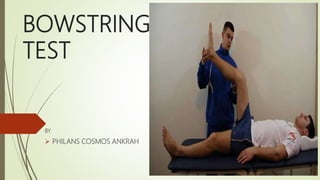
BOWSTRING
TEST
BY
 PHILANS COSMOS ANKRAH
OBJECTIVES
By the end of this presentation, students should be able to;
 Describe the sciatic nerve and its course of supply
 Identify lesions of the sciatic nerve
 Identify the bowstring test as one of the tests of sciatic nerve
pathology
 Outline the steps in conducting the bowstring test
 Give the implications of the results obtained
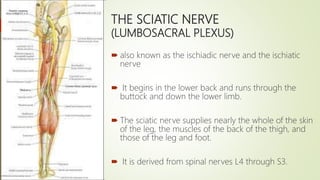
THE SCIATIC NERVE
(LUMBOSACRAL PLEXUS)
 also known as the ischiadic nerve and the ischiatic
nerve
 It begins in the lower back and runs through the
buttock and down the lower limb.
 The sciatic nerve supplies nearly the whole of the skin
of the leg, the muscles of the back of the thigh, and
those of the leg and foot.
 It is derived from spinal nerves L4 through S3.
COURSE
 Exits the sciatic notch and runs anterior (deep) to piriformis.
 It then lies posterior (superficial) to the short external rotators
(superior gemellus, inferior gemellus and obturator internus).
 It then runs down the posterior leg where it breaks into its three
main divisions at the level of the mid thigh.
 The terminal branches are the common peroneal and tibial
nerve.
SUPPLY
 Articular branches supply the hip-joint
 Muscular branches supply posterior thigh muscles and
muscles of the leg.
 Sensor supply; innervates the skin on the posterior aspect of
the thigh and gluteal regions, as well as the entire lower leg
(except for its medial aspect).
PATHOLOGY
 Pain caused by a compression or irritation of the sciatic nerve by
a problem in the lower back is called sciatica.
 Common causes of sciatica include the following lower back and
hip conditions: spinal disc herniation, degenerative disc disease,
lumbar spinal stenosis, spondylolisthesis, and piriformis
syndrome
 Sciatic nerve palsy is a complication of total hip arthroplasty
 Sciatic nerve palsy can also result from severe spinal stenosis
SCIATICA
THE BOWSTRING TEST
Steps
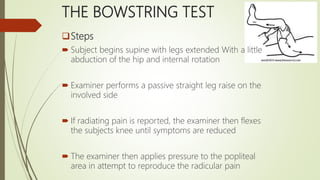
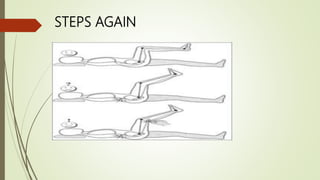
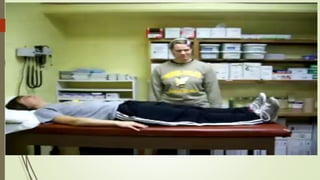
 Subject begins supine with legs extended With a little
abduction of the hip and internal rotation
 Examiner performs a passive straight leg raise on the
involved side
 If radiating pain is reported, the examiner then flexes
the subjects knee until symptoms are reduced
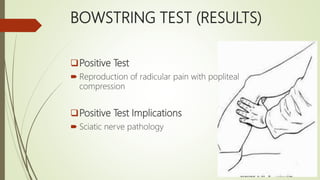
 The examiner then applies pressure to the popliteal
area in attempt to reproduce the radicular pain
BOWSTRING TEST (RESULTS)
Positive Test
 Reproduction of radicular pain with popliteal
compression
Positive Test Implications
 Sciatic nerve pathology
STEPS AGAIN
THANK YOU…

Bowstring test. By Philans Cosmos Ankrah

  • 1.
  • 3.
    OBJECTIVES By the endof this presentation, students should be able to;  Describe the sciatic nerve and its course of supply  Identify lesions of the sciatic nerve  Identify the bowstring test as one of the tests of sciatic nerve pathology  Outline the steps in conducting the bowstring test  Give the implications of the results obtained
  • 4.
    THE SCIATIC NERVE (LUMBOSACRALPLEXUS)  also known as the ischiadic nerve and the ischiatic nerve  It begins in the lower back and runs through the buttock and down the lower limb.  The sciatic nerve supplies nearly the whole of the skin of the leg, the muscles of the back of the thigh, and those of the leg and foot.  It is derived from spinal nerves L4 through S3.
  • 5.
    COURSE  Exits thesciatic notch and runs anterior (deep) to piriformis.  It then lies posterior (superficial) to the short external rotators (superior gemellus, inferior gemellus and obturator internus).  It then runs down the posterior leg where it breaks into its three main divisions at the level of the mid thigh.  The terminal branches are the common peroneal and tibial nerve.
  • 6.
    SUPPLY  Articular branchessupply the hip-joint  Muscular branches supply posterior thigh muscles and muscles of the leg.  Sensor supply; innervates the skin on the posterior aspect of the thigh and gluteal regions, as well as the entire lower leg (except for its medial aspect).
  • 7.
    PATHOLOGY  Pain causedby a compression or irritation of the sciatic nerve by a problem in the lower back is called sciatica.  Common causes of sciatica include the following lower back and hip conditions: spinal disc herniation, degenerative disc disease, lumbar spinal stenosis, spondylolisthesis, and piriformis syndrome  Sciatic nerve palsy is a complication of total hip arthroplasty  Sciatic nerve palsy can also result from severe spinal stenosis
  • 8.
  • 10.
    THE BOWSTRING TEST Steps Subject begins supine with legs extended With a little abduction of the hip and internal rotation  Examiner performs a passive straight leg raise on the involved side  If radiating pain is reported, the examiner then flexes the subjects knee until symptoms are reduced  The examiner then applies pressure to the popliteal area in attempt to reproduce the radicular pain
  • 11.
    BOWSTRING TEST (RESULTS) PositiveTest  Reproduction of radicular pain with popliteal compression Positive Test Implications  Sciatic nerve pathology
  • 12.
  • 14.