Prof	
  Shivananda	
  R	
  Koteshwar	
  
Director,	
  The	
  Amaatra	
  Academy	
  
shivoo@pes.edu	
  /	
  Facebook:	
  shivoo.koteshwar	
  
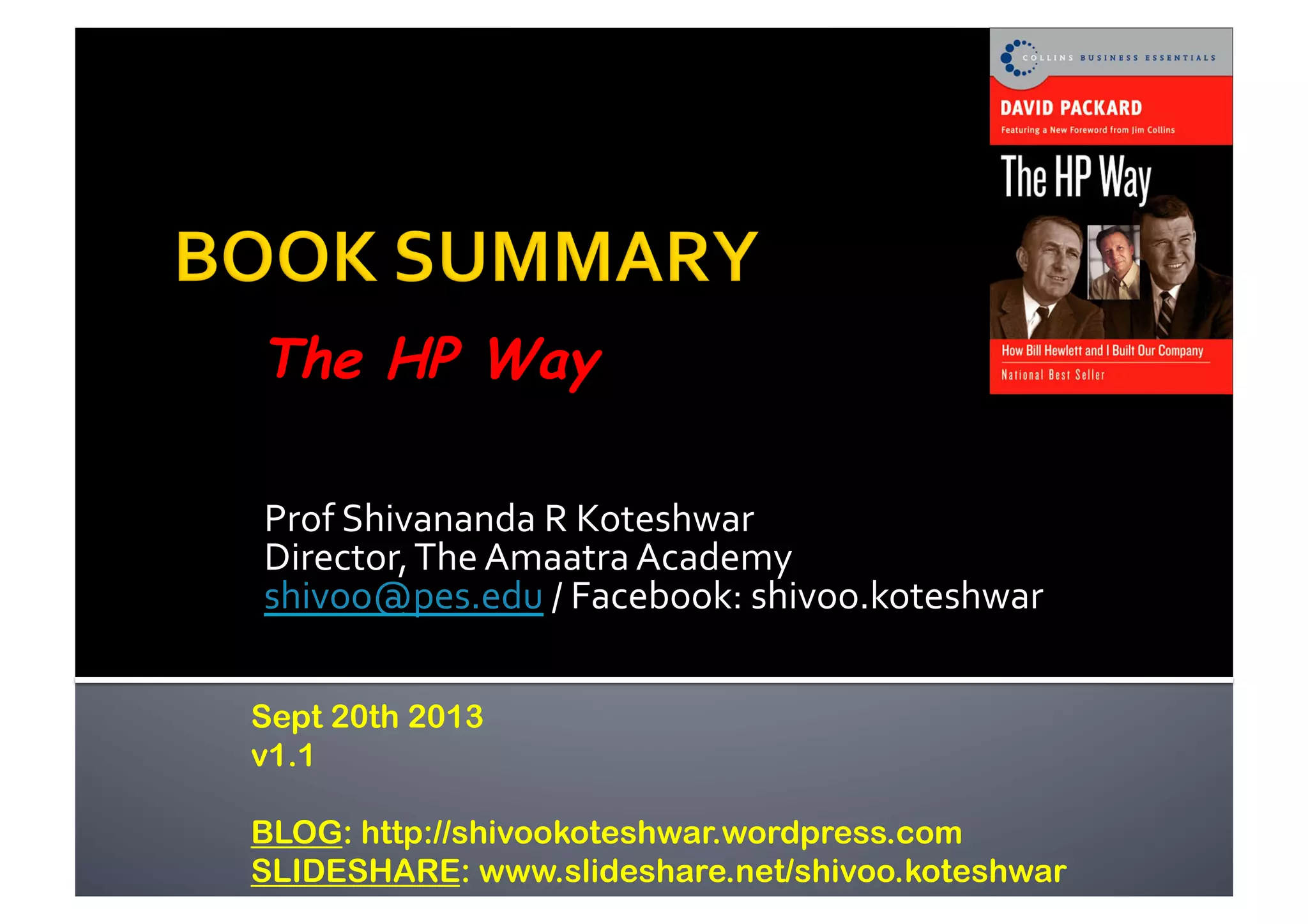
The HP Way
Sept 20th 2013
v1.1
BLOG: http://shivookoteshwar.wordpress.com
SLIDESHARE: www.slideshare.net/shivoo.koteshwar
Prof Shivananda R Koteshwar ©
The Book
 The HP Way
  By David Packard –The P in HP (H= Bill Hewlett,
man with insatiable curiosity)
  ISBN-10: 0-06-084579-1
  ISBN-13: 978-0-06-084579-7
Their greatest product was HP company and their greatest idea was “The HP Way”
2
Prof Shivananda R Koteshwar ©
5 Fundamental Teaching of The HP
Way
1.  The HP company exists to make a technical contribution and
should only pursue opportunities consistent with this purpose
2.  The HP company demands of itself and its people superior
performance-profitable growth, both a means and a
measure of enduring success
3.  The HP believes the best results come when you get the right
people, trust them and give them freedom to find the best
path to achieve objectives and let them share in the
rewards their work makes possible
4.  The HP company has a responsibility to contribute directly
to the well being of the communities in which it operates
5.  Integrity, period.
3
Prof Shivananda R Koteshwar ©
Real Reasons why any company
exists
1.  Right Reasons of existence
  Make profit for shareholders
  Responsibility to recognize the dignity of employees as human beings
  Responsibility to the well-being of its customers
  Responsibility towards the community at large
2.  Questions one need to ask
1.  Are you making money?
2.  Is the lives of employees better than they would be without us?
3.  Do the products offer something unique –be it a technical contribution,
a level of quality, a problem solver to our customers?
4.  Are the communities in which we operate stronger ? Has peoples’ lives
improved because of what we do ?
Group of people get together and exists as an institution –company
so they are able to accomplish something collectively which they could not
accomplish separately.
4
Prof Shivananda R Koteshwar ©
Hidden DNA of The HP Way –
“The AND”
1.  Make a technical contribution AND meet customer needs
2.  Take care of your people AND demand results
3.  Set unwavering standards AND allow immense operating
flexibility
4.  Achieve growth AND profitability
5.  Limit growth to arenas of distinctive contribution AND create
new arenas of growth through innovation
6.  Never compromise integrity AND always win in your chosen
fields
7.  Contribute to community AND deliver exceptional
shareholder returns
8.  Preserve the core AND stimulate progress
5
Prof Shivananda R Koteshwar ©
The change in every successful
company
  Core guiding philosophy (Core values and fundamental
purpose) changes very little over time …
  What changes in response to changing realities are :
  Operating Practices
  Cultural Norms
  Strategies
  Tactics
  Processes
  Structures
  MethodsLose your core values, and you lose your soul; refuse to change your practices,
and the world will pass you by.
6
Prof Shivananda R Koteshwar ©
Philosophy of MBO –Management
By Objectives
  Individual works for a company because he feels he
is accomplishing something worthwhile not just to
make money
  People work to make a contribution and they do
this best when they have a real objective, when
they know what they are trying to achieve and are
able to use their own capabilities to the greatest
extent
Supervision is not giving orders, it is a job of providing the opportunity for people
to use their capabilities efficiently and effectively.
7
Prof Shivananda R Koteshwar ©
What about Profit then …is it not
important ?
  Profit is final measure …
  Profit is the measure of company’s contribution to
customers and society –it is a measure of what the
customers are willing to pay HP over and above the
actual cost of an instrument
  Profit is the measure of how well the employees work
together
  Profit is the ultimate source of corporate strength. The
margin, what is left over after paying for the material,
labor, overhead and so on is the source of capital for
growth
8
Prof Shivananda R Koteshwar ©
Objectives built on strong Values
Profit: Attempt to achieve the maximum possible
profits consistent to other objectives
Customers: Strive for continual improvement in
quality, usefulness and values of the products and
services we offer our customers
Field of Interest: Concentrate our efforts,
continually seeking new opportunities for growth
but limiting our involvement to fields in which we
have capability and can make a contribution
Growth: To emphasize growth as a measure of
strength and a requirement for survival
Employees: Provide opportunity to share in the
company’s success, which they help make
possible. Provide for them job security based on
performance and to provide the opportunity for
personal satisfaction that comes from a sense of
accomplishments in their work
Organization: Maintain an organization
environment that fosters individual motivation,
initiative and creativity and a wide latitude of
freedom in working toward established objectives
and goals
Citizenship: Meet the obligations of a good
citizenship by making contribution to the
community and to the institutions in our society
which generate the environment in which we
operate
9
Prof Shivananda R Koteshwar ©
Managing enthusiastic inventors
  Problem
  Enthusiastic inventor presents a very creative and innovative idea- an idea that after careful
and objective analysis by others is turned down. How do managers provide encouragement
and help the inventor retain enthusiasm in the face of such disappointment ?
  Bill Hewlett Approach –Hat wearing Process which provides the inventor with a sense
of satisfaction, even when the decision went against the project- a vitally important
outcome for stimulating continued enthusiasm and creativity
  Wear a Enthusiasm Hat: Upon first being approached by a creative inventor with
uncontrolled enthusiasm, listen, express excitement and appreciate in general, while asking
a few rather gentle and not too pointed questions
  Wear a Inquisition Hat: Few days later, get back to inventor and ask pointed questions, a
thorough probing of the idea, lots of give and take. Without a final decision, adjourn the
session
  Wear a Decision Hat: Shortly thereafter, meet once again the inventor and with
appropriate logic and sensitivity, judgment was rendered and a decision made about the
idea.
10
Prof Shivananda R Koteshwar ©
19 Gems from HP Management (1/3)
1.  Management by walking around (MBWA) and MBO are key for success
2.  Use slowdown as an opportunity to seek out and attract some good
technical people to the company
3.  Reinvest profits instead of going for long term borrowing –Helps survive
during recession/depression. Self finance requires constant vigilance and
self discipline
4.  Bonus tied to productivity – Profit sharing program that encourages
teamwork and maintains the link between employee effort and corporate
success
5.  Collaboration with university (Stanford) – Additional research opportunities
and Part time Degree program while working full time at HP attracted and
retained top talent across the country
6.  Give responsibility to the level where it can be exercised effectively,
usually on the lowest possible level of the organization, the level nearest
the customer
7.  Despite growth, try to maintain a small company atmosphere and have key
managers thoroughly familiar with management styles and objectives
11
Prof Shivananda R Koteshwar ©
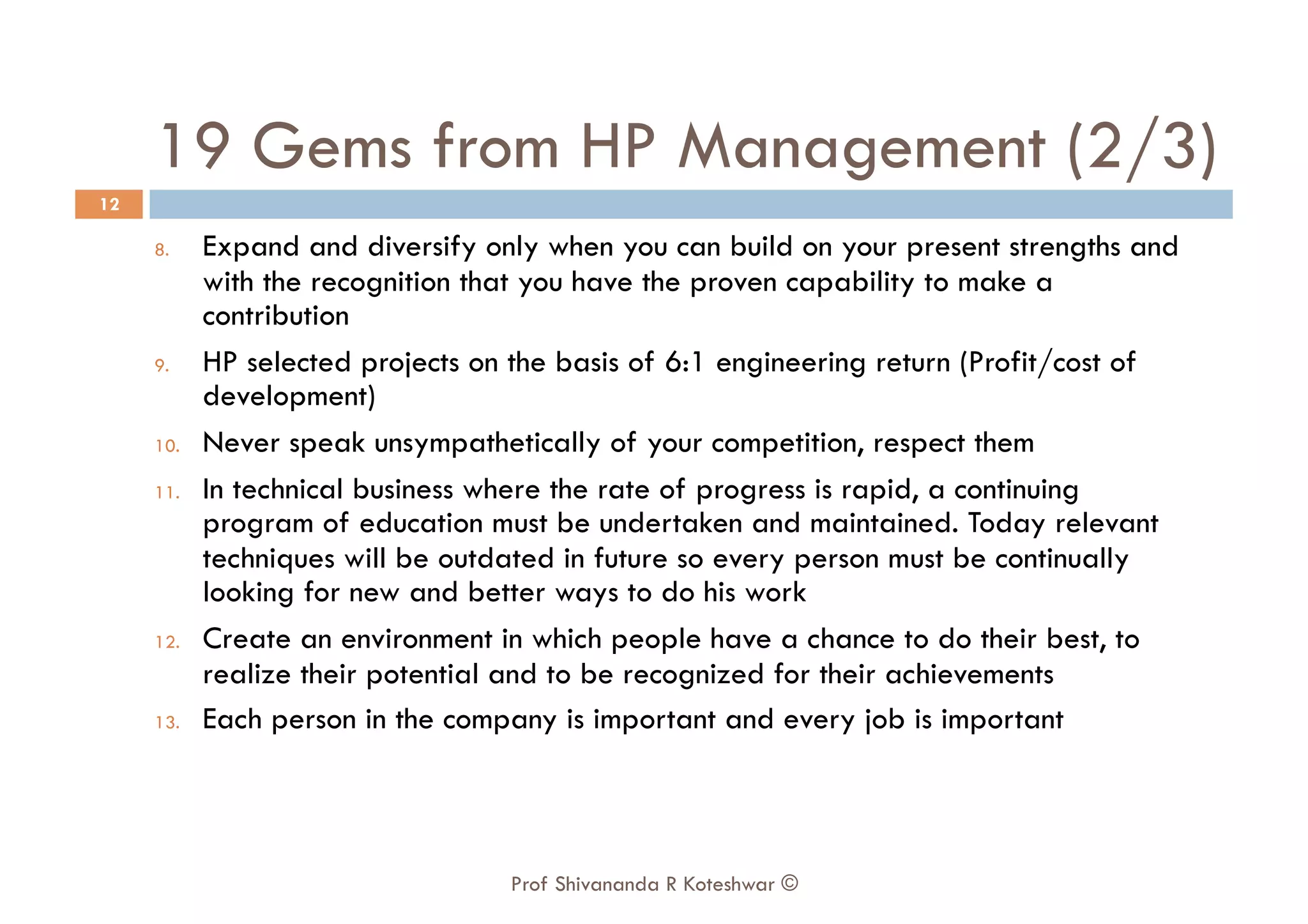
8.  Expand and diversify only when you can build on your present strengths and
with the recognition that you have the proven capability to make a
contribution
9.  HP selected projects on the basis of 6:1 engineering return (Profit/cost of
development)
10.  Never speak unsympathetically of your competition, respect them
11.  In technical business where the rate of progress is rapid, a continuing
program of education must be undertaken and maintained. Today relevant
techniques will be outdated in future so every person must be continually
looking for new and better ways to do his work
12.  Create an environment in which people have a chance to do their best, to
realize their potential and to be recognized for their achievements
13.  Each person in the company is important and every job is important
19 Gems from HP Management (2/3)
12
Prof Shivananda R Koteshwar ©
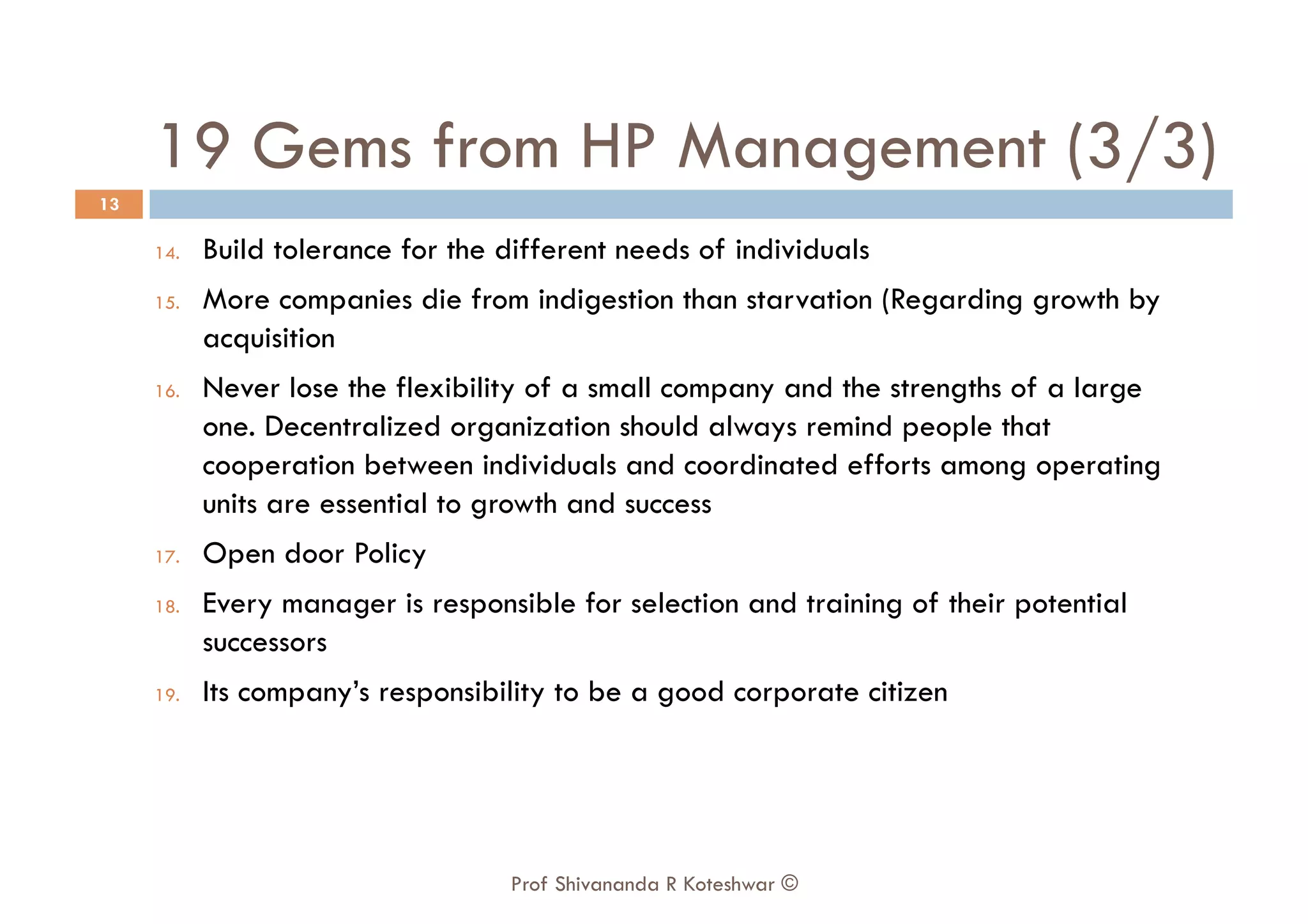
14.  Build tolerance for the different needs of individuals
15.  More companies die from indigestion than starvation (Regarding growth by
acquisition
16.  Never lose the flexibility of a small company and the strengths of a large
one. Decentralized organization should always remind people that
cooperation between individuals and coordinated efforts among operating
units are essential to growth and success
17.  Open door Policy
18.  Every manager is responsible for selection and training of their potential
successors
19.  Its company’s responsibility to be a good corporate citizen
19 Gems from HP Management (3/3)
13
Prof Shivananda R Koteshwar ©
Thank You !
Prof Shivananda R Koteshwar
shivoo@pes.edu
BLOG: http://shivookoteshwar.wordpress.com
SLIDESHARE: www.slideshare.net/shivoo.koteshwar

Book Summary -The HP Way

  • 1.
    Prof  Shivananda  R  Koteshwar   Director,  The  Amaatra  Academy   shivoo@pes.edu  /  Facebook:  shivoo.koteshwar   The HP Way Sept 20th 2013 v1.1 BLOG: http://shivookoteshwar.wordpress.com SLIDESHARE: www.slideshare.net/shivoo.koteshwar
  • 2.
    Prof Shivananda RKoteshwar © The Book  The HP Way   By David Packard –The P in HP (H= Bill Hewlett, man with insatiable curiosity)   ISBN-10: 0-06-084579-1   ISBN-13: 978-0-06-084579-7 Their greatest product was HP company and their greatest idea was “The HP Way” 2
  • 3.
    Prof Shivananda RKoteshwar © 5 Fundamental Teaching of The HP Way 1.  The HP company exists to make a technical contribution and should only pursue opportunities consistent with this purpose 2.  The HP company demands of itself and its people superior performance-profitable growth, both a means and a measure of enduring success 3.  The HP believes the best results come when you get the right people, trust them and give them freedom to find the best path to achieve objectives and let them share in the rewards their work makes possible 4.  The HP company has a responsibility to contribute directly to the well being of the communities in which it operates 5.  Integrity, period. 3
  • 4.
    Prof Shivananda RKoteshwar © Real Reasons why any company exists 1.  Right Reasons of existence   Make profit for shareholders   Responsibility to recognize the dignity of employees as human beings   Responsibility to the well-being of its customers   Responsibility towards the community at large 2.  Questions one need to ask 1.  Are you making money? 2.  Is the lives of employees better than they would be without us? 3.  Do the products offer something unique –be it a technical contribution, a level of quality, a problem solver to our customers? 4.  Are the communities in which we operate stronger ? Has peoples’ lives improved because of what we do ? Group of people get together and exists as an institution –company so they are able to accomplish something collectively which they could not accomplish separately. 4
  • 5.
    Prof Shivananda RKoteshwar © Hidden DNA of The HP Way – “The AND” 1.  Make a technical contribution AND meet customer needs 2.  Take care of your people AND demand results 3.  Set unwavering standards AND allow immense operating flexibility 4.  Achieve growth AND profitability 5.  Limit growth to arenas of distinctive contribution AND create new arenas of growth through innovation 6.  Never compromise integrity AND always win in your chosen fields 7.  Contribute to community AND deliver exceptional shareholder returns 8.  Preserve the core AND stimulate progress 5
  • 6.
    Prof Shivananda RKoteshwar © The change in every successful company   Core guiding philosophy (Core values and fundamental purpose) changes very little over time …   What changes in response to changing realities are :   Operating Practices   Cultural Norms   Strategies   Tactics   Processes   Structures   MethodsLose your core values, and you lose your soul; refuse to change your practices, and the world will pass you by. 6
  • 7.
    Prof Shivananda RKoteshwar © Philosophy of MBO –Management By Objectives   Individual works for a company because he feels he is accomplishing something worthwhile not just to make money   People work to make a contribution and they do this best when they have a real objective, when they know what they are trying to achieve and are able to use their own capabilities to the greatest extent Supervision is not giving orders, it is a job of providing the opportunity for people to use their capabilities efficiently and effectively. 7
  • 8.
    Prof Shivananda RKoteshwar © What about Profit then …is it not important ?   Profit is final measure …   Profit is the measure of company’s contribution to customers and society –it is a measure of what the customers are willing to pay HP over and above the actual cost of an instrument   Profit is the measure of how well the employees work together   Profit is the ultimate source of corporate strength. The margin, what is left over after paying for the material, labor, overhead and so on is the source of capital for growth 8
  • 9.
    Prof Shivananda RKoteshwar © Objectives built on strong Values Profit: Attempt to achieve the maximum possible profits consistent to other objectives Customers: Strive for continual improvement in quality, usefulness and values of the products and services we offer our customers Field of Interest: Concentrate our efforts, continually seeking new opportunities for growth but limiting our involvement to fields in which we have capability and can make a contribution Growth: To emphasize growth as a measure of strength and a requirement for survival Employees: Provide opportunity to share in the company’s success, which they help make possible. Provide for them job security based on performance and to provide the opportunity for personal satisfaction that comes from a sense of accomplishments in their work Organization: Maintain an organization environment that fosters individual motivation, initiative and creativity and a wide latitude of freedom in working toward established objectives and goals Citizenship: Meet the obligations of a good citizenship by making contribution to the community and to the institutions in our society which generate the environment in which we operate 9
  • 10.
    Prof Shivananda RKoteshwar © Managing enthusiastic inventors   Problem   Enthusiastic inventor presents a very creative and innovative idea- an idea that after careful and objective analysis by others is turned down. How do managers provide encouragement and help the inventor retain enthusiasm in the face of such disappointment ?   Bill Hewlett Approach –Hat wearing Process which provides the inventor with a sense of satisfaction, even when the decision went against the project- a vitally important outcome for stimulating continued enthusiasm and creativity   Wear a Enthusiasm Hat: Upon first being approached by a creative inventor with uncontrolled enthusiasm, listen, express excitement and appreciate in general, while asking a few rather gentle and not too pointed questions   Wear a Inquisition Hat: Few days later, get back to inventor and ask pointed questions, a thorough probing of the idea, lots of give and take. Without a final decision, adjourn the session   Wear a Decision Hat: Shortly thereafter, meet once again the inventor and with appropriate logic and sensitivity, judgment was rendered and a decision made about the idea. 10
  • 11.
    Prof Shivananda RKoteshwar © 19 Gems from HP Management (1/3) 1.  Management by walking around (MBWA) and MBO are key for success 2.  Use slowdown as an opportunity to seek out and attract some good technical people to the company 3.  Reinvest profits instead of going for long term borrowing –Helps survive during recession/depression. Self finance requires constant vigilance and self discipline 4.  Bonus tied to productivity – Profit sharing program that encourages teamwork and maintains the link between employee effort and corporate success 5.  Collaboration with university (Stanford) – Additional research opportunities and Part time Degree program while working full time at HP attracted and retained top talent across the country 6.  Give responsibility to the level where it can be exercised effectively, usually on the lowest possible level of the organization, the level nearest the customer 7.  Despite growth, try to maintain a small company atmosphere and have key managers thoroughly familiar with management styles and objectives 11
  • 12.
    Prof Shivananda RKoteshwar © 8.  Expand and diversify only when you can build on your present strengths and with the recognition that you have the proven capability to make a contribution 9.  HP selected projects on the basis of 6:1 engineering return (Profit/cost of development) 10.  Never speak unsympathetically of your competition, respect them 11.  In technical business where the rate of progress is rapid, a continuing program of education must be undertaken and maintained. Today relevant techniques will be outdated in future so every person must be continually looking for new and better ways to do his work 12.  Create an environment in which people have a chance to do their best, to realize their potential and to be recognized for their achievements 13.  Each person in the company is important and every job is important 19 Gems from HP Management (2/3) 12
  • 13.
    Prof Shivananda RKoteshwar © 14.  Build tolerance for the different needs of individuals 15.  More companies die from indigestion than starvation (Regarding growth by acquisition 16.  Never lose the flexibility of a small company and the strengths of a large one. Decentralized organization should always remind people that cooperation between individuals and coordinated efforts among operating units are essential to growth and success 17.  Open door Policy 18.  Every manager is responsible for selection and training of their potential successors 19.  Its company’s responsibility to be a good corporate citizen 19 Gems from HP Management (3/3) 13
  • 14.
    Prof Shivananda RKoteshwar © Thank You ! Prof Shivananda R Koteshwar shivoo@pes.edu BLOG: http://shivookoteshwar.wordpress.com SLIDESHARE: www.slideshare.net/shivoo.koteshwar