Motivation I
Goal-Setting Theory and Management by
Objectives (MBO)

Chris Wan
Irina Antonescu
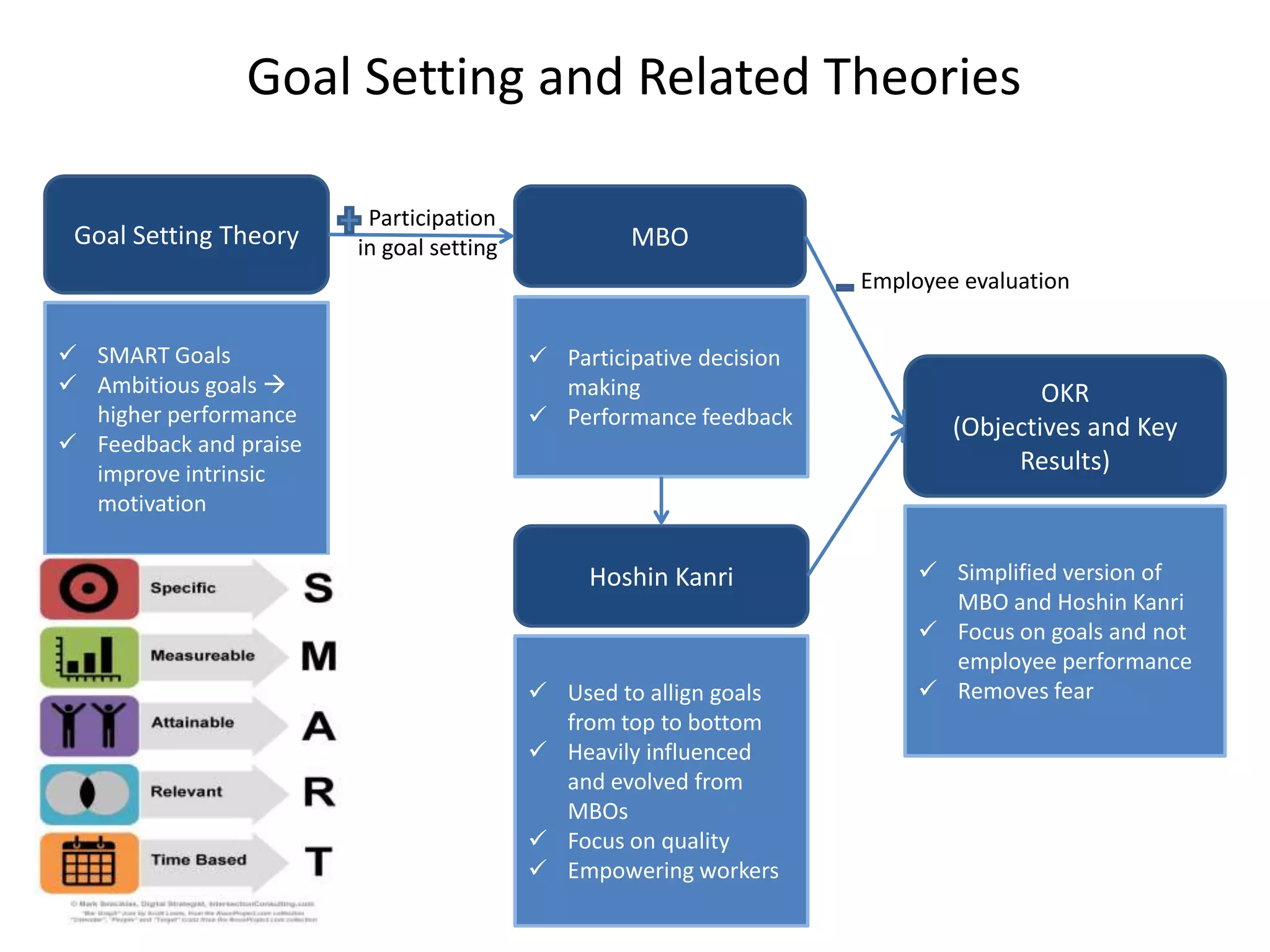
Goal Setting and Related Theories
Goal Setting Theory

Participation
in goal setting

MBO
Employee evaluation

 SMART Goals
 Ambitious goals 
higher performance
 Feedback and praise
improve intrinsic
motivation

 Participative decision
making
 Performance feedback

Hoshin Kanri

 Used to allign goals
from top to bottom
 Heavily influenced
and evolved from
MBOs
 Focus on quality
 Empowering workers

OKR
(Objectives and Key
Results)

 Simplified version of
MBO and Hoshin Kanri
 Focus on goals and not
employee performance
 Removes fear
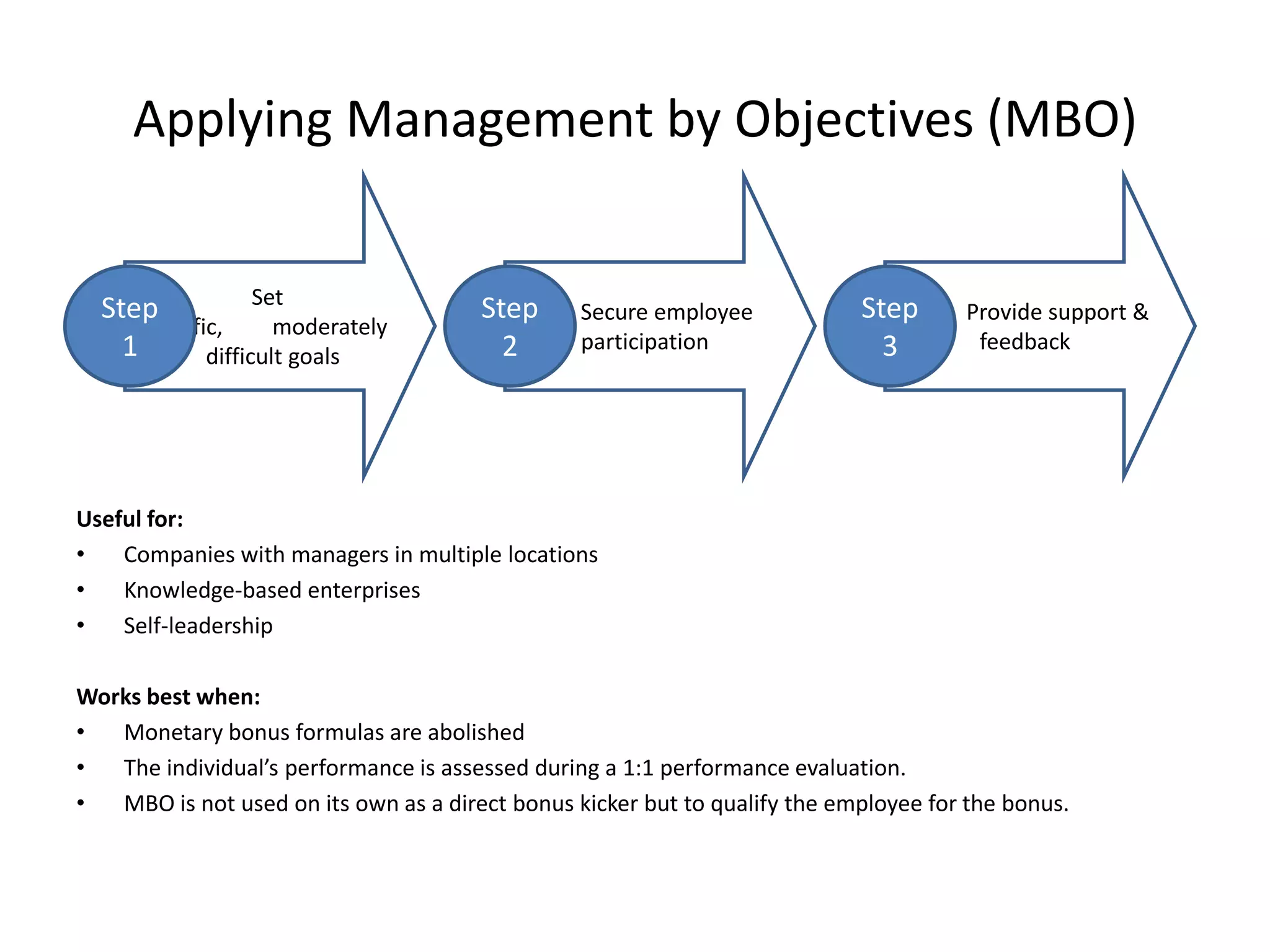
Applying Management by Objectives (MBO)
Set
Step
specific,
moderately
1
difficult goals

Step
2

Secure employee
participation

Step
3

Provide support &
feedback

Useful for:
•
Companies with managers in multiple locations
•
Knowledge-based enterprises
•
Self-leadership
Works best when:
•
Monetary bonus formulas are abolished
•
The individual’s performance is assessed during a 1:1 performance evaluation.
•
MBO is not used on its own as a direct bonus kicker but to qualify the employee for the bonus.
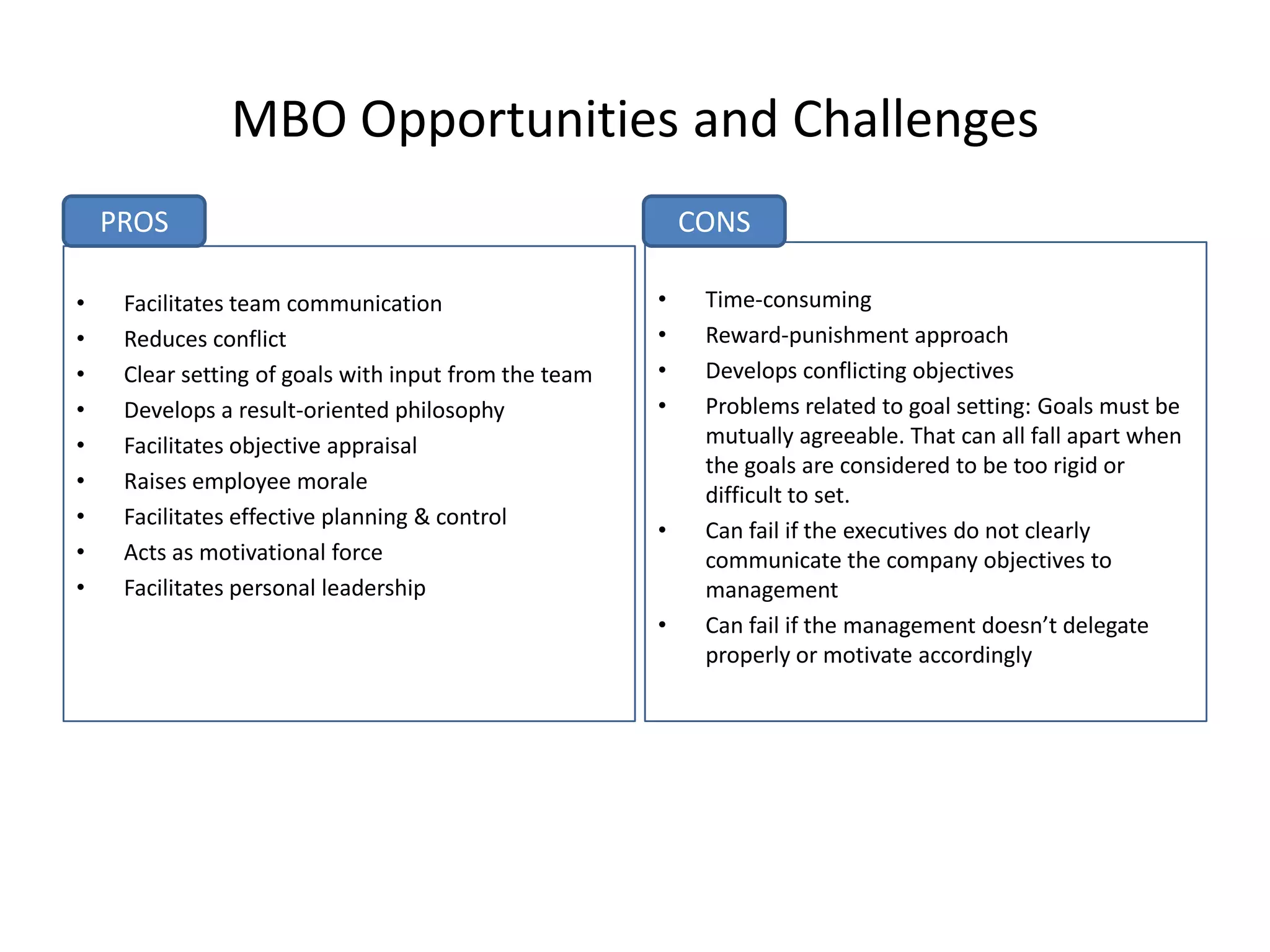
MBO Opportunities and Challenges
PROS
•
•
•
•
•
•
•
•
•

Facilitates team communication
Reduces conflict
Clear setting of goals with input from the team
Develops a result-oriented philosophy
Facilitates objective appraisal
Raises employee morale
Facilitates effective planning & control
Acts as motivational force
Facilitates personal leadership

CONS
•
•
•
•

•

•

Time-consuming
Reward-punishment approach
Develops conflicting objectives
Problems related to goal setting: Goals must be
mutually agreeable. That can all fall apart when
the goals are considered to be too rigid or
difficult to set.
Can fail if the executives do not clearly
communicate the company objectives to
management
Can fail if the management doesn’t delegate
properly or motivate accordingly
MBO and the Financial Crisis
•

System of misaligned incentives, short-termism and a lack of transparency instead of sustainable financial
development

•

Inability to implement adequate controls

•

Compensation systems encourage the greatest amount of irresponsible risk taking

•

Obsession with achieving an MBO deadline that ends up costing the company a lot more than the
expected bonus, therefore creating a conflict of interest.

•

Inflexibility: once goals are set down, the superior may not like to modify

´MBO is about doing your job, and about how managers can manage the common goals
that a company has
Hoshin Kanri and OKRs
Hoshin Kanri
•
•

More detailed version of an MBO
Improves on it by breaking down power-distance heirarchy and eliminating fear

OKRs
•

About contribution to company goals, not employee performance evaluations

Benefits
•
Disciplines thinking
•
Communicates accurately
•
Establishes Indicators
•
Focuses effort (Keeps organisation on the same path)
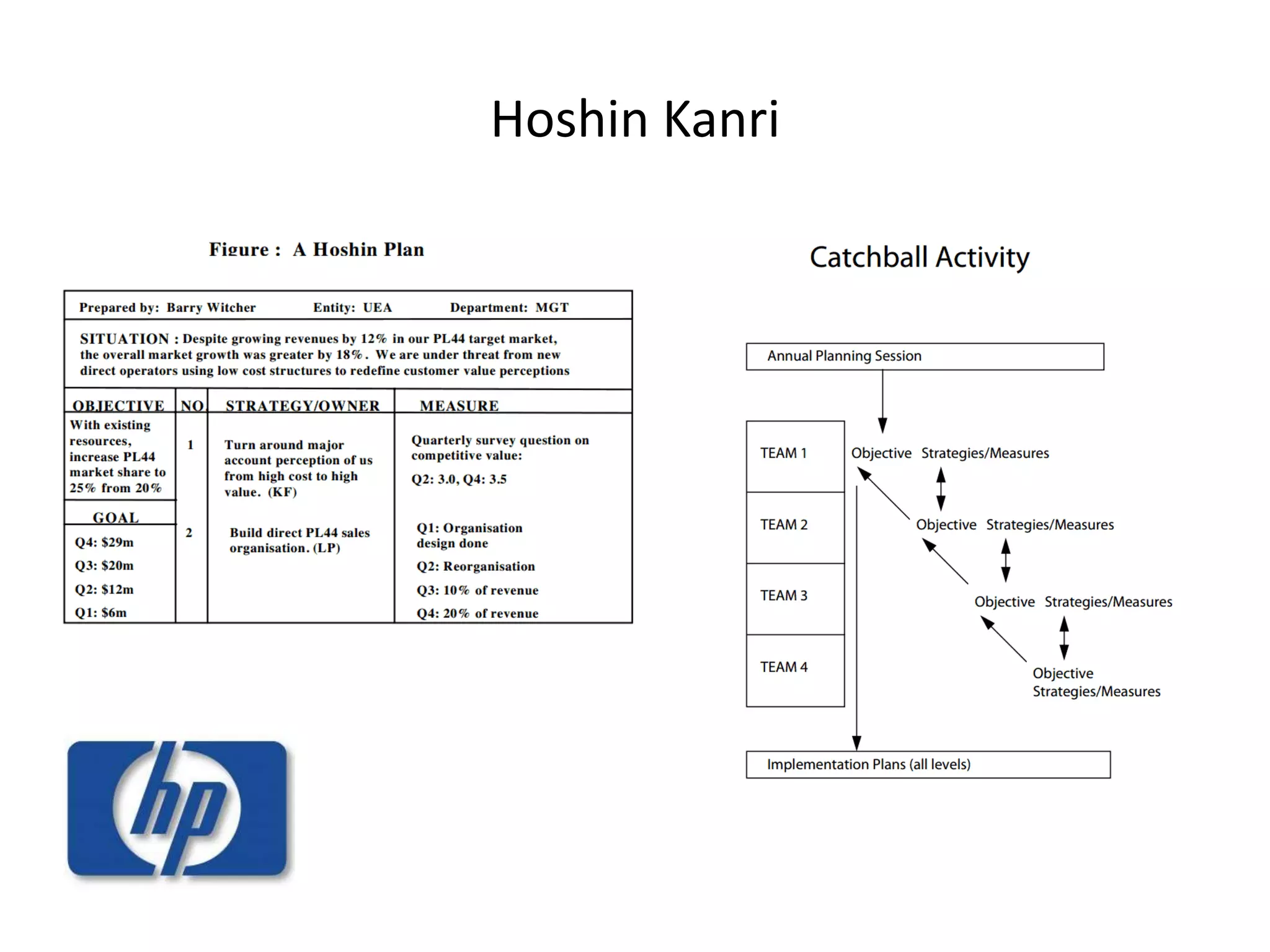
Hoshin Kanri
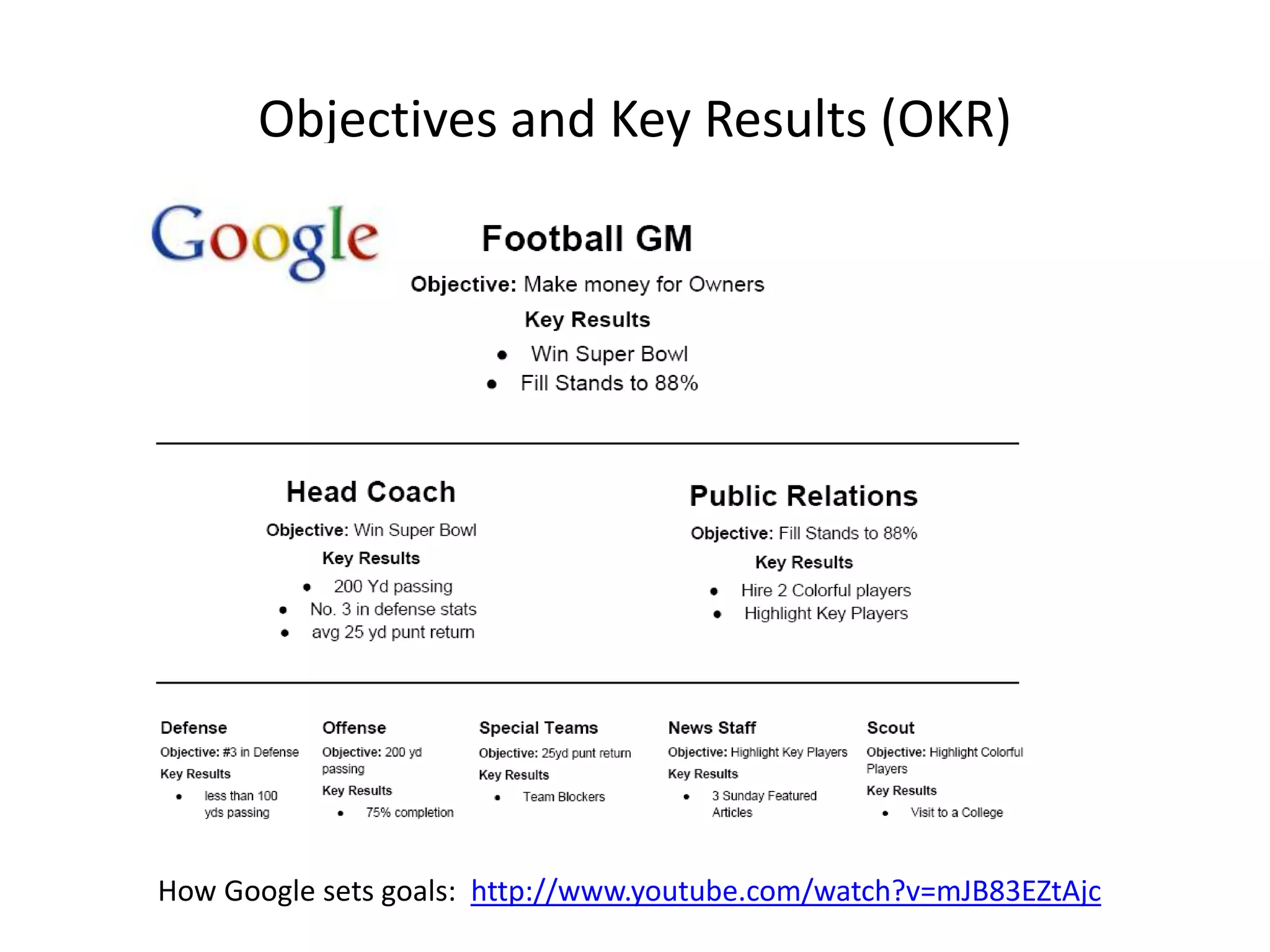
Objectives and Key Results (OKR)

How Google sets goals: http://www.youtube.com/watch?v=mJB83EZtAjc
References
•
•
•
•
•
•
•
•
•
•
•
•
•
•
•
•
•
•

Allison, Scott. (2012, February 28). OKRs – objectives and key results. Retrieved from http://teamly.com/771-okr-objectives-and-key-results
Bauer, Talya; Erdogan, Berrin. (2012). An Introduction to Organizational Behavior v.1.0. Retrieved from http://2012books.lardbucket.org/books/anintroduction-to-organizational-behavior-v1.0/s10-02-motivating-employees-through-g.html
Dynos, Lukasz. (2007). MBO in Makro (Metro Group): Company's Objective Identified With The One Of Its' Employees. BCC. Retrieved
from http://www.bcc.com.pl/en/academy-of-better-business/mbo-in-makro-metro-group-company-s-objective-identified-with-the-one-of-itsemployees.html
GoogleVentures. (2013, October 15). Startup Lab workshop: How Google sets goals: OKRs (Video File). Retrieved from
http://www.youtube.com/watch?v=mJB83EZtAjc
Hindle, Tim. (October 2009). Management by Objectives. The Economist. Retrieved from http://www.economist.com/node/14299761
Kaizen Consulting Group. Origins of Hoshin Kanri. Retrieved from http://www.kcg.com.sg/origins-hoshin-kanri.html
Klau, Rick. (May 2013). How Google sets goals: OKRs. Google Ventures. Retrieved from http://startuplab.googleventures.com/public-workshops-2013-0514
Liker, Jeff. (August 2013). What Management By Objectives Does Wrong & Hoshin Kanri Does Right. Gray. Retrieved
from http://www.gray.com/news/blog/2013/08/12/what-management-objectives-does-wrong-hoshin-kanri-does-right
Mougayar, William. (2000, October 2013). Don't Abolish MBOs. Startup Mangagement. Retrieved
from http://startupmanagement.org/2013/10/09/dont-abolish-mbos/
Pugh, Derek S. (1971) Organization Theory. Penguin Books
Raj, Ritu. (October 2012). Limitations of Management By Objectives. Management By Objectives. Retrieved from http://managementbyobjectives.com
Robbins, Stephen P.; Judge, Timothy A. (2013): Organizational Behavior. 15. ed., global ed. Boston: Pearson.
Schermerhorn, John R.; Hunt, James G; Osborn, Richard N. (2011) Organizational Behavior 10/E. Wiley.
SoccerFootball Fail. (2013, October 15). Soccer/Football Fail!: Beautiful own goal (nice shot!) (Video File). Retrieved from
http://www.youtube.com/watch?v=SWU_oZWtIdY
Steers, Richard M.; Black, Steward J. (1994) Organizational Behaviour 5ed. Prentice Hall
The W. Edwards Deming Institute. (2013). The Fourteen Points For The Transformation of Management. Retrieved from
https://www.deming.org/theman/theories/fourteenpoints
Zammit-Lucia, J. (2013, August 29). Misaligned incentives will lead us right back into another financial crisis. The Guardian. Retrieved from
http://www.theguardian.com/sustainable-business/financial-crisis-credit-agencies-incentives
Witcher, B.; Butterworth, R. (2000, September). Hoshin Kanri at Hewlett-Packard, Journal of General Management, Vol. 25 No. 4, 70-85. Retrieved from
http://www.cforc.org/images/uploads/tools-and-methods/Hoshin_Kanri_-_HP.pdf

Motivation Theories: Goal setting theory and MBO

  • 1.
    Motivation I Goal-Setting Theoryand Management by Objectives (MBO) Chris Wan Irina Antonescu
  • 2.
    Goal Setting andRelated Theories Goal Setting Theory Participation in goal setting MBO Employee evaluation  SMART Goals  Ambitious goals  higher performance  Feedback and praise improve intrinsic motivation  Participative decision making  Performance feedback Hoshin Kanri  Used to allign goals from top to bottom  Heavily influenced and evolved from MBOs  Focus on quality  Empowering workers OKR (Objectives and Key Results)  Simplified version of MBO and Hoshin Kanri  Focus on goals and not employee performance  Removes fear
  • 3.
    Applying Management byObjectives (MBO) Set Step specific, moderately 1 difficult goals Step 2 Secure employee participation Step 3 Provide support & feedback Useful for: • Companies with managers in multiple locations • Knowledge-based enterprises • Self-leadership Works best when: • Monetary bonus formulas are abolished • The individual’s performance is assessed during a 1:1 performance evaluation. • MBO is not used on its own as a direct bonus kicker but to qualify the employee for the bonus.
  • 4.
    MBO Opportunities andChallenges PROS • • • • • • • • • Facilitates team communication Reduces conflict Clear setting of goals with input from the team Develops a result-oriented philosophy Facilitates objective appraisal Raises employee morale Facilitates effective planning & control Acts as motivational force Facilitates personal leadership CONS • • • • • • Time-consuming Reward-punishment approach Develops conflicting objectives Problems related to goal setting: Goals must be mutually agreeable. That can all fall apart when the goals are considered to be too rigid or difficult to set. Can fail if the executives do not clearly communicate the company objectives to management Can fail if the management doesn’t delegate properly or motivate accordingly
  • 5.
    MBO and theFinancial Crisis • System of misaligned incentives, short-termism and a lack of transparency instead of sustainable financial development • Inability to implement adequate controls • Compensation systems encourage the greatest amount of irresponsible risk taking • Obsession with achieving an MBO deadline that ends up costing the company a lot more than the expected bonus, therefore creating a conflict of interest. • Inflexibility: once goals are set down, the superior may not like to modify ´MBO is about doing your job, and about how managers can manage the common goals that a company has
  • 6.
    Hoshin Kanri andOKRs Hoshin Kanri • • More detailed version of an MBO Improves on it by breaking down power-distance heirarchy and eliminating fear OKRs • About contribution to company goals, not employee performance evaluations Benefits • Disciplines thinking • Communicates accurately • Establishes Indicators • Focuses effort (Keeps organisation on the same path)
  • 7.
  • 8.
    Objectives and KeyResults (OKR) How Google sets goals: http://www.youtube.com/watch?v=mJB83EZtAjc
  • 9.
    References • • • • • • • • • • • • • • • • • • Allison, Scott. (2012,February 28). OKRs – objectives and key results. Retrieved from http://teamly.com/771-okr-objectives-and-key-results Bauer, Talya; Erdogan, Berrin. (2012). An Introduction to Organizational Behavior v.1.0. Retrieved from http://2012books.lardbucket.org/books/anintroduction-to-organizational-behavior-v1.0/s10-02-motivating-employees-through-g.html Dynos, Lukasz. (2007). MBO in Makro (Metro Group): Company's Objective Identified With The One Of Its' Employees. BCC. Retrieved from http://www.bcc.com.pl/en/academy-of-better-business/mbo-in-makro-metro-group-company-s-objective-identified-with-the-one-of-itsemployees.html GoogleVentures. (2013, October 15). Startup Lab workshop: How Google sets goals: OKRs (Video File). Retrieved from http://www.youtube.com/watch?v=mJB83EZtAjc Hindle, Tim. (October 2009). Management by Objectives. The Economist. Retrieved from http://www.economist.com/node/14299761 Kaizen Consulting Group. Origins of Hoshin Kanri. Retrieved from http://www.kcg.com.sg/origins-hoshin-kanri.html Klau, Rick. (May 2013). How Google sets goals: OKRs. Google Ventures. Retrieved from http://startuplab.googleventures.com/public-workshops-2013-0514 Liker, Jeff. (August 2013). What Management By Objectives Does Wrong & Hoshin Kanri Does Right. Gray. Retrieved from http://www.gray.com/news/blog/2013/08/12/what-management-objectives-does-wrong-hoshin-kanri-does-right Mougayar, William. (2000, October 2013). Don't Abolish MBOs. Startup Mangagement. Retrieved from http://startupmanagement.org/2013/10/09/dont-abolish-mbos/ Pugh, Derek S. (1971) Organization Theory. Penguin Books Raj, Ritu. (October 2012). Limitations of Management By Objectives. Management By Objectives. Retrieved from http://managementbyobjectives.com Robbins, Stephen P.; Judge, Timothy A. (2013): Organizational Behavior. 15. ed., global ed. Boston: Pearson. Schermerhorn, John R.; Hunt, James G; Osborn, Richard N. (2011) Organizational Behavior 10/E. Wiley. SoccerFootball Fail. (2013, October 15). Soccer/Football Fail!: Beautiful own goal (nice shot!) (Video File). Retrieved from http://www.youtube.com/watch?v=SWU_oZWtIdY Steers, Richard M.; Black, Steward J. (1994) Organizational Behaviour 5ed. Prentice Hall The W. Edwards Deming Institute. (2013). The Fourteen Points For The Transformation of Management. Retrieved from https://www.deming.org/theman/theories/fourteenpoints Zammit-Lucia, J. (2013, August 29). Misaligned incentives will lead us right back into another financial crisis. The Guardian. Retrieved from http://www.theguardian.com/sustainable-business/financial-crisis-credit-agencies-incentives Witcher, B.; Butterworth, R. (2000, September). Hoshin Kanri at Hewlett-Packard, Journal of General Management, Vol. 25 No. 4, 70-85. Retrieved from http://www.cforc.org/images/uploads/tools-and-methods/Hoshin_Kanri_-_HP.pdf