M.Sc Hamid AL-Tameemi
Bone
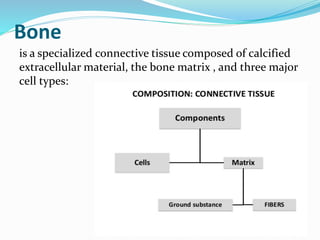
is a specialized connective tissue composed of calcified
extracellular material, the bone matrix , and three major
cell types:
1- Osteocytes (Gr. osteon , bone + kytos , cell), which
are found in cavities ( lacunae ) between bone matrix
layers ( lamellae ), with cytoplasmic processes extending
into small canaliculi (L. canalis , canal) between
lamellae.
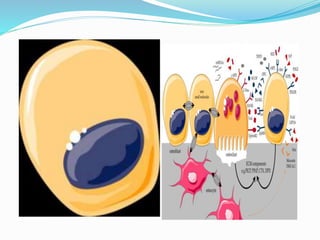
2- Osteoblasts ( osteon + Gr. blastos , germ), which
synthesize the organic components of the matrix
3- Osteoclasts ( osteon + Gr. klastos , broken), which
are multinucleated, giant cells involved in the resorption
and remodeling of bone tissue.
Because metabolites are unable to diffuse through the
calcified matrix of bone, the exchanges between osteocytes
and blood capillaries depend on communication through the
very thin, cylindrical spaces of the canaliculi.
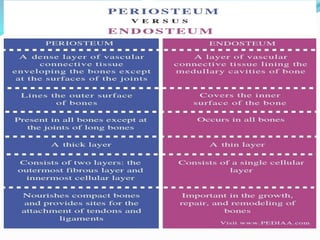
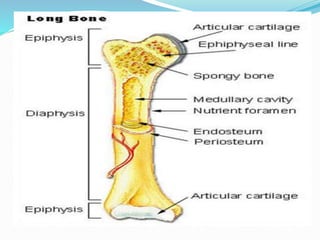
All bones are lined on both internal and external surfaces by
layers of connective tissue containing osteogenic cells—
endosteum on the internal surface surrounding the marrow
cavity and periosteum on the external surface.
Bone Functions
• Protects vital organs
• Supports soft tissue
• Movement
• Mineral storage
• Blood cell production
BONE CELLs
Osteoblasts
Osteoblasts synthesize and secrete the organic
components of bone matrix, which include type I
collagen fibers, proteoglycans, and several glycoproteins
such as osteonectin. Deposition of the inorganic
components of bone also depends on viable osteoblasts.
Calcification of the matrix is not completely understood,
Prominent among the noncollagen proteins secreted by
osteoblasts is the small, vitamin K–dependent
polypeptide osteocalcin, which together with various
glycoproteins binds Ca2+ ions and raises their
concentration locally.
Osteoblasts also release membrane- enclosed matrix
vesicles rich in alkaline phosphatase and other enzymes
whose activity raises the local concentration of PO4 −
ions. With high concentrations of both calcium and
phosphate ions, these vesicles serve as foci for the
formation of hydroxyapatite [Ca10(PO4)6(OH)2]
crystals, the first visible step in calcification. These
crystals grow rapidly by accretion of more mineral and
eventually produce a confluent mass of calcified
material embedding the collagen fibers and
proteoglycans.
Osteocytes
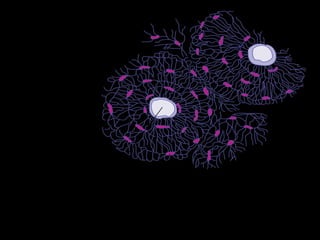
Many osteoblasts are gradually surrounded by the
material they secreted and differentiate further as
osteocytes enclosed singly within the lacunae that are
regularly spaced throughout the mineralized matrix. In
the transition from osteoblasts to osteocytes, the cells
extend many long dendritic processes, which also
become surrounded by calcifying matrix. Osteocytic
processes thus come to occupy the many canaliculi, 250-
300 nm in diameter, that radiate from each lacuna.
Diffusion of metabolites between osteocytes and blood
vessels occurs through the small amount of extracellular fluid
between the bone matrix and the osteocytes and their
processes. Osteocytes also communicate with one another via
gap junctions on the dendritic processes in the canaliculi and
on osteoblasts and bone lining cells.
When compared with osteoblasts, the flat, almond shaped
osteocytes exhibit significantly less RER, smaller Golgi
complexes, and more condensed nuclear chromatin. These
cells maintain the bony matrix, and their death is followed by
rapid matrix resorption.
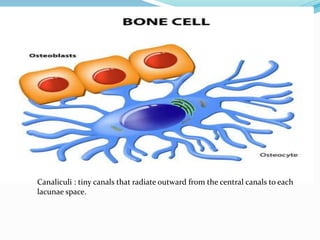
Canaliculi : tiny canals that radiate outward from the central canals to each
lacunae space.
Osteoclasts
Osteoclasts are very large, motile cells with multiple
nuclei and play a major role in matrix resorption during
bone growth and remodeling. The large size and
multinucleated condition of osteoclasts are due to their
origin from the fusion of bone marrow–derived cells. In
areas of bone undergoing resorption, osteoclasts lie
within enzymatically etched depressions or cavities in
the matrix known as resorption cavities (also called
Howship lacunae).
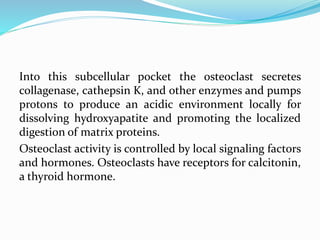
In active osteoclasts, the surface against the bone matrix
is folded into irregular projections, forming a ruffled
border surrounded by a cytoplasmic zone rich in actin
filaments, which is the site of adhesion to the matrix.
Into this subcellular pocket the osteoclast secretes
collagenase, cathepsin K, and other enzymes and pumps
protons to produce an acidic environment locally for
dissolving hydroxyapatite and promoting the localized
digestion of matrix proteins.
Osteoclast activity is controlled by local signaling factors
and hormones. Osteoclasts have receptors for calcitonin,
a thyroid hormone.
BONE MATRIX
Inorganic material represents about 50% of the dry
weight of bone matrix. Calcium hydroxyapatite is most
abundant, but bicarbonate, citrate, magnesium,
potassium, and sodium ions are also found. Significant
quantities of amorphous (noncrystalline) calcium
phosphate are also present.
The organic matter embedded in the calcified matrix
includes type I collagen, proteoglycan aggregates, and
bone specific multiadhesive glycoproteins such as
osteonectin.
Types of Bone
Gross observation of a bone shows a dense area near the
surface corresponding to compact (cortical) bone, which
represents 80% of the total bone mass, and deeper areas
with numerous interconnecting cavities, called
cancellous (trabecular or spongy) bone, constituting
about 20% of total bone mass.
Microscopic examination of bone
tissue shows two types of organization:
lamellar bone and woven bone, which is usually more
immature than lamellar bone.
Lamellar Bone
Most bone in adults, compact or cancellous, is organized
as lamellar bone, characterized by multiple layers or
lamellae of calcified matrix, each 3-7 μm thick. The
lamellae are organized either parallel to each other or
concentrically around a central canal.
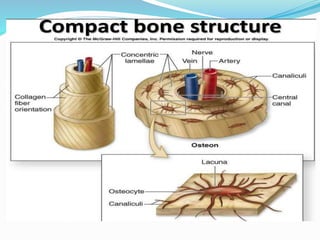
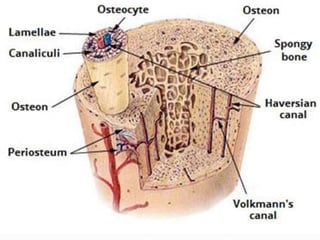
An osteon (or Haversian system) refers to the complex of
concentric lamellae surrounding a small central canal
that contains blood vessels, nerves, loose connective
tissue, and endosteum. The central canals communicate
with the marrow cavity and the periosteum and with one
another through transverse perforating canals (or
Volkmann canals).
Woven Bone
Woven bone is nonlamellar and characterized by
random disposition of type I collagen fibers and is the
first bone tissue to appear in embryonic development
and in fracture repair. Woven bone tissue is usually
temporary and is replaced in adults by lamellar bone,
except in a very few places in the body, for example, near
the sutures of the calvaria and in the insertions of some
tendons.
Osteogenesis
Bone development or osteogenesis occurs by one of two
processes:
Intramembranous ossification, in which osteoblasts
differentiate directly from mesenchyme and begin
secreting osteoid
Endochondral ossification, in which a preexisting
matrix of hyaline cartilage is eroded and invaded by
osteoblasts, which then begin osteoid production.
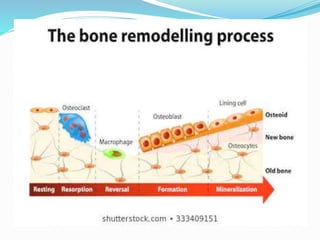
Bone remodeling
is continuous throughout life and involves a process of
bone resorption and bone formation. In compact bone,
remodeling resorbs parts of old osteons and produces
new ones. Resorption involves the actions of osteoclasts
and bone formation involves action of osteoblast. In
healthy adults 5%-10% of the bone turns over annually.
Bone   histology

Bone histology

  • 1.
  • 2.
    Bone is a specializedconnective tissue composed of calcified extracellular material, the bone matrix , and three major cell types:
  • 3.
    1- Osteocytes (Gr.osteon , bone + kytos , cell), which are found in cavities ( lacunae ) between bone matrix layers ( lamellae ), with cytoplasmic processes extending into small canaliculi (L. canalis , canal) between lamellae. 2- Osteoblasts ( osteon + Gr. blastos , germ), which synthesize the organic components of the matrix 3- Osteoclasts ( osteon + Gr. klastos , broken), which are multinucleated, giant cells involved in the resorption and remodeling of bone tissue.
  • 4.
    Because metabolites areunable to diffuse through the calcified matrix of bone, the exchanges between osteocytes and blood capillaries depend on communication through the very thin, cylindrical spaces of the canaliculi. All bones are lined on both internal and external surfaces by layers of connective tissue containing osteogenic cells— endosteum on the internal surface surrounding the marrow cavity and periosteum on the external surface.
  • 5.
    Bone Functions • Protectsvital organs • Supports soft tissue • Movement • Mineral storage • Blood cell production
  • 6.
    BONE CELLs Osteoblasts Osteoblasts synthesizeand secrete the organic components of bone matrix, which include type I collagen fibers, proteoglycans, and several glycoproteins such as osteonectin. Deposition of the inorganic components of bone also depends on viable osteoblasts.
  • 7.
    Calcification of thematrix is not completely understood, Prominent among the noncollagen proteins secreted by osteoblasts is the small, vitamin K–dependent polypeptide osteocalcin, which together with various glycoproteins binds Ca2+ ions and raises their concentration locally.
  • 8.
    Osteoblasts also releasemembrane- enclosed matrix vesicles rich in alkaline phosphatase and other enzymes whose activity raises the local concentration of PO4 − ions. With high concentrations of both calcium and phosphate ions, these vesicles serve as foci for the formation of hydroxyapatite [Ca10(PO4)6(OH)2] crystals, the first visible step in calcification. These crystals grow rapidly by accretion of more mineral and eventually produce a confluent mass of calcified material embedding the collagen fibers and proteoglycans.
  • 10.
    Osteocytes Many osteoblasts aregradually surrounded by the material they secreted and differentiate further as osteocytes enclosed singly within the lacunae that are regularly spaced throughout the mineralized matrix. In the transition from osteoblasts to osteocytes, the cells extend many long dendritic processes, which also become surrounded by calcifying matrix. Osteocytic processes thus come to occupy the many canaliculi, 250- 300 nm in diameter, that radiate from each lacuna.
  • 11.
    Diffusion of metabolitesbetween osteocytes and blood vessels occurs through the small amount of extracellular fluid between the bone matrix and the osteocytes and their processes. Osteocytes also communicate with one another via gap junctions on the dendritic processes in the canaliculi and on osteoblasts and bone lining cells. When compared with osteoblasts, the flat, almond shaped osteocytes exhibit significantly less RER, smaller Golgi complexes, and more condensed nuclear chromatin. These cells maintain the bony matrix, and their death is followed by rapid matrix resorption.
  • 13.
    Canaliculi : tinycanals that radiate outward from the central canals to each lacunae space.
  • 14.
    Osteoclasts Osteoclasts are verylarge, motile cells with multiple nuclei and play a major role in matrix resorption during bone growth and remodeling. The large size and multinucleated condition of osteoclasts are due to their origin from the fusion of bone marrow–derived cells. In areas of bone undergoing resorption, osteoclasts lie within enzymatically etched depressions or cavities in the matrix known as resorption cavities (also called Howship lacunae).
  • 15.
    In active osteoclasts,the surface against the bone matrix is folded into irregular projections, forming a ruffled border surrounded by a cytoplasmic zone rich in actin filaments, which is the site of adhesion to the matrix.
  • 16.
    Into this subcellularpocket the osteoclast secretes collagenase, cathepsin K, and other enzymes and pumps protons to produce an acidic environment locally for dissolving hydroxyapatite and promoting the localized digestion of matrix proteins. Osteoclast activity is controlled by local signaling factors and hormones. Osteoclasts have receptors for calcitonin, a thyroid hormone.
  • 17.
    BONE MATRIX Inorganic materialrepresents about 50% of the dry weight of bone matrix. Calcium hydroxyapatite is most abundant, but bicarbonate, citrate, magnesium, potassium, and sodium ions are also found. Significant quantities of amorphous (noncrystalline) calcium phosphate are also present. The organic matter embedded in the calcified matrix includes type I collagen, proteoglycan aggregates, and bone specific multiadhesive glycoproteins such as osteonectin.
  • 19.
    Types of Bone Grossobservation of a bone shows a dense area near the surface corresponding to compact (cortical) bone, which represents 80% of the total bone mass, and deeper areas with numerous interconnecting cavities, called cancellous (trabecular or spongy) bone, constituting about 20% of total bone mass.
  • 22.
    Microscopic examination ofbone tissue shows two types of organization: lamellar bone and woven bone, which is usually more immature than lamellar bone. Lamellar Bone Most bone in adults, compact or cancellous, is organized as lamellar bone, characterized by multiple layers or lamellae of calcified matrix, each 3-7 μm thick. The lamellae are organized either parallel to each other or concentrically around a central canal.
  • 23.
    An osteon (orHaversian system) refers to the complex of concentric lamellae surrounding a small central canal that contains blood vessels, nerves, loose connective tissue, and endosteum. The central canals communicate with the marrow cavity and the periosteum and with one another through transverse perforating canals (or Volkmann canals).
  • 25.
    Woven Bone Woven boneis nonlamellar and characterized by random disposition of type I collagen fibers and is the first bone tissue to appear in embryonic development and in fracture repair. Woven bone tissue is usually temporary and is replaced in adults by lamellar bone, except in a very few places in the body, for example, near the sutures of the calvaria and in the insertions of some tendons.
  • 26.
    Osteogenesis Bone development orosteogenesis occurs by one of two processes: Intramembranous ossification, in which osteoblasts differentiate directly from mesenchyme and begin secreting osteoid Endochondral ossification, in which a preexisting matrix of hyaline cartilage is eroded and invaded by osteoblasts, which then begin osteoid production.
  • 27.
    Bone remodeling is continuousthroughout life and involves a process of bone resorption and bone formation. In compact bone, remodeling resorbs parts of old osteons and produces new ones. Resorption involves the actions of osteoclasts and bone formation involves action of osteoblast. In healthy adults 5%-10% of the bone turns over annually.