Dr. Juan J JallerDr. Juan J Jaller
Actualizacion en densitometriaActualizacion en densitometria
WHO Classification ofWHO Classification of
Postmenopausal OsteoporosisPostmenopausal Osteoporosis
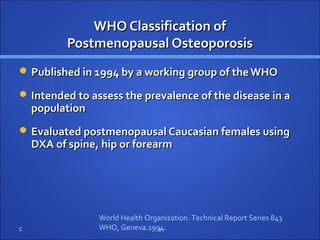
 Published in 1994 by a working group of the WHOPublished in 1994 by a working group of the WHO
 Intended to assess the prevalence of the disease in aIntended to assess the prevalence of the disease in a
populationpopulation
 Evaluated postmenopausal Caucasian females usingEvaluated postmenopausal Caucasian females using
DXA of spine, hip or forearmDXA of spine, hip or forearm
C 2
World Health Organization. Technical Report Series 843
WHO, Geneva.1994.
C 3
WHO Classification of
Postmenopausal Osteoporosis
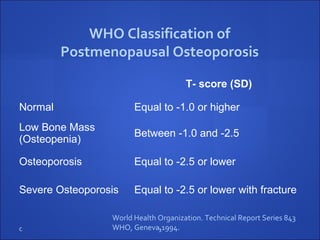
T- score (SD)
Normal Equal to -1.0 or higher
Low Bone Mass
(Osteopenia)
Between -1.0 and -2.5
Osteoporosis Equal to -2.5 or lower
Severe Osteoporosis Equal to -2.5 or lower with fracture
World Health Organization. Technical Report Series 843
WHO, Geneva.1994.
C 4
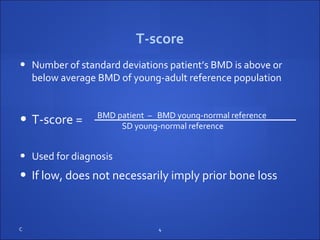
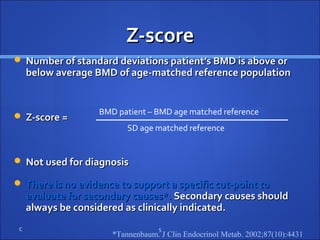
• Number of standard deviations patient’s BMD is above or
below average BMD of young-adult reference population
• T-score =
• Used for diagnosis
• If low, does not necessarily imply prior bone loss
T-score
BMD patient – BMD young-normal reference
SD young-normal reference
Z-scoreZ-score
 Number of standard deviations patient’s BMD is above orNumber of standard deviations patient’s BMD is above or
below average BMD of age-matched reference populationbelow average BMD of age-matched reference population
 Z-score =Z-score =
 Not used for diagnosisNot used for diagnosis
 There is no evidence to support a specific cut-point toThere is no evidence to support a specific cut-point to
evaluate for secondary causes*.evaluate for secondary causes*. Secondary causes shouldSecondary causes should
always be considered as clinically indicated.always be considered as clinically indicated.
C 5
BMD patient – BMD age matched reference
SD age matched reference
*Tannenbaum. J Clin Endocrinol Metab. 2002;87(10):4431
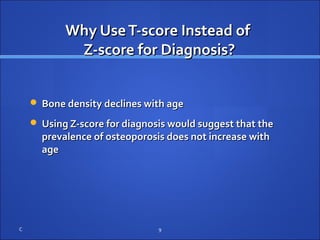
Why UseT-score Instead ofWhy UseT-score Instead of
Z-score for Diagnosis?Z-score for Diagnosis?
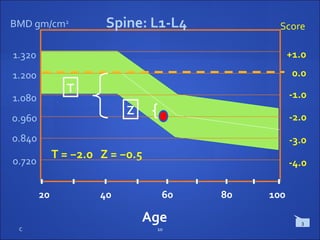
 Bone density declines with ageBone density declines with age
 Using Z-score for diagnosis would suggest that theUsing Z-score for diagnosis would suggest that the
prevalence of osteoporosis does not increase withprevalence of osteoporosis does not increase with
ageage
C 9
C 10
Score
T = −2.0 Z = −0.5
0.0
-1.0
-2.0
-3.0
+1.0
T
Z
20 40 60 80 100
1.200
0.960
0.840
-4.00.720
1.080
1.320
BMD gm/cm2
Spine: L1-L4
Age 3
T-scoreT-score
Equal to or LowerThanEqual to or LowerThan −−2.52.5
Is Not AlwaysIs Not Always
Due to Primary OsteoporosisDue to Primary Osteoporosis
C 11
Central DXA for Diagnosis:Central DXA for Diagnosis:
Skeletal Sites to MeasureSkeletal Sites to Measure
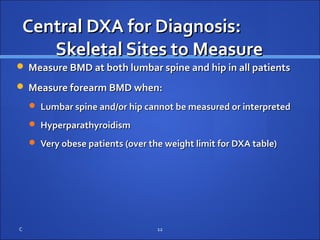
 Measure BMD at both lumbar spine and hip in all patientsMeasure BMD at both lumbar spine and hip in all patients
 Measure forearm BMD when:Measure forearm BMD when:
 Lumbar spine and/or hip cannot be measured or interpretedLumbar spine and/or hip cannot be measured or interpreted
 HyperparathyroidismHyperparathyroidism
 Very obese patients (over the weight limit for DXA table)Very obese patients (over the weight limit for DXA table)
C 12
Central DXA for Diagnosis:Central DXA for Diagnosis:
Spine Region of InterestSpine Region of Interest
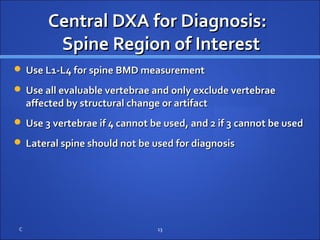
 Use L1-L4 for spine BMD measurementUse L1-L4 for spine BMD measurement
 Use all evaluable vertebrae and only exclude vertebraeUse all evaluable vertebrae and only exclude vertebrae
affected by structural change or artifactaffected by structural change or artifact
 Use 3 vertebrae if 4 cannot be used, and 2 if 3 cannot be usedUse 3 vertebrae if 4 cannot be used, and 2 if 3 cannot be used
 Lateral spine should not be used for diagnosisLateral spine should not be used for diagnosis
C 13
Central DXA for Diagnosis:Central DXA for Diagnosis:
Hip Region of InterestHip Region of Interest
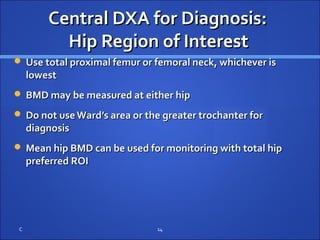
 Use total proximal femur or femoral neck, whichever isUse total proximal femur or femoral neck, whichever is
lowestlowest
 BMD may be measured at either hipBMD may be measured at either hip
 Do not useWard’s area or the greater trochanter forDo not useWard’s area or the greater trochanter for
diagnosisdiagnosis
 Mean hip BMD can be used for monitoring with total hipMean hip BMD can be used for monitoring with total hip
preferred ROIpreferred ROI
C 14
Central DXA for Diagnosis:Central DXA for Diagnosis:
Forearm Region of InterestForearm Region of Interest
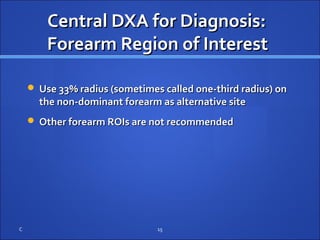
 Use 33% radius (sometimes called one-third radius) onUse 33% radius (sometimes called one-third radius) on
the non-dominant forearm as alternative sitethe non-dominant forearm as alternative site
 Other forearm ROIs are not recommendedOther forearm ROIs are not recommended
C 15
Diagnosis in Premenopausal WomenDiagnosis in Premenopausal Women
(age 20 and older)(age 20 and older)
 WHO classification should not be applied to healthyWHO classification should not be applied to healthy
premenopausal womenpremenopausal women
 For women prior to menopause, Z-scores, rather thanT-scores,For women prior to menopause, Z-scores, rather thanT-scores,
are preferred.This is particularly important in children.are preferred.This is particularly important in children.
 A Z-score of -2.0 or lower is defined as “below the expected rangeA Z-score of -2.0 or lower is defined as “below the expected range
for age” and a Z-score above -2.0 is “within the expected range forfor age” and a Z-score above -2.0 is “within the expected range for
age.”age.”
C 16ISCD 2005 Position Statement. Vancouver, B.C.
BMD Reporting in Females Prior toBMD Reporting in Females Prior to
Menopause and in MalesYoungerThan Age 50Menopause and in MalesYoungerThan Age 50
 Z-scores, notT-scores, are preferred.This is particularly importantZ-scores, notT-scores, are preferred.This is particularly important
in children.in children.
 A Z-score of -2.0 or lower is defined as “below the expected rangeA Z-score of -2.0 or lower is defined as “below the expected range
for age”, and a Z-score above -2.0 is “within the expected rangefor age”, and a Z-score above -2.0 is “within the expected range
for age.”for age.”
 Osteoporosis cannot be diagnosed in men under age 50 on theOsteoporosis cannot be diagnosed in men under age 50 on the
basis of BMD alone.basis of BMD alone.
 The WHO diagnostic criteria may be applied to women in theThe WHO diagnostic criteria may be applied to women in the
menopausal transition.menopausal transition.
C
Skeletal Sites to Measure forSkeletal Sites to Measure for
Diagnosis in ChildrenDiagnosis in Children
 Patients should have spine and total body less headPatients should have spine and total body less head
(TBLH) BMC and areal BMD measured(TBLH) BMC and areal BMD measured
 The total hip is not a reliable site in growing children dueThe total hip is not a reliable site in growing children due
to significant variability in skeletal development and lackto significant variability in skeletal development and lack
of reproducible regions of interestof reproducible regions of interest
18Gordon C, et. al., J Clin Densitom; 2008; 11:43-58
DXA Interpretation and ReportingDXA Interpretation and Reporting
in Children and Adolescents (9)in Children and Adolescents (9)
o The term “osteoporosis” should not appear in pediatric DXAThe term “osteoporosis” should not appear in pediatric DXA
reports without knowledge of clinically significant fracturereports without knowledge of clinically significant fracture
history.history.
o ““Low bone mineral content or bone mineral density forLow bone mineral content or bone mineral density for
chronologic age” is the preferred term when BMC or BMD Z-chronologic age” is the preferred term when BMC or BMD Z-
scores are less than or equal to -2.0.scores are less than or equal to -2.0.
DXA Interpretation and ReportingDXA Interpretation and Reporting
in Children and Adolescents (2)in Children and Adolescents (2)
 The hip (including total hip and proximal femur) is not aThe hip (including total hip and proximal femur) is not a
reliable site for measurement in growing children due toreliable site for measurement in growing children due to
significant variability in skeletal development and lack ofsignificant variability in skeletal development and lack of
reproducible ROI.reproducible ROI.
 In children with linear growth or maturational delay, spineIn children with linear growth or maturational delay, spine
andTBLH BMC and areal BMD results should be adjustedandTBLH BMC and areal BMD results should be adjusted
for absolute height or height age, or compared tofor absolute height or height age, or compared to
pediatric reference data that provide age-, gender-, andpediatric reference data that provide age-, gender-, and
height-specific Z-scores.height-specific Z-scores.
DXA Interpretation and ReportingDXA Interpretation and Reporting
in Children and Adolescents (8)in Children and Adolescents (8)
 TerminologyTerminology
o T-scores should not appear in pediatric DXA reports.T-scores should not appear in pediatric DXA reports.
o The term “osteopenia” should not appear in pediatric DXAThe term “osteopenia” should not appear in pediatric DXA
reports.reports.
o The term “osteoporosis” should not appear in pediatric DXAThe term “osteoporosis” should not appear in pediatric DXA
reports without knowledge of clinically significant fracturereports without knowledge of clinically significant fracture
history.history.
o ““Low bone mineral content or bone mineral density forLow bone mineral content or bone mineral density for
chronologic age” is the preferred term when BMC or BMD Z-chronologic age” is the preferred term when BMC or BMD Z-
scores are less than or equal to -2.0.scores are less than or equal to -2.0.
Diagnosis in Men: ISCD PositionDiagnosis in Men: ISCD Position
 Age 50 and older:Age 50 and older:
 T-scores are preferred.T-scores are preferred.
 The WHO densitometric classification is applicable.The WHO densitometric classification is applicable.
 In men younger than age 50:In men younger than age 50:
 Z-scores, notT-scores are preferred.Z-scores, notT-scores are preferred.
 Osteoporosis cannot be diagnosed on the basis of BMD alone.Osteoporosis cannot be diagnosed on the basis of BMD alone.
C 23
www.iscd.org
Indications forVFAIndications forVFA
 ConsiderVFA when the results may influence clinicalConsiderVFA when the results may influence clinical
management.management.
 Postmenopausal women with low bone mass (osteopenia)Postmenopausal women with low bone mass (osteopenia)
by BMD criteria, PLUS any one of the following:by BMD criteria, PLUS any one of the following:
o Age greater than or equal to 70 yearsAge greater than or equal to 70 years
o Historical height loss greater than 4 cm (1.6 in.)Historical height loss greater than 4 cm (1.6 in.)
o Prospective height loss greater than 2 cm (0.8 in.)Prospective height loss greater than 2 cm (0.8 in.)
o Self-reported vertebral fracture (not previously documented)Self-reported vertebral fracture (not previously documented)
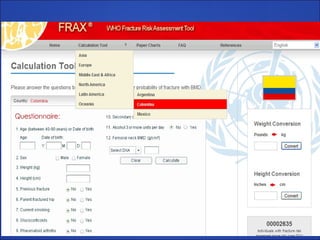
FRAX is a computer-based algorithm which uses
easily obtained clinical risk factors
to estimate an individual’s 10-year fracture
probability.
It may be utilized by clinicians to assist in the
identification of patients at high risk for
fractures.
INTRODUCTORY STATEMENT
Strengths:Strengths:
 The FRAX model determines the predictive importance of eachThe FRAX model determines the predictive importance of each
clinical risk factor, as well as interactions between them, toclinical risk factor, as well as interactions between them, to
optimize the accuracy of fracture probability.optimize the accuracy of fracture probability.
 It is primarily used as a clinical tool to help physicians assessIt is primarily used as a clinical tool to help physicians assess
fracture probability.fracture probability.
 FRAX aid in identifying which individuals may be candidates forFRAX aid in identifying which individuals may be candidates for
bone density evaluation or pharmacological treatment.bone density evaluation or pharmacological treatment.
Limitations:Limitations:
 FRAX does not take into account all risk variables ( ex. falls,FRAX does not take into account all risk variables ( ex. falls,
markers of bone turnover levels, other bone densitymarkers of bone turnover levels, other bone density
assessments, as well as certain secondary causes ofassessments, as well as certain secondary causes of
osteoporosis).osteoporosis).
 FRAX uses yes/no answers and the average risk is computed.FRAX uses yes/no answers and the average risk is computed.
 Does not take into account the variation of risks associatedDoes not take into account the variation of risks associated
with high or low doses of glucocorticoids, the number andwith high or low doses of glucocorticoids, the number and
type of prior fractures, or the quantity of alcohol or tobaccotype of prior fractures, or the quantity of alcohol or tobacco
consumption.consumption.
2010 ISCD-IOF FRAX Initiative and2010 ISCD-IOF FRAX Initiative and
ISCD Position Development ConferenceISCD Position Development Conference
Bucharest, RomaniaBucharest, Romania
November 12-14, 2010November 12-14, 2010
Sanford Baim, MDSanford Baim, MD
Associate Professor of MedicineAssociate Professor of Medicine
Division of EndocrinologyDivision of Endocrinology
University of Miami, Miller School of MedicineUniversity of Miami, Miller School of Medicine
FRAX may underestimate fracture probability in
individuals with a parental history of non-hip fragility
fracture.
Bone turnover markers are not included as risk factors in
FRAX.
FRAX CLINICAL STATEMENTS
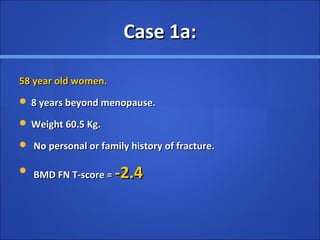
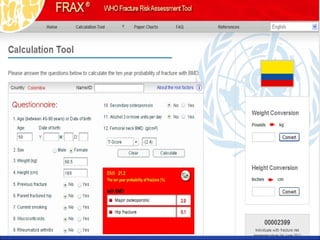
Case 1a:Case 1a:
58 year old women.58 year old women.
 8 years beyond menopause.8 years beyond menopause.
 Weight 60.5 Kg.Weight 60.5 Kg.
 No personal or family history of fracture.No personal or family history of fracture.
 BMD FN T-score =BMD FN T-score = -2.4-2.4
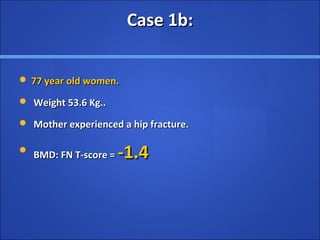
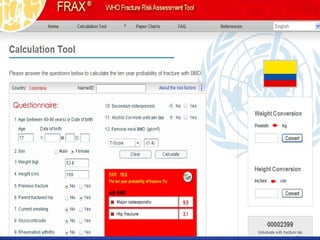
Case 1b:Case 1b:
 77 year old women.77 year old women.
 Weight 53.6 Kg..Weight 53.6 Kg..
 Mother experienced a hip fracture.Mother experienced a hip fracture.

BMD: FN T-score =BMD: FN T-score = -1.4-1.4
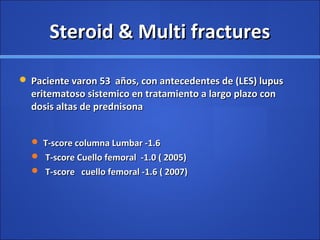
Steroid & Multi fracturesSteroid & Multi fractures
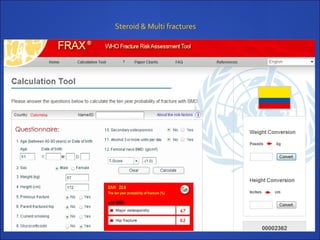
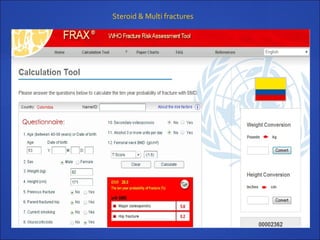
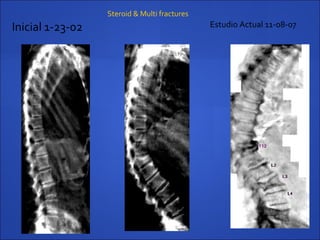
 Paciente varon 53 años, con antecedentes de (LES) lupusPaciente varon 53 años, con antecedentes de (LES) lupus
eritematoso sistemico en tratamiento a largo plazo coneritematoso sistemico en tratamiento a largo plazo con
dosis altas de prednisonadosis altas de prednisona
 T-score columna Lumbar -1.6T-score columna Lumbar -1.6
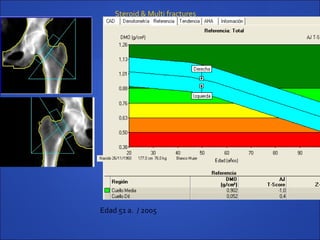
 T-score Cuello femoral -1.0 ( 2005)T-score Cuello femoral -1.0 ( 2005)
 T-score cuello femoral -1.6 ( 2007)T-score cuello femoral -1.6 ( 2007)
Edad 51 a. / 2005
Steroid & Multi fractures
Inicial 1-23-02 Estudio Actual 11-08-07
Steroid & Multi fractures
T12
PDC declaraciónPDC declaración
 Existe correlacion entre el uso de corticoides por mas de 3 meses y elExiste correlacion entre el uso de corticoides por mas de 3 meses y el
riesgo de fracturariesgo de fractura
 El promedio de dosis de corticoides incorporado en el FRAX es de 2.5 aEl promedio de dosis de corticoides incorporado en el FRAX es de 2.5 a
7.5 mg dia de prednisona o su equivalente7.5 mg dia de prednisona o su equivalente
la probabilidad de fractura es subestimada cuando lala probabilidad de fractura es subestimada cuando la
dosis de prednisona es mayor de 7.5 mg/dia, y esdosis de prednisona es mayor de 7.5 mg/dia, y es
sobre estimada cuando la dosis de prednisona essobre estimada cuando la dosis de prednisona es
menor de 2.5 mg/diamenor de 2.5 mg/dia
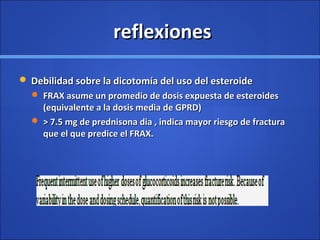
reflexionesreflexiones
 Debilidad sobre la dicotomía del uso del esteroideDebilidad sobre la dicotomía del uso del esteroide
 FRAX asume un promedio de dosis expuesta de esteroidesFRAX asume un promedio de dosis expuesta de esteroides
(equivalente a la dosis media de GPRD)(equivalente a la dosis media de GPRD)
 > 7.5 mg de prednisona dia , indica mayor riesgo de fractura> 7.5 mg de prednisona dia , indica mayor riesgo de fractura
que el que predice el FRAX.que el que predice el FRAX.
Caso 1 reflexiónCaso 1 reflexión
 Debilidad sobre la dicotomia del uso del esteroideDebilidad sobre la dicotomia del uso del esteroide
 FRAX asume un promedio de dosis de esteroidesFRAX asume un promedio de dosis de esteroides
 > 7.5 mg de prednisona dia , indica mayor riesgo de fractura> 7.5 mg de prednisona dia , indica mayor riesgo de fractura
que el que predice el FRAX.que el que predice el FRAX.
L a Obesidad podria no ser protectoraL a Obesidad podria no ser protectora
la masa muscular puede no incrementarse con el pesola masa muscular puede no incrementarse con el peso
“Cuando QUEREMOS INTERPRETAR POSIBILIDADES, ES
NECESARIO
UTILIZAR EL JUICIO
CLINICO”
“Cuando QUEREMOS INTERPRETAR POSIBILIDADES, ES
NECESARIO
UTILIZAR EL JUICIO
CLINICO”
Caidas multiplesCaidas multiples
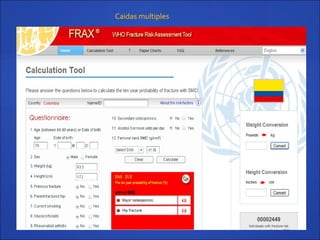
 Varon 76 a. con antecedentes de múltiples caídas,Varon 76 a. con antecedentes de múltiples caídas,
hipertensión, hiperlipidemia, osteoartritis de rodilla yhipertensión, hiperlipidemia, osteoartritis de rodilla y
cadera, nicturia.cadera, nicturia.
 25(oh) D = 26 ng/ml25(oh) D = 26 ng/ml
 AtorvastatinaAtorvastatina
 ASAASA
 HCTZHCTZ
 metoprololmetoprolol
 AlprazolanAlprazolan
 multivitaminamultivitamina
Caidas multiples
PDC declaraciónPDC declaración
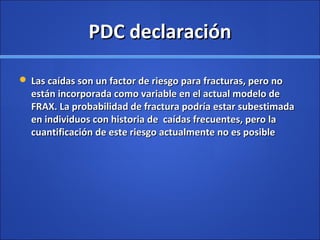
 Las caídas son un factor de riesgo para fracturas, pero noLas caídas son un factor de riesgo para fracturas, pero no
están incorporada como variable en el actual modelo deestán incorporada como variable en el actual modelo de
FRAX. La probabilidad de fractura podría estar subestimadaFRAX. La probabilidad de fractura podría estar subestimada
en individuos con historia de caídas frecuentes, pero laen individuos con historia de caídas frecuentes, pero la
cuantificación de este riesgo actualmente no es posiblecuantificación de este riesgo actualmente no es posible
reflexiónreflexión
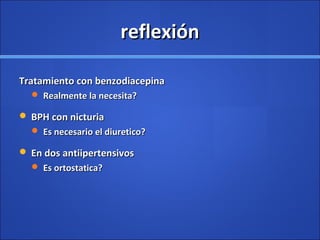
Tratamiento con benzodiacepinaTratamiento con benzodiacepina
 Realmente la necesita?Realmente la necesita?
 BPH con nicturiaBPH con nicturia
 Es necesario el diuretico?Es necesario el diuretico?
 En dos antiipertensivosEn dos antiipertensivos
 Es ortostatica?Es ortostatica?
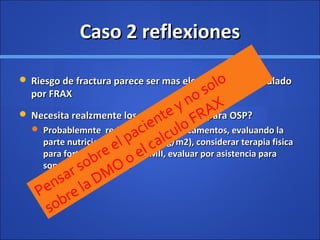
Caso 2 reflexionesCaso 2 reflexiones
 Riesgo de fractura parece ser mas elevado que el calculadoRiesgo de fractura parece ser mas elevado que el calculado
por FRAXpor FRAX
 Necesita realzmente los medicamentos para OSP?Necesita realzmente los medicamentos para OSP?
 Probablemnte reduciendo los medicamentos, evaluando laProbablemnte reduciendo los medicamentos, evaluando la
parte nutricional ( BMI de 20 Kg/m2), considerar terapia fisicaparte nutricional ( BMI de 20 Kg/m2), considerar terapia fisica
para fortalecimiento en MMII, evaluar por asistencia parapara fortalecimiento en MMII, evaluar por asistencia para
soporte y estabilidad.soporte y estabilidad.
Pensar sobre el paciente y no solo
sobre la DMO o el calculo FRAX
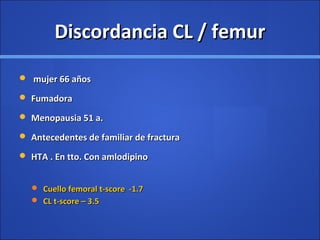
Discordancia CL / femurDiscordancia CL / femur
 mujer 66 añosmujer 66 años
 FumadoraFumadora
 Menopausia 51 a.Menopausia 51 a.
 Antecedentes de familiar de fracturaAntecedentes de familiar de fractura
 HTA . En tto. Con amlodipinoHTA . En tto. Con amlodipino
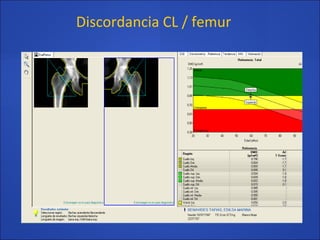
 Cuello femoral t-score -1.7Cuello femoral t-score -1.7
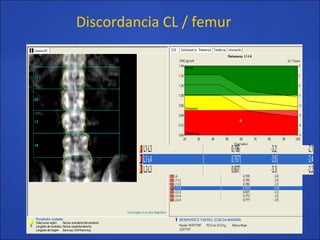
 CL t-score – 3.5CL t-score – 3.5
Discordancia CL / femur
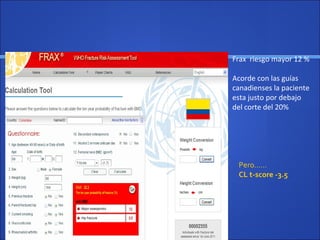
Frax riesgo mayor 12 %
Acorde con las guías
canadienses la paciente
esta justo por debajo
del corte del 20%
Pero……
CL t-score -3.5
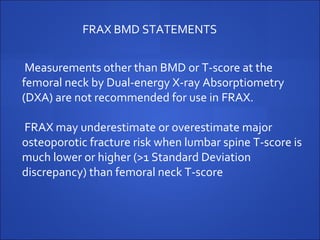
Measurements other than BMD or T-score at the
femoral neck by Dual-energy X-ray Absorptiometry
(DXA) are not recommended for use in FRAX.
FRAX may underestimate or overestimate major
osteoporotic fracture risk when lumbar spine T-score is
much lower or higher (>1 Standard Deviation
discrepancy) than femoral neck T-score
FRAX BMD STATEMENTS

Errores en el Diagnóstico de Osteoporosis. Densitometría Ósea

  • 1.
    Dr. Juan JJallerDr. Juan J Jaller Actualizacion en densitometriaActualizacion en densitometria
  • 2.
    WHO Classification ofWHOClassification of Postmenopausal OsteoporosisPostmenopausal Osteoporosis  Published in 1994 by a working group of the WHOPublished in 1994 by a working group of the WHO  Intended to assess the prevalence of the disease in aIntended to assess the prevalence of the disease in a populationpopulation  Evaluated postmenopausal Caucasian females usingEvaluated postmenopausal Caucasian females using DXA of spine, hip or forearmDXA of spine, hip or forearm C 2 World Health Organization. Technical Report Series 843 WHO, Geneva.1994.
  • 3.
    C 3 WHO Classificationof Postmenopausal Osteoporosis T- score (SD) Normal Equal to -1.0 or higher Low Bone Mass (Osteopenia) Between -1.0 and -2.5 Osteoporosis Equal to -2.5 or lower Severe Osteoporosis Equal to -2.5 or lower with fracture World Health Organization. Technical Report Series 843 WHO, Geneva.1994.
  • 4.
    C 4 • Numberof standard deviations patient’s BMD is above or below average BMD of young-adult reference population • T-score = • Used for diagnosis • If low, does not necessarily imply prior bone loss T-score BMD patient – BMD young-normal reference SD young-normal reference
  • 5.
    Z-scoreZ-score  Number ofstandard deviations patient’s BMD is above orNumber of standard deviations patient’s BMD is above or below average BMD of age-matched reference populationbelow average BMD of age-matched reference population  Z-score =Z-score =  Not used for diagnosisNot used for diagnosis  There is no evidence to support a specific cut-point toThere is no evidence to support a specific cut-point to evaluate for secondary causes*.evaluate for secondary causes*. Secondary causes shouldSecondary causes should always be considered as clinically indicated.always be considered as clinically indicated. C 5 BMD patient – BMD age matched reference SD age matched reference *Tannenbaum. J Clin Endocrinol Metab. 2002;87(10):4431
  • 6.
    Why UseT-score InsteadofWhy UseT-score Instead of Z-score for Diagnosis?Z-score for Diagnosis?  Bone density declines with ageBone density declines with age  Using Z-score for diagnosis would suggest that theUsing Z-score for diagnosis would suggest that the prevalence of osteoporosis does not increase withprevalence of osteoporosis does not increase with ageage C 9
  • 7.
    C 10 Score T =−2.0 Z = −0.5 0.0 -1.0 -2.0 -3.0 +1.0 T Z 20 40 60 80 100 1.200 0.960 0.840 -4.00.720 1.080 1.320 BMD gm/cm2 Spine: L1-L4 Age 3
  • 8.
    T-scoreT-score Equal to orLowerThanEqual to or LowerThan −−2.52.5 Is Not AlwaysIs Not Always Due to Primary OsteoporosisDue to Primary Osteoporosis C 11
  • 9.
    Central DXA forDiagnosis:Central DXA for Diagnosis: Skeletal Sites to MeasureSkeletal Sites to Measure  Measure BMD at both lumbar spine and hip in all patientsMeasure BMD at both lumbar spine and hip in all patients  Measure forearm BMD when:Measure forearm BMD when:  Lumbar spine and/or hip cannot be measured or interpretedLumbar spine and/or hip cannot be measured or interpreted  HyperparathyroidismHyperparathyroidism  Very obese patients (over the weight limit for DXA table)Very obese patients (over the weight limit for DXA table) C 12
  • 10.
    Central DXA forDiagnosis:Central DXA for Diagnosis: Spine Region of InterestSpine Region of Interest  Use L1-L4 for spine BMD measurementUse L1-L4 for spine BMD measurement  Use all evaluable vertebrae and only exclude vertebraeUse all evaluable vertebrae and only exclude vertebrae affected by structural change or artifactaffected by structural change or artifact  Use 3 vertebrae if 4 cannot be used, and 2 if 3 cannot be usedUse 3 vertebrae if 4 cannot be used, and 2 if 3 cannot be used  Lateral spine should not be used for diagnosisLateral spine should not be used for diagnosis C 13
  • 11.
    Central DXA forDiagnosis:Central DXA for Diagnosis: Hip Region of InterestHip Region of Interest  Use total proximal femur or femoral neck, whichever isUse total proximal femur or femoral neck, whichever is lowestlowest  BMD may be measured at either hipBMD may be measured at either hip  Do not useWard’s area or the greater trochanter forDo not useWard’s area or the greater trochanter for diagnosisdiagnosis  Mean hip BMD can be used for monitoring with total hipMean hip BMD can be used for monitoring with total hip preferred ROIpreferred ROI C 14
  • 12.
    Central DXA forDiagnosis:Central DXA for Diagnosis: Forearm Region of InterestForearm Region of Interest  Use 33% radius (sometimes called one-third radius) onUse 33% radius (sometimes called one-third radius) on the non-dominant forearm as alternative sitethe non-dominant forearm as alternative site  Other forearm ROIs are not recommendedOther forearm ROIs are not recommended C 15
  • 13.
    Diagnosis in PremenopausalWomenDiagnosis in Premenopausal Women (age 20 and older)(age 20 and older)  WHO classification should not be applied to healthyWHO classification should not be applied to healthy premenopausal womenpremenopausal women  For women prior to menopause, Z-scores, rather thanT-scores,For women prior to menopause, Z-scores, rather thanT-scores, are preferred.This is particularly important in children.are preferred.This is particularly important in children.  A Z-score of -2.0 or lower is defined as “below the expected rangeA Z-score of -2.0 or lower is defined as “below the expected range for age” and a Z-score above -2.0 is “within the expected range forfor age” and a Z-score above -2.0 is “within the expected range for age.”age.” C 16ISCD 2005 Position Statement. Vancouver, B.C.
  • 14.
    BMD Reporting inFemales Prior toBMD Reporting in Females Prior to Menopause and in MalesYoungerThan Age 50Menopause and in MalesYoungerThan Age 50  Z-scores, notT-scores, are preferred.This is particularly importantZ-scores, notT-scores, are preferred.This is particularly important in children.in children.  A Z-score of -2.0 or lower is defined as “below the expected rangeA Z-score of -2.0 or lower is defined as “below the expected range for age”, and a Z-score above -2.0 is “within the expected rangefor age”, and a Z-score above -2.0 is “within the expected range for age.”for age.”  Osteoporosis cannot be diagnosed in men under age 50 on theOsteoporosis cannot be diagnosed in men under age 50 on the basis of BMD alone.basis of BMD alone.  The WHO diagnostic criteria may be applied to women in theThe WHO diagnostic criteria may be applied to women in the menopausal transition.menopausal transition.
  • 15.
    C Skeletal Sites toMeasure forSkeletal Sites to Measure for Diagnosis in ChildrenDiagnosis in Children  Patients should have spine and total body less headPatients should have spine and total body less head (TBLH) BMC and areal BMD measured(TBLH) BMC and areal BMD measured  The total hip is not a reliable site in growing children dueThe total hip is not a reliable site in growing children due to significant variability in skeletal development and lackto significant variability in skeletal development and lack of reproducible regions of interestof reproducible regions of interest 18Gordon C, et. al., J Clin Densitom; 2008; 11:43-58
  • 16.
    DXA Interpretation andReportingDXA Interpretation and Reporting in Children and Adolescents (9)in Children and Adolescents (9) o The term “osteoporosis” should not appear in pediatric DXAThe term “osteoporosis” should not appear in pediatric DXA reports without knowledge of clinically significant fracturereports without knowledge of clinically significant fracture history.history. o ““Low bone mineral content or bone mineral density forLow bone mineral content or bone mineral density for chronologic age” is the preferred term when BMC or BMD Z-chronologic age” is the preferred term when BMC or BMD Z- scores are less than or equal to -2.0.scores are less than or equal to -2.0.
  • 17.
    DXA Interpretation andReportingDXA Interpretation and Reporting in Children and Adolescents (2)in Children and Adolescents (2)  The hip (including total hip and proximal femur) is not aThe hip (including total hip and proximal femur) is not a reliable site for measurement in growing children due toreliable site for measurement in growing children due to significant variability in skeletal development and lack ofsignificant variability in skeletal development and lack of reproducible ROI.reproducible ROI.  In children with linear growth or maturational delay, spineIn children with linear growth or maturational delay, spine andTBLH BMC and areal BMD results should be adjustedandTBLH BMC and areal BMD results should be adjusted for absolute height or height age, or compared tofor absolute height or height age, or compared to pediatric reference data that provide age-, gender-, andpediatric reference data that provide age-, gender-, and height-specific Z-scores.height-specific Z-scores.
  • 18.
    DXA Interpretation andReportingDXA Interpretation and Reporting in Children and Adolescents (8)in Children and Adolescents (8)  TerminologyTerminology o T-scores should not appear in pediatric DXA reports.T-scores should not appear in pediatric DXA reports. o The term “osteopenia” should not appear in pediatric DXAThe term “osteopenia” should not appear in pediatric DXA reports.reports. o The term “osteoporosis” should not appear in pediatric DXAThe term “osteoporosis” should not appear in pediatric DXA reports without knowledge of clinically significant fracturereports without knowledge of clinically significant fracture history.history. o ““Low bone mineral content or bone mineral density forLow bone mineral content or bone mineral density for chronologic age” is the preferred term when BMC or BMD Z-chronologic age” is the preferred term when BMC or BMD Z- scores are less than or equal to -2.0.scores are less than or equal to -2.0.
  • 19.
    Diagnosis in Men:ISCD PositionDiagnosis in Men: ISCD Position  Age 50 and older:Age 50 and older:  T-scores are preferred.T-scores are preferred.  The WHO densitometric classification is applicable.The WHO densitometric classification is applicable.  In men younger than age 50:In men younger than age 50:  Z-scores, notT-scores are preferred.Z-scores, notT-scores are preferred.  Osteoporosis cannot be diagnosed on the basis of BMD alone.Osteoporosis cannot be diagnosed on the basis of BMD alone. C 23 www.iscd.org
  • 20.
    Indications forVFAIndications forVFA ConsiderVFA when the results may influence clinicalConsiderVFA when the results may influence clinical management.management.  Postmenopausal women with low bone mass (osteopenia)Postmenopausal women with low bone mass (osteopenia) by BMD criteria, PLUS any one of the following:by BMD criteria, PLUS any one of the following: o Age greater than or equal to 70 yearsAge greater than or equal to 70 years o Historical height loss greater than 4 cm (1.6 in.)Historical height loss greater than 4 cm (1.6 in.) o Prospective height loss greater than 2 cm (0.8 in.)Prospective height loss greater than 2 cm (0.8 in.) o Self-reported vertebral fracture (not previously documented)Self-reported vertebral fracture (not previously documented)
  • 22.
    FRAX is acomputer-based algorithm which uses easily obtained clinical risk factors to estimate an individual’s 10-year fracture probability. It may be utilized by clinicians to assist in the identification of patients at high risk for fractures. INTRODUCTORY STATEMENT
  • 23.
    Strengths:Strengths:  The FRAXmodel determines the predictive importance of eachThe FRAX model determines the predictive importance of each clinical risk factor, as well as interactions between them, toclinical risk factor, as well as interactions between them, to optimize the accuracy of fracture probability.optimize the accuracy of fracture probability.  It is primarily used as a clinical tool to help physicians assessIt is primarily used as a clinical tool to help physicians assess fracture probability.fracture probability.  FRAX aid in identifying which individuals may be candidates forFRAX aid in identifying which individuals may be candidates for bone density evaluation or pharmacological treatment.bone density evaluation or pharmacological treatment.
  • 24.
    Limitations:Limitations:  FRAX doesnot take into account all risk variables ( ex. falls,FRAX does not take into account all risk variables ( ex. falls, markers of bone turnover levels, other bone densitymarkers of bone turnover levels, other bone density assessments, as well as certain secondary causes ofassessments, as well as certain secondary causes of osteoporosis).osteoporosis).  FRAX uses yes/no answers and the average risk is computed.FRAX uses yes/no answers and the average risk is computed.  Does not take into account the variation of risks associatedDoes not take into account the variation of risks associated with high or low doses of glucocorticoids, the number andwith high or low doses of glucocorticoids, the number and type of prior fractures, or the quantity of alcohol or tobaccotype of prior fractures, or the quantity of alcohol or tobacco consumption.consumption.
  • 25.
    2010 ISCD-IOF FRAXInitiative and2010 ISCD-IOF FRAX Initiative and ISCD Position Development ConferenceISCD Position Development Conference Bucharest, RomaniaBucharest, Romania November 12-14, 2010November 12-14, 2010 Sanford Baim, MDSanford Baim, MD Associate Professor of MedicineAssociate Professor of Medicine Division of EndocrinologyDivision of Endocrinology University of Miami, Miller School of MedicineUniversity of Miami, Miller School of Medicine
  • 26.
    FRAX may underestimatefracture probability in individuals with a parental history of non-hip fragility fracture. Bone turnover markers are not included as risk factors in FRAX. FRAX CLINICAL STATEMENTS
  • 27.
    Case 1a:Case 1a: 58year old women.58 year old women.  8 years beyond menopause.8 years beyond menopause.  Weight 60.5 Kg.Weight 60.5 Kg.  No personal or family history of fracture.No personal or family history of fracture.  BMD FN T-score =BMD FN T-score = -2.4-2.4
  • 29.
    Case 1b:Case 1b: 77 year old women.77 year old women.  Weight 53.6 Kg..Weight 53.6 Kg..  Mother experienced a hip fracture.Mother experienced a hip fracture.  BMD: FN T-score =BMD: FN T-score = -1.4-1.4
  • 31.
    Steroid & MultifracturesSteroid & Multi fractures  Paciente varon 53 años, con antecedentes de (LES) lupusPaciente varon 53 años, con antecedentes de (LES) lupus eritematoso sistemico en tratamiento a largo plazo coneritematoso sistemico en tratamiento a largo plazo con dosis altas de prednisonadosis altas de prednisona  T-score columna Lumbar -1.6T-score columna Lumbar -1.6  T-score Cuello femoral -1.0 ( 2005)T-score Cuello femoral -1.0 ( 2005)  T-score cuello femoral -1.6 ( 2007)T-score cuello femoral -1.6 ( 2007)
  • 32.
    Edad 51 a./ 2005 Steroid & Multi fractures
  • 33.
    Steroid & Multifractures
  • 34.
    Steroid & Multifractures
  • 35.
    Inicial 1-23-02 EstudioActual 11-08-07 Steroid & Multi fractures T12
  • 36.
    PDC declaraciónPDC declaración Existe correlacion entre el uso de corticoides por mas de 3 meses y elExiste correlacion entre el uso de corticoides por mas de 3 meses y el riesgo de fracturariesgo de fractura  El promedio de dosis de corticoides incorporado en el FRAX es de 2.5 aEl promedio de dosis de corticoides incorporado en el FRAX es de 2.5 a 7.5 mg dia de prednisona o su equivalente7.5 mg dia de prednisona o su equivalente la probabilidad de fractura es subestimada cuando lala probabilidad de fractura es subestimada cuando la dosis de prednisona es mayor de 7.5 mg/dia, y esdosis de prednisona es mayor de 7.5 mg/dia, y es sobre estimada cuando la dosis de prednisona essobre estimada cuando la dosis de prednisona es menor de 2.5 mg/diamenor de 2.5 mg/dia
  • 37.
    reflexionesreflexiones  Debilidad sobrela dicotomía del uso del esteroideDebilidad sobre la dicotomía del uso del esteroide  FRAX asume un promedio de dosis expuesta de esteroidesFRAX asume un promedio de dosis expuesta de esteroides (equivalente a la dosis media de GPRD)(equivalente a la dosis media de GPRD)  > 7.5 mg de prednisona dia , indica mayor riesgo de fractura> 7.5 mg de prednisona dia , indica mayor riesgo de fractura que el que predice el FRAX.que el que predice el FRAX.
  • 38.
    Caso 1 reflexiónCaso1 reflexión  Debilidad sobre la dicotomia del uso del esteroideDebilidad sobre la dicotomia del uso del esteroide  FRAX asume un promedio de dosis de esteroidesFRAX asume un promedio de dosis de esteroides  > 7.5 mg de prednisona dia , indica mayor riesgo de fractura> 7.5 mg de prednisona dia , indica mayor riesgo de fractura que el que predice el FRAX.que el que predice el FRAX. L a Obesidad podria no ser protectoraL a Obesidad podria no ser protectora la masa muscular puede no incrementarse con el pesola masa muscular puede no incrementarse con el peso “Cuando QUEREMOS INTERPRETAR POSIBILIDADES, ES NECESARIO UTILIZAR EL JUICIO CLINICO” “Cuando QUEREMOS INTERPRETAR POSIBILIDADES, ES NECESARIO UTILIZAR EL JUICIO CLINICO”
  • 39.
    Caidas multiplesCaidas multiples Varon 76 a. con antecedentes de múltiples caídas,Varon 76 a. con antecedentes de múltiples caídas, hipertensión, hiperlipidemia, osteoartritis de rodilla yhipertensión, hiperlipidemia, osteoartritis de rodilla y cadera, nicturia.cadera, nicturia.  25(oh) D = 26 ng/ml25(oh) D = 26 ng/ml  AtorvastatinaAtorvastatina  ASAASA  HCTZHCTZ  metoprololmetoprolol  AlprazolanAlprazolan  multivitaminamultivitamina
  • 40.
  • 41.
    PDC declaraciónPDC declaración Las caídas son un factor de riesgo para fracturas, pero noLas caídas son un factor de riesgo para fracturas, pero no están incorporada como variable en el actual modelo deestán incorporada como variable en el actual modelo de FRAX. La probabilidad de fractura podría estar subestimadaFRAX. La probabilidad de fractura podría estar subestimada en individuos con historia de caídas frecuentes, pero laen individuos con historia de caídas frecuentes, pero la cuantificación de este riesgo actualmente no es posiblecuantificación de este riesgo actualmente no es posible
  • 42.
    reflexiónreflexión Tratamiento con benzodiacepinaTratamientocon benzodiacepina  Realmente la necesita?Realmente la necesita?  BPH con nicturiaBPH con nicturia  Es necesario el diuretico?Es necesario el diuretico?  En dos antiipertensivosEn dos antiipertensivos  Es ortostatica?Es ortostatica?
  • 43.
    Caso 2 reflexionesCaso2 reflexiones  Riesgo de fractura parece ser mas elevado que el calculadoRiesgo de fractura parece ser mas elevado que el calculado por FRAXpor FRAX  Necesita realzmente los medicamentos para OSP?Necesita realzmente los medicamentos para OSP?  Probablemnte reduciendo los medicamentos, evaluando laProbablemnte reduciendo los medicamentos, evaluando la parte nutricional ( BMI de 20 Kg/m2), considerar terapia fisicaparte nutricional ( BMI de 20 Kg/m2), considerar terapia fisica para fortalecimiento en MMII, evaluar por asistencia parapara fortalecimiento en MMII, evaluar por asistencia para soporte y estabilidad.soporte y estabilidad. Pensar sobre el paciente y no solo sobre la DMO o el calculo FRAX
  • 44.
    Discordancia CL /femurDiscordancia CL / femur  mujer 66 añosmujer 66 años  FumadoraFumadora  Menopausia 51 a.Menopausia 51 a.  Antecedentes de familiar de fracturaAntecedentes de familiar de fractura  HTA . En tto. Con amlodipinoHTA . En tto. Con amlodipino  Cuello femoral t-score -1.7Cuello femoral t-score -1.7  CL t-score – 3.5CL t-score – 3.5
  • 45.
  • 46.
  • 47.
    Frax riesgo mayor12 % Acorde con las guías canadienses la paciente esta justo por debajo del corte del 20% Pero…… CL t-score -3.5
  • 48.
    Measurements other thanBMD or T-score at the femoral neck by Dual-energy X-ray Absorptiometry (DXA) are not recommended for use in FRAX. FRAX may underestimate or overestimate major osteoporotic fracture risk when lumbar spine T-score is much lower or higher (>1 Standard Deviation discrepancy) than femoral neck T-score FRAX BMD STATEMENTS

Editor's Notes

  • #3 Developed by a study group of the WHO in 1994 to help epidemiologists compare data from different countries and regions. Not originally intended as intervention thresholds Emphasize specific population studied (post menopausal Caucasian females) and specific measurements used (central DXA of spine and hip; forearm)
  • #4 osteopenia does not include either –1 or -2.5 (-1 is normal; -2.5 is osteoporosis). Limitations of this definition are discussed in later slide
  • #5 T-score is used for diagnosis (select the lowest value of L1-L4 spine, total hip, femoral neck or trochanter); include forearm if either hip or spine can not be evaluated Patients may have a low T-score without actively losing bone. See subsequent slide on normal Gaussian distribution
  • #6 Z score is not used for diagnosis since it would underestimate prevalence of disease as populations lose BMD as they age Z-score has also been used to determine relative risk of fracture since it compares risk to appropriate age-matched population
  • #7 In developing the WHO classification it was appealing to identify the same number of individuals with osteoporosis as would eventually have an osteoporotic fracture (realize that these would not necessarily be the same individuals). Using the T=-2.5 threshold, the prevalence of osteoporosis in postmenopausal women approximately equals the lifetime fracture risk for a a 50-year-old Caucasian women. For further explanation see the next slide.
  • #8 WHO classification were developed from data in post-menopausal Caucasian women. Applying them to other populations may not be appropriate. The same applies to peripheral sites and technologies other than DXA.
  • #9 Again, summarizes the limitations of the WHO classification. Limited by patient population, site and technology.
  • #10 Unlike other fields of medicine where age-adjusted comparisons are routine, Z-score is NOT for diagnosis of osteoporosis. This is because many elderly have a high risk of fracture despite having BMD normal for their age Z-score based diagnosis would result in as many 50-year-olds with disease as 90-year-olds and yet we know that 90-year-olds have much higher fracture rates than 50-year-olds. In some cases, (e.g., children or patients with secondary causes for bone loss) Z-scores may be of value, not so much for diagnosis, but to help direct patient management.
  • #11 Graph courtesy of S. Petak Example of a 60-year-old woman with a T-score = –2 and Z-score= –0.5. Mean value at each age is represented by white line in center of gray bar Gray bar represents SD from mean; for Lunar (shown here) this represents 1 SD; for Hologic it is 2 SD
  • #12 Examples provided in next slide
  • #13 Forearm proper site is 1/3 rd distal forearm. Most closely corresponds to WHO site. Ultradistal forearm is site with greatest proportion of trabecular bone; midforearm region contains mostly cortical bone There is limited standardization among different manufacturers regarding ROIs in forearm Reasons to scan the forearm (expanded list) 300-450# is the upper limit; varies by different instruments. Advise to check with manufacturer. Abnormalities of the lumbar spine Degenerative arthritis Prior vertebral fractures Spinal instrumentation (including vertebroplasty or kyphoplasty) Significant scoliosis Abnormalities of the hips Degenerative arthritis Total hip arthroplasty Obesity Hyperparathyroidism Patient unable to lie supine on table
  • #16 1/3 rd site corresponds most closely to WHO site.
  • #17 ISCD position
  • #33 El modelo FRAX determina la importancia de predicción de cada factor de riesgo clínico, así como las interacciones entre ellos, para optimizar la exactitud de la probabilidad de fractura. FRAX es apreciado por su sencillez de uso en atención primaria. Se utiliza sobre todo como herramienta clínica para ayudar a los médicos a evaluar la probabilidad de fractura. FRAX ayuda en la identificación de los individuos que pueden ser candidatos para la evaluación de la densidad ósea o el tratamiento farmacológico
  • #35 The task force of the IOF ISCD FRAX Initiative is developing resource documents in order to make recommendations on how to improve FRAX and better inform clinicians who use the tool. The review describes inclusion and exclusion criteria for certain clinical risk factors, and provides recommendations for the use of surrogate models where country-specific FRAX models are not available. Interpretation and use of FRAX in clinical practice. Osteoporos Int. 2011. DOI: 10.1007/s00198-011-1713-z. Available here on the Springer website. The International Osteoporosis Foundation (IOF) and the International Society for Clinical Densitometry (ISCD) appointed a joint Task Force to develop resource documents in order to make recommendations on how to improve FRAX and better inform clinicians who use FRAX. The Task Force met in November 2010 for 3 days to discuss these topics which form the focus of this review.
  • #36 A parental history of non-hip fragility fracture may be a risk factor for fracture. Evidence that bone turnover markers predict fracture risk independent of Bone Mineral Density (BMD) is inconclusive.
  • #37 These 2 cases could be presented together – without the FRAX data at the beginning – to show how FRAX helps move thoughts about fracture risk away from just BMD. Te younger woman with lower BMD is at much lower risk of fracture than is the older woman with less low BMD
  • #41 Fractura sintomatica G 3 en T12, y fractura G1y2 en T9,T11yL2