Video Lecture By,
Er.M.Balasubramaniam.,M.E.,
Lecturer / Automobile Engineering.,
Christian Polytechnic College, Oddanchatram.
Bomb Calorimeter
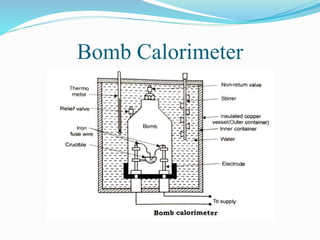
 Bomb calorimeter is used to find the calorific value of an
unit mass of solid and liquid fuels.
 Bomb calorimeter is consists of outer container, inner
container, bomb, crucible, thermometer, stirrer, pressure
relief valve and oxygen supply valve.
 The bomb is made of thick walled stainless steel.
 This is capable of withstanding high pressure, heat and
corrosion.
 The upper portion of the bomb contains two valves namely
pressure relief valve and non return valve.
 The oxygen required for burning the fuel is supplied to the
bomb through the non return valve.
 The pressure relief valve is used to discharge the burnt
gases from the bomb.
Bomb Calorimeter
 At the bottom, two electrodes are provided.
 A crucible is supported by one of the electrodes.
 The electrodes carry a fuse wire made up of platinum or
nichrome.
 The fuse wire dips into the crucible.
 The fuse wire is connected to a battery.
 The fuse wire is heated by passing current to ignite the fuel
in the crucible.
 The bomb placed in a water bath containing measured
quantity of water.
 A thermometer to measure the temperature of water.
 A stirrer is also provided.
Bomb Calorimeter
 A known mass of fuel sample ( Usually 1gm) is placed in
the crucible.
 The non return valve is opened and the oxygen is admitted
till the pressure inside the bomb rises to 30 atm.
 Then the bomb is completely submerged in a known
quantity of water (mw) in a large insulated copper vessel
(outer container) to reduce radiation heat losses.
 When steady temperature (t1) is reached, the fuse wire is
heated up electrically.
 The fuel is ignited and burns completely.
 The heat released during the combustion of the fuel is
absorbed by surrounding water and apparatus. The final
temperature of water (t2) is noted.
Bomb Calorimeter
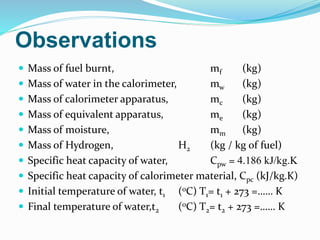
 Mass of fuel burnt, mf (kg)
 Mass of water in the calorimeter, mw (kg)
 Mass of calorimeter apparatus, mc (kg)
 Mass of equivalent apparatus, me (kg)
 Mass of moisture, mm (kg)
 Mass of Hydrogen, H2 (kg / kg of fuel)
 Specific heat capacity of water, Cpw = 4.186 kJ/kg.K
 Specific heat capacity of calorimeter material, Cpc (kJ/kg.K)
 Initial temperature of water, t1 (oC) T1= t1 + 273 =…… K
 Final temperature of water,t2 (oC) T2= t2 + 273 =…… K
Observations
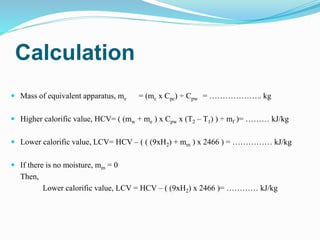
 Mass of equivalent apparatus, me = (mc x Cpc) ÷ Cpw = ……………….. kg
 Higher calorific value, HCV= ( (mw + me ) x Cpw x (T2 – T1) ) ÷ mf )= ……… kJ/kg
 Lower calorific value, LCV= HCV – ( ( (9xH2) + mm ) x 2466 ) = …………… kJ/kg
 If there is no moisture, mm = 0
Then,
Lower calorific value, LCV = HCV – ( (9xH2) x 2466 )= ………… kJ/kg
Calculation
Advantages
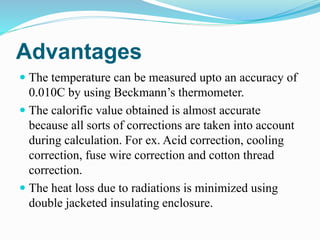
 The temperature can be measured upto an accuracy of
0.010C by using Beckmann’s thermometer.
 The calorific value obtained is almost accurate
because all sorts of corrections are taken into account
during calculation. For ex. Acid correction, cooling
correction, fuse wire correction and cotton thread
correction.
 The heat loss due to radiations is minimized using
double jacketed insulating enclosure.
Disadvantages
 The calorific value of a gaseous fuel cannot be
determined by bomb calorimeter. For this Boy’s
Calorimeter and Junker’s calorimeter are used.
 AAlthough bomb calorimeter is insulated to avoid
heat losses, heat loss cannot be eradicated completely
and hence is a possible source of error.
 That not all types of reactions can be studied using
bomb calorimeter since some reactions may occur
slowly while others may be too vigorous.
Thank You.!

Bomb Calorimeter.pptx

  • 1.
    Video Lecture By, Er.M.Balasubramaniam.,M.E., Lecturer/ Automobile Engineering., Christian Polytechnic College, Oddanchatram.
  • 2.
    Bomb Calorimeter  Bombcalorimeter is used to find the calorific value of an unit mass of solid and liquid fuels.  Bomb calorimeter is consists of outer container, inner container, bomb, crucible, thermometer, stirrer, pressure relief valve and oxygen supply valve.  The bomb is made of thick walled stainless steel.  This is capable of withstanding high pressure, heat and corrosion.  The upper portion of the bomb contains two valves namely pressure relief valve and non return valve.  The oxygen required for burning the fuel is supplied to the bomb through the non return valve.  The pressure relief valve is used to discharge the burnt gases from the bomb.
  • 3.
    Bomb Calorimeter  Atthe bottom, two electrodes are provided.  A crucible is supported by one of the electrodes.  The electrodes carry a fuse wire made up of platinum or nichrome.  The fuse wire dips into the crucible.  The fuse wire is connected to a battery.  The fuse wire is heated by passing current to ignite the fuel in the crucible.  The bomb placed in a water bath containing measured quantity of water.  A thermometer to measure the temperature of water.  A stirrer is also provided.
  • 4.
    Bomb Calorimeter  Aknown mass of fuel sample ( Usually 1gm) is placed in the crucible.  The non return valve is opened and the oxygen is admitted till the pressure inside the bomb rises to 30 atm.  Then the bomb is completely submerged in a known quantity of water (mw) in a large insulated copper vessel (outer container) to reduce radiation heat losses.  When steady temperature (t1) is reached, the fuse wire is heated up electrically.  The fuel is ignited and burns completely.  The heat released during the combustion of the fuel is absorbed by surrounding water and apparatus. The final temperature of water (t2) is noted.
  • 5.
  • 6.
     Mass offuel burnt, mf (kg)  Mass of water in the calorimeter, mw (kg)  Mass of calorimeter apparatus, mc (kg)  Mass of equivalent apparatus, me (kg)  Mass of moisture, mm (kg)  Mass of Hydrogen, H2 (kg / kg of fuel)  Specific heat capacity of water, Cpw = 4.186 kJ/kg.K  Specific heat capacity of calorimeter material, Cpc (kJ/kg.K)  Initial temperature of water, t1 (oC) T1= t1 + 273 =…… K  Final temperature of water,t2 (oC) T2= t2 + 273 =…… K Observations
  • 7.
     Mass ofequivalent apparatus, me = (mc x Cpc) ÷ Cpw = ……………….. kg  Higher calorific value, HCV= ( (mw + me ) x Cpw x (T2 – T1) ) ÷ mf )= ……… kJ/kg  Lower calorific value, LCV= HCV – ( ( (9xH2) + mm ) x 2466 ) = …………… kJ/kg  If there is no moisture, mm = 0 Then, Lower calorific value, LCV = HCV – ( (9xH2) x 2466 )= ………… kJ/kg Calculation
  • 8.
    Advantages  The temperaturecan be measured upto an accuracy of 0.010C by using Beckmann’s thermometer.  The calorific value obtained is almost accurate because all sorts of corrections are taken into account during calculation. For ex. Acid correction, cooling correction, fuse wire correction and cotton thread correction.  The heat loss due to radiations is minimized using double jacketed insulating enclosure.
  • 9.
    Disadvantages  The calorificvalue of a gaseous fuel cannot be determined by bomb calorimeter. For this Boy’s Calorimeter and Junker’s calorimeter are used.  AAlthough bomb calorimeter is insulated to avoid heat losses, heat loss cannot be eradicated completely and hence is a possible source of error.  That not all types of reactions can be studied using bomb calorimeter since some reactions may occur slowly while others may be too vigorous.
  • 10.