Experimental Determination
of the Higher Calorific Value
Experimental Determination of the
Higher Calorific Value
The analytical method for determining the Higher
Calorific Value gives approximate results only.
The most satisfactory method for obtaining the
calorific value of the fuel is by actual experiment.
A known mass of the fuel is burnt into suitable
calorimeter, and the heat so evolved is found by
measuring the rise in temperature of the
surrounding water.
Experimental Determination of the
Higher Calorific Value
The calorimeters used for finding there calorific value
of the fuel is known as fuel calorimeter.
The following two calorific meters are important
from the subject point of view.
◦ Bomb Calorimeter
◦ Boys Calorimeter
Bomb Calorimeter
Bomb Calorimeter-Introduction
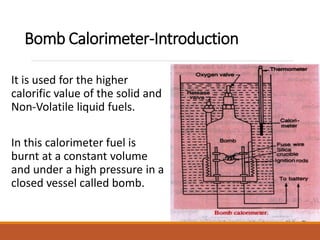
It is used for the higher
calorific value of the solid and
Non-Volatile liquid fuels.
In this calorimeter fuel is
burnt at a constant volume
and under a high pressure in a
closed vessel called bomb.
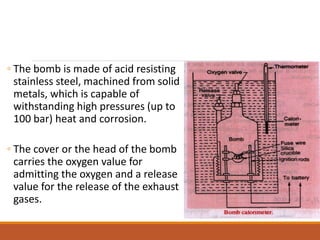
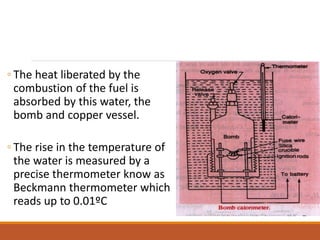
◦ The bomb is made of acid resisting
stainless steel, machined from solid
metals, which is capable of
withstanding high pressures (up to
100 bar) heat and corrosion.
◦ The cover or the head of the bomb
carries the oxygen value for
admitting the oxygen and a release
value for the release of the exhaust
gases.
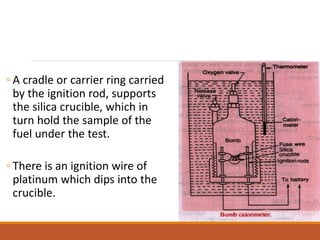
◦ A cradle or carrier ring carried
by the ignition rod, supports
the silica crucible, which in
turn hold the sample of the
fuel under the test.
◦ There is an ignition wire of
platinum which dips into the
crucible.
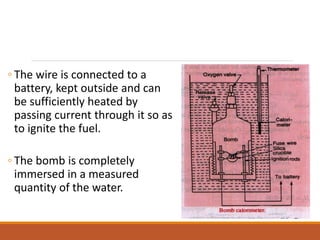
◦ The wire is connected to a
battery, kept outside and can
be sufficiently heated by
passing current through it so as
to ignite the fuel.
◦ The bomb is completely
immersed in a measured
quantity of the water.
◦ The heat liberated by the
combustion of the fuel is
absorbed by this water, the
bomb and copper vessel.
◦ The rise in the temperature of
the water is measured by a
precise thermometer know as
Beckmann thermometer which
reads up to 0.01ºC
Bomb Calorimeter-Procedure
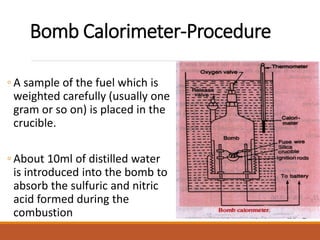
◦ A sample of the fuel which is
weighted carefully (usually one
gram or so on) is placed in the
crucible.
◦ About 10ml of distilled water
is introduced into the bomb to
absorb the sulfuric and nitric
acid formed during the
combustion
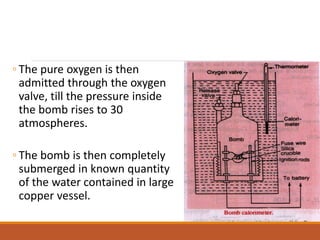
◦ The pure oxygen is then
admitted through the oxygen
valve, till the pressure inside
the bomb rises to 30
atmospheres.
◦ The bomb is then completely
submerged in known quantity
of the water contained in large
copper vessel.
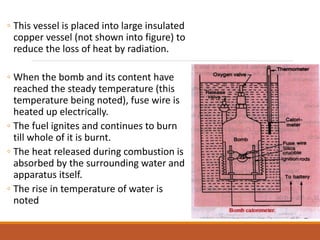
◦ This vessel is placed into large insulated
copper vessel (not shown into figure) to
reduce the loss of heat by radiation.
◦ When the bomb and its content have
reached the steady temperature (this
temperature being noted), fuse wire is
heated up electrically.
◦ The fuel ignites and continues to burn
till whole of it is burnt.
◦ The heat released during combustion is
absorbed by the surrounding water and
apparatus itself.
◦ The rise in temperature of water is
noted
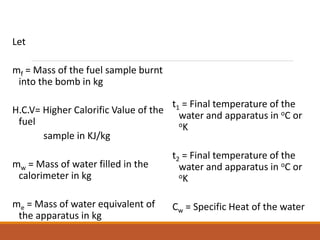
Let
mf = Mass of the fuel sample burnt
into the bomb in kg
H.C.V= Higher Calorific Value of the
fuel
sample in KJ/kg
mw = Mass of water filled in the
calorimeter in kg
me = Mass of water equivalent of
the apparatus in kg
t1 = Final temperature of the
water and apparatus in oC or
oK
t2 = Final temperature of the
water and apparatus in oC or
oK
Cw = Specific Heat of the water
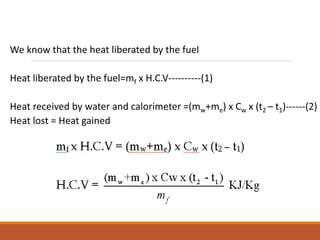
We know that the heat liberated by the fuel
Heat liberated by the fuel=mf x H.C.V----------(1)
Heat received by water and calorimeter =(mw+me) x Cw x (t2 – t1)------(2)
Heat lost = Heat gained
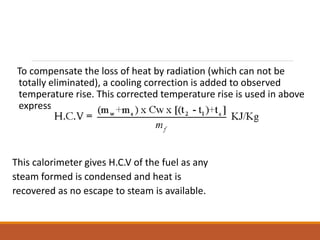
To compensate the loss of heat by radiation (which can not be
totally eliminated), a cooling correction is added to observed
temperature rise. This corrected temperature rise is used in above
expression.
This calorimeter gives H.C.V of the fuel as any
steam formed is condensed and heat is
recovered as no escape to steam is available.
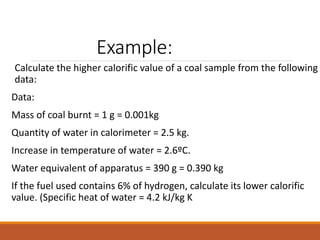
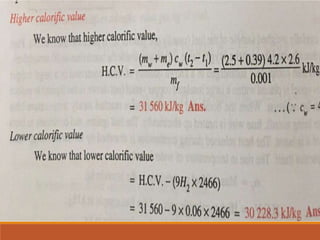
Example:
Calculate the higher calorific value of a coal sample from the following
data:
Data:
Mass of coal burnt = 1 g = 0.001kg
Quantity of water in calorimeter = 2.5 kg.
Increase in temperature of water = 2.6ºC.
Water equivalent of apparatus = 390 g = 0.390 kg
If the fuel used contains 6% of hydrogen, calculate its lower calorific
value. (Specific heat of water = 4.2 kJ/kg K
Laboratory method for Heating value.ppt

Laboratory method for Heating value.ppt

  • 1.
    Experimental Determination of theHigher Calorific Value
  • 2.
    Experimental Determination ofthe Higher Calorific Value The analytical method for determining the Higher Calorific Value gives approximate results only. The most satisfactory method for obtaining the calorific value of the fuel is by actual experiment. A known mass of the fuel is burnt into suitable calorimeter, and the heat so evolved is found by measuring the rise in temperature of the surrounding water.
  • 3.
    Experimental Determination ofthe Higher Calorific Value The calorimeters used for finding there calorific value of the fuel is known as fuel calorimeter. The following two calorific meters are important from the subject point of view. ◦ Bomb Calorimeter ◦ Boys Calorimeter
  • 4.
  • 5.
    Bomb Calorimeter-Introduction It isused for the higher calorific value of the solid and Non-Volatile liquid fuels. In this calorimeter fuel is burnt at a constant volume and under a high pressure in a closed vessel called bomb.
  • 6.
    ◦ The bombis made of acid resisting stainless steel, machined from solid metals, which is capable of withstanding high pressures (up to 100 bar) heat and corrosion. ◦ The cover or the head of the bomb carries the oxygen value for admitting the oxygen and a release value for the release of the exhaust gases.
  • 7.
    ◦ A cradleor carrier ring carried by the ignition rod, supports the silica crucible, which in turn hold the sample of the fuel under the test. ◦ There is an ignition wire of platinum which dips into the crucible.
  • 8.
    ◦ The wireis connected to a battery, kept outside and can be sufficiently heated by passing current through it so as to ignite the fuel. ◦ The bomb is completely immersed in a measured quantity of the water.
  • 9.
    ◦ The heatliberated by the combustion of the fuel is absorbed by this water, the bomb and copper vessel. ◦ The rise in the temperature of the water is measured by a precise thermometer know as Beckmann thermometer which reads up to 0.01ºC
  • 10.
    Bomb Calorimeter-Procedure ◦ Asample of the fuel which is weighted carefully (usually one gram or so on) is placed in the crucible. ◦ About 10ml of distilled water is introduced into the bomb to absorb the sulfuric and nitric acid formed during the combustion
  • 11.
    ◦ The pureoxygen is then admitted through the oxygen valve, till the pressure inside the bomb rises to 30 atmospheres. ◦ The bomb is then completely submerged in known quantity of the water contained in large copper vessel.
  • 12.
    ◦ This vesselis placed into large insulated copper vessel (not shown into figure) to reduce the loss of heat by radiation. ◦ When the bomb and its content have reached the steady temperature (this temperature being noted), fuse wire is heated up electrically. ◦ The fuel ignites and continues to burn till whole of it is burnt. ◦ The heat released during combustion is absorbed by the surrounding water and apparatus itself. ◦ The rise in temperature of water is noted
  • 13.
    Let mf = Massof the fuel sample burnt into the bomb in kg H.C.V= Higher Calorific Value of the fuel sample in KJ/kg mw = Mass of water filled in the calorimeter in kg me = Mass of water equivalent of the apparatus in kg t1 = Final temperature of the water and apparatus in oC or oK t2 = Final temperature of the water and apparatus in oC or oK Cw = Specific Heat of the water
  • 14.
    We know thatthe heat liberated by the fuel Heat liberated by the fuel=mf x H.C.V----------(1) Heat received by water and calorimeter =(mw+me) x Cw x (t2 – t1)------(2) Heat lost = Heat gained
  • 15.
    To compensate theloss of heat by radiation (which can not be totally eliminated), a cooling correction is added to observed temperature rise. This corrected temperature rise is used in above expression. This calorimeter gives H.C.V of the fuel as any steam formed is condensed and heat is recovered as no escape to steam is available.
  • 16.
    Example: Calculate the highercalorific value of a coal sample from the following data: Data: Mass of coal burnt = 1 g = 0.001kg Quantity of water in calorimeter = 2.5 kg. Increase in temperature of water = 2.6ºC. Water equivalent of apparatus = 390 g = 0.390 kg If the fuel used contains 6% of hydrogen, calculate its lower calorific value. (Specific heat of water = 4.2 kJ/kg K

Editor's Notes

  • #14 Water equivalent of a calorimeter is nothing but amount of water which will absorb same amount of heat that the calorimeter will absorb.