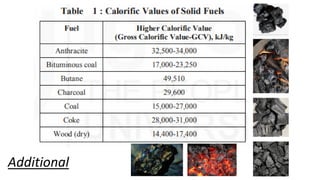
CALORIFIC VALUE DEFINED
The calorific value or heating value of a food and fuel is defined as the
quantity of heat released during combustion of a specified amount of it.
The calorific value is a characteristic for each substance.
UNITS OF CALORIFIC VALUES
The units of calorific value are energy per unit of the substance, such as:
kcal/kg, kJ/kg.
Higher Calorific Value (HCV) or Higher Heating Value (HHV) or Gross Calorific
Value:
When 1 kg of a fuel is burnt, the heat obtained by the complete combustion after the
products of the combustion are cooled down to room temperature (usually 15 degree
Celsius) is called higher calorific value of that fuel.
Lower Heating Value (LLV) or Lower Calorific Value (LCV) or Net Calorific
Value:
When 1 kg of a fuel is completely burned and the products of combustions are not cooled
down or the heat carried away the products of combustion is not recovered and the steam
produced in this process is not condensed then the heat obtained is known as the Lower
Calorific Value.
Relation between Higher and Lower Calorific Value.
Answer: The amount of Lower Calorific Value can be obtained by subtracting the amount
heat carried away by the combustion products especially the heat carried away by the steam
LCV = HCV – Heat carried away by the steam.
Additional
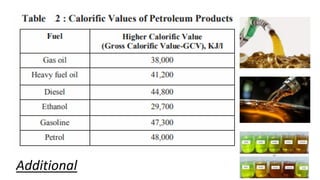
Additional
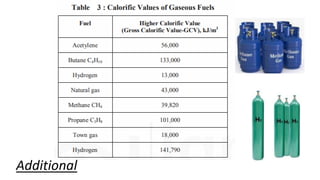
Additional
Additional
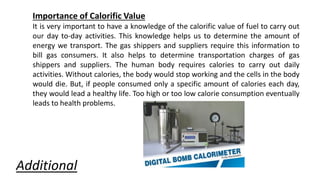
Importance of Calorific Value
It is very important to have a knowledge of the calorific value of fuel to carry out
our day to-day activities. This knowledge helps us to determine the amount of
energy we transport. The gas shippers and suppliers require this information to
bill gas consumers. It also helps to determine transportation charges of gas
shippers and suppliers. The human body requires calories to carry out daily
activities. Without calories, the body would stop working and the cells in the body
would die. But, if people consumed only a specific amount of calories each day,
they would lead a healthy life. Too high or too low calorie consumption eventually
leads to health problems.
Additional
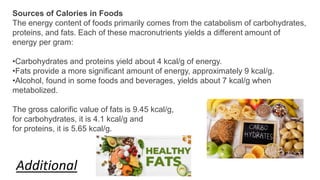
Sources of Calories in Foods
The energy content of foods primarily comes from the catabolism of carbohydrates,
proteins, and fats. Each of these macronutrients yields a different amount of
energy per gram:
•Carbohydrates and proteins yield about 4 kcal/g of energy.
•Fats provide a more significant amount of energy, approximately 9 kcal/g.
•Alcohol, found in some foods and beverages, yields about 7 kcal/g when
metabolized.
The gross calorific value of fats is 9.45 kcal/g,
for carbohydrates, it is 4.1 kcal/g and
for proteins, it is 5.65 kcal/g.
Additional
Calculating caloric content in foods
Ques. To determine the number of kilocalories from a specific component in a
food item, multiply the number of grams of that component by its respective
energy content.
For example, if a meal contains 37 grams of carbohydrates, 20 grams of fat, and
15 grams of protein, the caloric content can be calculated as follows:
Ans. Carbohydrates: 37 g × 4 kcal/g = 148 kcal
Fat: 20 g × 9 kcal/g = 180 kcal
Protein: 15 g × 4 kcal/g = 60 kcal
Total kcal in the slice of pizza: 148 kcal + 180 kcal + 60 kcal = 388 kcal.
Additional
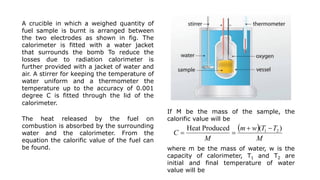
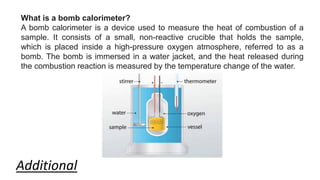
Definition of Bomb Calorimeters:
The calorific value of solid and liquid fuels is determined in the laboratory by ‘Bomb
calorimeter’ It is so named shape resembles that of a Bomb. Fig shows the schematic
sketch of the bomb calorimeter.
Construction of Bomb Calorimeters :
The calorimeter is made of austenitic steel
which provides considerable resistance to
corrosion and enables it to withstand high
pressure. In the calorimeter use of a
strong cylindrical bomb in which
combustion occurs. The bomb has two
valves at the top one supplies oxygen to
the bomb and the other releases the
exhaust gases.
A crucible in which a weighed quantity of
fuel sample is burnt is arranged between
the two electrodes as shown in fig. The
calorimeter is fitted with a water jacket
that surrounds the bomb To reduce the
losses due to radiation calorimeter is
further provided with a jacket of water and
air. A stirrer for keeping the temperature of
water uniform and a thermometer the
temperature up to the accuracy of 0.001
degree C is fitted through the lid of the
calorimeter.
The heat released by the fuel on
combustion is absorbed by the surrounding
water and the calorimeter. From the
equation the calorific value of the fuel can
be found.
 
M
T
T
w
m
M
C
)
(
Produced
Heat 2
1 



If M be the mass of the sample, the
calorific value will be
where m be the mass of water, w is the
capacity of calorimeter, T1 and T2 are
initial and final temperature of water
value will be
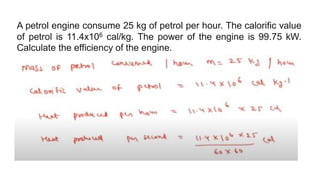
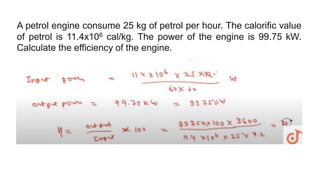
A petrol engine consume 25 kg of petrol per hour. The calorific value
of petrol is 11.4x10⁶ cal/kg. The power of the engine is 99.75 kW.
Calculate the efficiency of the engine.
A petrol engine consume 25 kg of petrol per hour. The calorific value
of petrol is 11.4x10⁶ cal/kg. The power of the engine is 99.75 kW.
Calculate the efficiency of the engine.
What is a bomb calorimeter?
A bomb calorimeter is a device used to measure the heat of combustion of a
sample. It consists of a small, non-reactive crucible that holds the sample,
which is placed inside a high-pressure oxygen atmosphere, referred to as a
bomb. The bomb is immersed in a water jacket, and the heat released during
the combustion reaction is measured by the temperature change of the water.
Additional
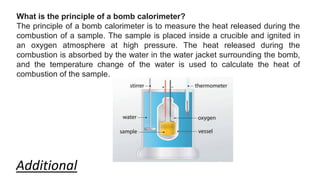
What is the principle of a bomb calorimeter?
The principle of a bomb calorimeter is to measure the heat released during the
combustion of a sample. The sample is placed inside a crucible and ignited in
an oxygen atmosphere at high pressure. The heat released during the
combustion is absorbed by the water in the water jacket surrounding the bomb,
and the temperature change of the water is used to calculate the heat of
combustion of the sample.
Additional
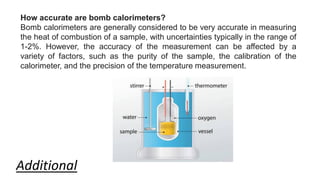
How accurate are bomb calorimeters?
Bomb calorimeters are generally considered to be very accurate in measuring
the heat of combustion of a sample, with uncertainties typically in the range of
1-2%. However, the accuracy of the measurement can be affected by a
variety of factors, such as the purity of the sample, the calibration of the
calorimeter, and the precision of the temperature measurement.
Additional
Uses of Bomb Calorimeter
The main use of a bomb calorimeter is to measure the heat of combustion of a
sample, which provides important information about the energy content of the
sample. Here are some specific uses of bomb calorimeters:
1.Energy Research: Bomb calorimeters are commonly used in the field of
energy research to measure the heat of combustion of various fuels, such as
coal, oil, and natural gas.
2.Food Science: Bomb calorimeters are used in food science to determine the
caloric content of food products.
3.Pharmaceutical Research: Bomb calorimeters are also used in
pharmaceutical research to determine the heat of combustion of drug samples.
4.Environmental Testing: Bomb calorimeters can be used to measure the heat
of combustion of various materials, including waste and biomass.
Additional
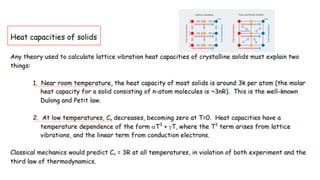
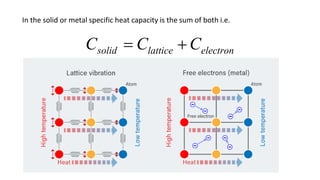
In the solid or metal specific heat capacity is the sum of both i.e.
electron
lattice
solid C
C
C 

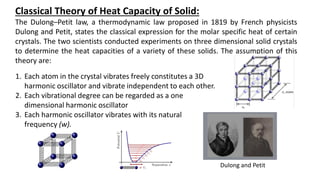
Classical Theory of Heat Capacity of Solid:
The Dulong–Petit law, a thermodynamic law proposed in 1819 by French physicists
Dulong and Petit, states the classical expression for the molar specific heat of certain
crystals. The two scientists conducted experiments on three dimensional solid crystals
to determine the heat capacities of a variety of these solids. The assumption of this
theory are:
Dulong and Petit
1. Each atom in the crystal vibrates freely constitutes a 3D
harmonic oscillator and vibrate independent to each other.
2. Each vibrational degree can be regarded as a one
dimensional harmonic oscillator
3. Each harmonic oscillator vibrates with its natural
frequency (w).
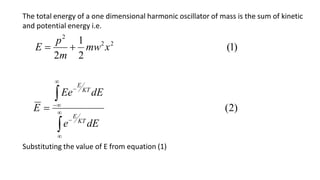
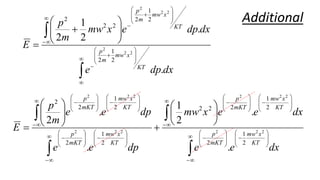
The total energy of a one dimensional harmonic oscillator of mass is the sum of kinetic
and potential energy i.e.
)
1
(
2
1
2
2
2
2
x
mw
m
p
E 

Substituting the value of E from equation (1)
)
2
(










dE
e
dE
Ee
E
KT
E
KT
E








































































































dx
e
e
dx
e
e
x
mw
dp
e
e
dp
e
e
m
p
E
KT
x
mw
mKT
p
KT
x
mw
mKT
p
KT
x
mw
mKT
p
KT
x
mw
mKT
p
2
2
2
2
2
2
2
2
2
2
2
2
2
1
2
2
1
2
2
2
2
1
2
2
1
2
2
.
.
2
1
.
.
2





































dx
dp
e
dx
dp
e
x
mw
m
p
E
KT
x
mw
m
p
KT
x
mw
m
p
.
.
2
1
2
2
2
2
2
2
2
2
1
2
2
1
2
2
2
2 Additional




































































dx
e
dx
e
x
mw
dp
e
dp
e
m
p
E
KT
x
mw
KT
x
mw
mKT
p
mKT
p
2
2
2
2
2
2
2
1
2
1
2
2
2
2
2
2
1
2
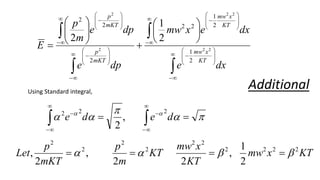
Using Standard integral,
KT
x
mw
KT
x
mw
KT
m
p
mKT
p
Let 2
2
2
2
2
2
2
2
2
2
2
1
,
2
2
,
2
, 


 







 


 









d
e
d
e
2
2
2
,
2
Additional
































d
e
d
e
KT
d
e
d
e
KT
E
2
2
2
2
2
2
KT
E
KT
KT
KT
KT
E





2
2
2
2




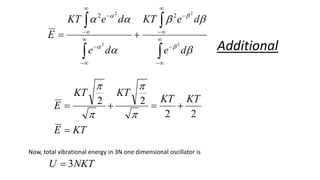
Now, total vibrational energy in 3N one dimensional oscillator is
NKT
U 3

Additional
R is universal gas constant for a gram atom
and R=1.9856 cal. per gram atom
R=8.31J/mol.K
K
mol
J
K
mol
cal
R
NK
dT
dU
C
v
v .
/
93
.
24
.
/
96
.
5
3
3 










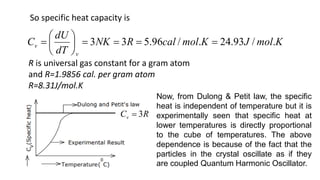
So specific heat capacity is
R
Cv 3

Now, from Dulong & Petit law, the specific
heat is independent of temperature but it is
experimentally seen that specific heat at
lower temperatures is directly proportional
to the cube of temperatures. The above
dependence is because of the fact that the
particles in the crystal oscillate as if they
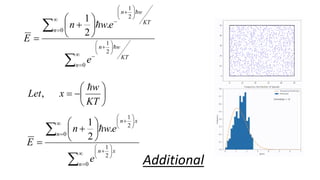
are coupled Quantum Harmonic Oscillator.
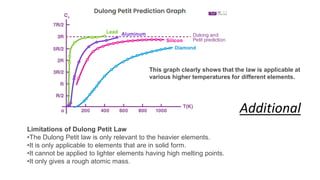
Limitations of Dulong Petit Law
•The Dulong Petit law is only relevant to the heavier elements.
•It is only applicable to elements that are in solid form.
•It cannot be applied to lighter elements having high melting points.
•It only gives a rough atomic mass.
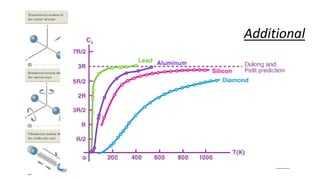
This graph clearly shows that the law is applicable at
various higher temperatures for different elements.
Additional
Additional
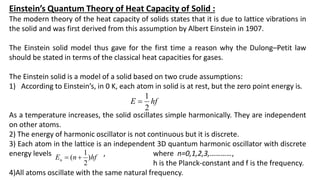
Einstein’s Quantum Theory of Heat Capacity of Solid :
The modern theory of the heat capacity of solids states that it is due to lattice vibrations in
the solid and was first derived from this assumption by Albert Einstein in 1907.
The Einstein solid model thus gave for the first time a reason why the Dulong–Petit law
should be stated in terms of the classical heat capacities for gases.
The Einstein solid is a model of a solid based on two crude assumptions:
1) According to Einstein’s, in 0 K, each atom in solid is at rest, but the zero point energy is.
As a temperature increases, the solid oscillates simple harmonically. They are independent
on other atoms.
2) The energy of harmonic oscillator is not continuous but it is discrete.
3) Each atom in the lattice is an independent 3D quantum harmonic oscillator with discrete
energy levels , where n=0,1,2,3,…………,
h is the Planck-constant and f is the frequency.
4)All atoms oscillate with the same natural frequency.
hf
E
2
1

hf
n
En )
2
1
( 











0
0
n
KT
E
n
KT
E
n
n
n
e
e
E
E
E
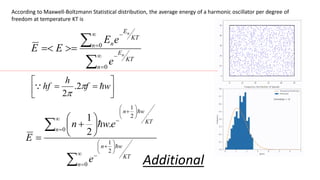
According to Maxwell-Boltzmann Statistical distribution, the average energy of a harmonic oscillator per degree of
freedom at temperature KT is






























0
2
1
0
2
1
.
2
1
n
KT
w
n
n
KT
w
n
e
e
w
n
E










 w
f
h
hf 
 

2
.
2
Additional








KT
w
x
Let

,






























0
2
1
0
2
1
.
2
1
n
KT
w
n
n
KT
w
n
e
e
w
n
E































0
2
1
0
2
1
.
2
1
n
x
n
n
x
n
e
e
w
n
E

Additional























.
..........
2
5
2
3
2
1
.
..........
2
5
2
3
2
1
2
5
2
3
2
1
2
5
2
3
2
1
x
x
x
x
x
x
e
e
e
e
e
e
w
E












 .
..........
ln 2
5
2
3
2
1
x
x
x
e
e
e
dx
d
w
E 
)
(
.
)
(
1
)
(
ln x
f
dx
d
x
f
x
f
dx
d

 








 .
..........
1
ln 2
2
1
x
x
x
e
e
e
dx
d
w
E 
 
.
..........
1
ln
ln 2
2
1




 x
x
x
e
e
dx
d
w
e
dx
d
w
E 
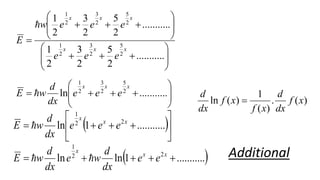
 Additional
 
.
..........
1
ln
ln 2
2
1




 x
x
x
e
e
dx
d
w
e
dx
d
w
E 

 
x
e
dx
d
w
x
dx
d
w
E 







 1
ln
2
1


  
x
x
e
e
w
w
E 


 0
.
1
1
2
1


 
x
x
e
e
w
w
E



1
2
1


 
1
1
2
1


 x
e
w
w
E 

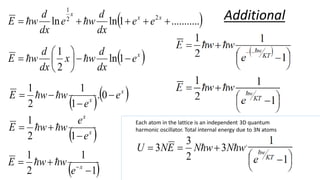
Each atom in the lattice is an independent 3D quantum
harmonic oscillator. Total internal energy due to 3N atoms
Additional





 



1
3
2
3
3
KT
w
e
w
w
N
w
N
E
N
U 



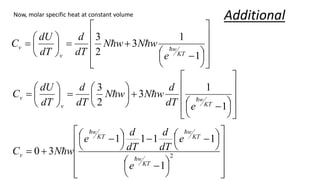
Now, molar specific heat at constant volume

















 





 






 

 2
1
1
1
1
1
3
0
KT
w
KT
w
KT
w
v
e
e
dT
d
dT
d
e
w
N
C



















 









1
1
3
2
3
KT
w
v
v
e
w
N
w
N
dT
d
dT
dU
C 

















 















1
1
3
2
3
KT
w
v
v
e
dT
d
w
N
w
N
dT
d
dT
dU
C 


Additional
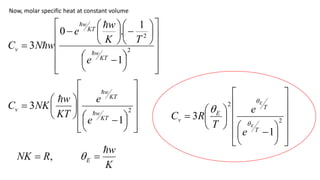
Now, molar specific heat at constant volume

















 














 2
2
1
1
.
0
3
KT
w
KT
w
v
e
T
K
w
e
w
N
C

 


















 






 2
1
3
KT
w
KT
w
v
e
e
KT
w
NK
C



K
w
R
NK E


 
,

























 2
2
1
3
T
T
E
v
E
E
e
e
T
R
C



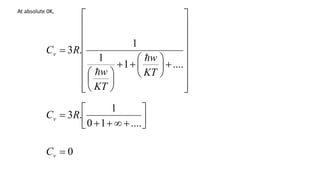
At absolute 0K,
1

KT
w
e

2
2
.
3













KT
w
KT
w
v
e
e
KT
w
R
C
















KT
w
v
e
KT
w
R
C 
 1
.
3
2








































....
1
.
3 3
2
2
KT
w
KT
w
KT
w
KT
w
R
Cv




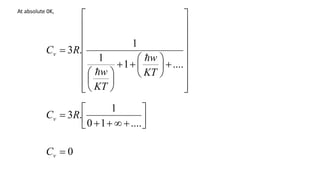
At absolute 0K,
0

v
C


































....
1
1
1
.
3
KT
w
KT
w
R
Cv













....
1
0
1
.
3R
Cv
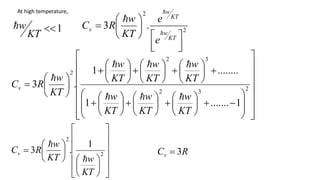
At high temperature,
1

KT
w
 2
2
.
3













KT
w
KT
w
v
e
e
KT
w
R
C














































































 2
3
2
3
2
2
1
.......
1
........
1
.
3
KT
w
KT
w
KT
w
KT
w
KT
w
KT
w
KT
w
R
Cv







R
Cv 3

























 2
2
1
.
3
KT
w
KT
w
R
Cv


At absolute 0K,
0

v
C


































....
1
1
1
.
3
KT
w
KT
w
R
Cv













....
1
0
1
.
3R
Cv
At high temperature,
1

KT
w














KT
w
v
e
KT
w
R
C 
 1
.
3
2













 KT
w
v e
KT
w
R
C


.
3
2
At low temperature molar specific
heat decreases exponentially.
Degree of Freedom
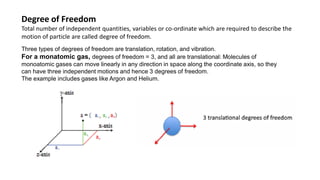
Total number of independent quantities, variables or co-ordinate which are required to describe the
motion of particle are called degree of freedom.
Three types of degrees of freedom are translation, rotation, and vibration.
For a monatomic gas, degrees of freedom = 3, and all are translational: Molecules of
monoatomic gases can move linearly in any direction in space along the coordinate axis, so they
can have three independent motions and hence 3 degrees of freedom.
The example includes gases like Argon and Helium.
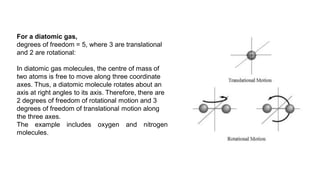
For a diatomic gas,
degrees of freedom = 5, where 3 are translational
and 2 are rotational:
In diatomic gas molecules, the centre of mass of
two atoms is free to move along three coordinate
axes. Thus, a diatomic molecule rotates about an
axis at right angles to its axis. Therefore, there are
2 degrees of freedom of rotational motion and 3
degrees of freedom of translational motion along
the three axes.
The example includes oxygen and nitrogen
molecules.
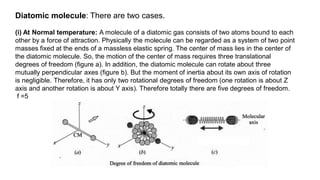
Diatomic molecule: There are two cases.
(i) At Normal temperature: A molecule of a diatomic gas consists of two atoms bound to each
other by a force of attraction. Physically the molecule can be regarded as a system of two point
masses fixed at the ends of a massless elastic spring. The center of mass lies in the center of
the diatomic molecule. So, the motion of the center of mass requires three translational
degrees of freedom (figure a). In addition, the diatomic molecule can rotate about three
mutually perpendicular axes (figure b). But the moment of inertia about its own axis of rotation
is negligible. Therefore, it has only two rotational degrees of freedom (one rotation is about Z
axis and another rotation is about Y axis). Therefore totally there are five degrees of freedom.
f =5
(ii) At High Temperature: At a very high temperature such as 5000 K, the diatomic molecules
possess additional two degrees of freedom due to vibrational motion [one due to kinetic energy of
vibration and the other is due to potential energy] (figure c ). So totally there are seven degrees of
freedom. f = 7.
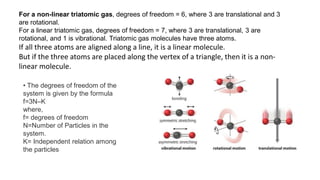
For a non-linear triatomic gas, degrees of freedom = 6, where 3 are translational and 3
are rotational.
For a linear triatomic gas, degrees of freedom = 7, where 3 are translational, 3 are
rotational, and 1 is vibrational. Triatomic gas molecules have three atoms.
If all three atoms are aligned along a line, it is a linear molecule.
But if the three atoms are placed along the vertex of a triangle, then it is a non-
linear molecule.
• The degrees of freedom of the
system is given by the formula
f=3N–K
where,
f= degrees of freedom
N=Number of Particles in the
system.
K= Independent relation among
the particles
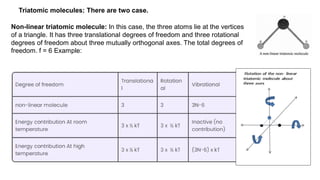
Non-linear triatomic molecule: In this case, the three atoms lie at the vertices
of a triangle. It has three translational degrees of freedom and three rotational
degrees of freedom about three mutually orthogonal axes. The total degrees of
freedom. f = 6 Example:
Triatomic molecules: There are two case.
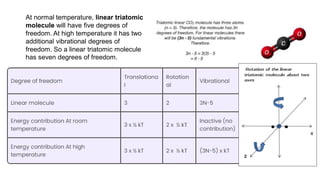
At normal temperature, linear triatomic
molecule will have five degrees of
freedom. At high temperature it has two
additional vibrational degrees of
freedom. So a linear triatomic molecule
has seven degrees of freedom.
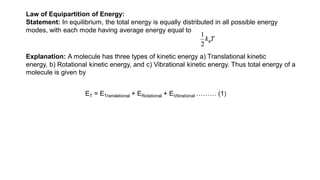
Law of Equipartition of Energy:
Statement: In equilibrium, the total energy is equally distributed in all possible energy
modes, with each mode having average energy equal to
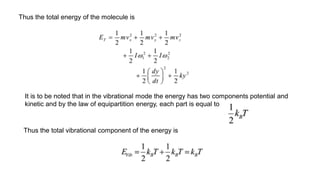
Explanation: A molecule has three types of kinetic energy a) Translational kinetic
energy, b) Rotational kinetic energy, and c) Vibrational kinetic energy. Thus total energy of a
molecule is given by
ET = ETranslational + ERotational + EVibrational ……… (1)
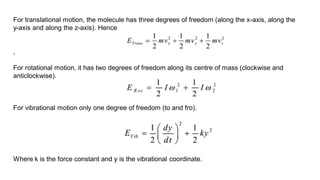
For translational motion, the molecule has three degrees of freedom (along the x-axis, along the
y-axis and along the z-axis). Hence
,
For rotational motion, it has two degrees of freedom along its centre of mass (clockwise and
anticlockwise).
For vibrational motion only one degree of freedom (to and fro).
Where k is the force constant and y is the vibrational coordinate.
Thus the total energy of the molecule is
It is to be noted that in the vibrational mode the energy has two components potential and
kinetic and by the law of equipartition energy, each part is equal to
Thus the total vibrational component of the energy is
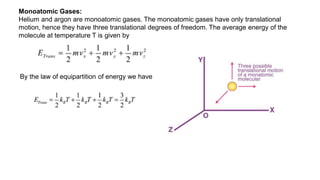
Monoatomic Gases:
Helium and argon are monoatomic gases. The monoatomic gases have only translational
motion, hence they have three translational degrees of freedom. The average energy of the
molecule at temperature T is given by
By the law of equipartition of energy we have
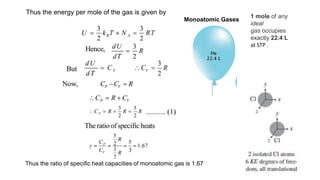
Thus the ratio of specific heat capacities of monoatomic gas is 1.67
Thus the energy per mole of the gas is given by
1 mole of any
ideal
gas occupies
exactly 22.4 L
at STP .
Monoatomic Gases
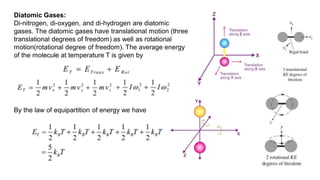
Diatomic Gases:
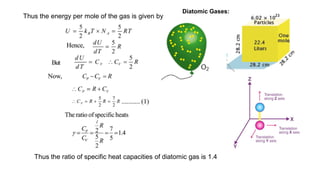
Di-nitrogen, di-oxygen, and di-hydrogen are diatomic
gases. The diatomic gases have translational motion (three
translational degrees of freedom) as well as rotational
motion(rotational degree of freedom). The average energy
of the molecule at temperature T is given by
By the law of equipartition of energy we have
Thus the energy per mole of the gas is given by
Thus the ratio of specific heat capacities of diatomic gas is 1.4
Diatomic Gases:
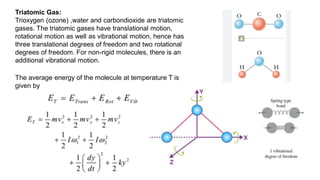
Triatomic Gas:
Trioxygen (ozone) ,water and carbondioxide are triatomic
gases. The triatomic gases have translational motion,
rotational motion as well as vibrational motion, hence has
three translational degrees of freedom and two rotational
degrees of freedom. For non-rigid molecules, there is an
additional vibrational motion.
The average energy of the molecule at temperature T is
given by
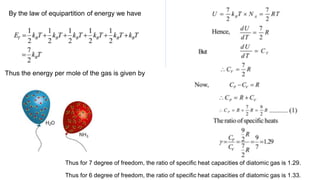
By the law of equipartition of energy we have
Thus the energy per mole of the gas is given by
Thus for 7 degree of freedom, the ratio of specific heat capacities of diatomic gas is 1.29.
Thus for 6 degree of freedom, the ratio of specific heat capacities of diatomic gas is 1.33.
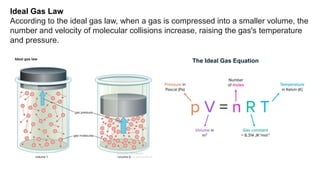
Ideal Gas Law
According to the ideal gas law, when a gas is compressed into a smaller volume, the
number and velocity of molecular collisions increase, raising the gas's temperature
and pressure.
The Ideal Gas Equation
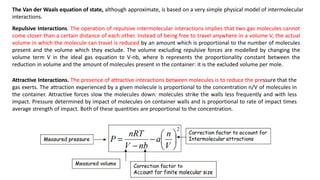
Repulsive Interactions. The operation of repulsive intermolecular interactions implies that two gas molecules cannot
come closer than a certain distance of each other. Instead of being free to travel anywhere in a volume V, the actual
volume in which the molecule can travel is reduced by an amount which is proportional to the number of molecules
present and the volume which they exclude. The volume excluding repulsive forces are modelled by changing the
volume term V in the ideal gas equation to V-nb, where b represents the proportionality constant between the
reduction in volume and the amount of molecules present in the container: it is the excluded volume per mole.
Attractive Interactions. The presence of attractive interactions between molecules is to reduce the pressure that the
gas exerts. The attraction experienced by a given molecule is proportional to the concentration n/V of molecules in
the container. Attractive forces slow the molecules down: molecules strike the walls less frequently and with less
impact. Pressure determined by impact of molecules on container walls and is proportional to rate of impact times
average strength of impact. Both of these quantities are proportional to the concentration.
The Van der Waals equation of state, although approximate, is based on a very simple physical model of intermolecular
interactions.
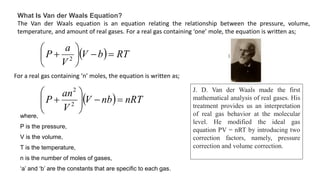
What Is Van der Waals Equation?
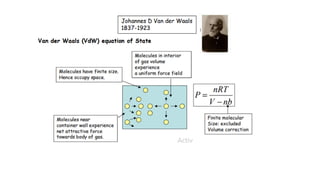
The Van der Waals equation is an equation relating the relationship between the pressure, volume,
temperature, and amount of real gases. For a real gas containing ‘one’ mole, the equation is written as;
  RT
b
V
V
a
P 







 2
where,
P is the pressure,
V is the volume,
T is the temperature,
n is the number of moles of gases,
‘a’ and ‘b’ are the constants that are specific to each gas.
  nRT
nb
V
V
an
P 









 2
2
For a real gas containing ‘n’ moles, the equation is written as;
J. D. Van der Waals made the first
mathematical analysis of real gases. His
treatment provides us an interpretation
of real gas behavior at the molecular
level. He modified the ideal gas
equation PV = nRT by introducing two
correction factors, namely, pressure
correction and volume correction.
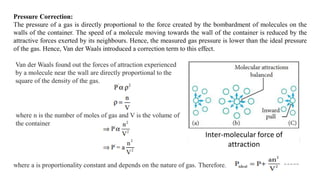
Pressure Correction:
The pressure of a gas is directly proportional to the force created by the bombardment of molecules on the
walls of the container. The speed of a molecule moving towards the wall of the container is reduced by the
attractive forces exerted by its neighbours. Hence, the measured gas pressure is lower than the ideal pressure
of the gas. Hence, Van der Waals introduced a correction term to this effect.
Van der Waals found out the forces of attraction experienced
by a molecule near the wall are directly proportional to the
square of the density of the gas.
where n is the number of moles of gas and V is the volume of
the container
where a is proportionality constant and depends on the nature of gas. Therefore,
Inter-molecular force of
attraction
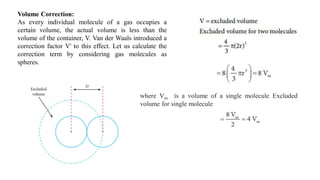
Volume Correction:
As every individual molecule of a gas occupies a
certain volume, the actual volume is less than the
volume of the container, V. Van der Waals introduced a
correction factor V' to this effect. Let us calculate the
correction term by considering gas molecules as
spheres.
where Vm is a volume of a single molecule Excluded
volume for single molecule
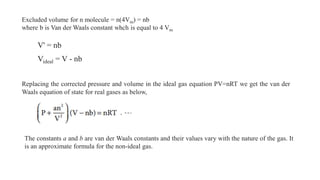
Excluded volume for n molecule = n(4Vm) = nb
where b is Van der Waals constant whch is equal to 4 Vm
V' = nb
Videal = V - nb
Replacing the corrected pressure and volume in the ideal gas equation PV=nRT we get the van der
Waals equation of state for real gases as below,
The constants a and b are van der Waals constants and their values vary with the nature of the gas. It
is an approximate formula for the non-ideal gas.
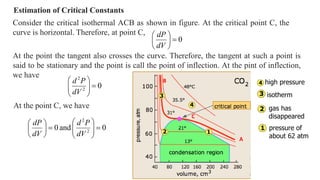
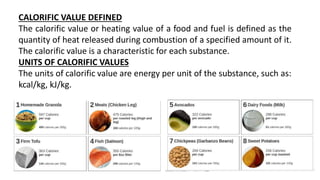
Estimation of Critical Constants
Consider the critical isothermal ACB as shown in figure. At the critical point C, the
curve is horizontal. Therefore, at point C,
0







dV
dP
At the point the tangent also crosses the curve. Therefore, the tangent at such a point is
said to be stationary and the point is call the point of inflection. At the pint of inflection,
we have
0
2
2









dV
P
d
At the point C, we have
0
and
0 2
2
















dV
P
d
dV
dP
A
C
B high pressure
isotherm
gas has
disappeared
pressure of
about 62 atm
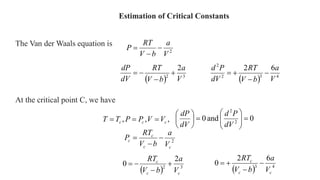
Estimation of Critical Constants
The Van der Waals equation is
2
V
a
b
V
RT
P 


,
,
, c
c
c V
V
P
P
T
T 


At the critical point C, we have
  3
2
2
V
a
b
V
RT
dV
dP




  4
3
2
2
6
2
V
a
b
V
RT
dV
P
d




2
c
c
c
c
V
a
b
V
RT
P 


  3
2
2
0
c
c
c
V
a
b
V
RT




  4
3
6
2
0
c
c
c
V
a
b
V
RT




0
and
0 2
2
















dV
P
d
dV
dP
Estimation of Critical Constants
  3
2
2
c
c
c
V
a
b
V
RT


  4
3
6
2
c
c
c
V
a
b
V
RT


From above equations, we have
 
3
2
c
c V
b
V


 
b
V
b
V
V
V
b
V
c
c
c
c
c
3
3
2
3
2
3





   3
2
3
2
3 b
a
b
b
RTc


  3
2
2
c
c
c
V
a
b
V
RT


bR
a
T
b
a
b
RT
c
c
27
8
27
2
4 3
2


2
c
c
c
c
V
a
b
V
RT
P 


   2
3
3
27
8
b
a
b
b
bR
a
R
Pc 


   
2
2
2
2
27
3
1
9
1
6
8
9
9
2
27
8
b
a
P
b
a
b
a
P
b
a
b
b
a
P
c
c
c














Heat and theromodynaicms_engineering physics

  • 1.
    CALORIFIC VALUE DEFINED Thecalorific value or heating value of a food and fuel is defined as the quantity of heat released during combustion of a specified amount of it. The calorific value is a characteristic for each substance. UNITS OF CALORIFIC VALUES The units of calorific value are energy per unit of the substance, such as: kcal/kg, kJ/kg.
  • 2.
    Higher Calorific Value(HCV) or Higher Heating Value (HHV) or Gross Calorific Value: When 1 kg of a fuel is burnt, the heat obtained by the complete combustion after the products of the combustion are cooled down to room temperature (usually 15 degree Celsius) is called higher calorific value of that fuel. Lower Heating Value (LLV) or Lower Calorific Value (LCV) or Net Calorific Value: When 1 kg of a fuel is completely burned and the products of combustions are not cooled down or the heat carried away the products of combustion is not recovered and the steam produced in this process is not condensed then the heat obtained is known as the Lower Calorific Value. Relation between Higher and Lower Calorific Value. Answer: The amount of Lower Calorific Value can be obtained by subtracting the amount heat carried away by the combustion products especially the heat carried away by the steam LCV = HCV – Heat carried away by the steam. Additional
  • 3.
  • 4.
  • 5.
  • 6.
    Importance of CalorificValue It is very important to have a knowledge of the calorific value of fuel to carry out our day to-day activities. This knowledge helps us to determine the amount of energy we transport. The gas shippers and suppliers require this information to bill gas consumers. It also helps to determine transportation charges of gas shippers and suppliers. The human body requires calories to carry out daily activities. Without calories, the body would stop working and the cells in the body would die. But, if people consumed only a specific amount of calories each day, they would lead a healthy life. Too high or too low calorie consumption eventually leads to health problems. Additional
  • 7.
    Sources of Caloriesin Foods The energy content of foods primarily comes from the catabolism of carbohydrates, proteins, and fats. Each of these macronutrients yields a different amount of energy per gram: •Carbohydrates and proteins yield about 4 kcal/g of energy. •Fats provide a more significant amount of energy, approximately 9 kcal/g. •Alcohol, found in some foods and beverages, yields about 7 kcal/g when metabolized. The gross calorific value of fats is 9.45 kcal/g, for carbohydrates, it is 4.1 kcal/g and for proteins, it is 5.65 kcal/g. Additional
  • 8.
    Calculating caloric contentin foods Ques. To determine the number of kilocalories from a specific component in a food item, multiply the number of grams of that component by its respective energy content. For example, if a meal contains 37 grams of carbohydrates, 20 grams of fat, and 15 grams of protein, the caloric content can be calculated as follows: Ans. Carbohydrates: 37 g × 4 kcal/g = 148 kcal Fat: 20 g × 9 kcal/g = 180 kcal Protein: 15 g × 4 kcal/g = 60 kcal Total kcal in the slice of pizza: 148 kcal + 180 kcal + 60 kcal = 388 kcal. Additional
  • 9.
    Definition of BombCalorimeters: The calorific value of solid and liquid fuels is determined in the laboratory by ‘Bomb calorimeter’ It is so named shape resembles that of a Bomb. Fig shows the schematic sketch of the bomb calorimeter. Construction of Bomb Calorimeters : The calorimeter is made of austenitic steel which provides considerable resistance to corrosion and enables it to withstand high pressure. In the calorimeter use of a strong cylindrical bomb in which combustion occurs. The bomb has two valves at the top one supplies oxygen to the bomb and the other releases the exhaust gases.
  • 10.
    A crucible inwhich a weighed quantity of fuel sample is burnt is arranged between the two electrodes as shown in fig. The calorimeter is fitted with a water jacket that surrounds the bomb To reduce the losses due to radiation calorimeter is further provided with a jacket of water and air. A stirrer for keeping the temperature of water uniform and a thermometer the temperature up to the accuracy of 0.001 degree C is fitted through the lid of the calorimeter. The heat released by the fuel on combustion is absorbed by the surrounding water and the calorimeter. From the equation the calorific value of the fuel can be found.   M T T w m M C ) ( Produced Heat 2 1     If M be the mass of the sample, the calorific value will be where m be the mass of water, w is the capacity of calorimeter, T1 and T2 are initial and final temperature of water value will be
  • 11.
    A petrol engineconsume 25 kg of petrol per hour. The calorific value of petrol is 11.4x10⁶ cal/kg. The power of the engine is 99.75 kW. Calculate the efficiency of the engine.
  • 12.
    A petrol engineconsume 25 kg of petrol per hour. The calorific value of petrol is 11.4x10⁶ cal/kg. The power of the engine is 99.75 kW. Calculate the efficiency of the engine.
  • 13.
    What is abomb calorimeter? A bomb calorimeter is a device used to measure the heat of combustion of a sample. It consists of a small, non-reactive crucible that holds the sample, which is placed inside a high-pressure oxygen atmosphere, referred to as a bomb. The bomb is immersed in a water jacket, and the heat released during the combustion reaction is measured by the temperature change of the water. Additional
  • 14.
    What is theprinciple of a bomb calorimeter? The principle of a bomb calorimeter is to measure the heat released during the combustion of a sample. The sample is placed inside a crucible and ignited in an oxygen atmosphere at high pressure. The heat released during the combustion is absorbed by the water in the water jacket surrounding the bomb, and the temperature change of the water is used to calculate the heat of combustion of the sample. Additional
  • 15.
    How accurate arebomb calorimeters? Bomb calorimeters are generally considered to be very accurate in measuring the heat of combustion of a sample, with uncertainties typically in the range of 1-2%. However, the accuracy of the measurement can be affected by a variety of factors, such as the purity of the sample, the calibration of the calorimeter, and the precision of the temperature measurement. Additional
  • 16.
    Uses of BombCalorimeter The main use of a bomb calorimeter is to measure the heat of combustion of a sample, which provides important information about the energy content of the sample. Here are some specific uses of bomb calorimeters: 1.Energy Research: Bomb calorimeters are commonly used in the field of energy research to measure the heat of combustion of various fuels, such as coal, oil, and natural gas. 2.Food Science: Bomb calorimeters are used in food science to determine the caloric content of food products. 3.Pharmaceutical Research: Bomb calorimeters are also used in pharmaceutical research to determine the heat of combustion of drug samples. 4.Environmental Testing: Bomb calorimeters can be used to measure the heat of combustion of various materials, including waste and biomass. Additional
  • 21.
    In the solidor metal specific heat capacity is the sum of both i.e. electron lattice solid C C C  
  • 22.
    Classical Theory ofHeat Capacity of Solid: The Dulong–Petit law, a thermodynamic law proposed in 1819 by French physicists Dulong and Petit, states the classical expression for the molar specific heat of certain crystals. The two scientists conducted experiments on three dimensional solid crystals to determine the heat capacities of a variety of these solids. The assumption of this theory are: Dulong and Petit 1. Each atom in the crystal vibrates freely constitutes a 3D harmonic oscillator and vibrate independent to each other. 2. Each vibrational degree can be regarded as a one dimensional harmonic oscillator 3. Each harmonic oscillator vibrates with its natural frequency (w).
  • 23.
    The total energyof a one dimensional harmonic oscillator of mass is the sum of kinetic and potential energy i.e. ) 1 ( 2 1 2 2 2 2 x mw m p E   Substituting the value of E from equation (1) ) 2 (           dE e dE Ee E KT E KT E
  • 24.
                                                                                                            dx e e dx e e x mw dp e e dp e e m p E KT x mw mKT p KT x mw mKT p KT x mw mKT p KT x mw mKT p 2 2 2 2 2 2 2 2 2 2 2 2 2 1 2 2 1 2 2 2 2 1 2 2 1 2 2 . . 2 1 . . 2                                      dx dp e dx dp e x mw m p E KT x mw m p KT x mw m p . . 2 1 2 2 2 2 2 2 2 2 1 2 2 1 2 2 2 2 Additional
  • 25.
  • 26.
  • 27.
    R is universalgas constant for a gram atom and R=1.9856 cal. per gram atom R=8.31J/mol.K K mol J K mol cal R NK dT dU C v v . / 93 . 24 . / 96 . 5 3 3            So specific heat capacity is R Cv 3  Now, from Dulong & Petit law, the specific heat is independent of temperature but it is experimentally seen that specific heat at lower temperatures is directly proportional to the cube of temperatures. The above dependence is because of the fact that the particles in the crystal oscillate as if they are coupled Quantum Harmonic Oscillator.
  • 28.
    Limitations of DulongPetit Law •The Dulong Petit law is only relevant to the heavier elements. •It is only applicable to elements that are in solid form. •It cannot be applied to lighter elements having high melting points. •It only gives a rough atomic mass. This graph clearly shows that the law is applicable at various higher temperatures for different elements. Additional
  • 29.
  • 30.
    Einstein’s Quantum Theoryof Heat Capacity of Solid : The modern theory of the heat capacity of solids states that it is due to lattice vibrations in the solid and was first derived from this assumption by Albert Einstein in 1907. The Einstein solid model thus gave for the first time a reason why the Dulong–Petit law should be stated in terms of the classical heat capacities for gases. The Einstein solid is a model of a solid based on two crude assumptions: 1) According to Einstein’s, in 0 K, each atom in solid is at rest, but the zero point energy is. As a temperature increases, the solid oscillates simple harmonically. They are independent on other atoms. 2) The energy of harmonic oscillator is not continuous but it is discrete. 3) Each atom in the lattice is an independent 3D quantum harmonic oscillator with discrete energy levels , where n=0,1,2,3,…………, h is the Planck-constant and f is the frequency. 4)All atoms oscillate with the same natural frequency. hf E 2 1  hf n En ) 2 1 (  
  • 31.
              0 0 n KT E n KT E n n n e e E E E According to Maxwell-BoltzmannStatistical distribution, the average energy of a harmonic oscillator per degree of freedom at temperature KT is                               0 2 1 0 2 1 . 2 1 n KT w n n KT w n e e w n E            w f h hf     2 . 2 Additional
  • 32.
  • 33.
                           . .......... 2 5 2 3 2 1 . .......... 2 5 2 3 2 1 2 5 2 3 2 1 2 5 2 3 2 1 x x x x x x e e e e e e w E              . .......... ln 2 5 2 3 2 1 x x x e e e dx d w E ) ( . ) ( 1 ) ( ln x f dx d x f x f dx d             . .......... 1 ln 2 2 1 x x x e e e dx d w E    . .......... 1 ln ln 2 2 1      x x x e e dx d w e dx d w E   Additional
  • 34.
      . .......... 1 ln ln 2 2 1     x x x e e dx d w e dx d w E     x e dx d w x dx d w E          1 ln 2 1      x x e e w w E     0 . 1 1 2 1     x x e e w w E    1 2 1     1 1 2 1    x e w w E   Each atom in the lattice is an independent 3D quantum harmonic oscillator. Total internal energy due to 3N atoms Additional           1 3 2 3 3 KT w e w w N w N E N U    
  • 35.
    Now, molar specificheat at constant volume                                     2 1 1 1 1 1 3 0 KT w KT w KT w v e e dT d dT d e w N C                               1 1 3 2 3 KT w v v e w N w N dT d dT dU C                                    1 1 3 2 3 KT w v v e dT d w N w N dT d dT dU C    Additional
  • 36.
    Now, molar specificheat at constant volume                                   2 2 1 1 . 0 3 KT w KT w v e T K w e w N C                               2 1 3 KT w KT w v e e KT w NK C    K w R NK E     ,                           2 2 1 3 T T E v E E e e T R C   
  • 37.
    At absolute 0K, 1  KT w e  2 2 . 3              KT w KT w v e e KT w R C                 KT w v e KT w R C  1 . 3 2                                         .... 1 . 3 3 2 2 KT w KT w KT w KT w R Cv    
  • 38.
  • 39.
    At high temperature, 1  KT w 2 2 . 3              KT w KT w v e e KT w R C                                                                                2 3 2 3 2 2 1 ....... 1 ........ 1 . 3 KT w KT w KT w KT w KT w KT w KT w R Cv        R Cv 3                           2 2 1 . 3 KT w KT w R Cv  
  • 40.
  • 41.
    At high temperature, 1  KT w               KT w v e KT w R C  1 . 3 2               KT w v e KT w R C   . 3 2 At low temperature molar specific heat decreases exponentially.
  • 42.
    Degree of Freedom Totalnumber of independent quantities, variables or co-ordinate which are required to describe the motion of particle are called degree of freedom. Three types of degrees of freedom are translation, rotation, and vibration. For a monatomic gas, degrees of freedom = 3, and all are translational: Molecules of monoatomic gases can move linearly in any direction in space along the coordinate axis, so they can have three independent motions and hence 3 degrees of freedom. The example includes gases like Argon and Helium.
  • 43.
    For a diatomicgas, degrees of freedom = 5, where 3 are translational and 2 are rotational: In diatomic gas molecules, the centre of mass of two atoms is free to move along three coordinate axes. Thus, a diatomic molecule rotates about an axis at right angles to its axis. Therefore, there are 2 degrees of freedom of rotational motion and 3 degrees of freedom of translational motion along the three axes. The example includes oxygen and nitrogen molecules.
  • 44.
    Diatomic molecule: Thereare two cases. (i) At Normal temperature: A molecule of a diatomic gas consists of two atoms bound to each other by a force of attraction. Physically the molecule can be regarded as a system of two point masses fixed at the ends of a massless elastic spring. The center of mass lies in the center of the diatomic molecule. So, the motion of the center of mass requires three translational degrees of freedom (figure a). In addition, the diatomic molecule can rotate about three mutually perpendicular axes (figure b). But the moment of inertia about its own axis of rotation is negligible. Therefore, it has only two rotational degrees of freedom (one rotation is about Z axis and another rotation is about Y axis). Therefore totally there are five degrees of freedom. f =5
  • 45.
    (ii) At HighTemperature: At a very high temperature such as 5000 K, the diatomic molecules possess additional two degrees of freedom due to vibrational motion [one due to kinetic energy of vibration and the other is due to potential energy] (figure c ). So totally there are seven degrees of freedom. f = 7.
  • 46.
    For a non-lineartriatomic gas, degrees of freedom = 6, where 3 are translational and 3 are rotational. For a linear triatomic gas, degrees of freedom = 7, where 3 are translational, 3 are rotational, and 1 is vibrational. Triatomic gas molecules have three atoms. If all three atoms are aligned along a line, it is a linear molecule. But if the three atoms are placed along the vertex of a triangle, then it is a non- linear molecule. • The degrees of freedom of the system is given by the formula f=3N–K where, f= degrees of freedom N=Number of Particles in the system. K= Independent relation among the particles
  • 47.
    Non-linear triatomic molecule:In this case, the three atoms lie at the vertices of a triangle. It has three translational degrees of freedom and three rotational degrees of freedom about three mutually orthogonal axes. The total degrees of freedom. f = 6 Example: Triatomic molecules: There are two case.
  • 48.
    At normal temperature,linear triatomic molecule will have five degrees of freedom. At high temperature it has two additional vibrational degrees of freedom. So a linear triatomic molecule has seven degrees of freedom.
  • 49.
    Law of Equipartitionof Energy: Statement: In equilibrium, the total energy is equally distributed in all possible energy modes, with each mode having average energy equal to Explanation: A molecule has three types of kinetic energy a) Translational kinetic energy, b) Rotational kinetic energy, and c) Vibrational kinetic energy. Thus total energy of a molecule is given by ET = ETranslational + ERotational + EVibrational ……… (1)
  • 50.
    For translational motion,the molecule has three degrees of freedom (along the x-axis, along the y-axis and along the z-axis). Hence , For rotational motion, it has two degrees of freedom along its centre of mass (clockwise and anticlockwise). For vibrational motion only one degree of freedom (to and fro). Where k is the force constant and y is the vibrational coordinate.
  • 51.
    Thus the totalenergy of the molecule is It is to be noted that in the vibrational mode the energy has two components potential and kinetic and by the law of equipartition energy, each part is equal to Thus the total vibrational component of the energy is
  • 52.
    Monoatomic Gases: Helium andargon are monoatomic gases. The monoatomic gases have only translational motion, hence they have three translational degrees of freedom. The average energy of the molecule at temperature T is given by By the law of equipartition of energy we have
  • 53.
    Thus the ratioof specific heat capacities of monoatomic gas is 1.67 Thus the energy per mole of the gas is given by 1 mole of any ideal gas occupies exactly 22.4 L at STP . Monoatomic Gases
  • 54.
    Diatomic Gases: Di-nitrogen, di-oxygen,and di-hydrogen are diatomic gases. The diatomic gases have translational motion (three translational degrees of freedom) as well as rotational motion(rotational degree of freedom). The average energy of the molecule at temperature T is given by By the law of equipartition of energy we have
  • 55.
    Thus the energyper mole of the gas is given by Thus the ratio of specific heat capacities of diatomic gas is 1.4 Diatomic Gases:
  • 56.
    Triatomic Gas: Trioxygen (ozone),water and carbondioxide are triatomic gases. The triatomic gases have translational motion, rotational motion as well as vibrational motion, hence has three translational degrees of freedom and two rotational degrees of freedom. For non-rigid molecules, there is an additional vibrational motion. The average energy of the molecule at temperature T is given by
  • 57.
    By the lawof equipartition of energy we have Thus the energy per mole of the gas is given by Thus for 7 degree of freedom, the ratio of specific heat capacities of diatomic gas is 1.29. Thus for 6 degree of freedom, the ratio of specific heat capacities of diatomic gas is 1.33.
  • 58.
    Ideal Gas Law Accordingto the ideal gas law, when a gas is compressed into a smaller volume, the number and velocity of molecular collisions increase, raising the gas's temperature and pressure. The Ideal Gas Equation
  • 59.
    Repulsive Interactions. Theoperation of repulsive intermolecular interactions implies that two gas molecules cannot come closer than a certain distance of each other. Instead of being free to travel anywhere in a volume V, the actual volume in which the molecule can travel is reduced by an amount which is proportional to the number of molecules present and the volume which they exclude. The volume excluding repulsive forces are modelled by changing the volume term V in the ideal gas equation to V-nb, where b represents the proportionality constant between the reduction in volume and the amount of molecules present in the container: it is the excluded volume per mole. Attractive Interactions. The presence of attractive interactions between molecules is to reduce the pressure that the gas exerts. The attraction experienced by a given molecule is proportional to the concentration n/V of molecules in the container. Attractive forces slow the molecules down: molecules strike the walls less frequently and with less impact. Pressure determined by impact of molecules on container walls and is proportional to rate of impact times average strength of impact. Both of these quantities are proportional to the concentration. The Van der Waals equation of state, although approximate, is based on a very simple physical model of intermolecular interactions.
  • 61.
    What Is Vander Waals Equation? The Van der Waals equation is an equation relating the relationship between the pressure, volume, temperature, and amount of real gases. For a real gas containing ‘one’ mole, the equation is written as;   RT b V V a P          2 where, P is the pressure, V is the volume, T is the temperature, n is the number of moles of gases, ‘a’ and ‘b’ are the constants that are specific to each gas.   nRT nb V V an P            2 2 For a real gas containing ‘n’ moles, the equation is written as; J. D. Van der Waals made the first mathematical analysis of real gases. His treatment provides us an interpretation of real gas behavior at the molecular level. He modified the ideal gas equation PV = nRT by introducing two correction factors, namely, pressure correction and volume correction.
  • 62.
    Pressure Correction: The pressureof a gas is directly proportional to the force created by the bombardment of molecules on the walls of the container. The speed of a molecule moving towards the wall of the container is reduced by the attractive forces exerted by its neighbours. Hence, the measured gas pressure is lower than the ideal pressure of the gas. Hence, Van der Waals introduced a correction term to this effect. Van der Waals found out the forces of attraction experienced by a molecule near the wall are directly proportional to the square of the density of the gas. where n is the number of moles of gas and V is the volume of the container where a is proportionality constant and depends on the nature of gas. Therefore, Inter-molecular force of attraction
  • 63.
    Volume Correction: As everyindividual molecule of a gas occupies a certain volume, the actual volume is less than the volume of the container, V. Van der Waals introduced a correction factor V' to this effect. Let us calculate the correction term by considering gas molecules as spheres. where Vm is a volume of a single molecule Excluded volume for single molecule
  • 64.
    Excluded volume forn molecule = n(4Vm) = nb where b is Van der Waals constant whch is equal to 4 Vm V' = nb Videal = V - nb Replacing the corrected pressure and volume in the ideal gas equation PV=nRT we get the van der Waals equation of state for real gases as below, The constants a and b are van der Waals constants and their values vary with the nature of the gas. It is an approximate formula for the non-ideal gas.
  • 65.
    Estimation of CriticalConstants Consider the critical isothermal ACB as shown in figure. At the critical point C, the curve is horizontal. Therefore, at point C, 0        dV dP At the point the tangent also crosses the curve. Therefore, the tangent at such a point is said to be stationary and the point is call the point of inflection. At the pint of inflection, we have 0 2 2          dV P d At the point C, we have 0 and 0 2 2                 dV P d dV dP A C B high pressure isotherm gas has disappeared pressure of about 62 atm
  • 66.
    Estimation of CriticalConstants The Van der Waals equation is 2 V a b V RT P    , , , c c c V V P P T T    At the critical point C, we have   3 2 2 V a b V RT dV dP       4 3 2 2 6 2 V a b V RT dV P d     2 c c c c V a b V RT P      3 2 2 0 c c c V a b V RT       4 3 6 2 0 c c c V a b V RT     0 and 0 2 2                 dV P d dV dP
  • 67.
    Estimation of CriticalConstants   3 2 2 c c c V a b V RT     4 3 6 2 c c c V a b V RT   From above equations, we have   3 2 c c V b V     b V b V V V b V c c c c c 3 3 2 3 2 3         3 2 3 2 3 b a b b RTc     3 2 2 c c c V a b V RT   bR a T b a b RT c c 27 8 27 2 4 3 2   2 c c c c V a b V RT P       2 3 3 27 8 b a b b bR a R Pc        2 2 2 2 27 3 1 9 1 6 8 9 9 2 27 8 b a P b a b a P b a b b a P c c c             