INTRODUCTION
CLASSIFICATION OF FUELS
CALORIFIC VALUE
FUELS, Lecture-1
INTRODUCTION
⚫Fuel is a combustible substance, containing carbon as main
constituent, which on
proper burning gives large amount of heat, which can be used
economically for domestic
and industrial purposes. Eg., Wood, Charcoal, Coal, Kerosene,
Petrol, Producer gas, Oil
gas, LPG etc.,
During the process of combustion of a fuel (like coal), the
atoms of carbon, hydrogen, etc. combine with oxygen with the
simultaneous liberation of heat at a rapid rate.
⚫Fuel + Oxygen ---> Products + Heat
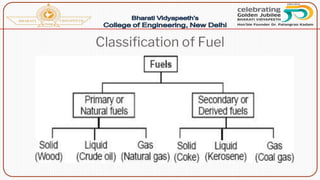
CLASSIFICATION OF FUELS:
⚫Chemical Fuels: It is of two types viz.,
⚫Primary or Natural Fuel and
⚫Secondary or Derived Fuel.
Classification of Fuel
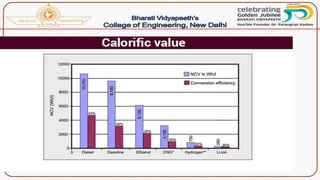
CALORIFIC VALUE
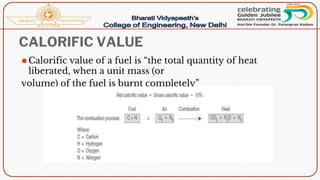
⚫Calorific value of a fuel is “the total quantity of heat
liberated, when a unit mass (or
volume) of the fuel is burnt completely”
Units of Heat:
⚫ (1) Calorie- is the amount of heat required to raise the
temperature of one gram of water through one degree centigrade
(15-16° C).
⚫ (2) Kilocalorie – is equal to 1,000 calories. This is the unit of
metric system and may be defined as “the quantity of heat
required to raise the temperature of one kilogram of water
through one degree centigrade. Thus, 1 kcal = 1,000 calories.
⚫ (3) British Thermal Unit (BTU)- is defined as “the quantity of heat
required to raise the temperature of one pound of water through
one degree Fahrenheit (60-61° F). This is the English system unit.
1 BTU = 252 cal = 0.252 kcal and 1 kcal = 3.968 BTU
⚫ (4) Centigrade heat unit (CHU)-is “the quantity of heat required to
raise the temperature of 1 pound of water through one degree
centigrade”. Thus,
1 kcal = 3.968 BTU = 2.2 CHU
HIGHER OR GROSS CALORIFIC VALUE:
⚫It is the total amount of heat produced, when unit
mass/volume of the fuel has been burnt completely and the
products of combustion have been cooled to room
temperature (15° C or 60° F).
⚫It is explained that all fuels contain some hydrogen and when
the calorific value of hydrogen containing fuel is determined
experimentally, the hydrogen is converted into steam. If the
products of combustion are condensed to the room
temperature, the latent heat of condensation of steam also
gets included in the measured heat which is then called GCV.
LOWER OR NET CALORIFIC VALUE
⚫It is the net heat produced, when unit mass/volume of the
fuel is burnt completely and the products are permitted to
escape.
⚫In actual practice of any fuel, the water vapour and moisture,
etc., are not condensed and escape as such along with hot
combustion gases. Hence, a lesser amount of heat is available.
Lower calorific value of the fuel = HCV – Latent heat of water
liberated by the fuel
Importance of Calorific Value
⚫It is very important to have a knowledge of the calorific value
of fuel to carry out our day-to-day activities. This knowledge
helps us to determine the amount of energy we transport.
The gas shippers and suppliers require this information to
bill gas consumers. It also helps to determine transportation
charges of gas shippers and suppliers.
DETERMINATION OF CALORIFIC VALUE
USING BOMB
CALORIMETER
FUELS, Lecture-2
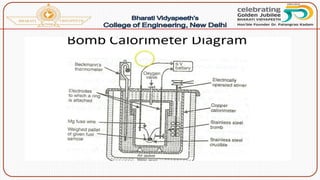
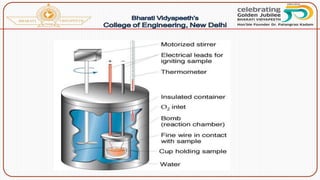
DETERMINATION OF CALORIFIC VALUE USING BOMB CALORIMETER
⚫The calorific value of solid fuels can be determined with the
help of bomb calorimeter.
⚫Description:
⚫Bomb Calorimeter consists of a strong stainless steel bomb
where the fuel sample is burnt. The bomb has oxygen inlet
valve and two stainless steel electrodes. A small ring is
attached to one of the electrodes. In this ring, a nickel or
stainless steel crucible is placed. The bomb is placed in a
copper calorimeter containing a known weight of water
sample. The copper calorimeter is provided with a
Beckmann’s thermometer and stirrer for stirring water. The
copper calorimeter is covered by an air jacket and water
jacket.
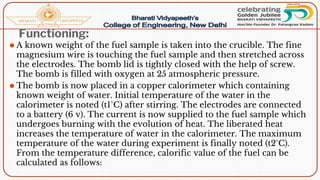
Functioning:
⚫ A known weight of the fuel sample is taken into the crucible. The fine
magnesium wire is touching the fuel sample and then stretched across
the electrodes. The bomb lid is tightly closed with the help of screw.
The bomb is filled with oxygen at 25 atmospheric pressure.
⚫ The bomb is now placed in a copper calorimeter which containing
known weight of water. Initial temperature of the water in the
calorimeter is noted (t1°C) after stirring. The electrodes are connected
to a battery (6 v). The current is now supplied to the fuel sample which
undergoes burning with the evolution of heat. The liberated heat
increases the temperature of water in the calorimeter. The maximum
temperature of the water during experiment is finally noted (t2°C).
From the temperature difference, calorific value of the fuel can be
calculated as follows:
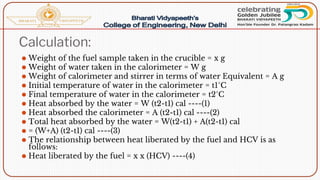
Calculation:
⚫ Weight of the fuel sample taken in the crucible = x g
⚫ Weight of water taken in the calorimeter = W g
⚫ Weight of calorimeter and stirrer in terms of water Equivalent = A g
⚫ Initial temperature of water in the calorimeter = t1°C
⚫ Final temperature of water in the calorimeter = t2°C
⚫ Heat absorbed by the water = W (t2-t1) cal ----(1)
⚫ Heat absorbed the calorimeter = A (t2-t1) cal ----(2)
⚫ Total heat absorbed by the water = W(t2-t1) + A(t2-t1) cal
⚫ = (W+A) (t2-t1) cal ----(3)
⚫ The relationship between heat liberated by the fuel and HCV is as
follows:
⚫ Heat liberated by the fuel = x x (HCV) ----(4)
Calculation of Higher Calorific Value (HCV):
⚫Therefore, heat liberated by the fuel = Heat absorbed by the
water and calorimeter
X Weight of fuel
⚫Compare equation (3) and (4), we get
⚫x x (HCV) = (W+A) (t2-t1)
⚫HCV = (W+A) (t2-t1) /X cal/g
Calculation of Lower Calorific Value (LCV):
⚫The percentage of hydrogen in the fuel = H
⚫Weight of water produced 1 g of the fuel = 9 H g/100 = 0.09 g
⚫Therefore, heat liberated during the Condensation of steam
= 0.09 H x 587 cal/g
⚫Lower calorific value of the fuel = HCV – Latent heat of
water
liberated by the fuel
⚫LCV = HCV – (0.09 H x 587) cal/g.
Corrections Of Bomb Calorimeter
a. Fuse wire correction: As Mg wire is used for ignition, the heat generated
by burning of Mg wire is also included in the gross calorific value. Hence this
amount of heat has to be subtracted from the total value.
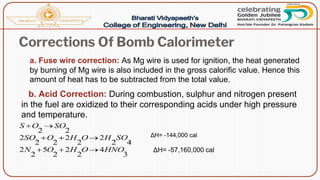
b. Acid Correction: During combustion, sulphur and nitrogen present
in the fuel are oxidized to their corresponding acids under high pressure
and temperature.
ΔH= -57,160,000 cal
ΔH= -144,000 cal
The corrections must be made for the heat liberated in the bomb by the formation of H2SO4 and
HNO3. The amount of H2SO4 and HNO3 is analyzed by washings of the calorimeter.
For each ml of 0.1 N H2SO4 formed, 3.6 calories should be subtracted.
For each ml of 0.1 HNO3 formed, 1.429 calories must be subtracted.
(C) Cooling correction: As the temperature rises above the room temperature, the loss of
heat does occur due to radiation, and the highest temperature recorded will be slightly less
than that obtained. A temperature correction is therefore necessary to get the correct rise
in temperature.
If the time taken for the water in the calorimeter to cool down from the maximum
temperature attained, to the room temperature is x minutes and the rate of cooling is
dt/min, then the cooling correction = x × dt. This should be added to the observed rise in
temperature
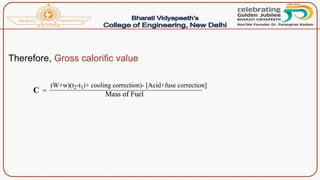
Therefore, Gross calorific value
DETERMINATION OF CALORIFIC VALUE
USING BOMB
CALORIMETER
FUELS, Lecture-3
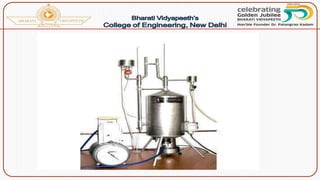
BOYS OR JUNKERS GAS CALORIMETER
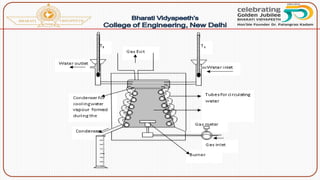
⚫ APPARATUS: It consists of following
(i) Bunsen Burner: special type of Burner clamped at the bottom. It can be
pulled out of the combustion chamber or pushed up in chamber during the
carrying out combustion.
(ii) Gasometer: It is employed to measure the volume of gas burning per unit
time. This attached with manometer fitted with the thermometer so that
pressure and temperature of the gas before burning can be read.
(iii) Pressure governor: It can control the supply of quantity of gas at give
pressure.
(iv) Gas Calorimeter/ Combustion chamber: It is a vertical cylinder, which is
surrounded by annular space for heating water and interchange coils. The
entire is covered by an outer jacket in order to reduce the heat loss by
radiation and convection.
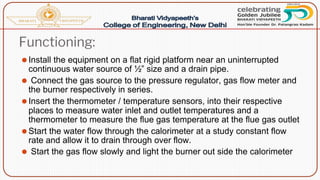
Functioning:
⚫Install the equipment on a flat rigid platform near an uninterrupted
continuous water source of ½” size and a drain pipe.
⚫ Connect the gas source to the pressure regulator, gas flow meter and
the burner respectively in series.
⚫Insert the thermometer / temperature sensors, into their respective
places to measure water inlet and outlet temperatures and a
thermometer to measure the flue gas temperature at the flue gas outlet
⚫Start the water flow through the calorimeter at a study constant flow
rate and allow it to drain through over flow.
⚫ Start the gas flow slowly and light the burner out side the calorimeter
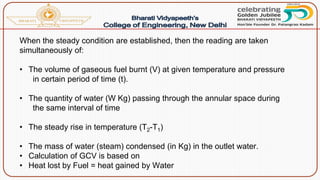
When the steady condition are established, then the reading are taken
simultaneously of:
• The volume of gaseous fuel burnt (V) at given temperature and pressure
in certain period of time (t).
• The quantity of water (W Kg) passing through the annular space during
the same interval of time
• The steady rise in temperature (T2-T1)
• The mass of water (steam) condensed (in Kg) in the outlet water.
• Calculation of GCV is based on
• Heat lost by Fuel = heat gained by Water
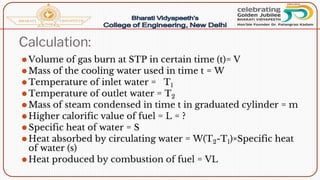
Calculation:
⚫Volume of gas burn at STP in certain time (t)= V
⚫Mass of the cooling water used in time t = W
⚫Temperature of inlet water = T1
⚫Temperature of outlet water = T2
⚫Mass of steam condensed in time t in graduated cylinder = m
⚫Higher calorific value of fuel = L = ?
⚫Specific heat of water = S
⚫Heat absorbed by circulating water = W(T2-T1)×Specific heat
of water (s)
⚫Heat produced by combustion of fuel = VL
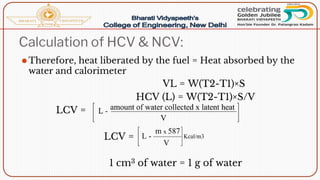
Calculation of HCV & NCV:
⚫Therefore, heat liberated by the fuel = Heat absorbed by the
water and calorimeter
VL = W(T2-T1)×S
HCV (L) = W(T2-T1)×S/V
LCV =
LCV =
1 cm3 of water = 1 g of water
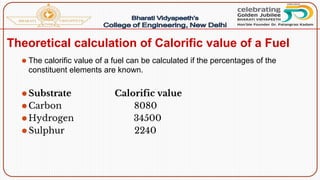
Theoretical calculation of Calorific value of a Fuel
⚫ The calorific value of a fuel can be calculated if the percentages of the
constituent elements are known.
⚫Substrate Calorific value
⚫Carbon 8080
⚫Hydrogen 34500
⚫Sulphur 2240
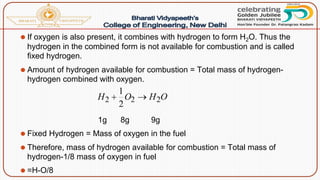
⚫ If oxygen is also present, it combines with hydrogen to form H2O. Thus the
hydrogen in the combined form is not available for combustion and is called
fixed hydrogen.
⚫ Amount of hydrogen available for combustion = Total mass of hydrogen-
hydrogen combined with oxygen.
1g 8g 9g
⚫ Fixed Hydrogen = Mass of oxygen in the fuel
⚫ Therefore, mass of hydrogen available for combustion = Total mass of
hydrogen-1/8 mass of oxygen in fuel
⚫ =H-O/8
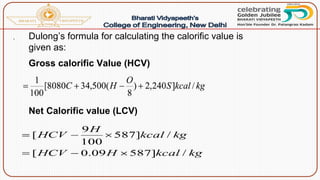
. Dulong’s formula for calculating the calorific value is
given as:
Gross calorific Value (HCV)
Net Calorific value (LCV)
Difference between gross and net calorific value
⚫Gross calorific value
(GCV) is the amount of
heat released by the
complete combustion of a
unit of natural gas. It is
also known as Higher
Heating Value (HCV).
⚫GCV= NCV when amount
of hydrogen will be zero
⚫ Net Calorific Value
(NCV) also known as lower
heating value (LHV) or
lower calorific value (LCV)
is determined by the
subtracting the heat of
vaporization of the water
vapour from the higher
heating value.This treats
any H20 formed as a vapor.
⚫ NCV= GCV when amount
of hydrogen will be zero
CHARACTERISTICS OF A GOOD FUEL
PROXIMATE ANALYSIS
FUELS, Lecture-4
CHARACTERISTICS OF A GOOD FUEL:
⚫ High calorific value
⚫ Moderate ignition temperature
⚫ Low moisture content
⚫ Low non-combustible matter content
⚫ Moderate velocity of combustion
⚫ Products of combustion should not be harmful
⚫ Low cost
⚫ Easy to transport
⚫ Combustion should be easily controllable
⚫ Should not undergo spontaneous combustion
⚫ Storage cost in bulk should be low
⚫ Should burn in air with efficiency without much smoke
⚫ In case of solid fuel, the size should be uniform so that combustion is
regular.
COAL:
⚫Coal is a highly carbonaceous matter that has been formed as a result
of alteration of vegetable matter (eg., plants) under certain favourable
conditions. It is chiefly composed of C, H, N and O besides non-
combustible inorganic matter.
⚫The successive stages in the transformation of vegetable matter into
coal are – wood, peat, lignite, bituminous coal, steam coal and
anthracite. Anthracite is probably the purest form of coal and contains
95 % carbon.
ANALYSIS OF COAL:
⚫The composition of coal varies widely and hence it is necessary to
analyse and interpret the results from the points of view of commercial
classification, price fixation and proper industrial utilization. The quality
of a coal is ascertained by the following two types of analysis.
⚫Proximate Analysis and
⚫Ultimate Analysis
PROXIMATE ANALYSIS:
⚫It is called ‘proximate’ because the data collected vary with the
procedure adopted.
⚫It is an empirical but important analysis dealing with the determination
of
⚫Moisture content
⚫Volatile matter
⚫Ash content
⚫Fixed carbon.
(i) Determination of moisture content in
coal:
⚫ It is the loss in weight of coal caused by heating a weighed quantity of coal
sample for one hour at 105 C.
⚫ % of moisture content = Loss in weight of coal x 100/ Weight of coal
taken initially
⚫ Significance of Moisture:
⚫ High moisture content of the coal is undesirable for the following reasons:
⚫ 1) Reduces the calorific value of coal
⚫ 2) Increases the consumption of coal for heating purpose.
⚫ 3) Lengthens the time of heating.
(ii) Determination of volatile matter in coal:
⚫ It is the loss in weight of moisture free powdered coal when heated in a
⚫ crucible fitted with cover in a muffle furnace at 950 C for seven minutes.
⚫ % of volatile matter in coal = Loss in weight of moisture free coal x100/Weight
of coal taken
⚫ Significance of volatile matter:
⚫ During burning of coal, gases like CO, CO2, CH4, N2, O2, hydrocarbons etc. that
⚫ come out are called volatile matter of the coal.
⚫ It has been found that the coal with higher volatile matter content ignites easily has
⚫ lower calorific value burns with long yellow smoky flame will evolve more coal gas
when
⚫ heated in the absence of air.
(iii) Determination of ash in coal:
⚫ It is the weight of residue obtained after burning a known weight of coal in an
⚫ open crucible in the presence of air at 750 C for 30 minutes.
⚫ % of ash in coal = Weight of residue ash formed x 100/Weight of coal taken
⚫ Significance of ash content:
⚫ 1) Ash in the combination product of mineral matter in the coal. It consists mainly
⚫ SiO2, Al2O3 and Fe2O3 with varying amount of other oxides such as Na2O, CaO,
MgO etc.
⚫ 2) Ash containing the oxides of Na, Ca and Mg melt easily.
⚫ 3) High ash content in coal is undesirable because it
⚫ i) increases transporting, handling and storage costs
⚫ ii) is harder and stronger
⚫ iii) has lower calorific value
(iv) Determination of fixed carbon:
⚫ It is determined indirectly by deducting the sum total of moisture, volatile
matter and
⚫ ash percentage from 100.
⚫ % of fixed carbon in coal = 100 - % (moisture + volatile matter + ash)
⚫ Significance of Fixed carbon:
⚫ It is the pure carbon present in coal. Higher the fixed carbon content of the
coal,
⚫ higher will be the calorific value of the sample.
⚫ The proximate analysis data of some Indian coal samples are presented
here.
The proximate analysis data of some Indian coal
samples are presented here.
N
o.
Source of
sample
Moisture
(%)
VM (%)
Ash (%)
Ash (%) Fixed
carbon
(%)
1 Assam 1.2 – 1.5 35-38 1.6-2 55-60
2 Jharia 0.6-2.0 15-25 10-20 60-68
3 Raniganj 4-6 30-35 9-15 50-60
ULTIMATE ANALYSIS
FUELS, Lecture-5
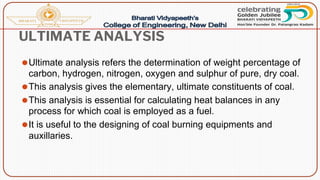
ULTIMATE ANALYSIS
⚫Ultimate analysis refers the determination of weight percentage of
carbon, hydrogen, nitrogen, oxygen and sulphur of pure, dry coal.
⚫This analysis gives the elementary, ultimate constituents of coal.
⚫This analysis is essential for calculating heat balances in any
process for which coal is employed as a fuel.
⚫It is useful to the designing of coal burning equipments and
auxillaries.
i) Determination of carbon and hydrogen in
coal:
⚫A known amount of coal is burnt in presence of oxygen thereby
converting carbon and hydrogen of coal into-
⚫(i) CO2 (C +O2 CO2) and
⚫(ii) H2O (H2 + ½ O2 H2O) respectively.
⚫The products of combustion CO2 and H2O are passing over weighed
tubes of anhydrous CaCl2 and KOH which absorb H2O and CO2
respectively.
⚫The increase in the weight of CaCl2 tube represents the weight of
water formed while the increase in the weight of KOH tube represents
the weight of CO2 formed.
The percentage of carbon and hydrogen in coal can be calculated
in the following way-
⚫ The weight of coal sample taken = x g
⚫ The increase in the weight of KOH tube = y g
⚫ The increase in the weight of CaCl2 tube = z g
⚫ Consider the following reaction
⚫ C (12) + O2 CO2(44)
⚫ 44 g of CO2 contains 12 g of carbon
⚫ Therefore y g of CO2 contains = y x 12 g of carbon.
44
⚫ X g of coal contains = 12 y g carbon
44
⚫ % of carbon in coal = 12 y x 100
44x
Significance of Total Carbon:
⚫It is the sum total of fixed carbon and the carbon present in the volatile
matters like CO, CO2, hydrocarbons. Thus, total carbon is always
more than fixed carbon in any coal. High total carbon containing coal
will have higher calorific value.
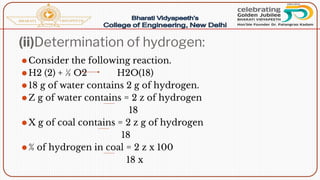
(ii)Determination of hydrogen:
⚫Consider the following reaction.
⚫H2 (2) + ½ O2 H2O(18)
⚫18 g of water contains 2 g of hydrogen.
⚫Z g of water contains = 2 z of hydrogen
18
⚫X g of coal contains = 2 z g of hydrogen
18
⚫% of hydrogen in coal = 2 z x 100
18 x
Significance of Hydrogen:
⚫It increases the calorific value of the coal. It is associated with the
volatile matter of the coal. When the coal containing more of
hydrogen is heated, it combines with nitrogen present in coal
forming ammonia. Ammonia is usually recovered as (NH4)2SO4, a
valuable fertilizer.
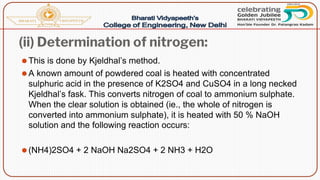
(ii) Determination of nitrogen:
⚫This is done by Kjeldhal’s method.
⚫A known amount of powdered coal is heated with concentrated
sulphuric acid in the presence of K2SO4 and CuSO4 in a long necked
Kjeldhal’s fask. This converts nitrogen of coal to ammonium sulphate.
When the clear solution is obtained (ie., the whole of nitrogen is
converted into ammonium sulphate), it is heated with 50 % NaOH
solution and the following reaction occurs:
⚫(NH4)2SO4 + 2 NaOH Na2SO4 + 2 NH3 + H2O
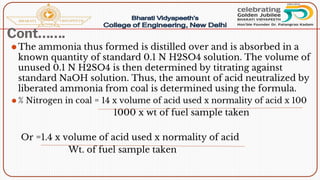
Cont…….
⚫The ammonia thus formed is distilled over and is absorbed in a
known quantity of standard 0.1 N H2SO4 solution. The volume of
unused 0.1 N H2SO4 is then determined by titrating against
standard NaOH solution. Thus, the amount of acid neutralized by
liberated ammonia from coal is determined using the formula.
⚫ % Nitrogen in coal = 14 x volume of acid used x normality of acid x 100
1000 x wt of fuel sample taken
Or =1.4 x volume of acid used x normality of acid
Wt. of fuel sample taken
Significance:
Presence of nitrogen decreases the calorific value of the
coal. However, when coal is carbonized, its N2 and H2
combine and form NH3. Ammonia is recovered as
(NH4)2SO4, a valuable fertilizer.
(iv) Determination of sulphur in coal:
A known amount of coal is burnt completely in Bomb calorimeter in presence of
oxygen.
Ash thus obtained contains sulphur of coal as sulphate which is extracted with
dil.HCl.
The acid extract is then treated with BaCl2 solution to precipitate sulphate as
BaSO4.
The precipitate is filtered, washed, dried and weighed. From the weight of
BaSO4,the percentage of sulphur in coal is calculated in the following way.
The weight of coal sample taken = x g
The weight of BaSO4 precipitate = y g
Cont…….
Consider the following equations
S (32) + 2O2 SO4 BaCl2 BaSO4 (233)
233 g of BaSO4 contains 32 g of sulphur.
Therefore, y g of BaSO4 contains = 32 y g sulphur.
233
Therefore x g of coal contains = 32 y g sulphur.
233
% of sulphur in the coal = 32 y x 100.
233
Significance:
It increases the calorific value of the coal, yet it has the
following undesirable effect-
The oxidation products of sulphur (SO2, SO3) especially
in presence of moisture forms sulphuric acid which
corrodes the equipment and pollutes the atmosphere.
v) Determination of oxygen in coal:
It is calculated indirectly in the following way-
% of oxygen in coal = 100 - % (C + H + N + S + ash).
Significance:
The less the oxygen content, the better is the coal. As the
oxygen content increases,
its moisture holding capacity also increases.
1.METALLURGICAL COKE
2.MANUFACTURE OF METALLURGICAL
COKE BY OTTO HOFFMANN’S METHOD
3.PETROLEUM PROCESSING AND
FRACTIONS
FUELS, Lecture-6
METALLURGICAL COKE:
⚫ When bituminous coal (coal containing about 90 % carbon) is heated strongly in
absence of air, the volatile matter escapes out and a while, lustrous, dense, strong,
porous and coherent mass is left which is called metallurgical coke.
⚫ Characteristics of metallurgical coke:
⚫ The most important industrial fuel is the metallurgical coke. This is used in the
metallurgical industry, especially in the blast furnace. A good metallurgical coke must
have following requirements:
⚫ Purity: Low moisture and ash content are desirable in metallurgical coke. It must
contain minimum percentage of phosphorous and sulphur.
⚫ Porosity: High porosity is desirable in furnace coke to obtain high rate of combustion.
⚫ Strength: The coke should be hard and strong to withstand pressure of ore, flux etc. in
the furnace.
⚫ Size: Metallurgical coke must be uniform and medium size.
⚫ Calorific value: This should be high.
⚫ Combustibility: It should burn easily.
⚫ Reactivity: It refers to its ability to react with O2, CO2, steam and air. The metallurgical
coke must have low reactivity.
⚫ Cost: It must be cheap and readily available.
Manufacture of Metallurgical coke by Otto Hoffmann’s
method:
⚫ In order to (i) save the fuel for heating purpose and (ii) recover
valuable by-products like coal gas, ammonia, benzol oil, tar etc. Otto
Hoffmann developed a modern by-product coke oven. Here, the
heating is done externally by a portion of coal gas produced during the
process itself. It also utilizes the waste flue gases for heating the
checker work bricks.
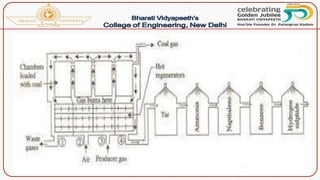
⚫ The oven consists of a number of narrow silica chambers, each about
10-12 m long, 3-4 m tall and 0.4-0.45 m wide, erected side by side with
vertical flues between them to form a sort of battery. Each chamber
has a hole at the top to introduce the charge, a gas off take and a
refractory lined cast iron door at each end for coke discharge. The
oven works on heat regenerative principle ie. the waste gas produced
during carbonization is utilized for heating. The ovens are charged
from the top and closed to restrict the entry of air.
Cont…….
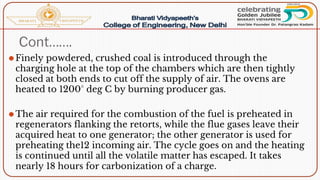
⚫Finely powdered, crushed coal is introduced through the
charging hole at the top of the chambers which are then tightly
closed at both ends to cut off the supply of air. The ovens are
heated to 1200° deg C by burning producer gas.
⚫The air required for the combustion of the fuel is preheated in
regenerators flanking the retorts, while the flue gases leave their
acquired heat to one generator; the other generator is used for
preheating the12 incoming air. The cycle goes on and the heating
is continued until all the volatile matter has escaped. It takes
nearly 18 hours for carbonization of a charge.
Cont…….
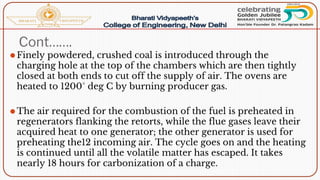
⚫Finely powdered, crushed coal is introduced through the
charging hole at the top of the chambers which are then tightly
closed at both ends to cut off the supply of air. The ovens are
heated to 1200° deg C by burning producer gas.
⚫The air required for the combustion of the fuel is preheated in
regenerators flanking the retorts, while the flue gases leave their
acquired heat to one generator; the other generator is used for
preheating the12 incoming air. The cycle goes on and the heating
is continued until all the volatile matter has escaped. It takes
nearly 18 hours for carbonization of a charge.
Cont…..
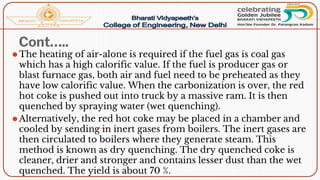
⚫The heating of air-alone is required if the fuel gas is coal gas
which has a high calorific value. If the fuel is producer gas or
blast furnace gas, both air and fuel need to be preheated as they
have low calorific value. When the carbonization is over, the red
hot coke is pushed out into truck by a massive ram. It is then
quenched by spraying water (wet quenching).
⚫Alternatively, the red hot coke may be placed in a chamber and
cooled by sending in inert gases from boilers. The inert gases are
then circulated to boilers where they generate steam. This
method is known as dry quenching. The dry quenched coke is
cleaner, drier and stronger and contains lesser dust than the wet
quenched. The yield is about 70 %.
Recovery of by-products:
⚫ The gas coming out of the retort is known as coke oven gas. This consist
of tar, ammonia, moisture, aromatic hydrocarbons (naphthalene,
benzene), H2S etc. It can be
⚫ used as a fuel after removing coal tar and ammonia.
⚫ i) Recovery of tar: The coke oven gas is first passed through a tower in
which liquid ammonia is sprayed. Tar and dust get collected in a tank
below, which is heated by a steam coil to recover back the ammonia
sprayed.
⚫ ii) Recovery of ammonia: The coke oven gas is passed through another
tower in which water is sprayed. Gaseous ammonia goes into solution as
NH4OH.
⚫ iii) Recovery of naphthalene: After recovering ammonia, the remaining
gases are led through another tower where water is sprayed at low
temperature when naphthalene gets condensed.
Cont….
⚫ iv) Recovery of benzene: The resultant gas from the previous step is
sprayed with
⚫ petroleum whereby benzene and its homologues can be recovered.
⚫ v) Recovery of H2S: The gases are then passed through a purifier,
packed with
⚫ moist Fe2O3. Hydrogen sulphide is retained here.
⚫ Fe2O3 + 3 H2S Fe2S3 + 3 H2O
⚫ When all the Fe2O3 is converted into Fe2S3, the purifier on
exposure to the
⚫ atmosphere, regenerates Fe2O3 in the following manner.
⚫ Fe2S3 + 4 O2 2 FeO + 3 SO2
⚫ 4 FeO + O2 2 Fe2O3
PETROLEUM PROCESSING AND FRACTIONS:
Petroleum or crude oil is a dark greenish-brown, viscous oil found
deep in earth crust. It is composed mainly of various hydrocarbons
(like straight-chain paraffins, cycloparaffins or naphthalenes, olefins
and aromatics), together with small amounts of
organic compounds containing oxygen, nitrogen and sulphur.
Mining of petroleum:
It is done by drilling holes in the earth’s crust and sinking pipes
upto the oil-bearing porous rocks.
Refining of crude oil:
The crude oil is separated into various useful fractions by fractional distillation
and finally converted into desired specific products. The process is called
‘refining of crude oil’ and the plants set up for the purpose, are called the oil
refineries. The refining involves
Step 1: Separation of water (Cottrell’s process):The crude oil from the oil
well is an extremely stable emulsion of oil and salt water.The process of freeing
oil from water consists in allowing the crude to flow between two highly charged
electrodes.
Step 2: Removal of harmful sulphur compounds:This involves in treating oil
with copper oxide. A reaction occurs with Sulphur compounds, which results in
the formation of copper sulphide (a solid), which is then removed by filtration.
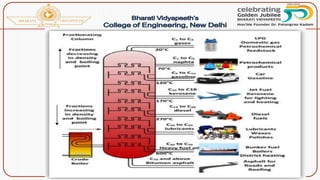
Step 3: Fractional distillation:
The crude oil is then heated to about 400 deg C in an iron retort whereby all
volatile constituents, except the residue (asphalt or coke) are evaporated. The
hot vapours are then passed up a fractionating colum, which is a tall cylindrical
tower containing a number of horizontal stainless steel trays at short distances.
Each tray is provided with small chimney, covered with a loose cap.
As the vapours go up, they become gradually cooler and fractional condensation
takes place at different heights of column. Higher boiling fraction condenses
first, while the lower boiling fractions turn-by-turn.
1. CRACKING
2. THERMAL CRACKING
3. CATALYTIC CRACKING
FUELS, Lecture-7
CRACKING:
It is defined as the decomposition of bigger hydrocarbon molecules into
simpler low boiling hydrocarbons of lower molecular weight. For example,
C10H22 (Decane) C5H12 (n-Pentane) + C5H10 (Pentane)
Boiling Point=174°C B.Pt. = 36°C
There are two methods of cracking in use:
1. Thermal cracking
2. 2. Catalytic cracking
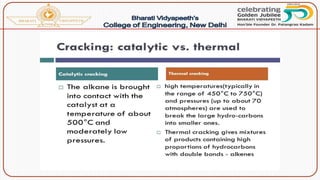
Thermal cracking:
⚫The heavy oils are subjected to high temperature and pressure,
when the bigger hydrocarbon molecules break down to give
smaller molecules of the paraffins, olefins plus some hydrogen.
This process may be carried out either in liquid-phase or
vapour-phase.
Liquid-phase thermal cracking: Vapour-phase thermal cracking:
⚫ The heavy oil or gas oil stock is
cracked at a suitable temperature
of 475-530°C and under pressure
of 100 kg/cm2.
⚫ The cracked products are then
separated in a fractionating
column.
⚫ The yield is 50-60 % and octane
rating of the petrol produced is
65-75.
⚫ The cracking oil is first vapourised
and then cracked at about 600-
650°C and under a low pressure of
10-20 kg/cm2.
⚫ This process is suitable only for
those oils, which may be readily
vaporized.
⚫ It requires less time than the liquid-
phase method. Petrol obtained from
vapour-phase cracking has better
anti-knock properties, but poorer
stability than petrol from liquid-
phase cracking.
Catalytic cracking:
The quality and yield of gasoline produced by cracking can be
greatly improved by using a suitable catalyst like aluminium silicate
[Al2(SiO3)3] or alumina [Al2O3]. There are two methods of catalytic
cracking in use:
(a)Fixed-bed catalytic cracking:
(b) Moving-bed catalytic cracking:
(a) Fixed-bed catalytic cracking:
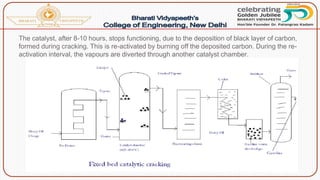
⚫ The oil vapours are heated in a pre-heater to cracking temperatures (420-
450°C) and then forced through a catalytic chamber maintained at 425-
450°C and 1.5 kg/cm2 pressure.
⚫ During the passage through the tower, about 40 % of the charge is
converted into gasoline and about 2-4 % carbon is formed. The later gets
adsorbed on the catalyst bed.
⚫ The vapours produced are then passed through a fractionating column,
where heavy oil fractions condense. The vapours are then led through a
cooler, where some of the gases are condensed along with gasoline and
uncondensed gases move on.
⚫ The gasoline containing some dissolved gases is then sent to a stabilizer,
where the dissolved gases are removed and pure gasoline is obtained.
The catalyst, after 8-10 hours, stops functioning, due to the deposition of black layer of carbon,
formed during cracking. This is re-activated by burning off the deposited carbon. During the re-
activation interval, the vapours are diverted through another catalyst chamber.
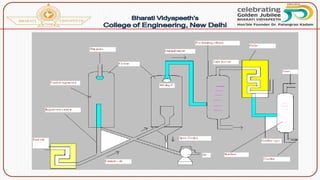
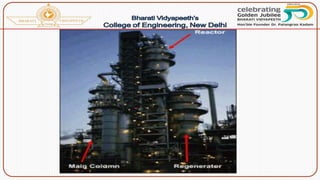
(b) Moving-bed catalytic cracking:
⚫ The solid catalyst is very finely powdered, so that it behaves almost as a fluid,
which can be circulated in gas stream. The vapours of cracking stock (gas oil,
heavy oil, etc.) mixed with fluidized catalyst is forced up into a large reactor
‘bed’ in which cracking of the heavier into lighter molecules occurs. Near the
top of the reactor, there is a centrifugal separator (called cyclone), which
allows only the cracked oil vapours to pass on to fractionating column, but
retains all the catalyst powder in the reactor itself. The catalyst powder
gradually becomes heavier, due to coating with carbon, and settles to the
bottom, from where it is forced by an air blast to regenerator maintained at
600°C.
⚫ In regenerator, carbon is burnt and the regenerated catalyst then flows
through a stand pipe for mixing with fresh batch of incoming cracking oil. At
the top of the regenerator, there is a separator, which permits only gases
(CO2, etc.) to pass out, but holds back catalyst particles.
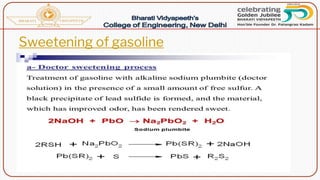
Sweetening of gasoline
1. KNOCKING
2. OCTANE NUMBER
3. CETANE NUMBER
FUELS, Lecture-8
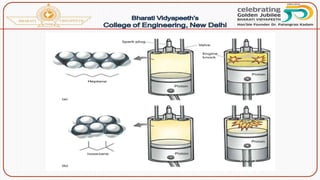
KNOCKING:
In certain circumstances, due to the presence of some constituents in the gasoline used, the rate
of oxidation becomes so great that the last portion of the fuel air mixture gets ignited
instantaneously producing an explosive violence
known as knocking. The knocking results in loss of efficiency, since this ultimately decreases the
compression ratio.
The phenomenon of knocking is not yet fully understood. However, it is noted that the tendency
of fuel constituents to knock is in the following order:
Straight chain paraffins (n-paraffins)>branched chain paraffins (iso
paraffins)>olefins>cycloparaffins (naphthalenes)>aromatics.
Thus, olefins of the same carbon chain length possess better antiknock properties
than the corresponding paraffins and so on.
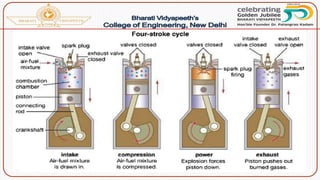
WORKING OF A INTERNAL COMBUSTION
ENGINE
⚫In an internal combustion engine, a mixture of gasoline (petroleum)
vapour and air is used as a fuel. After the initiation of the combustion
reaction by spark in the cylinder, the flame should spread rapidly and
smoothly through the gaseous mixture; thereby the expanding gas
drives the piston down the cylinder. The ratio of the gaseous volume in
the cylinder at the end of the suction stroke to the volume at the end of
compression stroke of the piston is known as the compression ratio.
The efficiency of an internal combustion engine increases with the
compression ratio.
⚫However, successful high compression ratio is dependent on the
nature of the constituents present in the gasoline used.
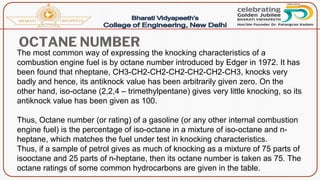
OCTANE NUMBER
The most common way of expressing the knocking characteristics of a
combustion engine fuel is by octane number introduced by Edger in 1972. It has
been found that nheptane, CH3-CH2-CH2-CH2-CH2-CH2-CH3, knocks very
badly and hence, its antiknock value has been arbitrarily given zero. On the
other hand, iso-octane (2,2,4 – trimethylpentane) gives very little knocking, so its
antiknock value has been given as 100.
Thus, Octane number (or rating) of a gasoline (or any other internal combustion
engine fuel) is the percentage of iso-octane in a mixture of iso-octane and n-
heptane, which matches the fuel under test in knocking characteristics.
Thus, if a sample of petrol gives as much of knocking as a mixture of 75 parts of
isooctane and 25 parts of n-heptane, then its octane number is taken as 75. The
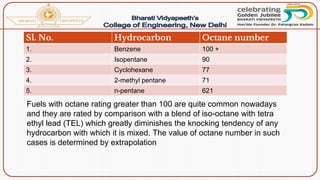
octane ratings of some common hydrocarbons are given in the table.
Sl. No. Hydrocarbon Octane number
1. Benzene 100 +
2. Isopentane 90
3. Cyclohexane 77
4. 2-methyl pentane 71
5. n-pentane 621
Fuels with octane rating greater than 100 are quite common nowadays
and they are rated by comparison with a blend of iso-octane with tetra
ethyl lead (TEL) which greatly diminishes the knocking tendency of any
hydrocarbon with which it is mixed. The value of octane number in such
cases is determined by extrapolation
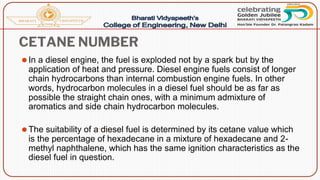
CETANE NUMBER
⚫In a diesel engine, the fuel is exploded not by a spark but by the
application of heat and pressure. Diesel engine fuels consist of longer
chain hydrocarbons than internal combustion engine fuels. In other
words, hydrocarbon molecules in a diesel fuel should be as far as
possible the straight chain ones, with a minimum admixture of
aromatics and side chain hydrocarbon molecules.
⚫The suitability of a diesel fuel is determined by its cetane value which
is the percentage of hexadecane in a mixture of hexadecane and 2-
methyl naphthalene, which has the same ignition characteristics as the
diesel fuel in question.
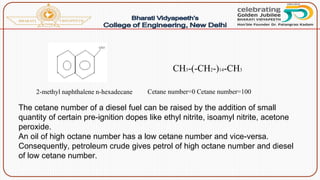
Cetane number=0 Cetane number=100
CH3-(-CH2-)14-CH3
2-methyl naphthalene n-hexadecane
The cetane number of a diesel fuel can be raised by the addition of small
quantity of certain pre-ignition dopes like ethyl nitrite, isoamyl nitrite, acetone
peroxide.
An oil of high octane number has a low cetane number and vice-versa.
Consequently, petroleum crude gives petrol of high octane number and diesel
of low cetane number.
Theoretical Air for Combustion:
⚫Combustion is a process of rapid oxidation in which a fuel burns
with the evolution of heat and light. The rate of combustion
depends on
⚫ (i) Nature of the fuel
⚫(ii) Temperature
⚫(iii) Concentration of the fuel and air or oxygen
Thus the combustion rate is increased by
⚫(i) Preheating the fuel and air
⚫(ii) Increasing the surface area of the fuel, and
⚫(iii) Increasing the pressure of air or oxygen used for combustion
Aim of combustion
⚫The aim of combustion is to get the maximum amount of heat from a
fuel in the shortest time and utilize the heat for various purposes.
During the combustion, a fuel may undergo thermal decomposition to
give simple products such as CO2, H2O etc.
⚫ For efficient combustion, it is essential that the fuel must be mixed
with sufficient quantity of air. The combustible constituents present in a
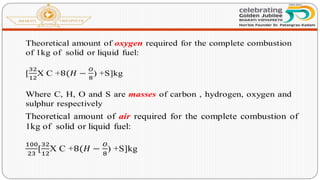
fuel are C, H, S and O. But, noncombustible constituents N2, CO2 and
ash present in the fuel do not take any oxygen during combustion.
Calculation of air used for combustion, by volume and by weight
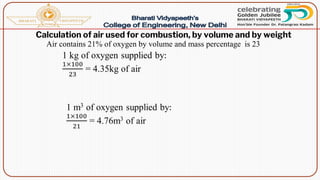
Air contains 21% of oxygen by volume and mass percentage is 23
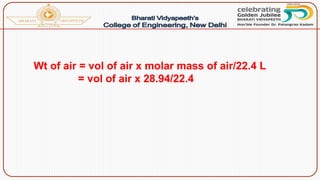
Wt of air = vol of air x molar mass of air/22.4 L
= vol of air x 28.94/22.4

Fuels,.pptx

  • 1.
  • 2.
    INTRODUCTION ⚫Fuel is acombustible substance, containing carbon as main constituent, which on proper burning gives large amount of heat, which can be used economically for domestic and industrial purposes. Eg., Wood, Charcoal, Coal, Kerosene, Petrol, Producer gas, Oil gas, LPG etc., During the process of combustion of a fuel (like coal), the atoms of carbon, hydrogen, etc. combine with oxygen with the simultaneous liberation of heat at a rapid rate. ⚫Fuel + Oxygen ---> Products + Heat
  • 3.
    CLASSIFICATION OF FUELS: ⚫ChemicalFuels: It is of two types viz., ⚫Primary or Natural Fuel and ⚫Secondary or Derived Fuel.
  • 4.
  • 5.
    CALORIFIC VALUE ⚫Calorific valueof a fuel is “the total quantity of heat liberated, when a unit mass (or volume) of the fuel is burnt completely”
  • 6.
    Units of Heat: ⚫(1) Calorie- is the amount of heat required to raise the temperature of one gram of water through one degree centigrade (15-16° C). ⚫ (2) Kilocalorie – is equal to 1,000 calories. This is the unit of metric system and may be defined as “the quantity of heat required to raise the temperature of one kilogram of water through one degree centigrade. Thus, 1 kcal = 1,000 calories. ⚫ (3) British Thermal Unit (BTU)- is defined as “the quantity of heat required to raise the temperature of one pound of water through one degree Fahrenheit (60-61° F). This is the English system unit. 1 BTU = 252 cal = 0.252 kcal and 1 kcal = 3.968 BTU ⚫ (4) Centigrade heat unit (CHU)-is “the quantity of heat required to raise the temperature of 1 pound of water through one degree centigrade”. Thus, 1 kcal = 3.968 BTU = 2.2 CHU
  • 7.
    HIGHER OR GROSSCALORIFIC VALUE: ⚫It is the total amount of heat produced, when unit mass/volume of the fuel has been burnt completely and the products of combustion have been cooled to room temperature (15° C or 60° F). ⚫It is explained that all fuels contain some hydrogen and when the calorific value of hydrogen containing fuel is determined experimentally, the hydrogen is converted into steam. If the products of combustion are condensed to the room temperature, the latent heat of condensation of steam also gets included in the measured heat which is then called GCV.
  • 8.
    LOWER OR NETCALORIFIC VALUE ⚫It is the net heat produced, when unit mass/volume of the fuel is burnt completely and the products are permitted to escape. ⚫In actual practice of any fuel, the water vapour and moisture, etc., are not condensed and escape as such along with hot combustion gases. Hence, a lesser amount of heat is available. Lower calorific value of the fuel = HCV – Latent heat of water liberated by the fuel
  • 10.
    Importance of CalorificValue ⚫It is very important to have a knowledge of the calorific value of fuel to carry out our day-to-day activities. This knowledge helps us to determine the amount of energy we transport. The gas shippers and suppliers require this information to bill gas consumers. It also helps to determine transportation charges of gas shippers and suppliers.
  • 11.
    DETERMINATION OF CALORIFICVALUE USING BOMB CALORIMETER FUELS, Lecture-2
  • 12.
    DETERMINATION OF CALORIFICVALUE USING BOMB CALORIMETER ⚫The calorific value of solid fuels can be determined with the help of bomb calorimeter. ⚫Description: ⚫Bomb Calorimeter consists of a strong stainless steel bomb where the fuel sample is burnt. The bomb has oxygen inlet valve and two stainless steel electrodes. A small ring is attached to one of the electrodes. In this ring, a nickel or stainless steel crucible is placed. The bomb is placed in a copper calorimeter containing a known weight of water sample. The copper calorimeter is provided with a Beckmann’s thermometer and stirrer for stirring water. The copper calorimeter is covered by an air jacket and water jacket.
  • 15.
    Functioning: ⚫ A knownweight of the fuel sample is taken into the crucible. The fine magnesium wire is touching the fuel sample and then stretched across the electrodes. The bomb lid is tightly closed with the help of screw. The bomb is filled with oxygen at 25 atmospheric pressure. ⚫ The bomb is now placed in a copper calorimeter which containing known weight of water. Initial temperature of the water in the calorimeter is noted (t1°C) after stirring. The electrodes are connected to a battery (6 v). The current is now supplied to the fuel sample which undergoes burning with the evolution of heat. The liberated heat increases the temperature of water in the calorimeter. The maximum temperature of the water during experiment is finally noted (t2°C). From the temperature difference, calorific value of the fuel can be calculated as follows:
  • 16.
    Calculation: ⚫ Weight ofthe fuel sample taken in the crucible = x g ⚫ Weight of water taken in the calorimeter = W g ⚫ Weight of calorimeter and stirrer in terms of water Equivalent = A g ⚫ Initial temperature of water in the calorimeter = t1°C ⚫ Final temperature of water in the calorimeter = t2°C ⚫ Heat absorbed by the water = W (t2-t1) cal ----(1) ⚫ Heat absorbed the calorimeter = A (t2-t1) cal ----(2) ⚫ Total heat absorbed by the water = W(t2-t1) + A(t2-t1) cal ⚫ = (W+A) (t2-t1) cal ----(3) ⚫ The relationship between heat liberated by the fuel and HCV is as follows: ⚫ Heat liberated by the fuel = x x (HCV) ----(4)
  • 17.
    Calculation of HigherCalorific Value (HCV): ⚫Therefore, heat liberated by the fuel = Heat absorbed by the water and calorimeter X Weight of fuel ⚫Compare equation (3) and (4), we get ⚫x x (HCV) = (W+A) (t2-t1) ⚫HCV = (W+A) (t2-t1) /X cal/g
  • 18.
    Calculation of LowerCalorific Value (LCV): ⚫The percentage of hydrogen in the fuel = H ⚫Weight of water produced 1 g of the fuel = 9 H g/100 = 0.09 g ⚫Therefore, heat liberated during the Condensation of steam = 0.09 H x 587 cal/g ⚫Lower calorific value of the fuel = HCV – Latent heat of water liberated by the fuel ⚫LCV = HCV – (0.09 H x 587) cal/g.
  • 19.
    Corrections Of BombCalorimeter a. Fuse wire correction: As Mg wire is used for ignition, the heat generated by burning of Mg wire is also included in the gross calorific value. Hence this amount of heat has to be subtracted from the total value. b. Acid Correction: During combustion, sulphur and nitrogen present in the fuel are oxidized to their corresponding acids under high pressure and temperature. ΔH= -57,160,000 cal ΔH= -144,000 cal
  • 20.
    The corrections mustbe made for the heat liberated in the bomb by the formation of H2SO4 and HNO3. The amount of H2SO4 and HNO3 is analyzed by washings of the calorimeter. For each ml of 0.1 N H2SO4 formed, 3.6 calories should be subtracted. For each ml of 0.1 HNO3 formed, 1.429 calories must be subtracted. (C) Cooling correction: As the temperature rises above the room temperature, the loss of heat does occur due to radiation, and the highest temperature recorded will be slightly less than that obtained. A temperature correction is therefore necessary to get the correct rise in temperature. If the time taken for the water in the calorimeter to cool down from the maximum temperature attained, to the room temperature is x minutes and the rate of cooling is dt/min, then the cooling correction = x × dt. This should be added to the observed rise in temperature
  • 21.
  • 22.
    DETERMINATION OF CALORIFICVALUE USING BOMB CALORIMETER FUELS, Lecture-3
  • 23.
    BOYS OR JUNKERSGAS CALORIMETER ⚫ APPARATUS: It consists of following (i) Bunsen Burner: special type of Burner clamped at the bottom. It can be pulled out of the combustion chamber or pushed up in chamber during the carrying out combustion. (ii) Gasometer: It is employed to measure the volume of gas burning per unit time. This attached with manometer fitted with the thermometer so that pressure and temperature of the gas before burning can be read. (iii) Pressure governor: It can control the supply of quantity of gas at give pressure. (iv) Gas Calorimeter/ Combustion chamber: It is a vertical cylinder, which is surrounded by annular space for heating water and interchange coils. The entire is covered by an outer jacket in order to reduce the heat loss by radiation and convection.
  • 26.
    Functioning: ⚫Install the equipmenton a flat rigid platform near an uninterrupted continuous water source of ½” size and a drain pipe. ⚫ Connect the gas source to the pressure regulator, gas flow meter and the burner respectively in series. ⚫Insert the thermometer / temperature sensors, into their respective places to measure water inlet and outlet temperatures and a thermometer to measure the flue gas temperature at the flue gas outlet ⚫Start the water flow through the calorimeter at a study constant flow rate and allow it to drain through over flow. ⚫ Start the gas flow slowly and light the burner out side the calorimeter
  • 27.
    When the steadycondition are established, then the reading are taken simultaneously of: • The volume of gaseous fuel burnt (V) at given temperature and pressure in certain period of time (t). • The quantity of water (W Kg) passing through the annular space during the same interval of time • The steady rise in temperature (T2-T1) • The mass of water (steam) condensed (in Kg) in the outlet water. • Calculation of GCV is based on • Heat lost by Fuel = heat gained by Water
  • 28.
    Calculation: ⚫Volume of gasburn at STP in certain time (t)= V ⚫Mass of the cooling water used in time t = W ⚫Temperature of inlet water = T1 ⚫Temperature of outlet water = T2 ⚫Mass of steam condensed in time t in graduated cylinder = m ⚫Higher calorific value of fuel = L = ? ⚫Specific heat of water = S ⚫Heat absorbed by circulating water = W(T2-T1)×Specific heat of water (s) ⚫Heat produced by combustion of fuel = VL
  • 29.
    Calculation of HCV& NCV: ⚫Therefore, heat liberated by the fuel = Heat absorbed by the water and calorimeter VL = W(T2-T1)×S HCV (L) = W(T2-T1)×S/V LCV = LCV = 1 cm3 of water = 1 g of water
  • 30.
    Theoretical calculation ofCalorific value of a Fuel ⚫ The calorific value of a fuel can be calculated if the percentages of the constituent elements are known. ⚫Substrate Calorific value ⚫Carbon 8080 ⚫Hydrogen 34500 ⚫Sulphur 2240
  • 31.
    ⚫ If oxygenis also present, it combines with hydrogen to form H2O. Thus the hydrogen in the combined form is not available for combustion and is called fixed hydrogen. ⚫ Amount of hydrogen available for combustion = Total mass of hydrogen- hydrogen combined with oxygen. 1g 8g 9g ⚫ Fixed Hydrogen = Mass of oxygen in the fuel ⚫ Therefore, mass of hydrogen available for combustion = Total mass of hydrogen-1/8 mass of oxygen in fuel ⚫ =H-O/8
  • 32.
    . Dulong’s formulafor calculating the calorific value is given as: Gross calorific Value (HCV) Net Calorific value (LCV)
  • 33.
    Difference between grossand net calorific value ⚫Gross calorific value (GCV) is the amount of heat released by the complete combustion of a unit of natural gas. It is also known as Higher Heating Value (HCV). ⚫GCV= NCV when amount of hydrogen will be zero ⚫ Net Calorific Value (NCV) also known as lower heating value (LHV) or lower calorific value (LCV) is determined by the subtracting the heat of vaporization of the water vapour from the higher heating value.This treats any H20 formed as a vapor. ⚫ NCV= GCV when amount of hydrogen will be zero
  • 34.
    CHARACTERISTICS OF AGOOD FUEL PROXIMATE ANALYSIS FUELS, Lecture-4
  • 35.
    CHARACTERISTICS OF AGOOD FUEL: ⚫ High calorific value ⚫ Moderate ignition temperature ⚫ Low moisture content ⚫ Low non-combustible matter content ⚫ Moderate velocity of combustion ⚫ Products of combustion should not be harmful ⚫ Low cost ⚫ Easy to transport ⚫ Combustion should be easily controllable ⚫ Should not undergo spontaneous combustion ⚫ Storage cost in bulk should be low ⚫ Should burn in air with efficiency without much smoke ⚫ In case of solid fuel, the size should be uniform so that combustion is regular.
  • 36.
    COAL: ⚫Coal is ahighly carbonaceous matter that has been formed as a result of alteration of vegetable matter (eg., plants) under certain favourable conditions. It is chiefly composed of C, H, N and O besides non- combustible inorganic matter. ⚫The successive stages in the transformation of vegetable matter into coal are – wood, peat, lignite, bituminous coal, steam coal and anthracite. Anthracite is probably the purest form of coal and contains 95 % carbon.
  • 37.
    ANALYSIS OF COAL: ⚫Thecomposition of coal varies widely and hence it is necessary to analyse and interpret the results from the points of view of commercial classification, price fixation and proper industrial utilization. The quality of a coal is ascertained by the following two types of analysis. ⚫Proximate Analysis and ⚫Ultimate Analysis
  • 38.
    PROXIMATE ANALYSIS: ⚫It iscalled ‘proximate’ because the data collected vary with the procedure adopted. ⚫It is an empirical but important analysis dealing with the determination of ⚫Moisture content ⚫Volatile matter ⚫Ash content ⚫Fixed carbon.
  • 39.
    (i) Determination ofmoisture content in coal: ⚫ It is the loss in weight of coal caused by heating a weighed quantity of coal sample for one hour at 105 C. ⚫ % of moisture content = Loss in weight of coal x 100/ Weight of coal taken initially ⚫ Significance of Moisture: ⚫ High moisture content of the coal is undesirable for the following reasons: ⚫ 1) Reduces the calorific value of coal ⚫ 2) Increases the consumption of coal for heating purpose. ⚫ 3) Lengthens the time of heating.
  • 40.
    (ii) Determination ofvolatile matter in coal: ⚫ It is the loss in weight of moisture free powdered coal when heated in a ⚫ crucible fitted with cover in a muffle furnace at 950 C for seven minutes. ⚫ % of volatile matter in coal = Loss in weight of moisture free coal x100/Weight of coal taken ⚫ Significance of volatile matter: ⚫ During burning of coal, gases like CO, CO2, CH4, N2, O2, hydrocarbons etc. that ⚫ come out are called volatile matter of the coal. ⚫ It has been found that the coal with higher volatile matter content ignites easily has ⚫ lower calorific value burns with long yellow smoky flame will evolve more coal gas when ⚫ heated in the absence of air.
  • 41.
    (iii) Determination ofash in coal: ⚫ It is the weight of residue obtained after burning a known weight of coal in an ⚫ open crucible in the presence of air at 750 C for 30 minutes. ⚫ % of ash in coal = Weight of residue ash formed x 100/Weight of coal taken ⚫ Significance of ash content: ⚫ 1) Ash in the combination product of mineral matter in the coal. It consists mainly ⚫ SiO2, Al2O3 and Fe2O3 with varying amount of other oxides such as Na2O, CaO, MgO etc. ⚫ 2) Ash containing the oxides of Na, Ca and Mg melt easily. ⚫ 3) High ash content in coal is undesirable because it ⚫ i) increases transporting, handling and storage costs ⚫ ii) is harder and stronger ⚫ iii) has lower calorific value
  • 42.
    (iv) Determination offixed carbon: ⚫ It is determined indirectly by deducting the sum total of moisture, volatile matter and ⚫ ash percentage from 100. ⚫ % of fixed carbon in coal = 100 - % (moisture + volatile matter + ash) ⚫ Significance of Fixed carbon: ⚫ It is the pure carbon present in coal. Higher the fixed carbon content of the coal, ⚫ higher will be the calorific value of the sample. ⚫ The proximate analysis data of some Indian coal samples are presented here.
  • 43.
    The proximate analysisdata of some Indian coal samples are presented here. N o. Source of sample Moisture (%) VM (%) Ash (%) Ash (%) Fixed carbon (%) 1 Assam 1.2 – 1.5 35-38 1.6-2 55-60 2 Jharia 0.6-2.0 15-25 10-20 60-68 3 Raniganj 4-6 30-35 9-15 50-60
  • 44.
  • 45.
    ULTIMATE ANALYSIS ⚫Ultimate analysisrefers the determination of weight percentage of carbon, hydrogen, nitrogen, oxygen and sulphur of pure, dry coal. ⚫This analysis gives the elementary, ultimate constituents of coal. ⚫This analysis is essential for calculating heat balances in any process for which coal is employed as a fuel. ⚫It is useful to the designing of coal burning equipments and auxillaries.
  • 46.
    i) Determination ofcarbon and hydrogen in coal: ⚫A known amount of coal is burnt in presence of oxygen thereby converting carbon and hydrogen of coal into- ⚫(i) CO2 (C +O2 CO2) and ⚫(ii) H2O (H2 + ½ O2 H2O) respectively. ⚫The products of combustion CO2 and H2O are passing over weighed tubes of anhydrous CaCl2 and KOH which absorb H2O and CO2 respectively. ⚫The increase in the weight of CaCl2 tube represents the weight of water formed while the increase in the weight of KOH tube represents the weight of CO2 formed.
  • 47.
    The percentage ofcarbon and hydrogen in coal can be calculated in the following way- ⚫ The weight of coal sample taken = x g ⚫ The increase in the weight of KOH tube = y g ⚫ The increase in the weight of CaCl2 tube = z g ⚫ Consider the following reaction ⚫ C (12) + O2 CO2(44) ⚫ 44 g of CO2 contains 12 g of carbon ⚫ Therefore y g of CO2 contains = y x 12 g of carbon. 44 ⚫ X g of coal contains = 12 y g carbon 44 ⚫ % of carbon in coal = 12 y x 100 44x
  • 48.
    Significance of TotalCarbon: ⚫It is the sum total of fixed carbon and the carbon present in the volatile matters like CO, CO2, hydrocarbons. Thus, total carbon is always more than fixed carbon in any coal. High total carbon containing coal will have higher calorific value.
  • 49.
    (ii)Determination of hydrogen: ⚫Considerthe following reaction. ⚫H2 (2) + ½ O2 H2O(18) ⚫18 g of water contains 2 g of hydrogen. ⚫Z g of water contains = 2 z of hydrogen 18 ⚫X g of coal contains = 2 z g of hydrogen 18 ⚫% of hydrogen in coal = 2 z x 100 18 x
  • 50.
    Significance of Hydrogen: ⚫Itincreases the calorific value of the coal. It is associated with the volatile matter of the coal. When the coal containing more of hydrogen is heated, it combines with nitrogen present in coal forming ammonia. Ammonia is usually recovered as (NH4)2SO4, a valuable fertilizer.
  • 51.
    (ii) Determination ofnitrogen: ⚫This is done by Kjeldhal’s method. ⚫A known amount of powdered coal is heated with concentrated sulphuric acid in the presence of K2SO4 and CuSO4 in a long necked Kjeldhal’s fask. This converts nitrogen of coal to ammonium sulphate. When the clear solution is obtained (ie., the whole of nitrogen is converted into ammonium sulphate), it is heated with 50 % NaOH solution and the following reaction occurs: ⚫(NH4)2SO4 + 2 NaOH Na2SO4 + 2 NH3 + H2O
  • 52.
    Cont……. ⚫The ammonia thusformed is distilled over and is absorbed in a known quantity of standard 0.1 N H2SO4 solution. The volume of unused 0.1 N H2SO4 is then determined by titrating against standard NaOH solution. Thus, the amount of acid neutralized by liberated ammonia from coal is determined using the formula. ⚫ % Nitrogen in coal = 14 x volume of acid used x normality of acid x 100 1000 x wt of fuel sample taken Or =1.4 x volume of acid used x normality of acid Wt. of fuel sample taken
  • 53.
    Significance: Presence of nitrogendecreases the calorific value of the coal. However, when coal is carbonized, its N2 and H2 combine and form NH3. Ammonia is recovered as (NH4)2SO4, a valuable fertilizer.
  • 54.
    (iv) Determination ofsulphur in coal: A known amount of coal is burnt completely in Bomb calorimeter in presence of oxygen. Ash thus obtained contains sulphur of coal as sulphate which is extracted with dil.HCl. The acid extract is then treated with BaCl2 solution to precipitate sulphate as BaSO4. The precipitate is filtered, washed, dried and weighed. From the weight of BaSO4,the percentage of sulphur in coal is calculated in the following way. The weight of coal sample taken = x g The weight of BaSO4 precipitate = y g
  • 55.
    Cont……. Consider the followingequations S (32) + 2O2 SO4 BaCl2 BaSO4 (233) 233 g of BaSO4 contains 32 g of sulphur. Therefore, y g of BaSO4 contains = 32 y g sulphur. 233 Therefore x g of coal contains = 32 y g sulphur. 233 % of sulphur in the coal = 32 y x 100. 233
  • 56.
    Significance: It increases thecalorific value of the coal, yet it has the following undesirable effect- The oxidation products of sulphur (SO2, SO3) especially in presence of moisture forms sulphuric acid which corrodes the equipment and pollutes the atmosphere.
  • 57.
    v) Determination ofoxygen in coal: It is calculated indirectly in the following way- % of oxygen in coal = 100 - % (C + H + N + S + ash). Significance: The less the oxygen content, the better is the coal. As the oxygen content increases, its moisture holding capacity also increases.
  • 58.
    1.METALLURGICAL COKE 2.MANUFACTURE OFMETALLURGICAL COKE BY OTTO HOFFMANN’S METHOD 3.PETROLEUM PROCESSING AND FRACTIONS FUELS, Lecture-6
  • 59.
    METALLURGICAL COKE: ⚫ Whenbituminous coal (coal containing about 90 % carbon) is heated strongly in absence of air, the volatile matter escapes out and a while, lustrous, dense, strong, porous and coherent mass is left which is called metallurgical coke. ⚫ Characteristics of metallurgical coke: ⚫ The most important industrial fuel is the metallurgical coke. This is used in the metallurgical industry, especially in the blast furnace. A good metallurgical coke must have following requirements: ⚫ Purity: Low moisture and ash content are desirable in metallurgical coke. It must contain minimum percentage of phosphorous and sulphur. ⚫ Porosity: High porosity is desirable in furnace coke to obtain high rate of combustion. ⚫ Strength: The coke should be hard and strong to withstand pressure of ore, flux etc. in the furnace. ⚫ Size: Metallurgical coke must be uniform and medium size. ⚫ Calorific value: This should be high. ⚫ Combustibility: It should burn easily. ⚫ Reactivity: It refers to its ability to react with O2, CO2, steam and air. The metallurgical coke must have low reactivity. ⚫ Cost: It must be cheap and readily available.
  • 60.
    Manufacture of Metallurgicalcoke by Otto Hoffmann’s method: ⚫ In order to (i) save the fuel for heating purpose and (ii) recover valuable by-products like coal gas, ammonia, benzol oil, tar etc. Otto Hoffmann developed a modern by-product coke oven. Here, the heating is done externally by a portion of coal gas produced during the process itself. It also utilizes the waste flue gases for heating the checker work bricks. ⚫ The oven consists of a number of narrow silica chambers, each about 10-12 m long, 3-4 m tall and 0.4-0.45 m wide, erected side by side with vertical flues between them to form a sort of battery. Each chamber has a hole at the top to introduce the charge, a gas off take and a refractory lined cast iron door at each end for coke discharge. The oven works on heat regenerative principle ie. the waste gas produced during carbonization is utilized for heating. The ovens are charged from the top and closed to restrict the entry of air.
  • 62.
    Cont……. ⚫Finely powdered, crushedcoal is introduced through the charging hole at the top of the chambers which are then tightly closed at both ends to cut off the supply of air. The ovens are heated to 1200° deg C by burning producer gas. ⚫The air required for the combustion of the fuel is preheated in regenerators flanking the retorts, while the flue gases leave their acquired heat to one generator; the other generator is used for preheating the12 incoming air. The cycle goes on and the heating is continued until all the volatile matter has escaped. It takes nearly 18 hours for carbonization of a charge.
  • 63.
    Cont……. ⚫Finely powdered, crushedcoal is introduced through the charging hole at the top of the chambers which are then tightly closed at both ends to cut off the supply of air. The ovens are heated to 1200° deg C by burning producer gas. ⚫The air required for the combustion of the fuel is preheated in regenerators flanking the retorts, while the flue gases leave their acquired heat to one generator; the other generator is used for preheating the12 incoming air. The cycle goes on and the heating is continued until all the volatile matter has escaped. It takes nearly 18 hours for carbonization of a charge.
  • 64.
    Cont….. ⚫The heating ofair-alone is required if the fuel gas is coal gas which has a high calorific value. If the fuel is producer gas or blast furnace gas, both air and fuel need to be preheated as they have low calorific value. When the carbonization is over, the red hot coke is pushed out into truck by a massive ram. It is then quenched by spraying water (wet quenching). ⚫Alternatively, the red hot coke may be placed in a chamber and cooled by sending in inert gases from boilers. The inert gases are then circulated to boilers where they generate steam. This method is known as dry quenching. The dry quenched coke is cleaner, drier and stronger and contains lesser dust than the wet quenched. The yield is about 70 %.
  • 65.
    Recovery of by-products: ⚫The gas coming out of the retort is known as coke oven gas. This consist of tar, ammonia, moisture, aromatic hydrocarbons (naphthalene, benzene), H2S etc. It can be ⚫ used as a fuel after removing coal tar and ammonia. ⚫ i) Recovery of tar: The coke oven gas is first passed through a tower in which liquid ammonia is sprayed. Tar and dust get collected in a tank below, which is heated by a steam coil to recover back the ammonia sprayed. ⚫ ii) Recovery of ammonia: The coke oven gas is passed through another tower in which water is sprayed. Gaseous ammonia goes into solution as NH4OH. ⚫ iii) Recovery of naphthalene: After recovering ammonia, the remaining gases are led through another tower where water is sprayed at low temperature when naphthalene gets condensed.
  • 66.
    Cont…. ⚫ iv) Recoveryof benzene: The resultant gas from the previous step is sprayed with ⚫ petroleum whereby benzene and its homologues can be recovered. ⚫ v) Recovery of H2S: The gases are then passed through a purifier, packed with ⚫ moist Fe2O3. Hydrogen sulphide is retained here. ⚫ Fe2O3 + 3 H2S Fe2S3 + 3 H2O ⚫ When all the Fe2O3 is converted into Fe2S3, the purifier on exposure to the ⚫ atmosphere, regenerates Fe2O3 in the following manner. ⚫ Fe2S3 + 4 O2 2 FeO + 3 SO2 ⚫ 4 FeO + O2 2 Fe2O3
  • 67.
    PETROLEUM PROCESSING ANDFRACTIONS: Petroleum or crude oil is a dark greenish-brown, viscous oil found deep in earth crust. It is composed mainly of various hydrocarbons (like straight-chain paraffins, cycloparaffins or naphthalenes, olefins and aromatics), together with small amounts of organic compounds containing oxygen, nitrogen and sulphur. Mining of petroleum: It is done by drilling holes in the earth’s crust and sinking pipes upto the oil-bearing porous rocks.
  • 68.
    Refining of crudeoil: The crude oil is separated into various useful fractions by fractional distillation and finally converted into desired specific products. The process is called ‘refining of crude oil’ and the plants set up for the purpose, are called the oil refineries. The refining involves Step 1: Separation of water (Cottrell’s process):The crude oil from the oil well is an extremely stable emulsion of oil and salt water.The process of freeing oil from water consists in allowing the crude to flow between two highly charged electrodes. Step 2: Removal of harmful sulphur compounds:This involves in treating oil with copper oxide. A reaction occurs with Sulphur compounds, which results in the formation of copper sulphide (a solid), which is then removed by filtration.
  • 69.
    Step 3: Fractionaldistillation: The crude oil is then heated to about 400 deg C in an iron retort whereby all volatile constituents, except the residue (asphalt or coke) are evaporated. The hot vapours are then passed up a fractionating colum, which is a tall cylindrical tower containing a number of horizontal stainless steel trays at short distances. Each tray is provided with small chimney, covered with a loose cap. As the vapours go up, they become gradually cooler and fractional condensation takes place at different heights of column. Higher boiling fraction condenses first, while the lower boiling fractions turn-by-turn.
  • 71.
    1. CRACKING 2. THERMALCRACKING 3. CATALYTIC CRACKING FUELS, Lecture-7
  • 72.
    CRACKING: It is definedas the decomposition of bigger hydrocarbon molecules into simpler low boiling hydrocarbons of lower molecular weight. For example, C10H22 (Decane) C5H12 (n-Pentane) + C5H10 (Pentane) Boiling Point=174°C B.Pt. = 36°C There are two methods of cracking in use: 1. Thermal cracking 2. 2. Catalytic cracking
  • 73.
    Thermal cracking: ⚫The heavyoils are subjected to high temperature and pressure, when the bigger hydrocarbon molecules break down to give smaller molecules of the paraffins, olefins plus some hydrogen. This process may be carried out either in liquid-phase or vapour-phase.
  • 74.
    Liquid-phase thermal cracking:Vapour-phase thermal cracking: ⚫ The heavy oil or gas oil stock is cracked at a suitable temperature of 475-530°C and under pressure of 100 kg/cm2. ⚫ The cracked products are then separated in a fractionating column. ⚫ The yield is 50-60 % and octane rating of the petrol produced is 65-75. ⚫ The cracking oil is first vapourised and then cracked at about 600- 650°C and under a low pressure of 10-20 kg/cm2. ⚫ This process is suitable only for those oils, which may be readily vaporized. ⚫ It requires less time than the liquid- phase method. Petrol obtained from vapour-phase cracking has better anti-knock properties, but poorer stability than petrol from liquid- phase cracking.
  • 75.
    Catalytic cracking: The qualityand yield of gasoline produced by cracking can be greatly improved by using a suitable catalyst like aluminium silicate [Al2(SiO3)3] or alumina [Al2O3]. There are two methods of catalytic cracking in use: (a)Fixed-bed catalytic cracking: (b) Moving-bed catalytic cracking:
  • 76.
    (a) Fixed-bed catalyticcracking: ⚫ The oil vapours are heated in a pre-heater to cracking temperatures (420- 450°C) and then forced through a catalytic chamber maintained at 425- 450°C and 1.5 kg/cm2 pressure. ⚫ During the passage through the tower, about 40 % of the charge is converted into gasoline and about 2-4 % carbon is formed. The later gets adsorbed on the catalyst bed. ⚫ The vapours produced are then passed through a fractionating column, where heavy oil fractions condense. The vapours are then led through a cooler, where some of the gases are condensed along with gasoline and uncondensed gases move on. ⚫ The gasoline containing some dissolved gases is then sent to a stabilizer, where the dissolved gases are removed and pure gasoline is obtained.
  • 77.
    The catalyst, after8-10 hours, stops functioning, due to the deposition of black layer of carbon, formed during cracking. This is re-activated by burning off the deposited carbon. During the re- activation interval, the vapours are diverted through another catalyst chamber.
  • 78.
    (b) Moving-bed catalyticcracking: ⚫ The solid catalyst is very finely powdered, so that it behaves almost as a fluid, which can be circulated in gas stream. The vapours of cracking stock (gas oil, heavy oil, etc.) mixed with fluidized catalyst is forced up into a large reactor ‘bed’ in which cracking of the heavier into lighter molecules occurs. Near the top of the reactor, there is a centrifugal separator (called cyclone), which allows only the cracked oil vapours to pass on to fractionating column, but retains all the catalyst powder in the reactor itself. The catalyst powder gradually becomes heavier, due to coating with carbon, and settles to the bottom, from where it is forced by an air blast to regenerator maintained at 600°C. ⚫ In regenerator, carbon is burnt and the regenerated catalyst then flows through a stand pipe for mixing with fresh batch of incoming cracking oil. At the top of the regenerator, there is a separator, which permits only gases (CO2, etc.) to pass out, but holds back catalyst particles.
  • 82.
  • 83.
    1. KNOCKING 2. OCTANENUMBER 3. CETANE NUMBER FUELS, Lecture-8
  • 84.
    KNOCKING: In certain circumstances,due to the presence of some constituents in the gasoline used, the rate of oxidation becomes so great that the last portion of the fuel air mixture gets ignited instantaneously producing an explosive violence known as knocking. The knocking results in loss of efficiency, since this ultimately decreases the compression ratio. The phenomenon of knocking is not yet fully understood. However, it is noted that the tendency of fuel constituents to knock is in the following order: Straight chain paraffins (n-paraffins)>branched chain paraffins (iso paraffins)>olefins>cycloparaffins (naphthalenes)>aromatics. Thus, olefins of the same carbon chain length possess better antiknock properties than the corresponding paraffins and so on.
  • 85.
    WORKING OF AINTERNAL COMBUSTION ENGINE ⚫In an internal combustion engine, a mixture of gasoline (petroleum) vapour and air is used as a fuel. After the initiation of the combustion reaction by spark in the cylinder, the flame should spread rapidly and smoothly through the gaseous mixture; thereby the expanding gas drives the piston down the cylinder. The ratio of the gaseous volume in the cylinder at the end of the suction stroke to the volume at the end of compression stroke of the piston is known as the compression ratio. The efficiency of an internal combustion engine increases with the compression ratio. ⚫However, successful high compression ratio is dependent on the nature of the constituents present in the gasoline used.
  • 87.
    OCTANE NUMBER The mostcommon way of expressing the knocking characteristics of a combustion engine fuel is by octane number introduced by Edger in 1972. It has been found that nheptane, CH3-CH2-CH2-CH2-CH2-CH2-CH3, knocks very badly and hence, its antiknock value has been arbitrarily given zero. On the other hand, iso-octane (2,2,4 – trimethylpentane) gives very little knocking, so its antiknock value has been given as 100. Thus, Octane number (or rating) of a gasoline (or any other internal combustion engine fuel) is the percentage of iso-octane in a mixture of iso-octane and n- heptane, which matches the fuel under test in knocking characteristics. Thus, if a sample of petrol gives as much of knocking as a mixture of 75 parts of isooctane and 25 parts of n-heptane, then its octane number is taken as 75. The octane ratings of some common hydrocarbons are given in the table.
  • 89.
    Sl. No. HydrocarbonOctane number 1. Benzene 100 + 2. Isopentane 90 3. Cyclohexane 77 4. 2-methyl pentane 71 5. n-pentane 621 Fuels with octane rating greater than 100 are quite common nowadays and they are rated by comparison with a blend of iso-octane with tetra ethyl lead (TEL) which greatly diminishes the knocking tendency of any hydrocarbon with which it is mixed. The value of octane number in such cases is determined by extrapolation
  • 90.
    CETANE NUMBER ⚫In adiesel engine, the fuel is exploded not by a spark but by the application of heat and pressure. Diesel engine fuels consist of longer chain hydrocarbons than internal combustion engine fuels. In other words, hydrocarbon molecules in a diesel fuel should be as far as possible the straight chain ones, with a minimum admixture of aromatics and side chain hydrocarbon molecules. ⚫The suitability of a diesel fuel is determined by its cetane value which is the percentage of hexadecane in a mixture of hexadecane and 2- methyl naphthalene, which has the same ignition characteristics as the diesel fuel in question.
  • 91.
    Cetane number=0 Cetanenumber=100 CH3-(-CH2-)14-CH3 2-methyl naphthalene n-hexadecane The cetane number of a diesel fuel can be raised by the addition of small quantity of certain pre-ignition dopes like ethyl nitrite, isoamyl nitrite, acetone peroxide. An oil of high octane number has a low cetane number and vice-versa. Consequently, petroleum crude gives petrol of high octane number and diesel of low cetane number.
  • 92.
    Theoretical Air forCombustion: ⚫Combustion is a process of rapid oxidation in which a fuel burns with the evolution of heat and light. The rate of combustion depends on ⚫ (i) Nature of the fuel ⚫(ii) Temperature ⚫(iii) Concentration of the fuel and air or oxygen Thus the combustion rate is increased by ⚫(i) Preheating the fuel and air ⚫(ii) Increasing the surface area of the fuel, and ⚫(iii) Increasing the pressure of air or oxygen used for combustion
  • 93.
    Aim of combustion ⚫Theaim of combustion is to get the maximum amount of heat from a fuel in the shortest time and utilize the heat for various purposes. During the combustion, a fuel may undergo thermal decomposition to give simple products such as CO2, H2O etc. ⚫ For efficient combustion, it is essential that the fuel must be mixed with sufficient quantity of air. The combustible constituents present in a fuel are C, H, S and O. But, noncombustible constituents N2, CO2 and ash present in the fuel do not take any oxygen during combustion.
  • 94.
    Calculation of airused for combustion, by volume and by weight Air contains 21% of oxygen by volume and mass percentage is 23
  • 96.
    Wt of air= vol of air x molar mass of air/22.4 L = vol of air x 28.94/22.4