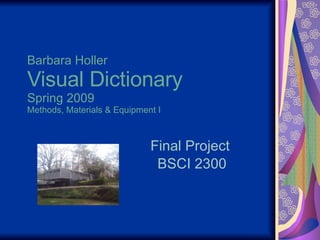
Barbara Holler Visual Dictionary Spring 2009 Methods, Materials & Equipment I Final Project  BSCI 2300
Air Barrier Paper Sheet of material/paper used as vapor retarder and air barrier allows vapor to pass through but not air. Vapor Retarder /Air Barrier. (Black Tar Paper)
Attic Ventilation Materials SOFFIT VENT RIDGE VENT GABLE VENT ROOF TURBINE Allows water vapor and heat to escape, and advantageous to have both low/intake and high/exhaust vents. ME ME  REALLY
Back Hoe Excavating equipment with a  digging bucket on one end and a two-part movable arm.  Typically attached to a tractor or front end loader. Backhoes are used for many things ie. construction, small demolitions, light transportation of building materials, powering building equipment, digging holes/excavating, landscaping, breaking asphalt, and paving roads). The backhoe bucket can also be replaced with powered attachments such as a breaker, grapple, auger, or a stump grinder.   http://en.wikipedia.org/wiki/Backhoe_loader 30” bucket 40” bucket
Batter Boards Temporary frame built to outline the dimensions of a building, foundation or on the ‘first level’ just outside the corners of an excavation for basements.  Used to show position, shape and sized of the building on the site. ME if I could have found any
Brick Arches Structural form as well as decorative detail above an opening made of bricks. Centering – is a temporary wood frame to help the mason to form the arch. Arch with a keystone Roman Arch Parabolic Arch Jack Arch Segmental Arch ___l ME  REALLY
Brick Bonds Adhesive force between mortar and brick masonry unit, or the pattern in which units are laid to tie two or more wythes together into a structural unit.  Rowlocks Stretchers Rowlocks Soldier
Brick Bonds Decorative CMU Stack Bond No overlapping has straight horizontal & vertical lines Running Bond All stretchers My BIG Head
Brick Sizes Standard sizes of Bricks depend on the  manufacture.  The typically used size is Modular 3 ½” W x 7 ½” L x 2 ¼” H  You can special order any size you would like at extra cost.  However there is such a wide range of sizes if  you shop around you will find what you want. Bricks are very versatile & can be made to look however  you would like. The typical other sizes available vary  from 3” to 3 5/8” width from 7 ½” to 11 5/8” length from 1 5/8” to 3 5/8” height These are not a standard brick They are brick pavers 6 ¼” W x  9 ½” L &  6 ¼” W x 6 ¼”   These are much larger than any standard sized  5 5/8” W x 11 5/8” L  These are actually a Modular brick size of 3 1/3” W x 7 ½” L x 2 ¼” H on the Standard Brick Size Chart However, they have added some nice details.
Bulldozer Heavy earthmoving equipment with front-mounted blades, pushes dirt, rubble, etc. around on the ground.
Cladding 1 of 2 Is the exterior wall material used to enclose a building. EIFS or Stucco Brick Cladding I’m  hidding Look in the Mirror
Cladding 2 of 2 Shingle   siding Stone Wood Siding
Code Requirements Set of legal requirements or restrictions to ensure a minimum standard of health and safety in buildings.  Since I live in a Studio Apt. my bedroom is also my living room, therefore the front door is my “Means of Egress” that meets the code requirements of at least one 3’ opening as a  means of exit to the exterior, it also meets the requirement of NOT having a double keyed deadbolt.  The Stairs meet the Code Requirements of a minimum of 10” treads and maximum of 7 ¾” risers, as well as meeting the code for having an exterior landing. Tread 11” wide  -  Riser 7 ¾” high
Concrete Joints An international, linear discontinuity of a structure, designed to form a weakness to ‘control’ where a crake will ‘hopefully’ form. It WILL crack because of various forces, therefore a Joint is to try to minimize or eliminate cracking elsewhere in the structure. Isolation Joint – is just as it is named.  It isolates things from others, such as isolates a column from the surrounding concrete. Control Joint Failed Isolation Joint
Concrete Masonry Units CMU is a block of hardened concrete, with or without hollow cores, in the form of a block, designed to be laid in the same manner as brick or stone.  Also designed so 3 rows of brick equals the height of 1 CMU Block. Typical dimensions 8” high x 16” long with different widths (depth) 2 different sized CMU Standard 8”H x 16”L x 12” W The other 12”H x 16”L x 12”W
Decorative Concrete Masonry Unit Are used to give a different architectural design &/or look.  There are several different ways this masonry and be formed and economically manufactured.  Surface patterns, textures and colors.  Used in exposed use for interior or exterior walls.  Split-face, scored-face, Slump, ribbed split-face, striated blocks Split-face Block Ribbed Split-face Block In the mirror again
Doors Interior & exterior doors come in many styles, color, and patterns you can come up with anything to fit your living style & look of your home.  First you have to decide where, interior – swing (single or double) bi-fold, pocket, or sliding.  Exterior - single hung, terrace, French, sliding, etc.  Style z-brace, flush, stile-and-rail, glazed glass, the number of panels, what material, with or without sidelights.  Then there are the materials you want to use and the choices go on and on. Sidelight – tall narrow window beside door Transom – short long window above door 2 panel door With sidelights and transom Top Rail Stile Lock Rail Panel Bottom Rail Flush Barn like door
Electrical Components Consist of many different parts to carry the direct-current voltage (electricity) from the supplier to the user.  Some of these components are the Power pole, transformer for above ground service, or underground supply has a transformer box on the ground.  The other items are service head, meter, service panel, duplex receptacle where the user plugs in there item’s electrical cord to be able to use the item. Meters Electric Meter Measures power usage Duplex Receptacle Appliance hook-up to electric circuit Light Switch To turn electricity on to a light Power pole & transformer Converts the several thousand volts to 110/220-volt for customer use Service Panel Where electric service comes into the building, Typically with circuit  breakers for safety Service Head Its me I promise
Framing Components 1 of 2 #1 Anchor Bolt #2 Sill Plate #3 Floor joints  & bracing #4 Subfloor #7 Top Plate #6 Stud #5 Sole Plate
Framing Components 2 of 2 Header Opening for window Seal Jack stud #9 Rafters &  #8 Ceiling joists #8 Ceiling joists & bracing #9 Rafters #10 Roof Decking (covered with felt paper) #11 Sheathing #12 Stringer
Front End Loader Heavy earthmoving equipment with a very large scoop bucket to scoop up or pick-up earth, materials, or large things on a jobsite too large  for humans to pick-up.
Gypsum Board Interior wall panels of gypsum core between paper, also called drywall or plasterboard.
Heat Pump Device that uses refrigeration cycle to heat or cool a building by passing air or water over condensing coils or evaporating coils. Heat Pump Advantage -You can Heat & Cool with the same unit Disadvantage – is not good in all climates
Insulation Insulation helps to keep cold or hot air in or out of a building.  It can be enclosed within the walls, or exterior foam panels.  It is made either as loose fill or packed tightly called batt.  It is made of foam, fiberglass or rigid board. Loose Fill Batt insulation Rigid Board (2 size) Styrofoam Panel Foam Foam Insulation for small home jobs.
Lintel Carry the load of a wall across a door or window opening.  Can be a beam, L-channel, or very long stone. Steel Lintel
Mortar Substance consisting of cement material, fine aggregate and water.  It is used to join masonry units together. 3/8” Extruded Mortar Joint on an Office building (is NOT tooled nor troweled) possibly type M mortar 3/8” Tooled Concave Mortar Joint on an Church building possibly type M mortar
Oriented Strand Board OSB is a nonveneered building material comes in panels (typ. Size 4’ x 8’. Made with long pieces of wood fibers in specific directions and bonded together under pressure. OSB  Plywood At my service learning project jobsite
Plumbing My plumbing (oh my   ) Water closet 3” drain pipe ½” typically rubber flexible water supply line (this case ¼” bendable pipe) Lavatory 1 ½”  VTR (plumbing roof vent) is to remove combustable sewage gases ME Drop in Kitchen Sink
Plywood A wood panel composed of an odd number of layers of wood veneer bonded together under pressure. Veneer is a thin layer, sheet or facing. Look at all the choices you have at Lowes
Radiant Barrier Reflective foil placed adjacent to an airspace in roof or wall to keep infrared energy from passing through it.  (couldn’t find it installed, but here it is at Lowes where you can buy it in rolls)
Rebar Steel reinforcing bars put into concrete or masonry to make it stronger and able to better handle compression loads.  The deformations rolled into the surface of a reinforcing bar helps it to bond tightly to concrete.  Approx. size #6 - ¾” Rebar
Steep Roof Drainage Gutter Down Spout Down Spout Gutter – A channel that collects rainwater and snowmelt at the eave of a roof. Downspout – Vertical pipe for conducting water from a roof to a lower level. Splash block – precast block of concrete or plastic used to divert water at  the bottom of the downspout.
Steep Roof Materials Underlayment – layer of waterproof materials (felt paper) between roof sheathing & roofing material. Shingle is a water-resistant roofing material, overlapped, nailed to form a layering cover for a sloping roof. Metal roofs are typically made of galvanized or aluminized steel. Clay Tile Roof Not sure What this One is But like it Maybe Concrete form Or shingle? Clay Tile Roof Metal Panel Roof
Steep Roof Shapes Polynesian Roof Hip Roof Hip Roof Hip Roof Shed roof Section Gable roof Section Mansard Roof
Steep Roof Terms
Stone
Vapor Retarder Layers of material to obstruct the passage of water vapor through to the building. Vapor Retarder
Waterproofing Water proofing comes in a variety of chooses.
Weep Holes Small opening whose purpose is to allow water to drain an not accumulate inside of the building’s walls. Weep Holes
Welded Wire Mesh Grid of steel rods welded together.  It is used to reinforce concrete slabs or sidewalks.
Windows Fixed Sidelights Awning Casement

Bolster

  • 1.
    Barbara Holler VisualDictionary Spring 2009 Methods, Materials & Equipment I Final Project BSCI 2300
  • 2.
    Air Barrier PaperSheet of material/paper used as vapor retarder and air barrier allows vapor to pass through but not air. Vapor Retarder /Air Barrier. (Black Tar Paper)
  • 3.
    Attic Ventilation MaterialsSOFFIT VENT RIDGE VENT GABLE VENT ROOF TURBINE Allows water vapor and heat to escape, and advantageous to have both low/intake and high/exhaust vents. ME ME REALLY
  • 4.
    Back Hoe Excavatingequipment with a digging bucket on one end and a two-part movable arm. Typically attached to a tractor or front end loader. Backhoes are used for many things ie. construction, small demolitions, light transportation of building materials, powering building equipment, digging holes/excavating, landscaping, breaking asphalt, and paving roads). The backhoe bucket can also be replaced with powered attachments such as a breaker, grapple, auger, or a stump grinder. http://en.wikipedia.org/wiki/Backhoe_loader 30” bucket 40” bucket
  • 5.
    Batter Boards Temporaryframe built to outline the dimensions of a building, foundation or on the ‘first level’ just outside the corners of an excavation for basements. Used to show position, shape and sized of the building on the site. ME if I could have found any
  • 6.
    Brick Arches Structuralform as well as decorative detail above an opening made of bricks. Centering – is a temporary wood frame to help the mason to form the arch. Arch with a keystone Roman Arch Parabolic Arch Jack Arch Segmental Arch ___l ME REALLY
  • 7.
    Brick Bonds Adhesiveforce between mortar and brick masonry unit, or the pattern in which units are laid to tie two or more wythes together into a structural unit. Rowlocks Stretchers Rowlocks Soldier
  • 8.
    Brick Bonds DecorativeCMU Stack Bond No overlapping has straight horizontal & vertical lines Running Bond All stretchers My BIG Head
  • 9.
    Brick Sizes Standardsizes of Bricks depend on the manufacture. The typically used size is Modular 3 ½” W x 7 ½” L x 2 ¼” H You can special order any size you would like at extra cost. However there is such a wide range of sizes if you shop around you will find what you want. Bricks are very versatile & can be made to look however you would like. The typical other sizes available vary from 3” to 3 5/8” width from 7 ½” to 11 5/8” length from 1 5/8” to 3 5/8” height These are not a standard brick They are brick pavers 6 ¼” W x 9 ½” L & 6 ¼” W x 6 ¼” These are much larger than any standard sized 5 5/8” W x 11 5/8” L These are actually a Modular brick size of 3 1/3” W x 7 ½” L x 2 ¼” H on the Standard Brick Size Chart However, they have added some nice details.
  • 10.
    Bulldozer Heavy earthmovingequipment with front-mounted blades, pushes dirt, rubble, etc. around on the ground.
  • 11.
    Cladding 1 of2 Is the exterior wall material used to enclose a building. EIFS or Stucco Brick Cladding I’m hidding Look in the Mirror
  • 12.
    Cladding 2 of2 Shingle siding Stone Wood Siding
  • 13.
    Code Requirements Setof legal requirements or restrictions to ensure a minimum standard of health and safety in buildings. Since I live in a Studio Apt. my bedroom is also my living room, therefore the front door is my “Means of Egress” that meets the code requirements of at least one 3’ opening as a means of exit to the exterior, it also meets the requirement of NOT having a double keyed deadbolt. The Stairs meet the Code Requirements of a minimum of 10” treads and maximum of 7 ¾” risers, as well as meeting the code for having an exterior landing. Tread 11” wide - Riser 7 ¾” high
  • 14.
    Concrete Joints Aninternational, linear discontinuity of a structure, designed to form a weakness to ‘control’ where a crake will ‘hopefully’ form. It WILL crack because of various forces, therefore a Joint is to try to minimize or eliminate cracking elsewhere in the structure. Isolation Joint – is just as it is named. It isolates things from others, such as isolates a column from the surrounding concrete. Control Joint Failed Isolation Joint
  • 15.
    Concrete Masonry UnitsCMU is a block of hardened concrete, with or without hollow cores, in the form of a block, designed to be laid in the same manner as brick or stone. Also designed so 3 rows of brick equals the height of 1 CMU Block. Typical dimensions 8” high x 16” long with different widths (depth) 2 different sized CMU Standard 8”H x 16”L x 12” W The other 12”H x 16”L x 12”W
  • 16.
    Decorative Concrete MasonryUnit Are used to give a different architectural design &/or look. There are several different ways this masonry and be formed and economically manufactured. Surface patterns, textures and colors. Used in exposed use for interior or exterior walls. Split-face, scored-face, Slump, ribbed split-face, striated blocks Split-face Block Ribbed Split-face Block In the mirror again
  • 17.
    Doors Interior &exterior doors come in many styles, color, and patterns you can come up with anything to fit your living style & look of your home. First you have to decide where, interior – swing (single or double) bi-fold, pocket, or sliding. Exterior - single hung, terrace, French, sliding, etc. Style z-brace, flush, stile-and-rail, glazed glass, the number of panels, what material, with or without sidelights. Then there are the materials you want to use and the choices go on and on. Sidelight – tall narrow window beside door Transom – short long window above door 2 panel door With sidelights and transom Top Rail Stile Lock Rail Panel Bottom Rail Flush Barn like door
  • 18.
    Electrical Components Consistof many different parts to carry the direct-current voltage (electricity) from the supplier to the user. Some of these components are the Power pole, transformer for above ground service, or underground supply has a transformer box on the ground. The other items are service head, meter, service panel, duplex receptacle where the user plugs in there item’s electrical cord to be able to use the item. Meters Electric Meter Measures power usage Duplex Receptacle Appliance hook-up to electric circuit Light Switch To turn electricity on to a light Power pole & transformer Converts the several thousand volts to 110/220-volt for customer use Service Panel Where electric service comes into the building, Typically with circuit breakers for safety Service Head Its me I promise
  • 19.
    Framing Components 1of 2 #1 Anchor Bolt #2 Sill Plate #3 Floor joints & bracing #4 Subfloor #7 Top Plate #6 Stud #5 Sole Plate
  • 20.
    Framing Components 2of 2 Header Opening for window Seal Jack stud #9 Rafters & #8 Ceiling joists #8 Ceiling joists & bracing #9 Rafters #10 Roof Decking (covered with felt paper) #11 Sheathing #12 Stringer
  • 21.
    Front End LoaderHeavy earthmoving equipment with a very large scoop bucket to scoop up or pick-up earth, materials, or large things on a jobsite too large for humans to pick-up.
  • 22.
    Gypsum Board Interiorwall panels of gypsum core between paper, also called drywall or plasterboard.
  • 23.
    Heat Pump Devicethat uses refrigeration cycle to heat or cool a building by passing air or water over condensing coils or evaporating coils. Heat Pump Advantage -You can Heat & Cool with the same unit Disadvantage – is not good in all climates
  • 24.
    Insulation Insulation helpsto keep cold or hot air in or out of a building. It can be enclosed within the walls, or exterior foam panels. It is made either as loose fill or packed tightly called batt. It is made of foam, fiberglass or rigid board. Loose Fill Batt insulation Rigid Board (2 size) Styrofoam Panel Foam Foam Insulation for small home jobs.
  • 25.
    Lintel Carry theload of a wall across a door or window opening. Can be a beam, L-channel, or very long stone. Steel Lintel
  • 26.
    Mortar Substance consistingof cement material, fine aggregate and water. It is used to join masonry units together. 3/8” Extruded Mortar Joint on an Office building (is NOT tooled nor troweled) possibly type M mortar 3/8” Tooled Concave Mortar Joint on an Church building possibly type M mortar
  • 27.
    Oriented Strand BoardOSB is a nonveneered building material comes in panels (typ. Size 4’ x 8’. Made with long pieces of wood fibers in specific directions and bonded together under pressure. OSB Plywood At my service learning project jobsite
  • 28.
    Plumbing My plumbing(oh my  ) Water closet 3” drain pipe ½” typically rubber flexible water supply line (this case ¼” bendable pipe) Lavatory 1 ½” VTR (plumbing roof vent) is to remove combustable sewage gases ME Drop in Kitchen Sink
  • 29.
    Plywood A woodpanel composed of an odd number of layers of wood veneer bonded together under pressure. Veneer is a thin layer, sheet or facing. Look at all the choices you have at Lowes
  • 30.
    Radiant Barrier Reflectivefoil placed adjacent to an airspace in roof or wall to keep infrared energy from passing through it. (couldn’t find it installed, but here it is at Lowes where you can buy it in rolls)
  • 31.
    Rebar Steel reinforcingbars put into concrete or masonry to make it stronger and able to better handle compression loads. The deformations rolled into the surface of a reinforcing bar helps it to bond tightly to concrete. Approx. size #6 - ¾” Rebar
  • 32.
    Steep Roof DrainageGutter Down Spout Down Spout Gutter – A channel that collects rainwater and snowmelt at the eave of a roof. Downspout – Vertical pipe for conducting water from a roof to a lower level. Splash block – precast block of concrete or plastic used to divert water at the bottom of the downspout.
  • 33.
    Steep Roof MaterialsUnderlayment – layer of waterproof materials (felt paper) between roof sheathing & roofing material. Shingle is a water-resistant roofing material, overlapped, nailed to form a layering cover for a sloping roof. Metal roofs are typically made of galvanized or aluminized steel. Clay Tile Roof Not sure What this One is But like it Maybe Concrete form Or shingle? Clay Tile Roof Metal Panel Roof
  • 34.
    Steep Roof ShapesPolynesian Roof Hip Roof Hip Roof Hip Roof Shed roof Section Gable roof Section Mansard Roof
  • 35.
  • 36.
  • 37.
    Vapor Retarder Layersof material to obstruct the passage of water vapor through to the building. Vapor Retarder
  • 38.
    Waterproofing Water proofingcomes in a variety of chooses.
  • 39.
    Weep Holes Smallopening whose purpose is to allow water to drain an not accumulate inside of the building’s walls. Weep Holes
  • 40.
    Welded Wire MeshGrid of steel rods welded together. It is used to reinforce concrete slabs or sidewalks.
  • 41.
    Windows Fixed SidelightsAwning Casement