Materials I 11.30.2009 Username: Siding
Air Barrier Paper Air Barrier Paper  is applied to the exterior wall sheathing but underneath the exterior finish. It serves to prevent water and air infiltration. It helps weatherproof the structure.
Attic Ventilation Soffit Vent: Allows air to flow through the attic, allowing heat to escape. This helps cool the structure and save on energy costs. Also increases the life of the roof.
Attic Ventilation Ridge Vents Arrows Show location of Vents Ridge Vents  are located on the ridge of the roof, which is  typically the highest point in the structure. They allow heat to escape which cools the structure. They often work in conjunction with soffit vents to provide ventilation.
Attic Ventilation Gable Vent Roof Turbine -Gable vents  are located at the very top of the gable, create a draft through the attic, helping ventilation. -Turbines  are wind powered and help suck hot air out of the structure.
Backhoe a hydraulic excavating machine consisting of a tractor having an attached hinged boom, with a bucket with movable jaws on the end of the boom. Typically used for excavation or the placing of backfill This bucket was 30” wide
Batter Boards Batter boards   are the first step in building a square foundation. They are built perfectly square (using 3, 4, 5 method).  String lines are then connected between each set of batter boards to keep the foundation square. Batter Boards  at site of foundation soon to be poured. Vapor barrier has been installed on half of the foundation
Brick Arches There are many different shapes for arches, although all use compression to support themselves.  Often there is a  keystone , placed last and in the center of the arch, which ties the whole structure together and allows the arch to be freestanding.  While under construction, arches need  centering , a unique type of temporary support structure that can support the weight of the arch until it is complete. -Gothic Arch -Roman Arch -keystone
Brick Bonds Flemish Bond -  Alternated between header and stretcher Running Bond
Brick Bonds Soldier Header Stretcher
Brick Bonds Rowlock Sailor Stretcher Rowlock
Brick Sizes  This is a picture that shows the two different sizes side by side. The red brick is modular (3 5/8” x 2 2/4” x 7 5/8”). The yellowish brick is an economy brick (3 5/8” x  3 5/8” x 7 5/8”). Modular Brick Economy Brick
Bulldozer a large, powerful tractor having a vertical blade at the front end for moving earth, tree stumps, rocks, etc.
Cladding Cladding is the exterior finish of the structure. It is the final step of weatherproofing and is what must be aesthetically pleasing. Brick Exterior Cladding
Cladding EIFS Exterior Cladding. Also commonly called DryVit
Cladding This is stone exterior cladding. Most of the time, it is actually cast colored concrete. The pattern used in this picture is  Coursed Rubble . Stone Cladding
Cladding Wood Boards This shows typical wood board horizontal siding. It is assembled to overlap so that water is able to pass down the wall without entering the structure.
Cladding Wood Shakes Wood shake siding can be made out of wood, composite material, concrete, or vinyl. They are assembled to overlap to prevent water intrusion. Real wood shakes are expensive to buy and maintain.
Code Requirements This room meets all necessary code requirements.  There are 2 means of egress, and the window has the necessary sq. footage (35” x 40”= 9.7 ft 2)   and minimum height and width.  It is also below the max height from the ground of 44” (32”).
Code Requirements This stair meets all applicable codes. The tread exceeds the 10” minimum. The riser is less than the 7 ¾” max. The nosing is between ¾” and 1 ¼”.
Concrete Joints Control Joints-Grooves cut into concrete surfaces to “control” cracking.  They are basically designed to weaken the surface so that cracks occur there instead of somewhere else. Isolation Joints-completely isolate the slab from something else. That something else can be a wall, column, drain pipe, etc. Crack, where control joint failed Isolation Joint Control Joint
Concrete Masonry Units (CMU) Large blocks used in construction that are made from cast concrete.  The most common size for CMU is a nominal 8x8x16 block.  Actual dimensions are slightly smaller to allow for mortar joints.  1 course of 8x8x16 CMU equals 3 courses of modular brick.
CMU Continued Different shapes of CMU… 4x8x16 CMU 12x8x16 CMU
Decorative CMU Decorative Concrete Masonry Units is a cost efficient method of building that does not sacrifice the aesthetic appeal of the building like normal CMU’s Split CMU Block
Doors Flush door Paneled door Top rail Panel Lock rail Stile Bottom rail Transom- A horizontal crosspiece over a door or between a door and a window above it. Sidelight- a window at the side of a door or another window.
Electrical Components Transformer box - Converts the electricity from high voltage that travels through the power lines to the typical voltage (120 volts for lights, 240 volts for appliances).  Service Head -  The service for this particular install comes from the ground rather on a line through the air. Meter Head - This particular transformer features the meter head mounded on it. The meter reads Kilowatt hours to shows how much energy the service user is consuming. Meter Head Transformer Service Head
Electrical Components Service Panel -  contains may breakers or fuses (older structures). Provides for a systematic distribution of power and allows for certain areas to be shut off for maintenance, etc.  Duplex Receptacle -  The point at which the power is used by the consumer. Lights, appliances, etc. are plugged in to receive power. The are both polarized and grounded. Single Duplex Receptacle Service Panel
Framing Elements 1)anchor bolt 2)sill plate 3)floor joist 4)subfloor 5)sole plate 6)stud 7)top plate 8)ceiling joist 9)rafter 10)roof decking 11)sheathing 12)stringer 1) 2)
Framing Elements Cont. 1)anchor bolt 2)sill plate 3)floor joist 4)subfloor 5)sole plate 6)stud 7)top plate 8)ceiling joist 9)rafter 10)roof decking 11)sheathing 12)stringer 3) 4)
Framing Elements Cont. 1)anchor bolt 2)sill plate 3)floor joist 4)subfloor 5)sole plate 6)stud 7)top plate 8)ceiling joist 9)rafter 10)roof decking 11)sheathing 12)stringer 5) 6)
Framing Elements Cont. 1)anchor bolt 2)sill plate 3)floor joist 4)subfloor 5)sole plate 6)stud 7)top plate 8)ceiling joist 9)rafter 10)roof decking 11)sheathing 12)stringer 7) 10) 9)
Framing Elements Cont. 1)anchor bolt 2)sill plate 3)floor joist 4)subfloor 5)sole plate 6)stud 7)top plate 8)ceiling joist 9)rafter 10)roof decking 11)sheathing 12)stringer 11) 12)
Front End Loader a loader having a shovel or bucket at the end of an articulated arm located at the front of the vehicle. Differs from a bulldozer because of the ability to pick up and scoop, not just scrape and push.  Does not have the control and digging power of a backhoe, but can load or carry more volume of load at a time.
Gypsum Board wallboard composed primarily of gypsum and often used as sheathing. (drywall)
Heat Pump Both cools and heats the structure according to the desired temperature. Consists of an inside air handler, and an outside compressor unit.  Outdoor Compressor Unit Indoor Air Handling Unit Ductwork
Insulation This is  Blanket Insulation . The purpose of insulation is to preserve the temperate of the interior of the house. It helps conserves energy costs and is the best way to conserve. Blanket Insulation
Insulation Loose Fill Loose fill insulation is the most cost effective and common type of attic insulation. It is blown in which allows it to easily fit into small cracks and crevices.
Insulation Foamed Foamed Insulation is sprayed in and expands tremendously as it dries. It is great to fill in cracks around pipes (like shown above). It can also be used to insulate an entire home (but more expensive). It is very effective in energy conservation.
Insulation Rigid Foam Board-  Typically installed on the exterior walls of a structure, underneath cladding and air barrier paper.
Lintel a horizontal architectural member supporting the weight above an opening, as a window or a door.
Mortar This is a flush troweled mortar joint.  It was approx. ½ inch but varied in different spots.  These bricks are on an exterior wall around an old house in Auburn. We would guess this mortar is type N because it has no weight bearing on it. This is a concave tooled mortar joint.  The joint is approx. 3/8”.  These bricks are on an old building in Auburn.  This mortar is probably type N but could be type M because this building might be old enough to be built using brick as the weight bearing structure.
Oriented Strand Board (OSB) OSB is manufactured from waterproof heat-cured adhesives and rectangular shaped wood strands that are pressed and arranged in cross-oriented layers, similar to plywood. This results in a structural engineered wood panel that shares many of the strength and performance characteristics of plywood. Produced in huge, continuous mats, OSB is a solid panel product of consistent quality with no laps, gaps or voids.
Plumbing Components Lavatory: 1 ½” drain pipe Water Closet (Toilet): Drain size 3”
Plumbing Component Prefabricated Tub/Shower Enclosure
Plumbing Components Vent Stack :  Shown is a vent stack from a kitchen sink. This is the interior view of it. Many new vent stacks don’t have to be vented to the outside. They have a special cap that allows them just to be vented to the attic and work just as well.
Plumbing Components Pictured is an drop in sink made of porcelain. The typical drain of a bathroom lavatory sink is 1 ½”
Plywood Veneer:  any of the thin layers of wood glued together to form plywood.  The outside facing veneer is typically better finished. Grain of Wood Veneer
Radiant Barrier
Rebar This rebar is ¾” thick and so would be referred to as #6 rebar.  Rebar is used to add tensile strength to concrete.  The surface of the rebar is deformed so that it has a better grip to the aggregate in concrete and can have better tensile strength.
Steep Roof Drainage Gutter:   a channel at the eaves or on the roof of a building, for carrying off rain water. Downspout : a pipe for conveying rain water from a roof or gutter to the ground away from the foundation or to a drain. Splash Block : helps to disperse water from the downspout away from the foundation.
Steep Roof Materials Underlayment :  a waterproof material (felt paper) that is installed between the roof sheathing and roofing material (shingles, etc.). Helps weatherproof structure.
Steep Roof Materials Clay Tile Roof Shingle: a thin piece of wood, slate, metal, asbestos, or the like, usually oblong, laid in overlapping rows to cover the roofs and walls of buildings. Slate Shingles
Steep Roof Materials Metal roofing-can be made of aluminum, copper, or countless alloys that have good resistance to oxidization.  Very long life, and can range from some of the most economical ways to roof a structure to the most expensive.  Can handle low pitches.
Steep Roof Shapes Gambrel Roof Hip Roof
Steep Roof Shapes Gable Roof Mansard Roof
Steep Roof Terms Rake  - The edge framing a roof gable.   Ridge  -the horizontal line in which the tops of the rafters of a roof meet. Usually consists of    a ridge vent .  Valley   -  a depression or angle formed by the meeting of two  inclined sides of a roof. A special piece of flashing is installed here.
Steep Roof Terms Eave The overhanging lower lower edge of a roof. Usually extend 24” out. Are made up of fascia and soffit. Fascia any relatively broad, flat, horizontal surface as the outer edge of a cornice, a stringcourse, etc. Creates a finished look on the edge of the eave. Soffit the underside of an architectural feature, as a beam, arch, ceiling, vault, cornice, or eave.  Typically includes some type of venting component, lil like soffit vents.
Steep Roof Terms Building with No Fascia - A building with  no fascia does not have the outer edge of the eave boxed in like commonly seen. Soffit attic ventilation can’t be installed in these types.
Stone Types Coursed Ashlar Random Rubble Coursed Rubble
Stone Types Random Rubble : This pattern is made from stones of different shapes and sizes without much order. The pieces fit together fairly well. Coursed Rubble : This pattern is made from uncut stones placed in rows called  courses. Random Ashlar : This pattern is made of cut stones that fit together, but are not in rows. Coursed Ashlar : This is a pattern of cut stones that fit together and are placed in rows.
Vapor Retarder The purpose of a vapor retarder, like the one shown, is to protect the foundation from water vapor intrusion. The one picture is installed before the slab on grade is poured. Vapor Retarder: Polyethylene
Waterproofing This is liquid applied water proofing. It seals under grade basement and crawlspace walls from moisture.
Weep Hole The purpose of a weep hole is to allow water that enters a masonry wall to escape. The water condenses when it hits the air barrier within the wall, weeps down, and exits through the weep hole. Weep Holes
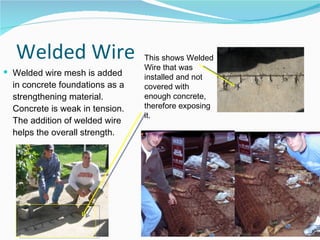
Welded Wire Welded wire mesh is added in concrete foundations as a strengthening material. Concrete is weak in tension. The addition of welded wire helps the overall strength. This shows Welded Wire that was installed and not covered with enough concrete, therefore exposing it.
Windows This is a  double hung  window because it consists of two sashes that are able to slide past each other on a vertical track. These are the most common in residential settings. This is a  sliding window  because it is able to open by sliding on a horizontal track. Double Hung Sliding Window
Windows This is a  casement window  because the window opens with hinges on the right side outward. Most use a crank like the one pictured. Right Hinged out swinging casement window

Visual Dictionary Revised 2

  • 1.
    Materials I 11.30.2009Username: Siding
  • 2.
    Air Barrier PaperAir Barrier Paper is applied to the exterior wall sheathing but underneath the exterior finish. It serves to prevent water and air infiltration. It helps weatherproof the structure.
  • 3.
    Attic Ventilation SoffitVent: Allows air to flow through the attic, allowing heat to escape. This helps cool the structure and save on energy costs. Also increases the life of the roof.
  • 4.
    Attic Ventilation RidgeVents Arrows Show location of Vents Ridge Vents are located on the ridge of the roof, which is typically the highest point in the structure. They allow heat to escape which cools the structure. They often work in conjunction with soffit vents to provide ventilation.
  • 5.
    Attic Ventilation GableVent Roof Turbine -Gable vents are located at the very top of the gable, create a draft through the attic, helping ventilation. -Turbines are wind powered and help suck hot air out of the structure.
  • 6.
    Backhoe a hydraulicexcavating machine consisting of a tractor having an attached hinged boom, with a bucket with movable jaws on the end of the boom. Typically used for excavation or the placing of backfill This bucket was 30” wide
  • 7.
    Batter Boards Batterboards are the first step in building a square foundation. They are built perfectly square (using 3, 4, 5 method). String lines are then connected between each set of batter boards to keep the foundation square. Batter Boards at site of foundation soon to be poured. Vapor barrier has been installed on half of the foundation
  • 8.
    Brick Arches Thereare many different shapes for arches, although all use compression to support themselves. Often there is a keystone , placed last and in the center of the arch, which ties the whole structure together and allows the arch to be freestanding. While under construction, arches need centering , a unique type of temporary support structure that can support the weight of the arch until it is complete. -Gothic Arch -Roman Arch -keystone
  • 9.
    Brick Bonds FlemishBond - Alternated between header and stretcher Running Bond
  • 10.
    Brick Bonds SoldierHeader Stretcher
  • 11.
    Brick Bonds RowlockSailor Stretcher Rowlock
  • 12.
    Brick Sizes This is a picture that shows the two different sizes side by side. The red brick is modular (3 5/8” x 2 2/4” x 7 5/8”). The yellowish brick is an economy brick (3 5/8” x 3 5/8” x 7 5/8”). Modular Brick Economy Brick
  • 13.
    Bulldozer a large,powerful tractor having a vertical blade at the front end for moving earth, tree stumps, rocks, etc.
  • 14.
    Cladding Cladding isthe exterior finish of the structure. It is the final step of weatherproofing and is what must be aesthetically pleasing. Brick Exterior Cladding
  • 15.
    Cladding EIFS ExteriorCladding. Also commonly called DryVit
  • 16.
    Cladding This isstone exterior cladding. Most of the time, it is actually cast colored concrete. The pattern used in this picture is Coursed Rubble . Stone Cladding
  • 17.
    Cladding Wood BoardsThis shows typical wood board horizontal siding. It is assembled to overlap so that water is able to pass down the wall without entering the structure.
  • 18.
    Cladding Wood ShakesWood shake siding can be made out of wood, composite material, concrete, or vinyl. They are assembled to overlap to prevent water intrusion. Real wood shakes are expensive to buy and maintain.
  • 19.
    Code Requirements Thisroom meets all necessary code requirements. There are 2 means of egress, and the window has the necessary sq. footage (35” x 40”= 9.7 ft 2) and minimum height and width. It is also below the max height from the ground of 44” (32”).
  • 20.
    Code Requirements Thisstair meets all applicable codes. The tread exceeds the 10” minimum. The riser is less than the 7 ¾” max. The nosing is between ¾” and 1 ¼”.
  • 21.
    Concrete Joints ControlJoints-Grooves cut into concrete surfaces to “control” cracking. They are basically designed to weaken the surface so that cracks occur there instead of somewhere else. Isolation Joints-completely isolate the slab from something else. That something else can be a wall, column, drain pipe, etc. Crack, where control joint failed Isolation Joint Control Joint
  • 22.
    Concrete Masonry Units(CMU) Large blocks used in construction that are made from cast concrete. The most common size for CMU is a nominal 8x8x16 block. Actual dimensions are slightly smaller to allow for mortar joints. 1 course of 8x8x16 CMU equals 3 courses of modular brick.
  • 23.
    CMU Continued Differentshapes of CMU… 4x8x16 CMU 12x8x16 CMU
  • 24.
    Decorative CMU DecorativeConcrete Masonry Units is a cost efficient method of building that does not sacrifice the aesthetic appeal of the building like normal CMU’s Split CMU Block
  • 25.
    Doors Flush doorPaneled door Top rail Panel Lock rail Stile Bottom rail Transom- A horizontal crosspiece over a door or between a door and a window above it. Sidelight- a window at the side of a door or another window.
  • 26.
    Electrical Components Transformerbox - Converts the electricity from high voltage that travels through the power lines to the typical voltage (120 volts for lights, 240 volts for appliances). Service Head - The service for this particular install comes from the ground rather on a line through the air. Meter Head - This particular transformer features the meter head mounded on it. The meter reads Kilowatt hours to shows how much energy the service user is consuming. Meter Head Transformer Service Head
  • 27.
    Electrical Components ServicePanel - contains may breakers or fuses (older structures). Provides for a systematic distribution of power and allows for certain areas to be shut off for maintenance, etc. Duplex Receptacle - The point at which the power is used by the consumer. Lights, appliances, etc. are plugged in to receive power. The are both polarized and grounded. Single Duplex Receptacle Service Panel
  • 28.
    Framing Elements 1)anchorbolt 2)sill plate 3)floor joist 4)subfloor 5)sole plate 6)stud 7)top plate 8)ceiling joist 9)rafter 10)roof decking 11)sheathing 12)stringer 1) 2)
  • 29.
    Framing Elements Cont.1)anchor bolt 2)sill plate 3)floor joist 4)subfloor 5)sole plate 6)stud 7)top plate 8)ceiling joist 9)rafter 10)roof decking 11)sheathing 12)stringer 3) 4)
  • 30.
    Framing Elements Cont.1)anchor bolt 2)sill plate 3)floor joist 4)subfloor 5)sole plate 6)stud 7)top plate 8)ceiling joist 9)rafter 10)roof decking 11)sheathing 12)stringer 5) 6)
  • 31.
    Framing Elements Cont.1)anchor bolt 2)sill plate 3)floor joist 4)subfloor 5)sole plate 6)stud 7)top plate 8)ceiling joist 9)rafter 10)roof decking 11)sheathing 12)stringer 7) 10) 9)
  • 32.
    Framing Elements Cont.1)anchor bolt 2)sill plate 3)floor joist 4)subfloor 5)sole plate 6)stud 7)top plate 8)ceiling joist 9)rafter 10)roof decking 11)sheathing 12)stringer 11) 12)
  • 33.
    Front End Loadera loader having a shovel or bucket at the end of an articulated arm located at the front of the vehicle. Differs from a bulldozer because of the ability to pick up and scoop, not just scrape and push. Does not have the control and digging power of a backhoe, but can load or carry more volume of load at a time.
  • 34.
    Gypsum Board wallboardcomposed primarily of gypsum and often used as sheathing. (drywall)
  • 35.
    Heat Pump Bothcools and heats the structure according to the desired temperature. Consists of an inside air handler, and an outside compressor unit. Outdoor Compressor Unit Indoor Air Handling Unit Ductwork
  • 36.
    Insulation This is Blanket Insulation . The purpose of insulation is to preserve the temperate of the interior of the house. It helps conserves energy costs and is the best way to conserve. Blanket Insulation
  • 37.
    Insulation Loose FillLoose fill insulation is the most cost effective and common type of attic insulation. It is blown in which allows it to easily fit into small cracks and crevices.
  • 38.
    Insulation Foamed FoamedInsulation is sprayed in and expands tremendously as it dries. It is great to fill in cracks around pipes (like shown above). It can also be used to insulate an entire home (but more expensive). It is very effective in energy conservation.
  • 39.
    Insulation Rigid FoamBoard- Typically installed on the exterior walls of a structure, underneath cladding and air barrier paper.
  • 40.
    Lintel a horizontalarchitectural member supporting the weight above an opening, as a window or a door.
  • 41.
    Mortar This isa flush troweled mortar joint. It was approx. ½ inch but varied in different spots. These bricks are on an exterior wall around an old house in Auburn. We would guess this mortar is type N because it has no weight bearing on it. This is a concave tooled mortar joint. The joint is approx. 3/8”. These bricks are on an old building in Auburn. This mortar is probably type N but could be type M because this building might be old enough to be built using brick as the weight bearing structure.
  • 42.
    Oriented Strand Board(OSB) OSB is manufactured from waterproof heat-cured adhesives and rectangular shaped wood strands that are pressed and arranged in cross-oriented layers, similar to plywood. This results in a structural engineered wood panel that shares many of the strength and performance characteristics of plywood. Produced in huge, continuous mats, OSB is a solid panel product of consistent quality with no laps, gaps or voids.
  • 43.
    Plumbing Components Lavatory:1 ½” drain pipe Water Closet (Toilet): Drain size 3”
  • 44.
  • 45.
    Plumbing Components VentStack : Shown is a vent stack from a kitchen sink. This is the interior view of it. Many new vent stacks don’t have to be vented to the outside. They have a special cap that allows them just to be vented to the attic and work just as well.
  • 46.
    Plumbing Components Picturedis an drop in sink made of porcelain. The typical drain of a bathroom lavatory sink is 1 ½”
  • 47.
    Plywood Veneer: any of the thin layers of wood glued together to form plywood. The outside facing veneer is typically better finished. Grain of Wood Veneer
  • 48.
  • 49.
    Rebar This rebaris ¾” thick and so would be referred to as #6 rebar. Rebar is used to add tensile strength to concrete. The surface of the rebar is deformed so that it has a better grip to the aggregate in concrete and can have better tensile strength.
  • 50.
    Steep Roof DrainageGutter: a channel at the eaves or on the roof of a building, for carrying off rain water. Downspout : a pipe for conveying rain water from a roof or gutter to the ground away from the foundation or to a drain. Splash Block : helps to disperse water from the downspout away from the foundation.
  • 51.
    Steep Roof MaterialsUnderlayment : a waterproof material (felt paper) that is installed between the roof sheathing and roofing material (shingles, etc.). Helps weatherproof structure.
  • 52.
    Steep Roof MaterialsClay Tile Roof Shingle: a thin piece of wood, slate, metal, asbestos, or the like, usually oblong, laid in overlapping rows to cover the roofs and walls of buildings. Slate Shingles
  • 53.
    Steep Roof MaterialsMetal roofing-can be made of aluminum, copper, or countless alloys that have good resistance to oxidization. Very long life, and can range from some of the most economical ways to roof a structure to the most expensive. Can handle low pitches.
  • 54.
    Steep Roof ShapesGambrel Roof Hip Roof
  • 55.
    Steep Roof ShapesGable Roof Mansard Roof
  • 56.
    Steep Roof TermsRake - The edge framing a roof gable. Ridge -the horizontal line in which the tops of the rafters of a roof meet. Usually consists of a ridge vent . Valley - a depression or angle formed by the meeting of two inclined sides of a roof. A special piece of flashing is installed here.
  • 57.
    Steep Roof TermsEave The overhanging lower lower edge of a roof. Usually extend 24” out. Are made up of fascia and soffit. Fascia any relatively broad, flat, horizontal surface as the outer edge of a cornice, a stringcourse, etc. Creates a finished look on the edge of the eave. Soffit the underside of an architectural feature, as a beam, arch, ceiling, vault, cornice, or eave. Typically includes some type of venting component, lil like soffit vents.
  • 58.
    Steep Roof TermsBuilding with No Fascia - A building with no fascia does not have the outer edge of the eave boxed in like commonly seen. Soffit attic ventilation can’t be installed in these types.
  • 59.
    Stone Types CoursedAshlar Random Rubble Coursed Rubble
  • 60.
    Stone Types RandomRubble : This pattern is made from stones of different shapes and sizes without much order. The pieces fit together fairly well. Coursed Rubble : This pattern is made from uncut stones placed in rows called courses. Random Ashlar : This pattern is made of cut stones that fit together, but are not in rows. Coursed Ashlar : This is a pattern of cut stones that fit together and are placed in rows.
  • 61.
    Vapor Retarder Thepurpose of a vapor retarder, like the one shown, is to protect the foundation from water vapor intrusion. The one picture is installed before the slab on grade is poured. Vapor Retarder: Polyethylene
  • 62.
    Waterproofing This isliquid applied water proofing. It seals under grade basement and crawlspace walls from moisture.
  • 63.
    Weep Hole Thepurpose of a weep hole is to allow water that enters a masonry wall to escape. The water condenses when it hits the air barrier within the wall, weeps down, and exits through the weep hole. Weep Holes
  • 64.
    Welded Wire Weldedwire mesh is added in concrete foundations as a strengthening material. Concrete is weak in tension. The addition of welded wire helps the overall strength. This shows Welded Wire that was installed and not covered with enough concrete, therefore exposing it.
  • 65.
    Windows This isa double hung window because it consists of two sashes that are able to slide past each other on a vertical track. These are the most common in residential settings. This is a sliding window because it is able to open by sliding on a horizontal track. Double Hung Sliding Window
  • 66.
    Windows This isa casement window because the window opens with hinges on the right side outward. Most use a crank like the one pictured. Right Hinged out swinging casement window