Bold Learning for Bold Schools
Making the Jump from Traditional to Modern Learning


                                     Will Richardson
                                     will@willrichardson.com
                                     willrichardson.com
                                     @willrich45
What is “Bold School” practice?
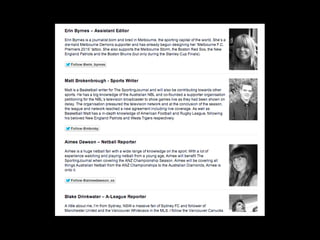
Jacob Arnott
14-year old Editor in Chief
Context
“Crisis of Contexts”
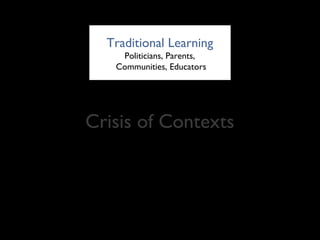
Traditional Learning
    Politicians, Parents,
   Communities, Educators


Crisis of Contexts
Traditional Learning
    Politicians, Parents,
   Communities, Educators


Crisis of Contexts

   Modern Learning
    Connected Learners
Traditional Learning
  Politicians, Parents,
 Communities, Educators


       ≠
 Modern Learning
  Connected Learners
New reality
Scarcity
ABUNDANCE
Change
CHANGE
“The change we are in the
middle of isn’t minor,
and it isn’t optional.”


                      Clay Shirky
ABUNDANCE
              750,000 Apps
            2.5 Billion People
           2 Trillion Webpages
4.5 Years of YouTube video per minute
       16,000 Tweets per second*
 5 Billion Internet Connected Devices
                    Etc...
                         *Japan’s 2012 New Years Celebration
...A world marked by “ubiquitous computing,
ubiquitous information, ubiquitous networks, at
unlimited speed, about everything, everywhere,
from anywhere, on all kinds of devices that make
it ridiculously easy to connect, organize, share,
collect, collaborate and publish.”


                                 Michael Wesch
Which is Changing:

       Media
       Politics
     Journalism
      Medicine
       Books
      Business
      Music...
ABUNDANCE
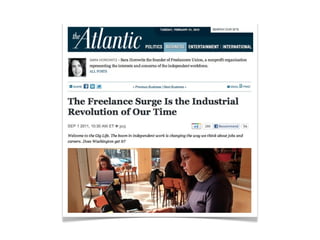
 And the future of work
bit.ly/UsKA4h
“Looking to the future of work, one could
sum up the anticipated impacts in a single
word: More. More intensity. More pressure.
More change. More risk. But also, more
opportunity. More engagement. More
transparency. More impact.”


                          Yvette Cameron
ABUNDANCE
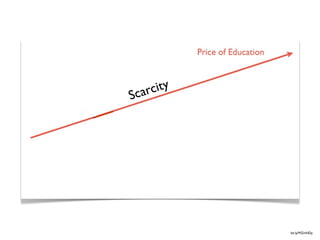
And the future of “an education”
bit.ly/MZmNDy
bit.ly/MZmNDy
bit.ly/MZmNDy
ca rci t y
S


              bit.ly/MZmNDy
ca rci t y
S


              bit.ly/MZmNDy
ca rci t y
 S


Abu
   n   danc
            e


                bit.ly/MZmNDy
ca rci t y
 S


Abu
   n   danc
            e


                bit.ly/MZmNDy
ca rci t y
 S


Abu
   n   danc
            e


                bit.ly/MZmNDy
Cal Tech, Georgia Tech, U. of Va, Duke, Rice, Johns
Hopkins, Stamford, U. of Washington, U. of Illinois, U. of
   Edinburgh, U. of Toronto, Princeton, U. of Penn.
Cal Tech, Georgia Tech, U. of Va, Duke, Rice, Johns
Hopkins, Stamford, U. of Washington, U. of Illinois, U. of
   Edinburgh, U. of Toronto, Princeton, U. of Penn.


                 “This is the tsunami.”
             --Richard DeMillo, Ga. Tech
2024?
ABUNDANCE
 And the future of schools
New Reality


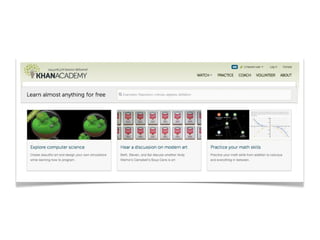
 Teachers are everywhere
Classrooms are everywhere
  “School” is everywhere
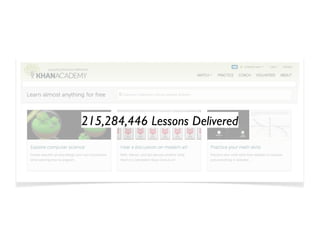
215,284,446 Lessons Delivered
New Question:


What do students need to learn in
school at a moment when they can
    learn so much without us?
New Question:


              And:
What is the value of school (and
 classrooms and teachers) at a
moment where we don’t need
      school to do school?
New Question:
New Answer:


That which cannot be
     “Khanified.”
New Answer:

       Curiosity
       Resilience
         Passion
Entrepreneurial Thinking
        Empathy
       Creativity
     Collaboration
         Inquiry
      Networking
    Communication
    Critical Thinking
      (and more)
New Reality


Schools need to be “different”...
       not just “better.”
Our Old (Traditional) Value


         Content
Our New Value
Our New Value


New Contexts for Learning
Our New Value


New Contexts for Learning
    New Literacies
Our New Value


New Contexts for Learning
    New Literacies
     New Futures
Our New Value


“Entrepreneurial Learners”
“Constantly looking around you,
      all the time, for new ways
              and new resources
            to learn new things.”


                   John Seely Brown
BE
BOLD
Bold Schools

1. Learning Centered
   2. Inquiry Driven
 3. Authentic Work
        4. Digital
     5. Connected
       6. Literate
    7. Transparent
      8. Innovative
    9. Provocative
Bold Schools


  1. Bold Schools are Learning
      and Learner Centered
Students and teachers direct their own learning
         and connect to their passions.
Bold Schools


      2. Bold Schools are Inquiry Driven
Learning is focused around exploring answers to “big questions”
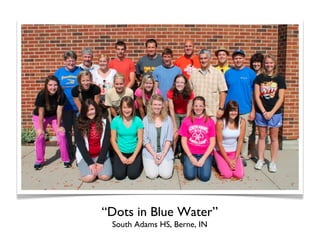
“Dots in Blue Water”
 South Adams HS, Berne, IN
“Dots in Blue Water”

1. Authentic Problem/Question
“How can we purify water for people in Haiti?”
“Dots in Blue Water”

        2. Student Directed Teams
Research, Development, Marketing, Community “Investment"
“Dots in Blue Water”

       3. Real Product/Real Audience
Teachers and students travelled to Haiti to install their devices.
             5 systems = clean water for 8,000
“Dots in Blue Water”

         Notes:

   -Aligned to standards
      -Interdisciplinary
     -Student-centered
      -Technology-rich
    -Innovative thinking
CHANGE
  (The World)
Bold Schools


3. Bold Schools Support Authentic Work
    Students and teachers create real work for
         real audiences and real purposes.
bit.ly/11PVoxq
Bold Schools


4. Bold Schools are Digital
Students and teachers have access to
    and fluency with technology.
Bold Schools


5. Bold Schools are Connected
  Students and teachers regularly learn
      from and with people online.
Our New Value


“Connected Learning”
“Connected learning is realized when a young
person is able to pursue a personal interest or
passion with the support of friends and caring
adults, and is in turn able to link this learning and
interest to academic achievement, career
success or civic engagement.”


                                          Mimi Ito
Networks are the new classrooms.
“What can you do has been replaced by what
can you and your network connections do.
Knowledge itself is moving from the individual
to the individual and his contacts.”


                                  Jay Cross
Bold Schools


 6. Bold Schools are Literate
 (by 21st Century Standards)
Students and teachers meet NCTE guidelines
      for modern readers and writers.
Bold Schools
• Develop proficiency with the tools of technology  
• Build relationships with others to pose and solve
  problems collaboratively and cross-culturally  
• Design and share information for global communities
  to meet a variety of purposes  
• Manage, analyze and synthesize multiple streams of
  simultaneous information  
• Create, critique, analyze, and evaluate multi-media
  texts  
• Attend to the ethical responsibilities required by these
  complex environments                                  bit.ly/nctelit
Bold Schools


 7. Bold Schools are Transparent
Students and teachers widely share best practices
         and reflections on their learning.
--Stephen Downes
Bold Schools


8. Bold Schools are Innovative
All learners are encouraged to “poke the box”
         and experiment with practice.
Bold Schools


         9. Bold Schools are Provocative
Conversations around change extend to parents, communities, and
              local, state and national governments.
Bold Schools


bit.ly/boldrubric
Bold Schools


Which of those nine qualities are the most
challenging to move toward when thinking
            about your school?
Bold Schools

1. Learning Centered
   2. Inquiry Driven
 3. Authentic Work
        4. Digital
     5. Connected
       6. Literate
    7. Transparent
      8. Innovative
    9. Provocative
New Requirements


 For our students.
For our classrooms.
  For ourselves.
Where Do We Start?


     With Us.
LEARNERS FIRST
LEARNERS FIRST
   Teachers Second
“In times of change, learners inherit
    the Earth, while the learned find
 themselves beautifully equipped to
    deal with a world that no longer
                              exists.”


                           Eric Hoffer
will@willrichardson.com
       @willrich45
   willrichardson.com

Bold Brazil

  • 1.
    Bold Learning forBold Schools Making the Jump from Traditional to Modern Learning Will Richardson will@willrichardson.com willrichardson.com @willrich45
  • 2.
    What is “BoldSchool” practice?
  • 6.
    Jacob Arnott 14-year oldEditor in Chief
  • 8.
  • 9.
  • 10.
    Traditional Learning Politicians, Parents, Communities, Educators Crisis of Contexts
  • 11.
    Traditional Learning Politicians, Parents, Communities, Educators Crisis of Contexts Modern Learning Connected Learners
  • 12.
    Traditional Learning Politicians, Parents, Communities, Educators ≠ Modern Learning Connected Learners
  • 13.
  • 14.
  • 15.
  • 16.
  • 17.
  • 18.
    “The change weare in the middle of isn’t minor, and it isn’t optional.” Clay Shirky
  • 19.
    ABUNDANCE 750,000 Apps 2.5 Billion People 2 Trillion Webpages 4.5 Years of YouTube video per minute 16,000 Tweets per second* 5 Billion Internet Connected Devices Etc... *Japan’s 2012 New Years Celebration
  • 21.
    ...A world markedby “ubiquitous computing, ubiquitous information, ubiquitous networks, at unlimited speed, about everything, everywhere, from anywhere, on all kinds of devices that make it ridiculously easy to connect, organize, share, collect, collaborate and publish.” Michael Wesch
  • 22.
    Which is Changing: Media Politics Journalism Medicine Books Business Music...
  • 23.
    ABUNDANCE And thefuture of work
  • 29.
  • 30.
    “Looking to thefuture of work, one could sum up the anticipated impacts in a single word: More. More intensity. More pressure. More change. More risk. But also, more opportunity. More engagement. More transparency. More impact.” Yvette Cameron
  • 31.
    ABUNDANCE And the futureof “an education”
  • 34.
  • 35.
  • 36.
  • 39.
    ca rci ty S bit.ly/MZmNDy
  • 40.
    ca rci ty S bit.ly/MZmNDy
  • 41.
    ca rci ty S Abu n danc e bit.ly/MZmNDy
  • 42.
    ca rci ty S Abu n danc e bit.ly/MZmNDy
  • 43.
    ca rci ty S Abu n danc e bit.ly/MZmNDy
  • 45.
    Cal Tech, GeorgiaTech, U. of Va, Duke, Rice, Johns Hopkins, Stamford, U. of Washington, U. of Illinois, U. of Edinburgh, U. of Toronto, Princeton, U. of Penn.
  • 46.
    Cal Tech, GeorgiaTech, U. of Va, Duke, Rice, Johns Hopkins, Stamford, U. of Washington, U. of Illinois, U. of Edinburgh, U. of Toronto, Princeton, U. of Penn. “This is the tsunami.” --Richard DeMillo, Ga. Tech
  • 50.
  • 51.
    ABUNDANCE And thefuture of schools
  • 52.
    New Reality Teachersare everywhere Classrooms are everywhere “School” is everywhere
  • 54.
  • 64.
    New Question: What dostudents need to learn in school at a moment when they can learn so much without us?
  • 65.
    New Question: And: What is the value of school (and classrooms and teachers) at a moment where we don’t need school to do school?
  • 66.
  • 67.
    New Answer: That whichcannot be “Khanified.”
  • 68.
    New Answer: Curiosity Resilience Passion Entrepreneurial Thinking Empathy Creativity Collaboration Inquiry Networking Communication Critical Thinking (and more)
  • 69.
    New Reality Schools needto be “different”... not just “better.”
  • 74.
    Our Old (Traditional)Value Content
  • 75.
  • 76.
    Our New Value NewContexts for Learning
  • 77.
    Our New Value NewContexts for Learning New Literacies
  • 78.
    Our New Value NewContexts for Learning New Literacies New Futures
  • 79.
  • 80.
    “Constantly looking aroundyou, all the time, for new ways and new resources to learn new things.” John Seely Brown
  • 81.
  • 82.
    Bold Schools 1. LearningCentered 2. Inquiry Driven 3. Authentic Work 4. Digital 5. Connected 6. Literate 7. Transparent 8. Innovative 9. Provocative
  • 83.
    Bold Schools 1. Bold Schools are Learning and Learner Centered Students and teachers direct their own learning and connect to their passions.
  • 84.
    Bold Schools 2. Bold Schools are Inquiry Driven Learning is focused around exploring answers to “big questions”
  • 85.
    “Dots in BlueWater” South Adams HS, Berne, IN
  • 86.
    “Dots in BlueWater” 1. Authentic Problem/Question “How can we purify water for people in Haiti?”
  • 87.
    “Dots in BlueWater” 2. Student Directed Teams Research, Development, Marketing, Community “Investment"
  • 88.
    “Dots in BlueWater” 3. Real Product/Real Audience Teachers and students travelled to Haiti to install their devices. 5 systems = clean water for 8,000
  • 89.
    “Dots in BlueWater” Notes: -Aligned to standards -Interdisciplinary -Student-centered -Technology-rich -Innovative thinking
  • 90.
  • 91.
    Bold Schools 3. BoldSchools Support Authentic Work Students and teachers create real work for real audiences and real purposes.
  • 92.
  • 94.
    Bold Schools 4. BoldSchools are Digital Students and teachers have access to and fluency with technology.
  • 95.
    Bold Schools 5. BoldSchools are Connected Students and teachers regularly learn from and with people online.
  • 96.
  • 97.
    “Connected learning isrealized when a young person is able to pursue a personal interest or passion with the support of friends and caring adults, and is in turn able to link this learning and interest to academic achievement, career success or civic engagement.” Mimi Ito
  • 99.
    Networks are thenew classrooms.
  • 101.
    “What can youdo has been replaced by what can you and your network connections do. Knowledge itself is moving from the individual to the individual and his contacts.” Jay Cross
  • 102.
    Bold Schools 6.Bold Schools are Literate (by 21st Century Standards) Students and teachers meet NCTE guidelines for modern readers and writers.
  • 103.
    Bold Schools • Developproficiency with the tools of technology   • Build relationships with others to pose and solve problems collaboratively and cross-culturally   • Design and share information for global communities to meet a variety of purposes   • Manage, analyze and synthesize multiple streams of simultaneous information   • Create, critique, analyze, and evaluate multi-media texts   • Attend to the ethical responsibilities required by these complex environments bit.ly/nctelit
  • 105.
    Bold Schools 7.Bold Schools are Transparent Students and teachers widely share best practices and reflections on their learning.
  • 107.
  • 112.
    Bold Schools 8. BoldSchools are Innovative All learners are encouraged to “poke the box” and experiment with practice.
  • 113.
    Bold Schools 9. Bold Schools are Provocative Conversations around change extend to parents, communities, and local, state and national governments.
  • 114.
  • 115.
    Bold Schools Which ofthose nine qualities are the most challenging to move toward when thinking about your school?
  • 116.
    Bold Schools 1. LearningCentered 2. Inquiry Driven 3. Authentic Work 4. Digital 5. Connected 6. Literate 7. Transparent 8. Innovative 9. Provocative
  • 117.
    New Requirements Forour students. For our classrooms. For ourselves.
  • 118.
    Where Do WeStart? With Us.
  • 119.
  • 120.
    LEARNERS FIRST Teachers Second
  • 121.
    “In times ofchange, learners inherit the Earth, while the learned find themselves beautifully equipped to deal with a world that no longer exists.” Eric Hoffer
  • 123.
    will@willrichardson.com @willrich45 willrichardson.com

Editor's Notes

  • #23 We’re asking kids questions that they can answer with their cell phones.
  • #24 We’re asking kids questions that they can answer with their cell phones.
  • #32 We’re asking kids questions that they can answer with their cell phones.
  • #52 We’re asking kids questions that they can answer with their cell phones.
  • #75 We’re asking kids questions that they can answer with their cell phones.
  • #76 We’re asking kids questions that they can answer with their cell phones.
  • #77 We’re asking kids questions that they can answer with their cell phones.
  • #78 We’re asking kids questions that they can answer with their cell phones.
  • #79 We’re asking kids questions that they can answer with their cell phones.
  • #97 We’re asking kids questions that they can answer with their cell phones.
  • #119 We’re asking kids questions that they can answer with their cell phones.