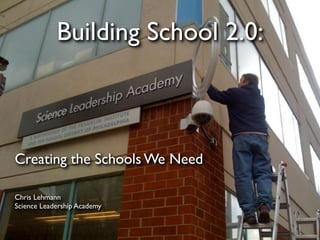

Building School 2.0:


Creating the Schools We Need

Chris Lehmann
Science Leadership Academy
Who Is This
  Guy?
Why This Matters
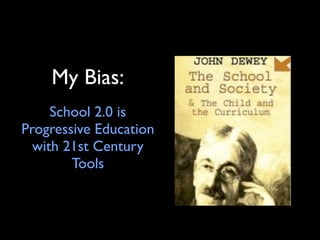
My Bias:
     School 2.0 is
Progressive Education
  with 21st Century
        Tools
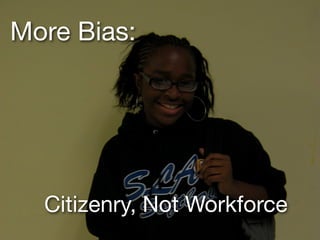
More Bias:


  Citizenry, Not Workforce
One Last Bias:
 Public Education = Democracy
What They Say About Us
       Obsolete
        Broken
       Wasteland
       Money Pits
        Failing
The Problem Is...
If we keep down our current path, they’re right.
Our Biggest Problem:
   A Lack of Vision


                http://www.flickr.com/photos/lnx/6257130/
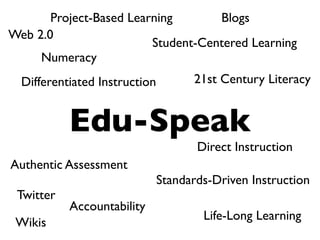
Project-Based Learning       Blogs
Web 2.0
                         Student-Centered Learning
     Numeracy
  Differentiated Instruction         21st Century Literacy


           Edu-Speak
                                      Direct Instruction
Authentic Assessment
                               Standards-Driven Instruction
 Twitter
           Accountability
                                       Life-Long Learning
 Wikis
We Deny Words Power
    When They Are Not Embedded In Practice
Another Big Problem:
      A Lack of Humility
A Related Problem:
Educators Are Too A-Historical
What the school system needs to understand is that its
 strength lies, not in the strength of the central organization,
  but in the strength of the individual school, not in making
one school like another, but in making each school a distinct
 unit. The need of the system is the preservation of its units,
     so that each school can keep itself alive, wide awake,
responsive to its people, easily adaptable, the best of its kind.

      Angelo Patri -- A Schoolmaster of the Great City
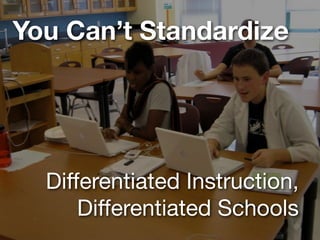
You Can’t Standardize


  Differentiated Instruction,
      Differentiated Schools
A Crazy Thought...
About Math Teaching,Virtual Schools and
       Why Class Still Matters
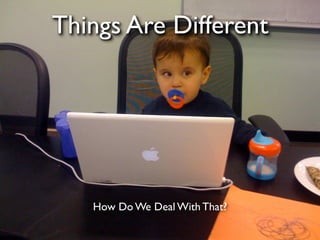
Things Are Different


   How Do We Deal With That?
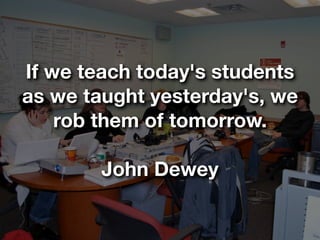
If we teach today's students
as we taught yesterday's, we
    rob them of tomorrow.

        John Dewey
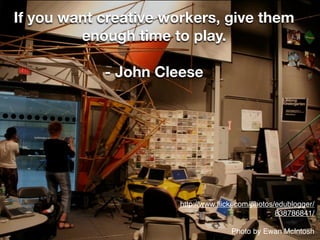
If you want creative workers, give them
         enough time to play.

            - John Cleese


                       http://www.flickr.com/photos/edublogger/
                                                   838786841/

                                     Photo by Ewan McIntosh
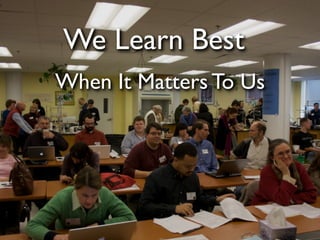
We Learn Best
When It Matters To Us
The illiterate of the 21st century will
 not be those who cannot read and
 write, but those who cannot learn,
         unlearn and relearn.

           -- Alvin Toffler


                http://www.flickr.com/photos/mwichary/2225299236/
Scary Thought:
What are we willing to unlearn and relearn?
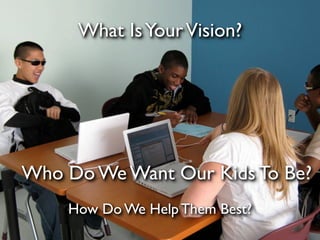
What Is Your Vision?


Who Do We Want Our Kids To Be?
    How Do We Help Them Best?
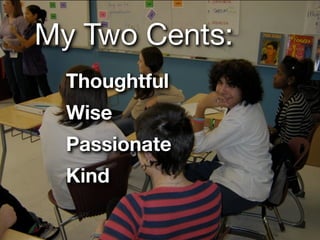
My Two Cents:
  Thoughtful
  Wise
  Passionate
  Kind
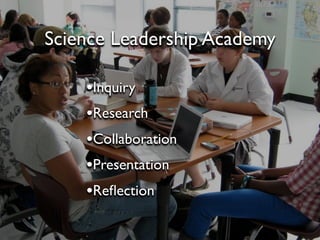
Science Leadership Academy

    •Inquiry
    •Research
    •Collaboration
    •Presentation
    •Reflection
Gates Foundation

  •   Rigor
  •   Relevance
  •   Relationships

       http://www.gatesfoundation.org/UnitedStates/Education/TransformingHighSchools/
Coalition of Essential
             Schools
•   Learning to use one’s mind well.
•   Less is More, depth over coverage
•   Goals apply to all students
•   Personalization
•   Student-as-worker, teacher-as-coach
•   Demonstration of mastery
•   A tone of decency and trust
•   Commitment to the entire school
•   Resources dedicated to teaching and learning
•   Democracy and equity

          http://www.essentialschools.org/pub/ces_docs/about/phil/10cps/10cps.html
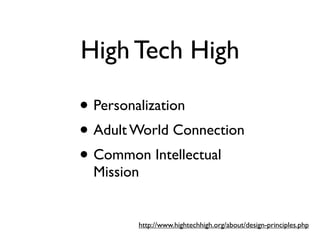
High Tech High

• Personalization
• Adult World Connection
• Common Intellectual
  Mission


        http://www.hightechhigh.org/about/design-principles.php
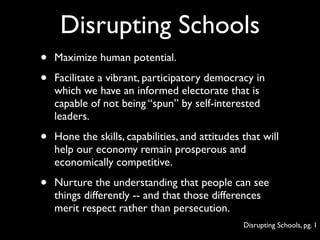
Disrupting Schools
•   Maximize human potential.

•   Facilitate a vibrant, participatory democracy in
    which we have an informed electorate that is
    capable of not being “spun” by self-interested
    leaders.

•   Hone the skills, capabilities, and attitudes that will
    help our economy remain prosperous and
    economically competitive.

•   Nurture the understanding that people can see
    things differently -- and that those differences
    merit respect rather than persecution.
                                                 Disrupting Schools, pg. 1
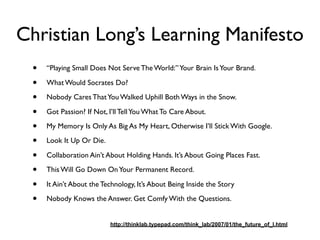
Christian Long’s Learning Manifesto
 •   “Playing Small Does Not Serve The World:” Your Brain Is Your Brand.

 •   What Would Socrates Do?

 •   Nobody Cares That You Walked Uphill Both Ways in the Snow.

 •   Got Passion? If Not, I’ll Tell You What To Care About.

 •   My Memory Is Only As Big As My Heart, Otherwise I’ll Stick With Google.

 •   Look It Up Or Die.

 •   Collaboration Ain’t About Holding Hands. It’s About Going Places Fast.

 •   This Will Go Down On Your Permanent Record.

 •   It Ain’t About the Technology, It’s About Being Inside the Story

 •   Nobody Knows the Answer. Get Comfy With the Questions.


                          http://thinklab.typepad.com/think_lab/2007/01/the_future_of_l.html
Discussion:
What Is Your Vision For Your School?
What Is Your Manifesto For Education?
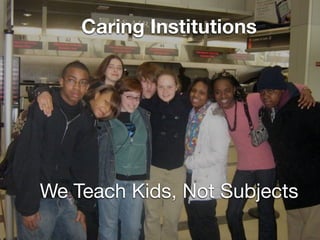
Caring Institutions


We Teach Kids, Not Subjects
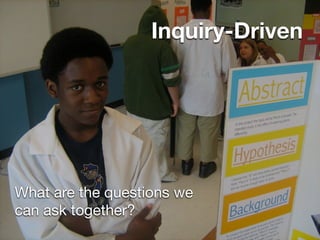
Inquiry-Driven


What are the questions we
can ask together?
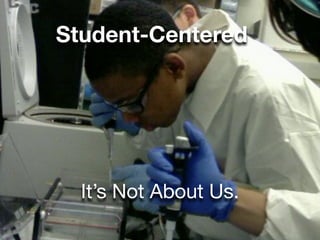
Student-Centered


  It’s Not About Us.
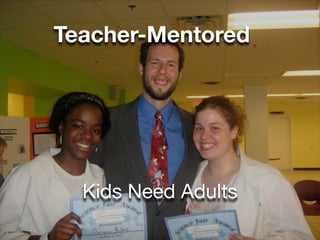
Teacher-Mentored


  Kids Need Adults
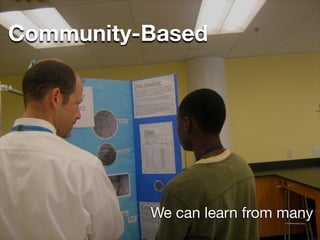
Community-Based


          We can learn from many
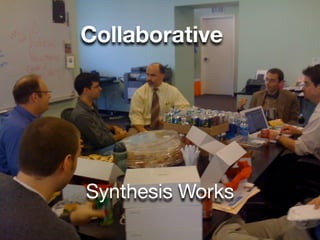
Collaborative


Synthesis Works
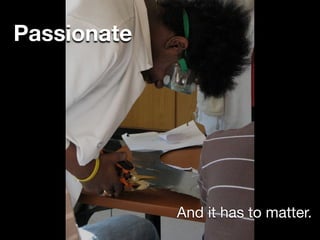
Passionate


             And it has to matter.
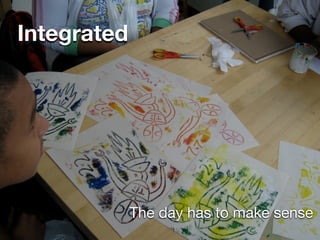
Integrated


             The day has to make sense
Meta-Cognitive


                 We need to think
                  about thinking.
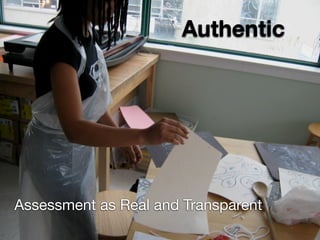
Authentic


Assessment as Real and Transparent
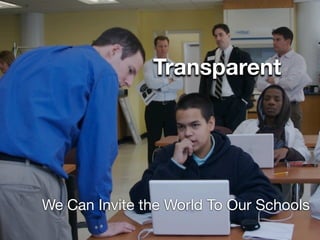
Transparent


We Can Invite the World To Our Schools
What Does Tech Do?
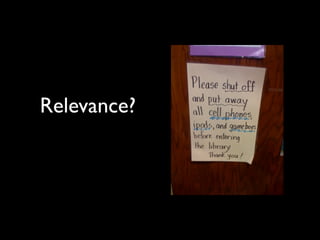
Relevance?
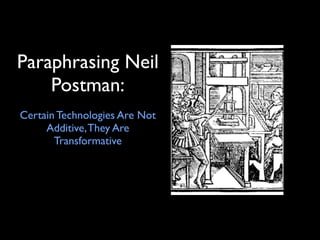
Paraphrasing Neil
    Postman:
Certain Technologies Are Not
     Additive, They Are
       Transformative
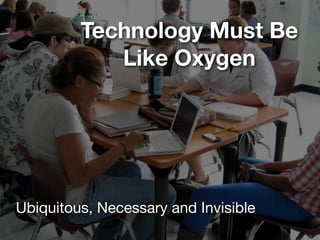
Technology Must Be
            Like Oxygen


Ubiquitous, Necessary and Invisible
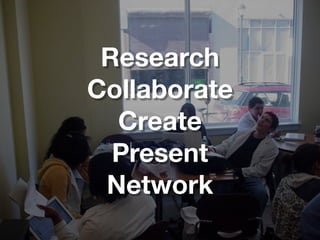
Research
Collaborate
  Create
  Present
 Network
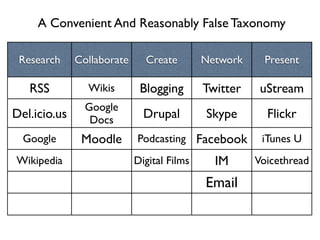
A Convenient And Reasonably False Taxonomy

 Research     Collaborate     Create        Network     Present

   RSS          Wikis        Blogging       Twitter    uStream
                Google
Del.icio.us      Docs         Drupal        Skype       Flickr
  Google       Moodle       Podcasting Facebook        iTunes U
Wikipedia                   Digital Films     IM      Voicethread

                                            Email
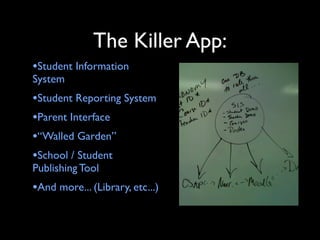
The Killer App:
•Student Information
System
•Student Reporting System
•Parent Interface
•“Walled Garden”
•School / Student
Publishing Tool
•And more... (Library, etc...)
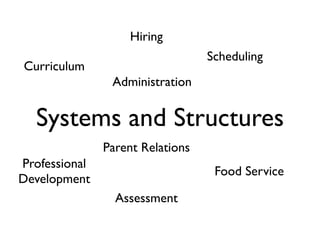
Hiring
                                  Scheduling
Curriculum
                Administration


  Systems and Structures
               Parent Relations
Professional
                                   Food Service
Development
                 Assessment
Say What You Do
         And Do What You Say
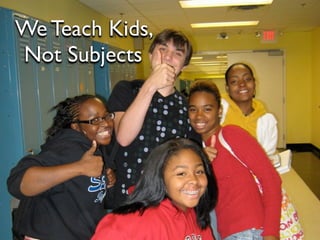
We Teach Kids,
Not Subjects
Discussion Prompt:
• How do we create curriculum in this
  model?
• What do we teach when THIS is
  available 24/7?
• How do you establish a link between
  your manifesto and your curriculum?
• What does assessment look like in
  your model?
Before You Leave For Lunch....
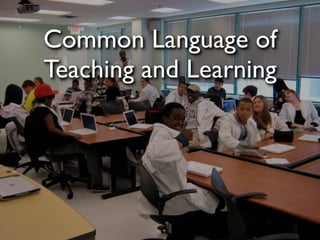
Common Language of
Teaching and Learning
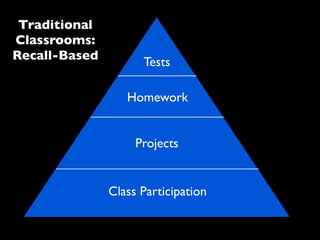
Traditional
Classrooms:
Recall-Based         Tests

                  Homework


                    Projects


               Class Participation
The Schools
  We Need:
Understanding-
   Driven           Projects

                   Homework


             Class Participation


                 Tests & Quizzes
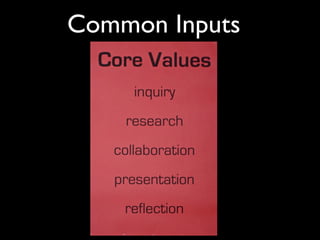
Common Inputs
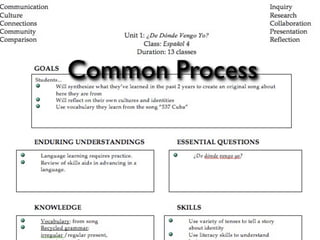
Common Process
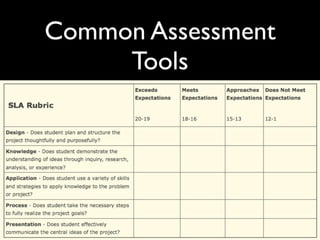
Common Assessment
     Tools
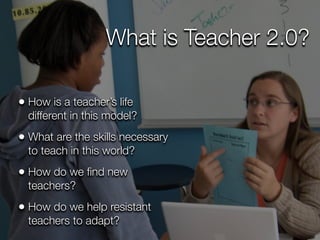
What is Teacher 2.0?

• How is a teacher’s life
  different in this model?
• What are the skills necessary
  to teach in this world?
• How do we find new
  teachers?
• How do we help resistant
  teachers to adapt?
Break-Out:
Examine Five Other Systems and Structures
of Your School:

How Should They Change To Better Reflect
Your Values.
Hard Questions:
• What is the worst consequence of your
  best idea?
• How can you mitigate them?
• What are the obstacles to this change?
• How can you overcome them?
Creating Change
 What is the action plan to move the systems and
structures of your school / classroom closer to the
                values you espouse?


               • One month plan
               • One year plan
               • Three year plan
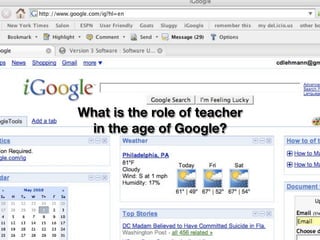
What is the role of teacher
 in the age of Google?
Wisdom.
Keep In Touch:
Chris Lehmann
Science Leadership Academy

chris@practicaltheory.org
http://www.practicaltheory.org
Twitter: chrislehmann
Skype: chrislehmann

EduCon 2.2 -- Jan. 29-31, 2010
http://educon22.wikispaces.com

Winston Salem Administrators Workshop - 7.28.09

  • 1.
    Building School 2.0: Creatingthe Schools We Need Chris Lehmann Science Leadership Academy
  • 2.
  • 3.
  • 5.
    My Bias: School 2.0 is Progressive Education with 21st Century Tools
  • 6.
    More Bias: Citizenry, Not Workforce
  • 7.
    One Last Bias: Public Education = Democracy
  • 8.
    What They SayAbout Us Obsolete Broken Wasteland Money Pits Failing
  • 9.
    The Problem Is... Ifwe keep down our current path, they’re right.
  • 10.
    Our Biggest Problem: A Lack of Vision http://www.flickr.com/photos/lnx/6257130/
  • 11.
    Project-Based Learning Blogs Web 2.0 Student-Centered Learning Numeracy Differentiated Instruction 21st Century Literacy Edu-Speak Direct Instruction Authentic Assessment Standards-Driven Instruction Twitter Accountability Life-Long Learning Wikis
  • 12.
    We Deny WordsPower When They Are Not Embedded In Practice
  • 13.
    Another Big Problem: A Lack of Humility
  • 14.
    A Related Problem: EducatorsAre Too A-Historical
  • 15.
    What the schoolsystem needs to understand is that its strength lies, not in the strength of the central organization, but in the strength of the individual school, not in making one school like another, but in making each school a distinct unit. The need of the system is the preservation of its units, so that each school can keep itself alive, wide awake, responsive to its people, easily adaptable, the best of its kind. Angelo Patri -- A Schoolmaster of the Great City
  • 16.
    You Can’t Standardize Differentiated Instruction, Differentiated Schools
  • 17.
    A Crazy Thought... AboutMath Teaching,Virtual Schools and Why Class Still Matters
  • 18.
    Things Are Different How Do We Deal With That?
  • 20.
    If we teachtoday's students as we taught yesterday's, we rob them of tomorrow. John Dewey
  • 22.
    If you wantcreative workers, give them enough time to play. - John Cleese http://www.flickr.com/photos/edublogger/ 838786841/ Photo by Ewan McIntosh
  • 23.
    We Learn Best WhenIt Matters To Us
  • 24.
    The illiterate ofthe 21st century will not be those who cannot read and write, but those who cannot learn, unlearn and relearn. -- Alvin Toffler http://www.flickr.com/photos/mwichary/2225299236/
  • 26.
    Scary Thought: What arewe willing to unlearn and relearn?
  • 27.
    What Is YourVision? Who Do We Want Our Kids To Be? How Do We Help Them Best?
  • 28.
    My Two Cents: Thoughtful Wise Passionate Kind
  • 29.
    Science Leadership Academy •Inquiry •Research •Collaboration •Presentation •Reflection
  • 30.
    Gates Foundation • Rigor • Relevance • Relationships http://www.gatesfoundation.org/UnitedStates/Education/TransformingHighSchools/
  • 31.
    Coalition of Essential Schools • Learning to use one’s mind well. • Less is More, depth over coverage • Goals apply to all students • Personalization • Student-as-worker, teacher-as-coach • Demonstration of mastery • A tone of decency and trust • Commitment to the entire school • Resources dedicated to teaching and learning • Democracy and equity http://www.essentialschools.org/pub/ces_docs/about/phil/10cps/10cps.html
  • 32.
    High Tech High •Personalization • Adult World Connection • Common Intellectual Mission http://www.hightechhigh.org/about/design-principles.php
  • 33.
    Disrupting Schools • Maximize human potential. • Facilitate a vibrant, participatory democracy in which we have an informed electorate that is capable of not being “spun” by self-interested leaders. • Hone the skills, capabilities, and attitudes that will help our economy remain prosperous and economically competitive. • Nurture the understanding that people can see things differently -- and that those differences merit respect rather than persecution. Disrupting Schools, pg. 1
  • 34.
    Christian Long’s LearningManifesto • “Playing Small Does Not Serve The World:” Your Brain Is Your Brand. • What Would Socrates Do? • Nobody Cares That You Walked Uphill Both Ways in the Snow. • Got Passion? If Not, I’ll Tell You What To Care About. • My Memory Is Only As Big As My Heart, Otherwise I’ll Stick With Google. • Look It Up Or Die. • Collaboration Ain’t About Holding Hands. It’s About Going Places Fast. • This Will Go Down On Your Permanent Record. • It Ain’t About the Technology, It’s About Being Inside the Story • Nobody Knows the Answer. Get Comfy With the Questions. http://thinklab.typepad.com/think_lab/2007/01/the_future_of_l.html
  • 35.
    Discussion: What Is YourVision For Your School? What Is Your Manifesto For Education?
  • 36.
    Caring Institutions We TeachKids, Not Subjects
  • 37.
    Inquiry-Driven What are thequestions we can ask together?
  • 38.
  • 39.
  • 40.
    Community-Based We can learn from many
  • 41.
  • 42.
    Passionate And it has to matter.
  • 43.
    Integrated The day has to make sense
  • 44.
    Meta-Cognitive We need to think about thinking.
  • 45.
  • 46.
    Transparent We Can Invitethe World To Our Schools
  • 47.
  • 48.
  • 49.
    Paraphrasing Neil Postman: Certain Technologies Are Not Additive, They Are Transformative
  • 50.
    Technology Must Be Like Oxygen Ubiquitous, Necessary and Invisible
  • 51.
  • 52.
    A Convenient AndReasonably False Taxonomy Research Collaborate Create Network Present RSS Wikis Blogging Twitter uStream Google Del.icio.us Docs Drupal Skype Flickr Google Moodle Podcasting Facebook iTunes U Wikipedia Digital Films IM Voicethread Email
  • 53.
    The Killer App: •StudentInformation System •Student Reporting System •Parent Interface •“Walled Garden” •School / Student Publishing Tool •And more... (Library, etc...)
  • 54.
    Hiring Scheduling Curriculum Administration Systems and Structures Parent Relations Professional Food Service Development Assessment
  • 55.
    Say What YouDo And Do What You Say
  • 56.
  • 57.
    Discussion Prompt: • Howdo we create curriculum in this model? • What do we teach when THIS is available 24/7? • How do you establish a link between your manifesto and your curriculum? • What does assessment look like in your model?
  • 58.
    Before You LeaveFor Lunch....
  • 59.
  • 60.
    Traditional Classrooms: Recall-Based Tests Homework Projects Class Participation
  • 61.
    The Schools We Need: Understanding- Driven Projects Homework Class Participation Tests & Quizzes
  • 62.
  • 63.
  • 64.
  • 65.
    What is Teacher2.0? • How is a teacher’s life different in this model? • What are the skills necessary to teach in this world? • How do we find new teachers? • How do we help resistant teachers to adapt?
  • 66.
    Break-Out: Examine Five OtherSystems and Structures of Your School: How Should They Change To Better Reflect Your Values.
  • 67.
    Hard Questions: • Whatis the worst consequence of your best idea? • How can you mitigate them? • What are the obstacles to this change? • How can you overcome them?
  • 68.
    Creating Change Whatis the action plan to move the systems and structures of your school / classroom closer to the values you espouse? • One month plan • One year plan • Three year plan
  • 69.
    What is therole of teacher in the age of Google?
  • 70.
  • 71.
    Keep In Touch: ChrisLehmann Science Leadership Academy chris@practicaltheory.org http://www.practicaltheory.org Twitter: chrislehmann Skype: chrislehmann EduCon 2.2 -- Jan. 29-31, 2010 http://educon22.wikispaces.com