Integrated Approaches to On-line Process Monitoring
and Control of Upstream & Downstream Operations
Julian Morris
Centre for Process Analytics & Control Technology
Newcastle University & Strathclyde University, UK
www.cpact.com
gbx 9th Annual Bioinnovation Summit Berlin 10th and 11th February 2016
CPACT Member Companies
Plus 8 Universities/Research Institutes
Overview of Presentation
■  Bio-pharmaceuticals Development and Production - A Systems View
■  Challenges for Predictive Data Analytics in Process Development &
Production
■  Process and Product Variability
●  Where is the Variability?
●  What is the Cost of Quality Variability?
■  Predictive Modelling and Data Fusion in Biologics Downstream
Processing
■  Predictive Modelling in Fermentation Development and Scale-up
■  Back-to-the-Future
●  Software Sensors in Product Quality Predictive Analytics
!  Case Studies - Industrial Fed Batch & Continuous Fermentations
■  Closure
Bio-Pharmaceuticals Development and Production
- A Systems View
■  Small, and to a greater extent, large molecular entities are complex
‘systems’.
■  ‘Systems’ Biology:
! Cell-based and product centric, …
! Omics, strain/clone, media driven, …
■  ‘Systems’ Engineering:
!  Process and Product Centric
!  Methods developed in R&D successfully transferred into production
!  Integrated product and process R&D and manufacturing:
upstream and downstream operations.
■  A “Systems” approach to quality is the foundation of a culture of
quality.
! A ‘System’ is the product of interacting parts. Improving the parts
taken separately will not improve the whole system.
Challenges for Data Analytics
in Product & Process Development and Production
■  Increasing new entity introductions demands the need for aggressive
development cycles:
●  Wider range of product forms:
! Reduced opportunity for generating data for method development
■  Need to embed a Multivariate Data Analytics paradigm into Product
and Process Development, Scale-up / Scale-down and Manufacturing:
■  This demands a culture-change:
! Products and Processes are ‘Complex’ and ‘Multivariate’
! Processes (e.g. regulated pathways, reactions, …) are non-
linear
! Processes are ‘Dynamic’ and ‘Time-varying’
! Products have ‘Distributions’
Process and Product Variability
The Impact on Product Quality
Process and Analytical Variability Challenges
‘Product Quality’ across lab, pilot & production scales
(Staffan Folestad AstraZeneca, APACT09)
Spectra from different probes
show distinct Inter-probe variability
Position 1
P 2
P3
P4
-20
-10
0
10
20
t[2]
t[1]
•P1-2225.0
•P1-
•P1-2303.0•P1-2322.0
•P1-2343.0
•P1-2401.0
•P1-2420.0
•P1-2552.0
•P1-2611.0
•P1-2534.0•P1-2648.0
•P1-2710.0
•P1-2728.0
•P1-2629.0
•P1-2842.0
•P1-2919.0
•P1-2746.0•P1-2805.0
•P1-2823.0•P1-2900.0
•P1-3014.0
•P1-3245.0•P1-3131.0
•P1-3726.0
•P1-3341.0
•P1-3418.0
•P1-2956.0
•P1-3304.0
•P1-3150.0
•P1-3208.0
•P1-3840.0•P1-3744.0
•P1-3803.0
•P1-4628.0
•P1-3437.0
•P1-3455.0
•P1-3514.0
•P1-3400.0
•P1-3708.0
•P1-3227.0
•P1-4225.0
•P1-4244.0
•P1-3859.0
•P1-4015.0
•P1-4609.0
•P1-4646.0
•P1-4514.0
•P1-4551.0
•P1-4819.0
•P1-4837.0
•P1-4705.0
•P1-4723.0
•P1-4742.0
•P1-3532.0
•P1-4532.0
•P1-4800.0
•P2-5400.0
•P2-5537.0
•P2-5746.0
•P2-5708.0
•P2-5919.0
•P2-5937.0
•P2-5900.0
•P2-0033.0
•P2-5805.0•P2-5507.0
•P2-5440.0
•P2-5420.0
•P2-5610.0
•P2-5727.0
•P2-5629.0
•P2-5649.0
•P2-0150.0
•P2-0245.0
•P2-2053.0
•P2-0707.0
•P2-0630.0
•P2-0612.0
•P2-0322.0
•P2-0208.0
•P2-0227.0
•P2-0437.0
•P2-0418.0
•P2-1440.0•P2-1147.0
•P2-2206.0
•P2-2111.0
•P2-2225.0
•P2-2342.0•P2-2244.0•P2-1806.0
•P2-1727.0•P2-1939.0
•P2-0649.0
•P2-0553.0•P2-0725.0
•P2-0839.0
•P2-0821.0
•P2-0744.0•P2-0803.0
•P2-0534.0
•P2-0304.0
•P2-0359.0
•P2-1421.0
•P2-1206.0•P2-1129.0
•P2-1650.0•P2-2148.0
•P2-2129.0
•P2-2400.0•P2-2323.0
•P2-2305.0•P2-2034.0
•P2-1825.0
•P2-1748.0
•P2-1708.0
•P2-1843.0
•P2-1957.0•P2-2015.0
•P2-1902.0
•P2-1920.0
•P2-0916.0
•P2-0858.0
•P4-2006.0
•P4-2348.0
•P4-1849.0
•P4-1658.0
•P4-1409.0•P4-1427.0
•P4-1331.0
•P4-1254.0
•P4-1313.0•P4-1603.0•P4-1621.0
•P4-1640.0
•P4-3040.0
•P4-2311.0
•P4-2253.0•P4-2157.0
•P4-2216.0
•P4-2234.0
•P4-2600.0
•P4-2427.0
•P4-2446.0
•P4-1217.0
•P4-1831.0
•P4-1350.0
•P4-1236.0
•P4-1544.0
•P4-2945.0
•P4-2849.0
•P4-2908.0
•P4-2926.0
•P4-2619.0
•P4-2330.0
•P4-2523.0
•P4-2542.0
•P4-2504.0•P4-2409.0
•P3-4438.0
•P3-5058.0•P3-5019.0
•P3-4941.0
•P3-5232.0
•P3-5154.0
•P3-5117.0
•P3-5135.0
•P3-4650.0
•P3-4631.0•P3-4845.0
•P4-0158.0
•P4-0220.0•P4-0238.0
•P3-4242.0
•P3-4516.0
•P3-4535.0
•P3-4457.0
•P3-4127.0
•P3-4050.0
•P3-5038.0
•P3-5000.0
•P3-5213.0
•P3-4922.0•P3-4708.0
•P3-4730.0
•P3-4612.0
•P3-3137.0
•P3-3640.0
•P3-3701.0
•P3-3621.0
•P3-3835.0
•P3-3446.0
•P3-3505.0
•P3-3427.0
•P3-3350.0
•P3-3408.0
•P4-0026.0
•P4-0140.0
•P4-0044.0
•P3-4340.0
•P3-4321.0•P3-4301.0
•P3-4420.0
•P3-4109.0
•P3-4554.0
•P3-3002.0
•P3-2921.0
•P3-3118.0
•P3-3059.0
•P3-3020.0
•P3-3039.0
•P3-3155.0
•P3-3544.0
•P3-3603.0•P3-3816.0
•P3-3233.0
•P4-0007.0•P4-5912.0
•P3-4401.0
•P3-2940.0
•P3-2844.0
•P3-2902.0
•P4-5949.0
•P4-5931.0
•P4-5854.0
•P3-2748.0
•P3-2806.0
•P3-2729.0
•P3-2710.0
•P4-5835.0
•P3-2651.0
-100 -80 -60 -40 -20 0 20 40 60 80 100
P2
P1
Position 1
P 2
P3
P4
-20
-10
0
10
20
t[2]
t[1]
•P1-2225.0
•P1-
•P1-2303.0•P1-2322.0
•P1-2343.0
•P1-2401.0
•P1-2420.0
•P1-2552.0
•P1-2611.0
•P1-2534.0•P1-2648.0
•P1-2710.0
•P1-2728.0
•P1-2629.0
•P1-2842.0
•P1-2919.0
•P1-2746.0•P1-2805.0
•P1-2823.0•P1-2900.0
•P1-3014.0
•P1-3245.0•P1-3131.0
•P1-3726.0
•P1-3341.0
•P1-3418.0
•P1-2956.0
•P1-3304.0
•P1-3150.0
•P1-3208.0
•P1-3840.0•P1-3744.0
•P1-3803.0
•P1-4628.0
•P1-3437.0
•P1-3455.0
•P1-3514.0
•P1-3400.0
•P1-3708.0
•P1-3227.0
•P1-4225.0
•P1-4244.0
•P1-3859.0
•P1-4015.0
•P1-4609.0
•P1-4646.0
•P1-4514.0
•P1-4551.0
•P1-4819.0
•P1-4837.0
•P1-4705.0
•P1-4723.0
•P1-4742.0
•P1-3532.0
•P1-4532.0
•P1-4800.0
•P2-5400.0
•P2-5537.0
•P2-5746.0
•P2-5708.0
•P2-5919.0
•P2-5937.0
•P2-5900.0
•P2-0033.0
•P2-5805.0•P2-5507.0
•P2-5440.0
•P2-5420.0
•P2-5610.0
•P2-5727.0
•P2-5629.0
•P2-5649.0
•P2-0150.0
•P2-0245.0
•P2-2053.0
•P2-0707.0
•P2-0630.0
•P2-0612.0
•P2-0322.0
•P2-0208.0
•P2-0227.0
•P2-0437.0
•P2-0418.0
•P2-1440.0•P2-1147.0
•P2-2206.0
•P2-2111.0
•P2-2225.0
•P2-2342.0•P2-2244.0•P2-1806.0
•P2-1727.0•P2-1939.0
•P2-0649.0
•P2-0553.0•P2-0725.0
•P2-0839.0
•P2-0821.0
•P2-0744.0•P2-0803.0
•P2-0534.0
•P2-0304.0
•P2-0359.0
•P2-1421.0
•P2-1206.0•P2-1129.0
•P2-1650.0•P2-2148.0
•P2-2129.0
•P2-2400.0•P2-2323.0
•P2-2305.0•P2-2034.0
•P2-1825.0
•P2-1748.0
•P2-1708.0
•P2-1843.0
•P2-1957.0•P2-2015.0
•P2-1902.0
•P2-1920.0
•P2-0916.0
•P2-0858.0
•P4-2006.0
•P4-2348.0
•P4-1849.0
•P4-1658.0
•P4-1409.0•P4-1427.0
•P4-1331.0
•P4-1254.0
•P4-1313.0•P4-1603.0•P4-1621.0
•P4-1640.0
•P4-3040.0
•P4-2311.0
•P4-2253.0•P4-2157.0
•P4-2216.0
•P4-2234.0
•P4-2600.0
•P4-2427.0
•P4-2446.0
•P4-1217.0
•P4-1831.0
•P4-1350.0
•P4-1236.0
•P4-1544.0
•P4-2945.0
•P4-2849.0
•P4-2908.0
•P4-2926.0
•P4-2619.0
•P4-2330.0
•P4-2523.0
•P4-2542.0
•P4-2504.0•P4-2409.0
•P3-4438.0
•P3-5058.0•P3-5019.0
•P3-4941.0
•P3-5232.0
•P3-5154.0
•P3-5117.0
•P3-5135.0
•P3-4650.0
•P3-4631.0•P3-4845.0
•P4-0158.0
•P4-0220.0•P4-0238.0
•P3-4242.0
•P3-4516.0
•P3-4535.0
•P3-4457.0
•P3-4127.0
•P3-4050.0
•P3-5038.0
•P3-5000.0
•P3-5213.0
•P3-4922.0•P3-4708.0
•P3-4730.0
•P3-4612.0
•P3-3137.0
•P3-3640.0
•P3-3701.0
•P3-3621.0
•P3-3835.0
•P3-3446.0
•P3-3505.0
•P3-3427.0
•P3-3350.0
•P3-3408.0
•P4-0026.0
•P4-0140.0
•P4-0044.0
•P3-4340.0
•P3-4321.0•P3-4301.0
•P3-4420.0
•P3-4109.0
•P3-4554.0
•P3-3002.0
•P3-2921.0
•P3-3118.0
•P3-3059.0
•P3-3020.0
•P3-3039.0
•P3-3155.0
•P3-3544.0
•P3-3603.0•P3-3816.0
•P3-3233.0
•P4-0007.0•P4-5912.0
•P3-4401.0
•P3-2940.0
•P3-2844.0
•P3-2902.0
•P4-5949.0
•P4-5931.0
•P4-5854.0
•P3-2748.0
•P3-2806.0
•P3-2729.0
•P3-2710.0
•P4-5835.0
•P3-2651.0
-100 -80 -60 -40 -20 0 20 40 60 80 100
P2
P1
Sensing space direction
PCA of spectra collected for over 1 hr
Courtesy R O’Kennedy et al (GSK & Univ Strathclyde)
Agitator
L1
L2
L3
L4
Probe Location
L2
L3
L4
Probe Location
‘Identical Reactors – Different heat-
transfer characteristics ?’
16m3
35m3
24m3
24m3
24m3
Are	
  ‘Iden)cal	
  Disposables’	
  
‘Iden)cal?’	
  
Factors Determining Output Variability
Process Variability
"  It is generally assumed that the agreed specification limits define
what the customer wants - this is often untrue.
! For many parameters what the customer (the patient) would
really like is no variance at all.
! Customer satisfaction can be increased by reducing the
variability to well within the current specification limits.
A Compelling Case for
Innovative Process Analytics & Control Technologies
Where is the Variability Problem?
■  Should the focus be on reducing the Process variability ?
■  Or the measuring system (PAT system) variability ?
■  Or both
Percentage contribution
from the PAT system is low
Percentage contribution
from the PAT system is high
Is Process Variability
the problem?
Is PAT (Measurement)
Variability the problem?
Process
PAT
Measurements
The Business Case for Quality - the ‘Cost of Quality’
Jeffrey Macher, Business Case for Quality, Pharmaceutical Quality Systems (ICH Q10) Conference, November 2011, Arlington MA USA
! Deviations
• Availability
• Deviations - Number and Type
! Manufacturing
• Batches Failed
• Yield (Theoretical vs Actual)
• Cycle Time
Yes
No
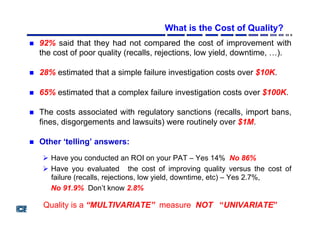
What is the Cost of Quality?
"  92% said that they had not compared the cost of improvement with
the cost of poor quality (recalls, rejections, low yield, downtime, …).
"  28% estimated that a simple failure investigation costs over $10K.
"  65% estimated that a complex failure investigation costs over $100K.
"  The costs associated with regulatory sanctions (recalls, import bans,
fines, disgorgements and lawsuits) were routinely over $1M.
"  Other ‘telling’ answers:
!  Have you conducted an ROI on your PAT – Yes 14% No 86%
!  Have you evaluated the cost of improving quality versus the cost of
failure (recalls, rejections, low yield, downtime, etc) – Yes 2.7%,
No 91.9% Don’t know 2.8%
Quality is a “MULTIVARIATE” measure NOT “UNIVARIATE”
Predictive Modelling and Data Fusion in
Biologics Downstream Processing
Real-Time Quantitative Monitoring of Proteins
Different Approaches to Real-Time Quantitative Monitoring
of Proteins in Chromatographic Protein Purification
Presently, the most conventional methods to quantify the proteins in the
effluents of chromatography are based on the monitoring of ultraviolet (UV)
absorbance at a univariate wavelength (typically 280 nm)
- fast and easy to implement.
Use full range UV, Raman with Spectral and Process data fusion
Biologics Data Fusion for Downstream Processing
■  One universal and critical aspect of protein purification with
chromatographic processes is the importance of separating the
qualified proteins from the impurities for consistent product quality.
■  Presently, the most conventional methods to quantify the proteins in
the effluents of chromatography are based on the monitoring of
ultraviolet (UV) absorbance at a univariate wavelength (typically 280
nm*) – fast and easy to implement.
■  This approach often cannot differentiate the target protein from other
species or impurities, thus a limited capability to aid reliable real-time
pooling decision during the chromatographic operations.
■  Application to chromatography processes provides a critical enabling
technology for process performance monitoring and control.
*	
  Rathore	
  AS,	
  Yu	
  M,	
  Yeboah	
  S,	
  Sharma	
  A.	
  Case	
  study	
  and	
  
applica)on	
  of	
  process	
  analy)cal	
  technology	
  (PAT)	
  towards	
  
bioprocessing,	
  use	
  of	
  on-­‐line	
  high-­‐performance	
  liquid	
  
chromatography	
  (HPLC)	
  for	
  making	
  real-­‐)me	
  pooling	
  
decisions	
  for	
  process	
  chromatography.	
  Biotechnol.	
  Bioeng.	
  
2008;100:306–316.	
  
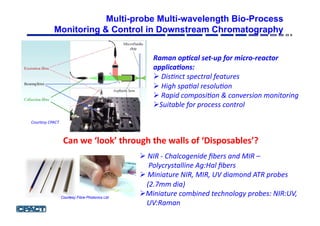
Multi-probe Multi-wavelength Bio-Process
Monitoring & Control in Downstream Chromatography
Raman	
  op(cal	
  set-­‐up	
  for	
  micro-­‐reactor	
  
applica(ons:	
  
! 	
  Dis%nct	
  spectral	
  features	
  
! 	
  High	
  spa%al	
  resolu%on	
  
! 	
  Rapid	
  composi%on	
  &	
  conversion	
  monitoring	
  
! Suitable	
  for	
  process	
  control	
  
Courtesy Fibre Photonics Ltd
! 	
  NIR	
  -­‐	
  Chalcogenide	
  fibers	
  and	
  MIR	
  –	


  Polycrystalline	
  Ag:Hal	
  fibers	
  
! 	
  Miniature	
  NIR,	
  MIR,	
  UV	
  diamond	
  ATR	
  probes	


  (2.7mm	
  dia)	
  
! Miniature	
  combined	
  technology	
  probes:	
  NIR:UV,	


  UV:Raman	
  
Courtesy	
  CPACT	
  
Can	
  we	
  ‘look’	
  through	
  the	
  walls	
  of	
  ‘Disposables’?	
  
Multi-technique Spectroscopic Probes with Data Fusion
■  The increasing availability of reliable, smaller footprint, low-cost and
easy-to-use on-line / at-line analyzers and probes is providing new
opportunities beyond being just integrating an analyser into a process:
multi-technique probes.
■  Data Fusion – the integration of multiple process measurements with
multi-wavelength spectroscopic data.
Combined NIR / UV-Vis Probe
For Process Chromatography:
a UV – Raman Probe?
Miniaturised
Analyser
Courtesy Fibre Photonics and the EU OPTICO project G.A. No. 280813
The probe consisted of a
central signal fibre
surrounded by two
illumination rings which can
be separately connected to
the illuminator.
Pitfalls in Calibration Modelling:
The Impact of Fluctuations in External Variables
"  Unlike in off-line assays, spectroscopic measurements in on-line/in-line
real-time applications are almost inevitably subjected to variations in
measurement conditions:
!  e.g. temperature, sample physical properties (e.g. cell density, particle
size, viscosity, sample compactness, surface texture, etc), ….
!  can invalidate the assumption of a linear relationship between the
spectroscopic measurements and the concentrations of the target
chemical or biological components.
"  Variations in ‘external’ variables can have a major impact on
predictive ability, the maintenance of the predictive abilities of the
multivariate calibration models as well as in their transfer from
laboratory/pilot to production plant and across manufacturing sites.
Concentrations (left), Temperatures (middle) and ATR probes (right)
for both training (blue) and test (red) data sets
■  The data consisted of UV spectra between 220 and 459nm during
12 process experiments.
■  The measurements were made on a multiplexed UV instrument with
four nominally identical ATR probes.
■  The first-derivative UV spectra were split into a training set (6
experiments, 629 spectra – blue lines) and test set (6 experiments,
627 spectra – red lines).
Coping with Different UV Probes and Messy Data (1)
Probes
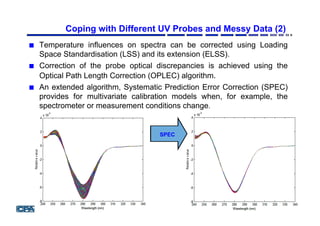
Coping with Different UV Probes and Messy Data (2)
SPEC
■  Temperature influences on spectra can be corrected using Loading
Space Standardisation (LSS) and its extension (ELSS).
■  Correction of the probe optical discrepancies is achieved using the
Optical Path Length Correction (OPLEC) algorithm.
■  An extended algorithm, Systematic Prediction Error Correction (SPEC)
provides for multivariate calibration models when, for example, the
spectrometer or measurement conditions change.
Calibration Models
Blue line: Standard PLS
Red line: OPLEC-LSS based PLS (SPEC)
SPEC
Zeng-Ping Chen, Li-Mei Li, Ru-Qin Yu, David Littlejohn, Alison Nordon, Julian Morris,
Alison S. Dann, Paul A. Jeffkins, Mark D. Richardson and Sarah L. Stimpson, 2011,
“Systematic prediction error correction: A novel strategy for maintaining the predictive
abilities of multivariate calibration models”, The Analyst, 136, 98-106
Application to the Predictive Modelling of
Fermentation Biomass
Zeng-Ping Chen, Li-Jing Zhong, Alison Nordon, David Littlejohn, Megan Holden, Mariana Fazenda, Linda Harvey, Brian McNeil, Jim Faulkner and Julian Morris,
Calibration of Multiplexed Fiber-Optic Spectroscopy, Anal. Chem. 2011, 83, 2655–2659
Zeng-Ping Chen, Li-Mei Li, Ru-Qin Yu, David Littlejohn, Alison Nordon, Julian Morris, Alison S. Dann, Paul A. Jeffkins, Mark D. Richardson and Sarah L. Stimpson,
Systematic prediction error correction: A novel strategy for maintaining the predictive abilities of multivariate calibration models, The Analyst, 2011, 36, 98-106
(Zeiss Corona 45 NIR Spectra Measured Every Fifteen Minutes)
■  The process under study was an industrial pilot-plant scale
streptomyces fermentation involving a seed stage and a production
stage.
■  Biomass was grown in the seed stage and then transferred into the
final fed batch stage for the production of the product lasting
approximately 140hrs.
■  Two sets of fermentation experiments were carried out. The first set
comprised seven batches (calibration batches); the second set was
made up of six batches (test batches).
■  The seven calibration batches were run under similar conditions, but
natural variation provided some degree of variability.
■  For the test batches, the runs were carried out under different
environmental conditions (pH and temperature), feed rates (sugar
feed) and feed amounts (oil feed).
Coping with Process Variation [Courtesy GSK]
Prediction of Product Concentration [Courtesy GSK]
PLS calibration built using the spectra of the
samples from primary instrument.
Global PLS using the spectra samples from the primary instrument
and six standardisation samples from the secondary instrument
Blue circles - product
concentration by off-line assay
Systematic Prediction Error Correction Algorithm
Stretomyces Fermentation
The Message
Its not just the installation of
Process Analytical Technologies
It is the COMBINED use of the appropriate PAT
technologies
along with Smart Modelling and Chemometrics
for success to be achieved
Software Sensors (Soft-Sensors)
and
Inferential Measurement & Control
Back to the Future
Virtual Measurement through Software Sensors:
(Potential for a major impact in bio-pharma)
■  Soft sensors - known also as software sensors or inferential
measurements are operators’ and engineers’ virtual eyes and ears.
! Software sensors create windows into your process where
physical equivalents are unrealistic or even impossible and where
difficulties in measuring quality (primary) variables inevitably
mean poor or no control at all:
! e.g. reliance on lab assays/measurements leading to long
measurement delays
! lack-of or cost-of or difficulty-of using on-line measurement
technologies
! Reliability of existing sensors
0.9
Soft-sensor Biomass Prediction:
Pruteen and Myco-Protein Continuous Fermentation
Acknowledgements to: Marlow Foods and ICI Biologics
Adaptive software sensor
Predictions of Biomass
■  Pruteen: 1,500m3 continuous
fermenter - animal feed.
■  In 1984 Marlow Foods in a joint
venture with ICI in myco-protein
production using a 140,000l air lift
fermenter.
■  Quorn, as a retail product, was
first produced in 1985 by Marlow
Foods in a joint venture between
RHM and ICI.
Ming T. Tham, Gary A. Montague, A. Julian Morris, and Paul A. Lant, Soft-sensors for
process estimation and inferential control, J. Proc. Control, 1, (1991) 3-14
G.A. Montague, A.J. Morris & M.T. Tham, Enhancing bioprocess operability with
generic software sensors, Journal of Biotechnology, 25 (1992) 183-201
Software-sensors
Enhancing Fed Batch Fermentation Controllability
Predicted Biomass
Acknowledgements to: SmithKline BeechamMontague, G & J. Morris, Neural-network contributions in biotechnology, Tibtech Aug 1994, 12, 312-324
!  Biomass estimation test data sets from
two 120,000L commercial scale
fermentation runs with SmithKline
Beecham.
!  Different sugar feed-rates resulted in
different levels of biomass
concentration.
!  Performance resulting from controlling
biomass by variation of sugar feed to a
set point profile predetermined by the
fermentation technologists.
!  Good set-point tracking is observed
when the loop is closed 40hr into the
fermentation, and good disturbance
rejection following an air flowrate
disturbance at 130h is also observed.
Biomass Control
Closure
What is the Future for PAT with Smart Data Analytics?
■  Novel process analytical technologies will play a massive role in
providing the right tools for directly controlling quality, not just
providing product and process ‘know-how’.
!  Configurable modular spectrometers; multi-technique probes;
innovative spectroscopy's; very low field NMR – potential for
earth-field NMR, …..
!  Increasing use of software sensors based on better process
understanding and predictive modelling.
■  Linking Process Analytical Technologies with Advanced Process
Control systems (APC) is an integral part of PAT and QbD.
!  Advanced process control systems are capable of integrating all
the information that comes from the production process and
adapt the process in real-time to match the desired product
quality – Real Time Quality Control.
From ‘Quality by Design’ to ‘Quality by Control’
Potential Impact of Delivering PAT-based Real Time Release
Courtesy Roger Benson, Benson Associates
Acknowledgements: My CPACT research colleagues past and present
and CPACT member companies for their R&D challenges
and in particular GSK, Pfizer, SmithKline Beecham, and RHM / ICI
Biologics for the CASE Studies
Many thanks to gbx Summits for their kind invitation
and of course you for your attention
I will be happy to answer questions
Bio-Pharmaceuticals Factory-of-the-Future?
(What Goes Around Comes Around)
■  Products (‘Medicines') made to order
! Formulation, tablet dose making and packing
! Hospital pharmacies ; Medical Centre's and Practices; ….
Only actives stocked – Manufacture to a “unit of one”
R Benson & J Morris, Future Low Cost Manufacture of Pharmaceuticals “What goes around Comes Around”,
Pharmaceutical Packing and Manufacturing, Sourcer (PMPS), February 2010, p 82-86
Plan
DeliverMakeSource
Patient
The Business Model – circa 2025?The Business Model - circa 1910
Additional Slides
CPACT Software Tools
" CPACT Software toolboxes available to member companies:
! Data PreScreen: highly visual multivariate data visualisation and data pre-
processing toolbox
! BatchDAT: highly visual batch process scale-up multivariate data visualisation
and modelling and performance monitoring toolbox
! DoEMan: Design of Experiments and Calibration advisory toolbox
! Spectral Shooter: highly visual user friendly calibration maintenance and
calibration transfer toolbox
! Neural Network modelling toolbox
! Software Sensors
! Hybrid Modelling: mechanistic plus data modelling
!  NewNet: Neural Network modelling toolbox
Application of Systematic Prediction Error
Correction (SPEC) Method
to Calibration Transfer and Maintenance
Zeng-Ping Chen, Li-Mei Li, Ru-Qin Yu, David Littlejohn, Alison Nordon, Julian Morris, Alison S. Dann, Paul A. Jeffkins, Mark D. Richardson and Sarah L.
Stimpson, 2011, “Systematic prediction error correction: A novel strategy for maintaining the predictive abilities of multivariate calibration models”,
The Analyst, 136, 98-106
Results
■  Spectra of the same pharmaceutical
tablets obtained with a primary (red
dotted line) and a different secondary
(blue solid line) instruments in
transmittance mode.
■  Subtle differences in instrumental
response functions causing spectral
variations in the region 600 to 720nm
along with additional subtle spectral
differences in other regions.
■  The challenge is to develop a
multivariate calibration model for the
assay value of the API on one
instrument (primary instrument), and
to provide the best means of
transferring the calibration model to
another instrument (secondary
instrument).
Calibration ‘Method’ Transfer:
Instrument Variation – Systematic Prediction Error Correction (SPEC)
!  Validated Lab NIR system – great !
!  But are we sure that it works in the
plant using another (similar) analyser
on the production plant ?
Results
Concentrations predicted from the spectra measured with the primary (Red
cross) and secondary instrument (Blue circle) using a PLS calibration model.
The diagonal line represents the theoretically correct predictions
Concentration Predictions
in Test Pharmaceutical Tablet Samples Using SPEC
160 180 200
280
260
240
220
200
180
160
140
PredictedConcentration(mg)
Expected Concentration (mg)
220 240
280
260
240
220
200
180
160
140

Newcastle BILS 2016

  • 1.
    Integrated Approaches toOn-line Process Monitoring and Control of Upstream & Downstream Operations Julian Morris Centre for Process Analytics & Control Technology Newcastle University & Strathclyde University, UK www.cpact.com gbx 9th Annual Bioinnovation Summit Berlin 10th and 11th February 2016
  • 2.
    CPACT Member Companies Plus8 Universities/Research Institutes
  • 3.
    Overview of Presentation ■ Bio-pharmaceuticals Development and Production - A Systems View ■  Challenges for Predictive Data Analytics in Process Development & Production ■  Process and Product Variability ●  Where is the Variability? ●  What is the Cost of Quality Variability? ■  Predictive Modelling and Data Fusion in Biologics Downstream Processing ■  Predictive Modelling in Fermentation Development and Scale-up ■  Back-to-the-Future ●  Software Sensors in Product Quality Predictive Analytics !  Case Studies - Industrial Fed Batch & Continuous Fermentations ■  Closure
  • 4.
    Bio-Pharmaceuticals Development andProduction - A Systems View ■  Small, and to a greater extent, large molecular entities are complex ‘systems’. ■  ‘Systems’ Biology: ! Cell-based and product centric, … ! Omics, strain/clone, media driven, … ■  ‘Systems’ Engineering: !  Process and Product Centric !  Methods developed in R&D successfully transferred into production !  Integrated product and process R&D and manufacturing: upstream and downstream operations. ■  A “Systems” approach to quality is the foundation of a culture of quality. ! A ‘System’ is the product of interacting parts. Improving the parts taken separately will not improve the whole system.
  • 5.
    Challenges for DataAnalytics in Product & Process Development and Production ■  Increasing new entity introductions demands the need for aggressive development cycles: ●  Wider range of product forms: ! Reduced opportunity for generating data for method development ■  Need to embed a Multivariate Data Analytics paradigm into Product and Process Development, Scale-up / Scale-down and Manufacturing: ■  This demands a culture-change: ! Products and Processes are ‘Complex’ and ‘Multivariate’ ! Processes (e.g. regulated pathways, reactions, …) are non- linear ! Processes are ‘Dynamic’ and ‘Time-varying’ ! Products have ‘Distributions’
  • 6.
    Process and ProductVariability The Impact on Product Quality
  • 7.
    Process and AnalyticalVariability Challenges ‘Product Quality’ across lab, pilot & production scales (Staffan Folestad AstraZeneca, APACT09) Spectra from different probes show distinct Inter-probe variability Position 1 P 2 P3 P4 -20 -10 0 10 20 t[2] t[1] •P1-2225.0 •P1- •P1-2303.0•P1-2322.0 •P1-2343.0 •P1-2401.0 •P1-2420.0 •P1-2552.0 •P1-2611.0 •P1-2534.0•P1-2648.0 •P1-2710.0 •P1-2728.0 •P1-2629.0 •P1-2842.0 •P1-2919.0 •P1-2746.0•P1-2805.0 •P1-2823.0•P1-2900.0 •P1-3014.0 •P1-3245.0•P1-3131.0 •P1-3726.0 •P1-3341.0 •P1-3418.0 •P1-2956.0 •P1-3304.0 •P1-3150.0 •P1-3208.0 •P1-3840.0•P1-3744.0 •P1-3803.0 •P1-4628.0 •P1-3437.0 •P1-3455.0 •P1-3514.0 •P1-3400.0 •P1-3708.0 •P1-3227.0 •P1-4225.0 •P1-4244.0 •P1-3859.0 •P1-4015.0 •P1-4609.0 •P1-4646.0 •P1-4514.0 •P1-4551.0 •P1-4819.0 •P1-4837.0 •P1-4705.0 •P1-4723.0 •P1-4742.0 •P1-3532.0 •P1-4532.0 •P1-4800.0 •P2-5400.0 •P2-5537.0 •P2-5746.0 •P2-5708.0 •P2-5919.0 •P2-5937.0 •P2-5900.0 •P2-0033.0 •P2-5805.0•P2-5507.0 •P2-5440.0 •P2-5420.0 •P2-5610.0 •P2-5727.0 •P2-5629.0 •P2-5649.0 •P2-0150.0 •P2-0245.0 •P2-2053.0 •P2-0707.0 •P2-0630.0 •P2-0612.0 •P2-0322.0 •P2-0208.0 •P2-0227.0 •P2-0437.0 •P2-0418.0 •P2-1440.0•P2-1147.0 •P2-2206.0 •P2-2111.0 •P2-2225.0 •P2-2342.0•P2-2244.0•P2-1806.0 •P2-1727.0•P2-1939.0 •P2-0649.0 •P2-0553.0•P2-0725.0 •P2-0839.0 •P2-0821.0 •P2-0744.0•P2-0803.0 •P2-0534.0 •P2-0304.0 •P2-0359.0 •P2-1421.0 •P2-1206.0•P2-1129.0 •P2-1650.0•P2-2148.0 •P2-2129.0 •P2-2400.0•P2-2323.0 •P2-2305.0•P2-2034.0 •P2-1825.0 •P2-1748.0 •P2-1708.0 •P2-1843.0 •P2-1957.0•P2-2015.0 •P2-1902.0 •P2-1920.0 •P2-0916.0 •P2-0858.0 •P4-2006.0 •P4-2348.0 •P4-1849.0 •P4-1658.0 •P4-1409.0•P4-1427.0 •P4-1331.0 •P4-1254.0 •P4-1313.0•P4-1603.0•P4-1621.0 •P4-1640.0 •P4-3040.0 •P4-2311.0 •P4-2253.0•P4-2157.0 •P4-2216.0 •P4-2234.0 •P4-2600.0 •P4-2427.0 •P4-2446.0 •P4-1217.0 •P4-1831.0 •P4-1350.0 •P4-1236.0 •P4-1544.0 •P4-2945.0 •P4-2849.0 •P4-2908.0 •P4-2926.0 •P4-2619.0 •P4-2330.0 •P4-2523.0 •P4-2542.0 •P4-2504.0•P4-2409.0 •P3-4438.0 •P3-5058.0•P3-5019.0 •P3-4941.0 •P3-5232.0 •P3-5154.0 •P3-5117.0 •P3-5135.0 •P3-4650.0 •P3-4631.0•P3-4845.0 •P4-0158.0 •P4-0220.0•P4-0238.0 •P3-4242.0 •P3-4516.0 •P3-4535.0 •P3-4457.0 •P3-4127.0 •P3-4050.0 •P3-5038.0 •P3-5000.0 •P3-5213.0 •P3-4922.0•P3-4708.0 •P3-4730.0 •P3-4612.0 •P3-3137.0 •P3-3640.0 •P3-3701.0 •P3-3621.0 •P3-3835.0 •P3-3446.0 •P3-3505.0 •P3-3427.0 •P3-3350.0 •P3-3408.0 •P4-0026.0 •P4-0140.0 •P4-0044.0 •P3-4340.0 •P3-4321.0•P3-4301.0 •P3-4420.0 •P3-4109.0 •P3-4554.0 •P3-3002.0 •P3-2921.0 •P3-3118.0 •P3-3059.0 •P3-3020.0 •P3-3039.0 •P3-3155.0 •P3-3544.0 •P3-3603.0•P3-3816.0 •P3-3233.0 •P4-0007.0•P4-5912.0 •P3-4401.0 •P3-2940.0 •P3-2844.0 •P3-2902.0 •P4-5949.0 •P4-5931.0 •P4-5854.0 •P3-2748.0 •P3-2806.0 •P3-2729.0 •P3-2710.0 •P4-5835.0 •P3-2651.0 -100 -80 -60 -40 -20 0 20 40 60 80 100 P2 P1 Position 1 P 2 P3 P4 -20 -10 0 10 20 t[2] t[1] •P1-2225.0 •P1- •P1-2303.0•P1-2322.0 •P1-2343.0 •P1-2401.0 •P1-2420.0 •P1-2552.0 •P1-2611.0 •P1-2534.0•P1-2648.0 •P1-2710.0 •P1-2728.0 •P1-2629.0 •P1-2842.0 •P1-2919.0 •P1-2746.0•P1-2805.0 •P1-2823.0•P1-2900.0 •P1-3014.0 •P1-3245.0•P1-3131.0 •P1-3726.0 •P1-3341.0 •P1-3418.0 •P1-2956.0 •P1-3304.0 •P1-3150.0 •P1-3208.0 •P1-3840.0•P1-3744.0 •P1-3803.0 •P1-4628.0 •P1-3437.0 •P1-3455.0 •P1-3514.0 •P1-3400.0 •P1-3708.0 •P1-3227.0 •P1-4225.0 •P1-4244.0 •P1-3859.0 •P1-4015.0 •P1-4609.0 •P1-4646.0 •P1-4514.0 •P1-4551.0 •P1-4819.0 •P1-4837.0 •P1-4705.0 •P1-4723.0 •P1-4742.0 •P1-3532.0 •P1-4532.0 •P1-4800.0 •P2-5400.0 •P2-5537.0 •P2-5746.0 •P2-5708.0 •P2-5919.0 •P2-5937.0 •P2-5900.0 •P2-0033.0 •P2-5805.0•P2-5507.0 •P2-5440.0 •P2-5420.0 •P2-5610.0 •P2-5727.0 •P2-5629.0 •P2-5649.0 •P2-0150.0 •P2-0245.0 •P2-2053.0 •P2-0707.0 •P2-0630.0 •P2-0612.0 •P2-0322.0 •P2-0208.0 •P2-0227.0 •P2-0437.0 •P2-0418.0 •P2-1440.0•P2-1147.0 •P2-2206.0 •P2-2111.0 •P2-2225.0 •P2-2342.0•P2-2244.0•P2-1806.0 •P2-1727.0•P2-1939.0 •P2-0649.0 •P2-0553.0•P2-0725.0 •P2-0839.0 •P2-0821.0 •P2-0744.0•P2-0803.0 •P2-0534.0 •P2-0304.0 •P2-0359.0 •P2-1421.0 •P2-1206.0•P2-1129.0 •P2-1650.0•P2-2148.0 •P2-2129.0 •P2-2400.0•P2-2323.0 •P2-2305.0•P2-2034.0 •P2-1825.0 •P2-1748.0 •P2-1708.0 •P2-1843.0 •P2-1957.0•P2-2015.0 •P2-1902.0 •P2-1920.0 •P2-0916.0 •P2-0858.0 •P4-2006.0 •P4-2348.0 •P4-1849.0 •P4-1658.0 •P4-1409.0•P4-1427.0 •P4-1331.0 •P4-1254.0 •P4-1313.0•P4-1603.0•P4-1621.0 •P4-1640.0 •P4-3040.0 •P4-2311.0 •P4-2253.0•P4-2157.0 •P4-2216.0 •P4-2234.0 •P4-2600.0 •P4-2427.0 •P4-2446.0 •P4-1217.0 •P4-1831.0 •P4-1350.0 •P4-1236.0 •P4-1544.0 •P4-2945.0 •P4-2849.0 •P4-2908.0 •P4-2926.0 •P4-2619.0 •P4-2330.0 •P4-2523.0 •P4-2542.0 •P4-2504.0•P4-2409.0 •P3-4438.0 •P3-5058.0•P3-5019.0 •P3-4941.0 •P3-5232.0 •P3-5154.0 •P3-5117.0 •P3-5135.0 •P3-4650.0 •P3-4631.0•P3-4845.0 •P4-0158.0 •P4-0220.0•P4-0238.0 •P3-4242.0 •P3-4516.0 •P3-4535.0 •P3-4457.0 •P3-4127.0 •P3-4050.0 •P3-5038.0 •P3-5000.0 •P3-5213.0 •P3-4922.0•P3-4708.0 •P3-4730.0 •P3-4612.0 •P3-3137.0 •P3-3640.0 •P3-3701.0 •P3-3621.0 •P3-3835.0 •P3-3446.0 •P3-3505.0 •P3-3427.0 •P3-3350.0 •P3-3408.0 •P4-0026.0 •P4-0140.0 •P4-0044.0 •P3-4340.0 •P3-4321.0•P3-4301.0 •P3-4420.0 •P3-4109.0 •P3-4554.0 •P3-3002.0 •P3-2921.0 •P3-3118.0 •P3-3059.0 •P3-3020.0 •P3-3039.0 •P3-3155.0 •P3-3544.0 •P3-3603.0•P3-3816.0 •P3-3233.0 •P4-0007.0•P4-5912.0 •P3-4401.0 •P3-2940.0 •P3-2844.0 •P3-2902.0 •P4-5949.0 •P4-5931.0 •P4-5854.0 •P3-2748.0 •P3-2806.0 •P3-2729.0 •P3-2710.0 •P4-5835.0 •P3-2651.0 -100 -80 -60 -40 -20 0 20 40 60 80 100 P2 P1 Sensing space direction PCA of spectra collected for over 1 hr Courtesy R O’Kennedy et al (GSK & Univ Strathclyde) Agitator L1 L2 L3 L4 Probe Location L2 L3 L4 Probe Location ‘Identical Reactors – Different heat- transfer characteristics ?’ 16m3 35m3 24m3 24m3 24m3 Are  ‘Iden)cal  Disposables’   ‘Iden)cal?’  
  • 8.
  • 9.
    Process Variability "  Itis generally assumed that the agreed specification limits define what the customer wants - this is often untrue. ! For many parameters what the customer (the patient) would really like is no variance at all. ! Customer satisfaction can be increased by reducing the variability to well within the current specification limits. A Compelling Case for Innovative Process Analytics & Control Technologies
  • 10.
    Where is theVariability Problem? ■  Should the focus be on reducing the Process variability ? ■  Or the measuring system (PAT system) variability ? ■  Or both Percentage contribution from the PAT system is low Percentage contribution from the PAT system is high Is Process Variability the problem? Is PAT (Measurement) Variability the problem? Process PAT Measurements
  • 11.
    The Business Casefor Quality - the ‘Cost of Quality’ Jeffrey Macher, Business Case for Quality, Pharmaceutical Quality Systems (ICH Q10) Conference, November 2011, Arlington MA USA ! Deviations • Availability • Deviations - Number and Type ! Manufacturing • Batches Failed • Yield (Theoretical vs Actual) • Cycle Time Yes No
  • 12.
    What is theCost of Quality? "  92% said that they had not compared the cost of improvement with the cost of poor quality (recalls, rejections, low yield, downtime, …). "  28% estimated that a simple failure investigation costs over $10K. "  65% estimated that a complex failure investigation costs over $100K. "  The costs associated with regulatory sanctions (recalls, import bans, fines, disgorgements and lawsuits) were routinely over $1M. "  Other ‘telling’ answers: !  Have you conducted an ROI on your PAT – Yes 14% No 86% !  Have you evaluated the cost of improving quality versus the cost of failure (recalls, rejections, low yield, downtime, etc) – Yes 2.7%, No 91.9% Don’t know 2.8% Quality is a “MULTIVARIATE” measure NOT “UNIVARIATE”
  • 13.
    Predictive Modelling andData Fusion in Biologics Downstream Processing Real-Time Quantitative Monitoring of Proteins
  • 14.
    Different Approaches toReal-Time Quantitative Monitoring of Proteins in Chromatographic Protein Purification Presently, the most conventional methods to quantify the proteins in the effluents of chromatography are based on the monitoring of ultraviolet (UV) absorbance at a univariate wavelength (typically 280 nm) - fast and easy to implement. Use full range UV, Raman with Spectral and Process data fusion
  • 15.
    Biologics Data Fusionfor Downstream Processing ■  One universal and critical aspect of protein purification with chromatographic processes is the importance of separating the qualified proteins from the impurities for consistent product quality. ■  Presently, the most conventional methods to quantify the proteins in the effluents of chromatography are based on the monitoring of ultraviolet (UV) absorbance at a univariate wavelength (typically 280 nm*) – fast and easy to implement. ■  This approach often cannot differentiate the target protein from other species or impurities, thus a limited capability to aid reliable real-time pooling decision during the chromatographic operations. ■  Application to chromatography processes provides a critical enabling technology for process performance monitoring and control. *  Rathore  AS,  Yu  M,  Yeboah  S,  Sharma  A.  Case  study  and   applica)on  of  process  analy)cal  technology  (PAT)  towards   bioprocessing,  use  of  on-­‐line  high-­‐performance  liquid   chromatography  (HPLC)  for  making  real-­‐)me  pooling   decisions  for  process  chromatography.  Biotechnol.  Bioeng.   2008;100:306–316.  
  • 16.
    Multi-probe Multi-wavelength Bio-Process Monitoring& Control in Downstream Chromatography Raman  op(cal  set-­‐up  for  micro-­‐reactor   applica(ons:   !   Dis%nct  spectral  features   !   High  spa%al  resolu%on   !   Rapid  composi%on  &  conversion  monitoring   ! Suitable  for  process  control   Courtesy Fibre Photonics Ltd !   NIR  -­‐  Chalcogenide  fibers  and  MIR  –              Polycrystalline  Ag:Hal  fibers   !   Miniature  NIR,  MIR,  UV  diamond  ATR  probes          (2.7mm  dia)   ! Miniature  combined  technology  probes:  NIR:UV,          UV:Raman   Courtesy  CPACT   Can  we  ‘look’  through  the  walls  of  ‘Disposables’?  
  • 17.
    Multi-technique Spectroscopic Probeswith Data Fusion ■  The increasing availability of reliable, smaller footprint, low-cost and easy-to-use on-line / at-line analyzers and probes is providing new opportunities beyond being just integrating an analyser into a process: multi-technique probes. ■  Data Fusion – the integration of multiple process measurements with multi-wavelength spectroscopic data. Combined NIR / UV-Vis Probe For Process Chromatography: a UV – Raman Probe? Miniaturised Analyser Courtesy Fibre Photonics and the EU OPTICO project G.A. No. 280813 The probe consisted of a central signal fibre surrounded by two illumination rings which can be separately connected to the illuminator.
  • 18.
    Pitfalls in CalibrationModelling: The Impact of Fluctuations in External Variables "  Unlike in off-line assays, spectroscopic measurements in on-line/in-line real-time applications are almost inevitably subjected to variations in measurement conditions: !  e.g. temperature, sample physical properties (e.g. cell density, particle size, viscosity, sample compactness, surface texture, etc), …. !  can invalidate the assumption of a linear relationship between the spectroscopic measurements and the concentrations of the target chemical or biological components. "  Variations in ‘external’ variables can have a major impact on predictive ability, the maintenance of the predictive abilities of the multivariate calibration models as well as in their transfer from laboratory/pilot to production plant and across manufacturing sites.
  • 19.
    Concentrations (left), Temperatures(middle) and ATR probes (right) for both training (blue) and test (red) data sets ■  The data consisted of UV spectra between 220 and 459nm during 12 process experiments. ■  The measurements were made on a multiplexed UV instrument with four nominally identical ATR probes. ■  The first-derivative UV spectra were split into a training set (6 experiments, 629 spectra – blue lines) and test set (6 experiments, 627 spectra – red lines). Coping with Different UV Probes and Messy Data (1) Probes
  • 20.
    Coping with DifferentUV Probes and Messy Data (2) SPEC ■  Temperature influences on spectra can be corrected using Loading Space Standardisation (LSS) and its extension (ELSS). ■  Correction of the probe optical discrepancies is achieved using the Optical Path Length Correction (OPLEC) algorithm. ■  An extended algorithm, Systematic Prediction Error Correction (SPEC) provides for multivariate calibration models when, for example, the spectrometer or measurement conditions change.
  • 21.
    Calibration Models Blue line:Standard PLS Red line: OPLEC-LSS based PLS (SPEC) SPEC Zeng-Ping Chen, Li-Mei Li, Ru-Qin Yu, David Littlejohn, Alison Nordon, Julian Morris, Alison S. Dann, Paul A. Jeffkins, Mark D. Richardson and Sarah L. Stimpson, 2011, “Systematic prediction error correction: A novel strategy for maintaining the predictive abilities of multivariate calibration models”, The Analyst, 136, 98-106
  • 22.
    Application to thePredictive Modelling of Fermentation Biomass Zeng-Ping Chen, Li-Jing Zhong, Alison Nordon, David Littlejohn, Megan Holden, Mariana Fazenda, Linda Harvey, Brian McNeil, Jim Faulkner and Julian Morris, Calibration of Multiplexed Fiber-Optic Spectroscopy, Anal. Chem. 2011, 83, 2655–2659 Zeng-Ping Chen, Li-Mei Li, Ru-Qin Yu, David Littlejohn, Alison Nordon, Julian Morris, Alison S. Dann, Paul A. Jeffkins, Mark D. Richardson and Sarah L. Stimpson, Systematic prediction error correction: A novel strategy for maintaining the predictive abilities of multivariate calibration models, The Analyst, 2011, 36, 98-106 (Zeiss Corona 45 NIR Spectra Measured Every Fifteen Minutes)
  • 23.
    ■  The processunder study was an industrial pilot-plant scale streptomyces fermentation involving a seed stage and a production stage. ■  Biomass was grown in the seed stage and then transferred into the final fed batch stage for the production of the product lasting approximately 140hrs. ■  Two sets of fermentation experiments were carried out. The first set comprised seven batches (calibration batches); the second set was made up of six batches (test batches). ■  The seven calibration batches were run under similar conditions, but natural variation provided some degree of variability. ■  For the test batches, the runs were carried out under different environmental conditions (pH and temperature), feed rates (sugar feed) and feed amounts (oil feed). Coping with Process Variation [Courtesy GSK]
  • 24.
    Prediction of ProductConcentration [Courtesy GSK] PLS calibration built using the spectra of the samples from primary instrument. Global PLS using the spectra samples from the primary instrument and six standardisation samples from the secondary instrument Blue circles - product concentration by off-line assay Systematic Prediction Error Correction Algorithm Stretomyces Fermentation
  • 25.
    The Message Its notjust the installation of Process Analytical Technologies It is the COMBINED use of the appropriate PAT technologies along with Smart Modelling and Chemometrics for success to be achieved
  • 26.
    Software Sensors (Soft-Sensors) and InferentialMeasurement & Control Back to the Future
  • 27.
    Virtual Measurement throughSoftware Sensors: (Potential for a major impact in bio-pharma) ■  Soft sensors - known also as software sensors or inferential measurements are operators’ and engineers’ virtual eyes and ears. ! Software sensors create windows into your process where physical equivalents are unrealistic or even impossible and where difficulties in measuring quality (primary) variables inevitably mean poor or no control at all: ! e.g. reliance on lab assays/measurements leading to long measurement delays ! lack-of or cost-of or difficulty-of using on-line measurement technologies ! Reliability of existing sensors 0.9
  • 28.
    Soft-sensor Biomass Prediction: Pruteenand Myco-Protein Continuous Fermentation Acknowledgements to: Marlow Foods and ICI Biologics Adaptive software sensor Predictions of Biomass ■  Pruteen: 1,500m3 continuous fermenter - animal feed. ■  In 1984 Marlow Foods in a joint venture with ICI in myco-protein production using a 140,000l air lift fermenter. ■  Quorn, as a retail product, was first produced in 1985 by Marlow Foods in a joint venture between RHM and ICI. Ming T. Tham, Gary A. Montague, A. Julian Morris, and Paul A. Lant, Soft-sensors for process estimation and inferential control, J. Proc. Control, 1, (1991) 3-14 G.A. Montague, A.J. Morris & M.T. Tham, Enhancing bioprocess operability with generic software sensors, Journal of Biotechnology, 25 (1992) 183-201
  • 29.
    Software-sensors Enhancing Fed BatchFermentation Controllability Predicted Biomass Acknowledgements to: SmithKline BeechamMontague, G & J. Morris, Neural-network contributions in biotechnology, Tibtech Aug 1994, 12, 312-324 !  Biomass estimation test data sets from two 120,000L commercial scale fermentation runs with SmithKline Beecham. !  Different sugar feed-rates resulted in different levels of biomass concentration. !  Performance resulting from controlling biomass by variation of sugar feed to a set point profile predetermined by the fermentation technologists. !  Good set-point tracking is observed when the loop is closed 40hr into the fermentation, and good disturbance rejection following an air flowrate disturbance at 130h is also observed. Biomass Control
  • 30.
  • 31.
    What is theFuture for PAT with Smart Data Analytics? ■  Novel process analytical technologies will play a massive role in providing the right tools for directly controlling quality, not just providing product and process ‘know-how’. !  Configurable modular spectrometers; multi-technique probes; innovative spectroscopy's; very low field NMR – potential for earth-field NMR, ….. !  Increasing use of software sensors based on better process understanding and predictive modelling. ■  Linking Process Analytical Technologies with Advanced Process Control systems (APC) is an integral part of PAT and QbD. !  Advanced process control systems are capable of integrating all the information that comes from the production process and adapt the process in real-time to match the desired product quality – Real Time Quality Control. From ‘Quality by Design’ to ‘Quality by Control’
  • 32.
    Potential Impact ofDelivering PAT-based Real Time Release Courtesy Roger Benson, Benson Associates
  • 33.
    Acknowledgements: My CPACTresearch colleagues past and present and CPACT member companies for their R&D challenges and in particular GSK, Pfizer, SmithKline Beecham, and RHM / ICI Biologics for the CASE Studies Many thanks to gbx Summits for their kind invitation and of course you for your attention I will be happy to answer questions
  • 34.
    Bio-Pharmaceuticals Factory-of-the-Future? (What GoesAround Comes Around) ■  Products (‘Medicines') made to order ! Formulation, tablet dose making and packing ! Hospital pharmacies ; Medical Centre's and Practices; …. Only actives stocked – Manufacture to a “unit of one” R Benson & J Morris, Future Low Cost Manufacture of Pharmaceuticals “What goes around Comes Around”, Pharmaceutical Packing and Manufacturing, Sourcer (PMPS), February 2010, p 82-86 Plan DeliverMakeSource Patient The Business Model – circa 2025?The Business Model - circa 1910
  • 35.
  • 36.
    CPACT Software Tools " CPACTSoftware toolboxes available to member companies: ! Data PreScreen: highly visual multivariate data visualisation and data pre- processing toolbox ! BatchDAT: highly visual batch process scale-up multivariate data visualisation and modelling and performance monitoring toolbox ! DoEMan: Design of Experiments and Calibration advisory toolbox ! Spectral Shooter: highly visual user friendly calibration maintenance and calibration transfer toolbox ! Neural Network modelling toolbox ! Software Sensors ! Hybrid Modelling: mechanistic plus data modelling !  NewNet: Neural Network modelling toolbox
  • 37.
    Application of SystematicPrediction Error Correction (SPEC) Method to Calibration Transfer and Maintenance Zeng-Ping Chen, Li-Mei Li, Ru-Qin Yu, David Littlejohn, Alison Nordon, Julian Morris, Alison S. Dann, Paul A. Jeffkins, Mark D. Richardson and Sarah L. Stimpson, 2011, “Systematic prediction error correction: A novel strategy for maintaining the predictive abilities of multivariate calibration models”, The Analyst, 136, 98-106
  • 38.
    Results ■  Spectra ofthe same pharmaceutical tablets obtained with a primary (red dotted line) and a different secondary (blue solid line) instruments in transmittance mode. ■  Subtle differences in instrumental response functions causing spectral variations in the region 600 to 720nm along with additional subtle spectral differences in other regions. ■  The challenge is to develop a multivariate calibration model for the assay value of the API on one instrument (primary instrument), and to provide the best means of transferring the calibration model to another instrument (secondary instrument). Calibration ‘Method’ Transfer: Instrument Variation – Systematic Prediction Error Correction (SPEC) !  Validated Lab NIR system – great ! !  But are we sure that it works in the plant using another (similar) analyser on the production plant ?
  • 39.
    Results Concentrations predicted fromthe spectra measured with the primary (Red cross) and secondary instrument (Blue circle) using a PLS calibration model. The diagonal line represents the theoretically correct predictions Concentration Predictions in Test Pharmaceutical Tablet Samples Using SPEC 160 180 200 280 260 240 220 200 180 160 140 PredictedConcentration(mg) Expected Concentration (mg) 220 240 280 260 240 220 200 180 160 140