Cell Debris Removal by
Single-Use
Diatomaceous Earth Filtration
9th BILS, Berlin 10th & 11th February 2016
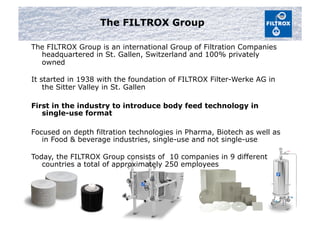
The FILTROX Group
The FILTROX Group is an international Group of Filtration Companies
headquartered in St. Gallen, Switzerland and 100% privately
owned
It started in 1938 with the foundation of FILTROX Filter-Werke AG in
the Sitter Valley in St. Gallen
First in the industry to introduce body feed technology in
single-use format
Focused on depth filtration technologies in Pharma, Biotech as well as
in Food & beverage industries, single-use and not single-use
Today, the FILTROX Group consists of 10 companies in 9 different
countries a total of approximately 250 employees
Objectives
1.  Optimization of separation of cell debris
2.  Protein content in filtrate
3.  Outlook
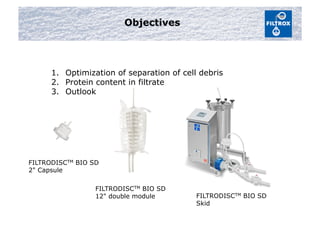
FILTRODISCTM BIO SD
2" Capsule
FILTRODISCTM BIO SD
12" double module FILTRODISCTM BIO SD
Skid
Optimization of separation of cell debris
Biomass
Recombinant E.coli producing the enzyme Cytochrome P450
- Buffer: Phosphate buffer (pH 7.5)
- Equipment: Niri Soavi Panda 2K
- Pressure: ~1000 barg
- Duration: 15 min
- Efficiency of rupture: ≥99%
- Concentration of debris after rupture: ~25 g/L (wet biomass)
Optimization of separation of cell debris
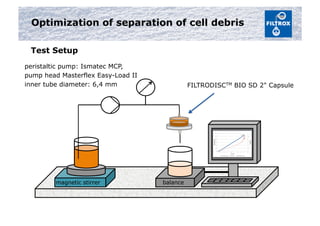
magnetic stirrer balance
FILTRODISCTM BIO SD 2" Capsule
peristaltic pump: Ismatec MCP,
pump head Masterflex Easy-Load II
inner tube diameter: 6,4 mm
Test Setup
Optimization of separation of cell debris
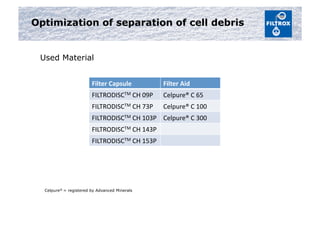
Filter	
  Capsule	
   Filter	
  Aid	
  
FILTRODISCTM	
  CH	
  09P	
   Celpure®	
  C	
  65	
  
FILTRODISCTM	
  CH	
  73P	
   Celpure®	
  C	
  100	
  
FILTRODISCTM	
  CH	
  103P	
   Celpure®	
  C	
  300	
  
FILTRODISCTM	
  CH	
  143P	
  
FILTRODISCTM	
  CH	
  153P	
  
Celpure® = registered by Advanced Minerals
Used Material
Optimization of separation of cell debris
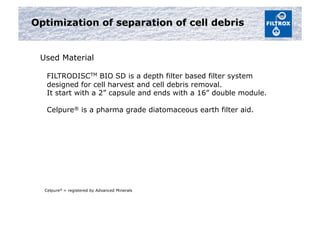
Used Material
FILTRODISCTM BIO SD is a depth filter based filter system
designed for cell harvest and cell debris removal.
It start with a 2” capsule and ends with a 16” double module.
Celpure® is a pharma grade diatomaceous earth filter aid.
Celpure® = registered by Advanced Minerals
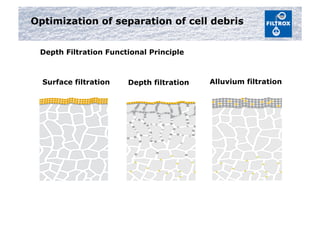
Depth filtration Alluvium filtration
Optimization of separation of cell debris
Surface filtration
Depth Filtration Functional Principle
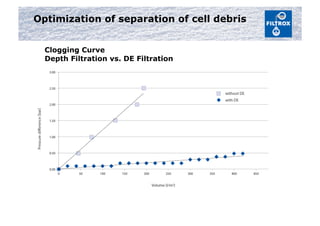
Clogging Curve
Depth Filtration vs. DE Filtration
Optimization of separation of cell debris
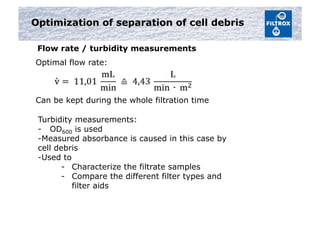
Optimal flow rate:
Can be kept during the whole filtration time
Turbidity measurements:
- OD600 is used
- Measured absorbance is caused in this case by
cell debris
- Used to
-  Characterize the filtrate samples
-  Compare the different filter types and
filter aids
Flow rate / turbidity measurements
Optimization of separation of cell debris
Filtration
number
Filter sheet
type
Filter aid type OD600 [-]
2 CH 73P Celpure® C300 0.118
6 CH 73P Celpure® C100 0.075
4 CH 73P Celpure® C65 0.056
Conclusion:
Celpure® C65 gave the lowest turbidity content
Selection of filter aid
Optimization of separation of cell debris
Selection of filter sheet type
Filtration
number
Filter
sheet type
Retention
rate [µ]
OD600 [-]
10 CH 103P 1.5 – 0.6 0.183
16 CH 143P 0.4 – 0.2 0.111
17 CH 153P 0.2 – 0.04 0.107
For further trials filter sheet type CH 103P and
Celpure® C65 was chosen.
Questions:
- reduction of OD by
1. increasing concentration of filter aid?
2. use of precoat filtration
3. use of flocculants
Optimization of separation of cell debris
Variation of filter aid concentration
Filtration
number
Cfilter aid [g/l] OD600 [-]
8 25 0.0435
13 37.5 0.0445
Celpure® C65 and
CH 103P are used
Optimization of separation of cell debris
Precoat filtration
Precoat and
filtration are done
with Celpure® C65,
CH 103P is used as
filter sheet type
Filtration Cfilter aid [g/L] OD600 [-]
precoating filtration
8 - 25 0,044
12 12,5 25 0,013
Optimization of separation of cell debris
Precoat filtration
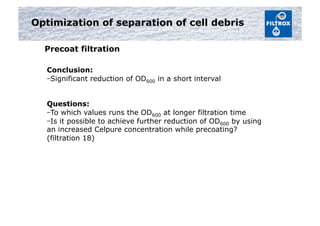
Conclusion:
- Significant reduction of OD600 in a short interval
Questions:
- To which values runs the OD600 at longer filtration time
- Is it possible to achieve further reduction of OD600 by using
an increased Celpure concentration while precoating?
(filtration 18)
Optimization of separation of cell debris
Precoat filtration
Celpure® C65 and
CH 103P are used
Filtration Vprecoating[mL] Cfilter aid [g/L] OD600
precoating filtration
8 - - 25 0,0435
11 200 25 25 0,013
18 400 25 25 0,004
Optimization of separation of cell debris
Precoat filtration
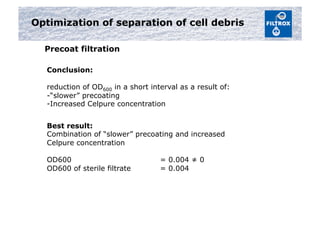
Conclusion:
reduction of OD600 in a short interval as a result of:
- “slower” precoating
- Increased Celpure concentration
Best result:
Combination of “slower” precoating and increased
Celpure concentration
OD600 = 0.004 ≠ 0
OD600 of sterile filtrate = 0.004
Optimization of separation of cell debris
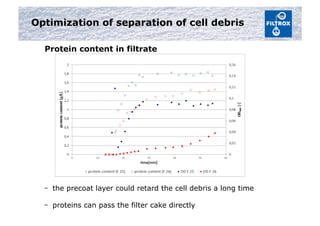
Protein content in filtrate
For the separation it is important to:
-  reduce the turbidity of the filtrate by retention of the
cell debris
-  ensure the unhindered passing of the proteins
through the precoat layer
Comparison of body feed filtration and precoat
filtration (concerning the protein concentration)
Filtration Cfilter aid [g/L] Vprecoating[mL] Vfiltration[mL]
Precoating Filtration
25 - 25 - 400
26 12,5 25 400 400
Optimization of separation of cell debris
Protein content in filtrate
-  the precoat layer could retard the cell debris a long time
-  proteins can pass the filter cake directly
Optimization of separation of cell debris
Conclusion
It is possible to separate cell debris in one step by use of
FILTRODISCTM BIO SD
best result: high protein content
low OD600 filtration
by use of precoat
Optimization of separation of cell debris
Outlook
• further optimization of all parameters while precoat filtration:
o  optimization of the formation of the precoat layer
o  optimization of Celpure® amount (precoating/filtration)
o  higher concentration of cells in unfiltrate
o  Influence of using flocculants like pDADMAC
o  examination of particle size distribution in unfiltrate and
filtrate
• determination of endotoxin levels
• determination of enzymatic activity
Optimization of separation of cell debris
Acknowledgments
• Sandra Schaumburg, MSc
• Prof. Percy Kampeis
University of Applied Science Trier
Umweltcampus Birkenfeld
Bioverfahrenstechnik
Quality from Switzerland
Thank you very much for
your attention!
Questions ?
You are welcome to visit us
on booth #10

Filtrox BILS 2016

  • 1.
    Cell Debris Removalby Single-Use Diatomaceous Earth Filtration 9th BILS, Berlin 10th & 11th February 2016
  • 2.
    The FILTROX Group TheFILTROX Group is an international Group of Filtration Companies headquartered in St. Gallen, Switzerland and 100% privately owned It started in 1938 with the foundation of FILTROX Filter-Werke AG in the Sitter Valley in St. Gallen First in the industry to introduce body feed technology in single-use format Focused on depth filtration technologies in Pharma, Biotech as well as in Food & beverage industries, single-use and not single-use Today, the FILTROX Group consists of 10 companies in 9 different countries a total of approximately 250 employees
  • 3.
    Objectives 1.  Optimization ofseparation of cell debris 2.  Protein content in filtrate 3.  Outlook FILTRODISCTM BIO SD 2" Capsule FILTRODISCTM BIO SD 12" double module FILTRODISCTM BIO SD Skid
  • 4.
    Optimization of separationof cell debris Biomass Recombinant E.coli producing the enzyme Cytochrome P450 - Buffer: Phosphate buffer (pH 7.5) - Equipment: Niri Soavi Panda 2K - Pressure: ~1000 barg - Duration: 15 min - Efficiency of rupture: ≥99% - Concentration of debris after rupture: ~25 g/L (wet biomass)
  • 5.
    Optimization of separationof cell debris magnetic stirrer balance FILTRODISCTM BIO SD 2" Capsule peristaltic pump: Ismatec MCP, pump head Masterflex Easy-Load II inner tube diameter: 6,4 mm Test Setup
  • 6.
    Optimization of separationof cell debris Filter  Capsule   Filter  Aid   FILTRODISCTM  CH  09P   Celpure®  C  65   FILTRODISCTM  CH  73P   Celpure®  C  100   FILTRODISCTM  CH  103P   Celpure®  C  300   FILTRODISCTM  CH  143P   FILTRODISCTM  CH  153P   Celpure® = registered by Advanced Minerals Used Material
  • 7.
    Optimization of separationof cell debris Used Material FILTRODISCTM BIO SD is a depth filter based filter system designed for cell harvest and cell debris removal. It start with a 2” capsule and ends with a 16” double module. Celpure® is a pharma grade diatomaceous earth filter aid. Celpure® = registered by Advanced Minerals
  • 8.
    Depth filtration Alluviumfiltration Optimization of separation of cell debris Surface filtration Depth Filtration Functional Principle
  • 9.
    Clogging Curve Depth Filtrationvs. DE Filtration Optimization of separation of cell debris
  • 10.
    Optimization of separationof cell debris Optimal flow rate: Can be kept during the whole filtration time Turbidity measurements: - OD600 is used - Measured absorbance is caused in this case by cell debris - Used to -  Characterize the filtrate samples -  Compare the different filter types and filter aids Flow rate / turbidity measurements
  • 11.
    Optimization of separationof cell debris Filtration number Filter sheet type Filter aid type OD600 [-] 2 CH 73P Celpure® C300 0.118 6 CH 73P Celpure® C100 0.075 4 CH 73P Celpure® C65 0.056 Conclusion: Celpure® C65 gave the lowest turbidity content Selection of filter aid
  • 12.
    Optimization of separationof cell debris Selection of filter sheet type Filtration number Filter sheet type Retention rate [µ] OD600 [-] 10 CH 103P 1.5 – 0.6 0.183 16 CH 143P 0.4 – 0.2 0.111 17 CH 153P 0.2 – 0.04 0.107 For further trials filter sheet type CH 103P and Celpure® C65 was chosen. Questions: - reduction of OD by 1. increasing concentration of filter aid? 2. use of precoat filtration 3. use of flocculants
  • 13.
    Optimization of separationof cell debris Variation of filter aid concentration Filtration number Cfilter aid [g/l] OD600 [-] 8 25 0.0435 13 37.5 0.0445 Celpure® C65 and CH 103P are used
  • 14.
    Optimization of separationof cell debris Precoat filtration Precoat and filtration are done with Celpure® C65, CH 103P is used as filter sheet type Filtration Cfilter aid [g/L] OD600 [-] precoating filtration 8 - 25 0,044 12 12,5 25 0,013
  • 15.
    Optimization of separationof cell debris Precoat filtration Conclusion: - Significant reduction of OD600 in a short interval Questions: - To which values runs the OD600 at longer filtration time - Is it possible to achieve further reduction of OD600 by using an increased Celpure concentration while precoating? (filtration 18)
  • 16.
    Optimization of separationof cell debris Precoat filtration Celpure® C65 and CH 103P are used Filtration Vprecoating[mL] Cfilter aid [g/L] OD600 precoating filtration 8 - - 25 0,0435 11 200 25 25 0,013 18 400 25 25 0,004
  • 17.
    Optimization of separationof cell debris Precoat filtration Conclusion: reduction of OD600 in a short interval as a result of: - “slower” precoating - Increased Celpure concentration Best result: Combination of “slower” precoating and increased Celpure concentration OD600 = 0.004 ≠ 0 OD600 of sterile filtrate = 0.004
  • 18.
    Optimization of separationof cell debris Protein content in filtrate For the separation it is important to: -  reduce the turbidity of the filtrate by retention of the cell debris -  ensure the unhindered passing of the proteins through the precoat layer Comparison of body feed filtration and precoat filtration (concerning the protein concentration) Filtration Cfilter aid [g/L] Vprecoating[mL] Vfiltration[mL] Precoating Filtration 25 - 25 - 400 26 12,5 25 400 400
  • 19.
    Optimization of separationof cell debris Protein content in filtrate -  the precoat layer could retard the cell debris a long time -  proteins can pass the filter cake directly
  • 20.
    Optimization of separationof cell debris Conclusion It is possible to separate cell debris in one step by use of FILTRODISCTM BIO SD best result: high protein content low OD600 filtration by use of precoat
  • 21.
    Optimization of separationof cell debris Outlook • further optimization of all parameters while precoat filtration: o  optimization of the formation of the precoat layer o  optimization of Celpure® amount (precoating/filtration) o  higher concentration of cells in unfiltrate o  Influence of using flocculants like pDADMAC o  examination of particle size distribution in unfiltrate and filtrate • determination of endotoxin levels • determination of enzymatic activity
  • 22.
    Optimization of separationof cell debris Acknowledgments • Sandra Schaumburg, MSc • Prof. Percy Kampeis University of Applied Science Trier Umweltcampus Birkenfeld Bioverfahrenstechnik
  • 23.
    Quality from Switzerland Thankyou very much for your attention! Questions ? You are welcome to visit us on booth #10