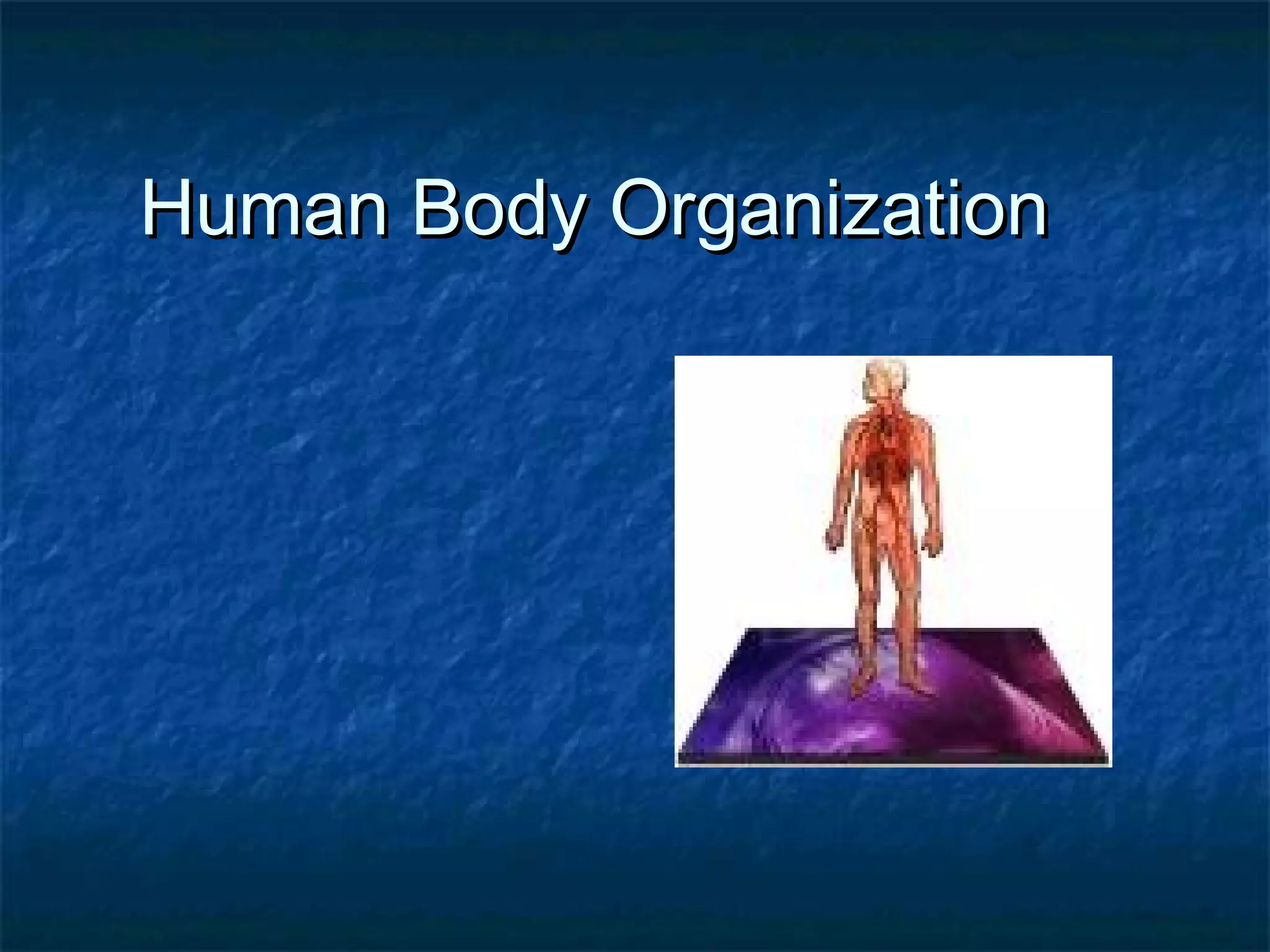
Human Body Organization
Levels of Organization
   The human body has several levels of
    organization :
   Cells of the same type joined together are
    called TISSUES
   Different Tissues are joined together to
    form ORGANS
   Various organs are arranged into an
    ORGAN SYSTEM
Lets look at tissues first...

   four major types of tissues in the human body:
   EPITHELIAL :           covers body surfaces and
    lines body cavities
   CONNECTIVE :           binds and supports body
    parts
   MUSCULAR : causes parts to move
   NERVOUS : responds to stimuli and transmits
    impulses from one body part to another
EPITHELIAL TISSUES:
     covers body, lines cavities
   covers entire body
    surface and most of the
    body's inner cavities.
   outer epidermis (skin)
    protects from injury
    and drying out
   inner epidermal tissue, on
    internal surfaces protects,
    secretes mucus (e.g.
    along digestive tract)
CONNECTIVE TISSUE
   : connects
    organs
   Functions
   bind
    structures
    together
   fill up spaces
   provide
    support and
    protection
   store fat
Structure
                                                                             Elastin
                                                                             Fiber

    cells in connective
                           Collagen
                             Fiber                                          Cell within
                                                                             Matrix

    tissue usually in
    MATRIX (a non-
                                      Structure of Loose Connective Tissue


    cellular material
    found between cells)
    usually made up of
    either collagen or
    elastin .
Muscle Tissue: Contracts for
            Movement

   muscle tissue is composed of fibers made
    of actin and myosin proteins (among
    other “helper” proteins) whose interaction
    is responsible for movement .
Nervous Tissue: Conduct
    Electrochemical Messages
   specialized tissue that forms nerves ,
    brain , spinal cord
   conduct electrical & chemical messages
    along special cells called neurons.
    Composed of cell body , dendrites
    (conduct messages to cell body), axon
    (send messages away from cell body).
ORGANS: Tissues working
          together
   organs (e.g. the heart) are
    made up of one or more
    types of tissues (usually
    more).
   SKIN is also an example of an
    organ. It is your largest organ,
    and has several tissue layers.
   Skin covers body surfaces,
    gives protection from water
    loss and invasion by
    microorganisms, contains
    sense organs , helps to
    regulate body temperature Skin
    is made up of Three Layers .
1. Digestive             convert food to usable nutrients

2. Circulatory           transport of necessary molecules to cells

3. Immune                defense against invading pathogens

4. Respiratory           gas exchange

5. Excretory             gets rid of metabolic wastes

6. Nervous & Sensory     regulation and control, response to stimuli, processing
                            information
7. Muscular & Skeletal   support and movement

8. Hormonal              regulation of internal environment, development

9. Reproductive          producing offspring
Body organization

Body organization

  • 1.
  • 2.
    Levels of Organization  The human body has several levels of organization :  Cells of the same type joined together are called TISSUES  Different Tissues are joined together to form ORGANS  Various organs are arranged into an ORGAN SYSTEM
  • 3.
    Lets look attissues first...  four major types of tissues in the human body:  EPITHELIAL : covers body surfaces and lines body cavities  CONNECTIVE : binds and supports body parts  MUSCULAR : causes parts to move  NERVOUS : responds to stimuli and transmits impulses from one body part to another
  • 4.
    EPITHELIAL TISSUES: covers body, lines cavities  covers entire body surface and most of the body's inner cavities.  outer epidermis (skin) protects from injury and drying out  inner epidermal tissue, on internal surfaces protects, secretes mucus (e.g. along digestive tract)
  • 5.
    CONNECTIVE TISSUE  : connects organs  Functions  bind structures together  fill up spaces  provide support and protection  store fat
  • 6.
    Structure Elastin Fiber cells in connective Collagen  Fiber Cell within Matrix tissue usually in MATRIX (a non- Structure of Loose Connective Tissue cellular material found between cells) usually made up of either collagen or elastin .
  • 7.
    Muscle Tissue: Contractsfor Movement  muscle tissue is composed of fibers made of actin and myosin proteins (among other “helper” proteins) whose interaction is responsible for movement .
  • 8.
    Nervous Tissue: Conduct Electrochemical Messages  specialized tissue that forms nerves , brain , spinal cord  conduct electrical & chemical messages along special cells called neurons. Composed of cell body , dendrites (conduct messages to cell body), axon (send messages away from cell body).
  • 9.
    ORGANS: Tissues working together  organs (e.g. the heart) are made up of one or more types of tissues (usually more).  SKIN is also an example of an organ. It is your largest organ, and has several tissue layers.  Skin covers body surfaces, gives protection from water loss and invasion by microorganisms, contains sense organs , helps to regulate body temperature Skin is made up of Three Layers .
  • 10.
    1. Digestive convert food to usable nutrients 2. Circulatory transport of necessary molecules to cells 3. Immune defense against invading pathogens 4. Respiratory gas exchange 5. Excretory gets rid of metabolic wastes 6. Nervous & Sensory regulation and control, response to stimuli, processing information 7. Muscular & Skeletal support and movement 8. Hormonal regulation of internal environment, development 9. Reproductive producing offspring