Introduction and Tissues
              Human Anatomy
                BIOL 1010

               Liston Campus
What is Anatomy?
Anatomy (= morphology): study of body’s structure
Physiology: study of body’s function
Structure reflects Function!!!
Branches of Anatomy
   Gross: Large structures
   Surface: Landmarks
   Histology: Cells and Tissues
   Developmental: Structures change through life
   Embryology: Structures form and develop before birth
Hierarchy of Structural
Organization
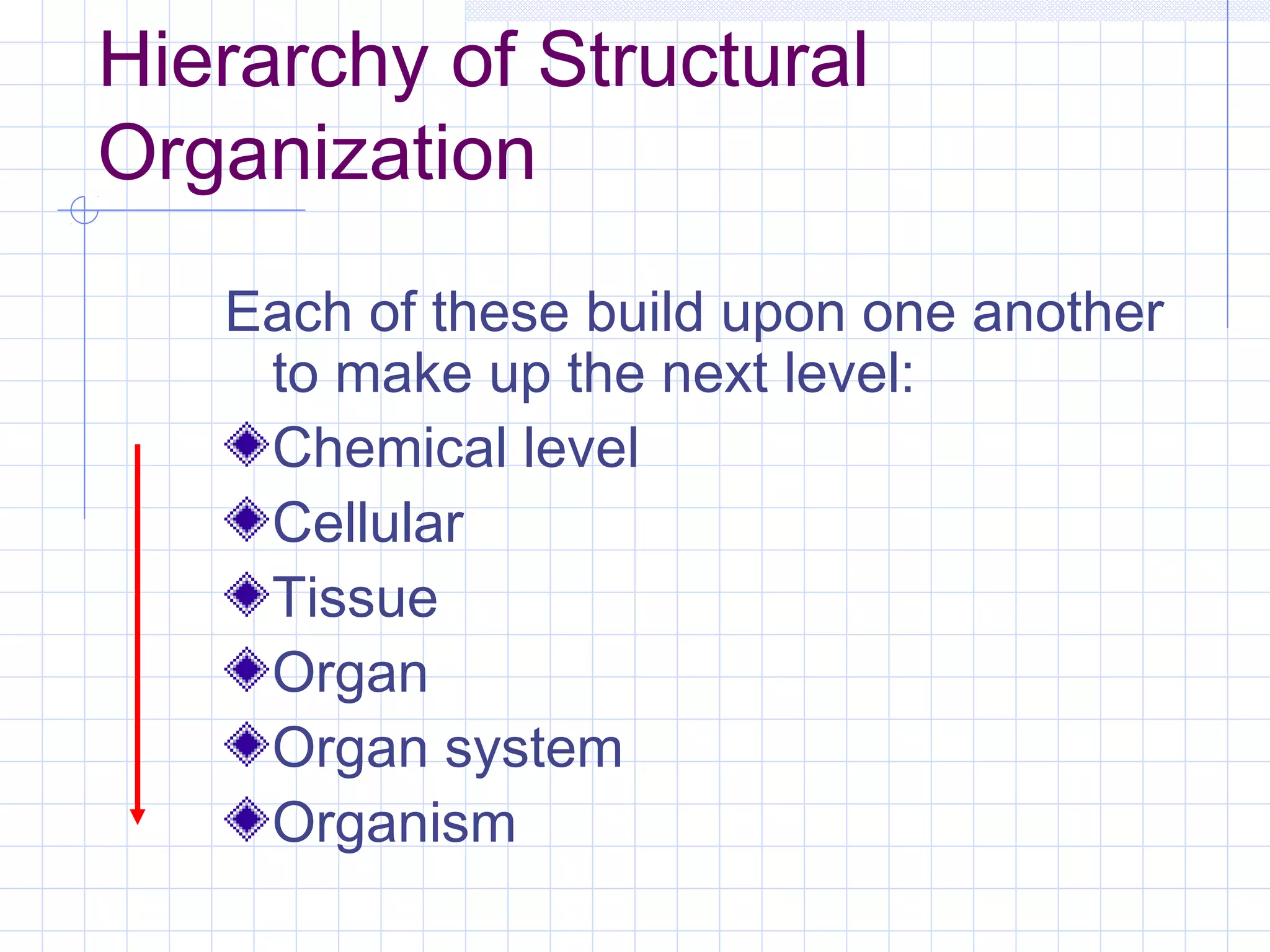
   Each of these build upon one another
    to make up the next level:
    Chemical level
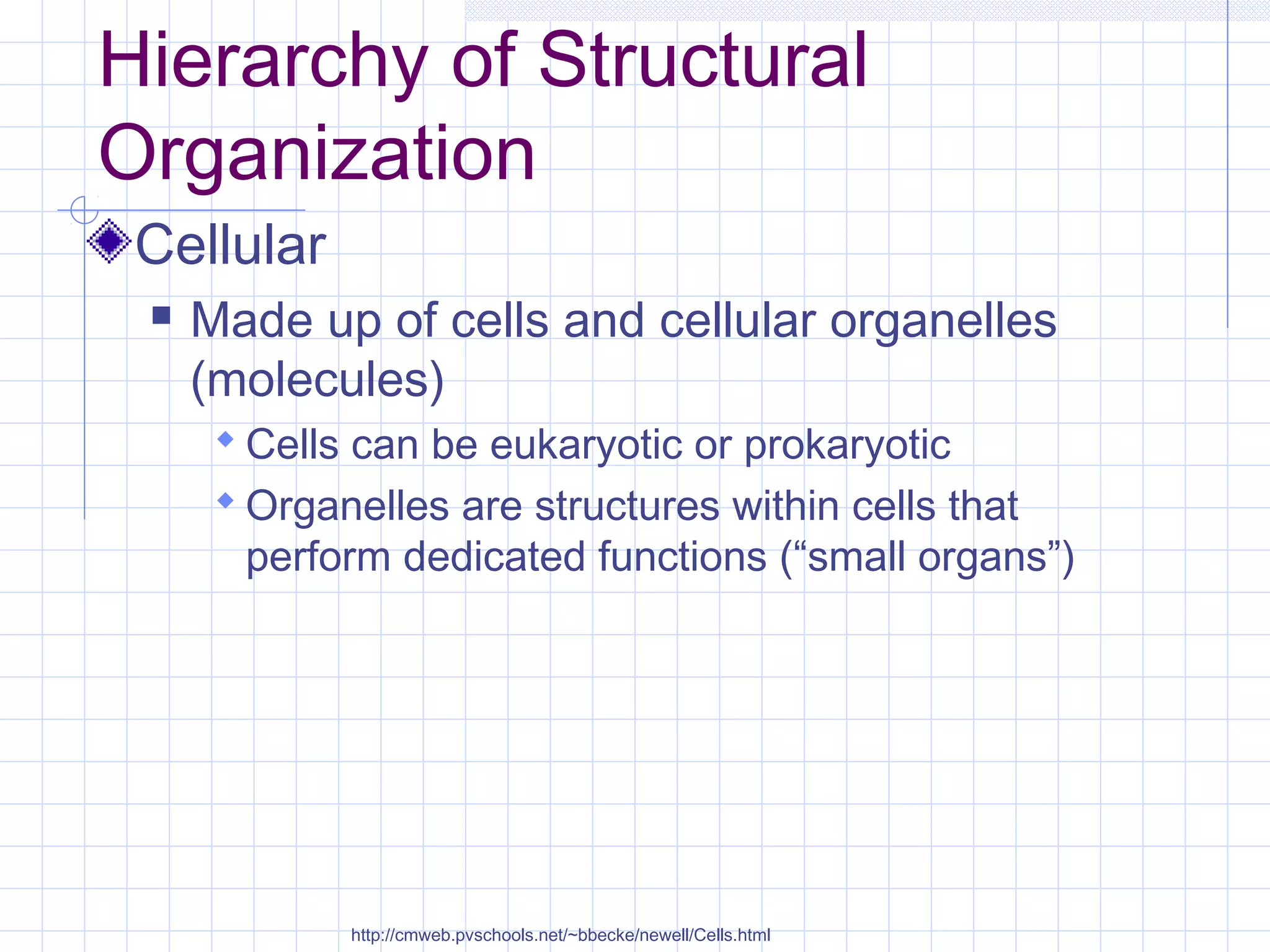
    Cellular
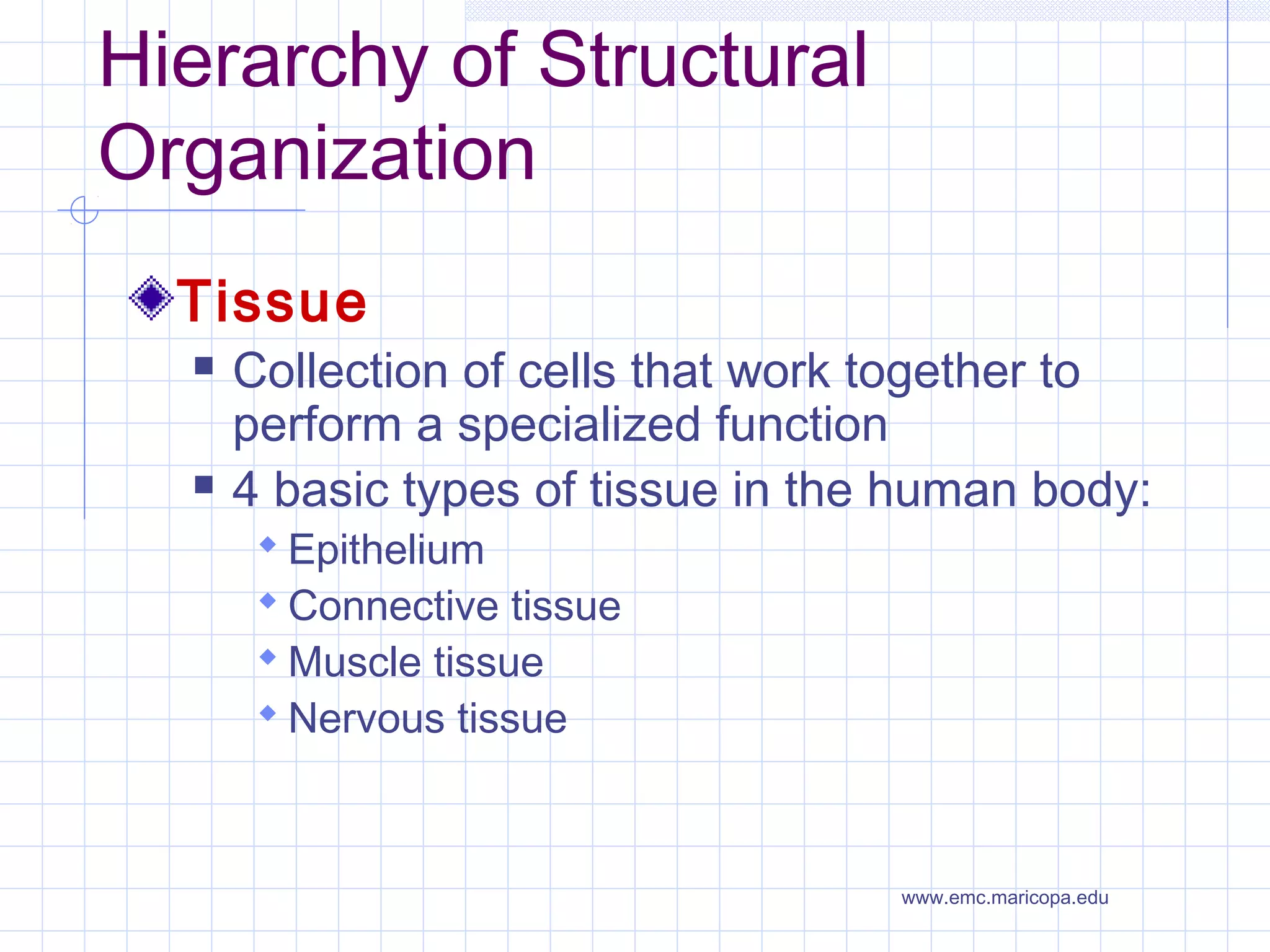
    Tissue
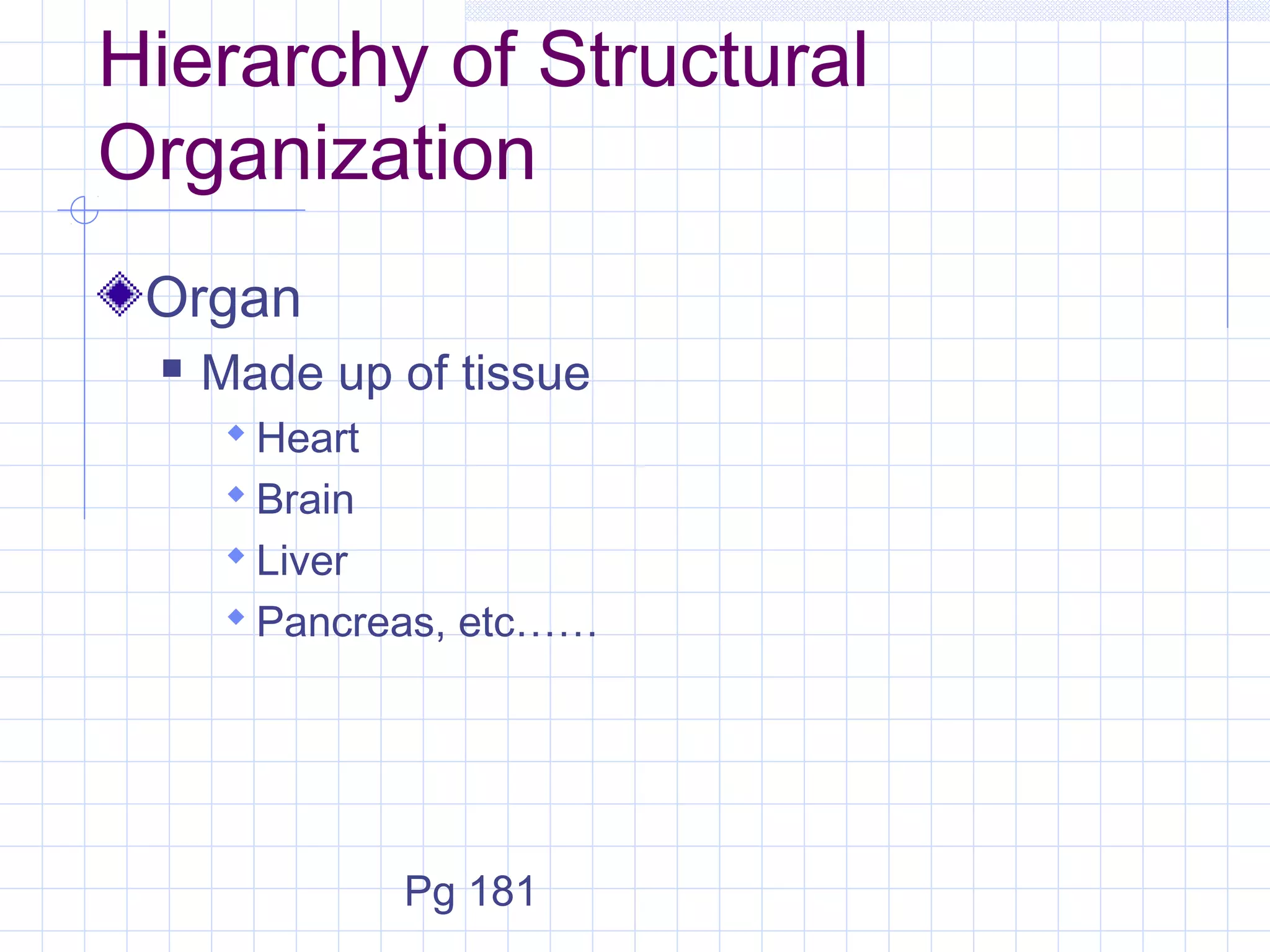
    Organ
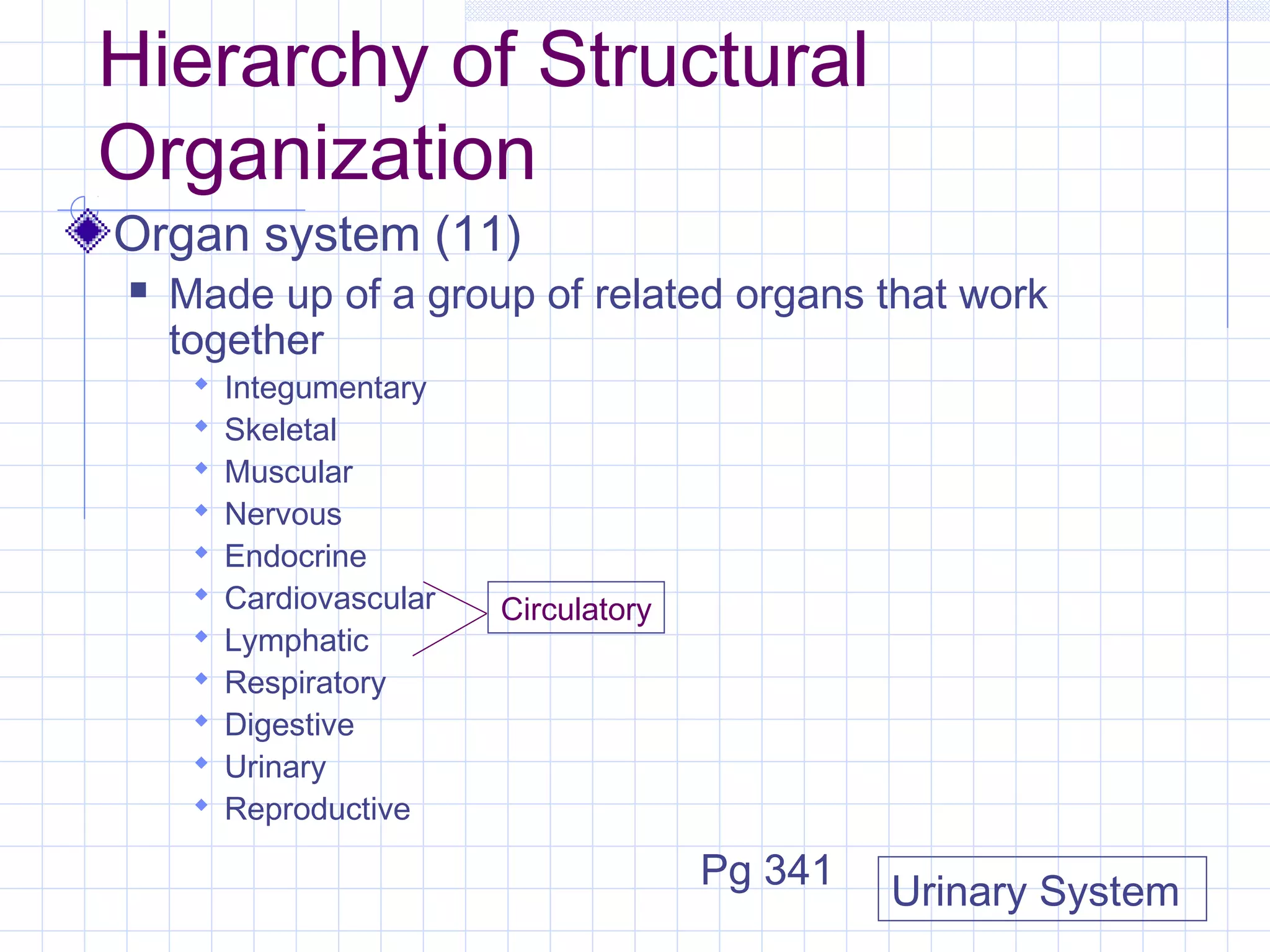
    Organ system
    Organism
Hierarchy of Structural
Organization
  Chemical level
     Atoms combine to make molecules
     4 macromolecules in the body
       Carbohydrates
       Lipids
       Proteins
       Nucleic acids
Hierarchy of Structural
Organization
 Cellular
    Made up of cells and cellular organelles
     (molecules)
       Cells can be eukaryotic or prokaryotic
       Organelles are structures within cells that
       perform dedicated functions (“small organs”)


             http://cmweb.pvschools.net/~bbecke/newell/Cells.html
Hierarchy of Structural
Organization
  Tissue
     Collection of cells that work together to
      perform a specialized function
     4 basic types of tissue in the human body:
        Epithelium
        Connective tissue
        Muscle tissue
        Nervous tissue


                                    www.emc.maricopa.edu
Hierarchy of Structural
Organization
 Organ
    Made up of tissue
       Heart
       Brain
       Liver
       Pancreas, etc……


                Pg 181
Hierarchy of Structural
Organization
Organ system (11)
   Made up of a group of related organs that work
    together
        Integumentary
        Skeletal
        Muscular
        Nervous
        Endocrine
        Cardiovascular   Circulatory
        Lymphatic
        Respiratory
        Digestive
        Urinary
        Reproductive

                                        Pg 341
                                                 Urinary System
Hierarchy of Structural
Organization
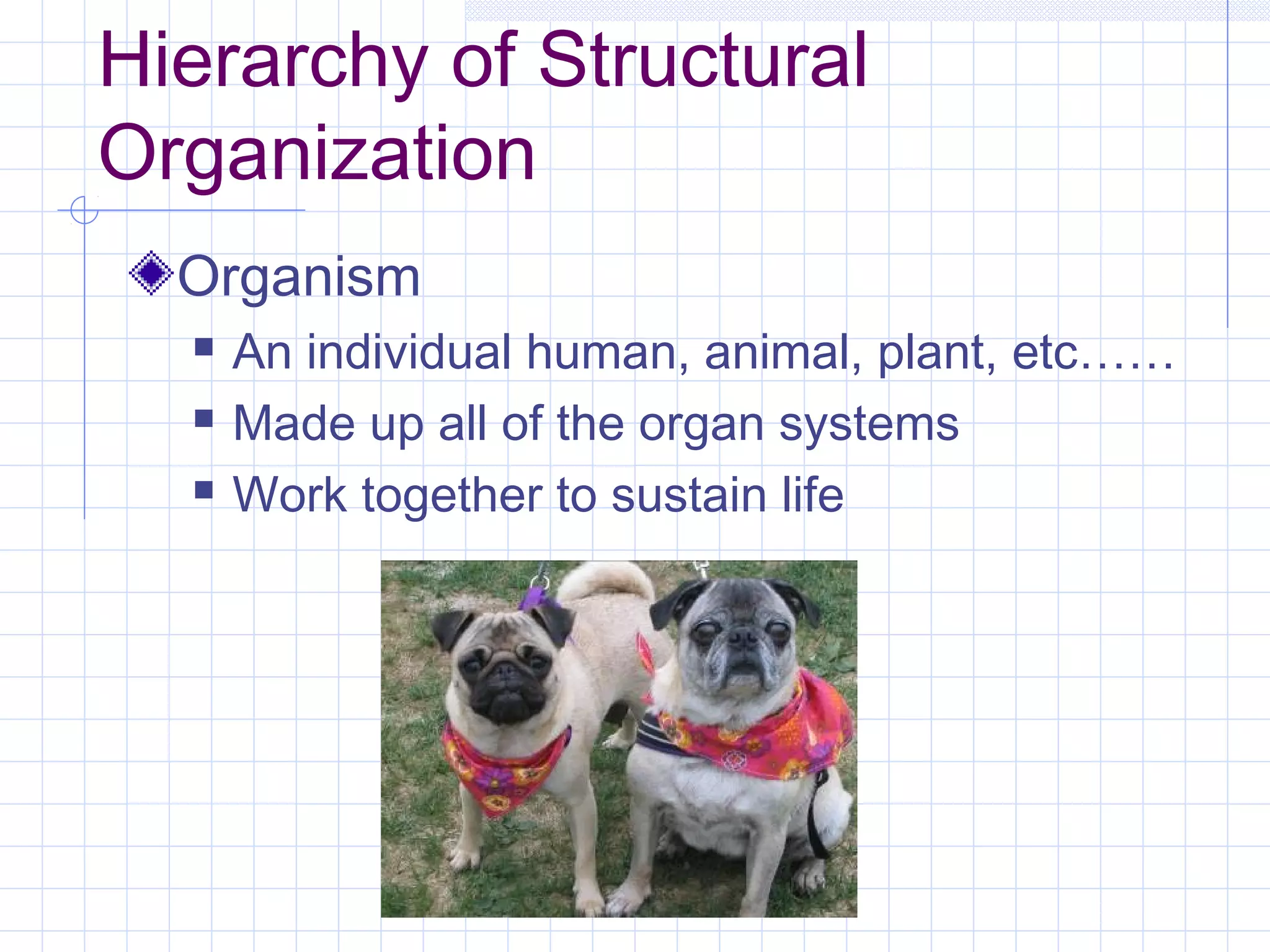
  Organism
     An individual human, animal, plant, etc……
     Made up all of the organ systems
     Work together to sustain life
Anatomical Directions
Anatomical position
Regions
   Axial vs. Appendicular
Anatomical Directions-It’s all Relative!
   Anterior (ventral) vs. Posterior (dorsal)
   Medial vs. Lateral
   Superior (cranial) vs. Inferior (caudal)
   Superficial vs. Deep
   Proximal vs. Distal
Anatomical Planes
   Frontal = Coronal
   Transverse = Horizontal = Cross Section
   Sagittal                                    Pg 5
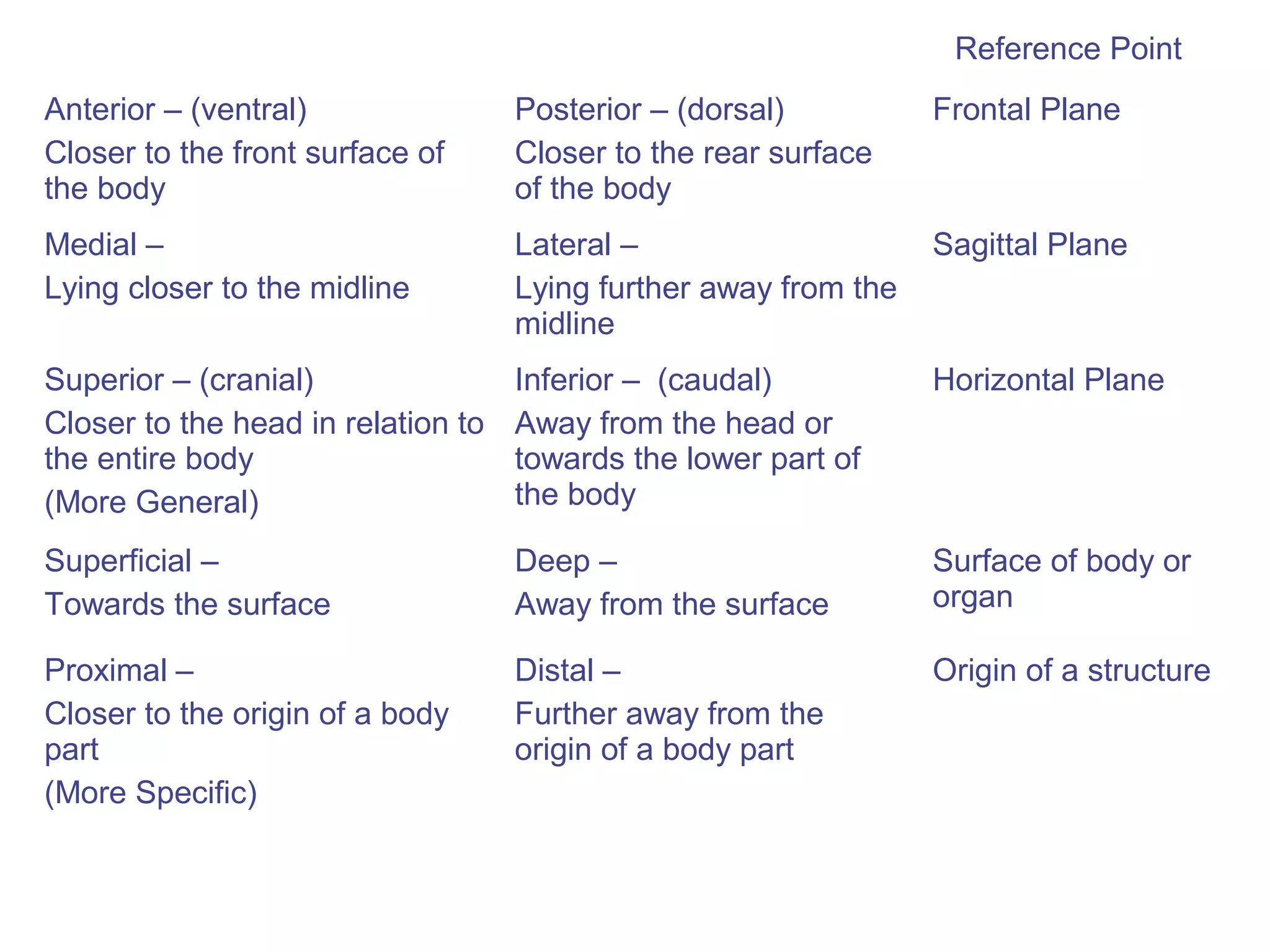
Reference Point
Anterior – (ventral)                Posterior – (dorsal)          Frontal Plane
Closer to the front surface of      Closer to the rear surface
the body                            of the body
Medial –                            Lateral –                     Sagittal Plane
Lying closer to the midline         Lying further away from the
                                    midline
Superior – (cranial)                Inferior – (caudal)           Horizontal Plane
Closer to the head in relation to   Away from the head or
the entire body                     towards the lower part of
(More General)                      the body

Superficial –                       Deep –                        Surface of body or
Towards the surface                 Away from the surface         organ

Proximal –                          Distal –                      Origin of a structure
Closer to the origin of a body      Further away from the
part                                origin of a body part
(More Specific)
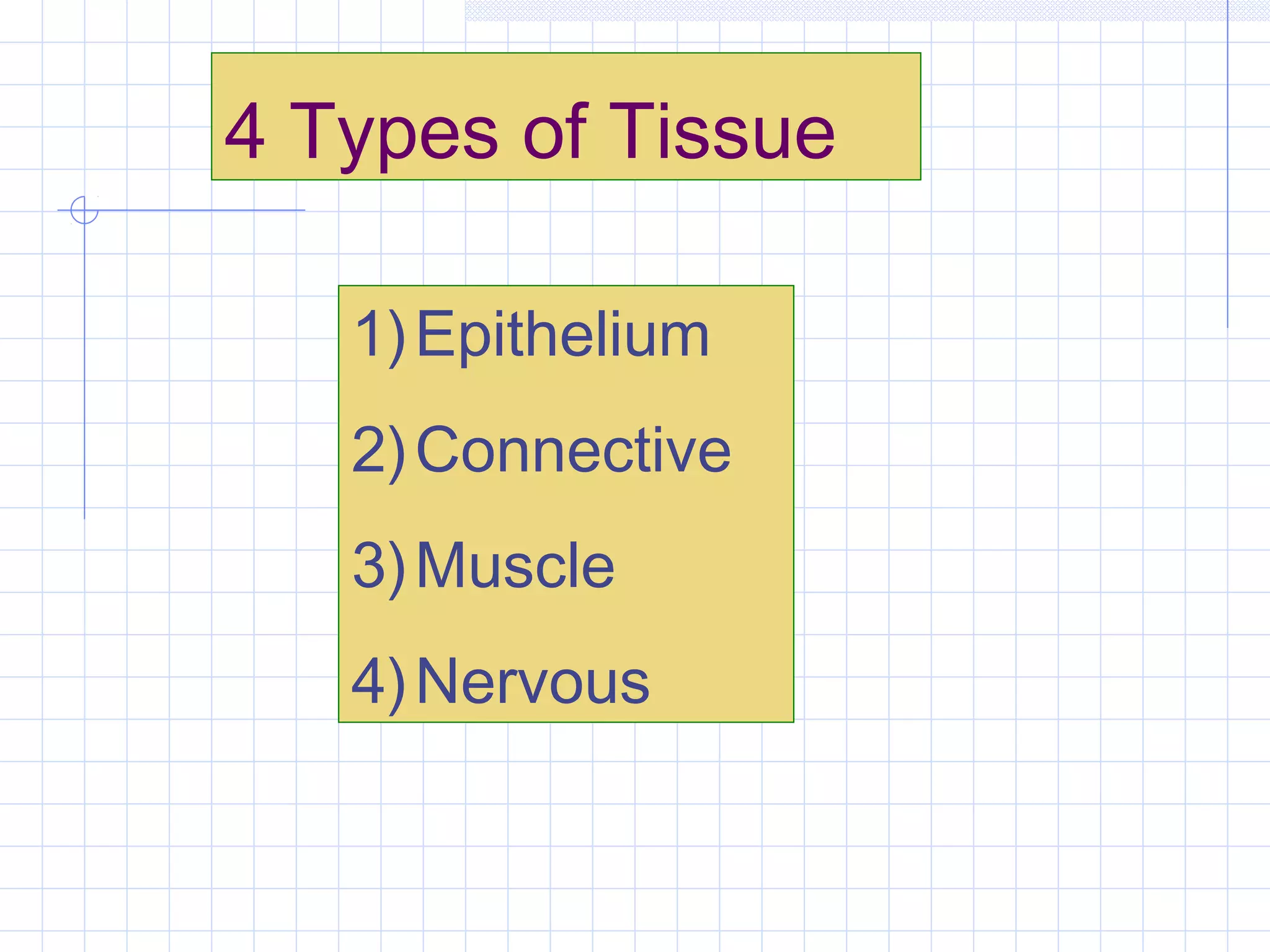
4 Types of Tissue

   1) Epithelium
   2) Connective
   3) Muscle
   4) Nervous
Tissues: groups of cells closely associated that
have a similar structure and perform a related function


    Four types of tissue
        Epithelial = covering/lining
        Connective = support
        Muscle = movement
        Nervous = control
    Most organs contain all 4 types
    Tissue has non-living extracellular
    material between its cells
EPITHELIAL TISSUE: sheets of
cells    cover a surface or line a cavity
 Functions
 Protection
 Secretion

 Absorption

 Ion Transport
Characteristics of Epithelium
 Cellularity
     Composed of cells
 Specialized contacts
     Joined by cell junctions
 Polarity
     Apical vs. Basal surfaces differ
 Supported by connective tissue
 Avascular
 Innervated
 Highly regenerative
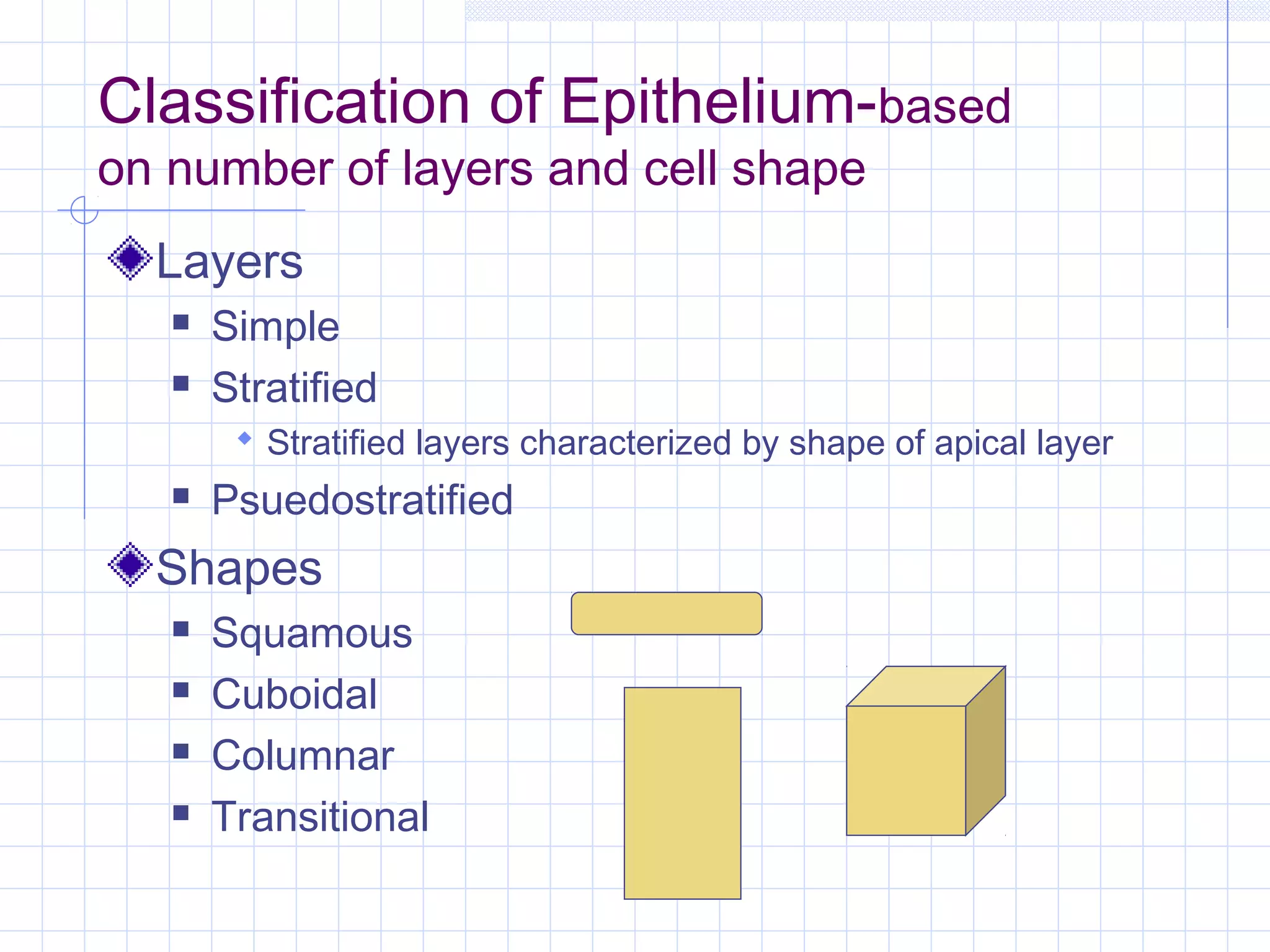
Classification of Epithelium-based
on number of layers and cell shape
  Layers
      Simple
      Stratified
         Stratified layers characterized by shape of apical layer
      Psuedostratified
  Shapes
      Squamous
      Cuboidal
      Columnar
      Transitional
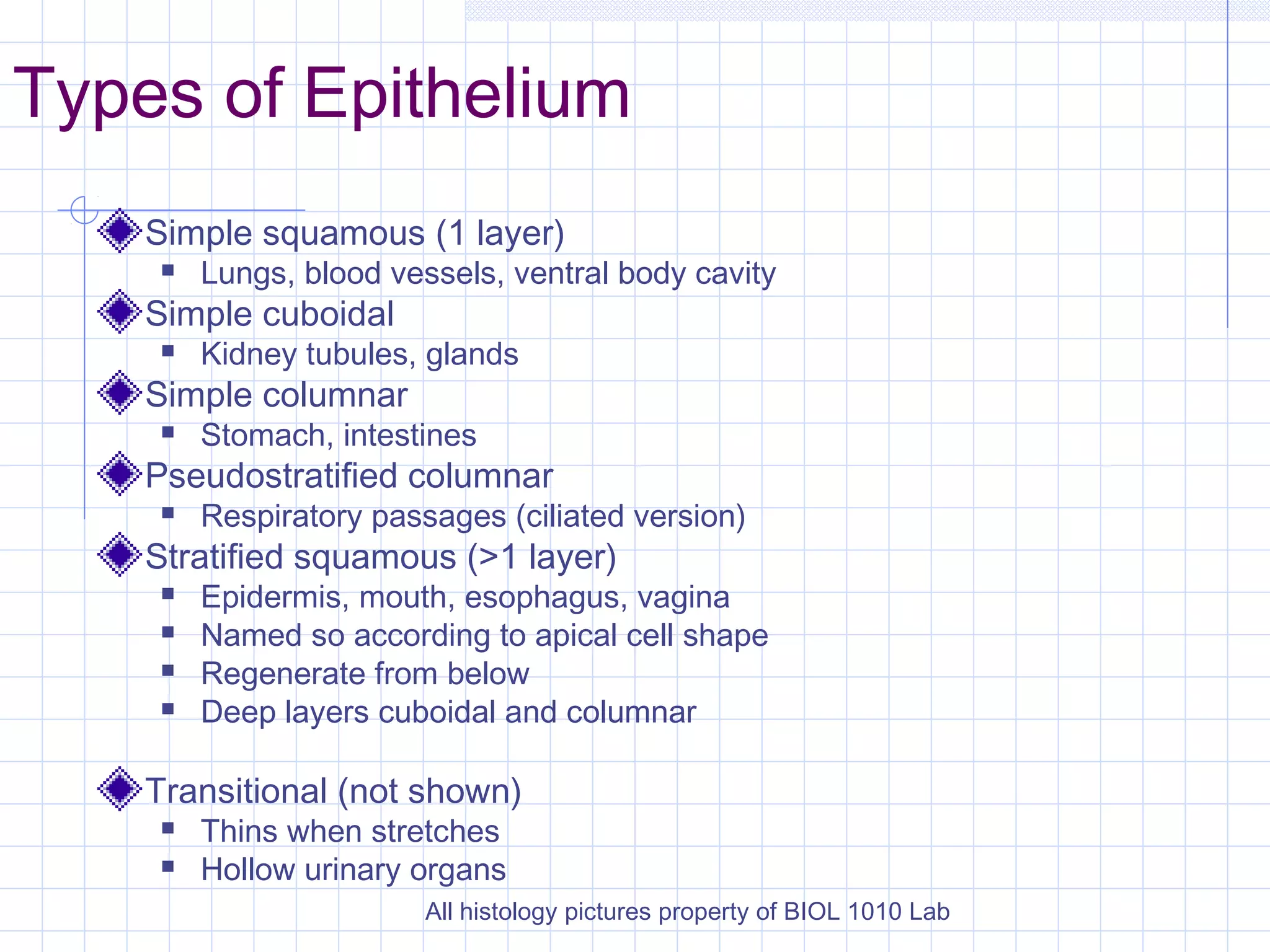
Types of Epithelium
    Simple squamous (1 layer)
        Lungs, blood vessels, ventral body cavity
    Simple cuboidal
        Kidney tubules, glands
    Simple columnar
        Stomach, intestines
    Pseudostratified columnar
        Respiratory passages (ciliated version)
    Stratified squamous (>1 layer)
        Epidermis, mouth, esophagus, vagina
        Named so according to apical cell shape
        Regenerate from below
        Deep layers cuboidal and columnar

    Transitional (not shown)
        Thins when stretches
        Hollow urinary organs
                         All histology pictures property of BIOL 1010 Lab
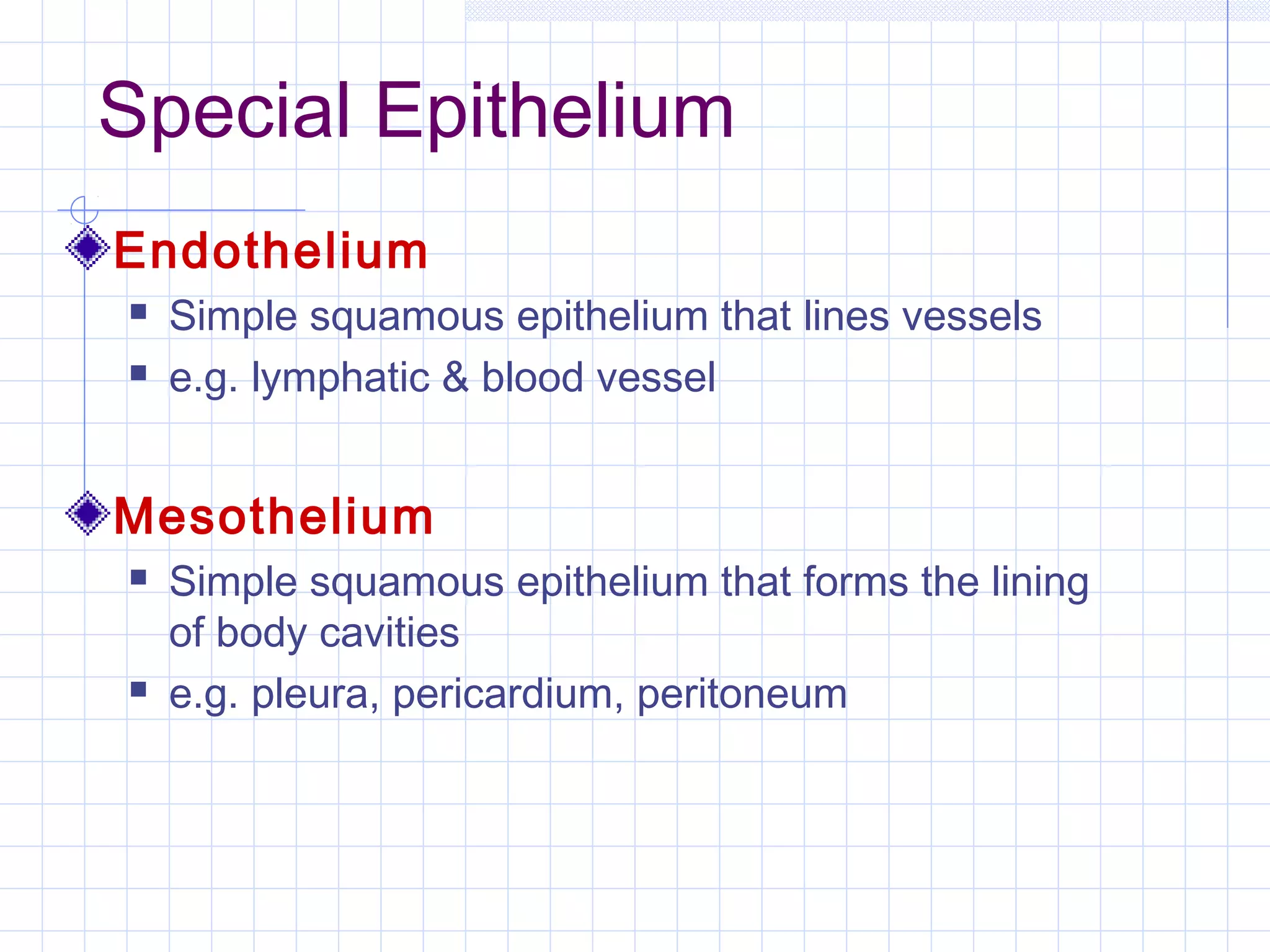
Special Epithelium
Endothelium
   Simple squamous epithelium that lines vessels
   e.g. lymphatic & blood vessel


Mesothelium
   Simple squamous epithelium that forms the lining
    of body cavities
   e.g. pleura, pericardium, peritoneum
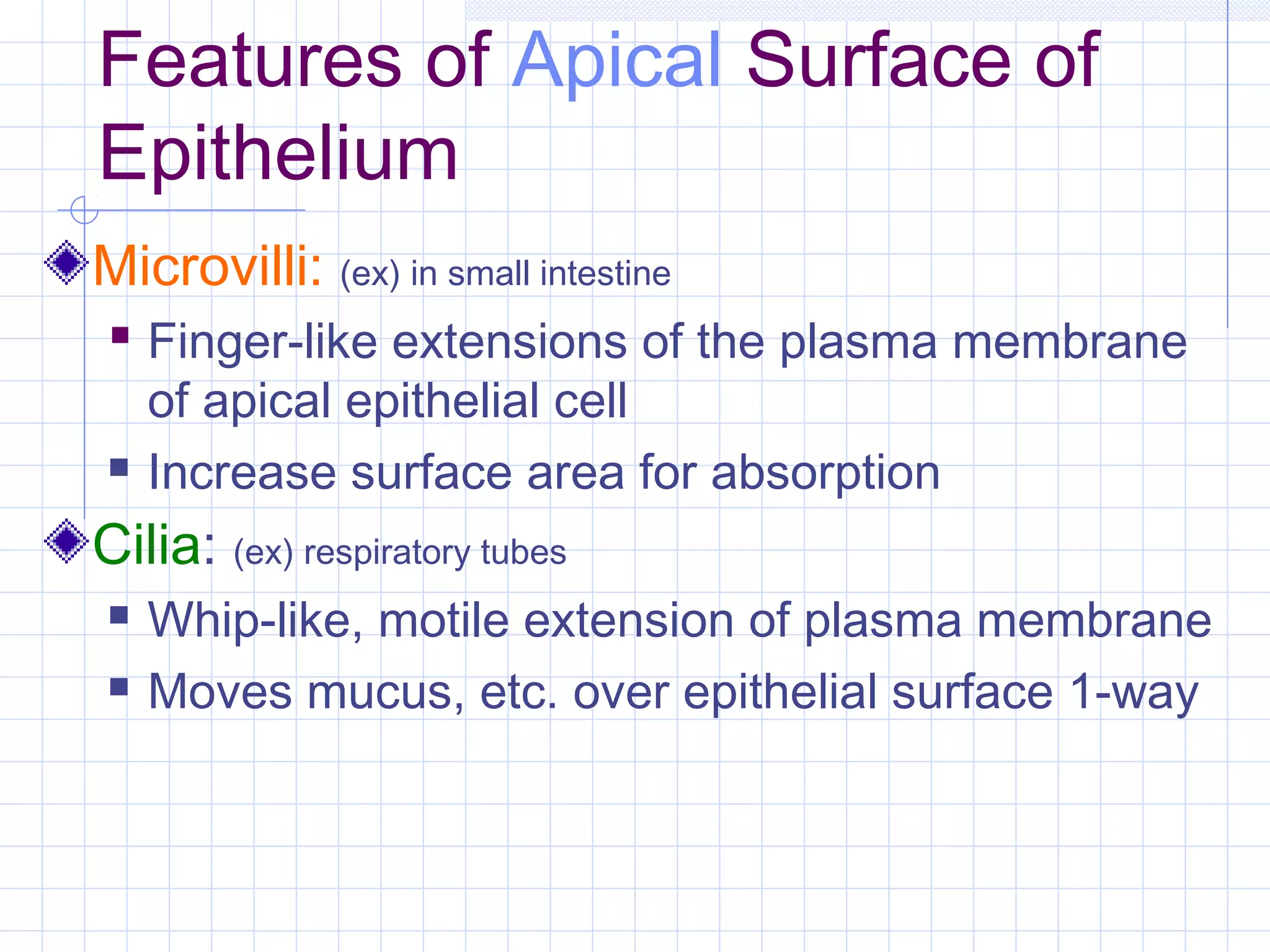
Features of Apical Surface of
Epithelium
Microvilli: (ex) in small intestine
 Finger-like extensions of the plasma membrane
    of apical epithelial cell
   Increase surface area for absorption
Cilia: (ex) respiratory tubes
   Whip-like, motile extension of plasma membrane
   Moves mucus, etc. over epithelial surface 1-way
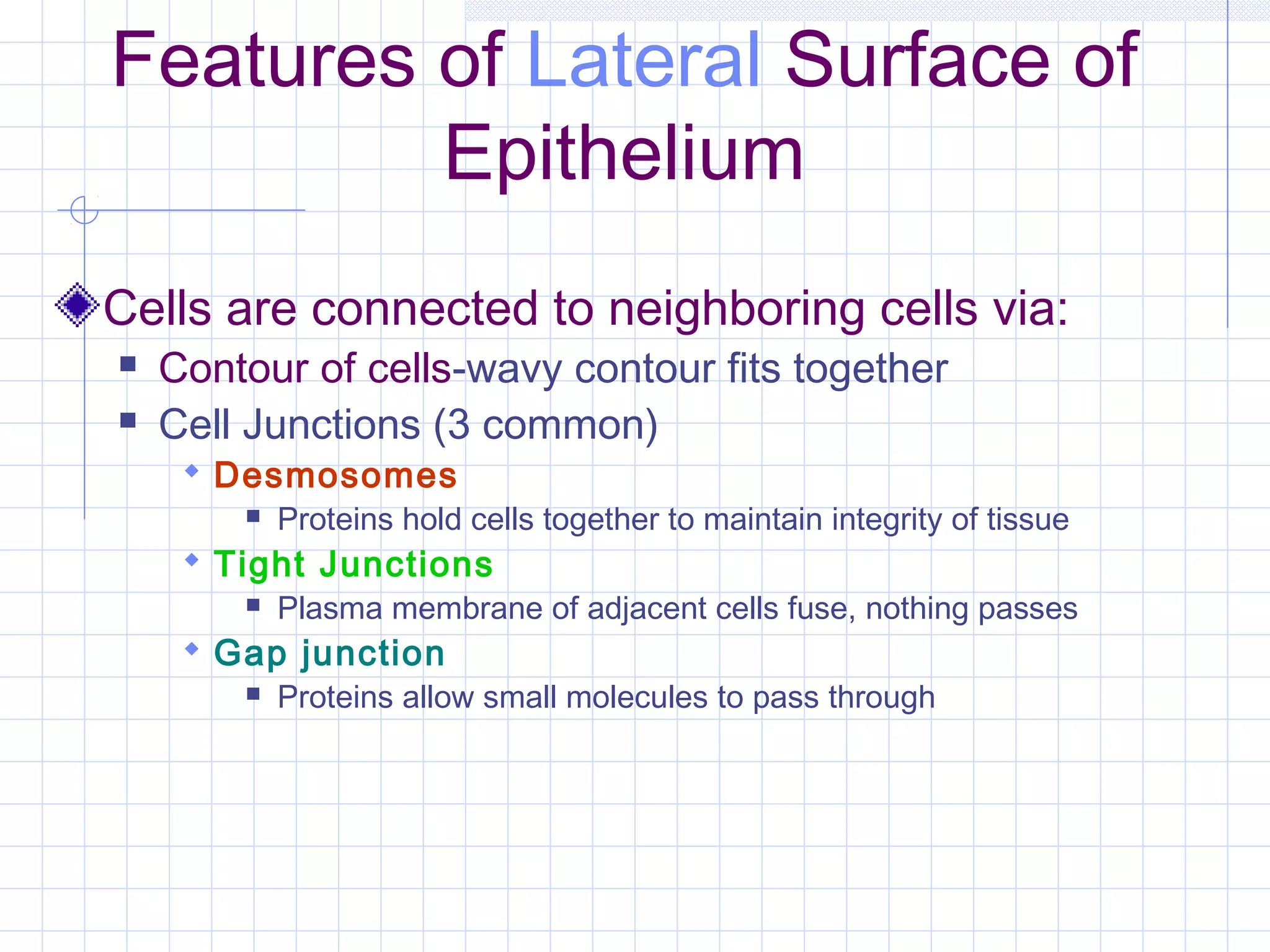
Features of Lateral Surface of
         Epithelium
Cells are connected to neighboring cells via:
   Contour of cells-wavy contour fits together
   Cell Junctions (3 common)
      Desmosomes
           Proteins hold cells together to maintain integrity of tissue
      Tight Junctions
           Plasma membrane of adjacent cells fuse, nothing passes
      Gap junction
           Proteins allow small molecules to pass through
Features of the Basal Surface
        of Epithelium
 Basement membrane
    Sheet between the epithelial and connective tissue
     layers
    Attaches epithelium to connective tissue below
    Made up of:
       Basal lamina: thin, non-cellular, supportive sheet made of
        proteins
             Superficial layer
             Acts as a selective filter
             Assists epithelial cell regeneration by moving new cells
       Reticular fiber layer
             Deeper layer
             Support
Glands
 Epithelial cells that make and secrete a
 product
 Products are water-based and usually
 contain proteins
 Classified as:
    Unicellular vs. multicellular
    Exocrine vs. Endocrine


                     Page
Glands: epithelial cells that make and
secrete a water-based substance w/proteins
 Exocrine Glands
     Secrete substance onto body surface or into
      body cavity
     Activity is local
     Have ducts
     Unicellular or Multicellular
     (ex) goblet cells, salivary, mammary,
      pancreas, liver
Glands: epithelial cells that make and
secrete a water-based substance w/proteins
  Endocrine Glands
     Secrete product into blood stream
     Either stored in secretory cells or in follicle
      surrounded by secretory cells
     Hormones travel to target organ to increase
      response (excitatory)
     No ducts
     (ex) pancreas, adrenal, pituitary, thyroid
4 Types of Tissue

   1) Epithelium
   2) Connective
   3) Muscle
   4) Nervous
4 Types of Connective Tissue

   1)   Connective Tissue Proper
   2)   Cartilage
   3)   Bone Tissue
   4)   Blood
Connective Tissue (CT):
most abundant and diverse tissue
  Four Classes
  Functions include connecting, storing &
 carrying nutrients, protection, fight infection
  CT contains large amounts of non-living
 extracellular matrix
 Contains a variety of cells and fibers
 Some types vascularized
 All CT originates from mesenchyme
    Embryonic connective tissue
Fibers in Connective Tissue
 Fibers For Support
     Reticular:
        form networks for structure & support
        (ex) cover capillaries
     Collagen:
        strongest, most numerous, provide tensile strength
        (ex) dominant fiber in ligaments
     Elastic:
        long + thin, stretch and retain shape
        (ex) dominant fiber in elastic cartilage
Components of Connective
Tissue
  Fibroblasts:
      cells that produce all fibers in CT
      produce + secrete protein subunits to make them
      produce ground matrix
  Interstitial (Tissue) Fluid
      derived from blood in CT proper
      medium for nutrients, waste + oxygen to travel to cells
      found in ground matrix
  Ground Matrix (substance):
      part of extra-cellular material that holds and absorbs
       interstitial fluid
      Made and secreted by fibroblasts
      jelly-like with sugar & protein molecules
1) Connective Tissue Proper
Two kinds: Loose CT & Dense CT
   Functions
      Support and bind to other tissue
      Hold body fluids
      Defends against infection
      Stores nutrients as fat
   Each function performed by different kind
    of fibers and cells in specific tissue
Defense from Infection
  Areolar tissue below epithelium is body’s first
 defense
 Cells travel to CT in blood
     Macrophages-eat foreign particles
     Plasma cells-secrete antibodies, mark molecules
      for destruction
     Mast cells-contain chemical mediators for
      inflammation response
     White Blood Cells = neutrophils, lymphocytes,
      eosinophils-fight infection
 Ground substance + cell fibers-slow invading
 microorganisms
Loose CT Proper

  Areolar CT
      All types of fibers present
      All typical cell types present
      Surrounds blood vessels and nerves
Specialized Loose CT Proper
Adipose tissue
    Loaded with adipocytes, highly vascularized, high
     metabolic activity
    Insulates, produces energy, supports
    Found in hypodermis under skin
Reticular CT
    Contains only reticular fibers
    Forms caverns to hold free cells, forms internal
     “skeleton” of some organs
    Found in bone marrow, holds blood cells, lymph
     nodes, spleen
Dense/Fibrous Connective
Tissue
  Contains more collagen
  Can resist extremely strong pulling forces
  Regular vs. Irregular
      Regular-fibers run same direction, parallel to pull
         (eg) fascia, tendons, ligaments
      Irregular-fibers thicker, run in different directions
         (eg) dermis, fibrous capsules at ends of bones


   Dense regular                            Dense irregular
Components of CT Proper
Summarized
   Cells                Matrix

   Fibroblasts          Gel-like ground
                        substance
   Defense cells Collagen fibers
   -macrophages
                        Reticular fibers
   -white blood cells
                        Elastic fibers
   Adipocytes
2) Cartilage
    Chondroblasts produce cartilage
    Chondrocytes mature cartilage cells
       Reside in lacunae
    More abundant in embryo than adult
    Firm, Flexible
    Resists compression
       (eg) trachea, meniscus
    Avascular (chondrocytes can function w/ low oxygen)
    NOT Innervated
    Perichondrium
       dense, irregular connective tissue around cartilage
       growth/repair of cartilage
       resists expansion during compression of cartilage
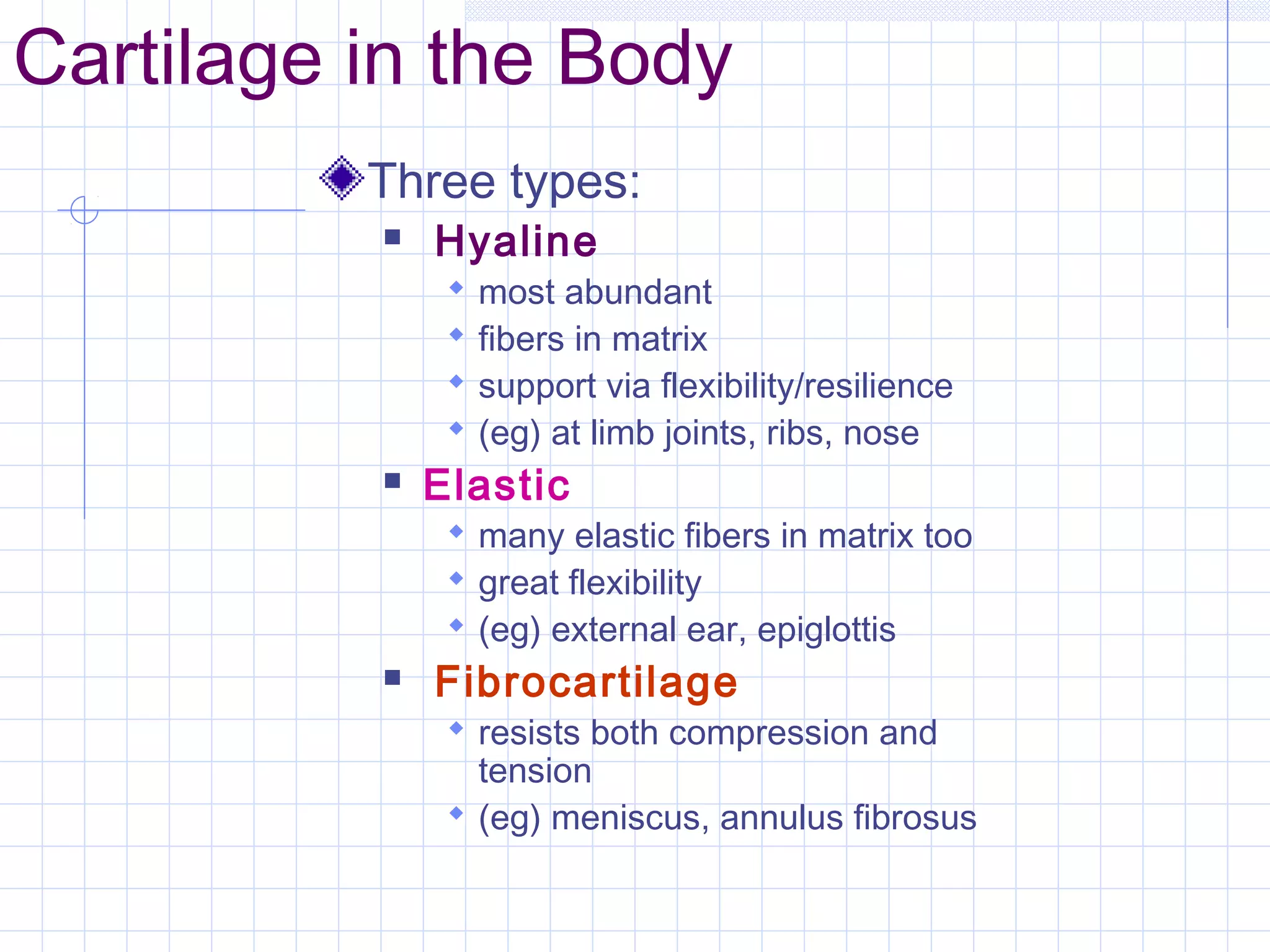
Cartilage in the Body
          Three types:
             Hyaline
                  most abundant
                  fibers in matrix
                  support via flexibility/resilience
                  (eg) at limb joints, ribs, nose
             Elastic
                many elastic fibers in matrix too
                great flexibility
                (eg) external ear, epiglottis
             Fibrocartilage
                resists both compression and
                 tension
                (eg) meniscus, annulus fibrosus
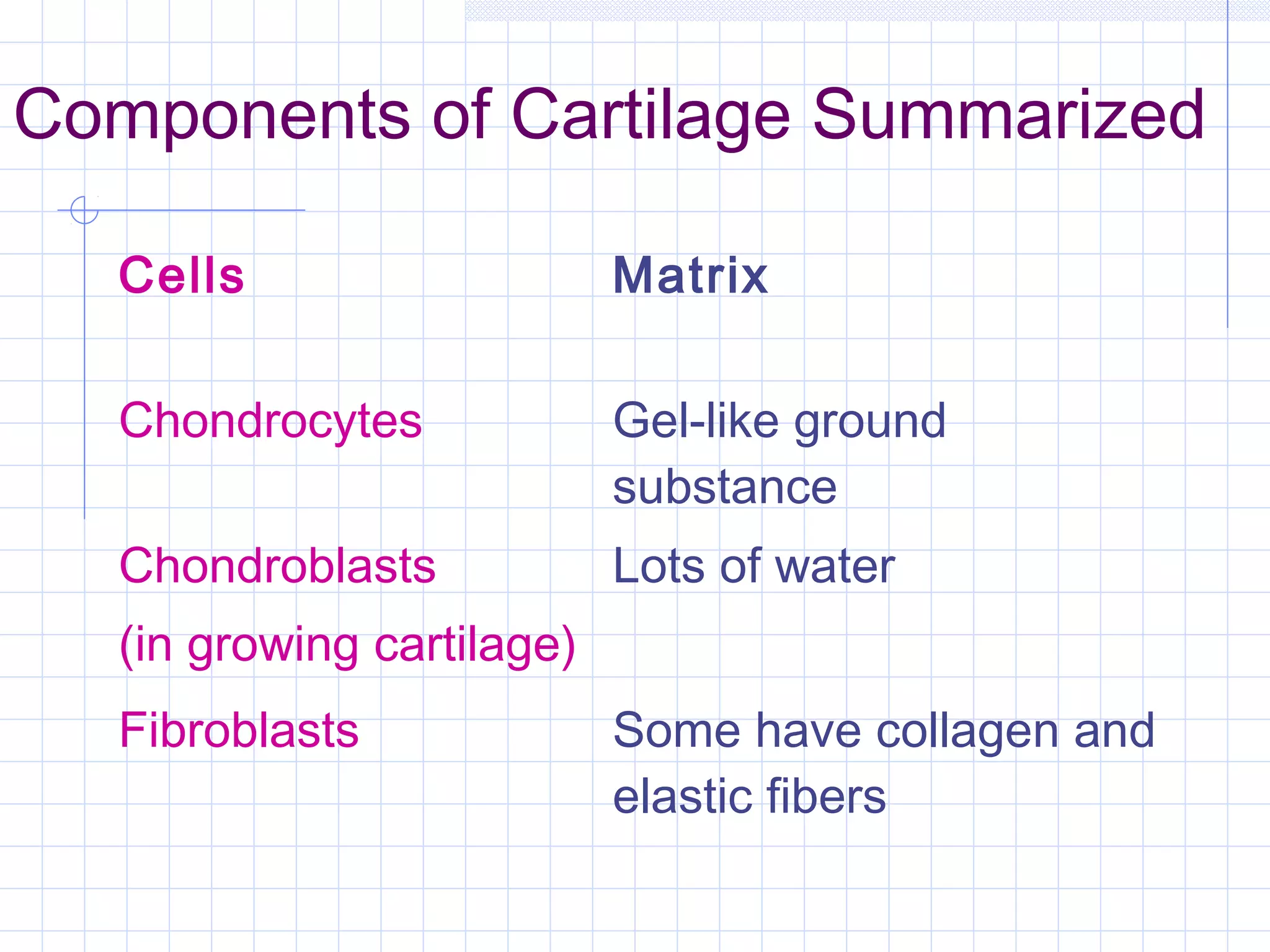
Components of Cartilage Summarized

   Cells                    Matrix

   Chondrocytes             Gel-like ground
                            substance
   Chondroblasts            Lots of water
   (in growing cartilage)
   Fibroblasts              Some have collagen and
                            elastic fibers
3) Bone Tissue: (a bone is an organ)

  Well-vascularized
  Function:
     support (eg) pelvic bowl, legs
     protect (eg) skull, vertebrae
     mineral storage (eg) calcium, phosphate
      (inorganic component)
     movement (eg) walk, grasp objects
     blood-cell formation (eg) red bone marrow
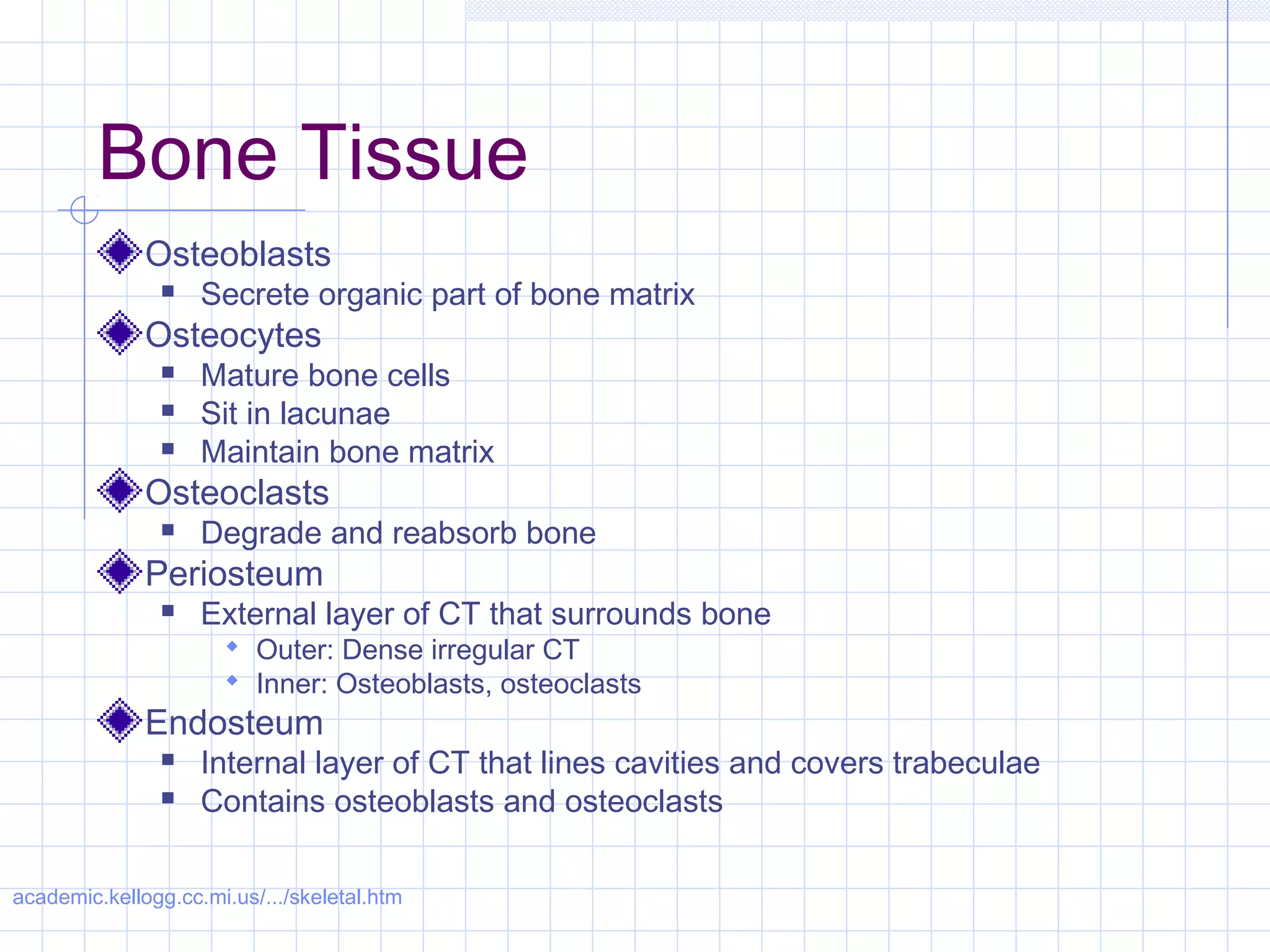
Bone Tissue
              Osteoblasts
                   Secrete organic part of bone matrix
              Osteocytes
                   Mature bone cells
                   Sit in lacunae
                   Maintain bone matrix
              Osteoclasts
                   Degrade and reabsorb bone
              Periosteum
                   External layer of CT that surrounds bone
                       Outer: Dense irregular CT
                       Inner: Osteoblasts, osteoclasts
              Endosteum
                   Internal layer of CT that lines cavities and covers trabeculae
                   Contains osteoblasts and osteoclasts

academic.kellogg.cc.mi.us/.../skeletal.htm
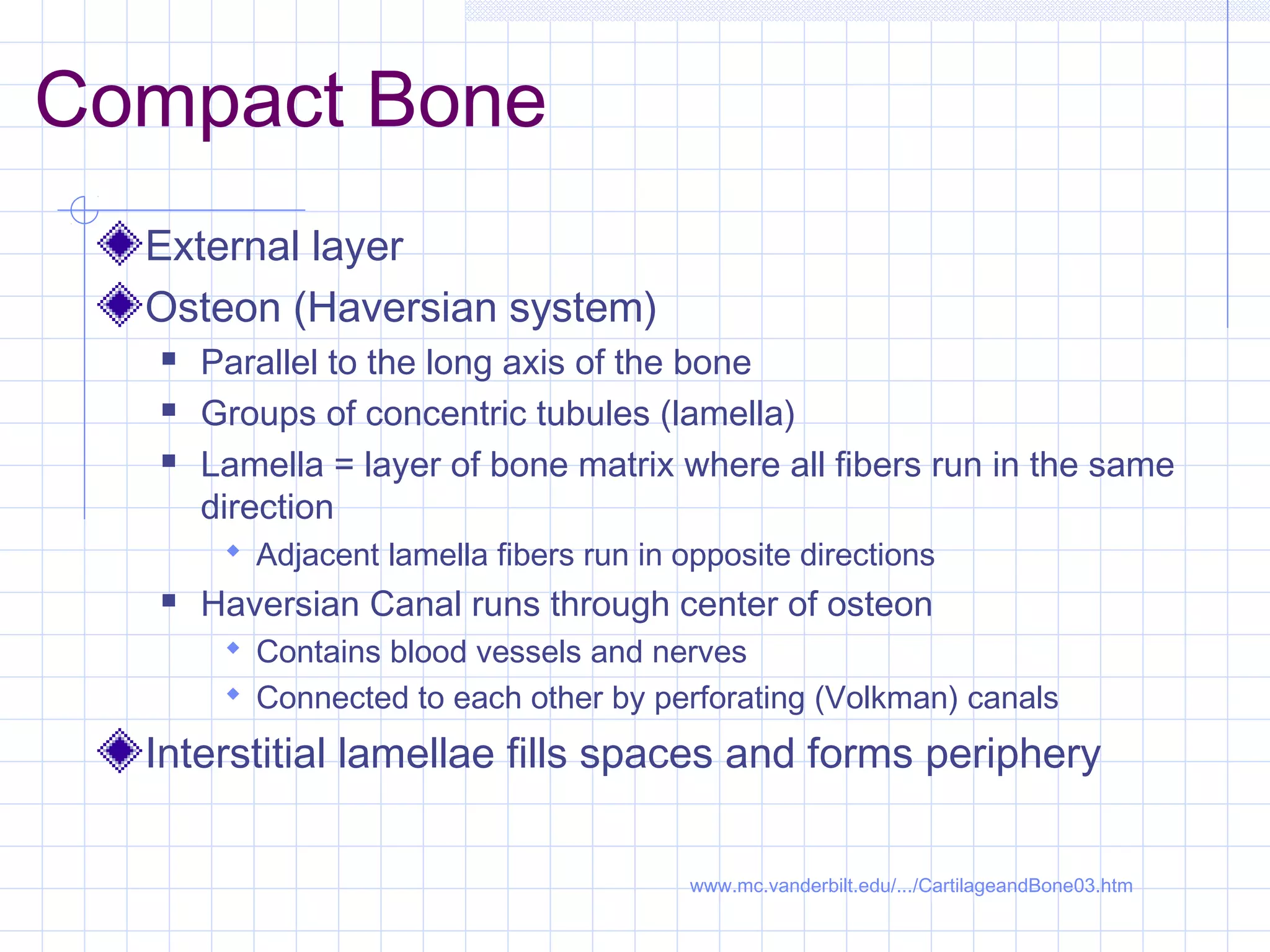
Compact Bone
  External layer
  Osteon (Haversian system)
     Parallel to the long axis of the bone
     Groups of concentric tubules (lamella)
     Lamella = layer of bone matrix where all fibers run in the same
      direction
        Adjacent lamella fibers run in opposite directions
     Haversian Canal runs through center of osteon
        Contains blood vessels and nerves
        Connected to each other by perforating (Volkman) canals

  Interstitial lamellae fills spaces and forms periphery

                                         www.mc.vanderbilt.edu/.../CartilageandBone03.htm
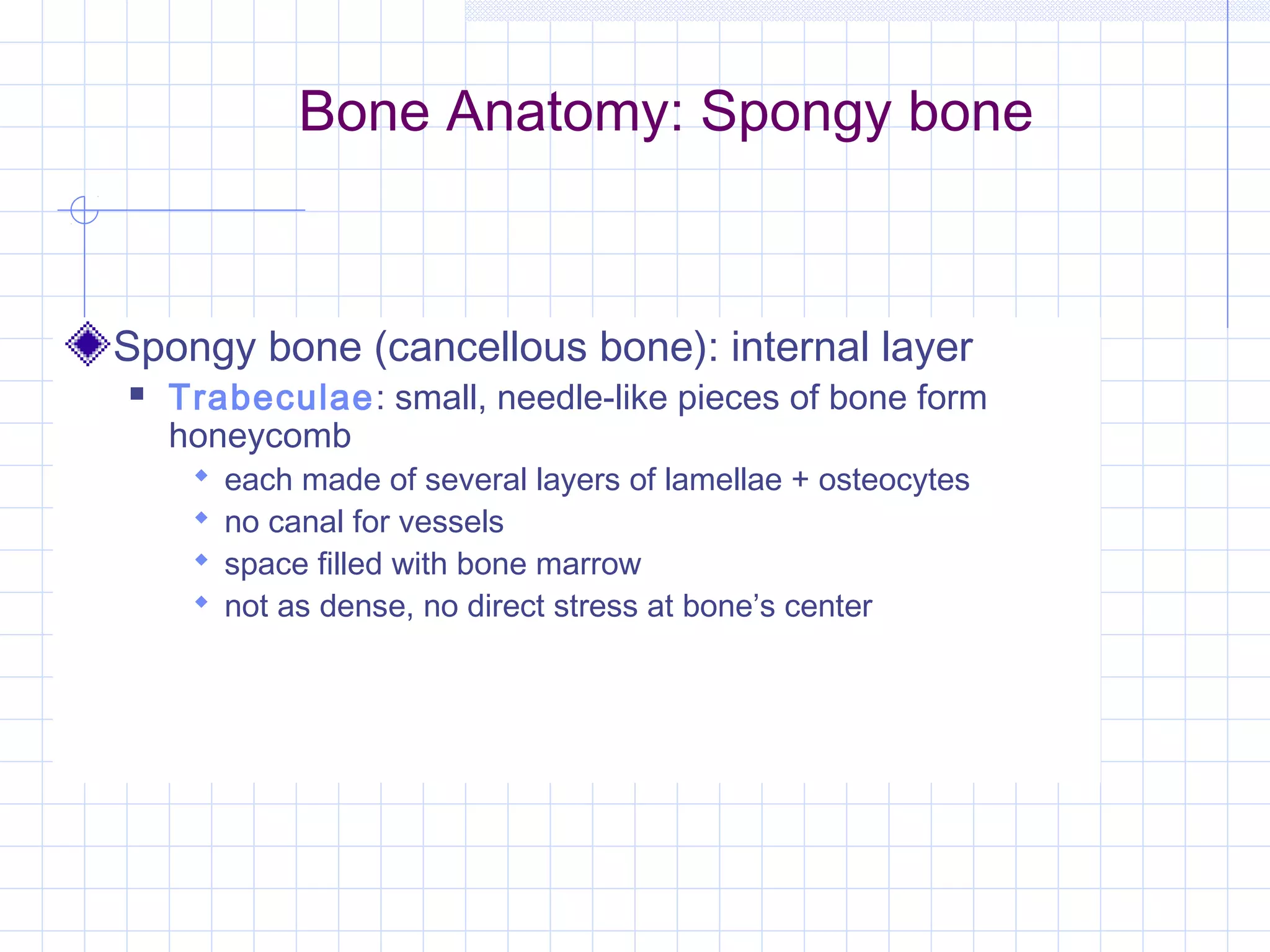
Bone Anatomy: Spongy bone


Spongy bone (cancellous bone): internal layer
   Trabeculae: small, needle-like pieces of bone form
    honeycomb
        each made of several layers of lamellae + osteocytes
        no canal for vessels
        space filled with bone marrow
        not as dense, no direct stress at bone’s center
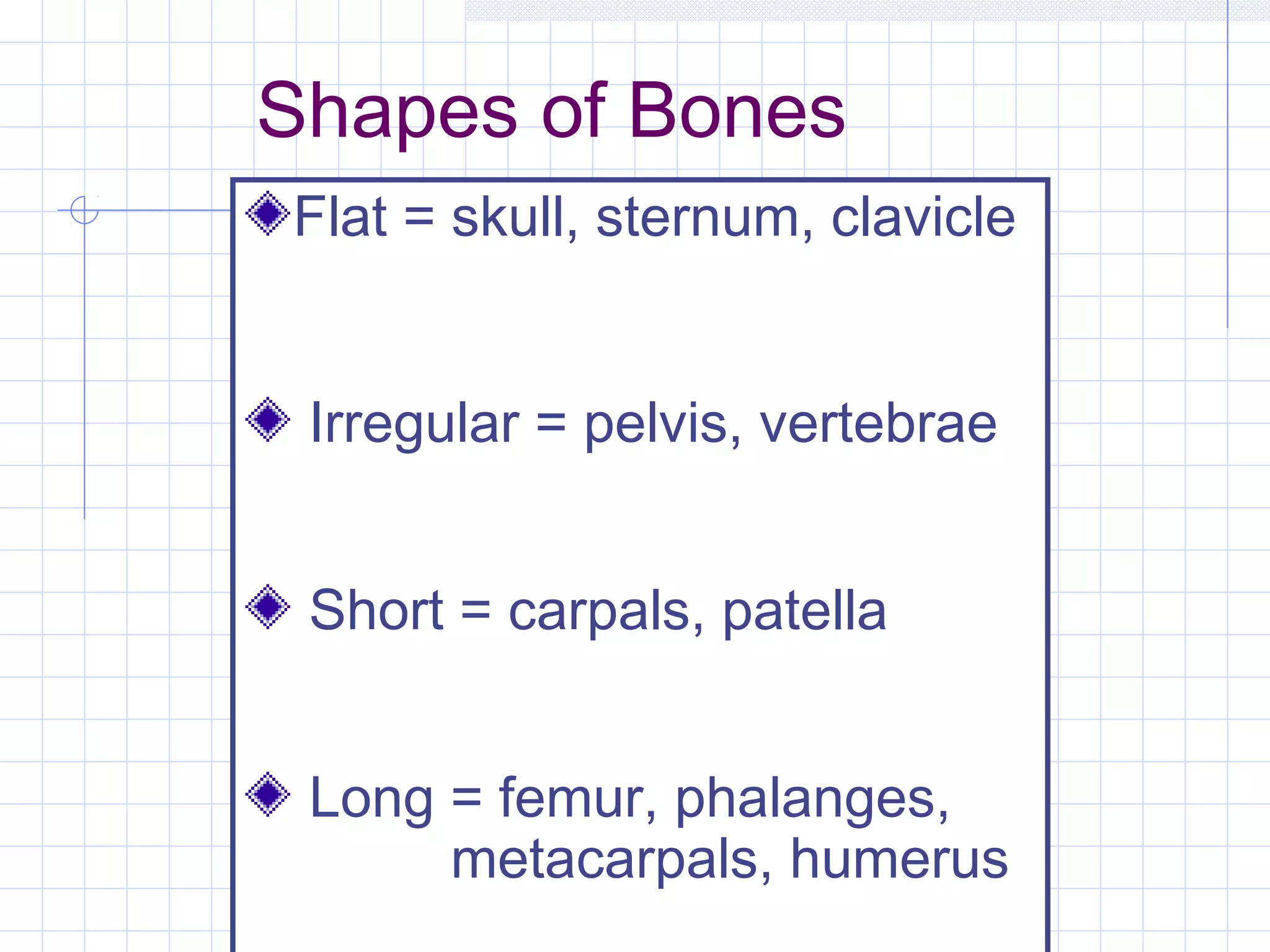
Shapes of Bones
Flat = skull, sternum, clavicle


 Irregular = pelvis, vertebrae


 Short = carpals, patella


 Long = femur, phalanges,
      metacarpals, humerus
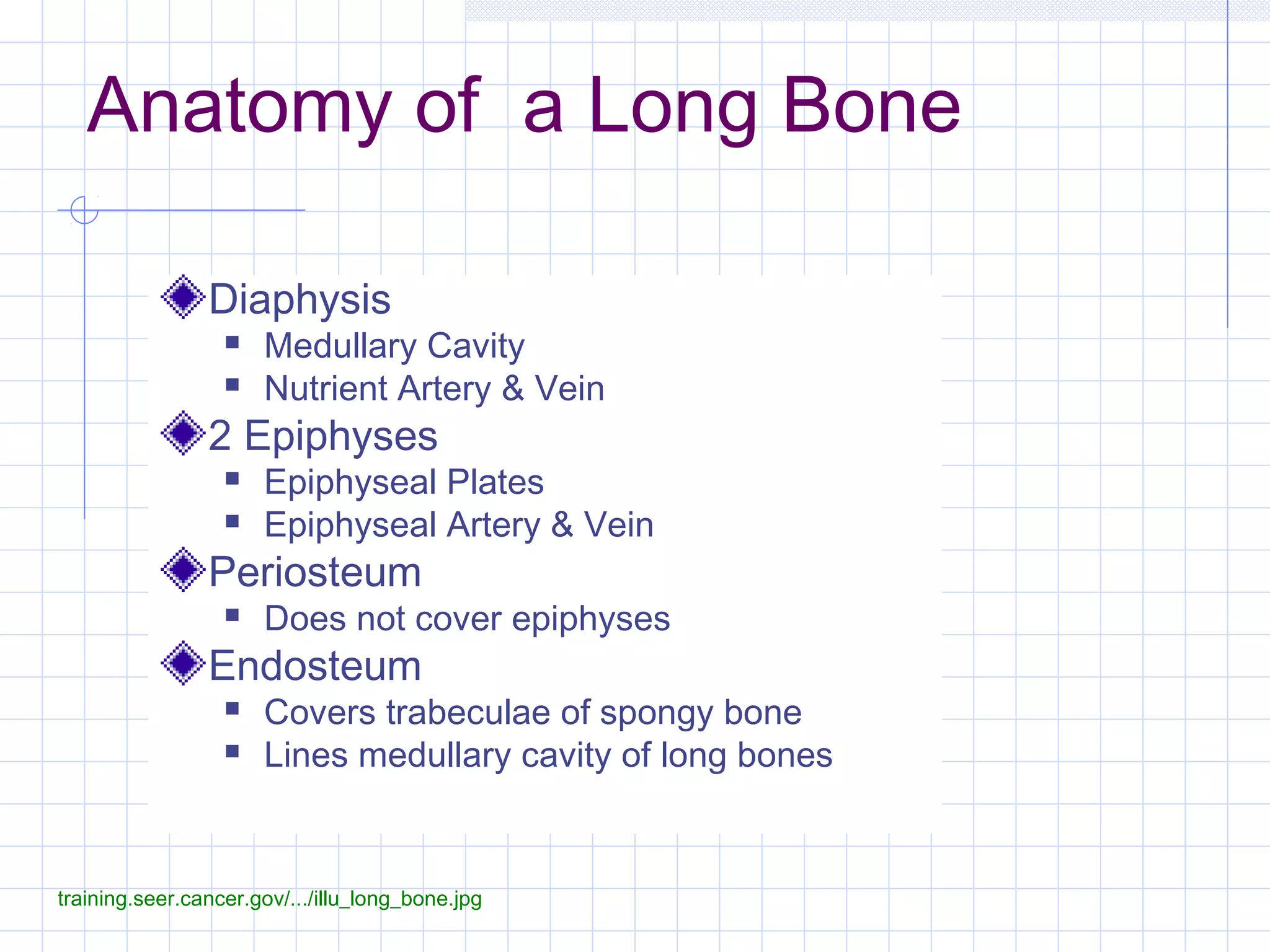
Anatomy of a Long Bone

                Diaphysis
                     Medullary Cavity
                     Nutrient Artery & Vein
                2 Epiphyses
                     Epiphyseal Plates
                     Epiphyseal Artery & Vein
                Periosteum
                     Does not cover epiphyses
                Endosteum
                     Covers trabeculae of spongy bone
                     Lines medullary cavity of long bones


training.seer.cancer.gov/.../illu_long_bone.jpg
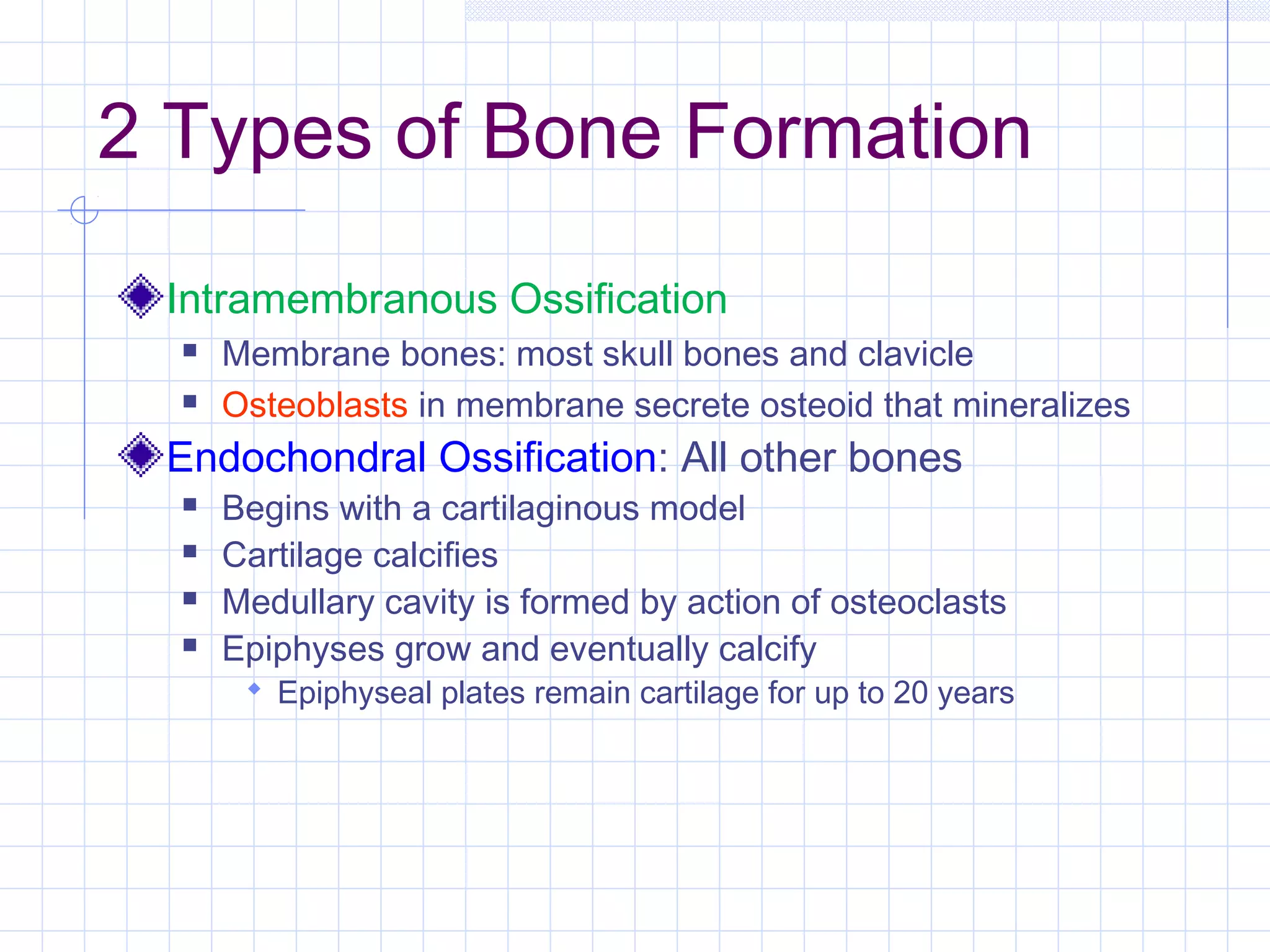
2 Types of Bone Formation

 Intramembranous Ossification
     Membrane bones: most skull bones and clavicle
     Osteoblasts in membrane secrete osteoid that mineralizes
 Endochondral Ossification: All other bones
     Begins with a cartilaginous model
     Cartilage calcifies
     Medullary cavity is formed by action of osteoclasts
     Epiphyses grow and eventually calcify
        Epiphyseal plates remain cartilage for up to 20 years
Bone Growth & Remodeling
GROWTH
   Appositional Growth = widening of bone
      Bone tissue added on surface by osteoblasts of periosteum
      Medullary cavity maintained by osteoclasts
   Lengthening of Bone
      Epiphyseal plates enlarge by chondroblasts
      Matrix calcifies (chondrocytes die and disintegrate)
      Bone tissue replaces cartilage on diaphysis side
REMODELING
   Due to mechanical stresses on bones, their tissue needs
    to be replaced
      Osteoclasts-take up bone ( = breakdown) release Ca2++ , PO4 to
       body fluids from bone
      Osteoblasts-form new bone by secreting osteoid
   Ideally osteoclasts & osteoblasts work at the same rate!
Components of Bone Tissue Summarized
  Cells          Matrix

  Osteblasts     Gel-like ground
                 substance calcified with
                 inorganic salts

  Fibroblasts    Collagen fibers

  Osteocytes

  Osteoclasts
4) Blood: Atypical Connective Tissue
 Function:
     Transports waste, gases, nutrients,
      hormones through cardiovascular system
     Helps regulate body temperature
     Protects body by fighting infection
 Derived from mesenchyme
 Hematopoiesis: production of blood cells
     Occurs in red bone marrow
     In adults, axial skeleton, girdles, proximal
      epiphyses of humerus and femur
Blood Cells
Erythrocytes: (RBC) small, oxygen-transporting
  most abundant in blood
  no organelles, filled w/hemoglobin
  pick up O2 at lungs, transport to rest of body

Leukocytes: (WBC) complete cells , 5 types
  fight against infectious microorganisms
   stored in bone marrow for emergencies
*Platelets = Thrombocytes:
  fragments of cytoplasm
  plug small tears in vessel walls, initiates clotting
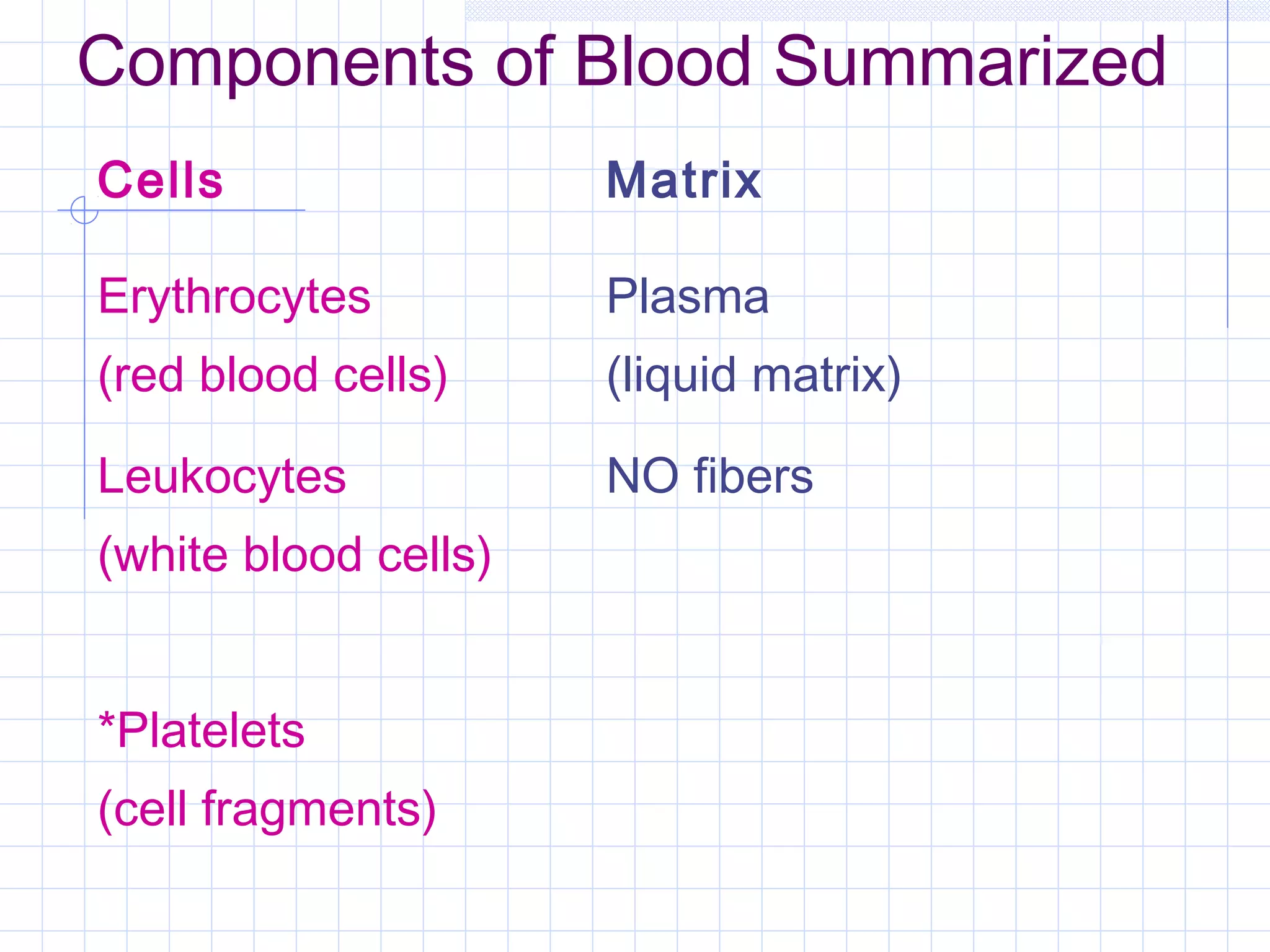
Components of Blood Summarized
Cells                 Matrix

Erythrocytes          Plasma
(red blood cells)     (liquid matrix)

Leukocytes            NO fibers
(white blood cells)


*Platelets
(cell fragments)
4 Types of Tissue

   1) Epithelium
   2) Connective
   3) Muscle
   4) Nervous
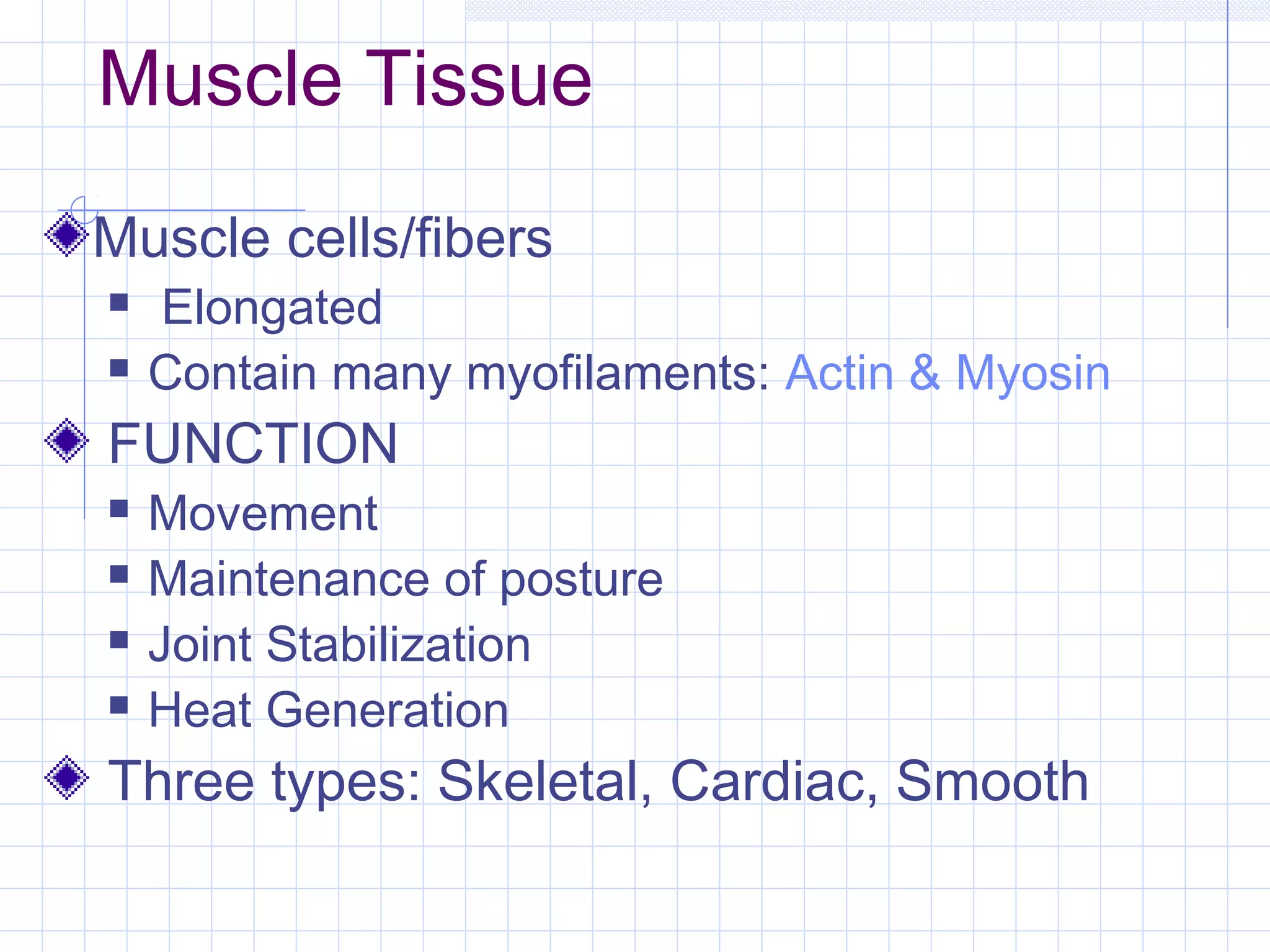
Muscle Tissue
Muscle cells/fibers
   Elongated
   Contain many myofilaments: Actin & Myosin
FUNCTION
   Movement
   Maintenance of posture
   Joint Stabilization
   Heat Generation
Three types: Skeletal, Cardiac, Smooth
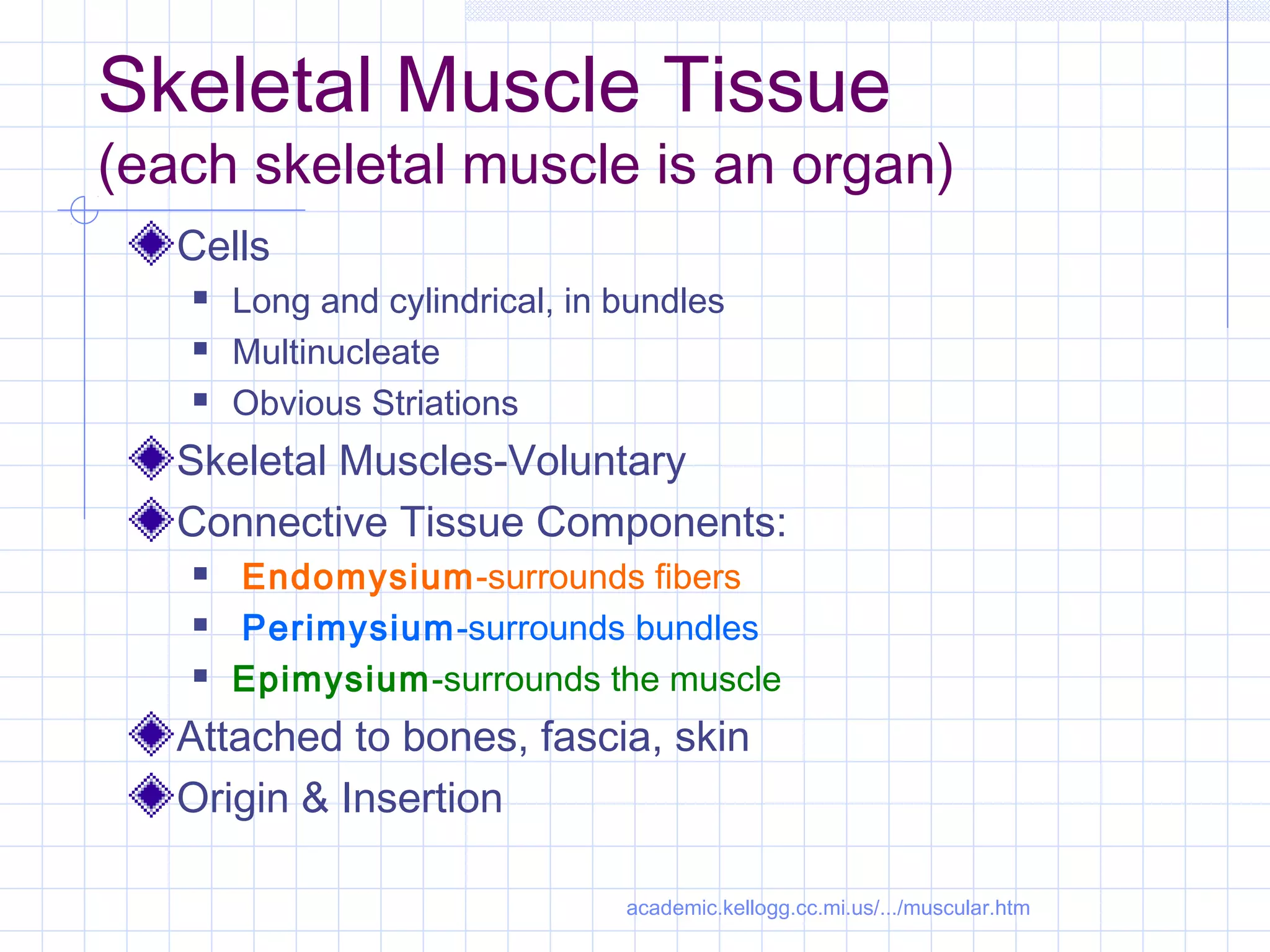
Skeletal Muscle Tissue
(each skeletal muscle is an organ)
   Cells
      Long and cylindrical, in bundles
      Multinucleate
      Obvious Striations
   Skeletal Muscles-Voluntary
   Connective Tissue Components:
      Endomysium-surrounds fibers
      Perimysium-surrounds bundles
      Epimysium-surrounds the muscle
   Attached to bones, fascia, skin
   Origin & Insertion

                                academic.kellogg.cc.mi.us/.../muscular.htm
Cardiac Muscle

   Cells
      Branching, chains of cells
      Single or Binucleated
      Striations
      Connected by Intercalated discs
   Cardiac Muscle-Involuntary
   Myocardium-heart muscle
      Pumps blood through vessels
   Connective Tissue Component
      Endomysium: surrounding cells     www.answers.com
Smooth Muscle Tissue

Cells
  Single cells, uninucleate
  No striations
Smooth Muscle-Involuntary
  2 layers-opposite orientation (peristalsis)
Found in hollow organs, blood vessels
Connective Tissue Component
  Endomysium: surrounds cells
4 Types of Tissue

   1) Epithelium
   2) Connective
   3) Muscle
   4) Nervous
Nervous Tissue

Neurons: specialized nerve cells conduct
impulses
   Cell body, dendrite, axon
Characterized by:
   No mitosis (cell replication)
   Longevity
   High metabolic rate


                                     www.morphonix.com
Nervous Tissue: control

 Support cells (= Neuroglial) : nourishment,
 insulation, protection
    Satellite cells-surround cell bodies within ganglia
    Schwann cells-surround axons (PNS)
    Microglia-phagocytes
    Oligodendrocytes-produce myelin sheaths around
     axons
    Ependymal cells-line brain/spinal cord, ciliated, help
     circulate CSF
 Brain, spinal cord, nerves
Integumentary System

 Functions
    Protection
       Mechanical, thermal, chemical, UV
    Cushions & insulates deeper organs
    Prevention of water loss
    Thermoregulation
    Excretion
       Salts, urea, water
    Sensory reception
Microanatomy - Layers of the
Skin
  Epidermis
   Epithelium
  Dermis
     Connective tissue
  Hypodermis / subcutis
     Loose connective tissue
     Anchors skin to bone or muscle
  Skin Appendages = outgrowths of epidermis
     Hair follicles
     Sweat and Sebaceous glands
     Nails


                                       www.uptodate.com/.../Melanoma_anatomy.jpg
Cell Layers of the Epidermis
   Stratum corneum
       Dead keratinocytes
   Stratum lucidum
       Only in “thick” skin
       Dead keratinocytes
   Stratum granulosum
       Water proofing
   Stratum spinosum
       Resists tears and tension
   Stratum basale
       Sensory receptors
       Melanocytes
       Keratinocytes (in all layers)   15minbeauty.blogspot.com
Layers of the Dermis
  Highly innervated
  Highly vascularized
  Collagen & Elastic fibers
  2 layers:
      Papillary layer (20%)
           Areolar CT
           Collagen & Elastic fibers
           Innervation
           Hair follicles
      Reticular layer (80%)
         Dense irregular CT
         Glands
                 sebum
                 2.5 million sweat glands!!
                                               www.uptodate.com/.../Melanoma_anatomy.jpg
         Smooth muscle fibers
         Innervation
Hypodermis
 Also called superficial fascia
 Areolar & Adipose Connective Tissue
 Functions
     Store fat
     Anchor skin to muscle, etc.
     Insulation
Structure of Tubular Organs
         LUMEN
Tunica Mucosa
    Lamina epithelialis
    Lamina propria
    Lamina muscularis mucosa
Tunica Submucosa
Tunica Muscularis
    Inner circular
    Outer longitudinal
Tunica Adventitia / Serosa
    Adventitia – covers organ directly
    Serosa – suspends organ in the peritoneal cavity

1+-+Intro+and+Histo+Grays.ppt

  • 1.
    Introduction and Tissues Human Anatomy BIOL 1010 Liston Campus
  • 2.
    What is Anatomy? Anatomy(= morphology): study of body’s structure Physiology: study of body’s function Structure reflects Function!!! Branches of Anatomy  Gross: Large structures  Surface: Landmarks  Histology: Cells and Tissues  Developmental: Structures change through life  Embryology: Structures form and develop before birth
  • 3.
    Hierarchy of Structural Organization Each of these build upon one another to make up the next level: Chemical level Cellular Tissue Organ Organ system Organism
  • 4.
    Hierarchy of Structural Organization Chemical level  Atoms combine to make molecules  4 macromolecules in the body  Carbohydrates  Lipids  Proteins  Nucleic acids
  • 5.
    Hierarchy of Structural Organization Cellular  Made up of cells and cellular organelles (molecules)  Cells can be eukaryotic or prokaryotic  Organelles are structures within cells that perform dedicated functions (“small organs”) http://cmweb.pvschools.net/~bbecke/newell/Cells.html
  • 6.
    Hierarchy of Structural Organization Tissue  Collection of cells that work together to perform a specialized function  4 basic types of tissue in the human body:  Epithelium  Connective tissue  Muscle tissue  Nervous tissue www.emc.maricopa.edu
  • 7.
    Hierarchy of Structural Organization Organ  Made up of tissue  Heart  Brain  Liver  Pancreas, etc…… Pg 181
  • 8.
    Hierarchy of Structural Organization Organsystem (11)  Made up of a group of related organs that work together  Integumentary  Skeletal  Muscular  Nervous  Endocrine  Cardiovascular Circulatory  Lymphatic  Respiratory  Digestive  Urinary  Reproductive Pg 341 Urinary System
  • 9.
    Hierarchy of Structural Organization Organism  An individual human, animal, plant, etc……  Made up all of the organ systems  Work together to sustain life
  • 10.
    Anatomical Directions Anatomical position Regions  Axial vs. Appendicular Anatomical Directions-It’s all Relative!  Anterior (ventral) vs. Posterior (dorsal)  Medial vs. Lateral  Superior (cranial) vs. Inferior (caudal)  Superficial vs. Deep  Proximal vs. Distal Anatomical Planes  Frontal = Coronal  Transverse = Horizontal = Cross Section  Sagittal Pg 5
  • 11.
    Reference Point Anterior –(ventral) Posterior – (dorsal) Frontal Plane Closer to the front surface of Closer to the rear surface the body of the body Medial – Lateral – Sagittal Plane Lying closer to the midline Lying further away from the midline Superior – (cranial) Inferior – (caudal) Horizontal Plane Closer to the head in relation to Away from the head or the entire body towards the lower part of (More General) the body Superficial – Deep – Surface of body or Towards the surface Away from the surface organ Proximal – Distal – Origin of a structure Closer to the origin of a body Further away from the part origin of a body part (More Specific)
  • 12.
    4 Types ofTissue 1) Epithelium 2) Connective 3) Muscle 4) Nervous
  • 13.
    Tissues: groups ofcells closely associated that have a similar structure and perform a related function Four types of tissue  Epithelial = covering/lining  Connective = support  Muscle = movement  Nervous = control Most organs contain all 4 types Tissue has non-living extracellular material between its cells
  • 14.
    EPITHELIAL TISSUE: sheetsof cells cover a surface or line a cavity Functions  Protection  Secretion  Absorption  Ion Transport
  • 15.
    Characteristics of Epithelium Cellularity  Composed of cells Specialized contacts  Joined by cell junctions Polarity  Apical vs. Basal surfaces differ Supported by connective tissue Avascular Innervated Highly regenerative
  • 16.
    Classification of Epithelium-based onnumber of layers and cell shape Layers  Simple  Stratified  Stratified layers characterized by shape of apical layer  Psuedostratified Shapes  Squamous  Cuboidal  Columnar  Transitional
  • 17.
    Types of Epithelium Simple squamous (1 layer)  Lungs, blood vessels, ventral body cavity Simple cuboidal  Kidney tubules, glands Simple columnar  Stomach, intestines Pseudostratified columnar  Respiratory passages (ciliated version) Stratified squamous (>1 layer)  Epidermis, mouth, esophagus, vagina  Named so according to apical cell shape  Regenerate from below  Deep layers cuboidal and columnar Transitional (not shown)  Thins when stretches  Hollow urinary organs All histology pictures property of BIOL 1010 Lab
  • 18.
    Special Epithelium Endothelium  Simple squamous epithelium that lines vessels  e.g. lymphatic & blood vessel Mesothelium  Simple squamous epithelium that forms the lining of body cavities  e.g. pleura, pericardium, peritoneum
  • 19.
    Features of ApicalSurface of Epithelium Microvilli: (ex) in small intestine  Finger-like extensions of the plasma membrane of apical epithelial cell  Increase surface area for absorption Cilia: (ex) respiratory tubes  Whip-like, motile extension of plasma membrane  Moves mucus, etc. over epithelial surface 1-way
  • 20.
    Features of LateralSurface of Epithelium Cells are connected to neighboring cells via:  Contour of cells-wavy contour fits together  Cell Junctions (3 common)  Desmosomes  Proteins hold cells together to maintain integrity of tissue  Tight Junctions  Plasma membrane of adjacent cells fuse, nothing passes  Gap junction  Proteins allow small molecules to pass through
  • 21.
    Features of theBasal Surface of Epithelium Basement membrane  Sheet between the epithelial and connective tissue layers  Attaches epithelium to connective tissue below  Made up of:  Basal lamina: thin, non-cellular, supportive sheet made of proteins  Superficial layer  Acts as a selective filter  Assists epithelial cell regeneration by moving new cells  Reticular fiber layer  Deeper layer  Support
  • 22.
    Glands Epithelial cellsthat make and secrete a product Products are water-based and usually contain proteins Classified as:  Unicellular vs. multicellular  Exocrine vs. Endocrine Page
  • 23.
    Glands: epithelial cellsthat make and secrete a water-based substance w/proteins Exocrine Glands  Secrete substance onto body surface or into body cavity  Activity is local  Have ducts  Unicellular or Multicellular  (ex) goblet cells, salivary, mammary, pancreas, liver
  • 24.
    Glands: epithelial cellsthat make and secrete a water-based substance w/proteins Endocrine Glands  Secrete product into blood stream  Either stored in secretory cells or in follicle surrounded by secretory cells  Hormones travel to target organ to increase response (excitatory)  No ducts  (ex) pancreas, adrenal, pituitary, thyroid
  • 25.
    4 Types ofTissue 1) Epithelium 2) Connective 3) Muscle 4) Nervous
  • 26.
    4 Types ofConnective Tissue 1) Connective Tissue Proper 2) Cartilage 3) Bone Tissue 4) Blood
  • 27.
    Connective Tissue (CT): mostabundant and diverse tissue Four Classes Functions include connecting, storing & carrying nutrients, protection, fight infection CT contains large amounts of non-living extracellular matrix Contains a variety of cells and fibers Some types vascularized All CT originates from mesenchyme  Embryonic connective tissue
  • 28.
    Fibers in ConnectiveTissue Fibers For Support  Reticular:  form networks for structure & support  (ex) cover capillaries  Collagen:  strongest, most numerous, provide tensile strength  (ex) dominant fiber in ligaments  Elastic:  long + thin, stretch and retain shape  (ex) dominant fiber in elastic cartilage
  • 29.
    Components of Connective Tissue Fibroblasts:  cells that produce all fibers in CT  produce + secrete protein subunits to make them  produce ground matrix Interstitial (Tissue) Fluid  derived from blood in CT proper  medium for nutrients, waste + oxygen to travel to cells  found in ground matrix Ground Matrix (substance):  part of extra-cellular material that holds and absorbs interstitial fluid  Made and secreted by fibroblasts  jelly-like with sugar & protein molecules
  • 30.
    1) Connective TissueProper Two kinds: Loose CT & Dense CT  Functions  Support and bind to other tissue  Hold body fluids  Defends against infection  Stores nutrients as fat  Each function performed by different kind of fibers and cells in specific tissue
  • 31.
    Defense from Infection Areolar tissue below epithelium is body’s first defense Cells travel to CT in blood  Macrophages-eat foreign particles  Plasma cells-secrete antibodies, mark molecules for destruction  Mast cells-contain chemical mediators for inflammation response  White Blood Cells = neutrophils, lymphocytes, eosinophils-fight infection Ground substance + cell fibers-slow invading microorganisms
  • 32.
    Loose CT Proper Areolar CT  All types of fibers present  All typical cell types present  Surrounds blood vessels and nerves
  • 33.
    Specialized Loose CTProper Adipose tissue  Loaded with adipocytes, highly vascularized, high metabolic activity  Insulates, produces energy, supports  Found in hypodermis under skin Reticular CT  Contains only reticular fibers  Forms caverns to hold free cells, forms internal “skeleton” of some organs  Found in bone marrow, holds blood cells, lymph nodes, spleen
  • 34.
    Dense/Fibrous Connective Tissue Contains more collagen Can resist extremely strong pulling forces Regular vs. Irregular  Regular-fibers run same direction, parallel to pull  (eg) fascia, tendons, ligaments  Irregular-fibers thicker, run in different directions  (eg) dermis, fibrous capsules at ends of bones Dense regular Dense irregular
  • 35.
    Components of CTProper Summarized Cells Matrix Fibroblasts Gel-like ground substance Defense cells Collagen fibers -macrophages Reticular fibers -white blood cells Elastic fibers Adipocytes
  • 36.
    2) Cartilage Chondroblasts produce cartilage Chondrocytes mature cartilage cells  Reside in lacunae More abundant in embryo than adult Firm, Flexible Resists compression  (eg) trachea, meniscus Avascular (chondrocytes can function w/ low oxygen) NOT Innervated Perichondrium  dense, irregular connective tissue around cartilage  growth/repair of cartilage  resists expansion during compression of cartilage
  • 37.
    Cartilage in theBody Three types:  Hyaline  most abundant  fibers in matrix  support via flexibility/resilience  (eg) at limb joints, ribs, nose  Elastic  many elastic fibers in matrix too  great flexibility  (eg) external ear, epiglottis  Fibrocartilage  resists both compression and tension  (eg) meniscus, annulus fibrosus
  • 38.
    Components of CartilageSummarized Cells Matrix Chondrocytes Gel-like ground substance Chondroblasts Lots of water (in growing cartilage) Fibroblasts Some have collagen and elastic fibers
  • 39.
    3) Bone Tissue:(a bone is an organ) Well-vascularized Function:  support (eg) pelvic bowl, legs  protect (eg) skull, vertebrae  mineral storage (eg) calcium, phosphate (inorganic component)  movement (eg) walk, grasp objects  blood-cell formation (eg) red bone marrow
  • 40.
    Bone Tissue Osteoblasts  Secrete organic part of bone matrix Osteocytes  Mature bone cells  Sit in lacunae  Maintain bone matrix Osteoclasts  Degrade and reabsorb bone Periosteum  External layer of CT that surrounds bone  Outer: Dense irregular CT  Inner: Osteoblasts, osteoclasts Endosteum  Internal layer of CT that lines cavities and covers trabeculae  Contains osteoblasts and osteoclasts academic.kellogg.cc.mi.us/.../skeletal.htm
  • 41.
    Compact Bone External layer Osteon (Haversian system)  Parallel to the long axis of the bone  Groups of concentric tubules (lamella)  Lamella = layer of bone matrix where all fibers run in the same direction  Adjacent lamella fibers run in opposite directions  Haversian Canal runs through center of osteon  Contains blood vessels and nerves  Connected to each other by perforating (Volkman) canals Interstitial lamellae fills spaces and forms periphery www.mc.vanderbilt.edu/.../CartilageandBone03.htm
  • 42.
    Bone Anatomy: Spongybone Spongy bone (cancellous bone): internal layer  Trabeculae: small, needle-like pieces of bone form honeycomb  each made of several layers of lamellae + osteocytes  no canal for vessels  space filled with bone marrow  not as dense, no direct stress at bone’s center
  • 43.
    Shapes of Bones Flat= skull, sternum, clavicle Irregular = pelvis, vertebrae Short = carpals, patella Long = femur, phalanges, metacarpals, humerus
  • 44.
    Anatomy of aLong Bone Diaphysis  Medullary Cavity  Nutrient Artery & Vein 2 Epiphyses  Epiphyseal Plates  Epiphyseal Artery & Vein Periosteum  Does not cover epiphyses Endosteum  Covers trabeculae of spongy bone  Lines medullary cavity of long bones training.seer.cancer.gov/.../illu_long_bone.jpg
  • 45.
    2 Types ofBone Formation Intramembranous Ossification  Membrane bones: most skull bones and clavicle  Osteoblasts in membrane secrete osteoid that mineralizes Endochondral Ossification: All other bones  Begins with a cartilaginous model  Cartilage calcifies  Medullary cavity is formed by action of osteoclasts  Epiphyses grow and eventually calcify  Epiphyseal plates remain cartilage for up to 20 years
  • 46.
    Bone Growth &Remodeling GROWTH  Appositional Growth = widening of bone  Bone tissue added on surface by osteoblasts of periosteum  Medullary cavity maintained by osteoclasts  Lengthening of Bone  Epiphyseal plates enlarge by chondroblasts  Matrix calcifies (chondrocytes die and disintegrate)  Bone tissue replaces cartilage on diaphysis side REMODELING  Due to mechanical stresses on bones, their tissue needs to be replaced  Osteoclasts-take up bone ( = breakdown) release Ca2++ , PO4 to body fluids from bone  Osteoblasts-form new bone by secreting osteoid  Ideally osteoclasts & osteoblasts work at the same rate!
  • 47.
    Components of BoneTissue Summarized Cells Matrix Osteblasts Gel-like ground substance calcified with inorganic salts Fibroblasts Collagen fibers Osteocytes Osteoclasts
  • 48.
    4) Blood: AtypicalConnective Tissue Function:  Transports waste, gases, nutrients, hormones through cardiovascular system  Helps regulate body temperature  Protects body by fighting infection Derived from mesenchyme Hematopoiesis: production of blood cells  Occurs in red bone marrow  In adults, axial skeleton, girdles, proximal epiphyses of humerus and femur
  • 49.
    Blood Cells Erythrocytes: (RBC)small, oxygen-transporting most abundant in blood no organelles, filled w/hemoglobin pick up O2 at lungs, transport to rest of body Leukocytes: (WBC) complete cells , 5 types fight against infectious microorganisms stored in bone marrow for emergencies *Platelets = Thrombocytes: fragments of cytoplasm plug small tears in vessel walls, initiates clotting
  • 50.
    Components of BloodSummarized Cells Matrix Erythrocytes Plasma (red blood cells) (liquid matrix) Leukocytes NO fibers (white blood cells) *Platelets (cell fragments)
  • 51.
    4 Types ofTissue 1) Epithelium 2) Connective 3) Muscle 4) Nervous
  • 52.
    Muscle Tissue Muscle cells/fibers  Elongated  Contain many myofilaments: Actin & Myosin FUNCTION  Movement  Maintenance of posture  Joint Stabilization  Heat Generation Three types: Skeletal, Cardiac, Smooth
  • 53.
    Skeletal Muscle Tissue (eachskeletal muscle is an organ) Cells  Long and cylindrical, in bundles  Multinucleate  Obvious Striations Skeletal Muscles-Voluntary Connective Tissue Components:  Endomysium-surrounds fibers  Perimysium-surrounds bundles  Epimysium-surrounds the muscle Attached to bones, fascia, skin Origin & Insertion academic.kellogg.cc.mi.us/.../muscular.htm
  • 54.
    Cardiac Muscle Cells  Branching, chains of cells  Single or Binucleated  Striations  Connected by Intercalated discs Cardiac Muscle-Involuntary Myocardium-heart muscle  Pumps blood through vessels Connective Tissue Component  Endomysium: surrounding cells www.answers.com
  • 55.
    Smooth Muscle Tissue Cells Single cells, uninucleate No striations Smooth Muscle-Involuntary 2 layers-opposite orientation (peristalsis) Found in hollow organs, blood vessels Connective Tissue Component Endomysium: surrounds cells
  • 56.
    4 Types ofTissue 1) Epithelium 2) Connective 3) Muscle 4) Nervous
  • 57.
    Nervous Tissue Neurons: specializednerve cells conduct impulses  Cell body, dendrite, axon Characterized by:  No mitosis (cell replication)  Longevity  High metabolic rate www.morphonix.com
  • 58.
    Nervous Tissue: control Support cells (= Neuroglial) : nourishment, insulation, protection  Satellite cells-surround cell bodies within ganglia  Schwann cells-surround axons (PNS)  Microglia-phagocytes  Oligodendrocytes-produce myelin sheaths around axons  Ependymal cells-line brain/spinal cord, ciliated, help circulate CSF Brain, spinal cord, nerves
  • 59.
    Integumentary System Functions  Protection  Mechanical, thermal, chemical, UV  Cushions & insulates deeper organs  Prevention of water loss  Thermoregulation  Excretion  Salts, urea, water  Sensory reception
  • 60.
    Microanatomy - Layersof the Skin Epidermis  Epithelium Dermis  Connective tissue Hypodermis / subcutis  Loose connective tissue  Anchors skin to bone or muscle Skin Appendages = outgrowths of epidermis  Hair follicles  Sweat and Sebaceous glands  Nails www.uptodate.com/.../Melanoma_anatomy.jpg
  • 61.
    Cell Layers ofthe Epidermis Stratum corneum  Dead keratinocytes Stratum lucidum  Only in “thick” skin  Dead keratinocytes Stratum granulosum  Water proofing Stratum spinosum  Resists tears and tension Stratum basale  Sensory receptors  Melanocytes  Keratinocytes (in all layers) 15minbeauty.blogspot.com
  • 62.
    Layers of theDermis Highly innervated Highly vascularized Collagen & Elastic fibers 2 layers:  Papillary layer (20%)  Areolar CT  Collagen & Elastic fibers  Innervation  Hair follicles  Reticular layer (80%)  Dense irregular CT  Glands  sebum  2.5 million sweat glands!! www.uptodate.com/.../Melanoma_anatomy.jpg  Smooth muscle fibers  Innervation
  • 63.
    Hypodermis Also calledsuperficial fascia Areolar & Adipose Connective Tissue Functions  Store fat  Anchor skin to muscle, etc.  Insulation
  • 64.
    Structure of TubularOrgans LUMEN Tunica Mucosa  Lamina epithelialis  Lamina propria  Lamina muscularis mucosa Tunica Submucosa Tunica Muscularis  Inner circular  Outer longitudinal Tunica Adventitia / Serosa  Adventitia – covers organ directly  Serosa – suspends organ in the peritoneal cavity