Communication
                                  Spoken and Written


                                  C
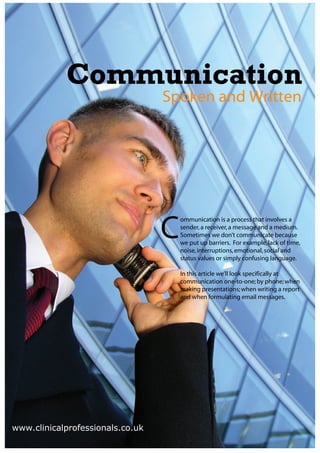
                                      ommunication is a process that involves a
                                      sender, a receiver, a message and a medium.
                                      Sometimes we don’t communicate because
                                      we put up barriers. For example, lack of time,
                                      noise, interruptions, emotional, social and
                                      status values or simply confusing language.

                                      In this article we’ll look specifically at
                                      communication one-to-one; by phone; when
                                      making presentations; when writing a report
                                      and when formulating email messages.


www.clinicalprofessionals.co.uk
One-to-One
Body language                                    Visit
Experts argue over the exact split but           When you get mail at home, a handwritten
communication components are thought             letter stands out from the junk you receive.
to comprise:                                     The equivalent in a work context is visiting
                                                 someone – not a brief meeting but a proper
7%  Verbal (the words you use)                   visit where you understand how and
38% Vocal (the way you use the words –           where the other person works. You then
    tone, volume, pitch and emphasis)            have more background and reduce the
55% Visual (the body language that               need for superficial communication.
    goes with it)
                                                 A shared mental picture and emotional
When the words and music don’t match, it         understanding is worth a thousand
creates unease. When the song and dance          emails.
don’t match, the message is in big trouble.

It’s not what you say, it’s how you say it
Disinterest is infectious. Be upbeat. Use
                                                 Listen -
analogy, metaphor and positive language
and don’t be afraid to let your emotional        and learn
commitment show.


Rapport                                          Summarise
Establishing rapport and getting someone         Summarising what another person has said
to identify you as someone they can trust,       is a critical skill in successful communication.
is key to successful communication               It makes the other person feel you’ve taken
                                                 all they’ve said on board and helps you gain
• start with small talk                          agreement and commitment.
• use the other person’s name
• find something for you both to smile           Handling questions
  about                                          Some questions are really concerns.
• empathise with them                            Acknowlege them, clarify, answer and check
• mirror their own body language                 you’ve answered satisfactorily to prove you
  (if you’re getting along well, you’ll be       value the relationship. If you don’t know the
  surprised that this has already happened!)     answer, say so. Offer to find out and make
• maintain gentle eye contact                    absolutely sure you do so and promptly.
• match their language by using the same         Listen
  or similar words and phrases.                  When you’re talking, you’re not listening.
• enter their reality - try to see things from   How many people do you know who drone
  their point of view so you can lead them       on about being a good listener when all the
  to your desired outcome .                      time you’re wishing that just for once they
                                                 would stop talking and listen to what you
                                                 have to say? Listen - and learn.

www.clinicalprofessionals.co.uk
Phone
It’s good to talk
We all use the phone as the main means of
communication in business whether by                  Talking with
land-line or mobile. In general, people like
it when you take time to call. A five minute
phone call can often do the work of several
                                                      people is
emails because you can hear someone’s
tone of voice and gauge reaction.                     the best
Brits are famous for not saying what they
mean and dressing up messages in layers
                                                      form of
of irony, humour or understatement.
Speaking with people directly ensures you             communication
hear what they mean as well as what they
say.


Plan to talk                                          Let them know you’re still there
Just because the phone is an informal                 Speaking on the phone is different to face-to
medium you can still plan an agenda of the            -face communication. You can’t check if the
points you need to cover and decide what              other person is paying attention. It’s irritating
information you need from the other person.           to hear the other person type while speaking.

This is essential if the person at the other end      If replying to an email, they are not listening
of the line has a reputation for being ‘chatty’       to you. You might be making a crucial point
and monopolising air-time. It’s important if          while they are signaling to a colleague they
you too, are a bit of a ‘gas-bag’, as you might       want a ‘10 strong’ from the vending machine.
get carried away and forget key points.
                                                      Talk in short bursts and use open questions
Call where you won’t be interrupted by people         that check for understanding. Similarly, if
or signal drop-out on a mobile.                       you’re listening, play your part by letting the
                                                      other person know you are there and not cut
Think about background noise as the other             off from lack of signal or interest!
person might not be able to hear you
speaking if there is a tannoy blasting out
flight arrivals. It’s also a bit deflating to start   Record it
off with “I don’t have much time as I’m about         When you’ve had an important call, commit
to go into a meeting” Dedicate time to the
                         .                            to paper what’s been said and agreed. This
call for both your and the other person’s sake.       helps you remember what was said and
                                                      reminds the other person if they deny it
                                                      afterwards!


www.clinicalprofessionals.co.uk
Be polite
If your mobile rings during a land-line call,
forward it into voicemail. Taking the call is
equivalent to looking over someone’s
shoulder while they are talking with you
and ignoring what they are saying.

An ex-colleague of mine had a habit of
putting you on hold while taking a second
call, leaving you holding for ages. If someone
does this to you, suggest they call you back.
Your time is important too, so why hold until
the other person is ready to speak? But if
chatting to a friend when a business call
comes through, remember, business comes
first.

Summarise what you’ve agreed at the end of
the call. It will only take seconds and allow
any misunderstanding to be ironed out there
and then. You can email or prepare a quick file
note to confirm the call.
                                                          Slides should
For those working on clinical trials, GCP                 encourage
requires you to have an audit trail. So,
conversations with Investigators regarding
protocol changes or adverse events will need
                                                          an audience
to be recorded. You may have an internal SOP
that provides a form for you to fill in recording         to see what
the salient points of a conversation.
                                                          you’re saying
If in doubt
Talking with people is the best form of
communication and the phone is often the
quickest medium to use. It’s easy to make a
quick call to check something out and even
when you have nothing much to say, it’s
amazing how often people are glad you’ve
called because they have something to say
to you.


                                                    www.clinicalprofessionals.co.uk
Presentations


                                                  Dos
                                                  • breathe!
                                                  • speak clearly and be natural
                                                  • pitch the presentation towards the back
                                                    of the room
                                                  • pause at key points for emphasis
                                                  • look at your audience
                                                  • keep an eye on the audience’s body
                                                    language
                                                  • know when to stop and or edit any
                                                    section of the presentation that’s sending
                                                    them to sleep
                                                  • be prepared for questions


The prospect of a presentation can have
a soporific effect on an audience. The            Donts
delivery can sometimes send them                  • shout or mumble.
completely to sleep!                              • rush or talk deliberately slowly
                                                  • you’re not on stage at the Comedy Store
                                                    - avoid too many jokes
Structure                                         • indulge in too much hand waving
1. Tell the audience what you’re presenting.      • talk to the display screen
2. Present it.                                    • read the slides verbatum
3. At the end, tell them what you’ve presented.   • start sentences with “ermm”
                                                  • jiggle loose change in your pocket!
Who is doing the talking?                         • move about too much. Some physical
You are – not the slides. No amount of              animation is desirable but pacing up and
information on your slides will communicate         down can unnerve an audience
your message for you. It’s vital you know
what your message is and can verbalise it
without relying on reading out what others
can read for themselves on the screen.

Less is always more. Use your own personal
skills to engage your audience.


                                                  www.clinicalprofessionals.co.uk
Help them to see
Slides should encourage an audience to
see what you’re saying. They offer a visual
component to your message that can be
in the form of pictures, graphics, graphs
etc. Why do some people only use words
on their slides?

Handouts
If you have a lot of information for your
audience to read, send it in advance of the
presentation or provide it as a handout.
It’s a cardinal sin and indeed a form of
miscommunication to embed a wordy
document into a slide. An audience will
never read a long piece of text on screen.


Does the audience need an eye test?
Going one worse, is to import a
spreadsheet into a presentation. Most of
your audience will not be able to see
anything on the slide and any who do
are unlikely to be able to make neither
head nor tail of it. Once again, provide a
print out of the details if important.
Otherwise, summarise salient points.


Use bullets
Not everyone likes them but bullet
points on a slide can prompt you as a
speaker to communicate your key
messages to your audience. Five bullets
are about the maximum on any one slide
or the font size has to decrease and
you’re back to the audience switching
off because they can’t read the words.
If you need more than five, use a further
slide or simply try to be more concise.


Animated slides
In small doses if at all please!

                                              www.onlymedics co uk
Writing a Report

Clarity
You don’t need to be a literary genius or, if you      • Support
are, keep reminding others in your written              Why is your proposal the right one?
communication. Why use several                          List the supporting points, costs,
words when one will do?                                 benefits and risks. Write in headlines,
                                                        like a newspaper or use bullet points.
Here are some examples -                                Keep supporting facts and figures
• ‘in view of the fact that’ (because)                  separate in an annex. If people want
• ‘an approximation as to how much’ (estimate)          them, they can find them but don’t
• ‘serious crisis’ (crisis)                             confuse the main message.
• ‘entirely complete’ (complete)
• ‘consequently’ or ‘accordingly’ (so)                  Play devil’s advocate (you can bet your
                                                        last dollar someone else will!) and
Watch out for confusibles like                          include contrary points and deal with
• ‘affect/effect’ or advice/advise                      them.
Brevity                                                  • Action
When writing, less is more - especially when            This is where you ask the reader to do
writing a report. An executive summary is all           something based on your proposal.
most people want to read. A good one-pager
can say enough to make an informed decision             Conclude by repeating your main
or take action. Try to get the main message             message and suggest actions, such as
into the headline and cover four key areas -            who does what and when.
 • Background
 Set the context, why you’re writing the report
 and briefly what you want to achieve.
                                                       Read and
 • Proposal
 This is your answer to the problem set out
 in the Background. Deliver the message in
                                                       re-read what
 the clearest way in the fewest words. Don’t
 use the passive approach. Take                        you’ve written
 responsibility and say ‘I recommend.’ A good
 way of structuring your thoughts is -                 before you
 opinion + fact + reason + example.
 e.g. ‘I believe we should eat more fruit.
                                                       send it
 Fruit is vital to a balanced diet. It’s full of
 vitamins and minerals. A single orange gives
 all the vitamin C a healthy adult requires in
 one day.’


                                                    www.clinicalprofessionals.co.uk
Email
Popularity
Fewer letters are written in business today          If you want to interact with others in the real
because the main focus is email. It’s like           world, turn your PC off, get your jacket on
working in our own personal post room as             and get out there.
communications arrive directly to the                Coverage
desktop. Yet despite being the most popular          Many people send emails to cover their backs,
form of communication, email continues to            copying others in to make sure every possible
cause headaches for may and is the single            person who had any conceivable reason to be
greatest source of embarrasing faux pas.             interested is informed. You are empowered to
                                                     use some authority without getting others’
Ignore them and they’ll go away                      permission and if you make a big mistake, a
Not so. Some people believe if you let email         covering email isn’t going to help.
sink to the bottom of the pile unanswered.
them they will eventually become irrelevant.         Rules
                                                     There are certain rules with emails that
Truth is, if you don’t reply, the person who         save a lot of bother. Try to reply as soon
sent the email to you will sooner or later           as you read an email, otherwise you’ll
contact you again, either by email or phone,         need to read it again at the time you do
for a response. Don’t be labeled as                  decide to reply. The exception is if
unresponsive - it can come back and bite             you’re angry or tired. You may regret
you when you need information from                   it later. Always read and re-read what
them. By not replying you’re only                    you’ve written before you send it. If in
increasing your workload.                            doubt, delete. We all keep too much
                                                     correspondence that clogs up our
Receipts                                             corporate servers. Do remember though,
Annoying, aren’t they? Why do people ask for         that for GCP audit trails, some emails may
a receipt that their email has been read? It tells   need to be printed out and filed.
them nothing other than that you’ve opened
their note. The only receipt that matters is         Forward/reply
whether you’ve managed to change the way             Never confuse forward and reply buttons
someone thinks, feels or acts.                       – you can keep sending long email messages
                                                     onwards for ever if you do. Only use copy to
Don’t ask for receipts and don’t send them. If       all where every person really does need to
it matters so much that someone gets                 know.
something, give them a call to check.
                                                     Finally, never forward anything that you
Get out more                                         wouldn’t pin up on your wall for everyone
Sitting at your PC is a lonely business. Email       to see.
is a way of pretending you’re in a social
environment. You can flirt or gossip on line         You never know where it may end up.
while pretending to work. Some people
generate email to get more in return.


                                                      www.clinicalprofessionals.co.uk

Communication - Spoken and Written

  • 1.
    Communication Spoken and Written C ommunication is a process that involves a sender, a receiver, a message and a medium. Sometimes we don’t communicate because we put up barriers. For example, lack of time, noise, interruptions, emotional, social and status values or simply confusing language. In this article we’ll look specifically at communication one-to-one; by phone; when making presentations; when writing a report and when formulating email messages. www.clinicalprofessionals.co.uk
  • 2.
    One-to-One Body language Visit Experts argue over the exact split but When you get mail at home, a handwritten communication components are thought letter stands out from the junk you receive. to comprise: The equivalent in a work context is visiting someone – not a brief meeting but a proper 7% Verbal (the words you use) visit where you understand how and 38% Vocal (the way you use the words – where the other person works. You then tone, volume, pitch and emphasis) have more background and reduce the 55% Visual (the body language that need for superficial communication. goes with it) A shared mental picture and emotional When the words and music don’t match, it understanding is worth a thousand creates unease. When the song and dance emails. don’t match, the message is in big trouble. It’s not what you say, it’s how you say it Disinterest is infectious. Be upbeat. Use Listen - analogy, metaphor and positive language and don’t be afraid to let your emotional and learn commitment show. Rapport Summarise Establishing rapport and getting someone Summarising what another person has said to identify you as someone they can trust, is a critical skill in successful communication. is key to successful communication It makes the other person feel you’ve taken all they’ve said on board and helps you gain • start with small talk agreement and commitment. • use the other person’s name • find something for you both to smile Handling questions about Some questions are really concerns. • empathise with them Acknowlege them, clarify, answer and check • mirror their own body language you’ve answered satisfactorily to prove you (if you’re getting along well, you’ll be value the relationship. If you don’t know the surprised that this has already happened!) answer, say so. Offer to find out and make • maintain gentle eye contact absolutely sure you do so and promptly. • match their language by using the same Listen or similar words and phrases. When you’re talking, you’re not listening. • enter their reality - try to see things from How many people do you know who drone their point of view so you can lead them on about being a good listener when all the to your desired outcome . time you’re wishing that just for once they would stop talking and listen to what you have to say? Listen - and learn. www.clinicalprofessionals.co.uk
  • 3.
    Phone It’s good totalk We all use the phone as the main means of communication in business whether by Talking with land-line or mobile. In general, people like it when you take time to call. A five minute phone call can often do the work of several people is emails because you can hear someone’s tone of voice and gauge reaction. the best Brits are famous for not saying what they mean and dressing up messages in layers form of of irony, humour or understatement. Speaking with people directly ensures you communication hear what they mean as well as what they say. Plan to talk Let them know you’re still there Just because the phone is an informal Speaking on the phone is different to face-to medium you can still plan an agenda of the -face communication. You can’t check if the points you need to cover and decide what other person is paying attention. It’s irritating information you need from the other person. to hear the other person type while speaking. This is essential if the person at the other end If replying to an email, they are not listening of the line has a reputation for being ‘chatty’ to you. You might be making a crucial point and monopolising air-time. It’s important if while they are signaling to a colleague they you too, are a bit of a ‘gas-bag’, as you might want a ‘10 strong’ from the vending machine. get carried away and forget key points. Talk in short bursts and use open questions Call where you won’t be interrupted by people that check for understanding. Similarly, if or signal drop-out on a mobile. you’re listening, play your part by letting the other person know you are there and not cut Think about background noise as the other off from lack of signal or interest! person might not be able to hear you speaking if there is a tannoy blasting out flight arrivals. It’s also a bit deflating to start Record it off with “I don’t have much time as I’m about When you’ve had an important call, commit to go into a meeting” Dedicate time to the . to paper what’s been said and agreed. This call for both your and the other person’s sake. helps you remember what was said and reminds the other person if they deny it afterwards! www.clinicalprofessionals.co.uk
  • 4.
    Be polite If yourmobile rings during a land-line call, forward it into voicemail. Taking the call is equivalent to looking over someone’s shoulder while they are talking with you and ignoring what they are saying. An ex-colleague of mine had a habit of putting you on hold while taking a second call, leaving you holding for ages. If someone does this to you, suggest they call you back. Your time is important too, so why hold until the other person is ready to speak? But if chatting to a friend when a business call comes through, remember, business comes first. Summarise what you’ve agreed at the end of the call. It will only take seconds and allow any misunderstanding to be ironed out there and then. You can email or prepare a quick file note to confirm the call. Slides should For those working on clinical trials, GCP encourage requires you to have an audit trail. So, conversations with Investigators regarding protocol changes or adverse events will need an audience to be recorded. You may have an internal SOP that provides a form for you to fill in recording to see what the salient points of a conversation. you’re saying If in doubt Talking with people is the best form of communication and the phone is often the quickest medium to use. It’s easy to make a quick call to check something out and even when you have nothing much to say, it’s amazing how often people are glad you’ve called because they have something to say to you. www.clinicalprofessionals.co.uk
  • 5.
    Presentations Dos • breathe! • speak clearly and be natural • pitch the presentation towards the back of the room • pause at key points for emphasis • look at your audience • keep an eye on the audience’s body language • know when to stop and or edit any section of the presentation that’s sending them to sleep • be prepared for questions The prospect of a presentation can have a soporific effect on an audience. The Donts delivery can sometimes send them • shout or mumble. completely to sleep! • rush or talk deliberately slowly • you’re not on stage at the Comedy Store - avoid too many jokes Structure • indulge in too much hand waving 1. Tell the audience what you’re presenting. • talk to the display screen 2. Present it. • read the slides verbatum 3. At the end, tell them what you’ve presented. • start sentences with “ermm” • jiggle loose change in your pocket! Who is doing the talking? • move about too much. Some physical You are – not the slides. No amount of animation is desirable but pacing up and information on your slides will communicate down can unnerve an audience your message for you. It’s vital you know what your message is and can verbalise it without relying on reading out what others can read for themselves on the screen. Less is always more. Use your own personal skills to engage your audience. www.clinicalprofessionals.co.uk
  • 6.
    Help them tosee Slides should encourage an audience to see what you’re saying. They offer a visual component to your message that can be in the form of pictures, graphics, graphs etc. Why do some people only use words on their slides? Handouts If you have a lot of information for your audience to read, send it in advance of the presentation or provide it as a handout. It’s a cardinal sin and indeed a form of miscommunication to embed a wordy document into a slide. An audience will never read a long piece of text on screen. Does the audience need an eye test? Going one worse, is to import a spreadsheet into a presentation. Most of your audience will not be able to see anything on the slide and any who do are unlikely to be able to make neither head nor tail of it. Once again, provide a print out of the details if important. Otherwise, summarise salient points. Use bullets Not everyone likes them but bullet points on a slide can prompt you as a speaker to communicate your key messages to your audience. Five bullets are about the maximum on any one slide or the font size has to decrease and you’re back to the audience switching off because they can’t read the words. If you need more than five, use a further slide or simply try to be more concise. Animated slides In small doses if at all please! www.onlymedics co uk
  • 7.
    Writing a Report Clarity Youdon’t need to be a literary genius or, if you • Support are, keep reminding others in your written Why is your proposal the right one? communication. Why use several List the supporting points, costs, words when one will do? benefits and risks. Write in headlines, like a newspaper or use bullet points. Here are some examples - Keep supporting facts and figures • ‘in view of the fact that’ (because) separate in an annex. If people want • ‘an approximation as to how much’ (estimate) them, they can find them but don’t • ‘serious crisis’ (crisis) confuse the main message. • ‘entirely complete’ (complete) • ‘consequently’ or ‘accordingly’ (so) Play devil’s advocate (you can bet your last dollar someone else will!) and Watch out for confusibles like include contrary points and deal with • ‘affect/effect’ or advice/advise them. Brevity • Action When writing, less is more - especially when This is where you ask the reader to do writing a report. An executive summary is all something based on your proposal. most people want to read. A good one-pager can say enough to make an informed decision Conclude by repeating your main or take action. Try to get the main message message and suggest actions, such as into the headline and cover four key areas - who does what and when. • Background Set the context, why you’re writing the report and briefly what you want to achieve. Read and • Proposal This is your answer to the problem set out in the Background. Deliver the message in re-read what the clearest way in the fewest words. Don’t use the passive approach. Take you’ve written responsibility and say ‘I recommend.’ A good way of structuring your thoughts is - before you opinion + fact + reason + example. e.g. ‘I believe we should eat more fruit. send it Fruit is vital to a balanced diet. It’s full of vitamins and minerals. A single orange gives all the vitamin C a healthy adult requires in one day.’ www.clinicalprofessionals.co.uk
  • 8.
    Email Popularity Fewer letters arewritten in business today If you want to interact with others in the real because the main focus is email. It’s like world, turn your PC off, get your jacket on working in our own personal post room as and get out there. communications arrive directly to the Coverage desktop. Yet despite being the most popular Many people send emails to cover their backs, form of communication, email continues to copying others in to make sure every possible cause headaches for may and is the single person who had any conceivable reason to be greatest source of embarrasing faux pas. interested is informed. You are empowered to use some authority without getting others’ Ignore them and they’ll go away permission and if you make a big mistake, a Not so. Some people believe if you let email covering email isn’t going to help. sink to the bottom of the pile unanswered. them they will eventually become irrelevant. Rules There are certain rules with emails that Truth is, if you don’t reply, the person who save a lot of bother. Try to reply as soon sent the email to you will sooner or later as you read an email, otherwise you’ll contact you again, either by email or phone, need to read it again at the time you do for a response. Don’t be labeled as decide to reply. The exception is if unresponsive - it can come back and bite you’re angry or tired. You may regret you when you need information from it later. Always read and re-read what them. By not replying you’re only you’ve written before you send it. If in increasing your workload. doubt, delete. We all keep too much correspondence that clogs up our Receipts corporate servers. Do remember though, Annoying, aren’t they? Why do people ask for that for GCP audit trails, some emails may a receipt that their email has been read? It tells need to be printed out and filed. them nothing other than that you’ve opened their note. The only receipt that matters is Forward/reply whether you’ve managed to change the way Never confuse forward and reply buttons someone thinks, feels or acts. – you can keep sending long email messages onwards for ever if you do. Only use copy to Don’t ask for receipts and don’t send them. If all where every person really does need to it matters so much that someone gets know. something, give them a call to check. Finally, never forward anything that you Get out more wouldn’t pin up on your wall for everyone Sitting at your PC is a lonely business. Email to see. is a way of pretending you’re in a social environment. You can flirt or gossip on line You never know where it may end up. while pretending to work. Some people generate email to get more in return. www.clinicalprofessionals.co.uk