Body Fluids and Electrolytes
By Ahmad Ahmeda
aahmeda@ksu.edu.sa
0536313454
(Foundation Block)
(Foundation Block)
1
Learning Objectives:
• Identify and describe daily intake and output of water
and maintenance of water balance.
• List and describe of body fluid compartments as intra‐
cellular fluid (ICF), Extra cellular fluid (ECF), interstitial
‐
fluid, trans cellular fluid, and total body water (TBW).
‐
• Describe the composition of each fluid compartment, in
terms of volume and ions and represent them in graphic
forms.
• Describe the physiological and pathological factors
influencing the body fluid.
2
Composition of the human body:
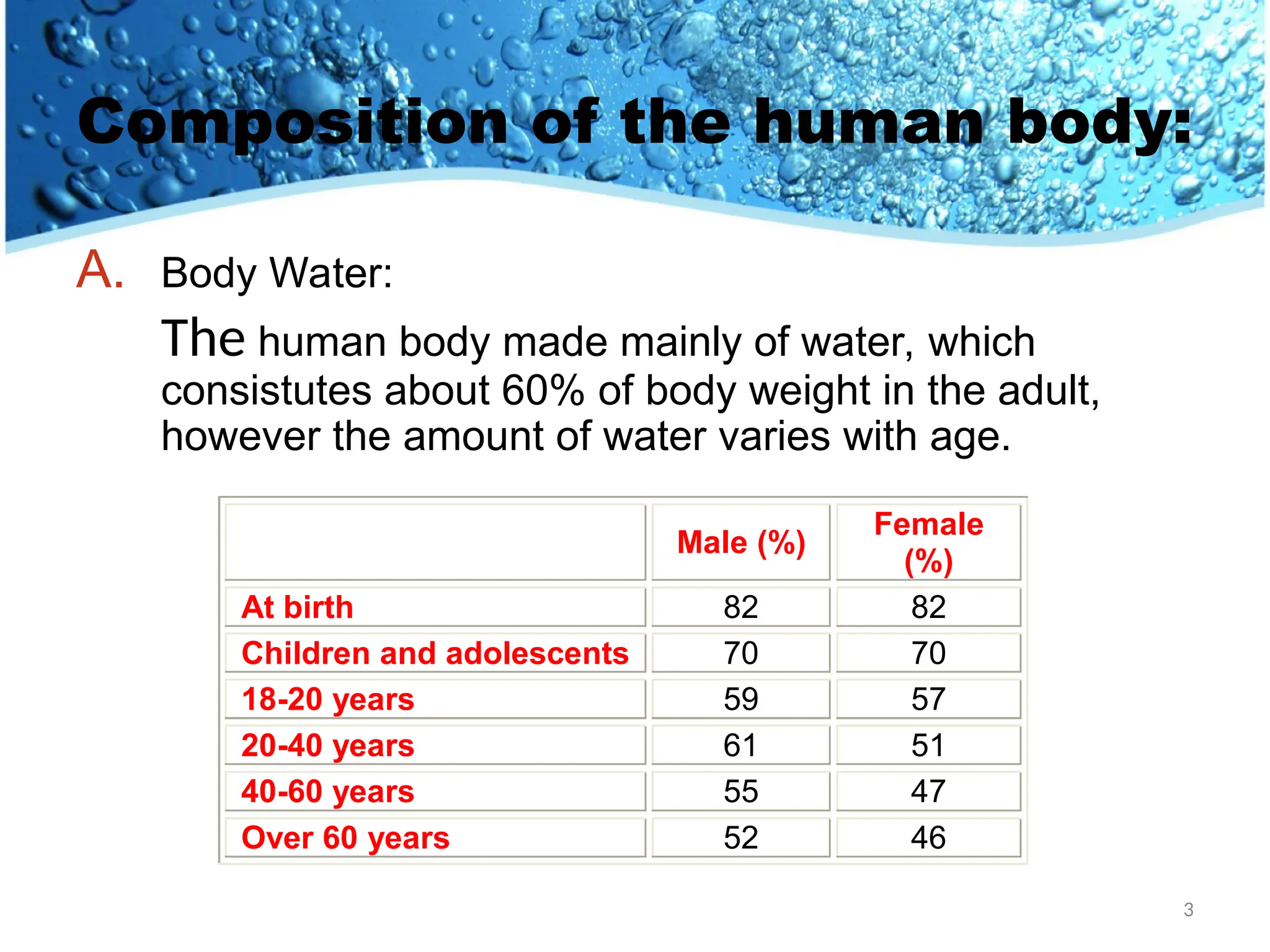
A. Body Water:
The human body made mainly of water, which
consistutes about 60% of body weight in the adult,
however the amount of water varies with age.
Male (%)
Female
(%)
At birth 82 82
Children and adolescents 70 70
18-20 years 59 57
20-40 years 61 51
40-60 years 55 47
Over 60 years 52 46
3
Composition of the human body:
B. Protein:
Is the second largest component in the human body,
largest amount found in skeletal muscle.
C. Fat:
The third largest component in lean individual. It is
found in adipose tissue
4
Composition of the human body:
D. Minerals:
Minerals, present in the human body in relatively small
quantities with the exception of calcium. (Found in
bones)
Minerals and electrolytes are found in the body fluids in
minute concentrations, which are closely regulated to
maintain the composition of the internal environment
5
The body fluids:
• Total body water (TBW):
consititutes 55-60% of the body weight in young men
and 45-50% in young women.
Why the percentage is lower in women?
• The TBW is distributed as follows:
Muscle (50%)
Skin (20%)
Other organs (20%)
Blood (10%)
6
The body fluids:
• Infants have low body fat, low bone mass, and are 73% or
more water.
• Total water content declines throughout life.
• Healthy males are about 60% water; healthy females are
around 50%
– This difference reflects females’:
• Higher body fat
• Smaller amount of skeletal muscle
• In old age, only about 45% of body weight is water.
7
The body fluids:
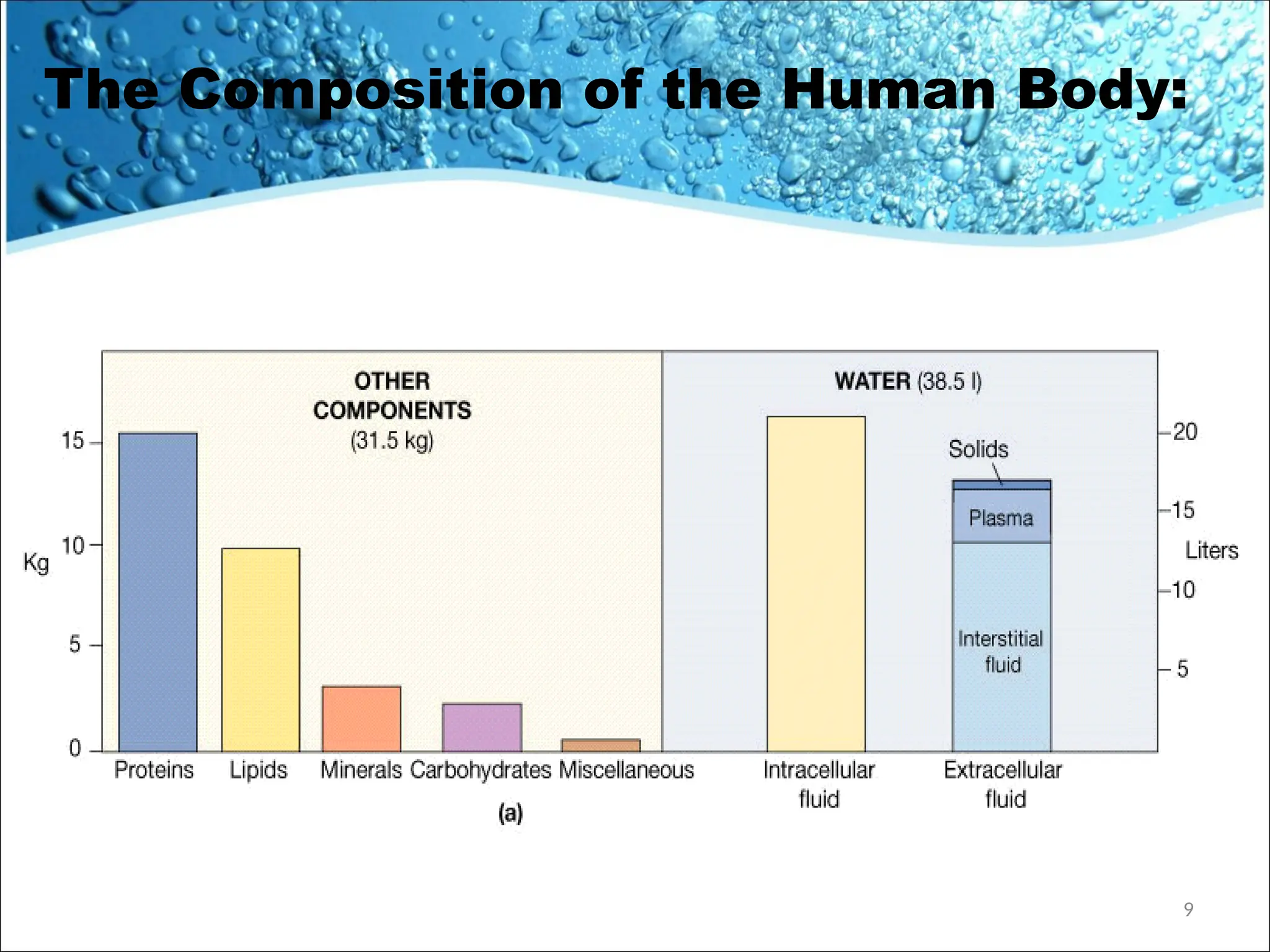
• The water content of the body is divided into two
compartments.
1) Intracellular compartment:
Contained within the cell, represent approximately
67% of the total body water, 40% of total body weight.
2) Extracellular Compartment:
Contained within the vessels of the cardiovascular
system, is the remaining 33% of the total body water,
about 20 % of total body weight,
8
The Composition of the Human Body:
9
Extracellular fluid (ECF)
The ECF compartments has several subcompartments:
1. Plasma, the fluid portion of the blood, represents
approximately 25% of the ECF.
Blood volume, approximately 80 ml/kg of body weight
(8%).
10
Extracellular fluid (ECF)
2. Interstitial fluid (ISF), is contained in a gel-like
extracellular matrix.
ISF sourrounds all cells except blood cells and
includes Lymph (2-3%) of total body weight
The ISF represent approximately 15% of the total body
weight and 75% of the ECF.
11
Extracellular fluid (ECF)
3. Transcellular fluid volume, is about 1 L, occupies
approximately 15 ml/kg of body weight (1.5%).
* Represents fluid in the lumen of structures lined by
epithelium and includes digestive secretions, sweat,
CSF, pleural, peritoneal, synovial, intraocular,
pericardial fluids, bile, thyroid, and cochlea.
12
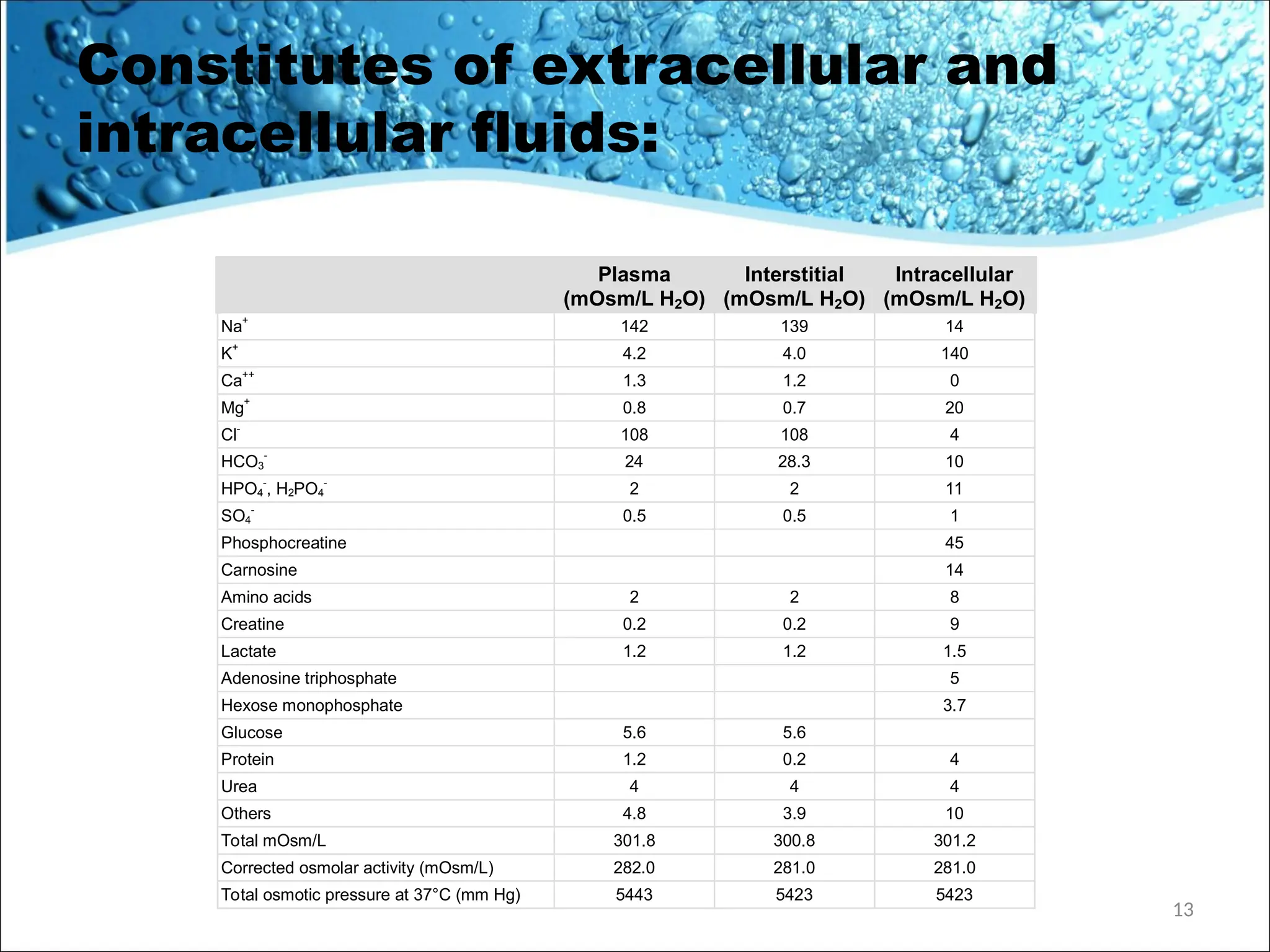
Constitutes of extracellular and
intracellular fluids:
Plasma
(mOsm/L H2O)
Interstitial
(mOsm/L H2O)
Intracellular
(mOsm/L H2O)
Na+
142 139 14
K+
4.2 4.0 140
Ca++
1.3 1.2 0
Mg
+
0.8 0.7 20
Cl-
108 108 4
HCO3
-
24 28.3 10
HPO4
-
, H2PO4
-
2 2 11
SO4
-
0.5 0.5 1
Phosphocreatine 45
Carnosine 14
Amino acids 2 2 8
Creatine 0.2 0.2 9
Lactate 1.2 1.2 1.5
Adenosine triphosphate 5
Hexose monophosphate 3.7
Glucose 5.6 5.6
Protein 1.2 0.2 4
Urea 4 4 4
Others 4.8 3.9 10
Total mOsm/L 301.8 300.8 301.2
Corrected osmolar activity (mOsm/L) 282.0 281.0 281.0
Total osmotic pressure at 37°C (mm Hg) 5443 5423 5423
13
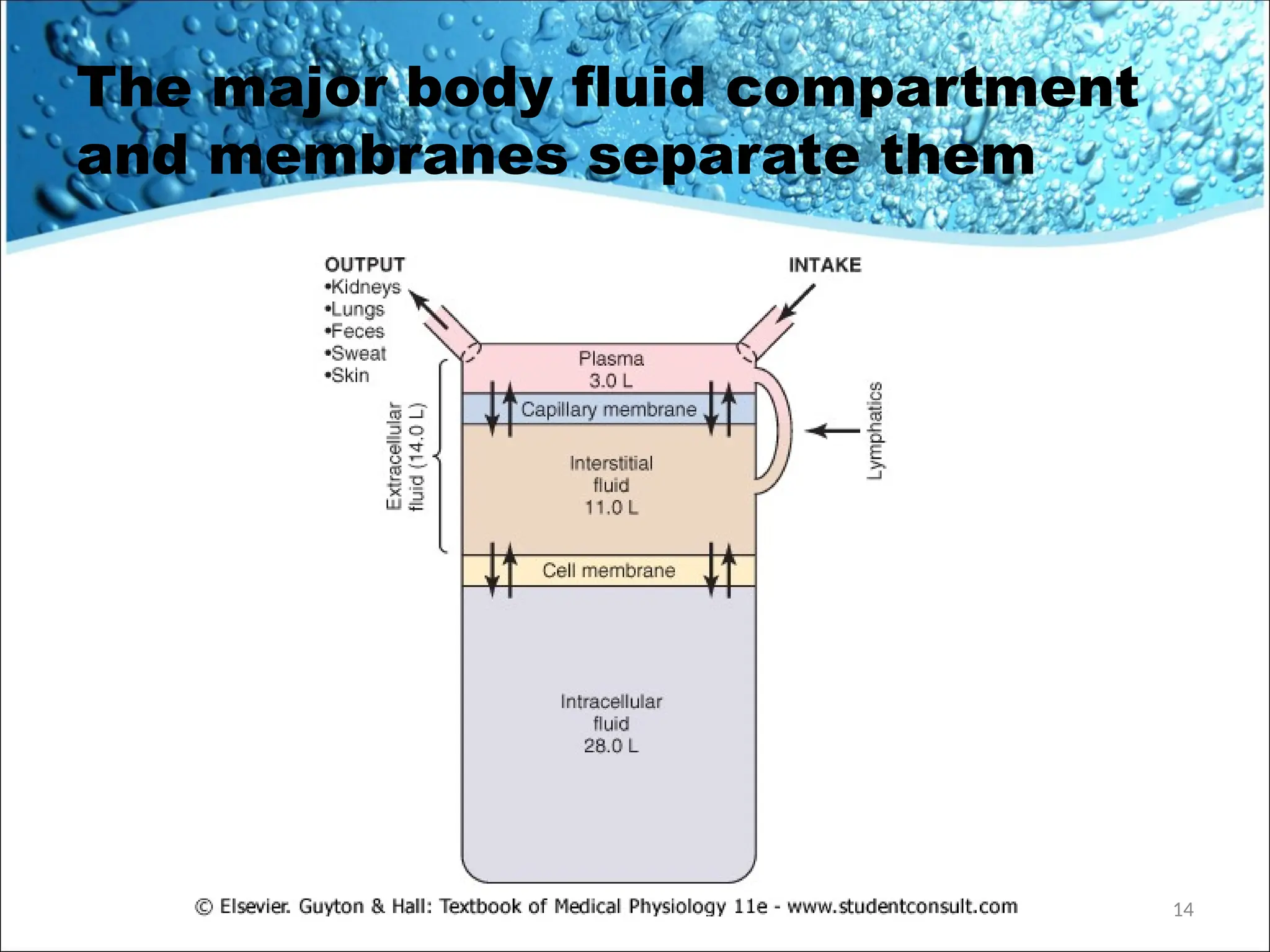
The major body fluid compartment
and membranes separate them
14
• The plasma and interstitial fluid are separated only by
highly permeable capillary membranes, their ionic
composition is similar but protein is higher in the plasma.
• the intracellular fluid is separated from extracellular fluid
by a cell membrane that is highly permeable to water but
not to most of the electrolytes in the body.
15
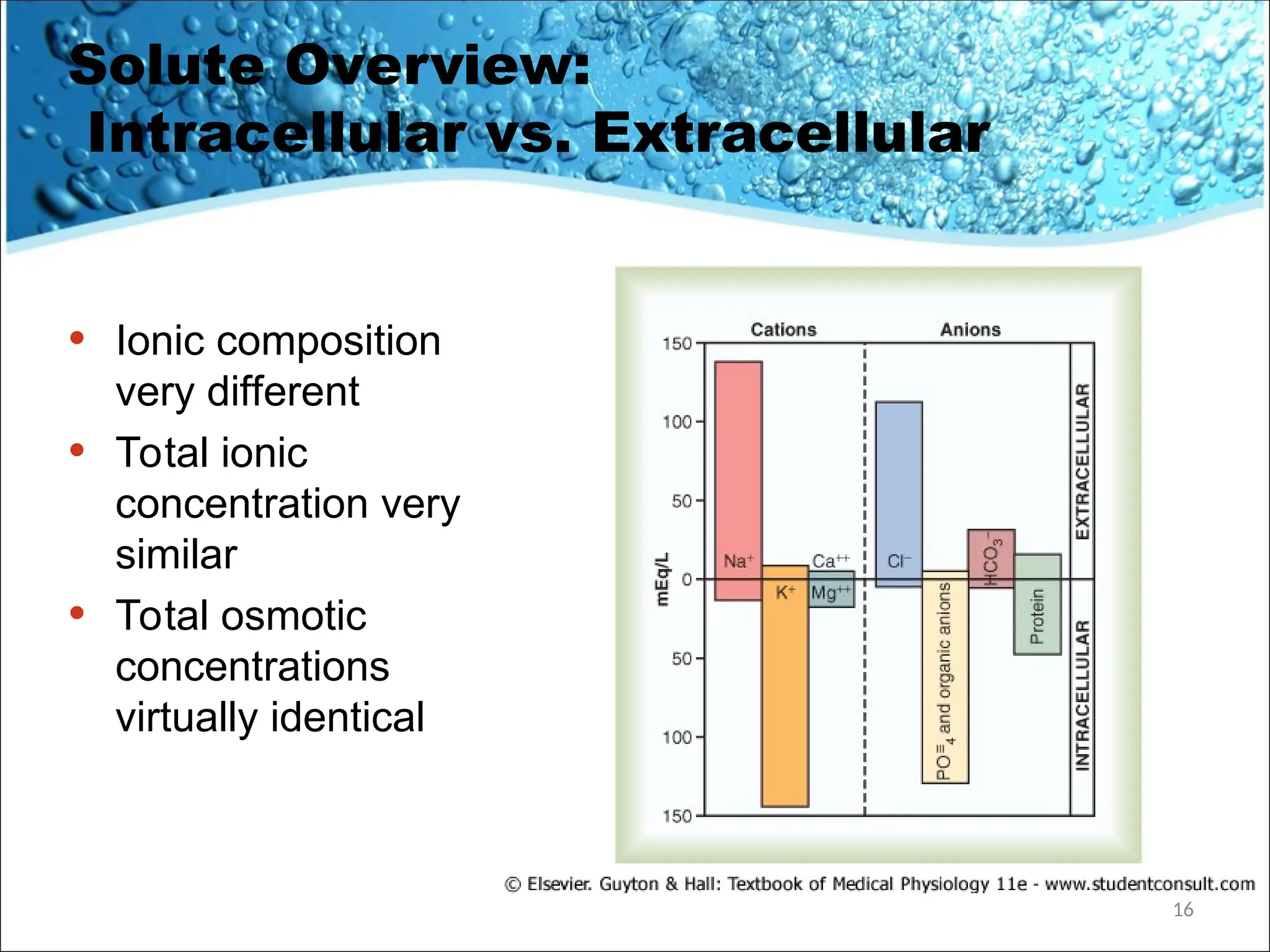
Solute Overview:
Intracellular vs. Extracellular
• Ionic composition
very different
• Total ionic
concentration very
similar
• Total osmotic
concentrations
virtually identical
16
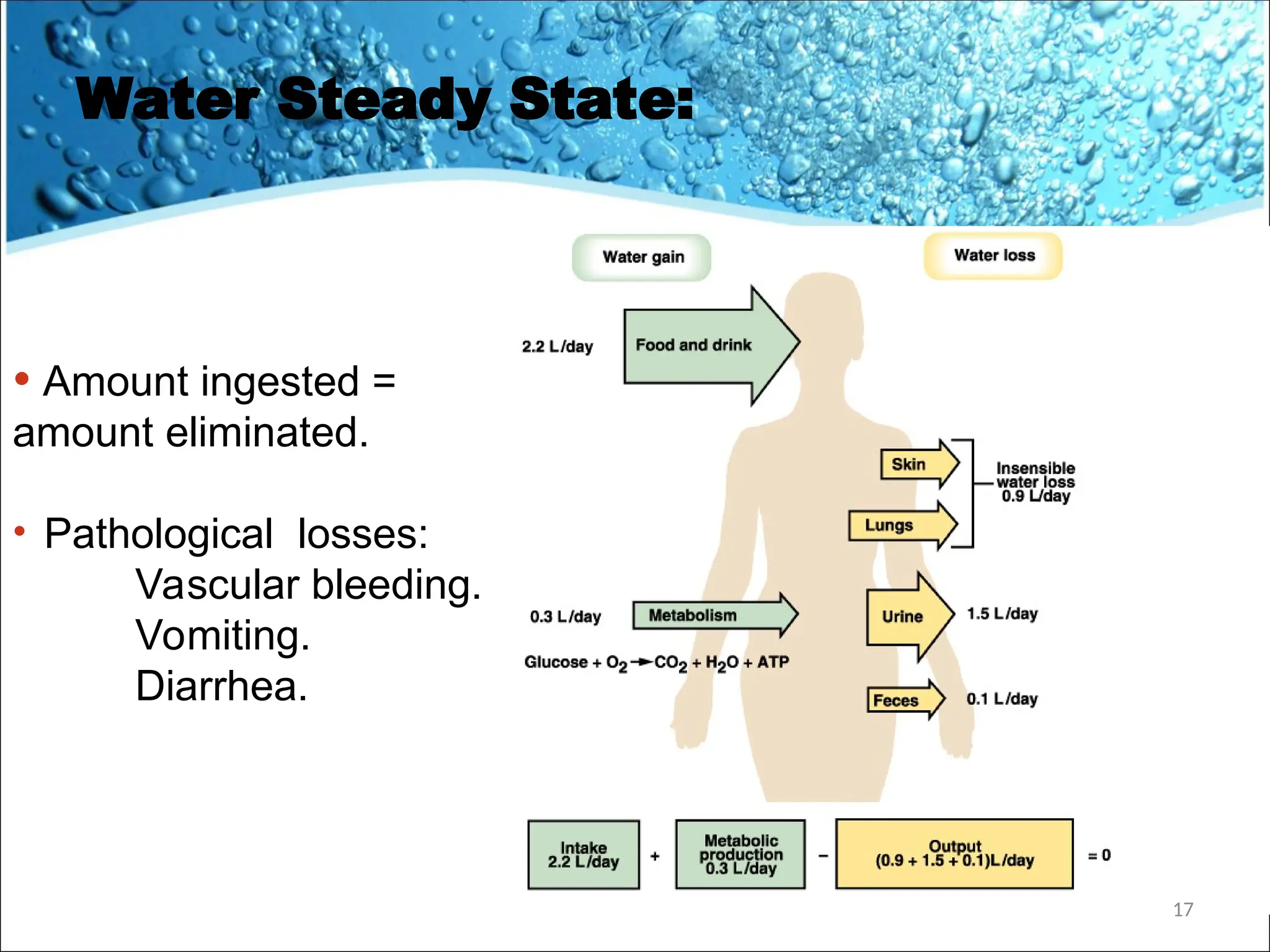
Water Steady State:
• Amount ingested =
amount eliminated.
• Pathological losses:
Vascular bleeding.
Vomiting.
Diarrhea.
17
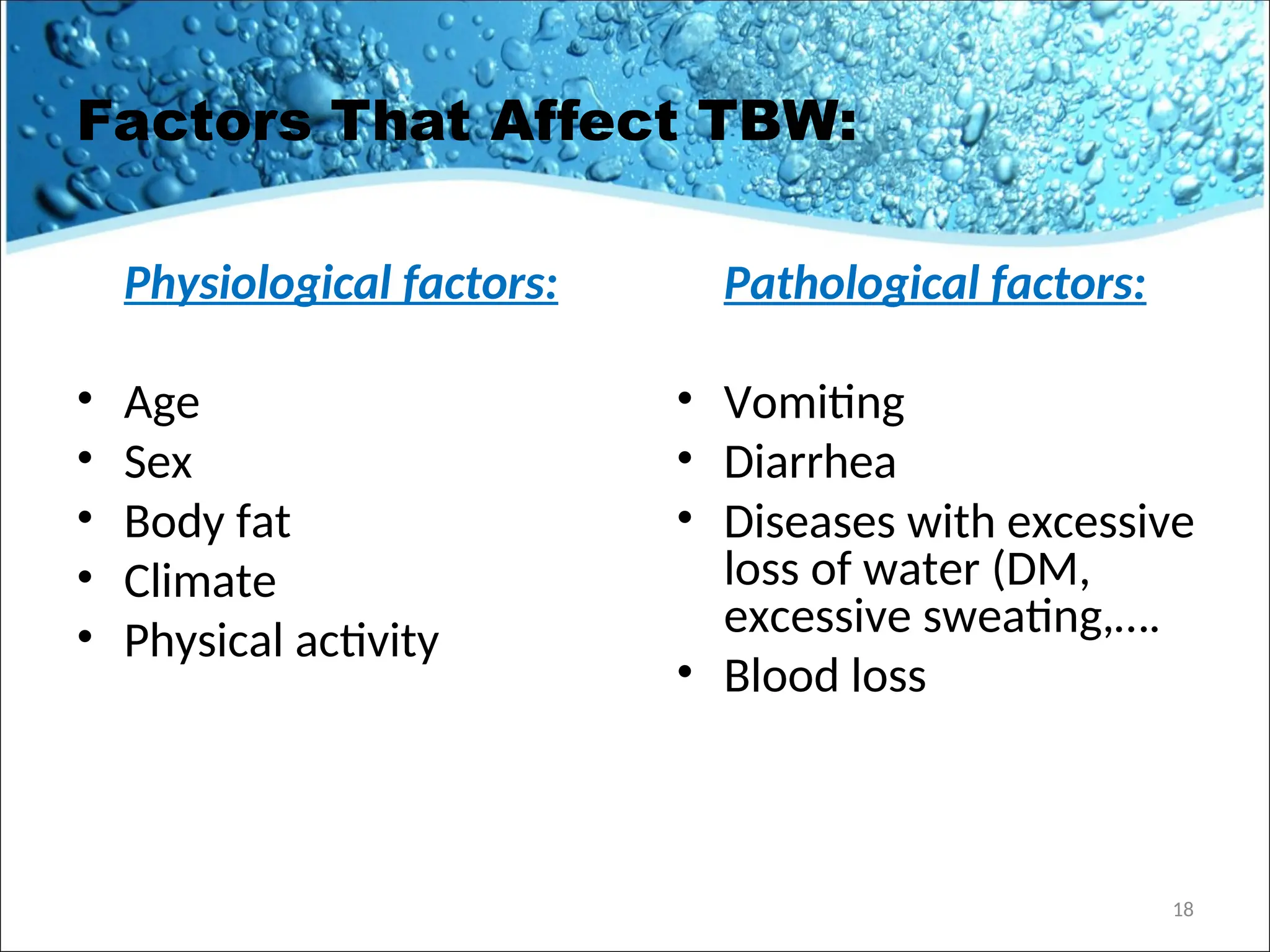
Factors That Affect TBW:
Physiological factors:
• Age
• Sex
• Body fat
• Climate
• Physical activity
18
Pathological factors:
• Vomiting
• Diarrhea
• Diseases with excessive
loss of water (DM,
excessive sweating,….
• Blood loss
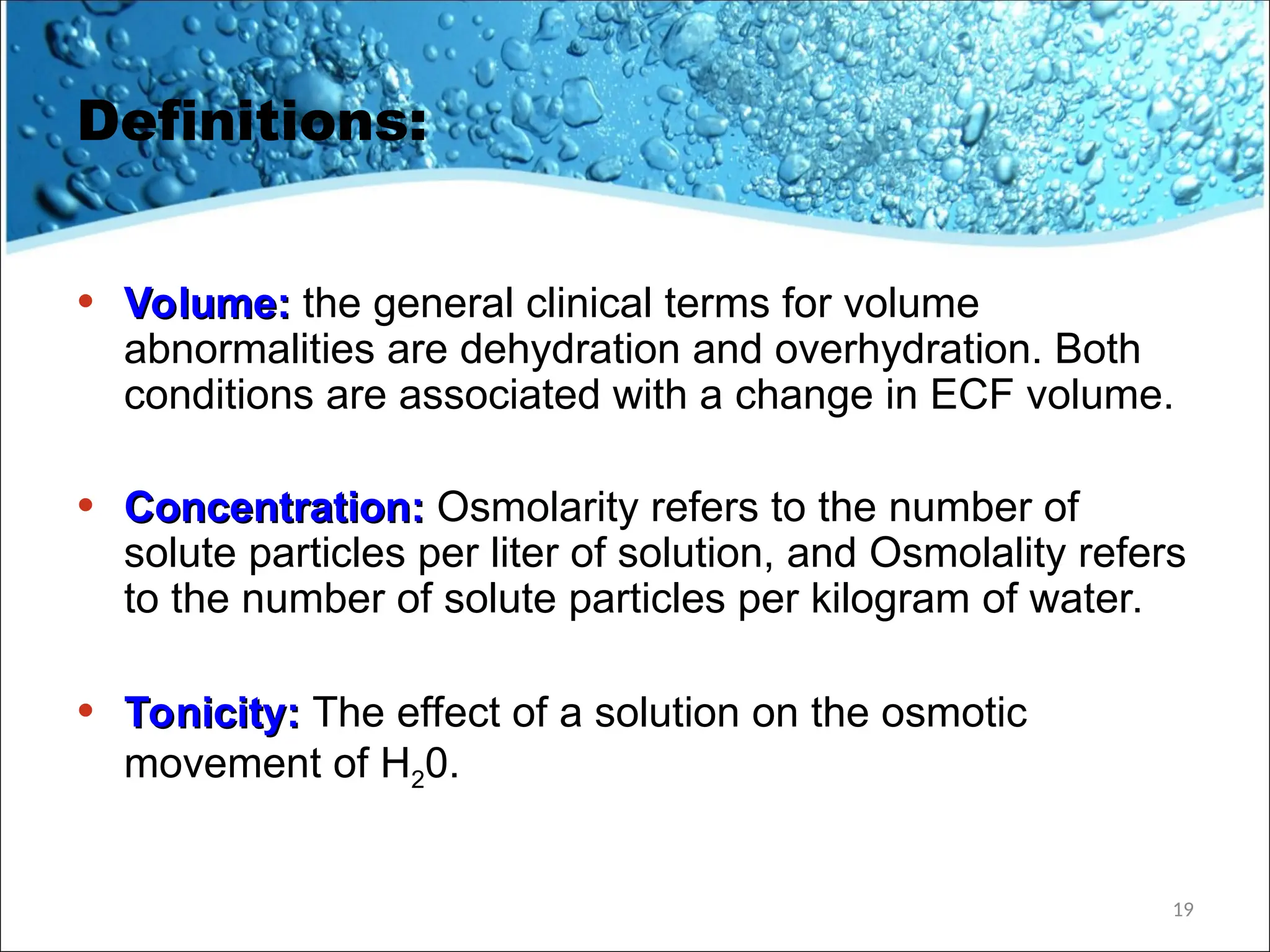
Definitions:
• Volume:
Volume: the general clinical terms for volume
abnormalities are dehydration and overhydration. Both
conditions are associated with a change in ECF volume.
• Concentration:
Concentration: Osmolarity refers to the number of
solute particles per liter of solution, and Osmolality refers
to the number of solute particles per kilogram of water.
• Tonicity:
Tonicity: The effect of a solution on the osmotic
movement of H20.
19
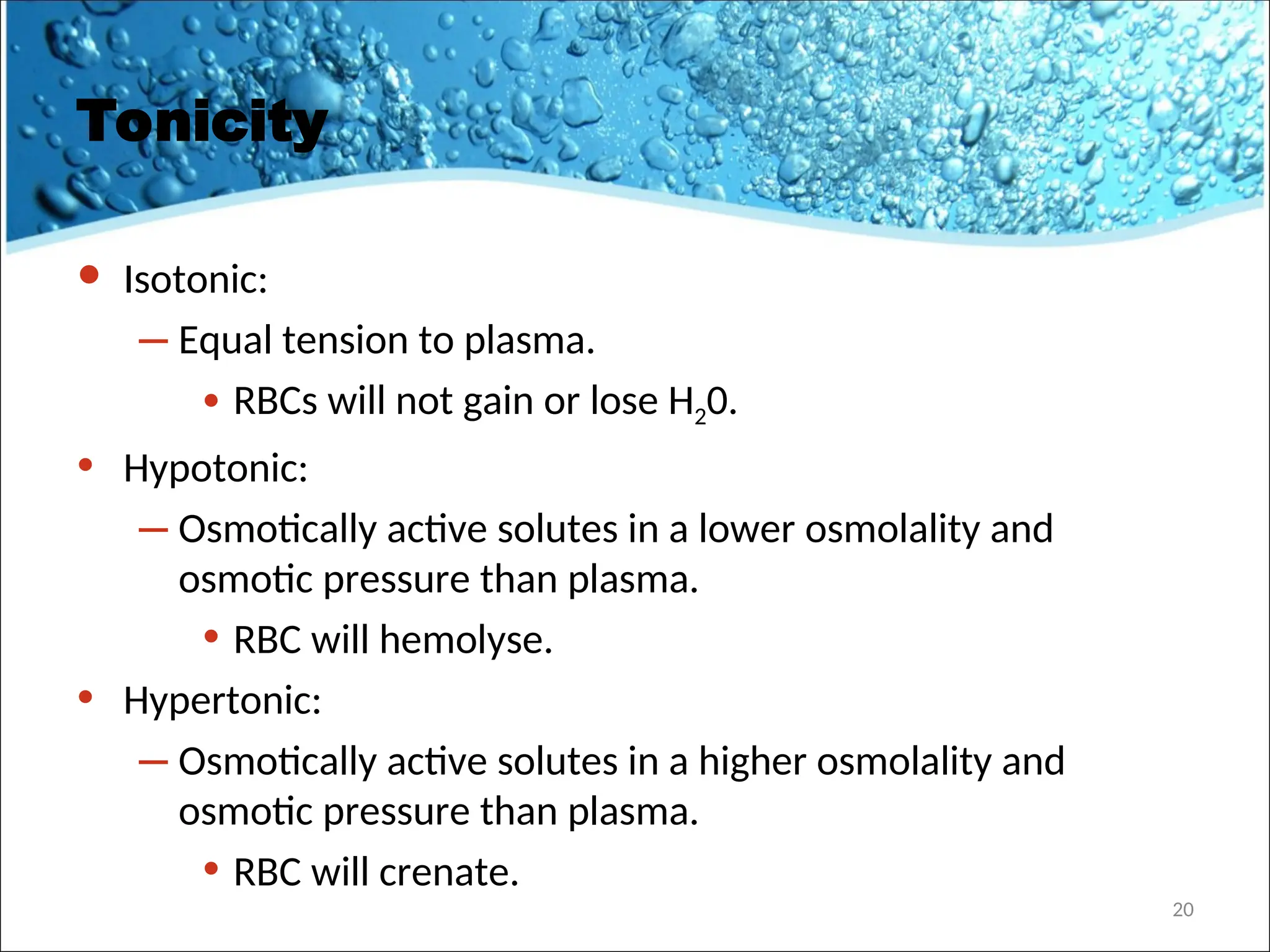
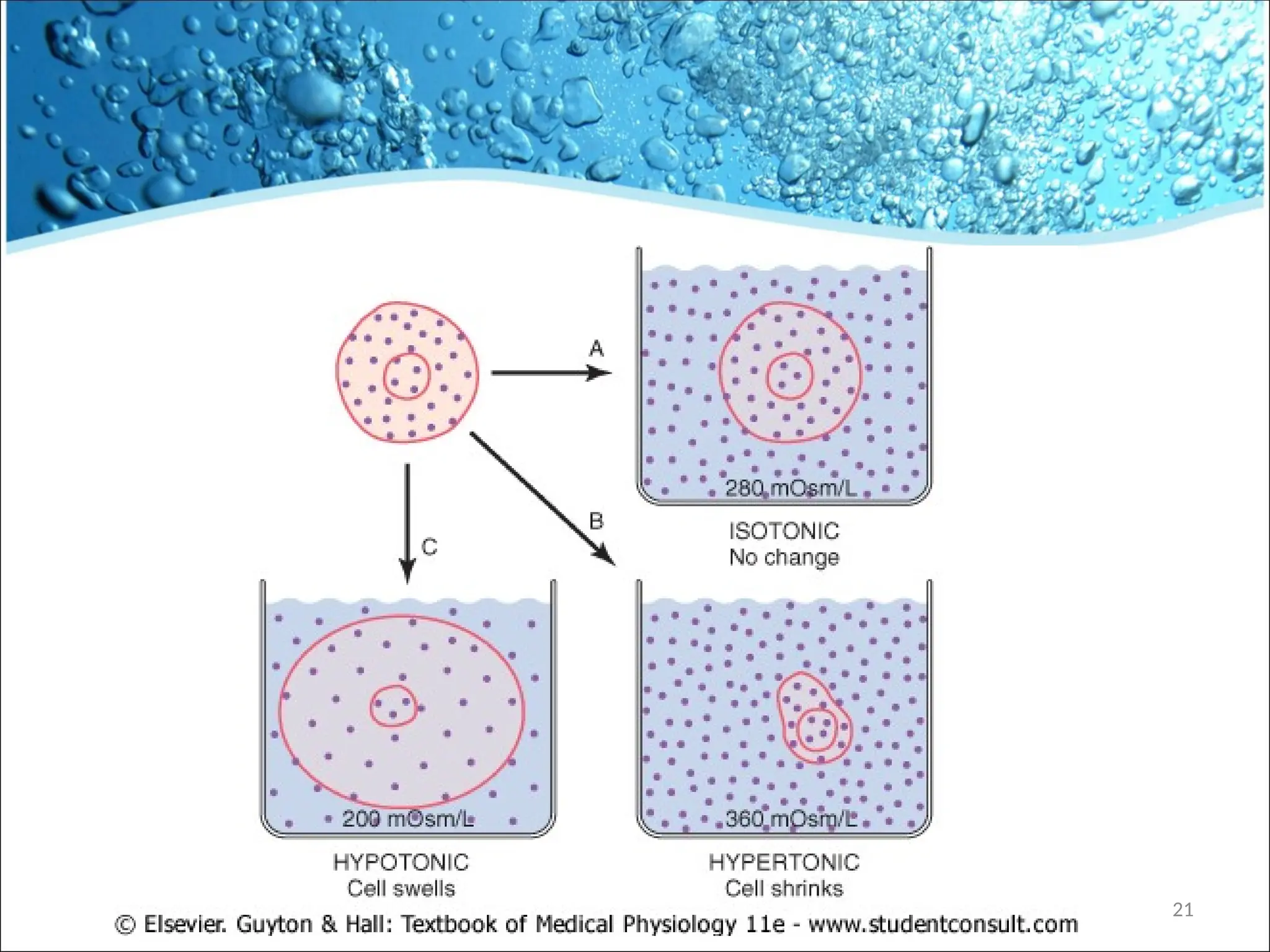
Tonicity
• Isotonic:
– Equal tension to plasma.
• RBCs will not gain or lose H20.
• Hypotonic:
– Osmotically active solutes in a lower osmolality and
osmotic pressure than plasma.
• RBC will hemolyse.
• Hypertonic:
– Osmotically active solutes in a higher osmolality and
osmotic pressure than plasma.
• RBC will crenate.
20
21
Regulation of fluids and electrolytes:
• Homeostatic mechanisms respond to changes in ECF
• No receptors directly monitor fluid or electrolyte balance
– Respond to changes in plasma volume or osmotic
concentrations.
– All water moves passively in response to osmotic gradients.
– Body content of watar or electrolytes rises if intake exceeds
outflow.
22
Primary regulatory hormones:
• Antidiuretic hormone (ADH)
– Stimulates water conservation and the thirst center
– Regulates the concentration of body fluid
• Aldosterone
– Controls Na+
absorption and K+
loss along the DCT
– Regulates the volume of body fluid compartment
• Natriuretic peptides
– Reduce thirst and block the release of ADH and
aldosterone
23
Sodium balance:
• Rate of sodium uptake across digestive tract directly
proportional to dietary intake
– Sodium losses occur through urine and perspiration
• Shifts in sodium balance result in expansion or
contraction of ECF
– Large variations corrected by homeostatic
mechanisms
• Too low, ADH / aldosterone secreted
• Too high, ANP secreted
24
Potassium balance:
• Potassium ion concentrations in ECF are low
– Not as closely regulated as sodium
– Potassium ion excretion increases as
• ECF concentrations rise
• Aldosterone secreted
• pH rises
– Potassium retention occurs when pH falls
25

2-Foundation Block New Lecture 2 (Body Fluids).ppt

  • 1.
    Body Fluids andElectrolytes Body Fluids and Electrolytes By Ahmad Ahmeda aahmeda@ksu.edu.sa 0536313454 (Foundation Block) (Foundation Block) 1
  • 2.
    Learning Objectives: • Identifyand describe daily intake and output of water and maintenance of water balance. • List and describe of body fluid compartments as intra‐ cellular fluid (ICF), Extra cellular fluid (ECF), interstitial ‐ fluid, trans cellular fluid, and total body water (TBW). ‐ • Describe the composition of each fluid compartment, in terms of volume and ions and represent them in graphic forms. • Describe the physiological and pathological factors influencing the body fluid. 2
  • 3.
    Composition of thehuman body: A. Body Water: The human body made mainly of water, which consistutes about 60% of body weight in the adult, however the amount of water varies with age. Male (%) Female (%) At birth 82 82 Children and adolescents 70 70 18-20 years 59 57 20-40 years 61 51 40-60 years 55 47 Over 60 years 52 46 3
  • 4.
    Composition of thehuman body: B. Protein: Is the second largest component in the human body, largest amount found in skeletal muscle. C. Fat: The third largest component in lean individual. It is found in adipose tissue 4
  • 5.
    Composition of thehuman body: D. Minerals: Minerals, present in the human body in relatively small quantities with the exception of calcium. (Found in bones) Minerals and electrolytes are found in the body fluids in minute concentrations, which are closely regulated to maintain the composition of the internal environment 5
  • 6.
    The body fluids: •Total body water (TBW): consititutes 55-60% of the body weight in young men and 45-50% in young women. Why the percentage is lower in women? • The TBW is distributed as follows: Muscle (50%) Skin (20%) Other organs (20%) Blood (10%) 6
  • 7.
    The body fluids: •Infants have low body fat, low bone mass, and are 73% or more water. • Total water content declines throughout life. • Healthy males are about 60% water; healthy females are around 50% – This difference reflects females’: • Higher body fat • Smaller amount of skeletal muscle • In old age, only about 45% of body weight is water. 7
  • 8.
    The body fluids: •The water content of the body is divided into two compartments. 1) Intracellular compartment: Contained within the cell, represent approximately 67% of the total body water, 40% of total body weight. 2) Extracellular Compartment: Contained within the vessels of the cardiovascular system, is the remaining 33% of the total body water, about 20 % of total body weight, 8
  • 9.
    The Composition ofthe Human Body: 9
  • 10.
    Extracellular fluid (ECF) TheECF compartments has several subcompartments: 1. Plasma, the fluid portion of the blood, represents approximately 25% of the ECF. Blood volume, approximately 80 ml/kg of body weight (8%). 10
  • 11.
    Extracellular fluid (ECF) 2.Interstitial fluid (ISF), is contained in a gel-like extracellular matrix. ISF sourrounds all cells except blood cells and includes Lymph (2-3%) of total body weight The ISF represent approximately 15% of the total body weight and 75% of the ECF. 11
  • 12.
    Extracellular fluid (ECF) 3.Transcellular fluid volume, is about 1 L, occupies approximately 15 ml/kg of body weight (1.5%). * Represents fluid in the lumen of structures lined by epithelium and includes digestive secretions, sweat, CSF, pleural, peritoneal, synovial, intraocular, pericardial fluids, bile, thyroid, and cochlea. 12
  • 13.
    Constitutes of extracellularand intracellular fluids: Plasma (mOsm/L H2O) Interstitial (mOsm/L H2O) Intracellular (mOsm/L H2O) Na+ 142 139 14 K+ 4.2 4.0 140 Ca++ 1.3 1.2 0 Mg + 0.8 0.7 20 Cl- 108 108 4 HCO3 - 24 28.3 10 HPO4 - , H2PO4 - 2 2 11 SO4 - 0.5 0.5 1 Phosphocreatine 45 Carnosine 14 Amino acids 2 2 8 Creatine 0.2 0.2 9 Lactate 1.2 1.2 1.5 Adenosine triphosphate 5 Hexose monophosphate 3.7 Glucose 5.6 5.6 Protein 1.2 0.2 4 Urea 4 4 4 Others 4.8 3.9 10 Total mOsm/L 301.8 300.8 301.2 Corrected osmolar activity (mOsm/L) 282.0 281.0 281.0 Total osmotic pressure at 37°C (mm Hg) 5443 5423 5423 13
  • 14.
    The major bodyfluid compartment and membranes separate them 14
  • 15.
    • The plasmaand interstitial fluid are separated only by highly permeable capillary membranes, their ionic composition is similar but protein is higher in the plasma. • the intracellular fluid is separated from extracellular fluid by a cell membrane that is highly permeable to water but not to most of the electrolytes in the body. 15
  • 16.
    Solute Overview: Intracellular vs.Extracellular • Ionic composition very different • Total ionic concentration very similar • Total osmotic concentrations virtually identical 16
  • 17.
    Water Steady State: •Amount ingested = amount eliminated. • Pathological losses: Vascular bleeding. Vomiting. Diarrhea. 17
  • 18.
    Factors That AffectTBW: Physiological factors: • Age • Sex • Body fat • Climate • Physical activity 18 Pathological factors: • Vomiting • Diarrhea • Diseases with excessive loss of water (DM, excessive sweating,…. • Blood loss
  • 19.
    Definitions: • Volume: Volume: thegeneral clinical terms for volume abnormalities are dehydration and overhydration. Both conditions are associated with a change in ECF volume. • Concentration: Concentration: Osmolarity refers to the number of solute particles per liter of solution, and Osmolality refers to the number of solute particles per kilogram of water. • Tonicity: Tonicity: The effect of a solution on the osmotic movement of H20. 19
  • 20.
    Tonicity • Isotonic: – Equaltension to plasma. • RBCs will not gain or lose H20. • Hypotonic: – Osmotically active solutes in a lower osmolality and osmotic pressure than plasma. • RBC will hemolyse. • Hypertonic: – Osmotically active solutes in a higher osmolality and osmotic pressure than plasma. • RBC will crenate. 20
  • 21.
  • 22.
    Regulation of fluidsand electrolytes: • Homeostatic mechanisms respond to changes in ECF • No receptors directly monitor fluid or electrolyte balance – Respond to changes in plasma volume or osmotic concentrations. – All water moves passively in response to osmotic gradients. – Body content of watar or electrolytes rises if intake exceeds outflow. 22
  • 23.
    Primary regulatory hormones: •Antidiuretic hormone (ADH) – Stimulates water conservation and the thirst center – Regulates the concentration of body fluid • Aldosterone – Controls Na+ absorption and K+ loss along the DCT – Regulates the volume of body fluid compartment • Natriuretic peptides – Reduce thirst and block the release of ADH and aldosterone 23
  • 24.
    Sodium balance: • Rateof sodium uptake across digestive tract directly proportional to dietary intake – Sodium losses occur through urine and perspiration • Shifts in sodium balance result in expansion or contraction of ECF – Large variations corrected by homeostatic mechanisms • Too low, ADH / aldosterone secreted • Too high, ANP secreted 24
  • 25.
    Potassium balance: • Potassiumion concentrations in ECF are low – Not as closely regulated as sodium – Potassium ion excretion increases as • ECF concentrations rise • Aldosterone secreted • pH rises – Potassium retention occurs when pH falls 25