BRIEF REVIEW
BODY COMPOSITION AND MILITARY
PERFORMANCEdMANY THINGS TO MANY PEOPLE
KARL E. FRIEDL
Telemedicine and Advanced Technology Research Center, U.S. Army Medical Research and Materiel Command, Fort Detrick,
Maryland
ABSTRACT
Friedl, KE. Body composition and military performancedMany
things to many people. J Strength Cond Res 26(7): S87–
S100, 2012dSoldiers are expected to maintain the highest
possible level of physical readiness because they must be
ready to mobilize and perform their duties anywhere in the
world at any time. The objective of Army body composition
standards is to motivate physical training and good nutrition
habits to ensure a high state of readiness. Establishment of
enforceable and rational standards to support this objective
has been challenging even at extremes of body size. Morbidly
obese individuals are clearly not suited to military service, but
very large muscular individuals may be superbly qualified for
soldier performance demands. For this reason, large individuals
are measured for body fat using a waist circumference-based
equation (female soldiers are also measured for hip circumfer-
ence). The main challenge comes in setting appropriate fat
standards to support the full range of Army requirements. Mil-
itary appearance ideals dictate the most stringent body fat
standards, whereas health risk thresholds anchor the most lib-
eral standards, and physical performance associations fall on
a spectrum between these 2 poles. Standards should not ex-
clude or penalize specialized performance capabilities such as
endurance running or power lifting across a spectrum of body
sizes and fat. The full integration of women into the military
further complicates the issue because of sexually dimorphic
characteristics that make gender-appropriate standards essen-
tial and where inappropriately stringent standards can compro-
mise both health and performance of this segment of the force.
Other associations with body composition such as stress
effects on intraabdominal fat distribution patterns and meta-
bolic implications of a fat reserve for survival in extreme environ-
ments are also relevant considerations. This is a review of
the science that underpins the U.S. Army body composition
standards.
KEY WORDS body fat, physical activity, metabolism, chronic
health, appearance
INTRODUCTION
M
ilitary and physical fitness trainers are keenly
aware that specific types of physical perfor-
mance are associated with specific body size
and composition characteristics (24). An
obvious example is the contrast between the massive mus-
cularity of a power lifter and the extreme thinness and
leanness of a marathon runner. Body size, body composi-
tion, and military bearing (appearance) have always been
important to the military because of real and perceived
associations with physical performance capabilities (28).
Despite associations, there is low specific predictive value
of body size or composition to soldier performance within
the wide range of healthy weights and adiposity (51). Nev-
ertheless, it is reasonable to select against extremes of un-
derweight and overweight where health and performance
has a high probability of compromise, but this still bounds
a large range of body size and composition, comprising
a full spectrum of individuals that look like Vogue models,
the fictional mesomorphic cartoon character “Sergeant
Rock,” and fatter but extremely strong men. It is also rea-
sonable to enforce body composition standards that drive
fitness and nutrition habits, but these must be achievable by
any motivated healthy soldier. These reasonably achievable
standards of size and body composition must take into
account factors such as genetics, developmental influences,
selection, and the plasticity of the body to recent and ha-
bitual physical demands and other environmental factors
(e.g., nutrition, health, neurobiology, and personal habits).
The more recent inclusion of women in military services
further complicates the issue because of sexually dimorphic
characteristics that make “gender-appropriate” (rather than
“gender-neutral”) standards essential to optimal health and
performance of the force (29,120). This is a review of the
basis for the U.S. Army body composition standards. The
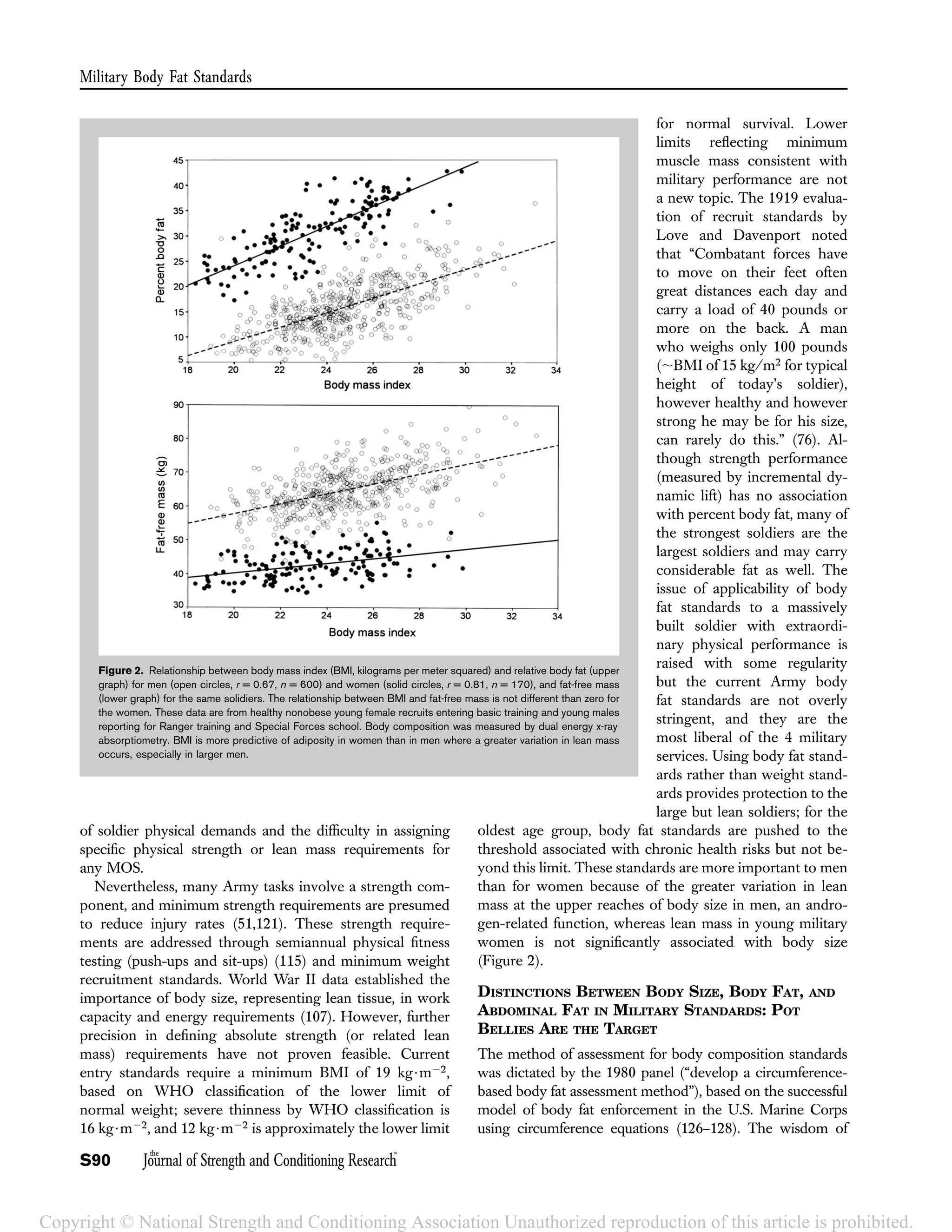
current U.S. Army screening weights and body fat stand-
ards are shown in Table 1.
The opinions and assertions in this article are those of the author and do
not necessarily represent the official position or views of the
Department of the Army or the Department of Defense.
Address correspondence to Karl E. Friedl, karl.friedl@us.army.mil.
26(7)/S87–S100
Journal of Strength and Conditioning Research
Ó 2012 National Strength and Conditioning Association
VOLUME 26 | SUPPLEMENT 7 | JULY 2012 | S87
Copyright © National Strength and Conditioning Association Unauthorized reproduction of this article is prohibited.
PURPOSE OF U.S. MILITARY OCCUPATIONAL WEIGHT
AND BODY COMPOSITION STANDARDS
The purpose of military entry standards is to select recruits
who will be able to meet soldier standards. In turn, soldier
body composition standards are set according to the
requirements of the Army, with general standards relevant
to every individual regardless of their job assignment. These
requirements include physical performance and military
appearance and chronic health risk outcomes. Morbid
obesity is negatively associated with each of these 3 broad
categories (health, performance, military appearance), but
more precise thresholds of risk at lower levels of obesity
(overweight and overfat) require careful analysis and con-
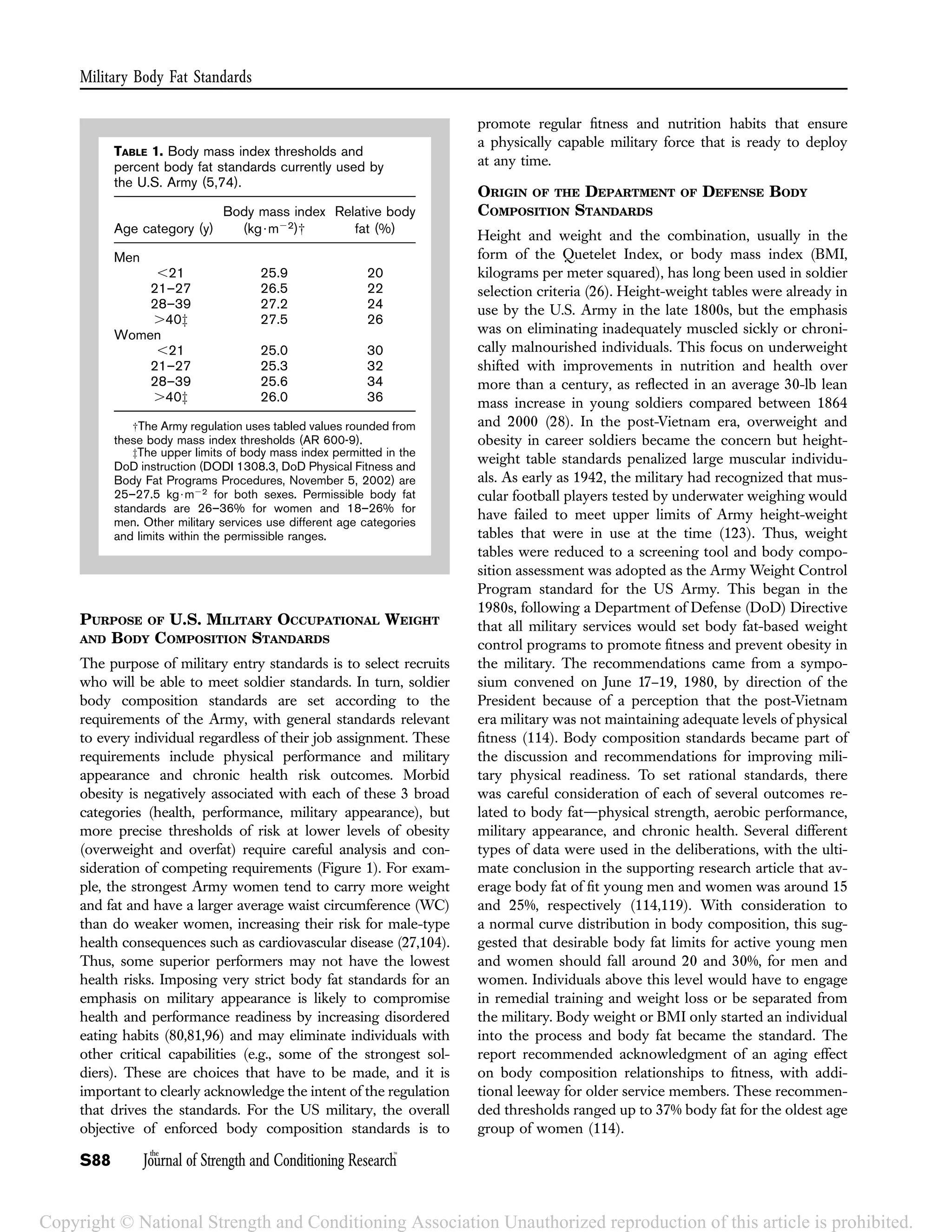
sideration of competing requirements (Figure 1). For exam-
ple, the strongest Army women tend to carry more weight
and fat and have a larger average waist circumference (WC)
than do weaker women, increasing their risk for male-type
health consequences such as cardiovascular disease (27,104).
Thus, some superior performers may not have the lowest
health risks. Imposing very strict body fat standards for an
emphasis on military appearance is likely to compromise
health and performance readiness by increasing disordered
eating habits (80,81,96) and may eliminate individuals with
other critical capabilities (e.g., some of the strongest sol-
diers). These are choices that have to be made, and it is
important to clearly acknowledge the intent of the regulation
that drives the standards. For the US military, the overall
objective of enforced body composition standards is to
promote regular fitness and nutrition habits that ensure
a physically capable military force that is ready to deploy
at any time.
ORIGIN OF THE DEPARTMENT OF DEFENSE BODY
COMPOSITION STANDARDS
Height and weight and the combination, usually in the
form of the Quetelet Index, or body mass index (BMI,
kilograms per meter squared), has long been used in soldier
selection criteria (26). Height-weight tables were already in
use by the U.S. Army in the late 1800s, but the emphasis
was on eliminating inadequately muscled sickly or chroni-
cally malnourished individuals. This focus on underweight
shifted with improvements in nutrition and health over
more than a century, as reflected in an average 30-lb lean
mass increase in young soldiers compared between 1864
and 2000 (28). In the post-Vietnam era, overweight and
obesity in career soldiers became the concern but height-
weight table standards penalized large muscular individu-
als. As early as 1942, the military had recognized that mus-
cular football players tested by underwater weighing would
have failed to meet upper limits of Army height-weight
tables that were in use at the time (123). Thus, weight
tables were reduced to a screening tool and body compo-
sition assessment was adopted as the Army Weight Control
Program standard for the US Army. This began in the
1980s, following a Department of Defense (DoD) Directive
that all military services would set body fat-based weight
control programs to promote fitness and prevent obesity in
the military. The recommendations came from a sympo-
sium convened on June 17–19, 1980, by direction of the
President because of a perception that the post-Vietnam
era military was not maintaining adequate levels of physical
fitness (114). Body composition standards became part of
the discussion and recommendations for improving mili-
tary physical readiness. To set rational standards, there
was careful consideration of each of several outcomes re-
lated to body fatdphysical strength, aerobic performance,
military appearance, and chronic health. Several different
types of data were used in the deliberations, with the ulti-
mate conclusion in the supporting research article that av-
erage body fat of fit young men and women was around 15
and 25%, respectively (114,119). With consideration to
a normal curve distribution in body composition, this sug-
gested that desirable body fat limits for active young men
and women should fall around 20 and 30%, for men and
women. Individuals above this level would have to engage
in remedial training and weight loss or be separated from
the military. Body weight or BMI only started an individual
into the process and body fat became the standard. The
report recommended acknowledgment of an aging effect
on body composition relationships to fitness, with addi-
tional leeway for older service members. These recommen-
ded thresholds ranged up to 37% body fat for the oldest age
group of women (114).
TABLE 1. Body mass index thresholds and
percent body fat standards currently used by
the U.S. Army (5,74).
Age category (y)
Body mass index
(kg$m22)†
Relative body
fat (%)
Men
,21 25.9 20
21–27 26.5 22
28–39 27.2 24
.40z 27.5 26
Women
,21 25.0 30
21–27 25.3 32
28–39 25.6 34
.40z 26.0 36
†The Army regulation uses tabled values rounded from
these body mass index thresholds (AR 600-9).
zThe upper limits of body mass index permitted in the
DoD instruction (DODI 1308.3, DoD Physical Fitness and
Body Fat Programs Procedures, November 5, 2002) are
25–27.5 kg$m22 for both sexes. Permissible body fat
standards are 26–36% for women and 18–26% for
men. Other military services use different age categories
and limits within the permissible ranges.
Military Body Fat Standards
S88 Journal of Strength and Conditioning Research
the TM
Copyright © National Strength and Conditioning Association Unauthorized reproduction of this article is prohibited.
Gender-appropriate, rather than gender-neutral, standards
for body composition were established, recognizing funda-
mental endocrine physiology, and human sexual dimorphism.
However, in the translation between the recommendations of
the panel (114) and the DoD Instruction, there was an ad-
justment to tighten the womens’ standards. This was based
on a prevailing misperception that, in terms of physical per-
formance, women were basically men with too much body
fat, and their performance might come closer to that of the
male counterparts if they were held to leaner standards.
Screening weights and body fat standards were later amended
in a revision of the Army Regulation and the DoD Directive
to the original recommendations, based on data that showed
how female soldier health and performance was impaired by
inappropriately stringent body fat standards (5,34,38). There
is clearly a weight penalty for additional sex-specific fat that
affects running and marching performance (14). However,
there is also a more enlightened understanding that female
physiology has its own performance advantages, particularly
in estrogen-regulated fat metabolism (59,111,112).
BODY SIZE AND STRENGTH REQUIREMENTS
In addition to the general body fat standards applicable to all
soldiers, there are also physical standards specific to military
occupational specialties (MOS). Previously, these were
focused on strength requirements associated with specific
tasks in the specialties such as ability to lift kettles of food
and handle fire hoses (46). These MOS-specific standards
have been revised over time and today include primarily
height standards such as minimum heights for man portable
field artillery system crewmem-
bers (6400
) and maximum
heights for armor crewmem-
bers (7300
) based on human lim-
itations of engineered systems.
Earlier strength requirements
were abandoned because it
was recognized that specific
thresholds for individual char-
acteristics or capabilities were
not defining limitations in mili-
tary job specialties, especially
considering the complexity of
modern jobs and team efforts,
and with changes in safety and
efficiency offered by reengin-
eering tasks and equipment.
This represents a significant
shift in common perceptions
that massive soldiers are the
best soldiers and recognition
that other soldier characteris-
tics are at least equally impor-
tant to mission success.
Consistent with this thinking,
the Army research investment has been in “skin-out” tech-
nologies such as exoskeletons and jet packs to provide Su-
perman performance rather than attempts to produce an
Army of massive soldiers through very narrow genetic selec-
tion or through genetic manipulation of myostatin or other
musculotrophic regulators (30).
A large effort to classify job strength requirements and
then classify eligible candidates by minimum strength
capability with an upright lift test in the recruit processing
centers failed because of testing safety concerns that reduced
the rigor of the test and changed the results to job advisory
guidance rather than requirements (67,113,121). The Assis-
tant Secretary of the Army for Manpower and Reserve
Affairs, Ms. Sara Lister, challenged Army researchers to find
any conclusive evidence that physical strength had relevance
to job selection criteria. This eventually led to a comprehen-
sive study of one military job specialty (wheeled vehicle
mechanics) to determine if body weight and strength meas-
ures were related to injury risk. Injuries provided a more
quantifiable outcome measure than “job performance” and
represented an aspect of military job performance. Wheeled
vehicle mechanics were chosen because they have one of the
highest injury rates for men and women. The results indi-
cated that the leading cause of injuries was physical fitness
training (notably, running), rather than job-specific mechan-
ical work. Although the female soldiers were smaller and
weaker on average than the males, men had the highest rates
of traumatic injury and men with a higher BMI were at
greater risk for sustaining an injury than the smaller men
(66). The results of this study highlight the complexity
Figure 1. Do we want “pretty” or healthy? Body fat standards are strictest if based on prevailing perceptions of
military appearance and most liberal if based on estimates of health risk thresholds. Optimal body composition for
many types of physical performance fall somewhere between these extremes of leanness and tolerable fatness.
Journal of Strength and Conditioning Research
the TM
| www.nsca.com
VOLUME 26 | SUPPLEMENT 7 | JULY 2012 | S89
Copyright © National Strength and Conditioning Association Unauthorized reproduction of this article is prohibited.
of soldier physical demands and the difficulty in assigning
specific physical strength or lean mass requirements for
any MOS.
Nevertheless, many Army tasks involve a strength com-
ponent, and minimum strength requirements are presumed
to reduce injury rates (51,121). These strength require-
ments are addressed through semiannual physical fitness
testing (push-ups and sit-ups) (115) and minimum weight
recruitment standards. World War II data established the
importance of body size, representing lean tissue, in work
capacity and energy requirements (107). However, further
precision in defining absolute strength (or related lean
mass) requirements have not proven feasible. Current
entry standards require a minimum BMI of 19 kg$m22,
based on WHO classification of the lower limit of
normal weight; severe thinness by WHO classification is
16 kg$m22, and 12 kg$m22 is approximately the lower limit
for normal survival. Lower
limits reflecting minimum
muscle mass consistent with
military performance are not
a new topic. The 1919 evalua-
tion of recruit standards by
Love and Davenport noted
that “Combatant forces have
to move on their feet often
great distances each day and
carry a load of 40 pounds or
more on the back. A man
who weighs only 100 pounds
(;BMI of 15 kg/m2 for typical
height of today’s soldier),
however healthy and however
strong he may be for his size,
can rarely do this.” (76). Al-
though strength performance
(measured by incremental dy-
namic lift) has no association
with percent body fat, many of
the strongest soldiers are the
largest soldiers and may carry
considerable fat as well. The
issue of applicability of body
fat standards to a massively
built soldier with extraordi-
nary physical performance is
raised with some regularity
but the current Army body
fat standards are not overly
stringent, and they are the
most liberal of the 4 military
services. Using body fat stand-
ards rather than weight stand-
ards provides protection to the
large but lean soldiers; for the
oldest age group, body fat standards are pushed to the
threshold associated with chronic health risks but not be-
yond this limit. These standards are more important to men
than for women because of the greater variation in lean
mass at the upper reaches of body size in men, an andro-
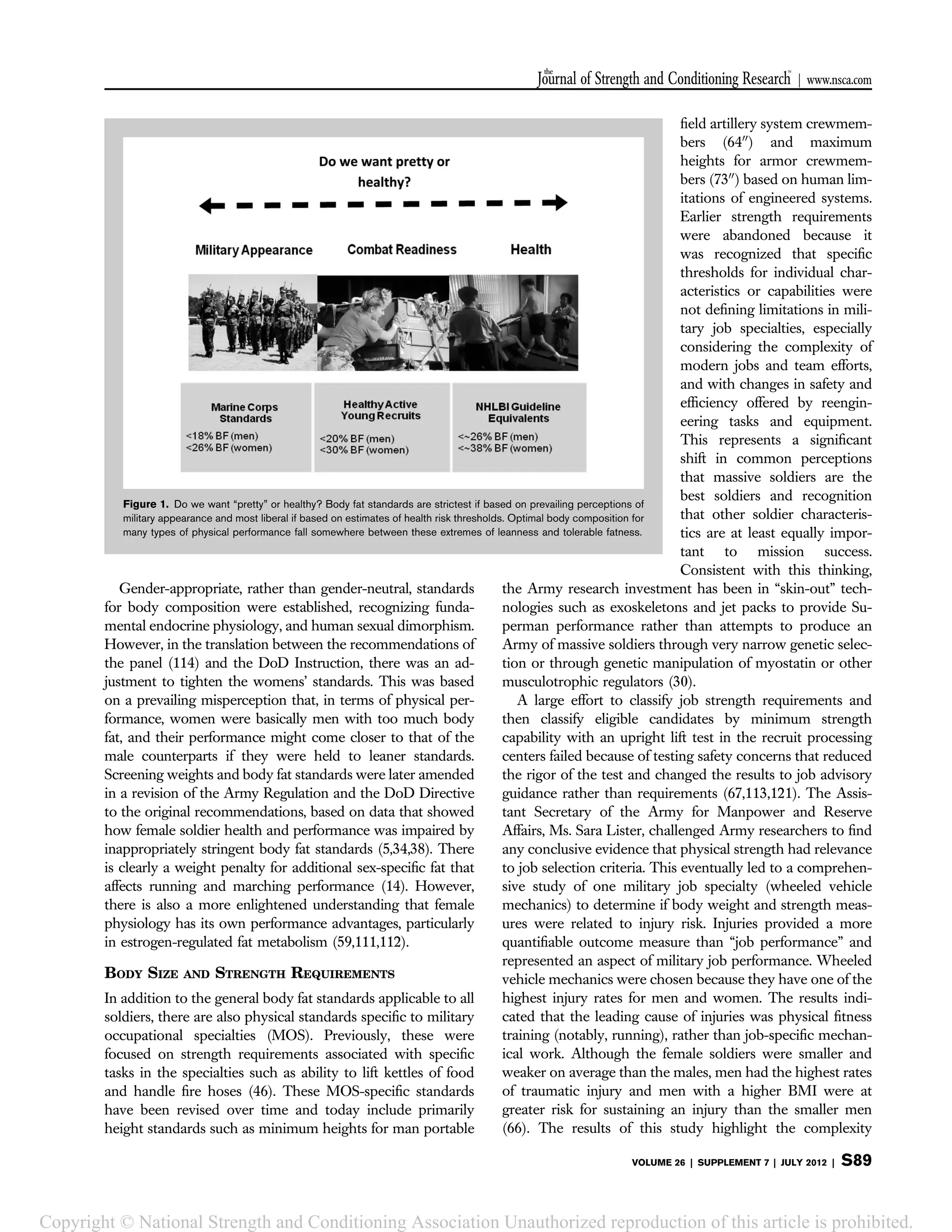
gen-related function, whereas lean mass in young military
women is not significantly associated with body size
(Figure 2).
DISTINCTIONS BETWEEN BODY SIZE, BODY FAT, AND
ABDOMINAL FAT IN MILITARY STANDARDS: POT
BELLIES ARE THE TARGET
The method of assessment for body composition standards
was dictated by the 1980 panel (“develop a circumference-
based body fat assessment method”), based on the successful
model of body fat enforcement in the U.S. Marine Corps
using circumference equations (126–128). The wisdom of
Figure 2. Relationship between body mass index (BMI, kilograms per meter squared) and relative body fat (upper
graph) for men (open circles, r = 0.67, n = 600) and women (solid circles, r = 0.81, n = 170), and fat-free mass
(lower graph) for the same solidiers. The relationship between BMI and fat-free mass is not different than zero for
the women. These data are from healthy nonobese young female recruits entering basic training and young males
reporting for Ranger training and Special Forces school. Body composition was measured by dual energy x-ray
absorptiometry. BMI is more predictive of adiposity in women than in men where a greater variation in lean mass
occurs, especially in larger men.
Military Body Fat Standards
S90 Journal of Strength and Conditioning Research
the TM
Copyright © National Strength and Conditioning Association Unauthorized reproduction of this article is prohibited.
this panel, which had to make recommendations with limited
available data, has been borne out over the ensuing 3 deca-
des. The move away from body size to a focus on abdominal
circumference was ahead of its time (31,62,73,103). The
insurance industry had long been predicting mortality risk
from girth (44), but WC has since emerged as a key marker
of many undesirable body composition-related outcomes.
Abdominal circumference has also proven to be a practical
method for widespread use by nontechnical users, and turn-
ing out to be superior to sophisticated state-of-the-art scien-
tific methods of body fat assessment in regards to the
outcomes of military interest. Specifically, a very accurate
total body fat measurement is not nearly as important to
the military standard as an abdominal circumference. The
target of each of the outcomes of interest is intraabdominal
fat. This is also one of the more labile fat depots under con-
trol of the service member through exercise and nutritional
habits. Furthermore, the circumference-based method is
blind to genetic variations in subcutaneous fat distribution
elsewhere on the body making it fairer and not racially
biased (28,71).
The U.S. military has a long investment in the area of
body composition and performance. This includes early
development of some of the body composition measurement
technologies including underwater weighing, body water
dilution, whole-body plethysmography, bioelectric imped-
ance, caliper-measured skinfold thicknesses, and abdominal
circumference (Table 2). It also includes a long history of
initiatives and studies that were driven by national security
issues. The criterion method against which the current mil-
itary body fat equations were developed was underwater
weighing (53,54), but this has since been revalidated in
multiple studies using 3 and 4 compartment models using
dual-energy x-ray absorptiometry (DXA) technology and
methods of body water estimation (57,71,117). Each method
of body fat estimation is based on factors and principals that
make comparison between methods problematic. The most
accurate assessments in living humans come from combining
methods that measure specific chemical compartments such
as body water, bone, fat, and everything else or additional
elemental components) (32,52). It must be reiterated that
this greater accuracy in body fat estimation is not preferable
to WC-based estimations for military body composition
standards, for reasons discussed in the previous paragraph.
The method is necessarily part of the standard and service
members are not permitted to shop for a method that pro-
vides a lower estimate. Originally, each of the 4 military
services had different circumference-based circumference
methods that gave very different assessments because of
the differences in measurement sites, especially for women
where there are more choices for regional fat deposition
(Figure 3) (42). Although the methods were applied consis-
tently within each military service, the differences called into
question the scientific basis of all of the standards and led to
the adoption of a single best set of equations for men and
women, the Hodgdon equations, developed by the Navy
(43,53,54). The Defense Advisory Committee on Women
in the Services demanded further investigation of the meth-
odology with the goal of a single unisex equation for body
fat prediction, but this yielded only poorer body fat predic-
tion for both men and women (Hodgdon, J, unpublished
results, 1996).
The performance of anthropometrically based equations
in longitudinal studies has not been well established (64,130).
The subcutaneous fat layer could be reasonably hypothe-
sized to adjust to fat loss at a slower rate than the more
labile intraabdominal fat stores; thus, skinfold thickness
measurements could be less sensitive to change than an
abdominal circumference. The WC-based military equations
are relatively sensitive to changes in criterion-measured body
fat for male and female soldiers during basic training and
male soldiers during Ranger training (35,36,39,98). The
Army regulation also takes into account the variability of
the measurement error (61% body fat), allowing for prog-
ress of overfat soldiers to be recognized by monthly changes
in weight or fat changes of 1% body fat or more. This is
different than the 63% body fat error of the estimate com-
pared with criterion methods, which is assumed not to be
an additional error in monthly measurements of the same
individual (27,37). Regardless of the actual reliability of fat
changes assessed by WC (and hip circumference, for
women), the standard is ultimately based on waist girth
and not total body fat loss.
The circumference-based body fat standards have also
been examined for their long-term effects on the population,
but these effects are difficult to separate from national trends
in weight gain. The average girth of male soldiers in their 20s
increased by at approximately 200
(5 cm) between the start of
the Army body composition standards enforcement in 1984
and a survey conducted in 2000; however, the impact of the
existing weight control standards on limiting this increase
could not be determined (28). For comparison, the WC of
men aged 20–29 years in the U.S. population (measured at
abdominal midpoint rather than the military standard of the
umbilicus) also increased by approximately 200
between the
1988–1994 and 1999–2000 National Health and Nutrition
Examination Survey survey (25). In U.S. and Finnish studies,
there has been a trend for young soldiers to increase in BMI
and body fat and for a decline in physical fitness levels
(99,105). The older career soldiers remained unchanged
and slightly below their upper limits of WC. Career soldiers
were examined in a study at the U.S. Army Sergeants Major
Academy (Fort Bliss, TX, USA) that compared circumfer-
ence determined body fat and DXA measurements. Many
older soldiers carried high total body fat as measured by
DXA but maintained abdominal circumferences within
standards for the Army body fat standards (28). This can
be explained by some combination of the effect of exercise
and nutrition habits on maintaining low abdominal girth
relative to total body fat and earlier elimination of individuals
Journal of Strength and Conditioning Research
the TM
| www.nsca.com
VOLUME 26 | SUPPLEMENT 7 | JULY 2012 | S91
Copyright © National Strength and Conditioning Association Unauthorized reproduction of this article is prohibited.
TABLE 2. Body composition technologies advanced by U.S. military research
1864 Soldier Anthropometry and Physiology: Benjamin Apthorp Gould publishes soldier “health and vigor” statistics
based on comprehensive measurements including anthropometry, lifting strength, and other physiological measures
collected by field research teams from .25,000 Union soldiers (47). Longitudinal health assessments of Civil War
veterans are mandated by the Pension Bureau, producing data that are still mined today.
1918 Soldier Weight Balance and Caloric Requirements: LTC John Murlin defines the caloric needs of soldiers based
on intake and weight balance studies of .300 Army messes described a 9-lb average weight gain in recruits offered
4,600 Kcal$d21 and actually consuming ,4,000 Kcal$d21 (83,84).
1921 Anthropometric measurement methods: Davenport and Love analyze anthropometric and medical data on 2
million recruits (1917–1918) and 100,000 troops demobilized in 1919, establishing anthropometric methods and
procedures still used in epidemiological surveys today (15).
1934 Biometric study of weight change and health risk: Reed and Love describe cardiovascular risk associated with
long-term weight gain, based on study of 20-year annual medical exams of Army officers (95).
1942 Use of body density to estimate body fat:* LCDR Albert Behnke estimates body fat from body density, driven by
the need to estimate body fat content for nitrogen calculations in diving medicine (proposed values for obesity
corresponded to 17% body fat and waist circumference .3000
(7).
1945 Use of body water to estimate lean mass:* In a 4-part publication, L.T. Nello Pace at the Naval Medical Research
Institute, demonstrates the relationship of body water to fat and lean components and describes a tritium dilution
method to predict fat and lean mass components (89).
1950 Correlates of Semistarvation and Refeeding in Healthy Men:* Landmark Minnesota Starvation Study
commissioned by the Army Office of the Surgeon General characterized the nature and consequences of voluntary
weight loss in healthy young men (loss of 24% of body weight in 24 weeks) and tested controlled refeeding regimens
to optimize recovery of returning U.S. prisoners of war (63). This classic dataset is still being used to validate
metabolic models.
1950s Use of skinfold thickness as practical estimates of body fat: Multiple military studies in the 1950s investigate the
use of skinfold thickness in estimating body composition; Army later adopts the Durnin and Womersley (18)
equations as the interim body fat standard measurement method based on studies by Jim Vogel conducted with the
UK military (33,118).
1954+ Use of x-ray to estimate soft tissue analysis: Stanley Garn funded by AFOSR to select optimal anthropometric
measurement sites and compare skinfold to x-ray techniques for soft tissue analysis (40,41). Predecessor of dual-
energy x-ray absorptiometry assessment of nonbone soft tissue components of body composition.
1959 Standardization of body composition methods:* National consensus conference hosted in 1959 at Natick Army
Labs with the National Research Council established the basis and standardization of techniques for underwater
weighing with correction of air-filled organs and assumptions about lean mass (8).
1960 Estimation of the density of tissues for multicompartment model estimates: Investigators at the Army Nutrition
Laboratory compared methods of body composition analysis in soldier populations, including potassium 40 counting,
water isotope dilution, and underwater weighing and were first to estimate the bone compartment for a 4-
compartment model (2,70,122).
1963 Use of body plethysmography for dry assessment of density: Tom Allen, in research at Brooke Air Force Base,
was the first to estimate body density using a plethysmographic system instead of underwater weighing,
a predecessor to the “Bod Pod” (1).
1974 Body fat estimation from circumference-based equations in the DoD: Wright and Wilmore produce the first
waist circumference–based equation for body fat estimation for the U.S. Marine Corps for practical estimation of
body fat that improved on predictions from body weight or body mass index (128). The Navy develops equations that
eventually become the DoD standard method (53,54); Army also conducts a major investigation of body composition
(23).
1988 Use of bioelectrical impedance for estimation of body composition:* Jim Hodgdon and CPT Pat Fitzgerald are
military participants in a team that explore the use of bioelectrical impedance in a major multicenter validation trial
that resulted in one of the most frequently cited articles in body composition literature (101), with later studies in
multicompartment models (13,55,117).
1990s Studies of body composition change in military training: Dual x-ray absorptiometry and multicompartment model
methods were employed to study semistarvation in Ranger students (35,36,59), in basic training and other special
populations (39).
2005 Bone density and quality assessments with pQCT: LTC Rachel Evans organizes and leads a series of studies
that extend bone mineral density measurements to measures of bone quality in soldiers using pQCT, including
collaborative studies with the Israeli Defence Forces on stress fracture risk in physical training (22).
*Studies cited with high frequency by other authors.
Military Body Fat Standards
S92 Journal of Strength and Conditioning Research
the TM
Copyright © National Strength and Conditioning Association Unauthorized reproduction of this article is prohibited.
who are unable to meet body fat standards as measured by
abdominal girth. Still to be determined is the impact of
retirement and the large weight gain that appears to occur
for a segment of soldiers in the first year of retirement
from the military. This may be particularly important for
restrained eaters who have carefully observed Army stand-
ards for 30 years of active duty and are suddenly relieved of
these constraints (4).
Methods to cheat the tape measure have been observed
and considered. Attempts to beat the technique range from
deliberate misinterpretations of the regulation (e.g., measur-
ing the abdominal circumference with tension tapes or with
a regulation tape pulled as tightly as possible) to bizarre
adaptations (e.g., targeted liposuction of a horizontal band at
the level of the umbilicus). Requests for waivers have been
just as varied and interesting, including neck surgery with
consequent neck muscle atrophy, milk intolerance causing
stomach distention, claims of bias based on unusual body
types, etc. (LTC Judy Turcotte, personal communication,
1989). Neck strength training can provide a neck muscle
hypertrophy averaging ½00
within 12 weeks for men and this
provides meaningful advantage in the equations to an indi-
vidual ranging close to their upper limit of body fat (110).
Arguments about this “loop hole” include consideration that
that individuals are being drawn to some form of regular
exercise in a gymnasium and may gain other desired fitness
benefits, meeting the intent of the regulation to promote
fitness habits.
AEROBIC PERFORMANCE BASIS OF THE ARMY BODY
FAT LIMITS
The 1980 panel made the important observation that
standards set according to a consensus of ideal military
appearance would be stricter than standards set by chronic
health risk thresholds (114). Ultimately, the recommenda-
tions were anchored to body fat of fit young men, with an
estimate of 15%, and a statistical allowance of up to 20%.
This was checked by estimating body fat from a linear
regression of aerobic capacity against percent body fat, with
20% body fat corresponding to a value of 50 ml$kg21$min21
as a good aerobic fitness level (Figure 4) (119). Clearly, body
fat is associated with aerobic performance but cannot be
Figure 3. The variety of measurement sites for circumference-based body composition equations that were originally developed by each of the military services
for assessment of body fat in women. This highlights the greater complexity of regional fat distribution in women compared with the intraabdominal fat deposition
that predominates in men. Ultimately, a focus on the waist circumference in both sexes proved to be the most relevant to DoD goals and to be the most accurate
in estimating overfat individuals.
Journal of Strength and Conditioning Research
the TM
| www.nsca.com
VOLUME 26 | SUPPLEMENT 7 | JULY 2012 | S93
Copyright © National Strength and Conditioning Association Unauthorized reproduction of this article is prohibited.
used to select for aerobic performance within this large range
of variability.
In the face of recruitment challenges in the previous
decade, many entry standard waivers were given and
motivated, but overfat recruits who entered Army training
were still able to achieve their training standards in basic
training (86). This entry waiver was based on success in
performing the Harvard Step Test. The investigators inferred
from their data that the test evaluated both aerobic perfor-
mance and motivation, with motivation of the volunteers to
succeed possibly being the more relevant factor to predicting
success in basic training. Nevertheless, individuals in this
waivered group are most likely to fail weight control stand-
ards later in their Army career. There may also be a gender
difference in weight management success. A study con-
ducted 2 decades ago demonstrated that men but not
women could lose fat weight (up to 4% body fat units) dur-
ing basic training and continue to meet their standards after
the first 6 months in the Army (38). In other words, a young
man with an upper limit of 20% body fat could enter basic
training at 24% because he had a reasonable chance of suc-
cess in meeting his standard by the end of eight weeks of
basic training, and continue to be successful in meeting the
standard 6 months later. Women promptly regained the
weight lost in basic training. The reason for this difference
was not further evaluated but may have included sex differ-
ences in posttraining aerobic fitness habits, and the physicality
of the MOS assignments avail-
able to young women 20 years
ago. This issue has not been
reexamined in the current
generation of Army recruits,
but medical standards for
entry still reflect this gender
dichotomy with a 4% allow-
ance for men only.
MILITARY APPEARANCE
RATING ASSOCIATIONS
Military appearance is a stated
consideration in military body
composition standards. Part
of an Army’s deterrent effect
comes from having soldiers
who at least look as if they are
fit to fight; it would be even bet-
ter if soldiers could all look like
a seriously intimidating force of
powerfully built individuals.
Previously, the US Army actu-
ally had minimum height stand-
ards for military police set at 100
taller than the population aver-
age for men and women based
on the rationale that this pro-
vided a psychological advantage in crowd control (46). The
US review of fitness in the military services in 1980 was
reputedly motivated by a nationally televised event in the
capital where cameras panned across the pot bellies of
members of a military honor guard and the reporters
expressed their reservations about whether this looked like
an Army that could defend our country (Col. David D.
Schnakenberg, personal communication, 1992). The Army
conducted a comprehensive study in 1984 to better under-
stand military appearance associations with body composi-
tion (56). A command-experienced panel made visual ratings
of military appearance from front, side, and rear view anthro-
pometrically posed photographs of .1,075 male and 251
female soldiers in formal uniforms and in swimsuits. In uni-
form, the correlation between appearance ratings and body
fat for men was 0.53, suggesting that uniforms worn well
may partially conceal a pot belly. In swimsuits, the correla-
tion was higher (r = 0.69), and the panel could also visually
estimate body fat with some accuracy (r = 0.78). The results
were similar for the female soldiers. In both men and
women, a “poor” or “fair” military appearance rating was
specifically associated with larger abdominal circumferences
(28), although other factors besides percent body fat and
abdominal girth also play into ratings of military appearance
(56). Further analysis of this dataset demonstrated that me-
dian ratings of uniformed military appearance were “good”
at the threshold percent body fat standard in each of the
Figure 4. Relationship between relative body fat and aerobic capcity (mL/kg/min) in male (open circles, r =
20.60, n = 964) and female soldiers (solid circles , r = 20.55, n = 236) (119). Body fat was estimated from body
density obtained by underwater weighing. James A. Vogel, an Army Senior Executive Service scientist and leader
in physical standards research, used this reproducible relationship between percent body fat and aerobic capacity
from an earlier dataset from young men to confirm that 20% body fat in young males mapped to a good average
fitness level of approximately 50 mL/kg/min; 20% body fat for young men served as the anchor value for all the
other upper limits of body fat in the recommendations of the 1980 panel on military fitness standards (114).
Military Body Fat Standards
S94 Journal of Strength and Conditioning Research
the TM
Copyright © National Strength and Conditioning Association Unauthorized reproduction of this article is prohibited.
Army age groups for men and women until the oldest group.
The oldest soldiers had median appearance ratings of only
“fair” as they approached the health-based upper limits of
body fat allowance; thus, military appearance dictates a more
stringent body fat standard than health risk thresholds (Col.
Karl E. Friedl, unpublished results, 1990).
CHRONIC HEALTH RISK ASSOCIATIONS
For upper limits of body fat standards at the oldest age
groups, thresholds of 26 and 36% body fat were set from
a variety of comparisons to epidemiological studies (Table 1),
with the strongest data from type 2 diabetes and overweight
associations (31,90). The screening weights that trigger
a body fat measurement in the Army regulation are BMI
of 27.5 kg$m22 (men) and 25.0 kg$m22 (women) (Table 1).
The body fat thresholds correspond to WCs of 38.500
and
35.000
for the typical male and female soldier, respectively
(31). Thus, the most liberal Army body composition stand-
ards, those applied to soldiers over age 40, map to health risk
thresholds including an approximation of the NHLBI guide-
lines for healthy body composition (BMI , 25 kg$m22;
WC , 4000
[men] and ,3500
[women]). Screening weights
are higher than BMI 25 for Army men; soldiers are larger but
leaner than the typical U.S. male because of selection and
because of the emphasis on fitness and enforced fitness test-
ing standards. If the male screening weight tables used an
upper limit of BMI 25 kg$m22, more than half of the Army
would also have to be measured for body fat in every semi-
annual evaluation required by the regulation. Thus, screening
weights extend up to BMI 27.5 kg$m22 for male soldiers.
There is a general perception that massively large men
must carry significant health risks no matter how their fat is
distributed. Although this may be true for factors such as
osteoarthritis that are suspected of an association with
biomechanical stress from increasing mass regardless of
whether it is from muscle or fat, it is not necessarily true
for cardiovascular and metabolic risks. Matsuzawa et al. (77)
highlighted this in a very interesting analysis of fat distribu-
tion and health risks in sumo wrestlers with BMI exceeding
35 kg$m22. This study demonstrated large differences in
CT-imaged intraabdominal fat distribution associated with
marked differences in biochemical health risk profiles.
Although BMI might effectively identify overfat women
where there is no statistically significant relationship between
increasing BMI and lean mass, there is a highly significant
increase in lean mass for men and greater variability in their
adiposity with increasing BMI (Figure 2). In any case,
WC-based body fat estimation is much better associated with
male and female chronic health risks than total body fat, body
weight, or body size (BMI) (28). Even for women, intraabdo-
minal fat becomes an issue above a certain threshold of
adiposity. Kvist et al. (72) demonstrated a linear increase in
intraabdominal fat with increasing adiposity in men. In
women, intraabdominal fat remained at a minimal level with
increasing fatness until an accumulation of 30 L (;27 kg) of
total body fat, at which point a steady increase in intraabdo-
minal accumulation began. Fat deposition in other subcuta-
neous sites in women, including arms, legs, buttocks, and
breast are not generally associated with health risks and in
some cases may reflect an association with reduced cardio-
vascular and other health risks. Intraabdominal fat (detected
by WC), on the other hand, is strongly associated with
increasing health risks in women as it is with men (31).
At present, there is no plausible rationale for a more
lenient WC or body fat standard than this current U.S. Army
upper limit for men and women. A better understanding of
the interaction between physical activity and adipose tissue
physiology (i.e., “fit fat”) could change this. A proposal to
link Army physical fitness test performance with body fat
standards, allowing a sliding scale for body fat limits in the
younger age categories (74), was carefully evaluated but
ultimately deemed too complicated to implement (LTG
Timothy J. Maude, personal communication, 2001). Stricter
standards are conceivable for other populations character-
ized by slighter body builds. In 2008, Japan adopted WC
limits for men and women between age 40 and 74 years with
measurements that trigger weight management interven-
tions at 33.500
(men) and 35.400
(women) (88). Arguments
have been made for body composition standards to be
adjusted to correspond to national weight gain trends as
the Army should reflect the national population from which
recruits are drawn. Such an adjustment, or the suspension of
body fat standards, would signal a deliberate acceptance of
lower fitness and health standards. Some armies, such as the
People’s Republic of China, have been forced to ease weight
standards for recruits to reflect population trends that reflect
recruit availability (91). The good news for recruiters in
western Armies is that the increase in BMI in several other
countries with weight and health monitoring statistics
peaked around 2000 and appears to have leveled off. The
reason for this plateau in obesity rate is unexplained (87).
OTHER HEALTH AND PERFORMANCE ASSOCIATIONS
AND IMPACTS
A central tenet behind the military body fat standards is the
use of these standards to drive fitness and nutrition habits. The
standards are only fair if healthy men and women can
reasonably attain and maintain the standards through per-
sonal habits. This is a critically important point and one that
again points to the relevance of the abdominal circumference
as a key component of the military standards because this is
one of the most labile sites of fat deposition. Intraabdominal
fat as reflected by WC is sensitive to exercise and dietary
control (16,17,36,50,97). Other sites of fat deposition such as
thigh fat have a lower responsiveness to lipogenic factors and
appear to be relatively stable and immovable (94).
Weight gain after smoking cessation has been a concern
expressed by some soldiers considering giving up cigarettes.
This represents a tradeoff between 2 different types of health
risks; however, earlier data have also suggested that smokers
Journal of Strength and Conditioning Research
the TM
| www.nsca.com
VOLUME 26 | SUPPLEMENT 7 | JULY 2012 | S95
Copyright © National Strength and Conditioning Association Unauthorized reproduction of this article is prohibited.
have an altered distribution of fat storage, with a higher waist
girth (106). For some individuals, nicotine suppression of
lipoprotein lipase may result in a rebound expression of
the enzyme when they quit smoking, leading to increased
triglyceride storage in adipose tissue (11). An existing data-
base of soldier data was used to test the effect of cigarette
smoking on WC, skinfold thickness, overall fatness, aerobic
performance, and lifting strength; aerobic fitness was signif-
icantly lower in smokers (COL Daniels, W, unpublished
results, 1994), but it was also noted that smokers were leaner
(;3% body fat) in each age group compared with non-
smokers (COL Friedl, KE, unpublished results, 2003).
Intraabdominal fat distribution is commonly cited as
a physiological marker of chronic psychological stress,
particularly the influence of a chronic activation of the
hypothalamic-pituitary-adrenal axis (100). This is supported
by experiments with animals where abdominal fat is specif-
ically reduced by administration of RU486, a drug that
blocks the effects of adrenal stress hormones on adipocytes
(6). Trauma spectrum disorder related to current combat
deployments may also be a critical factor in weight gain from
disordered eating and other behavioral changes observed in
some soldiers (61). Certain drugs such as protease inhibitors
(e.g., indinavir) also have specific effects on increasing
intraabdominal fat distribution (82). In men, the role of
testosterone and dihydrotestosterone has been well inves-
tigated and aging-related reductions in testosterone in men
are associated with an increased intraabdominal fat distri-
bution (78,79). This effect has also been demonstrated in
shorter term studies with artificial reduction of testosterone
(125). Fat is mobilized from all stores (intraabdominal, sub-
cutaneous, intermuscular), especially in intermuscular fat
depots, in men with high dose testosterone administration,
along with increases in lean mass (125). Androgen effects in
women have been well studied for conditions such as poly-
cystic ovary syndrome and associated overweight and up-
per body fat (“android”) distribution. Androgenicity
increases male-type health risks and fat distribution and
also increases male-type strength and training responses
(3,68,69,21,102,116).
Important in utero effects were discovered through an
observation that a cohort of overweight Dutch Army con-
scripts were sons of women who had been chronically
malnourished in early pregnancy during the wartime blockade
of northern Holland, referred to as the Dutch “Hungerwinter”
(93). This effect of semistarvation during early pregnancy has
since been further studied in animals, with a postpartum
alteration in brain appetite centers that result in a chronic
hyperphagia and excessive fat weight gain. It has since been
confirmed in other human disasters such as the Biafran war
(60). This points to another potential harm from overly strin-
gent female body composition standards that may cause
excessive dietary restriction during pregnancy. Ironically,
proud young female soldiers seeking to minimize gestational
weight gain are more likely to produce obese offspring.
Weight management and physical fitness habits are
interrelated and, somewhere in this interrelationship, are
benefits to the brain. This is seen repeatedly in epidemiolog-
ical studies of general health such as illness rates and BMI
associations (48) and aerobic exercise and pain perception and
other symptom complaints (45). Other findings are highlight-
ing the importance of weight management and fitness habits
to long-term health associations with neurodegenerative dis-
eases such as Alzheimer’s and Parkinson’s disease (12,65).
Thus, as jobs become more technical and cognitively de-
manding but possibly less physically demanding, the value
of fitness and nutrition habits continue to be important (75).
OTHER INFLUENCESdHOW MUCH FAT IS USEFUL?
Body size has been a factor in logistical considerations, with
large soldiers having higher metabolic requirements than
smaller soldiers do. This is the basis of the Military Dietary
Reference Intakes for male and female soldiers (2,300 vs.
3,250 kcal). It has been impractical to produce a “pink ration”
with adequate nutrients but lower energy content for women
but there has been a better effort to educate and inform (e.g.,
with ration labeling) so that women can make more appro-
priate food choices from the nearly 4,000 Kcal$d21 opera-
tional rations (29). Even in World War I, there was
consideration to providing different rations for groups of
male soldiers organized into units by different European
ethnic origins, based on the perception that some groups
required more calories than others (67).
Clearly, more fat is advantageous in a starvation situation.
This gives female soldiers a survival advantage over male
soldiers, both because of larger sex-specific fat stores and also
because of more efficient fat metabolism. A greater proportion
of Russian women survived the Siege of Stalingrad than did
men (9). In high stress military training with no food for
a week, women were more efficient in fat energy metabolism
than were the men (59). In an extended semistarvation, sol-
diers nearing the limits of accessible fat reserves sacrifice
increasing amounts of lean mass and sacrifice strength perfor-
mance; the more extreme fat losses begin to affect fat pads on
the soles of the feet making even walking painful (36).
The adaptive role of fat in sensitivity, performance, and
survival in the cold has been well studied and modeled by
thermal physiologists, with low body fat individuals at
significantly disadvantage (10,92,129). Distance cold water
swimmers have high insulative fat levels while Ama pearl
divers, known for their extended endurance dives in cold
water, appear to have metabolic adaptations rather than
higher insulative fat (58). The role of brown adipose tissue
in thermogenesis and lifetime weight maintenance and glu-
cose disposal makes this a potential intervention target of
interest to military medical research.
FUTURE DIRECTIONS
The important research to be done in military weight
control programs is on how to provide effective assistance
Military Body Fat Standards
S96 Journal of Strength and Conditioning Research
the TM
Copyright © National Strength and Conditioning Association Unauthorized reproduction of this article is prohibited.
to soldiers who are motivated to meet and maintain stand-
ards. Training service members and their family members in
how to choose and prepare satisfying but healthy meals is
one piece of the intervention. Teaching soldiers sensible
approaches to physical activity without incurring significant
injuries, including overuse injuries, is another. Today’s sol-
diers use everyday technologies such as smartphones and
expect to receive information and training through these
technologies. Sophisticated metabolic models can now be
brought to bear behind simple inputs and outputs for smart
food and exercise choices (49). With the Pennington Bio-
medical Research Center, the Army has developed an inter-
net-based program that provides such choices (108,109,124).
This is part of the weight management intervention in a cur-
rent statewide randomized control trial with the Louisiana
Army National Guard (85). Smartphone technologies can
provide biomonitoring feedback to individuals through mea-
sured activity patterns and other sensing. For example, the
Nokia Activity Monitor in the Nokia S60 phone has an
accelerometer that can capture daily voluntary activity dis-
played for the user for days and months of activity patterns.
A wide array of technology opportunities exist as high-
lighted in a recent special workshop on this topic between
TATRC and the National Science Foundation (19,20), with
many of these currently being tested in related health and
weight management applications.
CONCLUSIONS
The Army body fat standards and screening weights have
not substantially changed since 1983. Constant reevaluation
of the standards with new data has reaffirmed that these
upper limits are about right in terms of key outcomes
(physical performance, military appearance, and chronic
health risk) and fairness. Military body composition stand-
ards are not intended to predict performance; they are
intended to motivate fitness and nutrition habits that
promote individual physical readiness. Regular physical
activity, good nutrition, and weight management provide
extensive health and performance benefits including physical
and mental performance and resistance to disease. Excessive
fat, particularly intraabdominal fat, is associated with
increased health risk and poor military appearance (the
“pot belly”). This distribution of body fat is particularly sus-
ceptible to environmental influences such as exercise and
dietary control but is also affected by stress hormones and
other metabolic factors. Fat-free mass is an important com-
ponent associated with strength and work capacity. Mini-
mum levels of fat-free mass, accurately reflected in body
weight of very light weight individuals, are important to
injury prevention, especially in tasks that require strength.
The BMI and WC thresholds related to these standards
approximate emerging data on health, performance, and
appearance. Current research gaps center on effective weight
management interventions to help soldiers achieve and sus-
tain good nutrition and fitness habits throughout their lives.
REFERENCES
1. Allen, TH. Measurement of human body fat. A quantitative
method suitable for use by aviation medical officers. Aerosp Med 34:
907–909, 1963.
2. Allen, TH, Welch, BE, Trujillo, TT, and Roberts, JE. Fat, water and
tissue solids of the whole body less its bone mineral. J Appl Physiol
14: 1009–1012, 1959.
3. Andersson, B, Xu, X, Rebuffe-Scrive, M, Terning, K,
Krotkiewski, M, and Bjorntorp, P. The effects of exercise training
on body composition and metabolism in men and women. Int J
Obes 15: 75–81, 1991.
4. Bathalon, GP, Hays, NP, McCrory, MA, Vinken, AG, Tucker, KL,
Greenberg, AS, Castaneda, C, and Roberts, SB. The energy
expenditure of postmenopausal women classified as restrained or
unrestrained eaters. Eur J Clin Nutr 55: 1059–1067, 2001.
5. Bathalon, GP, McGraw, SM, Sharp, MA, Williamson, DA,
Young, AJ, and Friedl, KE. The effect of proposed improvements to
the Army Weight Control Program on female soldiers. Mil Med
171: 800–806, 2006.
6. Beebe, KL, Block, T, Debattista, C, Blasey, C, and Belanoff, JK. The
efficacy of mifepristone in the reduction and prevention of olanzapine-
induced weight gain in rats. Behav Brain Res 171: 225–229, 2006.
7. Behnke, AR, Feen, BG, and Welham, WC. The specific gravity of
healthy men. Body weight/volume as an index of obesity. JAMA
118: 495–497, 1942.
8. Brozek, J and Henschel, A, eds. Techniques for Measuring Body
Composition. Washington, DC: National Academy of Sciences, 1961.
9. Brozek, J, Wells, S, and Keys, A. Medical aspects of semistarvation in
Leningrad (Siege 1941–1942). Am Rev Sov Med 4: 70–86, 1946.
10. Buskirk, ER, Thompson, RH, and Whedon, GD. Metabolic
response to cold air in men and women in relation to total body fat
content. J Appl Physiol 18: 603–612, 1963.
11. Carney, RM and Goldberg, AP. Weight gain after cessation of
cigarette smoking. A possible role for adipose-tissue lipoprotein
lipase. N Engl J Med 310: 614–616, 1984.
12. Chen, H, Zhang, SM, Schwarzschild, MA, Hernan, MA, and
Ascherio, A. Physical activity and the risk of Parkinson disease.
Neurology 64: 664–669, 2005.
13. Chumlea, WC, Guo, SS, Kuczmarski, RJ, Flegal, KM, Johnson, CL,
Heymsfield, SB, Lukaski, HC, Friedl, KE, and Hubbard, VS. Body
composition estimates from NHANES III bioelectrical impedance
data. Int J Obes Relat Metab Disord 26: 1596–1609, 2002.
14. Cureton, KJ. Effects of experimental alterations in excess weight on
physiological responses to exercise and physical performance. In:
Body Composition and Physical Performance: Applications for the
Military Services. Marriott, BM and Grumstrup-Scott, J, eds.
Washington, DC: National Academy Press, 1992. pp. 71–88.
15. Davenport, CB and Love, AG. The Medical Department of the United
States Army in the World War (Vol. 15). Statistics; Part 1, Army
Anthropology. Washington, DC: U.S. Government Printing Office, 1921.
16. Despres, JP, Bouchard, C, Tremblay, A, Savard, R, and
Marcotte, M. Effects of aerobic training on fat distribution in male
subjects. Med Sci Sports Exerc 17: 113–118, 1985.
17. Despres, JP, Pouliot, MC, Moorjani, S, Nadeau, A, Tremblay, A,
Lupien, PJ, Theriault, G, and Bouchard, C. Loss of abdominal fat
and metabolic response to exercise training in obese women. Am J
Physiol 261: E159–E167, 1991.
18. Durnin, JVGA and Womersely, J. Body fat assessed from total body
density and its estimation from skinfold thickness: Measurements on
481 men and women aged 16 to 72 years. Br J Nutr 32: 77–97, 1974.
19. Ershow, AG, Friedl, KE, Peterson, CM, Riley, WT, Rizzo, AS, and
Wansink, B. Symposium: Virtual reality technologies for research
and education in obesity and diabetesdSponsored by the National
Institutes of Health and Department of Defense. J Diabetes Sci
Technol 5: 212–344, 2011.
Journal of Strength and Conditioning Research
the TM
| www.nsca.com
VOLUME 26 | SUPPLEMENT 7 | JULY 2012 | S97
Copyright © National Strength and Conditioning Association Unauthorized reproduction of this article is prohibited.
20. Ershow, AG, Ortega, A, Baldwin, JT, and Hill, JO. Engineering
approaches to energy balance and obesity: Opportunities for novel
collaborations and researchdReport of a Joint National Science
Foundation and National Institutes of Health Workshop. J Diabetes
Sci Technol 1: 96–105, 2007.
21. Evans, DJ, Hoffmann, RG, Kalkhoff, RK, and Kissebah, AH.
Relationship of androgenic activity to body fat topography, fat cell
morphology, and metabolic aberrations in premenopausal women.
J Clin Endocrinol Metab 57: 304–310, 1983.
22. Evans, RK, Negus, C, Antczak, AJ, Yanovich, R, Israeli, E, and
Moran, DS. Sex differences in parameters of bone strength in new
recruits: Beyond bone density. Med Sci Sports Exerc 40: S645–S653,
2008.
23. Fitzgerald, PI, Vogel, JA, Daniels, WL, Dziados, JE, Teves, MA,
Mello, RP, and Reich, PJ. The Body Composition Project: A Summary
Report and Descriptive Data. Technical Report No. T5–87. Natick, MA:
U.S. Army Research Institute of Environmental Medicine, 1987.
24. Fleck, SJ. Body composition of elite American athletes. Am J Sports
Med 11: 393–403, 1983.
25. Ford, ES, Mokdad, AH, and Giles, WH. Trends in waist
circumference among U.S. adults. Obes Res 11: 1223–1231, 2003.
26. Friedl, KE. Body composition and military performance: Origins of
the army standards. In: Body Composition and Physical Performance:
Applications for the Military Services. B.M. Marriott and
J. Grumstrup-Scott, eds. Washington, DC: National Academy
Press, 1992. pp. 31–55.
27. Friedl, KE. Military application of body composition assessment
technologies. In: Emerging Technologies for Nutrition Research:
Potential for Assessing Military Performance Capability. S. Carlson-
Newberry and R. Costello, eds. Washington, DC: National
Academy Press, 1997. pp. 81–126.
28. Friedl, KE. Can you be large and not obese? The distinction
between body weight, body fat, and abdominal fat in occupational
standards. Diab Technol Ther 6: 732–749, 2004.
29. Friedl, KE. Biomedical research on health and performance of
military women: Accomplishments of the 1994 Defense Women’s
Health Research Program (DWHRP). J Women’s Health 14: 764–
802, 2005.
30. Friedl, KE. Overview of the HFM-181 symposium programme:
Medical technology repurposed to enhance human performance.
In: Workshop on Human Performance Enhancement for NATO Military
Operations (Science, Technology, and Ethics). Technical Report RTO-
HFM/WS-181. Neuilly-sur-Seine Cedex, France: Research and
Technological Organization, North Atlantic Treaty Organization,
2009. pp. 1.1–1.20.
31. Friedl, KE. Waist circumference threshold values for type 2
diabetes risk. J Diabetes Sci Technol 3: 761–769, 2009.
32. Friedl, KE, DeLuca, JP, Marchitelli, LJ, and Vogel, JA. Reliability of
body-fat estimations from a four-compartment model using
density, body water, and bone mineral measurements. Am J Clin
Nutr 55: 764–770, 1992.
33. Friedl, KE, DeWinne, CM, and Taylor, RL. The use of the Durnin-
Womersley generalized equations for body fat estimation and their
impact on the Army Weight Control Program. Mil Med 152: 150–
155, 1987.
34. Friedl, KE, Marchitelli, LJ, Sherman, DE, and Tulley, R. Nutritional
assessment of cadets at the U.S. Military Academy: Part 1.
Anthropometric and Biochemical Measures. Technical Report No.
T4–91, November 1990. Natick, MA: US Army Res Institute of
Environmental Medicine, 45 pp. AD-A231918, 1991.
35. Friedl, KE, Moore, RJ, Hoyt, RW, Marchitelli, LJ,
Martiniez-Lopez, LE, and Askew, EW. Endocrine markers of
semistarvation in healthy lean men in a multistressor environment.
J Appl Physiol 88: 1820–1830, 2000.
36. Friedl, KE, Moore, RJ, Martinez-Lopez, LE, Vogel, JA, Askew, EW,
Marchitelli, LJ, Hoyt, R, and Gordon, CC. Lower limits of body fat
in healthy active men. J Appl Physiol 77: 933–940, 1994.
37. Friedl, KE and Vogel, JA. Validity of percent body fat predicted by
circumferences: Classification of men for weight control
regulations. Mil Med 162: 194–200, 1997.
38. Friedl, KE, Vogel, JA, Bovee, MW, and Jones, BH. Assessment of
Body Weight Standards in Male and Female Army Recruits. Technical
Report T15–90. Natick, MA: US Army Research Institute of
Environmental Medicine, 1990.
39. Friedl, KE, Westphal, KA, Marchitelli, LJ, Patton, JF,
Chumlea, WC, and Guo, S. Evaluation of changes in body
composition in young women after a physical training program.
Am J Clin Nutr 73: 268–275, 2001.
40. Garn, SM. Fat patterning and fat intercorrelations in the adult
male. Hum Biol 26: 59–69, 1954.
41. Garn, SM. Comparison of pinch-caliper and x-ray measurements
of skin plus subcutaneous fat. Science 124: 178–179, 1956.
42. Garn, SM. Fat weight and fat placement in the female. Science 125:
1091–1092, 1957.
43. General Accounting Office. Improved Guidance and Oversight are
Needed to Ensure Validity and Equity of fitness standards. GAO/
NSAID-99–9, October 1998.
44. Girth and death. Stat Bull Metropolitan Life Insurance Co 18: 2–5,
1937.
45. Glass, JM, Lyden, AK, Petzke, F, Stein, P, Whalen, G, Ambrose, K,
Chrousos, G, and Clauw, DJ. The effect of brief exercise cessation
on pain, fatigue, and mood symptom development in healthy, fit
individuals. J Psychosom Res 57: 391–398, 2004.
46. Gordon, CC and Friedl, KE. Anthropometry in the U.S. Armed
Forces. In: Anthropometry: The Individual and the Population.
S.J. Ulijaszek and C.G.N. Mascie-Taylor, eds. Cambridge, MA:
Cambridge University Press, 1994. pp. 178–210.
47. Gould, BA. Investigations in the Military and Anthropological Statistics
of American Soldiers. New York, NY: H.O. Houghton and Co, 1869.
48. Ha¨kkinen, A, Rinne, M, Vasankari, T, Santtila, M, Hakkinen, K, and
Kyrolainen, H. Association of physical fitness with health-related
quality of life in Finnish young men. Health Qual Life Outcomes 8:
1–8, 2010.
49. Hall, KD. Computational model of in vivo human energy
metabolism during semistarvation and refeeding. Am J Physiol
Endocrinol Metab 291: E23–E37, 2006.
50. Han, TS, Richmond, P, Avenell, A, and Lean, MEJ. Waist
circumference reduction and cardiovascular benefits during
weight loss in women. Int J Obes Relat Metab Disorder 21:
127–134, 1997.
51. Harman, EA and Frykman, PN. The relationship of body size and
composition to the performance of physically demanding
military tasks. In: Body Composition and Physical Performance:
Applications for the Military Services. B.M. Marriott and
J. Grumstrup-Scott, eds. Washington, DC: National Academy
Press, 1992. pp. 105–118.
52. Heymsfield, SB, Waki, M, Kehayias, J, Lichtman, S, Dilmanian, FA,
Kamen, Y, Wang, J, and Pierson, RN. Chemical and elemental
analysis of humans in vivo using improved body composition
models. Am J Physiol 261: E190–E198, 1991.
53. Hodgdon, JA and Beckett, MB. Prediction of Percent Body Fat for US
Navy Men from Body Circumferences and Height. Report No. 84-11.
San Diego, CA: Naval Health Research Center, 1984.
54. Hodgdon, JA and Beckett, MB. Prediction of Percent Body Fat for US
Navy Women from Body Circumferences and Height. Report No. 84-29.
San Diego, CA: Naval Health Research Center, 1984.
55. Hodgdon, JA and Fitzgerald, PI. Validity of impedance predictions
at various levels of fatness. Hum Biol 59: 281–298, 1987.
Military Body Fat Standards
S98 Journal of Strength and Conditioning Research
the TM
Copyright © National Strength and Conditioning Association Unauthorized reproduction of this article is prohibited.
56. Hodgdon, JA, Fitzgerald, PI, and Vogel, JA. Relationships Between
Body Fat and Appearance Ratings of U.S. Soldiers. Technical
Report No. T12–90. US Army Research Institute of Environmental
Medicine, Natick, MA and Naval Health Research Center, San
Diego, CA, 1990.
57. Hodgdon, JA and Friedl, KE. Development of the DoD Body
Composition Estimation Equations. Technical Document 99–2B. San
Diego, CA: Naval Health Research Center, 1999.
58. Hong, SK. Pattern of cold adaptation in women divers of Korea
(ama). Fed Proc 32: 1614–1622, 1973.
59. Hoyt, RW, Opstad, PK, Haugen, AH, Delany, JP, Cymerman, A,
and Friedl, KE. Negative energy balance in male and female
rangers: Effects of 7 days of sustained exercise and food
deprivation. Am J Clin Nutr 83: 1068–1075, 2006.
60. Hult, M, Tornhammar, P, Ueda, P, Chima, C, Bonamy, AK,
Ozumba, B, and Norman, M. Hypertension, diabetes and
overweight: Looming legacies of the Biafran famine. PLoS One 5:
313582, 2010.
61. Jacobson, IG, Smith, TC, Smith, B, Keel, PK, Amoroso, PJ, Wells, TS,
Bathalon, GP, Boyko, EJ, and Ryan, MAK. Disordered eating and
weight changes after deployment: Longitudinal assessment of a large
US military cohort. Am J Epidemiol 169: 415–427, 2009.
62. Janssen, I, Katzmarzyk, PT, and Ross, R. Waist circumference and
not body mass index explains obesity-related health risk. Am J Clin
Nutr 79: 379–384, 2004.
63. Keys, A, Brozek, J, Henschel, A, Mickelsen, O, and Taylor, HL. The
Biology of Human Starvation. Vols. 1 and 2. Minneapolis, MN:
University of Minnesota Press, 1950.
64. King, MA and Katch, FI. Changes in body density, fatfolds and
girths at 2.3 kg increments of weight loss. Hum Biol 58: 709–718,
1986.
65. Kivipelto, M, Ngandu, T, Fratiglioni, L, Viitanen, M, Ka˚reholt, I,
Winblad, B, Helkala, EL, Tuomilehto, J, Soininen, H, and
Nissinen, A. Obesity and vascular risk factors at midlife and the risk
of dementia and Alzheimer disease. Arch Neurol 62: 1556–1560, 2005.
66. Knapik, JJ, Jones, SB, Darakjy, S, Hauret, KG, Bullock, SH,
Sharp, MA, and Jones, BH. Injury rates and injury risk factors among
U.S. Army wheel vehicle mechanics. Mil Med 172: 988–996, 2007.
67. Knapik, JJ and Sharp, MA. Task-specific and generalized physical
training for improving manual-material handling capability. Int J
Industrial Ergonomics 22: 149–160, 1998.
68. Krotkiewski, M and Bjorntorp, P. Muscle tissue in obesity with
different distribution of adipose tissue. Effects of physical training.
Int J Obes 10: 331–341, 1986.
69. Krotkiewski, M, Bjorntorp, P, Sjostrom, L, and Smith, U. Impact
of obesity on metabolism in men and women. Importance of
regional adipose tissue distribution. J Clin Invest 72: 1150–1162, 1983.
70. Krzywicki, HJ and Chinn, KSK. Body composition of a military
population, Fort Carson, 1963. Am J Clin Nutr 20: 708–715, 1967.
71. Kujawa, KI, Loan, MV, Conway, JM, Stewart, WL, and
Hodgdon, JA. Validity of Navy circumference body fat equation in
women of African-American, Asian, Hispanic and Filipina descent.
Med Sci Sports Exerc 34: S238, 2002.
72. Kvist, H, Chowdhury, B, Grangard, U, Tylen, U, and Sjostrom, L.
Total and visceral adipose-tissue volumes derived from
measurements with computed tomography in adult men and
women: Predictive equations. Am J Clin Nutr 48: 1351–1361, 1988.
73. Lemieux, S, Prud’homme, D, Bouchard, C, Tremblay, A, and
Despres, JP. Sex differences in the relation of visceral adipose tissue
accumulation to total body fatness. Am J Clin Nutr 58: 463–467, 1993.
74. Leu, JR and Friedl, KE. Body fat standards and individual physical
readiness in a randomized Army sample: Screening weights,
methods of fat assessment, and linkage to physical fitness. Mil Med
167: 994–1000, 2002.
75. Leyk, D, Ruther, T, Wunderlich, M, Sievert, A, Essfeld, D, Witzki, A,
Erley, O, Ku¨chmeister, G, Piekarski, C, and Lo¨llgen, H. Physical
performance in middle age and old age: Good news for our
sedentary and aging society. Dtsch Arztebl Int 107: 809–816, 2010.
76. Love, AG and Davenport, CB. Physical Examination of the First
Million Draft Recruits: Methods and Results. Bulletin No. 11. U.S.
Army Medical Department. Washington, DC: Government
Printing Office, 1919. p. 17.
77. Matsuzawa, Y, Fujioka, S, Tokunaga, K, and Tarui, S. Classification
of obesity with respect to morbidity. Proc Soc Exp Biol Med 200:
197–201, 1992.
78. Ma˚rin, P, Holma¨ng, S, Jo¨nsson, L, Sjo¨stro¨m, L, Kvist, H, Holm, G,
Lindstedt, G, and Bjo¨rntorp, P. The effects of testosterone
treatment on body composition and metabolism in middle-aged
obese men. Int J Obes 16: 991–997, 1992.
79. Ma˚rin, P, Ode´n, B, and Bjo¨rntorp, P. Assimilation and mobilization
of triglycerides in subcutaneous abdominal and femoral adipose
tissue in vivo in men: Effects of androgens. J Clin Endocrinol Metab
80: 239–243, 1995.
80. McNulty, PA. Prevalence and contributing factors of eating
disorder behaviors in a population of female Navy nurses. Mil Med
162: 703–706, 1997.
81. McNulty, PA. Prevalence and contributing factors of eating
disorder behaviors in active duty service women in the Army,
Navy, Air Force, and Marines. Mil Med 166: 53–58, 2001.
82. Miller, KD, Jones, E, Yanovski, JA, Shankar, R, Feuerstein, I, and
Falloon, J. Visceral abdominal fat accumulation associated with use
of indinavir. Lancet 351: 871–875, 1998.
83. Murlin, JR. Some problems of nutrition in the Army. Science 47:
495–508, 1918.
84. Murlin, JR and Hildebrandt, FM. Average food consumption in the
training camps of the United States Army. Am J Physiol 49: 531–
556, 1919.
85. Newton, RL Jr, Han, H, Stewart, TM, Ryan, DH, and Williamson, DA.
Efficacy of a pilot internet-based weight management program
(H.E.A.L.T.H.) and longitudinal physical fitness data in Army Reserve
soldiers. J Diabetes Sci Technol 5: 1255–1262, 2011.
86. Niebuhr, DW, Scott, CT, Li, Y, Bedno, SA, Han, W, and
Powers, TE. Preaccession fitness and body composition as predictors
of attrition in U.S. Army recruits. Mil Med 174: 695–701, 2009.
87. Ogden, CL, Carroll, MD, Kit, BK, and Flegal, KM. Prevalence
of obesity and trends in body mass index among us children
and adolescents, 1999–2010. JAMA doi:10.1001/jama.2012.40, 2012.
88. Onishi, N. Japan, seeking trim waists, measures millions. New York
Times June 13, 2008. Available at: http://www.nytimes.com/2008/
06/13/world/asia/13fat.html. Accessed June 2, 2012.
89. Pace, N and Rathbun, EN. Studies on body composition. III. The
body water and chemically combined nitrogen content in relation
to fat content. J Biol Chem 158: 685–691, 1945.
90. Paris, RM, Bedno, SA, Krauss, MR, Keep, LW, and Rubertone, MV.
Weighing in on type 2 diabetes in the military. Diabetes Care 24:
1894–1898, 2001.
91. Pingting, X. China relaxes tattoo, weight rules for army recruits. China
Daily 2, 2011. Available at: http://www.chinadaily.com.cn/usa/china/
2011-11/02/content_14023791.htm. Accessed June 2, 2012.
92. Prisby, R, Glickman-Weiss, EL, Nelson, AG, and Caine, N.
Thermal and metabolic responses of high and low fat women to
cold water immersion. Aviat Space Environ Med 70: 887–891, 1999.
93. Ravelli, GP, Stein, ZA, and Susser, MW. Obesity in young men
after famine exposure in utero and early infancy. N Engl J Med 295:
349–353, 1976.
94. Rebuffe-Scrive, M, Enk, L, Crona, N, Lo¨nnroth, P,
Abrahamsson, L, Smith, U, and Bjo¨rntorp, P. Regional human
adipose tissue metabolism during the menstrual cycle, pregnancy,
and lactation. J Clin Invest 75: 1973–1976, 1985.
Journal of Strength and Conditioning Research
the TM
| www.nsca.com
VOLUME 26 | SUPPLEMENT 7 | JULY 2012 | S99
Copyright © National Strength and Conditioning Association Unauthorized reproduction of this article is prohibited.
95. Reed, LJ and Love, AG. Biometric studies on US Army officers:
Somatological norms, correlations, and changes with age. Hum Biol
4: 509–524, 1932.
96. Rose, MS, Moore, R, Mahnke, E, Christensen, E, and Askew, EW.
Weight Reduction Techniques Adopted When Weight Standards are
Enforced. Technical Report No. T4-93. Natick, MA: Army Research
Institute of Environmental Medicine, 2002.
97. Ross, R and Rissanen, J. Mobilization of visceral and subcutaneous
adipose tissue in response to energy restriction and exercise. Am J
Clin Nutr 60: 695–703, 1994.
98. Santtila, M, Hakkinen, K, Karavirta, L, and Kyrolainen, H. Changes
in cardiovascular performance during an 8-week military basic
training period combined with added endurance or strength
training. Mil Med 173: 1173–1179, 2008.
99. Santtila, M, Kyrolainen, H, Vasankari, T, Tiainen, S, Palvalin, K, and
Hakkinen, A. Physical fitness profiles in young Finnish men during
the years 1975–2004. Med Sci Sports Exerc 38: 1990–1994, 2006.
100. Seeman, TE, McEwen, BS, Rowe, JW, and Singer, BH. Allostatic
load as a marker of cumulative biological risk: MacArthur studies of
successful aging. Proc Natl Acad Sci U S A 98: 4770–4775, 2001.
101. Segal, KR, Van Loan, M, Fitzgerald, PI, Hodgdon, JA, and Van
Itallie, TB. Lean body mass estimation by bioelectrical impedance
analysis: A four-site cross-validation study. Am J Clin Nutr 47:
7–14, 1988.
102. Seidell, JC, Cigolini, M, Charzewska, J, Ellsinger, BM, DiBiase, G,
Bjorntrop, P, Hautvast, JGAJ, Contaldo, F, Szostak, V, and
Scuro, LA. Androgenicity in relation to body fat distribution and
metabolism in 38-year-old womendThe European fat distribution
study. J Clin Epidemiol 43: 21–34, 1990.
103. Seidell, JC, Kahn, HS, Williamson, DF, Lissner, L, and Valdez, R.
Report from a Centers for Disease Control and Prevention
workshop on use of adult anthropometry for public health and
primary health care. Am J Clin Nutr 73: 123–126, 2001.
104. Sharp, MA, Nindl, BC, Westphal, KA, and Friedl, KE. The physical
performance of woman Army basic trainees who pass and fail the
Army body weight and %BF standards. In: Advances in Industrial
Ergonomics and Safety VI. Agedzadeh, E, ed. Washington, DC:
Taylor and Francis, 1994. pp. 743–750.
105. Sharp, MA, Patton, JF, Knapik, JJ, Hauret, K, Mello, RP, Ito, M, and
Frykman, PN. Comparison of the physical fitness of men and
women entering the U.S. Army: 1978–1998. Med Sci Sports Exerc
34: 356–363, 2002.
106. Shimoka, H, Muller, DC, and Andres, R. Studies in the distribution of
body fat. III. Effects of cigarette smoking. JAMA 261: 1169–1173, 1989.
107. Spurr, GB. Physical work performance under conditions of
prolonged hypocaloria. In: Predicting Decrements in Military
Performance Due to Inadequate Nutrition. Washington, DC: National
Academy Press, 1986. pp. 99–135.
108. Stewart, T, Han, H, Allen, RH, Bathalon, G, Ryan, DH,
Newton, RL Jr, and Williamson, DA. H.E.A.L.T.H.: Efficacy of an
internet/population-based behavioral weight management
program for the U.S. Army. J Diabetes Sci Technol 5: 178–187, 2011.
109. Stewart, T, May, S, Allen, HR, Bathalon, GP, Lavergne, G,
Sigrist, L, Ryan, D, and Williamson, DA. Development of an
internet/population-based weight management Program for the U.
S. Army. J Diabetes Sci Technol 2: 116–126, 2008.
110. Taylor, MK, Hodgdon, JA, Griswold, L, Miller, A, Roberts, DE, and
Escamilla, RF. Cervical resistance training: Effects on isometric and
dynamic strength. Aviat Space Environ Med 77: 1131–1135, 2006.
111. Tarnopolsky, LJ, MacDougall, JD, Atkinson, SA, Tarnopolsky, MA,
and Sutton, JR. Gender differences in substrate for endurance
exercise. J Appl Physiol 68: 302–308, 1990.
112. Tarnopolsky, MA. Sex difference in exercise metabolism and the
role of 17-beta estradiol. Med Sci Sports Exerc 40: 648–654, 2008.
113. Teves, MA, Wright, JE, and Vogel, A. Performance on Selected
Candidate Screening Test Procedures Before and After Army Basic and
Advanced Individual Training. Technical Report T13/85. Natick, MA:
USARIEM, 1985. ADA162805.
114. US Department of Defense, Office of the Assistant Secretary of
Defense for Manpower, Reserve Affairs and Logistics. Study of the
Military Services Physical Fitness. Washington, DC. April 3, 1981.
115. US Department of Defense; Joint Technical Coordinating Group 5
(Military Operational Medicine Research Program). Summary
Report. Research Workshop on Physical Fitness Standards and
Measurements Within the Military Services. August 31 to
September 2, 1999. Washington, DC. 20 pp. Available at: http://
www.momrp.org/publications/PhysFitStds_Bklt_Web.pdf.
Accessed June 2, 2012.
116. Vague, J. The degree of masculine differentiation of obesities: A
factor determining predisposition to diabetes, atherosclerosis, gout
and uric calculous disease. Am J Clin Nutr 4: 20–34, 1956.
117. Van Loan, M, Hodgdon, JA, and Kujawa, K. Body Composition in
Military or Military Eligible Women. Final Report. Presidio of San
Francisco, CA: Western Human Nutrition Research Center, 2001.
19 pp. AD A400125.
118. Vogel, JA, Crowdy, JP, Amor, AF, and Worsley, DE. Changes in
aerobic fitness and body fat during army recruit training. Eur J
Appl Physiol 40: 37–43, 1978.
119. Vogel, JA and Friedl, KE. Army data: Body composition and
physical capacity. In: Body Composition and Physical Performance:
Applications for the Military Services. Marriott, BM and Grumstrup-
Scott, J, eds. Washington, DC: National Academy Press, 1992. pp.
89–103.
120. Vogel, JA and Friedl, KE. Body fat assessment in women: Special
considerations. Sports Med 13: 245–269, 1992.
121. Vogel, JA, Wright, JE, Patton, JF III, Dawson, J, and
Escherback, MP. A system for establishing occupationally-related
gender-free physical fitness standards. Technical Report T5/80.
Natick, MA: US Army Res Inst Environ Med, 1980. ADA094518.
122. Ward, GM, Krzywicki, HJ, Rahman, DP, Quaas, RL, Nelson, RA,
and Consolazio, CF. Relationship of anthropometric
measurements to body fat as determined by densitometry,
potassium-40, and body water. Am J Clin Nutr 28: 162–169, 1975.
123. Welham, WC and Behnke, AR. The specific gravity of healthy
men. Body weight divided by volume and other physical
characteristics of exceptional athletes and of naval personnel.
JAMA 118: 498–501, 1942.
124. Williamson, DA, Bathalon, GP, Sigrist, LD, Allen, HR, Friedl, KE,
Young, AJ, Martin, CK, Stewart, TM, Burrell, L, Han, H,
Hubbard, VS, and Ryan, D. Military services fitness database:
Development of a computerized physical fitness and weight
management database for the U.S. army. Mil Med 174: 1–8, 2009.
125. Woodhouse, LJ, Gupta, N, Bhasin, M, Singh, AB, Ross, R,
Phillips, J, and Bhasin, S. Dose-dependent effects of testosterone on
regional adipose tissue distribution in healthy young men. J Clin
Endocrinol Metab 89: 718–726, 2004.
126. Wright, HF, Dotson, CO, and Davis, PO. An investigation of
assessment techniques for body composition of women Marines.
US Navy Med 71: 15–26, 1980.
127. Wright, HF, Dotson, CO, and Davis, PO. A simple technique for
measurement of percent body fat in man. US Navy Med 72: 23–27,
1981.
128. Wright, HF and Wilmore, JH. Estimation of relative body fat and
lean body weight in a United States Marine Corps population.
Aerosp Med 45: 301–306, 1974.
129. Xu, X, Castellani, JW, Santee, W, and Kolka, M. Thermal responses
for men with different fat compositions during immersion in cold
water at two depths: Prediction versus observation. Eur J Appl
Physiol 100: 79–88. 2007.
130. Zwiren, L, Skinner, JS, and Buskirk, ER. Use of body density and
various skinfold equations for estimating small reductions in body
fatness. J Sports Med Phys Fitness 13: 213–218, 1973.
Military Body Fat Standards
S100 Journal of Strength and Conditioning Research
the TM
Copyright © National Strength and Conditioning Association Unauthorized reproduction of this article is prohibited.

Body composition and Military Performance

  • 1.
    BRIEF REVIEW BODY COMPOSITIONAND MILITARY PERFORMANCEdMANY THINGS TO MANY PEOPLE KARL E. FRIEDL Telemedicine and Advanced Technology Research Center, U.S. Army Medical Research and Materiel Command, Fort Detrick, Maryland ABSTRACT Friedl, KE. Body composition and military performancedMany things to many people. J Strength Cond Res 26(7): S87– S100, 2012dSoldiers are expected to maintain the highest possible level of physical readiness because they must be ready to mobilize and perform their duties anywhere in the world at any time. The objective of Army body composition standards is to motivate physical training and good nutrition habits to ensure a high state of readiness. Establishment of enforceable and rational standards to support this objective has been challenging even at extremes of body size. Morbidly obese individuals are clearly not suited to military service, but very large muscular individuals may be superbly qualified for soldier performance demands. For this reason, large individuals are measured for body fat using a waist circumference-based equation (female soldiers are also measured for hip circumfer- ence). The main challenge comes in setting appropriate fat standards to support the full range of Army requirements. Mil- itary appearance ideals dictate the most stringent body fat standards, whereas health risk thresholds anchor the most lib- eral standards, and physical performance associations fall on a spectrum between these 2 poles. Standards should not ex- clude or penalize specialized performance capabilities such as endurance running or power lifting across a spectrum of body sizes and fat. The full integration of women into the military further complicates the issue because of sexually dimorphic characteristics that make gender-appropriate standards essen- tial and where inappropriately stringent standards can compro- mise both health and performance of this segment of the force. Other associations with body composition such as stress effects on intraabdominal fat distribution patterns and meta- bolic implications of a fat reserve for survival in extreme environ- ments are also relevant considerations. This is a review of the science that underpins the U.S. Army body composition standards. KEY WORDS body fat, physical activity, metabolism, chronic health, appearance INTRODUCTION M ilitary and physical fitness trainers are keenly aware that specific types of physical perfor- mance are associated with specific body size and composition characteristics (24). An obvious example is the contrast between the massive mus- cularity of a power lifter and the extreme thinness and leanness of a marathon runner. Body size, body composi- tion, and military bearing (appearance) have always been important to the military because of real and perceived associations with physical performance capabilities (28). Despite associations, there is low specific predictive value of body size or composition to soldier performance within the wide range of healthy weights and adiposity (51). Nev- ertheless, it is reasonable to select against extremes of un- derweight and overweight where health and performance has a high probability of compromise, but this still bounds a large range of body size and composition, comprising a full spectrum of individuals that look like Vogue models, the fictional mesomorphic cartoon character “Sergeant Rock,” and fatter but extremely strong men. It is also rea- sonable to enforce body composition standards that drive fitness and nutrition habits, but these must be achievable by any motivated healthy soldier. These reasonably achievable standards of size and body composition must take into account factors such as genetics, developmental influences, selection, and the plasticity of the body to recent and ha- bitual physical demands and other environmental factors (e.g., nutrition, health, neurobiology, and personal habits). The more recent inclusion of women in military services further complicates the issue because of sexually dimorphic characteristics that make “gender-appropriate” (rather than “gender-neutral”) standards essential to optimal health and performance of the force (29,120). This is a review of the basis for the U.S. Army body composition standards. The current U.S. Army screening weights and body fat stand- ards are shown in Table 1. The opinions and assertions in this article are those of the author and do not necessarily represent the official position or views of the Department of the Army or the Department of Defense. Address correspondence to Karl E. Friedl, karl.friedl@us.army.mil. 26(7)/S87–S100 Journal of Strength and Conditioning Research Ó 2012 National Strength and Conditioning Association VOLUME 26 | SUPPLEMENT 7 | JULY 2012 | S87 Copyright © National Strength and Conditioning Association Unauthorized reproduction of this article is prohibited.
  • 2.
    PURPOSE OF U.S.MILITARY OCCUPATIONAL WEIGHT AND BODY COMPOSITION STANDARDS The purpose of military entry standards is to select recruits who will be able to meet soldier standards. In turn, soldier body composition standards are set according to the requirements of the Army, with general standards relevant to every individual regardless of their job assignment. These requirements include physical performance and military appearance and chronic health risk outcomes. Morbid obesity is negatively associated with each of these 3 broad categories (health, performance, military appearance), but more precise thresholds of risk at lower levels of obesity (overweight and overfat) require careful analysis and con- sideration of competing requirements (Figure 1). For exam- ple, the strongest Army women tend to carry more weight and fat and have a larger average waist circumference (WC) than do weaker women, increasing their risk for male-type health consequences such as cardiovascular disease (27,104). Thus, some superior performers may not have the lowest health risks. Imposing very strict body fat standards for an emphasis on military appearance is likely to compromise health and performance readiness by increasing disordered eating habits (80,81,96) and may eliminate individuals with other critical capabilities (e.g., some of the strongest sol- diers). These are choices that have to be made, and it is important to clearly acknowledge the intent of the regulation that drives the standards. For the US military, the overall objective of enforced body composition standards is to promote regular fitness and nutrition habits that ensure a physically capable military force that is ready to deploy at any time. ORIGIN OF THE DEPARTMENT OF DEFENSE BODY COMPOSITION STANDARDS Height and weight and the combination, usually in the form of the Quetelet Index, or body mass index (BMI, kilograms per meter squared), has long been used in soldier selection criteria (26). Height-weight tables were already in use by the U.S. Army in the late 1800s, but the emphasis was on eliminating inadequately muscled sickly or chroni- cally malnourished individuals. This focus on underweight shifted with improvements in nutrition and health over more than a century, as reflected in an average 30-lb lean mass increase in young soldiers compared between 1864 and 2000 (28). In the post-Vietnam era, overweight and obesity in career soldiers became the concern but height- weight table standards penalized large muscular individu- als. As early as 1942, the military had recognized that mus- cular football players tested by underwater weighing would have failed to meet upper limits of Army height-weight tables that were in use at the time (123). Thus, weight tables were reduced to a screening tool and body compo- sition assessment was adopted as the Army Weight Control Program standard for the US Army. This began in the 1980s, following a Department of Defense (DoD) Directive that all military services would set body fat-based weight control programs to promote fitness and prevent obesity in the military. The recommendations came from a sympo- sium convened on June 17–19, 1980, by direction of the President because of a perception that the post-Vietnam era military was not maintaining adequate levels of physical fitness (114). Body composition standards became part of the discussion and recommendations for improving mili- tary physical readiness. To set rational standards, there was careful consideration of each of several outcomes re- lated to body fatdphysical strength, aerobic performance, military appearance, and chronic health. Several different types of data were used in the deliberations, with the ulti- mate conclusion in the supporting research article that av- erage body fat of fit young men and women was around 15 and 25%, respectively (114,119). With consideration to a normal curve distribution in body composition, this sug- gested that desirable body fat limits for active young men and women should fall around 20 and 30%, for men and women. Individuals above this level would have to engage in remedial training and weight loss or be separated from the military. Body weight or BMI only started an individual into the process and body fat became the standard. The report recommended acknowledgment of an aging effect on body composition relationships to fitness, with addi- tional leeway for older service members. These recommen- ded thresholds ranged up to 37% body fat for the oldest age group of women (114). TABLE 1. Body mass index thresholds and percent body fat standards currently used by the U.S. Army (5,74). Age category (y) Body mass index (kg$m22)† Relative body fat (%) Men ,21 25.9 20 21–27 26.5 22 28–39 27.2 24 .40z 27.5 26 Women ,21 25.0 30 21–27 25.3 32 28–39 25.6 34 .40z 26.0 36 †The Army regulation uses tabled values rounded from these body mass index thresholds (AR 600-9). zThe upper limits of body mass index permitted in the DoD instruction (DODI 1308.3, DoD Physical Fitness and Body Fat Programs Procedures, November 5, 2002) are 25–27.5 kg$m22 for both sexes. Permissible body fat standards are 26–36% for women and 18–26% for men. Other military services use different age categories and limits within the permissible ranges. Military Body Fat Standards S88 Journal of Strength and Conditioning Research the TM Copyright © National Strength and Conditioning Association Unauthorized reproduction of this article is prohibited.
  • 3.
    Gender-appropriate, rather thangender-neutral, standards for body composition were established, recognizing funda- mental endocrine physiology, and human sexual dimorphism. However, in the translation between the recommendations of the panel (114) and the DoD Instruction, there was an ad- justment to tighten the womens’ standards. This was based on a prevailing misperception that, in terms of physical per- formance, women were basically men with too much body fat, and their performance might come closer to that of the male counterparts if they were held to leaner standards. Screening weights and body fat standards were later amended in a revision of the Army Regulation and the DoD Directive to the original recommendations, based on data that showed how female soldier health and performance was impaired by inappropriately stringent body fat standards (5,34,38). There is clearly a weight penalty for additional sex-specific fat that affects running and marching performance (14). However, there is also a more enlightened understanding that female physiology has its own performance advantages, particularly in estrogen-regulated fat metabolism (59,111,112). BODY SIZE AND STRENGTH REQUIREMENTS In addition to the general body fat standards applicable to all soldiers, there are also physical standards specific to military occupational specialties (MOS). Previously, these were focused on strength requirements associated with specific tasks in the specialties such as ability to lift kettles of food and handle fire hoses (46). These MOS-specific standards have been revised over time and today include primarily height standards such as minimum heights for man portable field artillery system crewmem- bers (6400 ) and maximum heights for armor crewmem- bers (7300 ) based on human lim- itations of engineered systems. Earlier strength requirements were abandoned because it was recognized that specific thresholds for individual char- acteristics or capabilities were not defining limitations in mili- tary job specialties, especially considering the complexity of modern jobs and team efforts, and with changes in safety and efficiency offered by reengin- eering tasks and equipment. This represents a significant shift in common perceptions that massive soldiers are the best soldiers and recognition that other soldier characteris- tics are at least equally impor- tant to mission success. Consistent with this thinking, the Army research investment has been in “skin-out” tech- nologies such as exoskeletons and jet packs to provide Su- perman performance rather than attempts to produce an Army of massive soldiers through very narrow genetic selec- tion or through genetic manipulation of myostatin or other musculotrophic regulators (30). A large effort to classify job strength requirements and then classify eligible candidates by minimum strength capability with an upright lift test in the recruit processing centers failed because of testing safety concerns that reduced the rigor of the test and changed the results to job advisory guidance rather than requirements (67,113,121). The Assis- tant Secretary of the Army for Manpower and Reserve Affairs, Ms. Sara Lister, challenged Army researchers to find any conclusive evidence that physical strength had relevance to job selection criteria. This eventually led to a comprehen- sive study of one military job specialty (wheeled vehicle mechanics) to determine if body weight and strength meas- ures were related to injury risk. Injuries provided a more quantifiable outcome measure than “job performance” and represented an aspect of military job performance. Wheeled vehicle mechanics were chosen because they have one of the highest injury rates for men and women. The results indi- cated that the leading cause of injuries was physical fitness training (notably, running), rather than job-specific mechan- ical work. Although the female soldiers were smaller and weaker on average than the males, men had the highest rates of traumatic injury and men with a higher BMI were at greater risk for sustaining an injury than the smaller men (66). The results of this study highlight the complexity Figure 1. Do we want “pretty” or healthy? Body fat standards are strictest if based on prevailing perceptions of military appearance and most liberal if based on estimates of health risk thresholds. Optimal body composition for many types of physical performance fall somewhere between these extremes of leanness and tolerable fatness. Journal of Strength and Conditioning Research the TM | www.nsca.com VOLUME 26 | SUPPLEMENT 7 | JULY 2012 | S89 Copyright © National Strength and Conditioning Association Unauthorized reproduction of this article is prohibited.
  • 4.
    of soldier physicaldemands and the difficulty in assigning specific physical strength or lean mass requirements for any MOS. Nevertheless, many Army tasks involve a strength com- ponent, and minimum strength requirements are presumed to reduce injury rates (51,121). These strength require- ments are addressed through semiannual physical fitness testing (push-ups and sit-ups) (115) and minimum weight recruitment standards. World War II data established the importance of body size, representing lean tissue, in work capacity and energy requirements (107). However, further precision in defining absolute strength (or related lean mass) requirements have not proven feasible. Current entry standards require a minimum BMI of 19 kg$m22, based on WHO classification of the lower limit of normal weight; severe thinness by WHO classification is 16 kg$m22, and 12 kg$m22 is approximately the lower limit for normal survival. Lower limits reflecting minimum muscle mass consistent with military performance are not a new topic. The 1919 evalua- tion of recruit standards by Love and Davenport noted that “Combatant forces have to move on their feet often great distances each day and carry a load of 40 pounds or more on the back. A man who weighs only 100 pounds (;BMI of 15 kg/m2 for typical height of today’s soldier), however healthy and however strong he may be for his size, can rarely do this.” (76). Al- though strength performance (measured by incremental dy- namic lift) has no association with percent body fat, many of the strongest soldiers are the largest soldiers and may carry considerable fat as well. The issue of applicability of body fat standards to a massively built soldier with extraordi- nary physical performance is raised with some regularity but the current Army body fat standards are not overly stringent, and they are the most liberal of the 4 military services. Using body fat stand- ards rather than weight stand- ards provides protection to the large but lean soldiers; for the oldest age group, body fat standards are pushed to the threshold associated with chronic health risks but not be- yond this limit. These standards are more important to men than for women because of the greater variation in lean mass at the upper reaches of body size in men, an andro- gen-related function, whereas lean mass in young military women is not significantly associated with body size (Figure 2). DISTINCTIONS BETWEEN BODY SIZE, BODY FAT, AND ABDOMINAL FAT IN MILITARY STANDARDS: POT BELLIES ARE THE TARGET The method of assessment for body composition standards was dictated by the 1980 panel (“develop a circumference- based body fat assessment method”), based on the successful model of body fat enforcement in the U.S. Marine Corps using circumference equations (126–128). The wisdom of Figure 2. Relationship between body mass index (BMI, kilograms per meter squared) and relative body fat (upper graph) for men (open circles, r = 0.67, n = 600) and women (solid circles, r = 0.81, n = 170), and fat-free mass (lower graph) for the same solidiers. The relationship between BMI and fat-free mass is not different than zero for the women. These data are from healthy nonobese young female recruits entering basic training and young males reporting for Ranger training and Special Forces school. Body composition was measured by dual energy x-ray absorptiometry. BMI is more predictive of adiposity in women than in men where a greater variation in lean mass occurs, especially in larger men. Military Body Fat Standards S90 Journal of Strength and Conditioning Research the TM Copyright © National Strength and Conditioning Association Unauthorized reproduction of this article is prohibited.
  • 5.
    this panel, whichhad to make recommendations with limited available data, has been borne out over the ensuing 3 deca- des. The move away from body size to a focus on abdominal circumference was ahead of its time (31,62,73,103). The insurance industry had long been predicting mortality risk from girth (44), but WC has since emerged as a key marker of many undesirable body composition-related outcomes. Abdominal circumference has also proven to be a practical method for widespread use by nontechnical users, and turn- ing out to be superior to sophisticated state-of-the-art scien- tific methods of body fat assessment in regards to the outcomes of military interest. Specifically, a very accurate total body fat measurement is not nearly as important to the military standard as an abdominal circumference. The target of each of the outcomes of interest is intraabdominal fat. This is also one of the more labile fat depots under con- trol of the service member through exercise and nutritional habits. Furthermore, the circumference-based method is blind to genetic variations in subcutaneous fat distribution elsewhere on the body making it fairer and not racially biased (28,71). The U.S. military has a long investment in the area of body composition and performance. This includes early development of some of the body composition measurement technologies including underwater weighing, body water dilution, whole-body plethysmography, bioelectric imped- ance, caliper-measured skinfold thicknesses, and abdominal circumference (Table 2). It also includes a long history of initiatives and studies that were driven by national security issues. The criterion method against which the current mil- itary body fat equations were developed was underwater weighing (53,54), but this has since been revalidated in multiple studies using 3 and 4 compartment models using dual-energy x-ray absorptiometry (DXA) technology and methods of body water estimation (57,71,117). Each method of body fat estimation is based on factors and principals that make comparison between methods problematic. The most accurate assessments in living humans come from combining methods that measure specific chemical compartments such as body water, bone, fat, and everything else or additional elemental components) (32,52). It must be reiterated that this greater accuracy in body fat estimation is not preferable to WC-based estimations for military body composition standards, for reasons discussed in the previous paragraph. The method is necessarily part of the standard and service members are not permitted to shop for a method that pro- vides a lower estimate. Originally, each of the 4 military services had different circumference-based circumference methods that gave very different assessments because of the differences in measurement sites, especially for women where there are more choices for regional fat deposition (Figure 3) (42). Although the methods were applied consis- tently within each military service, the differences called into question the scientific basis of all of the standards and led to the adoption of a single best set of equations for men and women, the Hodgdon equations, developed by the Navy (43,53,54). The Defense Advisory Committee on Women in the Services demanded further investigation of the meth- odology with the goal of a single unisex equation for body fat prediction, but this yielded only poorer body fat predic- tion for both men and women (Hodgdon, J, unpublished results, 1996). The performance of anthropometrically based equations in longitudinal studies has not been well established (64,130). The subcutaneous fat layer could be reasonably hypothe- sized to adjust to fat loss at a slower rate than the more labile intraabdominal fat stores; thus, skinfold thickness measurements could be less sensitive to change than an abdominal circumference. The WC-based military equations are relatively sensitive to changes in criterion-measured body fat for male and female soldiers during basic training and male soldiers during Ranger training (35,36,39,98). The Army regulation also takes into account the variability of the measurement error (61% body fat), allowing for prog- ress of overfat soldiers to be recognized by monthly changes in weight or fat changes of 1% body fat or more. This is different than the 63% body fat error of the estimate com- pared with criterion methods, which is assumed not to be an additional error in monthly measurements of the same individual (27,37). Regardless of the actual reliability of fat changes assessed by WC (and hip circumference, for women), the standard is ultimately based on waist girth and not total body fat loss. The circumference-based body fat standards have also been examined for their long-term effects on the population, but these effects are difficult to separate from national trends in weight gain. The average girth of male soldiers in their 20s increased by at approximately 200 (5 cm) between the start of the Army body composition standards enforcement in 1984 and a survey conducted in 2000; however, the impact of the existing weight control standards on limiting this increase could not be determined (28). For comparison, the WC of men aged 20–29 years in the U.S. population (measured at abdominal midpoint rather than the military standard of the umbilicus) also increased by approximately 200 between the 1988–1994 and 1999–2000 National Health and Nutrition Examination Survey survey (25). In U.S. and Finnish studies, there has been a trend for young soldiers to increase in BMI and body fat and for a decline in physical fitness levels (99,105). The older career soldiers remained unchanged and slightly below their upper limits of WC. Career soldiers were examined in a study at the U.S. Army Sergeants Major Academy (Fort Bliss, TX, USA) that compared circumfer- ence determined body fat and DXA measurements. Many older soldiers carried high total body fat as measured by DXA but maintained abdominal circumferences within standards for the Army body fat standards (28). This can be explained by some combination of the effect of exercise and nutrition habits on maintaining low abdominal girth relative to total body fat and earlier elimination of individuals Journal of Strength and Conditioning Research the TM | www.nsca.com VOLUME 26 | SUPPLEMENT 7 | JULY 2012 | S91 Copyright © National Strength and Conditioning Association Unauthorized reproduction of this article is prohibited.
  • 6.
    TABLE 2. Bodycomposition technologies advanced by U.S. military research 1864 Soldier Anthropometry and Physiology: Benjamin Apthorp Gould publishes soldier “health and vigor” statistics based on comprehensive measurements including anthropometry, lifting strength, and other physiological measures collected by field research teams from .25,000 Union soldiers (47). Longitudinal health assessments of Civil War veterans are mandated by the Pension Bureau, producing data that are still mined today. 1918 Soldier Weight Balance and Caloric Requirements: LTC John Murlin defines the caloric needs of soldiers based on intake and weight balance studies of .300 Army messes described a 9-lb average weight gain in recruits offered 4,600 Kcal$d21 and actually consuming ,4,000 Kcal$d21 (83,84). 1921 Anthropometric measurement methods: Davenport and Love analyze anthropometric and medical data on 2 million recruits (1917–1918) and 100,000 troops demobilized in 1919, establishing anthropometric methods and procedures still used in epidemiological surveys today (15). 1934 Biometric study of weight change and health risk: Reed and Love describe cardiovascular risk associated with long-term weight gain, based on study of 20-year annual medical exams of Army officers (95). 1942 Use of body density to estimate body fat:* LCDR Albert Behnke estimates body fat from body density, driven by the need to estimate body fat content for nitrogen calculations in diving medicine (proposed values for obesity corresponded to 17% body fat and waist circumference .3000 (7). 1945 Use of body water to estimate lean mass:* In a 4-part publication, L.T. Nello Pace at the Naval Medical Research Institute, demonstrates the relationship of body water to fat and lean components and describes a tritium dilution method to predict fat and lean mass components (89). 1950 Correlates of Semistarvation and Refeeding in Healthy Men:* Landmark Minnesota Starvation Study commissioned by the Army Office of the Surgeon General characterized the nature and consequences of voluntary weight loss in healthy young men (loss of 24% of body weight in 24 weeks) and tested controlled refeeding regimens to optimize recovery of returning U.S. prisoners of war (63). This classic dataset is still being used to validate metabolic models. 1950s Use of skinfold thickness as practical estimates of body fat: Multiple military studies in the 1950s investigate the use of skinfold thickness in estimating body composition; Army later adopts the Durnin and Womersley (18) equations as the interim body fat standard measurement method based on studies by Jim Vogel conducted with the UK military (33,118). 1954+ Use of x-ray to estimate soft tissue analysis: Stanley Garn funded by AFOSR to select optimal anthropometric measurement sites and compare skinfold to x-ray techniques for soft tissue analysis (40,41). Predecessor of dual- energy x-ray absorptiometry assessment of nonbone soft tissue components of body composition. 1959 Standardization of body composition methods:* National consensus conference hosted in 1959 at Natick Army Labs with the National Research Council established the basis and standardization of techniques for underwater weighing with correction of air-filled organs and assumptions about lean mass (8). 1960 Estimation of the density of tissues for multicompartment model estimates: Investigators at the Army Nutrition Laboratory compared methods of body composition analysis in soldier populations, including potassium 40 counting, water isotope dilution, and underwater weighing and were first to estimate the bone compartment for a 4- compartment model (2,70,122). 1963 Use of body plethysmography for dry assessment of density: Tom Allen, in research at Brooke Air Force Base, was the first to estimate body density using a plethysmographic system instead of underwater weighing, a predecessor to the “Bod Pod” (1). 1974 Body fat estimation from circumference-based equations in the DoD: Wright and Wilmore produce the first waist circumference–based equation for body fat estimation for the U.S. Marine Corps for practical estimation of body fat that improved on predictions from body weight or body mass index (128). The Navy develops equations that eventually become the DoD standard method (53,54); Army also conducts a major investigation of body composition (23). 1988 Use of bioelectrical impedance for estimation of body composition:* Jim Hodgdon and CPT Pat Fitzgerald are military participants in a team that explore the use of bioelectrical impedance in a major multicenter validation trial that resulted in one of the most frequently cited articles in body composition literature (101), with later studies in multicompartment models (13,55,117). 1990s Studies of body composition change in military training: Dual x-ray absorptiometry and multicompartment model methods were employed to study semistarvation in Ranger students (35,36,59), in basic training and other special populations (39). 2005 Bone density and quality assessments with pQCT: LTC Rachel Evans organizes and leads a series of studies that extend bone mineral density measurements to measures of bone quality in soldiers using pQCT, including collaborative studies with the Israeli Defence Forces on stress fracture risk in physical training (22). *Studies cited with high frequency by other authors. Military Body Fat Standards S92 Journal of Strength and Conditioning Research the TM Copyright © National Strength and Conditioning Association Unauthorized reproduction of this article is prohibited.
  • 7.
    who are unableto meet body fat standards as measured by abdominal girth. Still to be determined is the impact of retirement and the large weight gain that appears to occur for a segment of soldiers in the first year of retirement from the military. This may be particularly important for restrained eaters who have carefully observed Army stand- ards for 30 years of active duty and are suddenly relieved of these constraints (4). Methods to cheat the tape measure have been observed and considered. Attempts to beat the technique range from deliberate misinterpretations of the regulation (e.g., measur- ing the abdominal circumference with tension tapes or with a regulation tape pulled as tightly as possible) to bizarre adaptations (e.g., targeted liposuction of a horizontal band at the level of the umbilicus). Requests for waivers have been just as varied and interesting, including neck surgery with consequent neck muscle atrophy, milk intolerance causing stomach distention, claims of bias based on unusual body types, etc. (LTC Judy Turcotte, personal communication, 1989). Neck strength training can provide a neck muscle hypertrophy averaging ½00 within 12 weeks for men and this provides meaningful advantage in the equations to an indi- vidual ranging close to their upper limit of body fat (110). Arguments about this “loop hole” include consideration that that individuals are being drawn to some form of regular exercise in a gymnasium and may gain other desired fitness benefits, meeting the intent of the regulation to promote fitness habits. AEROBIC PERFORMANCE BASIS OF THE ARMY BODY FAT LIMITS The 1980 panel made the important observation that standards set according to a consensus of ideal military appearance would be stricter than standards set by chronic health risk thresholds (114). Ultimately, the recommenda- tions were anchored to body fat of fit young men, with an estimate of 15%, and a statistical allowance of up to 20%. This was checked by estimating body fat from a linear regression of aerobic capacity against percent body fat, with 20% body fat corresponding to a value of 50 ml$kg21$min21 as a good aerobic fitness level (Figure 4) (119). Clearly, body fat is associated with aerobic performance but cannot be Figure 3. The variety of measurement sites for circumference-based body composition equations that were originally developed by each of the military services for assessment of body fat in women. This highlights the greater complexity of regional fat distribution in women compared with the intraabdominal fat deposition that predominates in men. Ultimately, a focus on the waist circumference in both sexes proved to be the most relevant to DoD goals and to be the most accurate in estimating overfat individuals. Journal of Strength and Conditioning Research the TM | www.nsca.com VOLUME 26 | SUPPLEMENT 7 | JULY 2012 | S93 Copyright © National Strength and Conditioning Association Unauthorized reproduction of this article is prohibited.
  • 8.
    used to selectfor aerobic performance within this large range of variability. In the face of recruitment challenges in the previous decade, many entry standard waivers were given and motivated, but overfat recruits who entered Army training were still able to achieve their training standards in basic training (86). This entry waiver was based on success in performing the Harvard Step Test. The investigators inferred from their data that the test evaluated both aerobic perfor- mance and motivation, with motivation of the volunteers to succeed possibly being the more relevant factor to predicting success in basic training. Nevertheless, individuals in this waivered group are most likely to fail weight control stand- ards later in their Army career. There may also be a gender difference in weight management success. A study con- ducted 2 decades ago demonstrated that men but not women could lose fat weight (up to 4% body fat units) dur- ing basic training and continue to meet their standards after the first 6 months in the Army (38). In other words, a young man with an upper limit of 20% body fat could enter basic training at 24% because he had a reasonable chance of suc- cess in meeting his standard by the end of eight weeks of basic training, and continue to be successful in meeting the standard 6 months later. Women promptly regained the weight lost in basic training. The reason for this difference was not further evaluated but may have included sex differ- ences in posttraining aerobic fitness habits, and the physicality of the MOS assignments avail- able to young women 20 years ago. This issue has not been reexamined in the current generation of Army recruits, but medical standards for entry still reflect this gender dichotomy with a 4% allow- ance for men only. MILITARY APPEARANCE RATING ASSOCIATIONS Military appearance is a stated consideration in military body composition standards. Part of an Army’s deterrent effect comes from having soldiers who at least look as if they are fit to fight; it would be even bet- ter if soldiers could all look like a seriously intimidating force of powerfully built individuals. Previously, the US Army actu- ally had minimum height stand- ards for military police set at 100 taller than the population aver- age for men and women based on the rationale that this pro- vided a psychological advantage in crowd control (46). The US review of fitness in the military services in 1980 was reputedly motivated by a nationally televised event in the capital where cameras panned across the pot bellies of members of a military honor guard and the reporters expressed their reservations about whether this looked like an Army that could defend our country (Col. David D. Schnakenberg, personal communication, 1992). The Army conducted a comprehensive study in 1984 to better under- stand military appearance associations with body composi- tion (56). A command-experienced panel made visual ratings of military appearance from front, side, and rear view anthro- pometrically posed photographs of .1,075 male and 251 female soldiers in formal uniforms and in swimsuits. In uni- form, the correlation between appearance ratings and body fat for men was 0.53, suggesting that uniforms worn well may partially conceal a pot belly. In swimsuits, the correla- tion was higher (r = 0.69), and the panel could also visually estimate body fat with some accuracy (r = 0.78). The results were similar for the female soldiers. In both men and women, a “poor” or “fair” military appearance rating was specifically associated with larger abdominal circumferences (28), although other factors besides percent body fat and abdominal girth also play into ratings of military appearance (56). Further analysis of this dataset demonstrated that me- dian ratings of uniformed military appearance were “good” at the threshold percent body fat standard in each of the Figure 4. Relationship between relative body fat and aerobic capcity (mL/kg/min) in male (open circles, r = 20.60, n = 964) and female soldiers (solid circles , r = 20.55, n = 236) (119). Body fat was estimated from body density obtained by underwater weighing. James A. Vogel, an Army Senior Executive Service scientist and leader in physical standards research, used this reproducible relationship between percent body fat and aerobic capacity from an earlier dataset from young men to confirm that 20% body fat in young males mapped to a good average fitness level of approximately 50 mL/kg/min; 20% body fat for young men served as the anchor value for all the other upper limits of body fat in the recommendations of the 1980 panel on military fitness standards (114). Military Body Fat Standards S94 Journal of Strength and Conditioning Research the TM Copyright © National Strength and Conditioning Association Unauthorized reproduction of this article is prohibited.
  • 9.
    Army age groupsfor men and women until the oldest group. The oldest soldiers had median appearance ratings of only “fair” as they approached the health-based upper limits of body fat allowance; thus, military appearance dictates a more stringent body fat standard than health risk thresholds (Col. Karl E. Friedl, unpublished results, 1990). CHRONIC HEALTH RISK ASSOCIATIONS For upper limits of body fat standards at the oldest age groups, thresholds of 26 and 36% body fat were set from a variety of comparisons to epidemiological studies (Table 1), with the strongest data from type 2 diabetes and overweight associations (31,90). The screening weights that trigger a body fat measurement in the Army regulation are BMI of 27.5 kg$m22 (men) and 25.0 kg$m22 (women) (Table 1). The body fat thresholds correspond to WCs of 38.500 and 35.000 for the typical male and female soldier, respectively (31). Thus, the most liberal Army body composition stand- ards, those applied to soldiers over age 40, map to health risk thresholds including an approximation of the NHLBI guide- lines for healthy body composition (BMI , 25 kg$m22; WC , 4000 [men] and ,3500 [women]). Screening weights are higher than BMI 25 for Army men; soldiers are larger but leaner than the typical U.S. male because of selection and because of the emphasis on fitness and enforced fitness test- ing standards. If the male screening weight tables used an upper limit of BMI 25 kg$m22, more than half of the Army would also have to be measured for body fat in every semi- annual evaluation required by the regulation. Thus, screening weights extend up to BMI 27.5 kg$m22 for male soldiers. There is a general perception that massively large men must carry significant health risks no matter how their fat is distributed. Although this may be true for factors such as osteoarthritis that are suspected of an association with biomechanical stress from increasing mass regardless of whether it is from muscle or fat, it is not necessarily true for cardiovascular and metabolic risks. Matsuzawa et al. (77) highlighted this in a very interesting analysis of fat distribu- tion and health risks in sumo wrestlers with BMI exceeding 35 kg$m22. This study demonstrated large differences in CT-imaged intraabdominal fat distribution associated with marked differences in biochemical health risk profiles. Although BMI might effectively identify overfat women where there is no statistically significant relationship between increasing BMI and lean mass, there is a highly significant increase in lean mass for men and greater variability in their adiposity with increasing BMI (Figure 2). In any case, WC-based body fat estimation is much better associated with male and female chronic health risks than total body fat, body weight, or body size (BMI) (28). Even for women, intraabdo- minal fat becomes an issue above a certain threshold of adiposity. Kvist et al. (72) demonstrated a linear increase in intraabdominal fat with increasing adiposity in men. In women, intraabdominal fat remained at a minimal level with increasing fatness until an accumulation of 30 L (;27 kg) of total body fat, at which point a steady increase in intraabdo- minal accumulation began. Fat deposition in other subcuta- neous sites in women, including arms, legs, buttocks, and breast are not generally associated with health risks and in some cases may reflect an association with reduced cardio- vascular and other health risks. Intraabdominal fat (detected by WC), on the other hand, is strongly associated with increasing health risks in women as it is with men (31). At present, there is no plausible rationale for a more lenient WC or body fat standard than this current U.S. Army upper limit for men and women. A better understanding of the interaction between physical activity and adipose tissue physiology (i.e., “fit fat”) could change this. A proposal to link Army physical fitness test performance with body fat standards, allowing a sliding scale for body fat limits in the younger age categories (74), was carefully evaluated but ultimately deemed too complicated to implement (LTG Timothy J. Maude, personal communication, 2001). Stricter standards are conceivable for other populations character- ized by slighter body builds. In 2008, Japan adopted WC limits for men and women between age 40 and 74 years with measurements that trigger weight management interven- tions at 33.500 (men) and 35.400 (women) (88). Arguments have been made for body composition standards to be adjusted to correspond to national weight gain trends as the Army should reflect the national population from which recruits are drawn. Such an adjustment, or the suspension of body fat standards, would signal a deliberate acceptance of lower fitness and health standards. Some armies, such as the People’s Republic of China, have been forced to ease weight standards for recruits to reflect population trends that reflect recruit availability (91). The good news for recruiters in western Armies is that the increase in BMI in several other countries with weight and health monitoring statistics peaked around 2000 and appears to have leveled off. The reason for this plateau in obesity rate is unexplained (87). OTHER HEALTH AND PERFORMANCE ASSOCIATIONS AND IMPACTS A central tenet behind the military body fat standards is the use of these standards to drive fitness and nutrition habits. The standards are only fair if healthy men and women can reasonably attain and maintain the standards through per- sonal habits. This is a critically important point and one that again points to the relevance of the abdominal circumference as a key component of the military standards because this is one of the most labile sites of fat deposition. Intraabdominal fat as reflected by WC is sensitive to exercise and dietary control (16,17,36,50,97). Other sites of fat deposition such as thigh fat have a lower responsiveness to lipogenic factors and appear to be relatively stable and immovable (94). Weight gain after smoking cessation has been a concern expressed by some soldiers considering giving up cigarettes. This represents a tradeoff between 2 different types of health risks; however, earlier data have also suggested that smokers Journal of Strength and Conditioning Research the TM | www.nsca.com VOLUME 26 | SUPPLEMENT 7 | JULY 2012 | S95 Copyright © National Strength and Conditioning Association Unauthorized reproduction of this article is prohibited.
  • 10.
    have an altereddistribution of fat storage, with a higher waist girth (106). For some individuals, nicotine suppression of lipoprotein lipase may result in a rebound expression of the enzyme when they quit smoking, leading to increased triglyceride storage in adipose tissue (11). An existing data- base of soldier data was used to test the effect of cigarette smoking on WC, skinfold thickness, overall fatness, aerobic performance, and lifting strength; aerobic fitness was signif- icantly lower in smokers (COL Daniels, W, unpublished results, 1994), but it was also noted that smokers were leaner (;3% body fat) in each age group compared with non- smokers (COL Friedl, KE, unpublished results, 2003). Intraabdominal fat distribution is commonly cited as a physiological marker of chronic psychological stress, particularly the influence of a chronic activation of the hypothalamic-pituitary-adrenal axis (100). This is supported by experiments with animals where abdominal fat is specif- ically reduced by administration of RU486, a drug that blocks the effects of adrenal stress hormones on adipocytes (6). Trauma spectrum disorder related to current combat deployments may also be a critical factor in weight gain from disordered eating and other behavioral changes observed in some soldiers (61). Certain drugs such as protease inhibitors (e.g., indinavir) also have specific effects on increasing intraabdominal fat distribution (82). In men, the role of testosterone and dihydrotestosterone has been well inves- tigated and aging-related reductions in testosterone in men are associated with an increased intraabdominal fat distri- bution (78,79). This effect has also been demonstrated in shorter term studies with artificial reduction of testosterone (125). Fat is mobilized from all stores (intraabdominal, sub- cutaneous, intermuscular), especially in intermuscular fat depots, in men with high dose testosterone administration, along with increases in lean mass (125). Androgen effects in women have been well studied for conditions such as poly- cystic ovary syndrome and associated overweight and up- per body fat (“android”) distribution. Androgenicity increases male-type health risks and fat distribution and also increases male-type strength and training responses (3,68,69,21,102,116). Important in utero effects were discovered through an observation that a cohort of overweight Dutch Army con- scripts were sons of women who had been chronically malnourished in early pregnancy during the wartime blockade of northern Holland, referred to as the Dutch “Hungerwinter” (93). This effect of semistarvation during early pregnancy has since been further studied in animals, with a postpartum alteration in brain appetite centers that result in a chronic hyperphagia and excessive fat weight gain. It has since been confirmed in other human disasters such as the Biafran war (60). This points to another potential harm from overly strin- gent female body composition standards that may cause excessive dietary restriction during pregnancy. Ironically, proud young female soldiers seeking to minimize gestational weight gain are more likely to produce obese offspring. Weight management and physical fitness habits are interrelated and, somewhere in this interrelationship, are benefits to the brain. This is seen repeatedly in epidemiolog- ical studies of general health such as illness rates and BMI associations (48) and aerobic exercise and pain perception and other symptom complaints (45). Other findings are highlight- ing the importance of weight management and fitness habits to long-term health associations with neurodegenerative dis- eases such as Alzheimer’s and Parkinson’s disease (12,65). Thus, as jobs become more technical and cognitively de- manding but possibly less physically demanding, the value of fitness and nutrition habits continue to be important (75). OTHER INFLUENCESdHOW MUCH FAT IS USEFUL? Body size has been a factor in logistical considerations, with large soldiers having higher metabolic requirements than smaller soldiers do. This is the basis of the Military Dietary Reference Intakes for male and female soldiers (2,300 vs. 3,250 kcal). It has been impractical to produce a “pink ration” with adequate nutrients but lower energy content for women but there has been a better effort to educate and inform (e.g., with ration labeling) so that women can make more appro- priate food choices from the nearly 4,000 Kcal$d21 opera- tional rations (29). Even in World War I, there was consideration to providing different rations for groups of male soldiers organized into units by different European ethnic origins, based on the perception that some groups required more calories than others (67). Clearly, more fat is advantageous in a starvation situation. This gives female soldiers a survival advantage over male soldiers, both because of larger sex-specific fat stores and also because of more efficient fat metabolism. A greater proportion of Russian women survived the Siege of Stalingrad than did men (9). In high stress military training with no food for a week, women were more efficient in fat energy metabolism than were the men (59). In an extended semistarvation, sol- diers nearing the limits of accessible fat reserves sacrifice increasing amounts of lean mass and sacrifice strength perfor- mance; the more extreme fat losses begin to affect fat pads on the soles of the feet making even walking painful (36). The adaptive role of fat in sensitivity, performance, and survival in the cold has been well studied and modeled by thermal physiologists, with low body fat individuals at significantly disadvantage (10,92,129). Distance cold water swimmers have high insulative fat levels while Ama pearl divers, known for their extended endurance dives in cold water, appear to have metabolic adaptations rather than higher insulative fat (58). The role of brown adipose tissue in thermogenesis and lifetime weight maintenance and glu- cose disposal makes this a potential intervention target of interest to military medical research. FUTURE DIRECTIONS The important research to be done in military weight control programs is on how to provide effective assistance Military Body Fat Standards S96 Journal of Strength and Conditioning Research the TM Copyright © National Strength and Conditioning Association Unauthorized reproduction of this article is prohibited.
  • 11.
    to soldiers whoare motivated to meet and maintain stand- ards. Training service members and their family members in how to choose and prepare satisfying but healthy meals is one piece of the intervention. Teaching soldiers sensible approaches to physical activity without incurring significant injuries, including overuse injuries, is another. Today’s sol- diers use everyday technologies such as smartphones and expect to receive information and training through these technologies. Sophisticated metabolic models can now be brought to bear behind simple inputs and outputs for smart food and exercise choices (49). With the Pennington Bio- medical Research Center, the Army has developed an inter- net-based program that provides such choices (108,109,124). This is part of the weight management intervention in a cur- rent statewide randomized control trial with the Louisiana Army National Guard (85). Smartphone technologies can provide biomonitoring feedback to individuals through mea- sured activity patterns and other sensing. For example, the Nokia Activity Monitor in the Nokia S60 phone has an accelerometer that can capture daily voluntary activity dis- played for the user for days and months of activity patterns. A wide array of technology opportunities exist as high- lighted in a recent special workshop on this topic between TATRC and the National Science Foundation (19,20), with many of these currently being tested in related health and weight management applications. CONCLUSIONS The Army body fat standards and screening weights have not substantially changed since 1983. Constant reevaluation of the standards with new data has reaffirmed that these upper limits are about right in terms of key outcomes (physical performance, military appearance, and chronic health risk) and fairness. Military body composition stand- ards are not intended to predict performance; they are intended to motivate fitness and nutrition habits that promote individual physical readiness. Regular physical activity, good nutrition, and weight management provide extensive health and performance benefits including physical and mental performance and resistance to disease. Excessive fat, particularly intraabdominal fat, is associated with increased health risk and poor military appearance (the “pot belly”). This distribution of body fat is particularly sus- ceptible to environmental influences such as exercise and dietary control but is also affected by stress hormones and other metabolic factors. Fat-free mass is an important com- ponent associated with strength and work capacity. Mini- mum levels of fat-free mass, accurately reflected in body weight of very light weight individuals, are important to injury prevention, especially in tasks that require strength. The BMI and WC thresholds related to these standards approximate emerging data on health, performance, and appearance. Current research gaps center on effective weight management interventions to help soldiers achieve and sus- tain good nutrition and fitness habits throughout their lives. REFERENCES 1. Allen, TH. Measurement of human body fat. A quantitative method suitable for use by aviation medical officers. Aerosp Med 34: 907–909, 1963. 2. Allen, TH, Welch, BE, Trujillo, TT, and Roberts, JE. Fat, water and tissue solids of the whole body less its bone mineral. J Appl Physiol 14: 1009–1012, 1959. 3. Andersson, B, Xu, X, Rebuffe-Scrive, M, Terning, K, Krotkiewski, M, and Bjorntorp, P. The effects of exercise training on body composition and metabolism in men and women. Int J Obes 15: 75–81, 1991. 4. Bathalon, GP, Hays, NP, McCrory, MA, Vinken, AG, Tucker, KL, Greenberg, AS, Castaneda, C, and Roberts, SB. The energy expenditure of postmenopausal women classified as restrained or unrestrained eaters. Eur J Clin Nutr 55: 1059–1067, 2001. 5. Bathalon, GP, McGraw, SM, Sharp, MA, Williamson, DA, Young, AJ, and Friedl, KE. The effect of proposed improvements to the Army Weight Control Program on female soldiers. Mil Med 171: 800–806, 2006. 6. Beebe, KL, Block, T, Debattista, C, Blasey, C, and Belanoff, JK. The efficacy of mifepristone in the reduction and prevention of olanzapine- induced weight gain in rats. Behav Brain Res 171: 225–229, 2006. 7. Behnke, AR, Feen, BG, and Welham, WC. The specific gravity of healthy men. Body weight/volume as an index of obesity. JAMA 118: 495–497, 1942. 8. Brozek, J and Henschel, A, eds. Techniques for Measuring Body Composition. Washington, DC: National Academy of Sciences, 1961. 9. Brozek, J, Wells, S, and Keys, A. Medical aspects of semistarvation in Leningrad (Siege 1941–1942). Am Rev Sov Med 4: 70–86, 1946. 10. Buskirk, ER, Thompson, RH, and Whedon, GD. Metabolic response to cold air in men and women in relation to total body fat content. J Appl Physiol 18: 603–612, 1963. 11. Carney, RM and Goldberg, AP. Weight gain after cessation of cigarette smoking. A possible role for adipose-tissue lipoprotein lipase. N Engl J Med 310: 614–616, 1984. 12. Chen, H, Zhang, SM, Schwarzschild, MA, Hernan, MA, and Ascherio, A. Physical activity and the risk of Parkinson disease. Neurology 64: 664–669, 2005. 13. Chumlea, WC, Guo, SS, Kuczmarski, RJ, Flegal, KM, Johnson, CL, Heymsfield, SB, Lukaski, HC, Friedl, KE, and Hubbard, VS. Body composition estimates from NHANES III bioelectrical impedance data. Int J Obes Relat Metab Disord 26: 1596–1609, 2002. 14. Cureton, KJ. Effects of experimental alterations in excess weight on physiological responses to exercise and physical performance. In: Body Composition and Physical Performance: Applications for the Military Services. Marriott, BM and Grumstrup-Scott, J, eds. Washington, DC: National Academy Press, 1992. pp. 71–88. 15. Davenport, CB and Love, AG. The Medical Department of the United States Army in the World War (Vol. 15). Statistics; Part 1, Army Anthropology. Washington, DC: U.S. Government Printing Office, 1921. 16. Despres, JP, Bouchard, C, Tremblay, A, Savard, R, and Marcotte, M. Effects of aerobic training on fat distribution in male subjects. Med Sci Sports Exerc 17: 113–118, 1985. 17. Despres, JP, Pouliot, MC, Moorjani, S, Nadeau, A, Tremblay, A, Lupien, PJ, Theriault, G, and Bouchard, C. Loss of abdominal fat and metabolic response to exercise training in obese women. Am J Physiol 261: E159–E167, 1991. 18. Durnin, JVGA and Womersely, J. Body fat assessed from total body density and its estimation from skinfold thickness: Measurements on 481 men and women aged 16 to 72 years. Br J Nutr 32: 77–97, 1974. 19. Ershow, AG, Friedl, KE, Peterson, CM, Riley, WT, Rizzo, AS, and Wansink, B. Symposium: Virtual reality technologies for research and education in obesity and diabetesdSponsored by the National Institutes of Health and Department of Defense. J Diabetes Sci Technol 5: 212–344, 2011. Journal of Strength and Conditioning Research the TM | www.nsca.com VOLUME 26 | SUPPLEMENT 7 | JULY 2012 | S97 Copyright © National Strength and Conditioning Association Unauthorized reproduction of this article is prohibited.
  • 12.
    20. Ershow, AG,Ortega, A, Baldwin, JT, and Hill, JO. Engineering approaches to energy balance and obesity: Opportunities for novel collaborations and researchdReport of a Joint National Science Foundation and National Institutes of Health Workshop. J Diabetes Sci Technol 1: 96–105, 2007. 21. Evans, DJ, Hoffmann, RG, Kalkhoff, RK, and Kissebah, AH. Relationship of androgenic activity to body fat topography, fat cell morphology, and metabolic aberrations in premenopausal women. J Clin Endocrinol Metab 57: 304–310, 1983. 22. Evans, RK, Negus, C, Antczak, AJ, Yanovich, R, Israeli, E, and Moran, DS. Sex differences in parameters of bone strength in new recruits: Beyond bone density. Med Sci Sports Exerc 40: S645–S653, 2008. 23. Fitzgerald, PI, Vogel, JA, Daniels, WL, Dziados, JE, Teves, MA, Mello, RP, and Reich, PJ. The Body Composition Project: A Summary Report and Descriptive Data. Technical Report No. T5–87. Natick, MA: U.S. Army Research Institute of Environmental Medicine, 1987. 24. Fleck, SJ. Body composition of elite American athletes. Am J Sports Med 11: 393–403, 1983. 25. Ford, ES, Mokdad, AH, and Giles, WH. Trends in waist circumference among U.S. adults. Obes Res 11: 1223–1231, 2003. 26. Friedl, KE. Body composition and military performance: Origins of the army standards. In: Body Composition and Physical Performance: Applications for the Military Services. B.M. Marriott and J. Grumstrup-Scott, eds. Washington, DC: National Academy Press, 1992. pp. 31–55. 27. Friedl, KE. Military application of body composition assessment technologies. In: Emerging Technologies for Nutrition Research: Potential for Assessing Military Performance Capability. S. Carlson- Newberry and R. Costello, eds. Washington, DC: National Academy Press, 1997. pp. 81–126. 28. Friedl, KE. Can you be large and not obese? The distinction between body weight, body fat, and abdominal fat in occupational standards. Diab Technol Ther 6: 732–749, 2004. 29. Friedl, KE. Biomedical research on health and performance of military women: Accomplishments of the 1994 Defense Women’s Health Research Program (DWHRP). J Women’s Health 14: 764– 802, 2005. 30. Friedl, KE. Overview of the HFM-181 symposium programme: Medical technology repurposed to enhance human performance. In: Workshop on Human Performance Enhancement for NATO Military Operations (Science, Technology, and Ethics). Technical Report RTO- HFM/WS-181. Neuilly-sur-Seine Cedex, France: Research and Technological Organization, North Atlantic Treaty Organization, 2009. pp. 1.1–1.20. 31. Friedl, KE. Waist circumference threshold values for type 2 diabetes risk. J Diabetes Sci Technol 3: 761–769, 2009. 32. Friedl, KE, DeLuca, JP, Marchitelli, LJ, and Vogel, JA. Reliability of body-fat estimations from a four-compartment model using density, body water, and bone mineral measurements. Am J Clin Nutr 55: 764–770, 1992. 33. Friedl, KE, DeWinne, CM, and Taylor, RL. The use of the Durnin- Womersley generalized equations for body fat estimation and their impact on the Army Weight Control Program. Mil Med 152: 150– 155, 1987. 34. Friedl, KE, Marchitelli, LJ, Sherman, DE, and Tulley, R. Nutritional assessment of cadets at the U.S. Military Academy: Part 1. Anthropometric and Biochemical Measures. Technical Report No. T4–91, November 1990. Natick, MA: US Army Res Institute of Environmental Medicine, 45 pp. AD-A231918, 1991. 35. Friedl, KE, Moore, RJ, Hoyt, RW, Marchitelli, LJ, Martiniez-Lopez, LE, and Askew, EW. Endocrine markers of semistarvation in healthy lean men in a multistressor environment. J Appl Physiol 88: 1820–1830, 2000. 36. Friedl, KE, Moore, RJ, Martinez-Lopez, LE, Vogel, JA, Askew, EW, Marchitelli, LJ, Hoyt, R, and Gordon, CC. Lower limits of body fat in healthy active men. J Appl Physiol 77: 933–940, 1994. 37. Friedl, KE and Vogel, JA. Validity of percent body fat predicted by circumferences: Classification of men for weight control regulations. Mil Med 162: 194–200, 1997. 38. Friedl, KE, Vogel, JA, Bovee, MW, and Jones, BH. Assessment of Body Weight Standards in Male and Female Army Recruits. Technical Report T15–90. Natick, MA: US Army Research Institute of Environmental Medicine, 1990. 39. Friedl, KE, Westphal, KA, Marchitelli, LJ, Patton, JF, Chumlea, WC, and Guo, S. Evaluation of changes in body composition in young women after a physical training program. Am J Clin Nutr 73: 268–275, 2001. 40. Garn, SM. Fat patterning and fat intercorrelations in the adult male. Hum Biol 26: 59–69, 1954. 41. Garn, SM. Comparison of pinch-caliper and x-ray measurements of skin plus subcutaneous fat. Science 124: 178–179, 1956. 42. Garn, SM. Fat weight and fat placement in the female. Science 125: 1091–1092, 1957. 43. General Accounting Office. Improved Guidance and Oversight are Needed to Ensure Validity and Equity of fitness standards. GAO/ NSAID-99–9, October 1998. 44. Girth and death. Stat Bull Metropolitan Life Insurance Co 18: 2–5, 1937. 45. Glass, JM, Lyden, AK, Petzke, F, Stein, P, Whalen, G, Ambrose, K, Chrousos, G, and Clauw, DJ. The effect of brief exercise cessation on pain, fatigue, and mood symptom development in healthy, fit individuals. J Psychosom Res 57: 391–398, 2004. 46. Gordon, CC and Friedl, KE. Anthropometry in the U.S. Armed Forces. In: Anthropometry: The Individual and the Population. S.J. Ulijaszek and C.G.N. Mascie-Taylor, eds. Cambridge, MA: Cambridge University Press, 1994. pp. 178–210. 47. Gould, BA. Investigations in the Military and Anthropological Statistics of American Soldiers. New York, NY: H.O. Houghton and Co, 1869. 48. Ha¨kkinen, A, Rinne, M, Vasankari, T, Santtila, M, Hakkinen, K, and Kyrolainen, H. Association of physical fitness with health-related quality of life in Finnish young men. Health Qual Life Outcomes 8: 1–8, 2010. 49. Hall, KD. Computational model of in vivo human energy metabolism during semistarvation and refeeding. Am J Physiol Endocrinol Metab 291: E23–E37, 2006. 50. Han, TS, Richmond, P, Avenell, A, and Lean, MEJ. Waist circumference reduction and cardiovascular benefits during weight loss in women. Int J Obes Relat Metab Disorder 21: 127–134, 1997. 51. Harman, EA and Frykman, PN. The relationship of body size and composition to the performance of physically demanding military tasks. In: Body Composition and Physical Performance: Applications for the Military Services. B.M. Marriott and J. Grumstrup-Scott, eds. Washington, DC: National Academy Press, 1992. pp. 105–118. 52. Heymsfield, SB, Waki, M, Kehayias, J, Lichtman, S, Dilmanian, FA, Kamen, Y, Wang, J, and Pierson, RN. Chemical and elemental analysis of humans in vivo using improved body composition models. Am J Physiol 261: E190–E198, 1991. 53. Hodgdon, JA and Beckett, MB. Prediction of Percent Body Fat for US Navy Men from Body Circumferences and Height. Report No. 84-11. San Diego, CA: Naval Health Research Center, 1984. 54. Hodgdon, JA and Beckett, MB. Prediction of Percent Body Fat for US Navy Women from Body Circumferences and Height. Report No. 84-29. San Diego, CA: Naval Health Research Center, 1984. 55. Hodgdon, JA and Fitzgerald, PI. Validity of impedance predictions at various levels of fatness. Hum Biol 59: 281–298, 1987. Military Body Fat Standards S98 Journal of Strength and Conditioning Research the TM Copyright © National Strength and Conditioning Association Unauthorized reproduction of this article is prohibited.
  • 13.
    56. Hodgdon, JA,Fitzgerald, PI, and Vogel, JA. Relationships Between Body Fat and Appearance Ratings of U.S. Soldiers. Technical Report No. T12–90. US Army Research Institute of Environmental Medicine, Natick, MA and Naval Health Research Center, San Diego, CA, 1990. 57. Hodgdon, JA and Friedl, KE. Development of the DoD Body Composition Estimation Equations. Technical Document 99–2B. San Diego, CA: Naval Health Research Center, 1999. 58. Hong, SK. Pattern of cold adaptation in women divers of Korea (ama). Fed Proc 32: 1614–1622, 1973. 59. Hoyt, RW, Opstad, PK, Haugen, AH, Delany, JP, Cymerman, A, and Friedl, KE. Negative energy balance in male and female rangers: Effects of 7 days of sustained exercise and food deprivation. Am J Clin Nutr 83: 1068–1075, 2006. 60. Hult, M, Tornhammar, P, Ueda, P, Chima, C, Bonamy, AK, Ozumba, B, and Norman, M. Hypertension, diabetes and overweight: Looming legacies of the Biafran famine. PLoS One 5: 313582, 2010. 61. Jacobson, IG, Smith, TC, Smith, B, Keel, PK, Amoroso, PJ, Wells, TS, Bathalon, GP, Boyko, EJ, and Ryan, MAK. Disordered eating and weight changes after deployment: Longitudinal assessment of a large US military cohort. Am J Epidemiol 169: 415–427, 2009. 62. Janssen, I, Katzmarzyk, PT, and Ross, R. Waist circumference and not body mass index explains obesity-related health risk. Am J Clin Nutr 79: 379–384, 2004. 63. Keys, A, Brozek, J, Henschel, A, Mickelsen, O, and Taylor, HL. The Biology of Human Starvation. Vols. 1 and 2. Minneapolis, MN: University of Minnesota Press, 1950. 64. King, MA and Katch, FI. Changes in body density, fatfolds and girths at 2.3 kg increments of weight loss. Hum Biol 58: 709–718, 1986. 65. Kivipelto, M, Ngandu, T, Fratiglioni, L, Viitanen, M, Ka˚reholt, I, Winblad, B, Helkala, EL, Tuomilehto, J, Soininen, H, and Nissinen, A. Obesity and vascular risk factors at midlife and the risk of dementia and Alzheimer disease. Arch Neurol 62: 1556–1560, 2005. 66. Knapik, JJ, Jones, SB, Darakjy, S, Hauret, KG, Bullock, SH, Sharp, MA, and Jones, BH. Injury rates and injury risk factors among U.S. Army wheel vehicle mechanics. Mil Med 172: 988–996, 2007. 67. Knapik, JJ and Sharp, MA. Task-specific and generalized physical training for improving manual-material handling capability. Int J Industrial Ergonomics 22: 149–160, 1998. 68. Krotkiewski, M and Bjorntorp, P. Muscle tissue in obesity with different distribution of adipose tissue. Effects of physical training. Int J Obes 10: 331–341, 1986. 69. Krotkiewski, M, Bjorntorp, P, Sjostrom, L, and Smith, U. Impact of obesity on metabolism in men and women. Importance of regional adipose tissue distribution. J Clin Invest 72: 1150–1162, 1983. 70. Krzywicki, HJ and Chinn, KSK. Body composition of a military population, Fort Carson, 1963. Am J Clin Nutr 20: 708–715, 1967. 71. Kujawa, KI, Loan, MV, Conway, JM, Stewart, WL, and Hodgdon, JA. Validity of Navy circumference body fat equation in women of African-American, Asian, Hispanic and Filipina descent. Med Sci Sports Exerc 34: S238, 2002. 72. Kvist, H, Chowdhury, B, Grangard, U, Tylen, U, and Sjostrom, L. Total and visceral adipose-tissue volumes derived from measurements with computed tomography in adult men and women: Predictive equations. Am J Clin Nutr 48: 1351–1361, 1988. 73. Lemieux, S, Prud’homme, D, Bouchard, C, Tremblay, A, and Despres, JP. Sex differences in the relation of visceral adipose tissue accumulation to total body fatness. Am J Clin Nutr 58: 463–467, 1993. 74. Leu, JR and Friedl, KE. Body fat standards and individual physical readiness in a randomized Army sample: Screening weights, methods of fat assessment, and linkage to physical fitness. Mil Med 167: 994–1000, 2002. 75. Leyk, D, Ruther, T, Wunderlich, M, Sievert, A, Essfeld, D, Witzki, A, Erley, O, Ku¨chmeister, G, Piekarski, C, and Lo¨llgen, H. Physical performance in middle age and old age: Good news for our sedentary and aging society. Dtsch Arztebl Int 107: 809–816, 2010. 76. Love, AG and Davenport, CB. Physical Examination of the First Million Draft Recruits: Methods and Results. Bulletin No. 11. U.S. Army Medical Department. Washington, DC: Government Printing Office, 1919. p. 17. 77. Matsuzawa, Y, Fujioka, S, Tokunaga, K, and Tarui, S. Classification of obesity with respect to morbidity. Proc Soc Exp Biol Med 200: 197–201, 1992. 78. Ma˚rin, P, Holma¨ng, S, Jo¨nsson, L, Sjo¨stro¨m, L, Kvist, H, Holm, G, Lindstedt, G, and Bjo¨rntorp, P. The effects of testosterone treatment on body composition and metabolism in middle-aged obese men. Int J Obes 16: 991–997, 1992. 79. Ma˚rin, P, Ode´n, B, and Bjo¨rntorp, P. Assimilation and mobilization of triglycerides in subcutaneous abdominal and femoral adipose tissue in vivo in men: Effects of androgens. J Clin Endocrinol Metab 80: 239–243, 1995. 80. McNulty, PA. Prevalence and contributing factors of eating disorder behaviors in a population of female Navy nurses. Mil Med 162: 703–706, 1997. 81. McNulty, PA. Prevalence and contributing factors of eating disorder behaviors in active duty service women in the Army, Navy, Air Force, and Marines. Mil Med 166: 53–58, 2001. 82. Miller, KD, Jones, E, Yanovski, JA, Shankar, R, Feuerstein, I, and Falloon, J. Visceral abdominal fat accumulation associated with use of indinavir. Lancet 351: 871–875, 1998. 83. Murlin, JR. Some problems of nutrition in the Army. Science 47: 495–508, 1918. 84. Murlin, JR and Hildebrandt, FM. Average food consumption in the training camps of the United States Army. Am J Physiol 49: 531– 556, 1919. 85. Newton, RL Jr, Han, H, Stewart, TM, Ryan, DH, and Williamson, DA. Efficacy of a pilot internet-based weight management program (H.E.A.L.T.H.) and longitudinal physical fitness data in Army Reserve soldiers. J Diabetes Sci Technol 5: 1255–1262, 2011. 86. Niebuhr, DW, Scott, CT, Li, Y, Bedno, SA, Han, W, and Powers, TE. Preaccession fitness and body composition as predictors of attrition in U.S. Army recruits. Mil Med 174: 695–701, 2009. 87. Ogden, CL, Carroll, MD, Kit, BK, and Flegal, KM. Prevalence of obesity and trends in body mass index among us children and adolescents, 1999–2010. JAMA doi:10.1001/jama.2012.40, 2012. 88. Onishi, N. Japan, seeking trim waists, measures millions. New York Times June 13, 2008. Available at: http://www.nytimes.com/2008/ 06/13/world/asia/13fat.html. Accessed June 2, 2012. 89. Pace, N and Rathbun, EN. Studies on body composition. III. The body water and chemically combined nitrogen content in relation to fat content. J Biol Chem 158: 685–691, 1945. 90. Paris, RM, Bedno, SA, Krauss, MR, Keep, LW, and Rubertone, MV. Weighing in on type 2 diabetes in the military. Diabetes Care 24: 1894–1898, 2001. 91. Pingting, X. China relaxes tattoo, weight rules for army recruits. China Daily 2, 2011. Available at: http://www.chinadaily.com.cn/usa/china/ 2011-11/02/content_14023791.htm. Accessed June 2, 2012. 92. Prisby, R, Glickman-Weiss, EL, Nelson, AG, and Caine, N. Thermal and metabolic responses of high and low fat women to cold water immersion. Aviat Space Environ Med 70: 887–891, 1999. 93. Ravelli, GP, Stein, ZA, and Susser, MW. Obesity in young men after famine exposure in utero and early infancy. N Engl J Med 295: 349–353, 1976. 94. Rebuffe-Scrive, M, Enk, L, Crona, N, Lo¨nnroth, P, Abrahamsson, L, Smith, U, and Bjo¨rntorp, P. Regional human adipose tissue metabolism during the menstrual cycle, pregnancy, and lactation. J Clin Invest 75: 1973–1976, 1985. Journal of Strength and Conditioning Research the TM | www.nsca.com VOLUME 26 | SUPPLEMENT 7 | JULY 2012 | S99 Copyright © National Strength and Conditioning Association Unauthorized reproduction of this article is prohibited.
  • 14.
    95. Reed, LJand Love, AG. Biometric studies on US Army officers: Somatological norms, correlations, and changes with age. Hum Biol 4: 509–524, 1932. 96. Rose, MS, Moore, R, Mahnke, E, Christensen, E, and Askew, EW. Weight Reduction Techniques Adopted When Weight Standards are Enforced. Technical Report No. T4-93. Natick, MA: Army Research Institute of Environmental Medicine, 2002. 97. Ross, R and Rissanen, J. Mobilization of visceral and subcutaneous adipose tissue in response to energy restriction and exercise. Am J Clin Nutr 60: 695–703, 1994. 98. Santtila, M, Hakkinen, K, Karavirta, L, and Kyrolainen, H. Changes in cardiovascular performance during an 8-week military basic training period combined with added endurance or strength training. Mil Med 173: 1173–1179, 2008. 99. Santtila, M, Kyrolainen, H, Vasankari, T, Tiainen, S, Palvalin, K, and Hakkinen, A. Physical fitness profiles in young Finnish men during the years 1975–2004. Med Sci Sports Exerc 38: 1990–1994, 2006. 100. Seeman, TE, McEwen, BS, Rowe, JW, and Singer, BH. Allostatic load as a marker of cumulative biological risk: MacArthur studies of successful aging. Proc Natl Acad Sci U S A 98: 4770–4775, 2001. 101. Segal, KR, Van Loan, M, Fitzgerald, PI, Hodgdon, JA, and Van Itallie, TB. Lean body mass estimation by bioelectrical impedance analysis: A four-site cross-validation study. Am J Clin Nutr 47: 7–14, 1988. 102. Seidell, JC, Cigolini, M, Charzewska, J, Ellsinger, BM, DiBiase, G, Bjorntrop, P, Hautvast, JGAJ, Contaldo, F, Szostak, V, and Scuro, LA. Androgenicity in relation to body fat distribution and metabolism in 38-year-old womendThe European fat distribution study. J Clin Epidemiol 43: 21–34, 1990. 103. Seidell, JC, Kahn, HS, Williamson, DF, Lissner, L, and Valdez, R. Report from a Centers for Disease Control and Prevention workshop on use of adult anthropometry for public health and primary health care. Am J Clin Nutr 73: 123–126, 2001. 104. Sharp, MA, Nindl, BC, Westphal, KA, and Friedl, KE. The physical performance of woman Army basic trainees who pass and fail the Army body weight and %BF standards. In: Advances in Industrial Ergonomics and Safety VI. Agedzadeh, E, ed. Washington, DC: Taylor and Francis, 1994. pp. 743–750. 105. Sharp, MA, Patton, JF, Knapik, JJ, Hauret, K, Mello, RP, Ito, M, and Frykman, PN. Comparison of the physical fitness of men and women entering the U.S. Army: 1978–1998. Med Sci Sports Exerc 34: 356–363, 2002. 106. Shimoka, H, Muller, DC, and Andres, R. Studies in the distribution of body fat. III. Effects of cigarette smoking. JAMA 261: 1169–1173, 1989. 107. Spurr, GB. Physical work performance under conditions of prolonged hypocaloria. In: Predicting Decrements in Military Performance Due to Inadequate Nutrition. Washington, DC: National Academy Press, 1986. pp. 99–135. 108. Stewart, T, Han, H, Allen, RH, Bathalon, G, Ryan, DH, Newton, RL Jr, and Williamson, DA. H.E.A.L.T.H.: Efficacy of an internet/population-based behavioral weight management program for the U.S. Army. J Diabetes Sci Technol 5: 178–187, 2011. 109. Stewart, T, May, S, Allen, HR, Bathalon, GP, Lavergne, G, Sigrist, L, Ryan, D, and Williamson, DA. Development of an internet/population-based weight management Program for the U. S. Army. J Diabetes Sci Technol 2: 116–126, 2008. 110. Taylor, MK, Hodgdon, JA, Griswold, L, Miller, A, Roberts, DE, and Escamilla, RF. Cervical resistance training: Effects on isometric and dynamic strength. Aviat Space Environ Med 77: 1131–1135, 2006. 111. Tarnopolsky, LJ, MacDougall, JD, Atkinson, SA, Tarnopolsky, MA, and Sutton, JR. Gender differences in substrate for endurance exercise. J Appl Physiol 68: 302–308, 1990. 112. Tarnopolsky, MA. Sex difference in exercise metabolism and the role of 17-beta estradiol. Med Sci Sports Exerc 40: 648–654, 2008. 113. Teves, MA, Wright, JE, and Vogel, A. Performance on Selected Candidate Screening Test Procedures Before and After Army Basic and Advanced Individual Training. Technical Report T13/85. Natick, MA: USARIEM, 1985. ADA162805. 114. US Department of Defense, Office of the Assistant Secretary of Defense for Manpower, Reserve Affairs and Logistics. Study of the Military Services Physical Fitness. Washington, DC. April 3, 1981. 115. US Department of Defense; Joint Technical Coordinating Group 5 (Military Operational Medicine Research Program). Summary Report. Research Workshop on Physical Fitness Standards and Measurements Within the Military Services. August 31 to September 2, 1999. Washington, DC. 20 pp. Available at: http:// www.momrp.org/publications/PhysFitStds_Bklt_Web.pdf. Accessed June 2, 2012. 116. Vague, J. The degree of masculine differentiation of obesities: A factor determining predisposition to diabetes, atherosclerosis, gout and uric calculous disease. Am J Clin Nutr 4: 20–34, 1956. 117. Van Loan, M, Hodgdon, JA, and Kujawa, K. Body Composition in Military or Military Eligible Women. Final Report. Presidio of San Francisco, CA: Western Human Nutrition Research Center, 2001. 19 pp. AD A400125. 118. Vogel, JA, Crowdy, JP, Amor, AF, and Worsley, DE. Changes in aerobic fitness and body fat during army recruit training. Eur J Appl Physiol 40: 37–43, 1978. 119. Vogel, JA and Friedl, KE. Army data: Body composition and physical capacity. In: Body Composition and Physical Performance: Applications for the Military Services. Marriott, BM and Grumstrup- Scott, J, eds. Washington, DC: National Academy Press, 1992. pp. 89–103. 120. Vogel, JA and Friedl, KE. Body fat assessment in women: Special considerations. Sports Med 13: 245–269, 1992. 121. Vogel, JA, Wright, JE, Patton, JF III, Dawson, J, and Escherback, MP. A system for establishing occupationally-related gender-free physical fitness standards. Technical Report T5/80. Natick, MA: US Army Res Inst Environ Med, 1980. ADA094518. 122. Ward, GM, Krzywicki, HJ, Rahman, DP, Quaas, RL, Nelson, RA, and Consolazio, CF. Relationship of anthropometric measurements to body fat as determined by densitometry, potassium-40, and body water. Am J Clin Nutr 28: 162–169, 1975. 123. Welham, WC and Behnke, AR. The specific gravity of healthy men. Body weight divided by volume and other physical characteristics of exceptional athletes and of naval personnel. JAMA 118: 498–501, 1942. 124. Williamson, DA, Bathalon, GP, Sigrist, LD, Allen, HR, Friedl, KE, Young, AJ, Martin, CK, Stewart, TM, Burrell, L, Han, H, Hubbard, VS, and Ryan, D. Military services fitness database: Development of a computerized physical fitness and weight management database for the U.S. army. Mil Med 174: 1–8, 2009. 125. Woodhouse, LJ, Gupta, N, Bhasin, M, Singh, AB, Ross, R, Phillips, J, and Bhasin, S. Dose-dependent effects of testosterone on regional adipose tissue distribution in healthy young men. J Clin Endocrinol Metab 89: 718–726, 2004. 126. Wright, HF, Dotson, CO, and Davis, PO. An investigation of assessment techniques for body composition of women Marines. US Navy Med 71: 15–26, 1980. 127. Wright, HF, Dotson, CO, and Davis, PO. A simple technique for measurement of percent body fat in man. US Navy Med 72: 23–27, 1981. 128. Wright, HF and Wilmore, JH. Estimation of relative body fat and lean body weight in a United States Marine Corps population. Aerosp Med 45: 301–306, 1974. 129. Xu, X, Castellani, JW, Santee, W, and Kolka, M. Thermal responses for men with different fat compositions during immersion in cold water at two depths: Prediction versus observation. Eur J Appl Physiol 100: 79–88. 2007. 130. Zwiren, L, Skinner, JS, and Buskirk, ER. Use of body density and various skinfold equations for estimating small reductions in body fatness. J Sports Med Phys Fitness 13: 213–218, 1973. Military Body Fat Standards S100 Journal of Strength and Conditioning Research the TM Copyright © National Strength and Conditioning Association Unauthorized reproduction of this article is prohibited.