Training Principles for
Power
G. Gregory Haff, PhD, CSCS*D, FNSCA, ASCC and Sophia Nimphius, PhD, CSCS*D
Centre for Exercise and Sport Science Research, Edith Cowan University, Joondalup, Western Australia, Australia
S U M M A R Y
THE ABILITY TO EXPRESS HIGH
POWER OUTPUTS IS CONSIDERED
TO BE ONE OF THE FOUNDA-
TIONAL CHARACTERISTICS
UNDERLYING SUCCESSFUL PER-
FORMANCE IN A VARIETY OF
SPORTING ACTIVITIES, INCLUDING
JUMPING, THROWING, AND
CHANGING DIRECTION. NUMER-
OUS TRAINING INTERVENTIONS
HAVE BEEN RECOMMENDED TO
ENHANCE THE ATHLETE’S ABILITY
TO EXPRESS HIGH POWER OUT-
PUTS AND IMPROVE THEIR OVER-
ALL SPORTS PERFORMANCE
CAPACITY. THIS BRIEF REVIEW
EXAMINES THE FACTORS THAT
UNDERLIE THE EXPRESSION OF
POWER AND VARIOUS METHODS
THAT CAN BE USED TO MAXIMIZE
POWER DEVELOPMENT.
INTRODUCTION
M
any sports require the ability
to generate high amounts of
force in relatively short peri-
ods of time (42,58). The ability to
express high rates of force development
is often related to an athlete’s overall
strength levels (71) and ability to express
high power outputs (27,30). Stone et al.
(71) suggested that the ability to express
high rates of force development and
high power outputs are critical perfor-
mance characteristics central to success
in most sporting events. These abilities
are considered to be among the most
important sports performance charac-
teristics, especially in activities that rely
on jumping, change of direction, and/or
sprinting performance (31,53,71).
The overall relationship between sport-
specific movements and the ability to
generate high power outputs is well
documented in the scientific literature
(4,5,8,60). For example, Hansen et al.
(33) reported that peak power outputs
are significantly (p , 0.001) higher in
Elite Rugby Union players compared
with their junior counterparts. Similarly,
Baker (4) suggested that professional
Rugby League players (National Rugby
League) produce significantly higher
power outputs in both upper- and
lower-body movements compared with
college-aged players (Student Rugby
League). Additionally, Fry and Kraemer
(25) demonstrated that in American Col-
legiate Football, strength and power
characteristics differentiate between level
of play, with stronger more powerful ath-
letes being more prevalent on higher
division teams. Similarly, Barker et al. (6)
reported that maximal strength and
power-generating capacity is able to dif-
ferentiate between starters and nonstar-
ters. When examining other sports such
as women’s basketball, volleyball, and
softball, significant correlations have been
found between maximal strength and
peak power output (r 5 0.719) and agility
Ttest time (r 5 20.408) (61). When both
men (basketball, volleyball) and women
(basketball, volleyball, and softball) from a
variety of sports were collapsed into one
group, back squat strength was highly
correlated with peak power (r 5 0.917)
and agility T test time (r 5 20.784).
Based upon the contemporary body of
scientific knowledge, it is evident that
maximal strength, the rate of force devel-
opment, and peak power generating
capacity are all important attributes that
need to be developed when implement-
ing strength and conditioning programs.
There is considerable debate concern-
ing which of these characteristics
should be the primary training targets
when attempting to optimize power
output with resistance training inter-
ventions. For example, some authors
argue that once adequate strength lev-
els are developed continuing to
develop this attribute results in dimin-
ishing returns (17), whereas others
argue that maximal strength impacts
power generating capacity in a hierar-
chical manner in which its influence on
power production diminishes as the
external load decreases (65,66). Con-
ceptually, it is often believed that as
the external load diminishes the influ-
ence of maximal strength decreases
and a greater reliance on the rate of
force development occurs. This rela-
tionship is often used as the central
argument for developing power out-
puts with explosive exercises that are
performed at what has been termed the
“optimal load” (20,42).
Generally, there seem to be 3 main
schools of thought when attempting to
maximize power output (20). The first
school suggests that using lower-
intensity efforts (,50% of 1 repetition
maximum [RM]) are optimal for the
development of power generating
capacity (44,54), whereas the second
school proposes that higher loads (50–
70% 1RM) are required (63,70,81). The
third school of thought suggests a mixed
methods approach in which a variety of
loads and exercise types are used in
K E Y W O R D S :
strength; rate of force development;
strength training
VOLUME 34 | NUMBER 6 | DECEMBER 2012 Copyright Ó National Strength and Conditioning Association2
a periodized fashion to optimize power
output (9,20,42,58).
Although each school of thought offers
compelling rationales for using low-
load, high-load, or mixed load training
methods, it is often difficult for the
strength and conditioning professional
to determine which methods are the
best approach for optimizing maximal
strength, rate of force development,
and power generating capacity. There-
fore, the current brief review is designed
to explain how power is calculated and
which key training outcome factors are
critical for the optimization of power
generating capacity. In the context of
this discussion, specific methods of ele-
vating power and how they may be
incorporated into a periodized training
plan will be addressed.
MECHANICAL POWER
To understand the main training attrib-
utes that contribute to maximal power
output, it is important to understand the
basic definition of power and how it is
mathematically calculated. Mechanical
power is often referred to as the rate
of doing work (45) and is calculated
by multiplying force by velocity (58)
Power 5
Work
Time
5
Force    3     Distance
Time
5 Force    3     Velocity:
Based upon these mathematical
equations, it is evident that the 2 cen-
tral components that impact the ath-
lete’s ability to generate high power
outputs are the ability to apply high
levels of force rapidly and express high
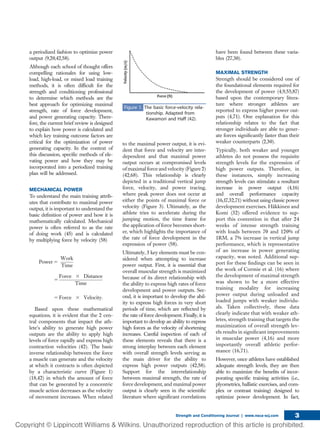
contraction velocities (42). The basic
inverse relationship between the force
a muscle can generate and the velocity
at which it contracts is often depicted
by a characteristic curve (Figure 1)
(18,42) in which the amount of force
that can be generated by a concentric
muscle action decreases as the velocity
of movement increases. When related
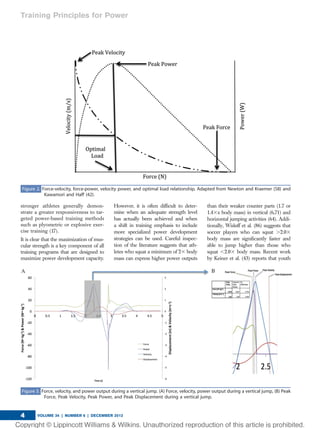
to the maximal power output, it is evi-
dent that force and velocity are inter-
dependent and that maximal power
output occurs at compromised levels
of maximal force and velocity (Figure 2)
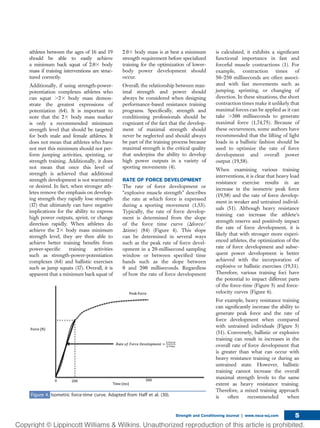
(42,68). This relationship is clearly
depicted in a traditional vertical jump
force, velocity, and power tracing,
where peak power does not occur at
either the points of maximal force or
velocity (Figure 3). Ultimately, as the
athlete tries to accelerate during the
jumping motion, the time frame for
the application of force becomes short-
er, which highlights the importance of
the rate of force development in the
expression of power (58).
Ultimately, 3 key elements must be con-
sidered when attempting to increase
power output. First, it is essential that
overall muscular strength is maximized
because of its direct relationship with
the ability to express high rates of force
development and power outputs. Sec-
ond, it is important to develop the abil-
ity to express high forces in very short
periods of time, which are reflected by
the rate of force development. Finally, it is
important to develop an ability to express
high forces as the velocity of shortening
increases. Careful inspection of each of
these elements reveals that there is a
strong interplay between each element
with overall strength levels serving as
the main driver for the ability to
express high power outputs (42,58).
Support for the interrelationship
between maximal strength, the rate of
force development, and maximal power
output is clearly seen in the scientific
literature where significant correlations
have been found between these varia-
bles (27,30).
MAXIMAL STRENGTH
Strength should be considered one of
the foundational elements required for
the development of power (4,9,55,87)
based upon the contemporary litera-
ture where stronger athletes are
reported to express higher power out-
puts (4,71). One explanation for this
relationship relates to the fact that
stronger individuals are able to gener-
ate forces significantly faster than their
weaker counterparts (2,30).
Typically, both weaker and younger
athletes do not possess the requisite
strength levels for the expression of
high power outputs. Therefore, in
these instances, simply increasing
strength levels can stimulate a resultant
increase in power output (4,16)
and overall performance capacity
(16,17,32,71) without using classic power
development exercises. Ha¨kkinen and
Komi (32) offered evidence to sup-
port this contention in that after 24
weeks of intense strength training
with loads between 70 and 120% of
1RM, a 7% increase in vertical jump
performance, which is representative
of an increase in power generating
capacity, was noted. Additional sup-
port for these findings can be seen in
the work of Cormie et al. (16) where
the development of maximal strength
was shown to be a more effective
training modality for increasing
power output during unloaded and
loaded jumps with weaker individu-
als. Taken collectively, these data
clearly indicate that with weaker ath-
letes, strength training that targets the
maximization of overall strength lev-
els results in significant improvements
in muscular power (4,16) and more
importantly overall athletic perfor-
mance (16,71).
However, once athletes have established
adequate strength levels, they are then
able to maximize the benefits of incor-
porating specific training activities (i.e.,
plyometrics, ballistic exercises, and com-
plex or contrast training) designed to
optimize power development. In fact,
Figure 1. The basic force-velocity rela-
tionship. Adapted from
Kawamori and Haff (42).
Strength and Conditioning Journal | www.nsca-scj.com 3
stronger athletes generally demon-
strate a greater responsiveness to tar-
geted power-based training methods
such as plyometric or explosive exer-
cise training (17).
It is clear that the maximization of mus-
cular strength is a key component of all
training programs that are designed to
maximize power development capacity.
However, it is often difficult to deter-
mine when an adequate strength level
has actually been achieved and when
a shift in training emphasis to include
more specialized power development
strategies can be used. Careful inspec-
tion of the literature suggests that ath-
letes who squat a minimum of 23 body
mass can express higher power outputs
than their weaker counter parts (1.7 or
1.43x body mass) in vertical (6,71) and
horizontal jumping activities (64). Addi-
tionally, Wisløff et al. (86) suggests that
soccer players who can squat .2.03
body mass are significantly faster and
able to jump higher than those who
squat ,2.03 body mass. Recent work
by Keiner et al. (43) reports that youth
Figure 3. Force, velocity, and power output during a vertical jump. (A) Force, velocity, power output during a vertical jump, (B) Peak
Force, Peak Velocity, Peak Power, and Peak Displacement during a vertical jump.
Figure 2. Force-velocity, force-power, velocity power, and optimal load relationship. Adapted from Newton and Kraemer (58) and
Kawamori and Haff (42).
Training Principles for Power
VOLUME 34 | NUMBER 6 | DECEMBER 20124
athletes between the ages of 16 and 19
should be able to easily achieve
a minimum back squat of 2.03 body
mass if training interventions are struc-
tured correctly.
Additionally, if using strength-power-
potentiation complexes athletes who
can squat .23 body mass demon-
strate the greatest expressions of
potentiation (64). It is important to
note that the 23 body mass marker
is only a recommended minimum
strength level that should be targeted
for both male and female athletes. It
does not mean that athletes who have
not met this minimum should not per-
form jumping activities, sprinting, or
strength training. Additionally, it does
not mean that once this level of
strength is achieved that additional
strength development is not warranted
or desired. In fact, when stronger ath-
letes remove the emphasis on develop-
ing strength they rapidly lose strength
(17) that ultimately can have negative
implications for the ability to express
high power outputs, sprint, or change
direction rapidly. When athletes do
achieve the 23 body mass minimum
strength level, they are then able to
achieve better training benefits from
power-specific training activities
such as strength-power-potentiation
complexes (64) and ballistic exercises
such as jump squats (17). Overall, it is
apparent that a minimum back squat of
2.03 body mass is at best a minimum
strength requirement before specialized
training for the optimization of lower-
body power development should
occur.
Overall, the relationship between max-
imal strength and power should
always be considered when designing
performance-based resistance training
programs. Specifically, strength and
conditioning professionals should be
cognizant of the fact that the develop-
ment of maximal strength should
never be neglected and should always
be part of the training process because
maximal strength is the critical quality
that underpins the ability to develop
high power outputs in a variety of
sporting movements (4).
RATE OF FORCE DEVELOPMENT
The rate of force development or
“explosive muscle strength” describes
the rate at which force is expressed
during a sporting movement (1,53).
Typically, the rate of force develop-
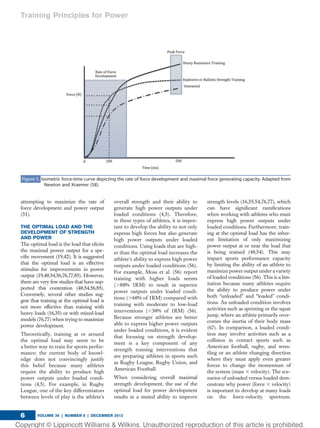
ment is determined from the slope
of the force time curve (Dforce/
Dtime) (84) (Figure 4). This slope
can be determined in several ways
such as the peak rate of force devel-
opment in a 20-millisecond sampling
window or between specified time
bands such as the slope between
0 and 200 milliseconds. Regardless
of how the rate of force development
is calculated, it exhibits a significant
functional importance in fast and
forceful muscle contractions (1). For
example, contraction times of
50–250 milliseconds are often associ-
ated with fast movements such as
jumping, sprinting, or changing of
direction. In these situations, the short
contraction times make it unlikely that
maximal forces can be applied as it can
take .300 milliseconds to generate
maximal force (1,74,75). Because of
these occurrences, some authors have
recommended that the lifting of light
loads in a ballistic fashion should be
used to optimize the rate of force
development and overall power
output (19,58).
When examining various training
interventions, it is clear that heavy load
resistance exercise results in an
increase in the isometric peak force
(19,58) and the rate of force develop-
ment in weaker and untrained individ-
uals (51). Although heavy resistance
training can increase the athlete’s
strength reserve and positively impact
the rate of force development, it is
likely that with stronger more experi-
enced athletes, the optimization of the
rate of force development and subse-
quent power development is better
achieved with the incorporation of
explosive or ballistic exercises (19,31).
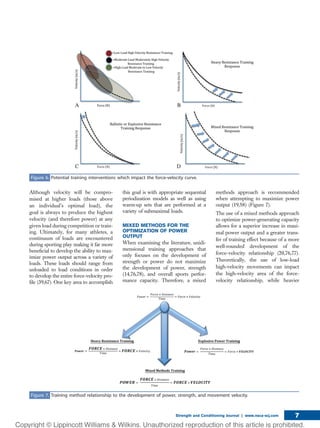
Therefore, various training foci have
the potential to impact different parts
of the force-time (Figure 5) and force-
velocity curves (Figure 6).
For example, heavy resistance training
can significantly increase the ability to
generate peak force and the rate of
force development when compared
with untrained individuals (Figure 5)
(51). Conversely, ballistic or explosive
training can result in increases in the
overall rate of force development that
is greater than what can occur with
heavy resistance training or during an
untrained state. However, ballistic
training cannot increase the overall
maximal strength levels to the same
extent as heavy resistance training.
Therefore, a mixed training approach
is often recommended whenFigure 4. Isometric force-time curve. Adapted from Haff et al. (30).
Strength and Conditioning Journal | www.nsca-scj.com 5
attempting to maximize the rate of
force development and power output
(31).
THE OPTIMAL LOAD AND THE
DEVELOPMENT OF STRENGTH
AND POWER
The optimal load is the load that elicits
the maximal power output for a spe-
cific movement (19,42). It is suggested
that the optimal load is an effective
stimulus for improvements in power
output (19,40,54,56,76,77,85). However,
there are very few studies that have sup-
ported this contention (40,54,56,85).
Conversely, several other studies sug-
gest that training at the optimal load is
not more effective than training with
heavy loads (16,35) or with mixed-load
models (76,77) when trying to maximize
power development.
Theoretically, training at or around
the optimal load may seem to be
a better way to train for sports perfor-
mance; the current body of knowl-
edge does not convincingly justify
this belief because many athletes
require the ability to produce high
power outputs under loaded condi-
tions (4,5). For example, in Rugby
League, one of the key differentiators
between levels of play is the athlete’s
overall strength and their ability to
generate high power outputs under
loaded conditions (4,5). Therefore,
in these types of athletes, it is impor-
tant to develop the ability to not only
express high forces but also generate
high power outputs under loaded
conditions. Using loads that are high-
er than the optimal load increases the
athlete’s ability to express high power
outputs under loaded conditions (56).
For example, Moss et al. (56) report
training with higher loads seems
(.80% 1RM) to result in superior
power outputs under loaded condi-
tions (.60% of 1RM) compared with
training with moderate to low-load
interventions (,30% of 1RM) (56).
Because stronger athletes are better
able to express higher power outputs
under loaded conditions, it is evident
that focusing on strength develop-
ment is a key component of any
strength training interventions that
are preparing athletes in sports such
as Rugby League, Rugby Union, and
American Football.
When considering overall maximal
strength development, the use of the
optimal load for power development
results in a muted ability to improve
strength levels (16,35,54,76,77), which
can have significant ramifications
when working with athletes who must
express high power outputs under
loaded conditions. Furthermore, train-
ing at the optimal load has the inher-
ent limitation of only maximizing
power output at or near the load that
is being trained (40,54). This may
impact sports performance capacity
by limiting the ability of an athlete to
maximize power output under a variety
of loaded conditions (56). This is a lim-
itation because many athletes require
the ability to produce power under
both “unloaded” and “loaded” condi-
tions. An unloaded condition involves
activities such as sprinting or the squat
jump, where an athlete primarily over-
comes the inertia of their body mass
(67). In comparison, a loaded condi-
tion may involve activities such as a
collision in contact sports such as
American football, rugby, and wres-
tling or an athlete changing direction
where they must apply even greater
forces to change the momentum of
the system (mass 3 velocity). The sce-
narios of unloaded versus loaded dem-
onstrate why power (force 3 velocity)
is important to develop at many loads
on the force-velocity spectrum.
Figure 5. Isometric force-time curve depicting the rate of force development and maximal force generating capacity. Adapted from
Newton and Kraemer (58).
Training Principles for Power
VOLUME 34 | NUMBER 6 | DECEMBER 20126
Although velocity will be compro-
mised at higher loads (those above
an individual’s optimal load), the
goal is always to produce the highest
velocity (and therefore power) at any
given load during competition or train-
ing. Ultimately, for many athletes, a
continuum of loads are encountered
during sporting play making it far more
beneficial to develop the ability to max-
imize power output across a variety of
loads. These loads should range from
unloaded to load conditions in order
to develop the entire force-velocity pro-
file (39,67). One key area to accomplish
this goal is with appropriate sequential
periodization models as well as using
warm-up sets that are performed at a
variety of submaximal loads.
MIXED METHODS FOR THE
OPTIMIZATION OF POWER
OUTPUT
When examining the literature, unidi-
mensional training approaches that
only focuses on the development of
strength or power do not maximize
the development of power, strength
(14,76,78), and overall sports perfor-
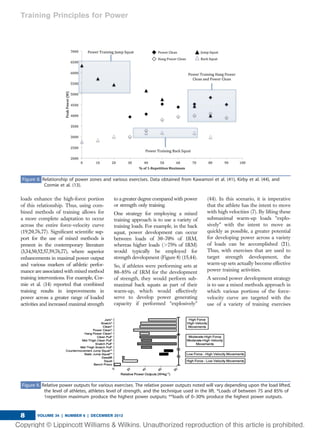
mance capacity. Therefore, a mixed
methods approach is recommended
when attempting to maximize power
output (19,58) (Figure 7).
The use of a mixed methods approach
to optimize power-generating capacity
allows for a superior increase in maxi-
mal power output and a greater trans-
fer of training effect because of a more
well-rounded development of the
force-velocity relationship (20,76,77).
Theoretically, the use of low-load
high-velocity movements can impact
the high-velocity area of the force-
velocity relationship, while heavier
Figure 7. Training method relationship to the development of power, strength, and movement velocity.
Figure 6. Potential training interventions which impact the force-velocity curve.
Strength and Conditioning Journal | www.nsca-scj.com 7
loads enhance the high-force portion
of this relationship. Thus, using com-
bined methods of training allows for
a more complete adaptation to occur
across the entire force-velocity curve
(19,20,76,77). Significant scientific sup-
port for the use of mixed methods is
present in the contemporary literature
(3,34,50,52,57,59,76,77), where superior
enhancements in maximal power output
and various markers of athletic perfor-
mance are associated with mixed method
training interventions. For example, Cor-
mie et al. (14) reported that combined
training results in improvements in
power across a greater range of loaded
activities and increased maximal strength
to a greater degree compared with power
or strength only training.
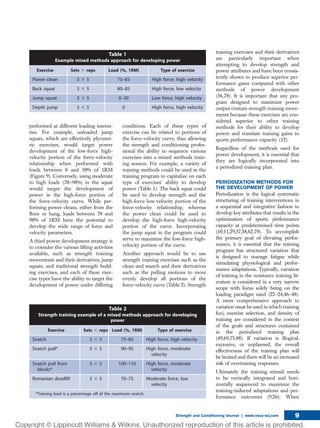
One strategy for employing a mixed
training approach is to use a variety of
training loads. For example, in the back
squat, power development can occur
between loads of 30–70% of 1RM,
whereas higher loads (.75% of 1RM)
would typically be employed for
strength development (Figure 8) (15,44).
So, if athletes were performing sets at
80–85% of 1RM for the development
of strength, they would perform sub-
maximal back squats as part of their
warm-up, which would effectively
serve to develop power generating
capacity if performed “explosively”
(44). In this scenario, it is imperative
that the athlete has the intent to move
with high velocities (7). By lifting these
submaximal warm-up loads “explo-
sively” with the intent to move as
quickly as possible, a greater potential
for developing power across a variety
of loads can be accomplished (21).
Thus, with exercises that are used to
target strength development, the
warm-up sets actually become effective
power training activities.
A second power development strategy
is to use a mixed methods approach in
which various portions of the force-
velocity curve are targeted with the
use of a variety of training exercises
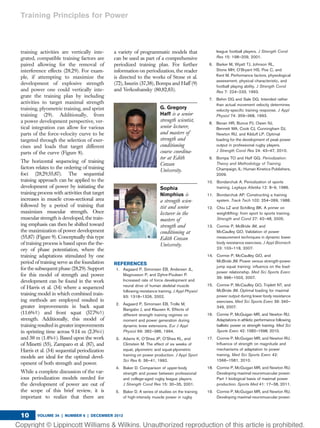
Figure 9. Relative power outputs for various exercises. The relative power outputs noted will vary depending upon the load lifted,
the level of athletes, athletes level of strength, and the technique used in the lift. *Loads of between 75 and 85% of
1repetition maximum produce the highest power outputs; **loads of 0–30% produce the highest power outputs.
Figure 8. Relationship of power zones and various exercises. Data obtained from Kawamori et al. (41), Kirby et al. (44), and
Cormie et al. (13).
Training Principles for Power
VOLUME 34 | NUMBER 6 | DECEMBER 20128
performed at different loading intensi-
ties. For example, unloaded jump
squats, which are effectively plyomet-
ric exercises, would target power
development of the low-force high-
velocity portion of the force-velocity
relationship when performed with
loads between 0 and 30% of 1RM
(Figure 9). Conversely, using moderate
to high loads (70–90%) in the squat
would target the development of
power in the high-force portion of
the force-velocity curve. While per-
forming power cleans, either from the
floor or hang, loads between 70 and
90% of 1RM have the potential to
develop the wide range of force and
velocity parameters.
A third power development strategy is
to consider the various lifting activities
available, such as strength training
movements and their derivatives, jump
squats, and traditional strength build-
ing exercises, and each of these exer-
cise types have the ability to target the
development of power under differing
conditions. Each of these types of
exercise can be related to portions of
the force-velocity curve, thus allowing
the strength and conditioning profes-
sional the ability to sequence various
exercises into a mixed methods train-
ing session. For example, a variety of
training methods could be used in the
training program to capitalize on each
type of exercises’ ability to develop
power (Table 1). The back squat could
be used to develop strength and the
high-force low-velocity portion of the
force-velocity relationship, whereas
the power clean could be used to
develop the high-force high-velocity
portion of the curve. Incorporating
the jump squat in the program could
serve to maximize the low-force high-
velocity portion of the curve.
Another approach would be to use
strength training exercises such as the
clean and snatch and their derivatives
such as the pulling motions to more
evenly develop all portions of the
force-velocity curve (Table 2). Strength
training exercises and their derivatives
are particularly important when
attempting to develop strength and
power attributes and have been consis-
tently shown to produce superior per-
formance gains compared with other
methods of power development
(36,78). It is important that any pro-
gram designed to maximize power
output contain strength training move-
ments because these exercises are con-
sidered superior to other training
methods for their ability to develop
power and translate training gains to
sports performance capacity (12).
Regardless of the methods used for
power development, it is essential that
they are logically incorporated into
a periodized training plan.
PERIODIZATION METHODS FOR
THE DEVELOPMENT OF POWER
Periodization is the logical systematic
structuring of training interventions in
a sequential and integrative fashion to
develop key attributes that results in the
optimization of sports performance
capacity at predetermined time points
(10,11,29,37,38,62,79). To accomplish
the primary goal of elevating perfor-
mance, it is essential that the training
program has structured variation that
is designed to manage fatigue while
stimulating physiological and perfor-
mance adaptations. Typically, variation
of training in the resistance training lit-
erature is considered in a very narrow
scope with focus solely being on the
loading paradigm used (22–24,46–48).
A more comprehensive approach to
variation must be used in which training
foci, exercise selection, and density of
training are considered in the context
of the goals and structures contained
in the periodized training plan
(49,69,73,88). If variation is illogical,
excessive, or unplanned, the overall
effectiveness of the training plan will
be limited and there will be an increased
risk of overtraining responses.
Ultimately the training stimuli needs
to be vertically integrated and hori-
zontally sequenced to maximize the
training-induced adaptations and per-
formance outcomes (9,26). When
Table 1
Example mixed methods approach for developing power
Exercise Sets 3 reps Load (%, 1RM) Type of exercise
Power clean 3 3 5 75–85 High force, high velocity
Back squat 3 3 5 80–85 High force, low velocity
Jump squat 3 3 5 0–30 Low force, high velocity
Depth jump 3 3 5 0 High force, high velocity
Table 2
Strength training example of a mixed methods approach for developing
power
Exercise Sets 3 reps Load (%, 1RM) Type of exercise
Snatch 3 3 5 75–85 High force, high velocity
Snatch pull* 3 3 5 90–95 High force, moderate
velocity
Snatch pull from
blocks*
3 3 5 100–110 High force, moderate
velocity
Romanian deadlift 3 3 5 70–75 Moderate force, low
velocity
*Training load is a percentage off of the maximum snatch.
Strength and Conditioning Journal | www.nsca-scj.com 9
training activities are vertically inte-
grated, compatible training factors are
paired allowing for the removal of
interference effects (28,29). For exam-
ple, if attempting to maximize the
development of explosive strength
and power one could vertically inte-
grate the training plan by including
activities to target maximal strength
training, plyometric training, and sprint
training (29). Additionally, from
a power development perspective, ver-
tical integration can allow for various
parts of the force-velocity curve to be
targeted through the selection of exer-
cises and loads that target different
parts of the curve (Figure 8).
The horizontal sequencing of training
factors relates to the ordering of training
foci (28,29,55,87). The sequential
training approach can be applied to the
development of power by initiating the
training process with activities that target
increases in muscle cross-sectional area
followed by a period of training that
maximizes muscular strength. Once
muscular strength is developed, the train-
ing emphasis can then be shifted toward
the maximization of power development
(55,87) (Figure 9). Conceptually this type
of training process is based upon the the-
ory of phase potentiation, where the
training adaptations stimulated by one
period of training serve as the foundation
for the subsequent phase (28,29). Support
for this model of strength and power
development can be found in the work
of Harris et al. (34) where a sequenced
training model in which combined train-
ing methods are employed resulted in
greater improvements in back squat
(11.6%⇑) and front squat (37.7%⇑)
strength. Additionally, this model of
training resulted in greater improvements
in sprinting time across 9.14 m (2.3%⇓)
and 30 m (1.4%⇓). Based upon the work
of Minetti (55), Zamparo et al. (87), and
Harris et al. (34) sequential periodization
models are ideal for the optimal devel-
opment of both strength and power.
While a complete discussion of the var-
ious periodization models needed for
the development of power are out of
the scope of this brief review, it is
important to realize that there are
a variety of programmatic models that
can be used as part of a comprehensive
periodized training plan. For further
information on periodization, the reader
is directed to the works of Stone et al.
(72), Issurin (37,38), Bompa and Haff (9)
and Verkoshansky (80,82,83).
G. Gregory
Haff is a senior
strength scientist,
senior lecturer,
and masters of
strength and
conditioning
course coordina-
tor at Edith
Cowan
University.
Sophia
Nimphius is
a strength scien-
tist and senior
lecturer in the
masters of
strength and
conditioning at
Edith Cowan
University.
REFERENCES
1. Aagaard P, Simonsen EB, Andersen JL,
Magnusson P, and Dyhre-Poulsen P.
Increased rate of force development and
neural drive of human skeletal muscle
following resistance training. J Appl Physiol
93: 1318–1326, 2002.
2. Aagaard P, Simonsen EB, Trolle M,
Bangsbo J, and Klausen K. Effects of
different strength training regimes on
moment and power generation during
dynamic knee extensions. Eur J Appl
Physiol 69: 382–386, 1994.
3. Adams K, O’Shea JP, O’Shea KL, and
Climstein M. The effect of six weeks of
squat, plyometric and squat-plyometric
training on power production. J Appl Sport
Sci Res 6: 36–41, 1992.
4. Baker D. Comparison of upper-body
strength and power between professional
and college-aged rugby league players.
J Strength Cond Res 15: 30–35, 2001.
5. Baker D. A series of studies on the training
of high-intensity muscle power in rugby
league football players. J Strength Cond
Res 15: 198–209, 2001.
6. Barker M, Wyatt TJ, Johnson RL,
Stone MH, O’Bryant HS, Poe C, and
Kent M. Performance factors, physiological
assessment, physical characteristic, and
football playing ability. J Strength Cond
Res 7: 224–233, 1993.
7. Behm DG and Sale DG. Intended rather
than actual movement velocity determines
velocity-specific training response. J Appl
Physiol 74: 359–368, 1993.
8. Bevan HR, Bunce PJ, Owen NJ,
Bennett MA, Cook CJ, Cunningham DJ,
Newton RU, and Kilduff LP. Optimal
loading for the development of peak power
output in professional rugby players.
J Strength Cond Res 24: 43–47, 2010.
9. Bompa TO and Haff GG. Periodization:
Theory and Methodology of Training.
Champaign, IL: Human Kinetics Publishers,
2009.
10. Bondarchuk A. Periodization of sports
training. Legkaya Atletika 12: 8–9, 1986.
11. Bondarchuk AP. Constructing a training
system. Track Tech 102: 254–269, 1988.
12. Chiu LZ and Schilling BK. A primer on
weightlifting: from sport to sports training.
Strength and Cond 27: 42–48, 2005.
13. Cormie P, McBride JM, and
McCaulley GO. Validation of power
measurement techniques in dynamic lower
body resistance exercises. J Appl Biomech
23: 103–118, 2007.
14. Cormie P, McCaulley GO, and
McBride JM. Power versus strength-power
jump squat training: influence on the load-
power relationship. Med Sci Sports Exerc
39: 996–1003, 2007.
15. Cormie P, McCaulley GO, Triplett NT, and
McBride JM. Optimal loading for maximal
power output during lower-body resistance
exercises. Med Sci Sports Exerc 39: 340–
349, 2007.
16. Cormie P, McGuigan MR, and Newton RU.
Adaptations in athletic performance following
ballistic power vs strength training. Med Sci
Sports Exerc 42: 1582–1598, 2010.
17. Cormie P, McGuigan MR, and Newton RU.
Influence of strength on magnitude and
mechanisms of adaptation to power
training. Med Sci Sports Exerc 42:
1566–1581, 2010.
18. Cormie P, McGuigan MR, and Newton RU.
Developing maximal neuromuscular power:
Part 1-biological basis of maximal power
production. Sports Med 41: 17–38, 2011.
19. Cormie P, McGuigan MR, and Newton RU.
Developing maximal neuromuscular power:
Training Principles for Power
VOLUME 34 | NUMBER 6 | DECEMBER 201210
part 2-training considerations for improving
maximal power production. Sports Med 41:
125–146, 2011.
20. Cronin J and Sleivert G. Challenges in
understanding the influence of maximal power
training on improving athletic performance.
Sports Med 35: 213–234, 2005.
21. Cronin JB, McNair PJ, and Marshall RN. Is
velocity-specific strength training important in
improving functional performance? J Sports
Med Phys Fitness 42: 267–273, 2002.
22. Fleck S and Kraemer WJ. Designing
Resistance Training Programs.
Champaign, IL: Human Kinetics, 2004.
23. Fleck SJ and Kraemer WJ. The Ultimate
Training System: Periodization
Breakthrough. New York, NY: Advanced
Research Press, 1996.
24. Fleck SJ and Kraemer WJ. Designing
Resistance Training Programs.
Champaign, IL: Human Kinetics, 1997.
25. Fry AC and Kraemer WJ. Physical
performance characteristics of american
collegiate football players. J Appl Sport Sci
Res 5: 126–138, 1991.
26. Haff GG. The essentials of periodization.
In: Strength and Conditioning for Sports
Performance. Jeffreys I and Moody J, eds.
London, England: Routledge, Taylor &
Frances Group, in press.
27. Haff GG, Carlock JM, Hartman MJ,
Kilgore JL, Kawamori N, Jackson JR,
Morris RT, Sands WA, and Stone MH.
Force-time curve characteristics of
dynamic and isometric muscle actions of
elite women olympic weightlifters.
J Strength Cond Res 19: 741–748, 2005.
28. Haff GG and Haff EE. Resistance training
program design. In: Essentials Of
Periodization. Malek MH and Coburn JW,
eds. Champaign, IL: Human Kinetics,
2012. pp. 359–401.
29. Haff GG and Haff EE. Training integration
and periodization. In: Strength and
Conditioning Program Design. Hoffman J,
ed. Champaign, IL: Human Kinetics, 2012.
pp. 209–254.
30. Haff GG, Stone MH, O’Bryant HS,
Harman E, Dinan CN, Johnson R, and
Han KH. Force-time dependent
characteristics of dynamic and isometric
muscle actions. J Strength Cond Res 11:
269–272, 1997.
31. Haff GG, Whitley A, and Potteiger JA. A
brief review: explosive exercises and sports
performance. Natl Strength Cond Assoc
23: 13–20, 2001.
32. Ha¨kkinen K and Komi PV. Changes in
electrical and mechanical behavior of leg
extensor muscles during heavy resistance
strength training. Scand J Sports Sci 7:
55–64, 1985.
33. Hansen KT, Cronin JB, Pickering SL, and
Douglas L. Do Force-Time and Power-Time
Measures in a Loaded Jump Squat
Differentiate between Speed Performance
and Playing Level in Elite and Elite Junior
Rugby Union Players? J Strength Cond
Res 25: 2382–2391, 2011.
34. Harris GR, Stone MH, O’Bryant HS,
Proulx CM, and Johnson RL. Short-term
performance effects of high power, high
force, or combined weight-training
methods. J Strength Cond Res 14: 14–20,
2000.
35. Harris NK, Cronin JB, Hopkins WG, and
Hansen KT. Squat Jump Training at
Maximal Power Loads vs. Heavy Loads:
Effect on Sprint Ability. J Strength Cond
Res 22: 1742–1749, 2008.
36. Hoffman JR, Cooper J, Wendell M, and
Kang J. Comparison of Olympic vs.
traditional power lifting training programs in
football players. J Strength Cond Res 18:
129–135, 2004.
37. Issurin V. Block periodization versus
traditional training theory: a review. J Sports
Med Phys Fitness 48: 65–75, 2008.
38. Issurin VB. New horizons for the methodology
and physiology of training periodization.
Sports Med 40: 189–206, 2010.
39. Jindrich DL, Besier TF, and Lloyd DG. A
hypothesis for the function of braking
forces during running turns. J Biomech 39:
1611–1620, 2006.
40. Kaneko M, Fuchimoto T, Toji H, and Suei K.
Training effect of different loads on the
force-velocity relationship and mechanical
power output in human muscle. Scand J
Sports Sci 5: 50–55, 1983.
41. Kawamori N, Crum AJ, Blumert P, Kulik J,
Childers J, Wood J, Stone MH, and
Haff GG. Influence of different relative
intensities on power output during the hang
power clean: identification of the optimal
load. J Strength Cond Res 19: 698–708,
2005.
42. Kawamori N and Haff GG. The optimal
training load for the development of
muscular power. J Strength Cond Res 18:
675–684, 2004.
43. Keiner M, Sander A, Wirth KPDP,
Caruso O, Immesberger P, and Zawieja M.
Trainability of Adolescents and Children in
the Back and Front Squat. J Strength Cond
Res, 2012.
44. Kirby TJ, Erickson T, and McBride JM.
Model for Progression of Strength, Power,
and Speed Training. Strength Cond J 32:
86–90, 2010.
45. Knudson DV. Correcting the use of the
term "power" in the strength and
conditioning literature. J Strength Cond
Res 23: 1902–1908, 2009.
46. Kraemer WJ, Hatfield DL, and Fleck SJ.
Types of muscle training. In: Strength
Training. Brown LE, ed. Champaign, IL:
Human Kinetics, 2007. pp. 45–72.
47. Kraemer WJ, Ratamess N, Fry AC,
Triplett-McBride T, Koziris LP, Bauer JA,
Lynch JM, and Fleck SJ. Influence of
resistance training volume and
periodization on physiological and
performance adaptations in collegiate
women tennis players. Am J Sports Med
28: 626–633, 2000.
48. Kraemer WJ, Vingren JL, Hatfield DL,
Spiering BA, and Fragala MS. Resistance
training programs. In: ACSM’s Resources
for the Personal Trainer. Thompson WR,
Baldwin KE, Pire NI, and Niederpruem M,
eds. Baltimore, MD: Lippincott, Williams, &
Wilkins, 2007. pp. 372–403.
49. Kurz T. Science of Sports Training. Island
Pond, VT: Stadion Publishing Company,
Inc., 2001.
50. Kyrolainen H, Avela J, McBride JM,
Koskinen S, Andersen JL, Sipila S,
Takala TE, and Komi PV. Effects of power
training on muscle structure and
neuromuscular performance. Scand J Med
Sci Sports 15: 58–64, 2005.
51. Lovell DI, Cuneo R, and Gass GC. The
effect of strength training and short-term
detraining on maximum force and the rate
of force development of older men. Eur
J Appl Physiol 109: 429–435, 2010.
52. Lyttle AD, Wilson GJ, and Ostrowski KJ.
Enhancing performance: Maximal power
versus combined weights and plyometrics
training. J Strength Cond Res 10:
173–179, 1996.
53. McBride JM, Triplett-McBride T, Davie A,
and Newton RU. A comparison of strength
and power characteristics between power
lifters, Olympic lifters, and sprinters.
J Strength Cond Res 13: 58–66, 1999.
54. McBride JM, Triplett-McBride T, Davie A,
and Newton RU. The effect of heavy- vs.
light-load jump squats on the development
of strength, power, and speed. J Strength
Cond Res 16: 75–82, 2002.
55. Minetti AE. On the mechanical power of
joint extensions as affected by the change
in muscle force (or cross-sectional area),
ceteris paribus. Eur J Appl Physiol 86:
363–369, 2002.
Strength and Conditioning Journal | www.nsca-scj.com 11
56. Moss BM, Refsnes PE, Abildgaard A,
Nicolaysen K, and Jensen J. Effects of
maximal effort strength training with
different loads on dynamic strength, cross-
sectional area, load-power and load-
velocity relationships. Eur J Appl Physiol
75: 193–199, 1997.
57. Newton RU, Hakkinen K, Hakkinen A,
McCormick M, Volek J, and Kraemer WJ.
Mixed-methods resistance training
increases power and strength of young and
older men. Med Sci Sports Exerc 34:
1367–1375, 2002.
58. Newton RU and Kraemer WJ. Developing
explosive muscular power: Implications for
a mixed methods training strategy.
Strength Cond J 16: 20–31, 1994.
59. Newton RU, Kraemer WJ, and Hakkinen K.
Effects of ballistic training on preseason
preparation of elite volleyball players. Med
Sci Sports Exerc 31: 323–330, 1999.
60. Nimphius S, McGuigan MR, and
Newton RU. Relationship between strength,
power, speed, and change of direction
performance of female softball players.
J Strength Cond Res 24: 885–895, 2010.
61. Peterson MD, Alvar BA, and Rhea MR. The
contribution of maximal force production to
explosive movement among young
collegiate athletes. J Strength Cond Res
20: 867–873, 2006.
62. Plisk SS and Gambetta V. Tactical
metabolic training: part 1. Strength and
Cond 19: 44–53, 1997.
63. Poprawski B. TRACK and FIELD: Aspects
of strength, power and speed in shot put
training. Strength Cond J 9: 39–43, 1987.
64. Ruben RM, Molinari MA, Bibbee CA,
Childress MA, Harman MS, Reed KP, and
Haff GG. The acute effects of an
ascending squat protocol on performance
during horizontal plyometric jumps.
J Strength Cond Res 24: 358–369, 2010.
65. Schmidtbleicher D. Training for power
events. In: Strength and Power in Sport.
Komi PV, ed. Oxford, England: Blackwell,
1992. pp. 381–385.
66. Schmidtbleicher D and Haralambie G.
Changes in contractile properties of
muscle after strength training in man. Eur
J Appl Physiol 46: 221–228, 1981.
67. Sheppard JM and Young WB. Agility
literature review: classifications, training
and testing. J Sports Sci 24: 919–932,
2006.
68. Siegel JA, Gilders RM, Staron RS, and
Hagerman FC. Human muscle power
output during upper- and lower-body
exercises. J Strength Cond Res 16: 173–
178, 2002.
69. Siff MC. Supertraining. Denver, CO:
Supertrainig Institute, 2003.
70. Spassov A. Special considerations when
programming for strength and power for
athletes: part I. Natl Strength Cond Assoc J
10: 58–61, 1988.
71. Stone MH, Moir G, Glaister M, and
Sanders R. How much strength is necessary?
Phys Ther Sport 3: 88–96, 2002.
72. Stone MH, O’Bryant H, and Garhammer J.
A hypothetical model for strength training.
J Sports Med 21: 342–351, 1981.
73. Stone MH, Stone ME, and Sands WA.
Principles and Practice of Resistance
Training. Champaign, IL: Human Kinetics
Publishers, 2007.
74. Sukop J and Nelson R. Effect of isometric
training on the force-time characteristics of
muscle contraction. In: Biomechanics IV.
Nelson RC and Morehouse CA, eds.
Baltimore, MD: University Park Press,
1974. pp. 440–447.
75. Thorstensson A, Grimby G, and Karlsson J.
Force-velocity relations and fiber
composition in human knee extensor
muscles. J Appl Physiol 40: 12–16, 1976.
76. Toji H and Kaneko M. Effect of multiple-
load training on the force-velocity
relationship. J Strength Cond Res 18:
792–795, 2004.
77. Toji H, Suei K, and Kaneko M. Effects of
combined training programs on force-
velocity relation and power output in human
muscle. Jpn J Phys Fitness Sports Med 44:
439–445, 1995.
78. Tricoli V, Lamas L, Carnevale R, and
Ugrinowitsch C. Short-term effects on
lower-body functional power development:
weightlifting vs. vertical jump training
programs. J Strength Cond Res 19: 433–
437, 2005.
79. Verkhoshansky YU. How to set up
a training program. Sov Sports Rev 16:
123–136, 1981.
80. Verkhoshansky YU and Verkhoshansky N.
Special Strength Training Manual for
Coaches. Rome, Italy: Verkhosansky STM,
2011.
81. Verkhoshansky YV and Lazarev VV.
Principles of planning speed and strength/
speed endurance training in sports.
Strength Cond J 11: 58–61, 1989.
82. Verkoshansky Y. Main features of a modern
scientific sports training theory. New
Studies in Athletics 13: 9–20, 1998.
83. Verkoshansky Y. Organization of the
training process. New Studies in Athletics
13: 21–31, 1998.
84. Viitasalo JT. Rate of force development,
muscle structure and fatigue. In:
Biomechanics VII-A: Proceedings of the
7th International Congress of
Biomechanics. Morecki A, Kazimirz F,
Kedzior K, and Wit A, eds. Baltimore, MD:
University Park Press, 1981, pp. 136–141.
85. Wilson GJ, Newton RU, Murphy AJ, and
Humphries BJ. The optimal training load for
the development of dynamic athletic
performance. Med Sci Sports Exerc 25:
1279–1286, 1993.
86. Wisløff U, Castagna C, Helgerud J,
Jones R, and Hoff J. Strong correlation of
maximal squat strength with sprint
performance and vertical jump height in
elite soccer players. Br J Sports Med 38:
285–288, 2004.
87. Zamparo P, Minetti AE, and di Prampero PE.
Interplay among the changes of muscle
strength, cross-sectional area and maximal
explosive power: theory and facts. Eur J Appl
Physiol 88: 193–202, 2002.
88. Zatsiorsky VM. Science and Practice of
Strength Training. Champaign, IL: Human
Kinetics, 1995.
Training Principles for Power
VOLUME 34 | NUMBER 6 | DECEMBER 201212

Training Principles for Power

  • 1.
    Training Principles for Power G.Gregory Haff, PhD, CSCS*D, FNSCA, ASCC and Sophia Nimphius, PhD, CSCS*D Centre for Exercise and Sport Science Research, Edith Cowan University, Joondalup, Western Australia, Australia S U M M A R Y THE ABILITY TO EXPRESS HIGH POWER OUTPUTS IS CONSIDERED TO BE ONE OF THE FOUNDA- TIONAL CHARACTERISTICS UNDERLYING SUCCESSFUL PER- FORMANCE IN A VARIETY OF SPORTING ACTIVITIES, INCLUDING JUMPING, THROWING, AND CHANGING DIRECTION. NUMER- OUS TRAINING INTERVENTIONS HAVE BEEN RECOMMENDED TO ENHANCE THE ATHLETE’S ABILITY TO EXPRESS HIGH POWER OUT- PUTS AND IMPROVE THEIR OVER- ALL SPORTS PERFORMANCE CAPACITY. THIS BRIEF REVIEW EXAMINES THE FACTORS THAT UNDERLIE THE EXPRESSION OF POWER AND VARIOUS METHODS THAT CAN BE USED TO MAXIMIZE POWER DEVELOPMENT. INTRODUCTION M any sports require the ability to generate high amounts of force in relatively short peri- ods of time (42,58). The ability to express high rates of force development is often related to an athlete’s overall strength levels (71) and ability to express high power outputs (27,30). Stone et al. (71) suggested that the ability to express high rates of force development and high power outputs are critical perfor- mance characteristics central to success in most sporting events. These abilities are considered to be among the most important sports performance charac- teristics, especially in activities that rely on jumping, change of direction, and/or sprinting performance (31,53,71). The overall relationship between sport- specific movements and the ability to generate high power outputs is well documented in the scientific literature (4,5,8,60). For example, Hansen et al. (33) reported that peak power outputs are significantly (p , 0.001) higher in Elite Rugby Union players compared with their junior counterparts. Similarly, Baker (4) suggested that professional Rugby League players (National Rugby League) produce significantly higher power outputs in both upper- and lower-body movements compared with college-aged players (Student Rugby League). Additionally, Fry and Kraemer (25) demonstrated that in American Col- legiate Football, strength and power characteristics differentiate between level of play, with stronger more powerful ath- letes being more prevalent on higher division teams. Similarly, Barker et al. (6) reported that maximal strength and power-generating capacity is able to dif- ferentiate between starters and nonstar- ters. When examining other sports such as women’s basketball, volleyball, and softball, significant correlations have been found between maximal strength and peak power output (r 5 0.719) and agility Ttest time (r 5 20.408) (61). When both men (basketball, volleyball) and women (basketball, volleyball, and softball) from a variety of sports were collapsed into one group, back squat strength was highly correlated with peak power (r 5 0.917) and agility T test time (r 5 20.784). Based upon the contemporary body of scientific knowledge, it is evident that maximal strength, the rate of force devel- opment, and peak power generating capacity are all important attributes that need to be developed when implement- ing strength and conditioning programs. There is considerable debate concern- ing which of these characteristics should be the primary training targets when attempting to optimize power output with resistance training inter- ventions. For example, some authors argue that once adequate strength lev- els are developed continuing to develop this attribute results in dimin- ishing returns (17), whereas others argue that maximal strength impacts power generating capacity in a hierar- chical manner in which its influence on power production diminishes as the external load decreases (65,66). Con- ceptually, it is often believed that as the external load diminishes the influ- ence of maximal strength decreases and a greater reliance on the rate of force development occurs. This rela- tionship is often used as the central argument for developing power out- puts with explosive exercises that are performed at what has been termed the “optimal load” (20,42). Generally, there seem to be 3 main schools of thought when attempting to maximize power output (20). The first school suggests that using lower- intensity efforts (,50% of 1 repetition maximum [RM]) are optimal for the development of power generating capacity (44,54), whereas the second school proposes that higher loads (50– 70% 1RM) are required (63,70,81). The third school of thought suggests a mixed methods approach in which a variety of loads and exercise types are used in K E Y W O R D S : strength; rate of force development; strength training VOLUME 34 | NUMBER 6 | DECEMBER 2012 Copyright Ó National Strength and Conditioning Association2
  • 2.
    a periodized fashionto optimize power output (9,20,42,58). Although each school of thought offers compelling rationales for using low- load, high-load, or mixed load training methods, it is often difficult for the strength and conditioning professional to determine which methods are the best approach for optimizing maximal strength, rate of force development, and power generating capacity. There- fore, the current brief review is designed to explain how power is calculated and which key training outcome factors are critical for the optimization of power generating capacity. In the context of this discussion, specific methods of ele- vating power and how they may be incorporated into a periodized training plan will be addressed. MECHANICAL POWER To understand the main training attrib- utes that contribute to maximal power output, it is important to understand the basic definition of power and how it is mathematically calculated. Mechanical power is often referred to as the rate of doing work (45) and is calculated by multiplying force by velocity (58) Power 5 Work Time 5 Force    3     Distance Time 5 Force    3     Velocity: Based upon these mathematical equations, it is evident that the 2 cen- tral components that impact the ath- lete’s ability to generate high power outputs are the ability to apply high levels of force rapidly and express high contraction velocities (42). The basic inverse relationship between the force a muscle can generate and the velocity at which it contracts is often depicted by a characteristic curve (Figure 1) (18,42) in which the amount of force that can be generated by a concentric muscle action decreases as the velocity of movement increases. When related to the maximal power output, it is evi- dent that force and velocity are inter- dependent and that maximal power output occurs at compromised levels of maximal force and velocity (Figure 2) (42,68). This relationship is clearly depicted in a traditional vertical jump force, velocity, and power tracing, where peak power does not occur at either the points of maximal force or velocity (Figure 3). Ultimately, as the athlete tries to accelerate during the jumping motion, the time frame for the application of force becomes short- er, which highlights the importance of the rate of force development in the expression of power (58). Ultimately, 3 key elements must be con- sidered when attempting to increase power output. First, it is essential that overall muscular strength is maximized because of its direct relationship with the ability to express high rates of force development and power outputs. Sec- ond, it is important to develop the abil- ity to express high forces in very short periods of time, which are reflected by the rate of force development. Finally, it is important to develop an ability to express high forces as the velocity of shortening increases. Careful inspection of each of these elements reveals that there is a strong interplay between each element with overall strength levels serving as the main driver for the ability to express high power outputs (42,58). Support for the interrelationship between maximal strength, the rate of force development, and maximal power output is clearly seen in the scientific literature where significant correlations have been found between these varia- bles (27,30). MAXIMAL STRENGTH Strength should be considered one of the foundational elements required for the development of power (4,9,55,87) based upon the contemporary litera- ture where stronger athletes are reported to express higher power out- puts (4,71). One explanation for this relationship relates to the fact that stronger individuals are able to gener- ate forces significantly faster than their weaker counterparts (2,30). Typically, both weaker and younger athletes do not possess the requisite strength levels for the expression of high power outputs. Therefore, in these instances, simply increasing strength levels can stimulate a resultant increase in power output (4,16) and overall performance capacity (16,17,32,71) without using classic power development exercises. Ha¨kkinen and Komi (32) offered evidence to sup- port this contention in that after 24 weeks of intense strength training with loads between 70 and 120% of 1RM, a 7% increase in vertical jump performance, which is representative of an increase in power generating capacity, was noted. Additional sup- port for these findings can be seen in the work of Cormie et al. (16) where the development of maximal strength was shown to be a more effective training modality for increasing power output during unloaded and loaded jumps with weaker individu- als. Taken collectively, these data clearly indicate that with weaker ath- letes, strength training that targets the maximization of overall strength lev- els results in significant improvements in muscular power (4,16) and more importantly overall athletic perfor- mance (16,71). However, once athletes have established adequate strength levels, they are then able to maximize the benefits of incor- porating specific training activities (i.e., plyometrics, ballistic exercises, and com- plex or contrast training) designed to optimize power development. In fact, Figure 1. The basic force-velocity rela- tionship. Adapted from Kawamori and Haff (42). Strength and Conditioning Journal | www.nsca-scj.com 3
  • 3.
    stronger athletes generallydemon- strate a greater responsiveness to tar- geted power-based training methods such as plyometric or explosive exer- cise training (17). It is clear that the maximization of mus- cular strength is a key component of all training programs that are designed to maximize power development capacity. However, it is often difficult to deter- mine when an adequate strength level has actually been achieved and when a shift in training emphasis to include more specialized power development strategies can be used. Careful inspec- tion of the literature suggests that ath- letes who squat a minimum of 23 body mass can express higher power outputs than their weaker counter parts (1.7 or 1.43x body mass) in vertical (6,71) and horizontal jumping activities (64). Addi- tionally, Wisløff et al. (86) suggests that soccer players who can squat .2.03 body mass are significantly faster and able to jump higher than those who squat ,2.03 body mass. Recent work by Keiner et al. (43) reports that youth Figure 3. Force, velocity, and power output during a vertical jump. (A) Force, velocity, power output during a vertical jump, (B) Peak Force, Peak Velocity, Peak Power, and Peak Displacement during a vertical jump. Figure 2. Force-velocity, force-power, velocity power, and optimal load relationship. Adapted from Newton and Kraemer (58) and Kawamori and Haff (42). Training Principles for Power VOLUME 34 | NUMBER 6 | DECEMBER 20124
  • 4.
    athletes between theages of 16 and 19 should be able to easily achieve a minimum back squat of 2.03 body mass if training interventions are struc- tured correctly. Additionally, if using strength-power- potentiation complexes athletes who can squat .23 body mass demon- strate the greatest expressions of potentiation (64). It is important to note that the 23 body mass marker is only a recommended minimum strength level that should be targeted for both male and female athletes. It does not mean that athletes who have not met this minimum should not per- form jumping activities, sprinting, or strength training. Additionally, it does not mean that once this level of strength is achieved that additional strength development is not warranted or desired. In fact, when stronger ath- letes remove the emphasis on develop- ing strength they rapidly lose strength (17) that ultimately can have negative implications for the ability to express high power outputs, sprint, or change direction rapidly. When athletes do achieve the 23 body mass minimum strength level, they are then able to achieve better training benefits from power-specific training activities such as strength-power-potentiation complexes (64) and ballistic exercises such as jump squats (17). Overall, it is apparent that a minimum back squat of 2.03 body mass is at best a minimum strength requirement before specialized training for the optimization of lower- body power development should occur. Overall, the relationship between max- imal strength and power should always be considered when designing performance-based resistance training programs. Specifically, strength and conditioning professionals should be cognizant of the fact that the develop- ment of maximal strength should never be neglected and should always be part of the training process because maximal strength is the critical quality that underpins the ability to develop high power outputs in a variety of sporting movements (4). RATE OF FORCE DEVELOPMENT The rate of force development or “explosive muscle strength” describes the rate at which force is expressed during a sporting movement (1,53). Typically, the rate of force develop- ment is determined from the slope of the force time curve (Dforce/ Dtime) (84) (Figure 4). This slope can be determined in several ways such as the peak rate of force devel- opment in a 20-millisecond sampling window or between specified time bands such as the slope between 0 and 200 milliseconds. Regardless of how the rate of force development is calculated, it exhibits a significant functional importance in fast and forceful muscle contractions (1). For example, contraction times of 50–250 milliseconds are often associ- ated with fast movements such as jumping, sprinting, or changing of direction. In these situations, the short contraction times make it unlikely that maximal forces can be applied as it can take .300 milliseconds to generate maximal force (1,74,75). Because of these occurrences, some authors have recommended that the lifting of light loads in a ballistic fashion should be used to optimize the rate of force development and overall power output (19,58). When examining various training interventions, it is clear that heavy load resistance exercise results in an increase in the isometric peak force (19,58) and the rate of force develop- ment in weaker and untrained individ- uals (51). Although heavy resistance training can increase the athlete’s strength reserve and positively impact the rate of force development, it is likely that with stronger more experi- enced athletes, the optimization of the rate of force development and subse- quent power development is better achieved with the incorporation of explosive or ballistic exercises (19,31). Therefore, various training foci have the potential to impact different parts of the force-time (Figure 5) and force- velocity curves (Figure 6). For example, heavy resistance training can significantly increase the ability to generate peak force and the rate of force development when compared with untrained individuals (Figure 5) (51). Conversely, ballistic or explosive training can result in increases in the overall rate of force development that is greater than what can occur with heavy resistance training or during an untrained state. However, ballistic training cannot increase the overall maximal strength levels to the same extent as heavy resistance training. Therefore, a mixed training approach is often recommended whenFigure 4. Isometric force-time curve. Adapted from Haff et al. (30). Strength and Conditioning Journal | www.nsca-scj.com 5
  • 5.
    attempting to maximizethe rate of force development and power output (31). THE OPTIMAL LOAD AND THE DEVELOPMENT OF STRENGTH AND POWER The optimal load is the load that elicits the maximal power output for a spe- cific movement (19,42). It is suggested that the optimal load is an effective stimulus for improvements in power output (19,40,54,56,76,77,85). However, there are very few studies that have sup- ported this contention (40,54,56,85). Conversely, several other studies sug- gest that training at the optimal load is not more effective than training with heavy loads (16,35) or with mixed-load models (76,77) when trying to maximize power development. Theoretically, training at or around the optimal load may seem to be a better way to train for sports perfor- mance; the current body of knowl- edge does not convincingly justify this belief because many athletes require the ability to produce high power outputs under loaded condi- tions (4,5). For example, in Rugby League, one of the key differentiators between levels of play is the athlete’s overall strength and their ability to generate high power outputs under loaded conditions (4,5). Therefore, in these types of athletes, it is impor- tant to develop the ability to not only express high forces but also generate high power outputs under loaded conditions. Using loads that are high- er than the optimal load increases the athlete’s ability to express high power outputs under loaded conditions (56). For example, Moss et al. (56) report training with higher loads seems (.80% 1RM) to result in superior power outputs under loaded condi- tions (.60% of 1RM) compared with training with moderate to low-load interventions (,30% of 1RM) (56). Because stronger athletes are better able to express higher power outputs under loaded conditions, it is evident that focusing on strength develop- ment is a key component of any strength training interventions that are preparing athletes in sports such as Rugby League, Rugby Union, and American Football. When considering overall maximal strength development, the use of the optimal load for power development results in a muted ability to improve strength levels (16,35,54,76,77), which can have significant ramifications when working with athletes who must express high power outputs under loaded conditions. Furthermore, train- ing at the optimal load has the inher- ent limitation of only maximizing power output at or near the load that is being trained (40,54). This may impact sports performance capacity by limiting the ability of an athlete to maximize power output under a variety of loaded conditions (56). This is a lim- itation because many athletes require the ability to produce power under both “unloaded” and “loaded” condi- tions. An unloaded condition involves activities such as sprinting or the squat jump, where an athlete primarily over- comes the inertia of their body mass (67). In comparison, a loaded condi- tion may involve activities such as a collision in contact sports such as American football, rugby, and wres- tling or an athlete changing direction where they must apply even greater forces to change the momentum of the system (mass 3 velocity). The sce- narios of unloaded versus loaded dem- onstrate why power (force 3 velocity) is important to develop at many loads on the force-velocity spectrum. Figure 5. Isometric force-time curve depicting the rate of force development and maximal force generating capacity. Adapted from Newton and Kraemer (58). Training Principles for Power VOLUME 34 | NUMBER 6 | DECEMBER 20126
  • 6.
    Although velocity willbe compro- mised at higher loads (those above an individual’s optimal load), the goal is always to produce the highest velocity (and therefore power) at any given load during competition or train- ing. Ultimately, for many athletes, a continuum of loads are encountered during sporting play making it far more beneficial to develop the ability to max- imize power output across a variety of loads. These loads should range from unloaded to load conditions in order to develop the entire force-velocity pro- file (39,67). One key area to accomplish this goal is with appropriate sequential periodization models as well as using warm-up sets that are performed at a variety of submaximal loads. MIXED METHODS FOR THE OPTIMIZATION OF POWER OUTPUT When examining the literature, unidi- mensional training approaches that only focuses on the development of strength or power do not maximize the development of power, strength (14,76,78), and overall sports perfor- mance capacity. Therefore, a mixed methods approach is recommended when attempting to maximize power output (19,58) (Figure 7). The use of a mixed methods approach to optimize power-generating capacity allows for a superior increase in maxi- mal power output and a greater trans- fer of training effect because of a more well-rounded development of the force-velocity relationship (20,76,77). Theoretically, the use of low-load high-velocity movements can impact the high-velocity area of the force- velocity relationship, while heavier Figure 7. Training method relationship to the development of power, strength, and movement velocity. Figure 6. Potential training interventions which impact the force-velocity curve. Strength and Conditioning Journal | www.nsca-scj.com 7
  • 7.
    loads enhance thehigh-force portion of this relationship. Thus, using com- bined methods of training allows for a more complete adaptation to occur across the entire force-velocity curve (19,20,76,77). Significant scientific sup- port for the use of mixed methods is present in the contemporary literature (3,34,50,52,57,59,76,77), where superior enhancements in maximal power output and various markers of athletic perfor- mance are associated with mixed method training interventions. For example, Cor- mie et al. (14) reported that combined training results in improvements in power across a greater range of loaded activities and increased maximal strength to a greater degree compared with power or strength only training. One strategy for employing a mixed training approach is to use a variety of training loads. For example, in the back squat, power development can occur between loads of 30–70% of 1RM, whereas higher loads (.75% of 1RM) would typically be employed for strength development (Figure 8) (15,44). So, if athletes were performing sets at 80–85% of 1RM for the development of strength, they would perform sub- maximal back squats as part of their warm-up, which would effectively serve to develop power generating capacity if performed “explosively” (44). In this scenario, it is imperative that the athlete has the intent to move with high velocities (7). By lifting these submaximal warm-up loads “explo- sively” with the intent to move as quickly as possible, a greater potential for developing power across a variety of loads can be accomplished (21). Thus, with exercises that are used to target strength development, the warm-up sets actually become effective power training activities. A second power development strategy is to use a mixed methods approach in which various portions of the force- velocity curve are targeted with the use of a variety of training exercises Figure 9. Relative power outputs for various exercises. The relative power outputs noted will vary depending upon the load lifted, the level of athletes, athletes level of strength, and the technique used in the lift. *Loads of between 75 and 85% of 1repetition maximum produce the highest power outputs; **loads of 0–30% produce the highest power outputs. Figure 8. Relationship of power zones and various exercises. Data obtained from Kawamori et al. (41), Kirby et al. (44), and Cormie et al. (13). Training Principles for Power VOLUME 34 | NUMBER 6 | DECEMBER 20128
  • 8.
    performed at differentloading intensi- ties. For example, unloaded jump squats, which are effectively plyomet- ric exercises, would target power development of the low-force high- velocity portion of the force-velocity relationship when performed with loads between 0 and 30% of 1RM (Figure 9). Conversely, using moderate to high loads (70–90%) in the squat would target the development of power in the high-force portion of the force-velocity curve. While per- forming power cleans, either from the floor or hang, loads between 70 and 90% of 1RM have the potential to develop the wide range of force and velocity parameters. A third power development strategy is to consider the various lifting activities available, such as strength training movements and their derivatives, jump squats, and traditional strength build- ing exercises, and each of these exer- cise types have the ability to target the development of power under differing conditions. Each of these types of exercise can be related to portions of the force-velocity curve, thus allowing the strength and conditioning profes- sional the ability to sequence various exercises into a mixed methods train- ing session. For example, a variety of training methods could be used in the training program to capitalize on each type of exercises’ ability to develop power (Table 1). The back squat could be used to develop strength and the high-force low-velocity portion of the force-velocity relationship, whereas the power clean could be used to develop the high-force high-velocity portion of the curve. Incorporating the jump squat in the program could serve to maximize the low-force high- velocity portion of the curve. Another approach would be to use strength training exercises such as the clean and snatch and their derivatives such as the pulling motions to more evenly develop all portions of the force-velocity curve (Table 2). Strength training exercises and their derivatives are particularly important when attempting to develop strength and power attributes and have been consis- tently shown to produce superior per- formance gains compared with other methods of power development (36,78). It is important that any pro- gram designed to maximize power output contain strength training move- ments because these exercises are con- sidered superior to other training methods for their ability to develop power and translate training gains to sports performance capacity (12). Regardless of the methods used for power development, it is essential that they are logically incorporated into a periodized training plan. PERIODIZATION METHODS FOR THE DEVELOPMENT OF POWER Periodization is the logical systematic structuring of training interventions in a sequential and integrative fashion to develop key attributes that results in the optimization of sports performance capacity at predetermined time points (10,11,29,37,38,62,79). To accomplish the primary goal of elevating perfor- mance, it is essential that the training program has structured variation that is designed to manage fatigue while stimulating physiological and perfor- mance adaptations. Typically, variation of training in the resistance training lit- erature is considered in a very narrow scope with focus solely being on the loading paradigm used (22–24,46–48). A more comprehensive approach to variation must be used in which training foci, exercise selection, and density of training are considered in the context of the goals and structures contained in the periodized training plan (49,69,73,88). If variation is illogical, excessive, or unplanned, the overall effectiveness of the training plan will be limited and there will be an increased risk of overtraining responses. Ultimately the training stimuli needs to be vertically integrated and hori- zontally sequenced to maximize the training-induced adaptations and per- formance outcomes (9,26). When Table 1 Example mixed methods approach for developing power Exercise Sets 3 reps Load (%, 1RM) Type of exercise Power clean 3 3 5 75–85 High force, high velocity Back squat 3 3 5 80–85 High force, low velocity Jump squat 3 3 5 0–30 Low force, high velocity Depth jump 3 3 5 0 High force, high velocity Table 2 Strength training example of a mixed methods approach for developing power Exercise Sets 3 reps Load (%, 1RM) Type of exercise Snatch 3 3 5 75–85 High force, high velocity Snatch pull* 3 3 5 90–95 High force, moderate velocity Snatch pull from blocks* 3 3 5 100–110 High force, moderate velocity Romanian deadlift 3 3 5 70–75 Moderate force, low velocity *Training load is a percentage off of the maximum snatch. Strength and Conditioning Journal | www.nsca-scj.com 9
  • 9.
    training activities arevertically inte- grated, compatible training factors are paired allowing for the removal of interference effects (28,29). For exam- ple, if attempting to maximize the development of explosive strength and power one could vertically inte- grate the training plan by including activities to target maximal strength training, plyometric training, and sprint training (29). Additionally, from a power development perspective, ver- tical integration can allow for various parts of the force-velocity curve to be targeted through the selection of exer- cises and loads that target different parts of the curve (Figure 8). The horizontal sequencing of training factors relates to the ordering of training foci (28,29,55,87). The sequential training approach can be applied to the development of power by initiating the training process with activities that target increases in muscle cross-sectional area followed by a period of training that maximizes muscular strength. Once muscular strength is developed, the train- ing emphasis can then be shifted toward the maximization of power development (55,87) (Figure 9). Conceptually this type of training process is based upon the the- ory of phase potentiation, where the training adaptations stimulated by one period of training serve as the foundation for the subsequent phase (28,29). Support for this model of strength and power development can be found in the work of Harris et al. (34) where a sequenced training model in which combined train- ing methods are employed resulted in greater improvements in back squat (11.6%⇑) and front squat (37.7%⇑) strength. Additionally, this model of training resulted in greater improvements in sprinting time across 9.14 m (2.3%⇓) and 30 m (1.4%⇓). Based upon the work of Minetti (55), Zamparo et al. (87), and Harris et al. (34) sequential periodization models are ideal for the optimal devel- opment of both strength and power. While a complete discussion of the var- ious periodization models needed for the development of power are out of the scope of this brief review, it is important to realize that there are a variety of programmatic models that can be used as part of a comprehensive periodized training plan. For further information on periodization, the reader is directed to the works of Stone et al. (72), Issurin (37,38), Bompa and Haff (9) and Verkoshansky (80,82,83). G. Gregory Haff is a senior strength scientist, senior lecturer, and masters of strength and conditioning course coordina- tor at Edith Cowan University. Sophia Nimphius is a strength scien- tist and senior lecturer in the masters of strength and conditioning at Edith Cowan University. REFERENCES 1. Aagaard P, Simonsen EB, Andersen JL, Magnusson P, and Dyhre-Poulsen P. Increased rate of force development and neural drive of human skeletal muscle following resistance training. J Appl Physiol 93: 1318–1326, 2002. 2. Aagaard P, Simonsen EB, Trolle M, Bangsbo J, and Klausen K. Effects of different strength training regimes on moment and power generation during dynamic knee extensions. Eur J Appl Physiol 69: 382–386, 1994. 3. Adams K, O’Shea JP, O’Shea KL, and Climstein M. The effect of six weeks of squat, plyometric and squat-plyometric training on power production. J Appl Sport Sci Res 6: 36–41, 1992. 4. Baker D. Comparison of upper-body strength and power between professional and college-aged rugby league players. J Strength Cond Res 15: 30–35, 2001. 5. Baker D. A series of studies on the training of high-intensity muscle power in rugby league football players. J Strength Cond Res 15: 198–209, 2001. 6. Barker M, Wyatt TJ, Johnson RL, Stone MH, O’Bryant HS, Poe C, and Kent M. Performance factors, physiological assessment, physical characteristic, and football playing ability. J Strength Cond Res 7: 224–233, 1993. 7. Behm DG and Sale DG. Intended rather than actual movement velocity determines velocity-specific training response. J Appl Physiol 74: 359–368, 1993. 8. Bevan HR, Bunce PJ, Owen NJ, Bennett MA, Cook CJ, Cunningham DJ, Newton RU, and Kilduff LP. Optimal loading for the development of peak power output in professional rugby players. J Strength Cond Res 24: 43–47, 2010. 9. Bompa TO and Haff GG. Periodization: Theory and Methodology of Training. Champaign, IL: Human Kinetics Publishers, 2009. 10. Bondarchuk A. Periodization of sports training. Legkaya Atletika 12: 8–9, 1986. 11. Bondarchuk AP. Constructing a training system. Track Tech 102: 254–269, 1988. 12. Chiu LZ and Schilling BK. A primer on weightlifting: from sport to sports training. Strength and Cond 27: 42–48, 2005. 13. Cormie P, McBride JM, and McCaulley GO. Validation of power measurement techniques in dynamic lower body resistance exercises. J Appl Biomech 23: 103–118, 2007. 14. Cormie P, McCaulley GO, and McBride JM. Power versus strength-power jump squat training: influence on the load- power relationship. Med Sci Sports Exerc 39: 996–1003, 2007. 15. Cormie P, McCaulley GO, Triplett NT, and McBride JM. Optimal loading for maximal power output during lower-body resistance exercises. Med Sci Sports Exerc 39: 340– 349, 2007. 16. Cormie P, McGuigan MR, and Newton RU. Adaptations in athletic performance following ballistic power vs strength training. Med Sci Sports Exerc 42: 1582–1598, 2010. 17. Cormie P, McGuigan MR, and Newton RU. Influence of strength on magnitude and mechanisms of adaptation to power training. Med Sci Sports Exerc 42: 1566–1581, 2010. 18. Cormie P, McGuigan MR, and Newton RU. Developing maximal neuromuscular power: Part 1-biological basis of maximal power production. Sports Med 41: 17–38, 2011. 19. Cormie P, McGuigan MR, and Newton RU. Developing maximal neuromuscular power: Training Principles for Power VOLUME 34 | NUMBER 6 | DECEMBER 201210
  • 10.
    part 2-training considerationsfor improving maximal power production. Sports Med 41: 125–146, 2011. 20. Cronin J and Sleivert G. Challenges in understanding the influence of maximal power training on improving athletic performance. Sports Med 35: 213–234, 2005. 21. Cronin JB, McNair PJ, and Marshall RN. Is velocity-specific strength training important in improving functional performance? J Sports Med Phys Fitness 42: 267–273, 2002. 22. Fleck S and Kraemer WJ. Designing Resistance Training Programs. Champaign, IL: Human Kinetics, 2004. 23. Fleck SJ and Kraemer WJ. The Ultimate Training System: Periodization Breakthrough. New York, NY: Advanced Research Press, 1996. 24. Fleck SJ and Kraemer WJ. Designing Resistance Training Programs. Champaign, IL: Human Kinetics, 1997. 25. Fry AC and Kraemer WJ. Physical performance characteristics of american collegiate football players. J Appl Sport Sci Res 5: 126–138, 1991. 26. Haff GG. The essentials of periodization. In: Strength and Conditioning for Sports Performance. Jeffreys I and Moody J, eds. London, England: Routledge, Taylor & Frances Group, in press. 27. Haff GG, Carlock JM, Hartman MJ, Kilgore JL, Kawamori N, Jackson JR, Morris RT, Sands WA, and Stone MH. Force-time curve characteristics of dynamic and isometric muscle actions of elite women olympic weightlifters. J Strength Cond Res 19: 741–748, 2005. 28. Haff GG and Haff EE. Resistance training program design. In: Essentials Of Periodization. Malek MH and Coburn JW, eds. Champaign, IL: Human Kinetics, 2012. pp. 359–401. 29. Haff GG and Haff EE. Training integration and periodization. In: Strength and Conditioning Program Design. Hoffman J, ed. Champaign, IL: Human Kinetics, 2012. pp. 209–254. 30. Haff GG, Stone MH, O’Bryant HS, Harman E, Dinan CN, Johnson R, and Han KH. Force-time dependent characteristics of dynamic and isometric muscle actions. J Strength Cond Res 11: 269–272, 1997. 31. Haff GG, Whitley A, and Potteiger JA. A brief review: explosive exercises and sports performance. Natl Strength Cond Assoc 23: 13–20, 2001. 32. Ha¨kkinen K and Komi PV. Changes in electrical and mechanical behavior of leg extensor muscles during heavy resistance strength training. Scand J Sports Sci 7: 55–64, 1985. 33. Hansen KT, Cronin JB, Pickering SL, and Douglas L. Do Force-Time and Power-Time Measures in a Loaded Jump Squat Differentiate between Speed Performance and Playing Level in Elite and Elite Junior Rugby Union Players? J Strength Cond Res 25: 2382–2391, 2011. 34. Harris GR, Stone MH, O’Bryant HS, Proulx CM, and Johnson RL. Short-term performance effects of high power, high force, or combined weight-training methods. J Strength Cond Res 14: 14–20, 2000. 35. Harris NK, Cronin JB, Hopkins WG, and Hansen KT. Squat Jump Training at Maximal Power Loads vs. Heavy Loads: Effect on Sprint Ability. J Strength Cond Res 22: 1742–1749, 2008. 36. Hoffman JR, Cooper J, Wendell M, and Kang J. Comparison of Olympic vs. traditional power lifting training programs in football players. J Strength Cond Res 18: 129–135, 2004. 37. Issurin V. Block periodization versus traditional training theory: a review. J Sports Med Phys Fitness 48: 65–75, 2008. 38. Issurin VB. New horizons for the methodology and physiology of training periodization. Sports Med 40: 189–206, 2010. 39. Jindrich DL, Besier TF, and Lloyd DG. A hypothesis for the function of braking forces during running turns. J Biomech 39: 1611–1620, 2006. 40. Kaneko M, Fuchimoto T, Toji H, and Suei K. Training effect of different loads on the force-velocity relationship and mechanical power output in human muscle. Scand J Sports Sci 5: 50–55, 1983. 41. Kawamori N, Crum AJ, Blumert P, Kulik J, Childers J, Wood J, Stone MH, and Haff GG. Influence of different relative intensities on power output during the hang power clean: identification of the optimal load. J Strength Cond Res 19: 698–708, 2005. 42. Kawamori N and Haff GG. The optimal training load for the development of muscular power. J Strength Cond Res 18: 675–684, 2004. 43. Keiner M, Sander A, Wirth KPDP, Caruso O, Immesberger P, and Zawieja M. Trainability of Adolescents and Children in the Back and Front Squat. J Strength Cond Res, 2012. 44. Kirby TJ, Erickson T, and McBride JM. Model for Progression of Strength, Power, and Speed Training. Strength Cond J 32: 86–90, 2010. 45. Knudson DV. Correcting the use of the term "power" in the strength and conditioning literature. J Strength Cond Res 23: 1902–1908, 2009. 46. Kraemer WJ, Hatfield DL, and Fleck SJ. Types of muscle training. In: Strength Training. Brown LE, ed. Champaign, IL: Human Kinetics, 2007. pp. 45–72. 47. Kraemer WJ, Ratamess N, Fry AC, Triplett-McBride T, Koziris LP, Bauer JA, Lynch JM, and Fleck SJ. Influence of resistance training volume and periodization on physiological and performance adaptations in collegiate women tennis players. Am J Sports Med 28: 626–633, 2000. 48. Kraemer WJ, Vingren JL, Hatfield DL, Spiering BA, and Fragala MS. Resistance training programs. In: ACSM’s Resources for the Personal Trainer. Thompson WR, Baldwin KE, Pire NI, and Niederpruem M, eds. Baltimore, MD: Lippincott, Williams, & Wilkins, 2007. pp. 372–403. 49. Kurz T. Science of Sports Training. Island Pond, VT: Stadion Publishing Company, Inc., 2001. 50. Kyrolainen H, Avela J, McBride JM, Koskinen S, Andersen JL, Sipila S, Takala TE, and Komi PV. Effects of power training on muscle structure and neuromuscular performance. Scand J Med Sci Sports 15: 58–64, 2005. 51. Lovell DI, Cuneo R, and Gass GC. The effect of strength training and short-term detraining on maximum force and the rate of force development of older men. Eur J Appl Physiol 109: 429–435, 2010. 52. Lyttle AD, Wilson GJ, and Ostrowski KJ. Enhancing performance: Maximal power versus combined weights and plyometrics training. J Strength Cond Res 10: 173–179, 1996. 53. McBride JM, Triplett-McBride T, Davie A, and Newton RU. A comparison of strength and power characteristics between power lifters, Olympic lifters, and sprinters. J Strength Cond Res 13: 58–66, 1999. 54. McBride JM, Triplett-McBride T, Davie A, and Newton RU. The effect of heavy- vs. light-load jump squats on the development of strength, power, and speed. J Strength Cond Res 16: 75–82, 2002. 55. Minetti AE. On the mechanical power of joint extensions as affected by the change in muscle force (or cross-sectional area), ceteris paribus. Eur J Appl Physiol 86: 363–369, 2002. Strength and Conditioning Journal | www.nsca-scj.com 11
  • 11.
    56. Moss BM,Refsnes PE, Abildgaard A, Nicolaysen K, and Jensen J. Effects of maximal effort strength training with different loads on dynamic strength, cross- sectional area, load-power and load- velocity relationships. Eur J Appl Physiol 75: 193–199, 1997. 57. Newton RU, Hakkinen K, Hakkinen A, McCormick M, Volek J, and Kraemer WJ. Mixed-methods resistance training increases power and strength of young and older men. Med Sci Sports Exerc 34: 1367–1375, 2002. 58. Newton RU and Kraemer WJ. Developing explosive muscular power: Implications for a mixed methods training strategy. Strength Cond J 16: 20–31, 1994. 59. Newton RU, Kraemer WJ, and Hakkinen K. Effects of ballistic training on preseason preparation of elite volleyball players. Med Sci Sports Exerc 31: 323–330, 1999. 60. Nimphius S, McGuigan MR, and Newton RU. Relationship between strength, power, speed, and change of direction performance of female softball players. J Strength Cond Res 24: 885–895, 2010. 61. Peterson MD, Alvar BA, and Rhea MR. The contribution of maximal force production to explosive movement among young collegiate athletes. J Strength Cond Res 20: 867–873, 2006. 62. Plisk SS and Gambetta V. Tactical metabolic training: part 1. Strength and Cond 19: 44–53, 1997. 63. Poprawski B. TRACK and FIELD: Aspects of strength, power and speed in shot put training. Strength Cond J 9: 39–43, 1987. 64. Ruben RM, Molinari MA, Bibbee CA, Childress MA, Harman MS, Reed KP, and Haff GG. The acute effects of an ascending squat protocol on performance during horizontal plyometric jumps. J Strength Cond Res 24: 358–369, 2010. 65. Schmidtbleicher D. Training for power events. In: Strength and Power in Sport. Komi PV, ed. Oxford, England: Blackwell, 1992. pp. 381–385. 66. Schmidtbleicher D and Haralambie G. Changes in contractile properties of muscle after strength training in man. Eur J Appl Physiol 46: 221–228, 1981. 67. Sheppard JM and Young WB. Agility literature review: classifications, training and testing. J Sports Sci 24: 919–932, 2006. 68. Siegel JA, Gilders RM, Staron RS, and Hagerman FC. Human muscle power output during upper- and lower-body exercises. J Strength Cond Res 16: 173– 178, 2002. 69. Siff MC. Supertraining. Denver, CO: Supertrainig Institute, 2003. 70. Spassov A. Special considerations when programming for strength and power for athletes: part I. Natl Strength Cond Assoc J 10: 58–61, 1988. 71. Stone MH, Moir G, Glaister M, and Sanders R. How much strength is necessary? Phys Ther Sport 3: 88–96, 2002. 72. Stone MH, O’Bryant H, and Garhammer J. A hypothetical model for strength training. J Sports Med 21: 342–351, 1981. 73. Stone MH, Stone ME, and Sands WA. Principles and Practice of Resistance Training. Champaign, IL: Human Kinetics Publishers, 2007. 74. Sukop J and Nelson R. Effect of isometric training on the force-time characteristics of muscle contraction. In: Biomechanics IV. Nelson RC and Morehouse CA, eds. Baltimore, MD: University Park Press, 1974. pp. 440–447. 75. Thorstensson A, Grimby G, and Karlsson J. Force-velocity relations and fiber composition in human knee extensor muscles. J Appl Physiol 40: 12–16, 1976. 76. Toji H and Kaneko M. Effect of multiple- load training on the force-velocity relationship. J Strength Cond Res 18: 792–795, 2004. 77. Toji H, Suei K, and Kaneko M. Effects of combined training programs on force- velocity relation and power output in human muscle. Jpn J Phys Fitness Sports Med 44: 439–445, 1995. 78. Tricoli V, Lamas L, Carnevale R, and Ugrinowitsch C. Short-term effects on lower-body functional power development: weightlifting vs. vertical jump training programs. J Strength Cond Res 19: 433– 437, 2005. 79. Verkhoshansky YU. How to set up a training program. Sov Sports Rev 16: 123–136, 1981. 80. Verkhoshansky YU and Verkhoshansky N. Special Strength Training Manual for Coaches. Rome, Italy: Verkhosansky STM, 2011. 81. Verkhoshansky YV and Lazarev VV. Principles of planning speed and strength/ speed endurance training in sports. Strength Cond J 11: 58–61, 1989. 82. Verkoshansky Y. Main features of a modern scientific sports training theory. New Studies in Athletics 13: 9–20, 1998. 83. Verkoshansky Y. Organization of the training process. New Studies in Athletics 13: 21–31, 1998. 84. Viitasalo JT. Rate of force development, muscle structure and fatigue. In: Biomechanics VII-A: Proceedings of the 7th International Congress of Biomechanics. Morecki A, Kazimirz F, Kedzior K, and Wit A, eds. Baltimore, MD: University Park Press, 1981, pp. 136–141. 85. Wilson GJ, Newton RU, Murphy AJ, and Humphries BJ. The optimal training load for the development of dynamic athletic performance. Med Sci Sports Exerc 25: 1279–1286, 1993. 86. Wisløff U, Castagna C, Helgerud J, Jones R, and Hoff J. Strong correlation of maximal squat strength with sprint performance and vertical jump height in elite soccer players. Br J Sports Med 38: 285–288, 2004. 87. Zamparo P, Minetti AE, and di Prampero PE. Interplay among the changes of muscle strength, cross-sectional area and maximal explosive power: theory and facts. Eur J Appl Physiol 88: 193–202, 2002. 88. Zatsiorsky VM. Science and Practice of Strength Training. Champaign, IL: Human Kinetics, 1995. Training Principles for Power VOLUME 34 | NUMBER 6 | DECEMBER 201212