Board of Directors Full Board Evaluation

                                                                                      DISAGREE ------------------ AGREE

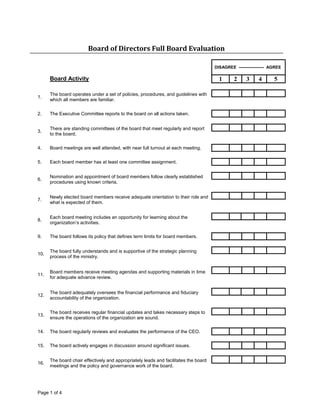
      Board Activity                                                                    1      2     3     4       5

      The board operates under a set of policies, procedures, and guidelines with
1.
      which all members are familiar.

2.    The Executive Committee reports to the board on all actions taken.


      There are standing committees of the board that meet regularly and report
3.
      to the board.

4.    Board meetings are well attended, with near full turnout at each meeting.

5.    Each board member has at least one committee assignment.


      Nomination and appointment of board members follow clearly established
6.
      procedures using known criteria.


      Newly elected board members receive adequate orientation to their role and
7.
      what is expected of them.


      Each board meeting includes an opportunity for learning about the
8.
      organization’s activities.

9.    The board follows its policy that defines term limits for board members.


      The board fully understands and is supportive of the strategic planning
10.
      process of the ministry.


      Board members receive meeting agendas and supporting materials in time
11.
      for adequate advance review.


      The board adequately oversees the financial performance and fiduciary
12.
      accountability of the organization.


      The board receives regular financial updates and takes necessary steps to
13.
      ensure the operations of the organization are sound.

14.   The board regularly reviews and evaluates the performance of the CEO.

15.   The board actively engages in discussion around significant issues.


      The board chair effectively and appropriately leads and facilitates the board
16.
      meetings and the policy and governance work of the board.


Page 1 of 4
Board of Directors Full Board Evaluation


                                                                                   DISAGREE ------------------ AGREE

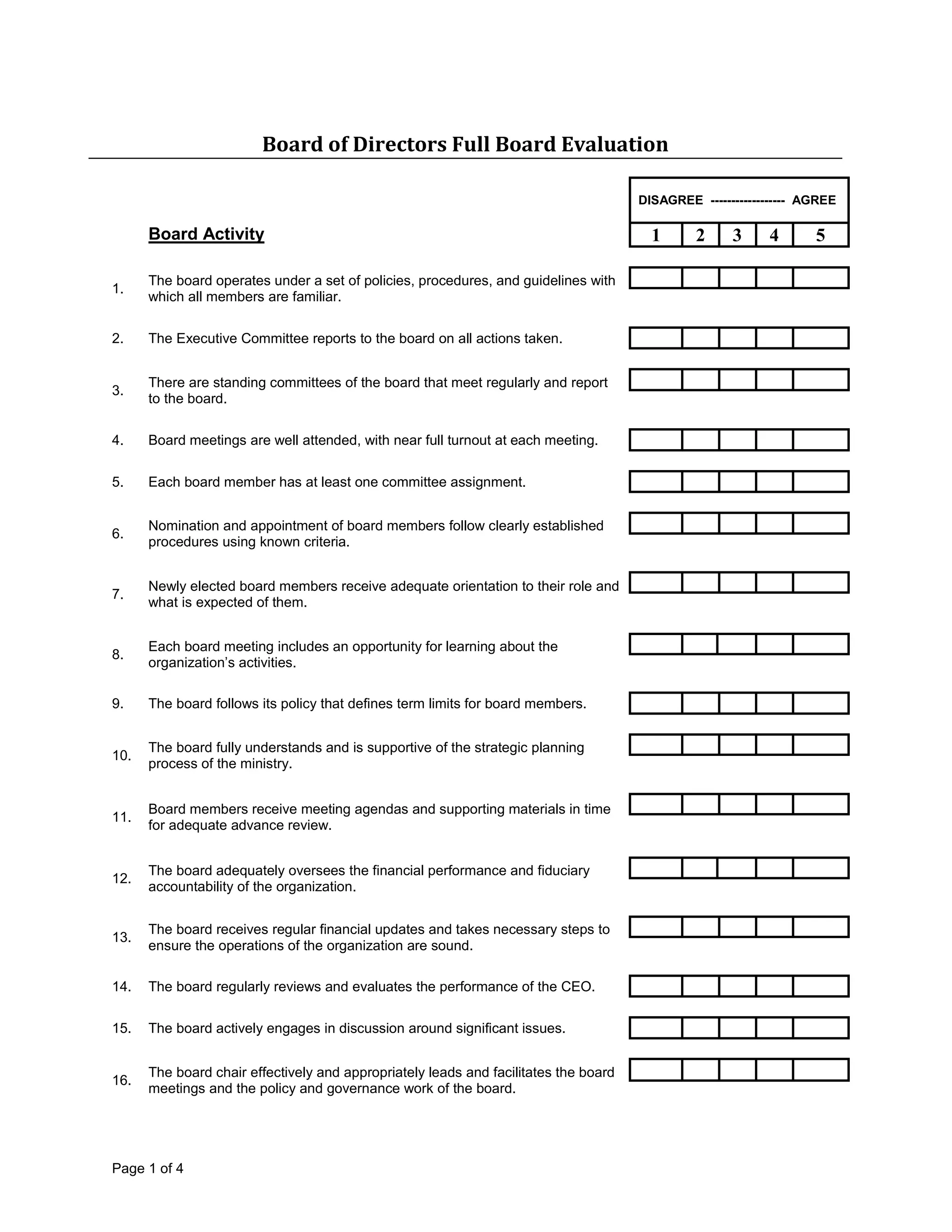
     Mission and Purpose                                                             1      2     3     4       5

     Statements of the organization’s mission are well understood and supported
1.
     by the board.


     Board meeting presentations and discussions consistently reference the
2.
     organization’s mission statement.


     The board reviews the organization’s performance in carrying out the stated
3.
     mission on a regular basis.


     Governance

1.
     The board exercises its governance role: Ensuring that the organization
     supports and upholds the mission statement, core values, vision statement,
     and conflict of interest policies.


     The board periodically reviews (every two years), and is familiar with, the
2.
     organization’s policies.


     The board reviews its own performance and measures its own effectiveness
3.
     in governance work.

4.   The board is actively engaged in the board development processes.


     Board Organization

     Information provided by staff is adequate to ensure effective board
1.
     governance and decision-making.


     The committee structure logically addresses the organization’s areas of
2.
     operation.


3.   All committees have adequate agendas and minutes for each meeting.


4.   All committees address issues of substance.


Page 2 of 4
Board of Directors Full Board Evaluation

                                                                                  DISAGREE ------------------ AGREE

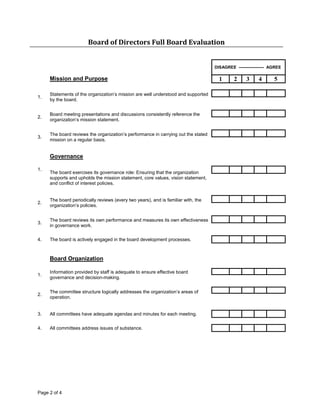
     Board Meetings                                                                 1      2     3     4       5

1.   Board meetings are frequent enough to ensure effective governance.

2.   Board meetings are long enough to accomplish the board’s work.

3.   Board members fully and positively participate in discussions.


     Board Membership

1.   The board size is adequate to effectively govern the organization.

2.   The board has a range of talents, experience, and knowledge to accomplish
     its role.


3.   The board uses its members’ talents and skills effectively.

4.   The board makeup is diverse with experience, skills, ethnicity, gender,
     denomination, and age group.


5.   Fellow board members review each member’s performance at the end of
     every three-year term.


6.   Each board member participates in financially supporting the organization
     on an annual basis.


7.   The board demonstrates a deep spiritual commitment to Jesus Christ, to the
     Christian mission of our organization, and to obedience to God’s word as
     revealed in the scriptures.


     Administration and Staff Support

1.   The committee structure provides adequate contact with administration and
     staff.


2.   Communication is strong and clear between the board and staff.


3.   Staff support before, during, and after-board meetings is effective.


Page 3 of 4
Board of Directors – Self Evaluation Form


Board Member:                                                         ____________________


1. How do you assess your contribution to our organization?
   (You might want to include such things as: attendance at board meetings, participation,
   promotion and fund-raising, prayer, committee work, or any other areas on which you would like
   to comment)


2. Do you feel that your financial contributions to our organization are at a level which is
   “personally significant” for you? Why or why not?


3. How has our organization invested in your growth as a board member?


4. What would you like to contribute to or involve yourself in if you were to serve another term?


5. How would you like our organization to invest in and facilitate your personal development as a
   board member?


6. What changes would you suggest, as a board member, in the operation and involvement of the
   board?


Page 4 of 4
Sample Job Description for Nonprofit Board Membership

Position Title: Member of the Board of Directors

Length of Term: ______________________________

Reports To: Entire Board of Directors

Responsibilities:

   •
   •
   •
   •
   •
   •
   •
   •
   •

The successful board member:

   •
   •
   •
   •
   •
BUILDING BLOCKS FOR BOARD DEVELOPMENT


 GOVERNANCE RESPONSIBILITIES OF A NONPROFIT BOARD OF DIRECTORS

DEFINE THE MISSION AND PURPOSE OF THE ORGANIZATION
  • Develop a mission statement that communicates the goals of the organization.
  • Many organizations also establish a Vision and articulate Values as well.
  • New projects, lines of business, and initiatives should meet the mission test.

BE AMBASSADORS FOR THE ORGANIZATION
   • Speak with one voice as a board.
   • Represent the organization well to the public, stakeholders, funders, and media.
   • Open doors for the organization and be a cheerleader.

ENABLE THE BOARD TO FUNCTION
  • Attend and participate
  • Establish a committee structure
  • Hold annual elections
  • Fill vacancies as they occur

PLANNING AND DIRECTION
   • Undertake regular strategic planning for the organization.
   • Assess the changing environment along with challenges and opportunities.
   • Develop an annual operations plan with specific goals and budget
   • Do succession planning.

ORGANIZATIONAL OVERSIGHT
  • Know and evaluate the organization’s programs, service areas, and populations served.
  • Review and evaluate productivity and outcomes of the programs/services.
  • Analyze trends and performance over time.
  • Understand the community needs, demand for services, and gaps in services offered.
  • Hear from customers as to how well their needs are being met.
  • Assure the organization has competent staff.

FINANCIAL OVERSIGHT
   • Receive and review financial reports monthly.
   • Conduct annual audits and have them presented to the board by the CPA.
   • Be sure financial policies provide for internal controls and safeguarding of assets.
   • Maintain appropriate financial reserves.
   • Make sure payroll taxes are paid, accounts are reconciled, and the IRS 990 is filed.
   • Receive insurance reviews from your carrier/agent.
   • Exercise fiduciary responsibility and seek to be transparent.
HIRE AND REVIEW PERFORMANCE OF CHIEF EXECUTIVE
   • Responsible for employing the Executive Director/CEO.
   • Develop a job description, share expectations, and communicate regularly.
   • Create parameters for CEO to operate in and don’t micro-manage
   • Conduct his/her annual performance review.
   • Review compensation comparables.
   • Document the review and salary decisions.

RESOURCE DEVELOPMENT
   • Assist with identifying and securing resources for the organization to operate with.
   • Help with “the ask” and the “thank you”.
   • Make sure 100% of board members financially support the organization.

CORPORATE DOCUMENTS, POLICIES AND COMPLIANCE
  • Review Articles of Incorporation and Bylaws every year or two.
  • Approve policies for the organization and make sure all necessary policies are in place.
  • Examples include Financial, Personnel, Operations, Ethics, Whistleblower, Disaster,
     Equal Opportunity, Conflict of Interest, Succession, etc.

BE REPRESENTATIVE
   • Strategically look at the make-up of the board to see if there is suitable representation.
   • Representation could include geographic, race/ethnicity, male/female, age, etc.
   • Define the skills sets and experience needed for the board, such as affordable housing,
      nonprofit management, government, consumers/residents, community development,
      lenders/financial, etc.

REPORT TO YOUR MEMBERS, STAKEHOLDERS, FUNDERS AND THE PUBLIC
  • Use newsletters and website to keep people informed.
  • Have an Annual Meeting and/or develop an Annual Report to articulate successes and
     outcomes.

ASSESS BOARD PERFORMANCE
   • Board should assess its performance as a whole every so often.
   • Board members should assess their individual performance.
   • Follow-up on recommendations and suggestions.

INVITE THIRD PARTY REVIEW
   • Learn from 3rd party evaluations such as audits, management reviews, and evaluations.
   • Consider suggestions and recommendations and make necessary changes.
   • Examples are United Way, NeighborWorks, HAC, T&MA Contractors, etc.
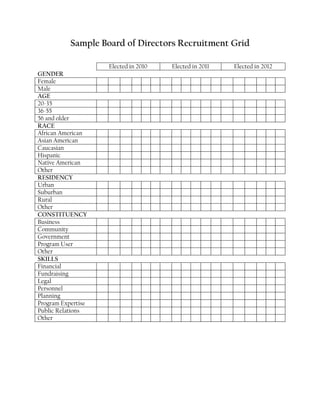
Sample Board of Directors Recruitment Grid

                    Elected in 2010   Elected in 2011   Elected in 2012
GENDER
Female
Male
AGE
20-35
36-55
56 and older
RACE
African American
Asian American
Caucasian
Hispanic
Native American
Other
RESIDENCY
Urban
Suburban
Rural
Other
CONSTITUENCY
Business
Community
Government
Program User
Other
SKILLS
Financial
Fundraising
Legal
Personnel
Planning
Program Expertise
Public Relations
Other
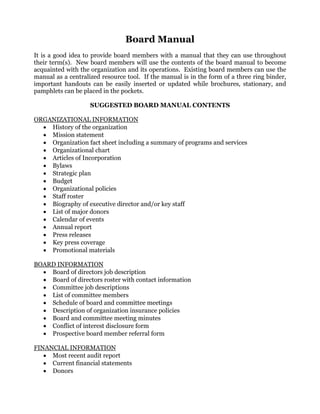
Board Manual
It is a good idea to provide board members with a manual that they can use throughout
their term(s). New board members will use the contents of the board manual to become
acquainted with the organization and its operations. Existing board members can use the
manual as a centralized resource tool. If the manual is in the form of a three ring binder,
important handouts can be easily inserted or updated while brochures, stationary, and
pamphlets can be placed in the pockets.

                    SUGGESTED BOARD MANUAL CONTENTS

ORGANIZATIONAL INFORMATION
  • History of the organization
  • Mission statement
  • Organization fact sheet including a summary of programs and services
  • Organizational chart
  • Articles of Incorporation
  • Bylaws
  • Strategic plan
  • Budget
  • Organizational policies
  • Staff roster
  • Biography of executive director and/or key staff
  • List of major donors
  • Calendar of events
  • Annual report
  • Press releases
  • Key press coverage
  • Promotional materials

BOARD INFORMATION
  • Board of directors job description
  • Board of directors roster with contact information
  • Committee job descriptions
  • List of committee members
  • Schedule of board and committee meetings
  • Description of organization insurance policies
  • Board and committee meeting minutes
  • Conflict of interest disclosure form
  • Prospective board member referral form

FINANCIAL INFORMATION
   • Most recent audit report
   • Current financial statements
   • Donors

B3 building blocks for board development - materials

  • 1.
    Board of DirectorsFull Board Evaluation DISAGREE ------------------ AGREE Board Activity 1 2 3 4 5 The board operates under a set of policies, procedures, and guidelines with 1. which all members are familiar. 2. The Executive Committee reports to the board on all actions taken. There are standing committees of the board that meet regularly and report 3. to the board. 4. Board meetings are well attended, with near full turnout at each meeting. 5. Each board member has at least one committee assignment. Nomination and appointment of board members follow clearly established 6. procedures using known criteria. Newly elected board members receive adequate orientation to their role and 7. what is expected of them. Each board meeting includes an opportunity for learning about the 8. organization’s activities. 9. The board follows its policy that defines term limits for board members. The board fully understands and is supportive of the strategic planning 10. process of the ministry. Board members receive meeting agendas and supporting materials in time 11. for adequate advance review. The board adequately oversees the financial performance and fiduciary 12. accountability of the organization. The board receives regular financial updates and takes necessary steps to 13. ensure the operations of the organization are sound. 14. The board regularly reviews and evaluates the performance of the CEO. 15. The board actively engages in discussion around significant issues. The board chair effectively and appropriately leads and facilitates the board 16. meetings and the policy and governance work of the board. Page 1 of 4
  • 2.
    Board of DirectorsFull Board Evaluation DISAGREE ------------------ AGREE Mission and Purpose 1 2 3 4 5 Statements of the organization’s mission are well understood and supported 1. by the board. Board meeting presentations and discussions consistently reference the 2. organization’s mission statement. The board reviews the organization’s performance in carrying out the stated 3. mission on a regular basis. Governance 1. The board exercises its governance role: Ensuring that the organization supports and upholds the mission statement, core values, vision statement, and conflict of interest policies. The board periodically reviews (every two years), and is familiar with, the 2. organization’s policies. The board reviews its own performance and measures its own effectiveness 3. in governance work. 4. The board is actively engaged in the board development processes. Board Organization Information provided by staff is adequate to ensure effective board 1. governance and decision-making. The committee structure logically addresses the organization’s areas of 2. operation. 3. All committees have adequate agendas and minutes for each meeting. 4. All committees address issues of substance. Page 2 of 4
  • 3.
    Board of DirectorsFull Board Evaluation DISAGREE ------------------ AGREE Board Meetings 1 2 3 4 5 1. Board meetings are frequent enough to ensure effective governance. 2. Board meetings are long enough to accomplish the board’s work. 3. Board members fully and positively participate in discussions. Board Membership 1. The board size is adequate to effectively govern the organization. 2. The board has a range of talents, experience, and knowledge to accomplish its role. 3. The board uses its members’ talents and skills effectively. 4. The board makeup is diverse with experience, skills, ethnicity, gender, denomination, and age group. 5. Fellow board members review each member’s performance at the end of every three-year term. 6. Each board member participates in financially supporting the organization on an annual basis. 7. The board demonstrates a deep spiritual commitment to Jesus Christ, to the Christian mission of our organization, and to obedience to God’s word as revealed in the scriptures. Administration and Staff Support 1. The committee structure provides adequate contact with administration and staff. 2. Communication is strong and clear between the board and staff. 3. Staff support before, during, and after-board meetings is effective. Page 3 of 4
  • 4.
    Board of Directors– Self Evaluation Form Board Member: ____________________ 1. How do you assess your contribution to our organization? (You might want to include such things as: attendance at board meetings, participation, promotion and fund-raising, prayer, committee work, or any other areas on which you would like to comment) 2. Do you feel that your financial contributions to our organization are at a level which is “personally significant” for you? Why or why not? 3. How has our organization invested in your growth as a board member? 4. What would you like to contribute to or involve yourself in if you were to serve another term? 5. How would you like our organization to invest in and facilitate your personal development as a board member? 6. What changes would you suggest, as a board member, in the operation and involvement of the board? Page 4 of 4
  • 5.
    Sample Job Descriptionfor Nonprofit Board Membership Position Title: Member of the Board of Directors Length of Term: ______________________________ Reports To: Entire Board of Directors Responsibilities: • • • • • • • • • The successful board member: • • • • •
  • 6.
    BUILDING BLOCKS FORBOARD DEVELOPMENT GOVERNANCE RESPONSIBILITIES OF A NONPROFIT BOARD OF DIRECTORS DEFINE THE MISSION AND PURPOSE OF THE ORGANIZATION • Develop a mission statement that communicates the goals of the organization. • Many organizations also establish a Vision and articulate Values as well. • New projects, lines of business, and initiatives should meet the mission test. BE AMBASSADORS FOR THE ORGANIZATION • Speak with one voice as a board. • Represent the organization well to the public, stakeholders, funders, and media. • Open doors for the organization and be a cheerleader. ENABLE THE BOARD TO FUNCTION • Attend and participate • Establish a committee structure • Hold annual elections • Fill vacancies as they occur PLANNING AND DIRECTION • Undertake regular strategic planning for the organization. • Assess the changing environment along with challenges and opportunities. • Develop an annual operations plan with specific goals and budget • Do succession planning. ORGANIZATIONAL OVERSIGHT • Know and evaluate the organization’s programs, service areas, and populations served. • Review and evaluate productivity and outcomes of the programs/services. • Analyze trends and performance over time. • Understand the community needs, demand for services, and gaps in services offered. • Hear from customers as to how well their needs are being met. • Assure the organization has competent staff. FINANCIAL OVERSIGHT • Receive and review financial reports monthly. • Conduct annual audits and have them presented to the board by the CPA. • Be sure financial policies provide for internal controls and safeguarding of assets. • Maintain appropriate financial reserves. • Make sure payroll taxes are paid, accounts are reconciled, and the IRS 990 is filed. • Receive insurance reviews from your carrier/agent. • Exercise fiduciary responsibility and seek to be transparent.
  • 7.
    HIRE AND REVIEWPERFORMANCE OF CHIEF EXECUTIVE • Responsible for employing the Executive Director/CEO. • Develop a job description, share expectations, and communicate regularly. • Create parameters for CEO to operate in and don’t micro-manage • Conduct his/her annual performance review. • Review compensation comparables. • Document the review and salary decisions. RESOURCE DEVELOPMENT • Assist with identifying and securing resources for the organization to operate with. • Help with “the ask” and the “thank you”. • Make sure 100% of board members financially support the organization. CORPORATE DOCUMENTS, POLICIES AND COMPLIANCE • Review Articles of Incorporation and Bylaws every year or two. • Approve policies for the organization and make sure all necessary policies are in place. • Examples include Financial, Personnel, Operations, Ethics, Whistleblower, Disaster, Equal Opportunity, Conflict of Interest, Succession, etc. BE REPRESENTATIVE • Strategically look at the make-up of the board to see if there is suitable representation. • Representation could include geographic, race/ethnicity, male/female, age, etc. • Define the skills sets and experience needed for the board, such as affordable housing, nonprofit management, government, consumers/residents, community development, lenders/financial, etc. REPORT TO YOUR MEMBERS, STAKEHOLDERS, FUNDERS AND THE PUBLIC • Use newsletters and website to keep people informed. • Have an Annual Meeting and/or develop an Annual Report to articulate successes and outcomes. ASSESS BOARD PERFORMANCE • Board should assess its performance as a whole every so often. • Board members should assess their individual performance. • Follow-up on recommendations and suggestions. INVITE THIRD PARTY REVIEW • Learn from 3rd party evaluations such as audits, management reviews, and evaluations. • Consider suggestions and recommendations and make necessary changes. • Examples are United Way, NeighborWorks, HAC, T&MA Contractors, etc.
  • 8.
    Sample Board ofDirectors Recruitment Grid Elected in 2010 Elected in 2011 Elected in 2012 GENDER Female Male AGE 20-35 36-55 56 and older RACE African American Asian American Caucasian Hispanic Native American Other RESIDENCY Urban Suburban Rural Other CONSTITUENCY Business Community Government Program User Other SKILLS Financial Fundraising Legal Personnel Planning Program Expertise Public Relations Other
  • 9.
    Board Manual It isa good idea to provide board members with a manual that they can use throughout their term(s). New board members will use the contents of the board manual to become acquainted with the organization and its operations. Existing board members can use the manual as a centralized resource tool. If the manual is in the form of a three ring binder, important handouts can be easily inserted or updated while brochures, stationary, and pamphlets can be placed in the pockets. SUGGESTED BOARD MANUAL CONTENTS ORGANIZATIONAL INFORMATION • History of the organization • Mission statement • Organization fact sheet including a summary of programs and services • Organizational chart • Articles of Incorporation • Bylaws • Strategic plan • Budget • Organizational policies • Staff roster • Biography of executive director and/or key staff • List of major donors • Calendar of events • Annual report • Press releases • Key press coverage • Promotional materials BOARD INFORMATION • Board of directors job description • Board of directors roster with contact information • Committee job descriptions • List of committee members • Schedule of board and committee meetings • Description of organization insurance policies • Board and committee meeting minutes • Conflict of interest disclosure form • Prospective board member referral form FINANCIAL INFORMATION • Most recent audit report • Current financial statements • Donors