Building a Board That Adds
Value to the Organization
Presented by
Berit M. Lakey, PhD
Objectives
• To develop a shared understanding of
board roles and responsibilities
• To clarify the roles of board and CEO, of
governance and management
• To identify board structures and practices
that add value to the organization and
makes good use of what board members
bring to the table
• To discuss steps in the process of
developing an effective board
• When you decided to run for
election to the board, what were
your expectations
– About the work of the board?
– About your own participation?
The board of a not-for-profit organization
holds the organization in trust
on behalf of the public interest.
The board serves as the organization’s
legal and moral guardian
and as such is responsible for ensuring
the current and future welfare of the
organization and its mission.

Board is Charged with
Organizational Governance
“To govern is to lead, to influence, and to control
from a position of authority. Governance deals
with the legitimate distribution of authority
throughout a system – whether a country or an
organization.” --BoardSource
Governance: The process of decision making
and ensuring that decisions are implemented
To Deal with the Challenges
out There, Just Being Good may no
Longer be Good Enough
• Ethics and Image
• Laws and Regulations
• The Economy, Financial Competition
• Rapid Technological Change
• Demographic and Cultural Issues
• Scarcity of Time Available for Volunteer
Activities
Good Boards
• Competent stewards
• Focus on fiduciary oversight and legal compliance
• Operate effectively and ethically
• Works well with the CEO
Great Boards Add
• Active engagement, a diversity of information sources,
search for meaning and exploration of implications, and
independent decision making
• Open and honest communication among the members
and with the chief executive
• Passionate support for efforts to pursue the mission
• “The right people on the bus”
Board Governance Roles
in the Not-for-Profit Sector
• Establish Strategic Direction
• Ensure Resources
• Provide Oversight
ESTABLISH STRATEGIC
DIRECTION
• Develop and maintain focus on MISSION
• Articulate the VALUES and POLICIES by
which the organization will operate
• Establish strategic direction
– VISION of
• the organization’s intended impact
• what the organization will be like at some point in the
future (3-5 years)
– Strategic GOALS
ENSURE RESOURCES
• Identify resources needed
– Financial
– Leadership (chief executive and board)
– Reputation
• Establish policies for how these
resources will be acquired
PROVIDE OVERSIGHT
• Program
• Financial policies and practices
• Laws and ethical standards
Board Responsibility
for the Program
• Once the board has established strategic
goals, it needs to
– Ensure that plans are made for how to reach
the goals
– Monitor implementation: are we doing what
we said we would do and accomplishing our
goals?
– Evaluate the outcomes: Are we effectively
meeting the needs we are here to address?
Board Responsibility for
Financial Oversight
• Approve the budget
• Oversee financial management
– Hold the chief executive accountable for
legal and ethical financial operations
– Review financial statements from a
strategic perspective and make decisions
necessary to safeguard the organization’s
future health
Board Responsibility for
Legal and Ethical Oversight
• Ensure compliance with legal
requirements
• Safeguard the organization’s values
• Avoid conflicts of interest
• Ensure accountability for performance
– The chief executive
– The board, its members, and its committees
On a scale of 1-5
(1=poor, 2=needs lots of improvement, 3=OK,
4=good, 5=excellent),
How would you rate your board
in each of these key roles:
» Establish Direction
» Ensure Resources
» Provide Oversight
» Programs and Services
» Finances
» Legal and ethical
The Board and the CEO Partnership
in Organizational Governance
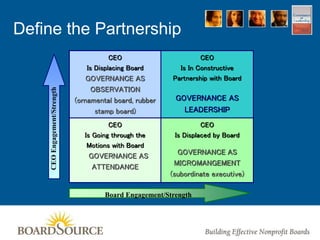
Define the Partnership
Board Engagement/Strength
CEO
Is Displacing Board
GOVERNANCE AS
OBSERVATION
(ornamental board, rubber
stamp board)
CEO
Is In Constructive
Partnership with Board
GOVERNANCE AS
LEADERSHIP
CEO
Is Going through the
Motions with Board
GOVERNANCE AS
ATTENDANCE
CEO
Is Displaced by Board
GOVERNANCE AS
MICROMANGEMENT
(subordinate executive)
CEO
Engagement/Strength
The Board/ Chief Executive
Partnership
• The board governs the life of the
organization
– Operates at the strategic policy level
– Has ultimate responsibility
– Is accountable to the organizations’ members and to
the public trust
• The executive coordinates and manages
the affairs of the organization
– Has immediate responsibility for operations
– Is accountable to the board
Mutual Responsibilities
of Board and Executive
• Executive to Board
– Accountability for organizational management
– Strategic information
– Listening and responding to board concerns
• Board to Executive
– Clarity of expectations
– Feedback, annual performance review
– Listening, confidentiality, advice as requested
– Timely decision making
Leadership Expectations
• Expectations must be clarified:
–Is CEO an administrator who will
basically do what the board dictates?
–Is CEO the Association’s leader?
–Is CEO a partner with the board in
Association leadership?
Ingredients
of an Effective Partnership
• Agreement on respective roles
• Communication! Communication!
– Sharing of accurate and relevant information
– Checking to ensure correct understandings
– Listening to each other’s ideas and concerns
– Clarification of mutual expectations
– Direct and accurate feedback
– Appreciation
– No surprises!
CEO Assessment:
A Key Board Responsibility
• Ensure that it is done on a regular basis
• Ensure that the assessment process is
viewed by both the CEO and the board
as fair and appropriate
• Ensure that the assessment process is
understood by the board and allows for
board input
• Ensure that it serves a developmental
purpose, not as a report card
Board Relationship
to Other Staff
• Staff is accountable to the board through the
chief executive
• Board members do not direct the work of staff
• Staff members should not use board members
to advance their own interests or complain
about each other or their boss
• Board members should not get involved with
staff issues or complaints
• Board and staff share commitment to mission
• Appreciation works
Board Meetings That Add Value
• What do you consider to be
characteristics of a productive board
meeting?
Impediments to
High Performance Board Meetings
1. Ineffective deliberation & decision-
making
A. Rivalries
B. Domination of the many by the few
C. One-way communication
D. Board members who have not read materials
E. Too much, too little, or one-sided information
F. Rubber-stamping
2. Lack of understanding of governance
roles/responsibilities
– Operational rather than strategic focus
High Performance Meetings:
Engaging, Strategic and Outcome
Oriented
• Stated objectives or themes – connected to
strategic plan and/or strategic challenges
• Agendas structured for exploring implications of
reports and ideas rather than for listening to
reports
– Use of consent agendas for routine business
– Written reports and proposals
• Well prepared board members
• Making decisions and identifying next steps
• Culture of inquiry approach
Culture of Inquiry:
Fostering High Performance
Timely information exchanges
Differing viewpoints are sought and encouraged
Assumptions are questioned and examined
Outsiders are consulted to gain additional
perspective and knowledge
Questions are welcomed
Board member expertise and perspective are
recognized
Ambiguity is tolerated
Differing opinions are aired during robust
discussions, but when a collective decision is
made, it is supported by the entire board
What are ways
in which your board meetings
might add more value
for the Association
and for you?
High Performance Board
Structures
• Limit number of standing committees
• Make use of ad hoc committees and task forces in
order to respond strategically to issues and to
make flexible use of board member time, interests,
expertise, and learning needs
• Ensure that all groups have a written job
description and time frames for their work
• Distinguish between governance committees and
those that deal with implementation of IRA’s
programs and services (Association committees)
• Use assignments to committees
• and task forces for leadership development
and board member education about issues
facing the board and the association
• Clarify the respective roles of board and staff
involved
• Require written reports to the board
– Include on consent agenda if no board action is
needed or if decision does not require discussion
– Proposals should outline background, options
considered, and rationale for proposed action
• Avoid repeating committee discussions
during board meetings
• What are examples of issues that
might be referred to a task force?
Board Development
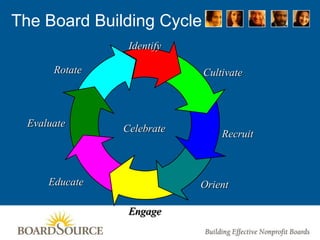
The Board Building Cycle
Identify
Cultivate
Recruit
Orient
Engage
Educate
Rotate
Evaluate Celebrate
Identify the Board’s Needs
(a Board Responsibility)
The mix you need to achieve strategic goals
– Skills / knowledge / expertise
– Perspectives / Life experience
– Connections in the community
– Access to resources
– Personal characteristics
• e.g., leadership ability, consensus builder,
visionary, analytical thinker, creativity, follow-
through, honesty, effective communicator
Cultivate and Recruit
Potential Board Members
(Nominations Committee Responsibility)
• Finding and preparing new board members requires
active involvement on an ongoing basis
• Let Association members and other potential board
members know about the roles and responsibilities of
the board and what it means to be a board member
• When seeking nominations, be clear about board
meeting schedules and participation on committees
Orientation / On-boarding
 To the Association: mission, values,
programs, history, bylaws, strategic
plan, pressing issues, finances,
facilities, organizational chart
 To the board: recent minutes,
committees, board member
responsibilities, list of board members
and contact information
Orient New Members
To the Public Trustee Role
– Duty of Care
Board members must exercise due care in all
dealings with the organization and its interests.
Active participation is essential to exercising the
duty of care.
– Duty of Loyalty
Conflicts of interest, including the perception of
conflicts of interest, must be avoided.
Confidentiality policies
– Duty of Obedience
Obedience to the laws of the land and the
organization’s central purposes must guide all
decisions..
Engage Board Members
Effective Use of Board Meetings,
Committees and Task Forces
• Identify board member interests, skills, and
knowledge,
• Involve and challenge them through committee
or task force assignments
• Support individuals in the exercise of their
responsibilities and hold them accountable
• Make sparing use of the Executive Committee
in order to avoid creating a two-tiered board
Conversations
What are effective ways for making use
of what each board member
brings to the table
1. In preparation for board discussions
2. During board discussions
Educate the Board
• Use annual agenda to ensure in-depth
consideration of each key aspect of the
organization’s work.
• Invite staff, outsiders, board members, or
committees to share in depth information with
the board on issues that might have an impact
on the organization’s performance
• Involve board members in discussing
implications for the Association of information
shared
Evaluate
Board Performance
• Effective board development requires
periodic check-ups and tune-ups
• The goal of board evaluation is further
development and plans for improved
performance
• A board evaluation should be educational and
help strengthen board communication
• All board members should be asked to
participate in the assessment
Celebrate
Accomplishments!
• Support the development of the board
as a team by acknowledging and
celebrating accomplishments
– In the life of the organization
– In the life of the board
– In the lives of board members
• Be creative and have a good time!
Board Development –
Whose Responsibility?
It’s a big job and needs to be a team effort
between
• The Nominations Committee
• The Governance Committee
• The board chair
• The chief executive
Boards are
Dynamic Organisms
• How responsibilities are carried out will change
as the organization changes
– Size of budget, staff, program
– Program visibility and reputation
• The organization changes as the environment
changes
– economy, political situation, educational trends
• A board must be responsive to changing needs
– What worked in the past may no longer be effective
– Keep growing and developing!
• Please identify what might be done to
make the Nominations Committee
aware of
– the diversities of background, experience,
and knowledge base needed on the board
– the information that needs to be shared
with everyone who is interested in being
nominated for a seat on the board
Next Steps
• Based on the work we have done
together today, what
– What actions should be taken to
strengthen the board and help it add more
value for the Association?
– By whom?
– By what time?
Farewell and Best Wishes!
Berit M. Lakey, PhD
Senior Governance Consultant
BoardSource
Phone # direct: 301-593-0335
beritlakey!@verizon.net

Ira oct 2010

  • 1.
    Building a BoardThat Adds Value to the Organization Presented by Berit M. Lakey, PhD
  • 2.
    Objectives • To developa shared understanding of board roles and responsibilities • To clarify the roles of board and CEO, of governance and management • To identify board structures and practices that add value to the organization and makes good use of what board members bring to the table • To discuss steps in the process of developing an effective board
  • 3.
    • When youdecided to run for election to the board, what were your expectations – About the work of the board? – About your own participation?
  • 4.
    The board ofa not-for-profit organization holds the organization in trust on behalf of the public interest. The board serves as the organization’s legal and moral guardian and as such is responsible for ensuring the current and future welfare of the organization and its mission.
  • 5.
    Board is Chargedwith Organizational Governance “To govern is to lead, to influence, and to control from a position of authority. Governance deals with the legitimate distribution of authority throughout a system – whether a country or an organization.” --BoardSource Governance: The process of decision making and ensuring that decisions are implemented
  • 6.
    To Deal withthe Challenges out There, Just Being Good may no Longer be Good Enough • Ethics and Image • Laws and Regulations • The Economy, Financial Competition • Rapid Technological Change • Demographic and Cultural Issues • Scarcity of Time Available for Volunteer Activities
  • 7.
    Good Boards • Competentstewards • Focus on fiduciary oversight and legal compliance • Operate effectively and ethically • Works well with the CEO Great Boards Add • Active engagement, a diversity of information sources, search for meaning and exploration of implications, and independent decision making • Open and honest communication among the members and with the chief executive • Passionate support for efforts to pursue the mission • “The right people on the bus”
  • 8.
    Board Governance Roles inthe Not-for-Profit Sector • Establish Strategic Direction • Ensure Resources • Provide Oversight
  • 9.
    ESTABLISH STRATEGIC DIRECTION • Developand maintain focus on MISSION • Articulate the VALUES and POLICIES by which the organization will operate • Establish strategic direction – VISION of • the organization’s intended impact • what the organization will be like at some point in the future (3-5 years) – Strategic GOALS
  • 10.
    ENSURE RESOURCES • Identifyresources needed – Financial – Leadership (chief executive and board) – Reputation • Establish policies for how these resources will be acquired
  • 11.
    PROVIDE OVERSIGHT • Program •Financial policies and practices • Laws and ethical standards
  • 12.
    Board Responsibility for theProgram • Once the board has established strategic goals, it needs to – Ensure that plans are made for how to reach the goals – Monitor implementation: are we doing what we said we would do and accomplishing our goals? – Evaluate the outcomes: Are we effectively meeting the needs we are here to address?
  • 13.
    Board Responsibility for FinancialOversight • Approve the budget • Oversee financial management – Hold the chief executive accountable for legal and ethical financial operations – Review financial statements from a strategic perspective and make decisions necessary to safeguard the organization’s future health
  • 14.
    Board Responsibility for Legaland Ethical Oversight • Ensure compliance with legal requirements • Safeguard the organization’s values • Avoid conflicts of interest • Ensure accountability for performance – The chief executive – The board, its members, and its committees
  • 15.
    On a scaleof 1-5 (1=poor, 2=needs lots of improvement, 3=OK, 4=good, 5=excellent), How would you rate your board in each of these key roles: » Establish Direction » Ensure Resources » Provide Oversight » Programs and Services » Finances » Legal and ethical
  • 16.
    The Board andthe CEO Partnership in Organizational Governance
  • 17.
    Define the Partnership BoardEngagement/Strength CEO Is Displacing Board GOVERNANCE AS OBSERVATION (ornamental board, rubber stamp board) CEO Is In Constructive Partnership with Board GOVERNANCE AS LEADERSHIP CEO Is Going through the Motions with Board GOVERNANCE AS ATTENDANCE CEO Is Displaced by Board GOVERNANCE AS MICROMANGEMENT (subordinate executive) CEO Engagement/Strength
  • 18.
    The Board/ ChiefExecutive Partnership • The board governs the life of the organization – Operates at the strategic policy level – Has ultimate responsibility – Is accountable to the organizations’ members and to the public trust • The executive coordinates and manages the affairs of the organization – Has immediate responsibility for operations – Is accountable to the board
  • 19.
    Mutual Responsibilities of Boardand Executive • Executive to Board – Accountability for organizational management – Strategic information – Listening and responding to board concerns • Board to Executive – Clarity of expectations – Feedback, annual performance review – Listening, confidentiality, advice as requested – Timely decision making
  • 20.
    Leadership Expectations • Expectationsmust be clarified: –Is CEO an administrator who will basically do what the board dictates? –Is CEO the Association’s leader? –Is CEO a partner with the board in Association leadership?
  • 21.
    Ingredients of an EffectivePartnership • Agreement on respective roles • Communication! Communication! – Sharing of accurate and relevant information – Checking to ensure correct understandings – Listening to each other’s ideas and concerns – Clarification of mutual expectations – Direct and accurate feedback – Appreciation – No surprises!
  • 22.
    CEO Assessment: A KeyBoard Responsibility • Ensure that it is done on a regular basis • Ensure that the assessment process is viewed by both the CEO and the board as fair and appropriate • Ensure that the assessment process is understood by the board and allows for board input • Ensure that it serves a developmental purpose, not as a report card
  • 23.
    Board Relationship to OtherStaff • Staff is accountable to the board through the chief executive • Board members do not direct the work of staff • Staff members should not use board members to advance their own interests or complain about each other or their boss • Board members should not get involved with staff issues or complaints • Board and staff share commitment to mission • Appreciation works
  • 24.
  • 25.
    • What doyou consider to be characteristics of a productive board meeting?
  • 26.
    Impediments to High PerformanceBoard Meetings 1. Ineffective deliberation & decision- making A. Rivalries B. Domination of the many by the few C. One-way communication D. Board members who have not read materials E. Too much, too little, or one-sided information F. Rubber-stamping 2. Lack of understanding of governance roles/responsibilities – Operational rather than strategic focus
  • 27.
    High Performance Meetings: Engaging,Strategic and Outcome Oriented • Stated objectives or themes – connected to strategic plan and/or strategic challenges • Agendas structured for exploring implications of reports and ideas rather than for listening to reports – Use of consent agendas for routine business – Written reports and proposals • Well prepared board members • Making decisions and identifying next steps • Culture of inquiry approach
  • 28.
    Culture of Inquiry: FosteringHigh Performance Timely information exchanges Differing viewpoints are sought and encouraged Assumptions are questioned and examined Outsiders are consulted to gain additional perspective and knowledge Questions are welcomed Board member expertise and perspective are recognized Ambiguity is tolerated Differing opinions are aired during robust discussions, but when a collective decision is made, it is supported by the entire board
  • 29.
    What are ways inwhich your board meetings might add more value for the Association and for you?
  • 30.
    High Performance Board Structures •Limit number of standing committees • Make use of ad hoc committees and task forces in order to respond strategically to issues and to make flexible use of board member time, interests, expertise, and learning needs • Ensure that all groups have a written job description and time frames for their work • Distinguish between governance committees and those that deal with implementation of IRA’s programs and services (Association committees)
  • 31.
    • Use assignmentsto committees • and task forces for leadership development and board member education about issues facing the board and the association • Clarify the respective roles of board and staff involved • Require written reports to the board – Include on consent agenda if no board action is needed or if decision does not require discussion – Proposals should outline background, options considered, and rationale for proposed action • Avoid repeating committee discussions during board meetings
  • 32.
    • What areexamples of issues that might be referred to a task force?
  • 33.
  • 34.
    The Board BuildingCycle Identify Cultivate Recruit Orient Engage Educate Rotate Evaluate Celebrate
  • 35.
    Identify the Board’sNeeds (a Board Responsibility) The mix you need to achieve strategic goals – Skills / knowledge / expertise – Perspectives / Life experience – Connections in the community – Access to resources – Personal characteristics • e.g., leadership ability, consensus builder, visionary, analytical thinker, creativity, follow- through, honesty, effective communicator
  • 36.
    Cultivate and Recruit PotentialBoard Members (Nominations Committee Responsibility) • Finding and preparing new board members requires active involvement on an ongoing basis • Let Association members and other potential board members know about the roles and responsibilities of the board and what it means to be a board member • When seeking nominations, be clear about board meeting schedules and participation on committees
  • 37.
    Orientation / On-boarding To the Association: mission, values, programs, history, bylaws, strategic plan, pressing issues, finances, facilities, organizational chart  To the board: recent minutes, committees, board member responsibilities, list of board members and contact information
  • 38.
    Orient New Members Tothe Public Trustee Role – Duty of Care Board members must exercise due care in all dealings with the organization and its interests. Active participation is essential to exercising the duty of care. – Duty of Loyalty Conflicts of interest, including the perception of conflicts of interest, must be avoided. Confidentiality policies – Duty of Obedience Obedience to the laws of the land and the organization’s central purposes must guide all decisions..
  • 39.
    Engage Board Members EffectiveUse of Board Meetings, Committees and Task Forces • Identify board member interests, skills, and knowledge, • Involve and challenge them through committee or task force assignments • Support individuals in the exercise of their responsibilities and hold them accountable • Make sparing use of the Executive Committee in order to avoid creating a two-tiered board
  • 40.
    Conversations What are effectiveways for making use of what each board member brings to the table 1. In preparation for board discussions 2. During board discussions
  • 41.
    Educate the Board •Use annual agenda to ensure in-depth consideration of each key aspect of the organization’s work. • Invite staff, outsiders, board members, or committees to share in depth information with the board on issues that might have an impact on the organization’s performance • Involve board members in discussing implications for the Association of information shared
  • 42.
    Evaluate Board Performance • Effectiveboard development requires periodic check-ups and tune-ups • The goal of board evaluation is further development and plans for improved performance • A board evaluation should be educational and help strengthen board communication • All board members should be asked to participate in the assessment
  • 43.
    Celebrate Accomplishments! • Support thedevelopment of the board as a team by acknowledging and celebrating accomplishments – In the life of the organization – In the life of the board – In the lives of board members • Be creative and have a good time!
  • 44.
    Board Development – WhoseResponsibility? It’s a big job and needs to be a team effort between • The Nominations Committee • The Governance Committee • The board chair • The chief executive
  • 45.
    Boards are Dynamic Organisms •How responsibilities are carried out will change as the organization changes – Size of budget, staff, program – Program visibility and reputation • The organization changes as the environment changes – economy, political situation, educational trends • A board must be responsive to changing needs – What worked in the past may no longer be effective – Keep growing and developing!
  • 46.
    • Please identifywhat might be done to make the Nominations Committee aware of – the diversities of background, experience, and knowledge base needed on the board – the information that needs to be shared with everyone who is interested in being nominated for a seat on the board
  • 47.
    Next Steps • Basedon the work we have done together today, what – What actions should be taken to strengthen the board and help it add more value for the Association? – By whom? – By what time?
  • 48.
    Farewell and BestWishes! Berit M. Lakey, PhD Senior Governance Consultant BoardSource Phone # direct: 301-593-0335 beritlakey!@verizon.net

Editor's Notes

  • #9 Examples and ideas --------------------------------------------------------------------------------------------------------------------------------------------------------------------------------------------------------------------------------------------------------------------------------------------------------------------------------------------------------------------------------------------------------------------------------------------------------------------------------------------------------------------------------------------------------------------------------------------------------------------------------------------------------------------------------------------------------
  • #10 Boards need to consider: What changes are needed in the community? In the nation? How will we as an organization be involved in the change effort? Will we do it on our own? With what resources? Or with other groups?
  • #11 PR activities and materials (annual reports, program brochures, newsletters, etc.) What funds to go after What resources are needed on the board to assist in implementing strategic goals
  • #12 Program: Monitor and evaluate Also: ensure that strategic priorities are reflected in the budget
  • #29 Exceptional boards embed learning opportunities into routine governance work and cultivate them outside of the boardroom. Board members, especially new ones, need guidance in governance duties, nonprofit practices and the organization’s field of endeavor. Long-time board members also benefit from a regular exchange of information with fellow board members. These continuing education conversations are important ways to pass on knowledge and to nurture board relationships.
  • #38 WHAT DO YOU WISH YOU HAD KNOWN BEFORE JOING THE BOARD? Ideas for agendas Worksheet Page 3 – Designing the agenda Also, Page 9 – Orientation Chart
  • #39 Duty of Care Board members must exercise due care in all dealings with the organization and its interests. This includes careful oversight of financial matters and reading of minutes, attention to issues that are of concern to the organization, attending board meetings, and raising questions whenever something appears unclear or uncertain. Active participation is essential to exercising the duty of care. Duty of Loyalty Conflicts of interest, including the perception of conflicts of interest, must be avoided. This includes internal conflicts of interest or conflicts with other organizations that are connected to a board member. Disclosure. Duty of Obedience Obedience to the organization’s central purposes must guide all decisions. The board must also ensure that the organization functions within the law, both the “law of the land” and its own bylaws and other policies.
  • #46 Examples and ideas --------------------------------------------------------------------------------------------------------------------------------------------------------------------------------------------------------------------------------------------------------------------------------------------------------------------------------------------------------------------------------------------------------------------------------------------------------------------------------------------------------------------------------------------------------------------------------------------------------------------------------------------------------------------------------------------------------