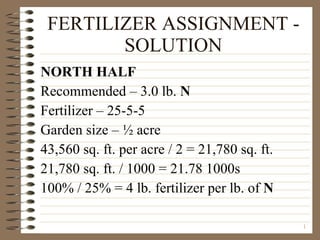
FERTILIZER ASSIGNMENT - SOLUTION NORTH HALF Recommended – 3.0 lb.  N Fertilizer – 25-5-5 Garden size – ½ acre 43,560 sq. ft. per acre / 2 = 21,780 sq. ft. 21,780 sq. ft. / 1000 = 21.78 1000s 100% / 25% = 4 lb. fertilizer per lb. of  N
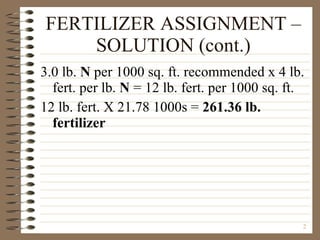
FERTILIZER ASSIGNMENT – SOLUTION (cont.) 3.0 lb.  N  per 1000 sq. ft. recommended x 4 lb. fert. per lb.  N  = 12 lb. fert. per 1000 sq. ft. 12 lb. fert. X 21.78 1000s =  261.36 lb. fertilizer
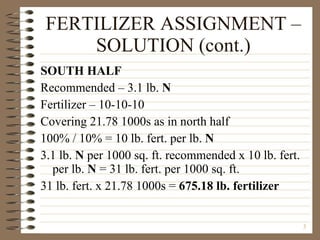
FERTILIZER ASSIGNMENT – SOLUTION (cont.) SOUTH HALF Recommended – 3.1 lb.  N Fertilizer – 10-10-10 Covering 21.78 1000s as in north half 100% / 10% = 10 lb. fert. per lb.  N 3.1 lb.  N  per 1000 sq. ft. recommended x 10 lb. fert. per lb.  N  = 31 lb. fert. per 1000 sq. ft. 31 lb. fert. x 21.78 1000s =  675.18 lb. fertilizer
PATHOLOGY & PESTS
METHODS OF CONTROL Resistant varieties Mechanical controls Organic controls Chemical controls INTEGRATED PEST MANAGEMENT (IPM) Best combination of all methods As environmentally friendly as possible Economical
RESISTANT VARIETIES ADVANTAGES Little or no other control needed for that pest DISADVANTAGES Resistant only to specific pests Seed may be more expensive
MECHANICAL CONTROLS Rotate plantings Netting, exclosures Picking insects Water spray Mechanical traps Insect vacuums Diatomaceous earth Clean up trash Hoe weeds Weed barriers Insecticidal soaps Horticultural oils
MECHANICAL CONTROLS (cont.) ADVANTAGES Often cheap Environmentally friendly DISADVANTAGES More attention May not be as effective as chemical or organic
ORGANIC CONTROLS Release of natural enemy of pest Lady bird beetle (lady bug) - aphids Preying mantis - other insects Bacillus thuringiensis (Bt) - bacterial disease of insects
ORGANIC CONTROLS (cont.) ADVANTAGES Environmentally friendly May last longer than chemicals DISADVANTAGES May be expensive May not be as quick or effective as chemical controls
CHEMICAL CONTROLS ADVANTAGES Usually immediate Sometimes specific to pest Often quite effective DISADVANTAGES Often expensive Least environmentally friendly May be dangerous to humans Often kills other insects or plants besides pest May be toxic to birds, animals, fish, etc.
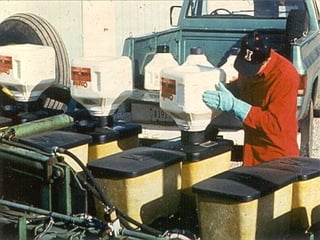
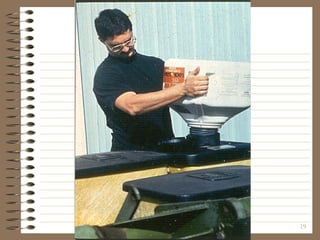
PESTICIDE SAFETY Homeowners are worst contaminators Latest label is the  LAW Violations may be costly & deadly Designed to be safe if  THE LABEL IS FOLLOWED Exposures are cumulative
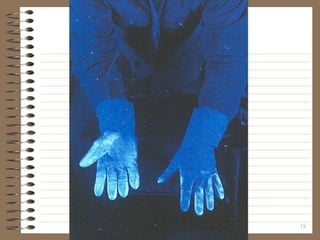
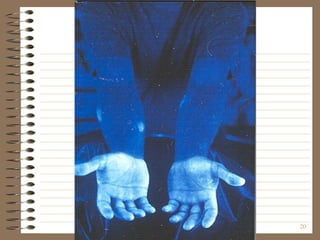
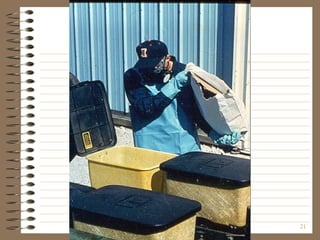
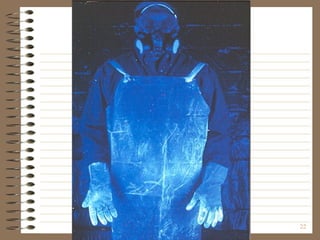
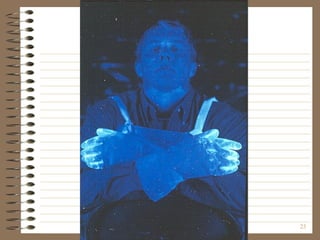
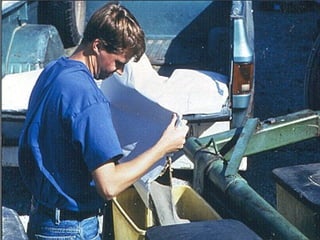
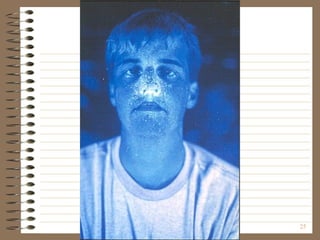
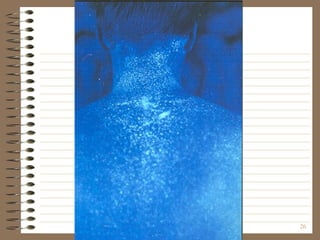
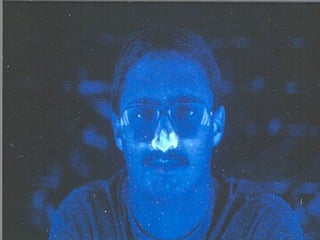
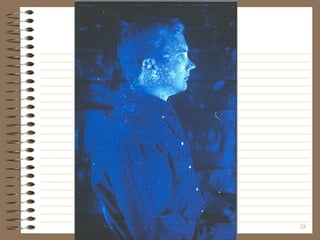
PESTICIDE SAFETY (cont.) Avenues of exposure: Mouth Breathing Skin Hands, face & neck, groin Eyes USE THE REQUIRED SAFETY EQUIPMENT If contaminated immediately flush w/ water, shower, change clothes See doctor immediately if symptoms occur
PESTICIDE SAFETY (cont.) Always shower & change clothes after application Wash clothes separate
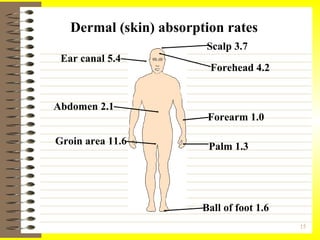
Dermal (skin) absorption rates Scalp 3.7 Forehead 4.2 Ear canal 5.4 Abdomen 2.1 Groin area 11.6 Forearm 1.0 Palm 1.3 Ball of foot 1.6


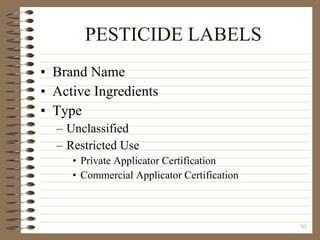
PESTICIDE LABELS Brand Name Active Ingredients Type Unclassified Restricted Use Private Applicator Certification Commercial Applicator Certification
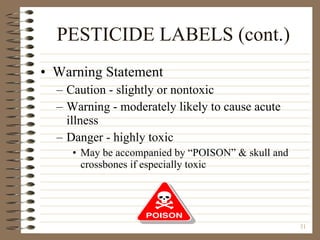
PESTICIDE LABELS (cont.) Warning Statement Caution - slightly or nontoxic Warning - moderately likely to cause acute illness Danger - highly toxic May be accompanied by “POISON” & skull and crossbones if especially toxic
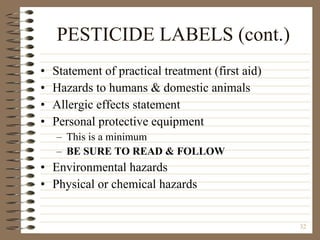
PESTICIDE LABELS (cont.) Statement of practical treatment (first aid) Hazards to humans & domestic animals Allergic effects statement Personal protective equipment This is a minimum BE SURE TO READ & FOLLOW Environmental hazards Physical or chemical hazards
PESTICIDE LABELS (cont.) Directions for use Mixing levels -  ILLEGAL TO EXCEED Crops & weeds specified -  CANNOT BE USED ON OTHERS Entry statement Storage & disposal

Garden Pathology/Pests

  • 1.
    FERTILIZER ASSIGNMENT -SOLUTION NORTH HALF Recommended – 3.0 lb. N Fertilizer – 25-5-5 Garden size – ½ acre 43,560 sq. ft. per acre / 2 = 21,780 sq. ft. 21,780 sq. ft. / 1000 = 21.78 1000s 100% / 25% = 4 lb. fertilizer per lb. of N
  • 2.
    FERTILIZER ASSIGNMENT –SOLUTION (cont.) 3.0 lb. N per 1000 sq. ft. recommended x 4 lb. fert. per lb. N = 12 lb. fert. per 1000 sq. ft. 12 lb. fert. X 21.78 1000s = 261.36 lb. fertilizer
  • 3.
    FERTILIZER ASSIGNMENT –SOLUTION (cont.) SOUTH HALF Recommended – 3.1 lb. N Fertilizer – 10-10-10 Covering 21.78 1000s as in north half 100% / 10% = 10 lb. fert. per lb. N 3.1 lb. N per 1000 sq. ft. recommended x 10 lb. fert. per lb. N = 31 lb. fert. per 1000 sq. ft. 31 lb. fert. x 21.78 1000s = 675.18 lb. fertilizer
  • 4.
  • 5.
    METHODS OF CONTROLResistant varieties Mechanical controls Organic controls Chemical controls INTEGRATED PEST MANAGEMENT (IPM) Best combination of all methods As environmentally friendly as possible Economical
  • 6.
    RESISTANT VARIETIES ADVANTAGESLittle or no other control needed for that pest DISADVANTAGES Resistant only to specific pests Seed may be more expensive
  • 7.
    MECHANICAL CONTROLS Rotateplantings Netting, exclosures Picking insects Water spray Mechanical traps Insect vacuums Diatomaceous earth Clean up trash Hoe weeds Weed barriers Insecticidal soaps Horticultural oils
  • 8.
    MECHANICAL CONTROLS (cont.)ADVANTAGES Often cheap Environmentally friendly DISADVANTAGES More attention May not be as effective as chemical or organic
  • 9.
    ORGANIC CONTROLS Releaseof natural enemy of pest Lady bird beetle (lady bug) - aphids Preying mantis - other insects Bacillus thuringiensis (Bt) - bacterial disease of insects
  • 10.
    ORGANIC CONTROLS (cont.)ADVANTAGES Environmentally friendly May last longer than chemicals DISADVANTAGES May be expensive May not be as quick or effective as chemical controls
  • 11.
    CHEMICAL CONTROLS ADVANTAGESUsually immediate Sometimes specific to pest Often quite effective DISADVANTAGES Often expensive Least environmentally friendly May be dangerous to humans Often kills other insects or plants besides pest May be toxic to birds, animals, fish, etc.
  • 12.
    PESTICIDE SAFETY Homeownersare worst contaminators Latest label is the LAW Violations may be costly & deadly Designed to be safe if THE LABEL IS FOLLOWED Exposures are cumulative
  • 13.
    PESTICIDE SAFETY (cont.)Avenues of exposure: Mouth Breathing Skin Hands, face & neck, groin Eyes USE THE REQUIRED SAFETY EQUIPMENT If contaminated immediately flush w/ water, shower, change clothes See doctor immediately if symptoms occur
  • 14.
    PESTICIDE SAFETY (cont.)Always shower & change clothes after application Wash clothes separate
  • 15.
    Dermal (skin) absorptionrates Scalp 3.7 Forehead 4.2 Ear canal 5.4 Abdomen 2.1 Groin area 11.6 Forearm 1.0 Palm 1.3 Ball of foot 1.6
  • 16.
  • 17.
  • 18.
  • 19.
  • 20.
  • 21.
  • 22.
  • 23.
  • 24.
  • 25.
  • 26.
  • 27.
  • 28.
  • 29.
  • 30.
    PESTICIDE LABELS BrandName Active Ingredients Type Unclassified Restricted Use Private Applicator Certification Commercial Applicator Certification
  • 31.
    PESTICIDE LABELS (cont.)Warning Statement Caution - slightly or nontoxic Warning - moderately likely to cause acute illness Danger - highly toxic May be accompanied by “POISON” & skull and crossbones if especially toxic
  • 32.
    PESTICIDE LABELS (cont.)Statement of practical treatment (first aid) Hazards to humans & domestic animals Allergic effects statement Personal protective equipment This is a minimum BE SURE TO READ & FOLLOW Environmental hazards Physical or chemical hazards
  • 33.
    PESTICIDE LABELS (cont.)Directions for use Mixing levels - ILLEGAL TO EXCEED Crops & weeds specified - CANNOT BE USED ON OTHERS Entry statement Storage & disposal

Editor's Notes

  • #5 PREPARATION, PLANTING, CARE REVIEW QUESTIONS
  • #6 Finding most environmentally friendly methods while remaining economical. Best combination using all methods. IPM – Integrated Pest Management
  • #7 Resistant varieties Many varieties have been developed with resistance to various diseases and pests. Some are GMOs (Genetically Modified Organisms) – is this good or bad? GMOs are going to increase I.e. tomatoes listed in last lesson
  • #8 Rotating location – disrupts life cycle of diseases and insects. Pick potato bugs, caterpillars, etc. Mechanical traps Sticky traps Pan of beer for slugs Diatomaceous earth Finely ground skeletons of fossil diatoms – irritates crawling insect’s outer body covering Clean up trash, leaves, places where insects and diseases breed and germinate. Weed barriers Fabric barrier, black plastic, old carpet
  • #9 Disadvantages May require regular or continual attention.
  • #10 Praying mantis – crawling or insects that light on plants.
  • #13 Latest label is the LAW – responsible for everything on the label down to the proper dress. Violations may be costly and deadly – EXAMPLE. 8/29/00 A North Carolina chemical company will conduct tests on a rural Salem home today, to determine if it was contaminated by a dangerous pesticide. Fire-year-old Bridget Carlson died Saturday of apparent pesticide poisoning. Her sisters, Rachel and Renae, ages 11 and 8, are hospitalized in serious condition. Their parents, Don and Mary Carlson, were released Sunday from Avera McKennan Hospital in Sioux Falls. Officials believe the family was poisoned by Fumitoxin pellets that Don Carlson placed in the ground hear the home to control pests. The pesticide is used primarily to kill bugs in grain bins, but is also used to gas ground squirrels, pocket gophers and other pests. The pesticide is activated after it comes in contact with air. The manufacturer, Pesticon Systems, will test the home today and should have results this afternoon, McCook County Civil Defense Director Brad Stiefvater said. “We’re not ruling our anything until we get confirmation,” Stiefvater said. Fumitoxin is a restricted-use pesticide that can be purchased and used only by certified applicators, who have received training. Don Carlson was certified as a private pesticide applicator, according to Jim Wilson, extension pesticide educator at South Dakota State University. The state Cooperative Extension Service provides training for certification in pesticide and herbicide application. Normally, a private or commercial applicator places the pellets in a grain bin, then leaves before they become activated, said Dennis Lokken, a program specialist with the state Department of Agriculture. Officials suspect that gas from the activated Fumitoxin pellets seeped into the Carlson basement and was distributed throughout the home by an air conditioner. Once inhaled, the gas is absorbed in lung tissue and interferes with the distribution of oxygen. Pesticides have allowed us freedom from diseases, rot, weeds, pests. Designed to be safe if label is followed.
  • #14 ALWAYS FOLLOW THE LABEL. Exposures are cumulative. If visiting the doctor take the label. DEMONSTRATE SAFETY EQUIPMENT
  • #16 Your body does not absorb pesticides at the same rate. It depends on which part of you body is exposed. If your forearm has an absorption rate of 1 that means that you head region will absorb the pesticide about 4 times more rapidly than your forearm. Your groin area will absorb the pesticide about 12 times more rapidly. That is why you must take extra precautions to protect these areas.
  • #31 HANDOUTS: Example labels. Brand name – WHICH TWO LABELS DO YOU HAVE? Tordon 22K, 2,4-D Amine 4 Active ingredients – WHAT ACTIVE INGREDIENT IS IN TORDON? picloram: 4-amino-e,5,6-trichloropicolinic acid, potassium salt Type Unclassified – general use, can be purchased by anyone. Restricted use – must be certified to purchase and apply WHICH OF THESE TWO LABELS IS RESTRICTED? Tordon Private applicator – can apply on own private property or someone else’s for no charge. Commercial applicator – required for application for hire or on public property.
  • #32 WHICH LEVEL IS 2,4-D? Danger WHICH LEVEL IS TORDON? Caution
  • #33 WHAT EQUIPMENT IS REQUIRED WHEN APPLYING 2,4-D? Coveralls over short-sleeved shirt & short pants, waterproof gloves; chemical-resistant footwear plus socks; protective eyewear; chemical-resistant headgear for overhead exposure; chemical-resistant apron when cleaning equipment, mixing or loading.
  • #34 NAME A PERRENIAL WEED THAT 2,4-D CAN BE USED ON? See p. 2 of lable. WHAT RATE OF TORDON IS REQUIRED FOR CONTROL OF BURSAGE? ½ pt/A