Better Companies,
Better Societies
Global Corporate Governance ForumGlobal Corporate Governance Forum
Role of Board of Directors in Corporate Governance
Financial Media Workshop
Chile, January 2010
1
Outline of Presentation
 What is Corporate Governance?What is Corporate Governance?
 Building effective Board GovernanceBuilding effective Board Governance
 The different roles related to the BoardThe different roles related to the Board
 Some Concluding Thoughts!Some Concluding Thoughts!
2
3
What is Corporate Governance?
Corporate Governance is a mechanism through which boards andboards and
directorsdirectors are able to direct, monitor and supervise the conduct and
operation of the corporation and its management in a manner that ensures
appropriate levels of authority, accountability, stewardship, leadershipleadership,
direction and control.
““The importance ofThe importance of
corporate governancecorporate governance
lies in its contributionlies in its contribution
both to businessboth to business
prosperity and toprosperity and to
accountability.”accountability.”
Paragraph 1.1, Committee on
Corporate Governance:
Final Report Hampel Committee
““Corporate governance is concerned withCorporate governance is concerned with
holding the balance between economic andholding the balance between economic and
social goals and between individual andsocial goals and between individual and
communal goals…… The aim is to align ascommunal goals…… The aim is to align as
nearly as possible the interests ofnearly as possible the interests of
individuals, corporations and society.”individuals, corporations and society.”
Sir Adrian Cadbury
Corporate Governance Overview, 1999
[World Bank Report]
4
It’s about Leadership………!
 Leadership for efficiency……Leadership for efficiency……
↳to compete in the global economy, create jobs
 Leadership for probityLeadership for probity (honradez, rectitud)(honradez, rectitud)…..…..
↳because investors require confidence
↳to provide assurance of management's integrity
 Leadership with responsibility….Leadership with responsibility….
↳to take account of broader stakeholder interests
 Leadership that is accountable and transparentLeadership that is accountable and transparent
↳to build trust in companies and in the economy!!
5
Building Effective Board Governance
 Defining key board rolesDefining key board roles
↳ Board Chairman
↳ Chief Executive Officer
↳ Board Directors - executive and non-executive
 Putting in place board governance arrangementsPutting in place board governance arrangements
↳ Board committees to support decision process
↳ Supporting functions to regulate processes
↳ Board procedures and rules, e.g. conflicts of interest
↳ Delegated authorities for management
 Ensuring proper oversight and supervisionEnsuring proper oversight and supervision
↳ Management reporting and public disclosures
↳ Assurance processes and controls
6
The Board of Directors is Pivotal
““The board should exercise compelling and relentlessThe board should exercise compelling and relentless
leadershipleadership and should not underestimate the power ofand should not underestimate the power of
leading by example - evidenced by high levels of visibilityleading by example - evidenced by high levels of visibility
and integrity, strong communications, and demandingand integrity, strong communications, and demanding
expectations. This leadership should be clear to ALL withinexpectations. This leadership should be clear to ALL within
the organization, as well as shareholdersthe organization, as well as shareholders (accionistas)(accionistas) and otherand other
stakeholdersstakeholders (grupos de(grupos de interésinterés)).”.”
Boardroom BehavioursBoardroom Behaviours
A report prepared for Sir David WalkerA report prepared for Sir David Walker
by the Institute of Chartered Secretaries and Administrators , UKby the Institute of Chartered Secretaries and Administrators , UK
June 2009June 2009
7
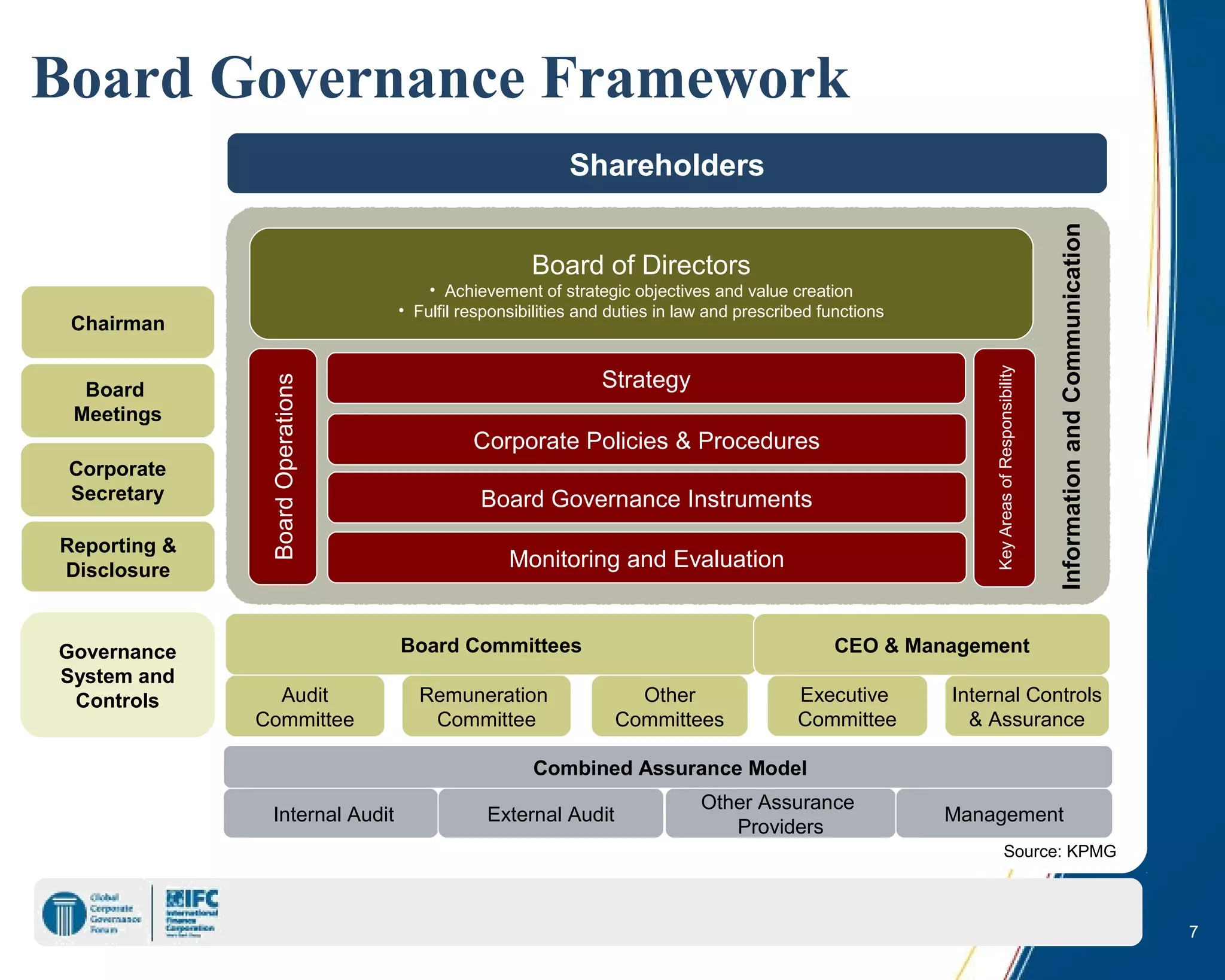
Audit
Committee
Remuneration
Committee
Other
Committees
Board Committees
Strategy
Board of Directors
• Achievement of strategic objectives and value creation
• Fulfil responsibilities and duties in law and prescribed functions
BoardOperations
Chairman
Board
Meetings
Reporting &
Disclosure
Internal Controls
& Assurance
Executive
Committee
Internal Audit External Audit
Other Assurance
Providers
Management
Combined Assurance Model
Governance
System and
Controls
Corporate Policies & Procedures
Board Governance Instruments
Monitoring and Evaluation
KeyAreasofResponsibility
CEO & Management
Shareholders
InformationandCommunication
Corporate
Secretary
Source: KPMG
Board Governance Framework
8
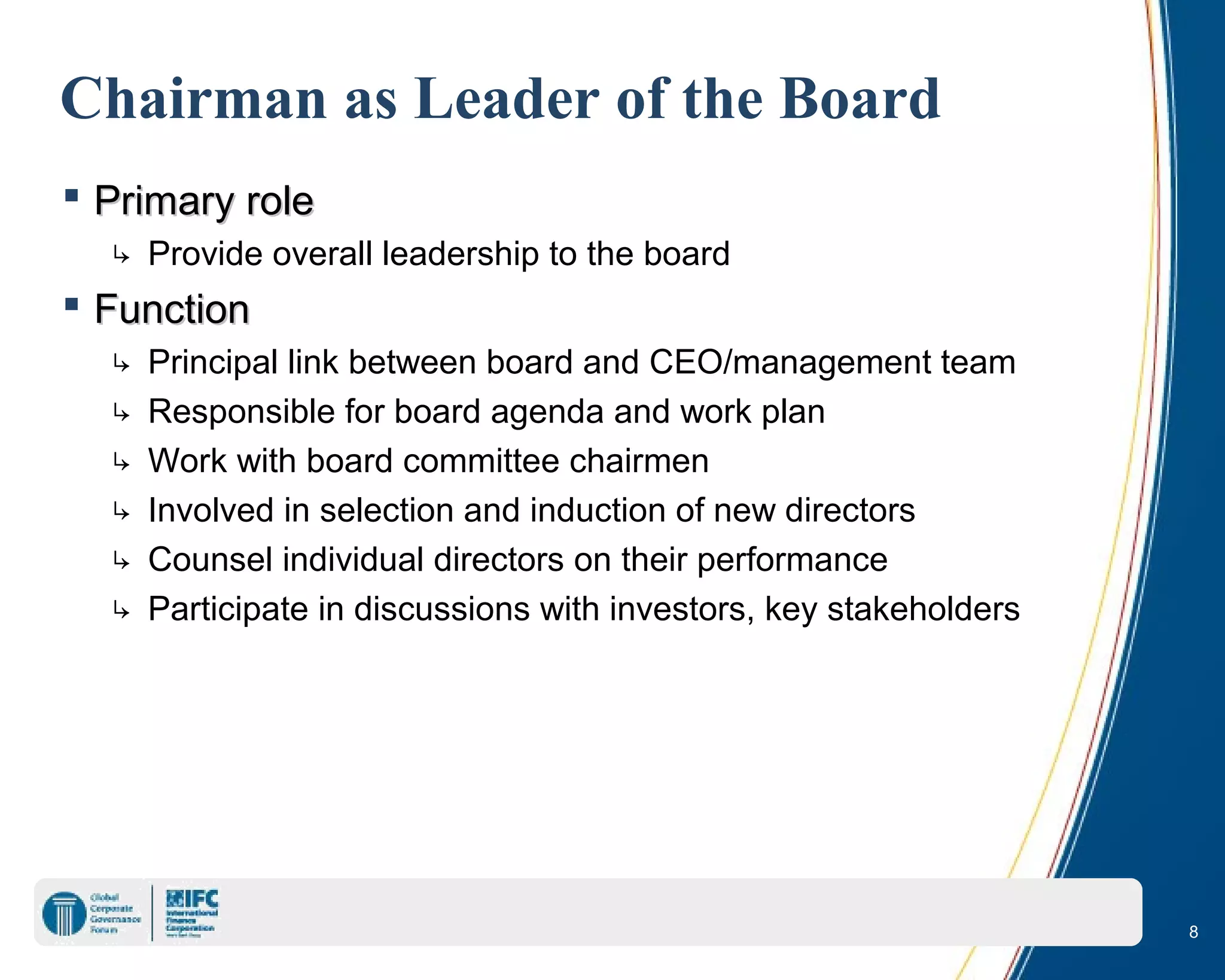
Chairman as Leader of the Board
 Primary rolePrimary role
↳ Provide overall leadership to the board
 FunctionFunction
↳ Principal link between board and CEO/management team
↳ Responsible for board agenda and work plan
↳ Work with board committee chairmen
↳ Involved in selection and induction of new directors
↳ Counsel individual directors on their performance
↳ Participate in discussions with investors, key stakeholders
9
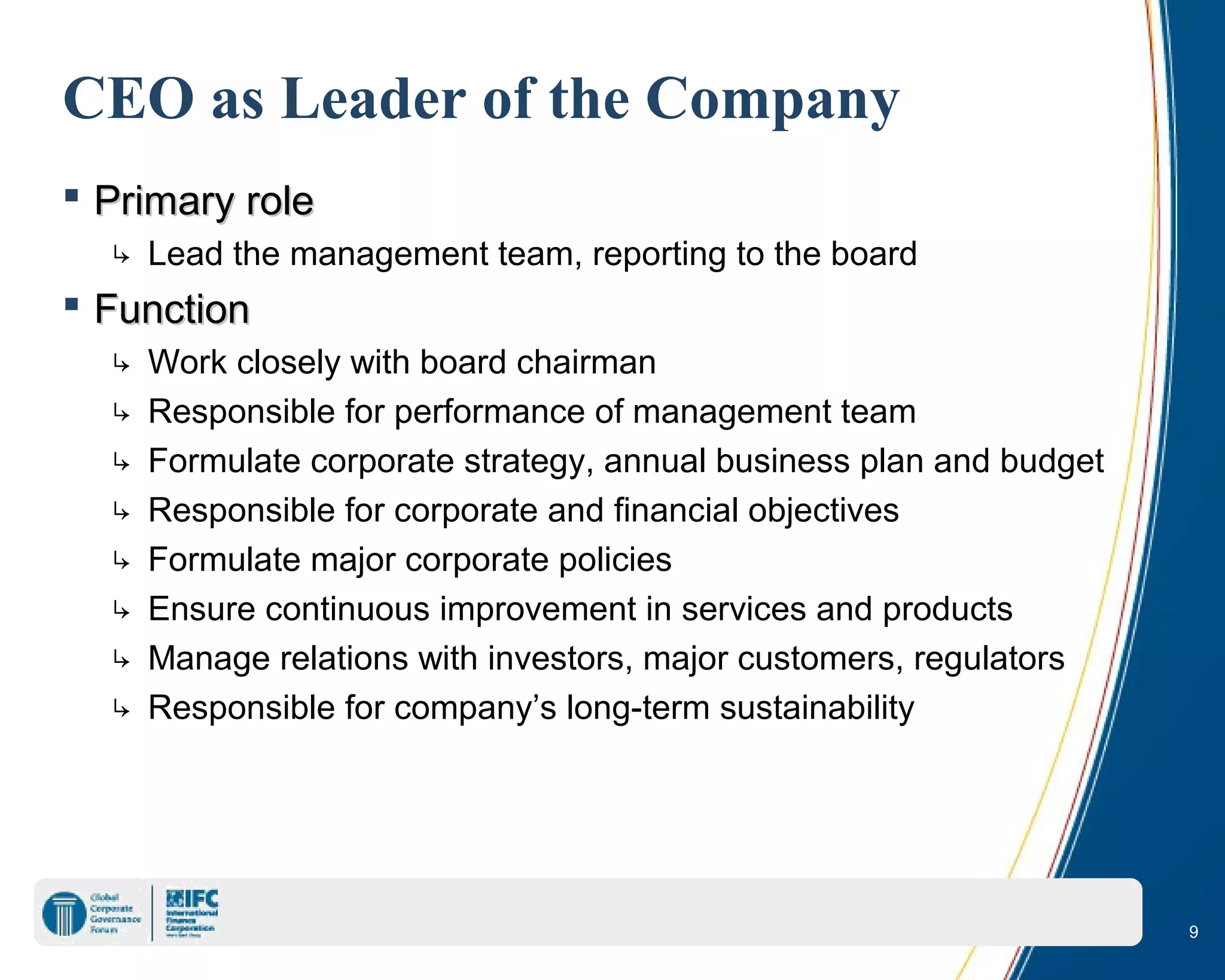
CEO as Leader of the Company
 Primary rolePrimary role
↳ Lead the management team, reporting to the board
 FunctionFunction
↳ Work closely with board chairman
↳ Responsible for performance of management team
↳ Formulate corporate strategy, annual business plan and budget
↳ Responsible for corporate and financial objectives
↳ Formulate major corporate policies
↳ Ensure continuous improvement in services and products
↳ Manage relations with investors, major customers, regulators
↳ Responsible for company’s long-term sustainability
10
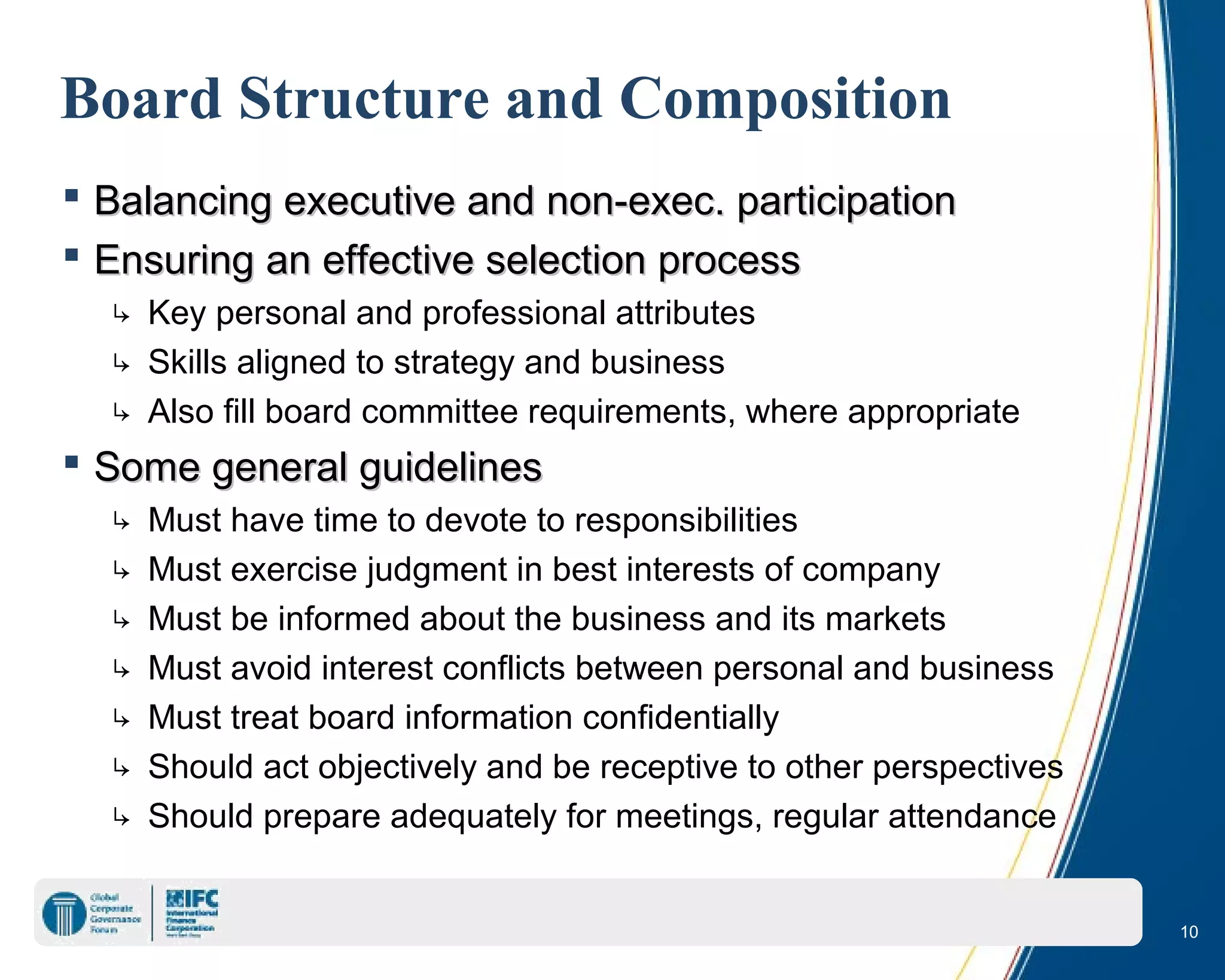
Board Structure and Composition
 Balancing executive and non-exec. participationBalancing executive and non-exec. participation
 Ensuring an effective selection processEnsuring an effective selection process
↳ Key personal and professional attributes
↳ Skills aligned to strategy and business
↳ Also fill board committee requirements, where appropriate
 Some general guidelinesSome general guidelines
↳ Must have time to devote to responsibilities
↳ Must exercise judgment in best interests of company
↳ Must be informed about the business and its markets
↳ Must avoid interest conflicts between personal and business
↳ Must treat board information confidentially
↳ Should act objectively and be receptive to other perspectives
↳ Should prepare adequately for meetings, regular attendance
11
Common Legal Principles of Directorship
 Exercise reasonable standard of careExercise reasonable standard of care
↳ Special business acumen or expertise not necessarily required
↳ Not necessarily liable for errors of judgment
↳ Given events following financial crisis, will this change?
 Duty to act in best interests of the companyDuty to act in best interests of the company
↳ In other words, for ALL shareholders, not special interests
““The legal framework and company charters should not permitThe legal framework and company charters should not permit
practices (such as “pre-meetings” and instructions on how to votepractices (such as “pre-meetings” and instructions on how to vote
by shareholders whose votes placed a director on the board)by shareholders whose votes placed a director on the board)
wherein shareholders may limit the ability of directors to exercisewherein shareholders may limit the ability of directors to exercise
their duties to act in the best interest of the company and alltheir duties to act in the best interest of the company and all
shareholders.”shareholders.”
Paragraph 90, OECD’s White Paper onParagraph 90, OECD’s White Paper on
Corporate Governance in Latin AmericaCorporate Governance in Latin America
12
Benefits of Effective Board Committees
 Assist the board in its decision makingAssist the board in its decision making
↳ Brings together non-executives and management
↳ Allows detailed discussion on management matters
↳ But, filters out operational issues that remain with management
↳ And, focuses on strategic decisions required of the board
 Supports board responsibilities in key areasSupports board responsibilities in key areas
↳ Audit, internal controls and risk
↳ Executive compensation and management appointments
↳ Governance issues and corporate policies
↳ Nomination and selection of non-executive directors
↳ Others, e.g. health, safety, environment, etc.
 Defined terms of reference and limitationsDefined terms of reference and limitations
 Generally, no executive powersGenerally, no executive powers
13
Instruments to Enhance Effectiveness
 Board Charter setting out procedural rulesBoard Charter setting out procedural rules
↳ Clarifies leadership roles and core responsibilities
↳ Reserves matters specifically reserved to board
↳ Sets management delegations and reporting arrangements
 Comprehensive induction for new directorsComprehensive induction for new directors
↳ Legal and regulatory obligations
↳ Financial structure of business, budgets and KPIs
↳ Understanding of strategic priorities and current status
↳ Familiarize with business operations, e.g. site visits
 Annual board work planAnnual board work plan
↳ Meetings and budget cycle, annual reporting
 Code of ethics or statement of business principlesCode of ethics or statement of business principles
↳ Defines corporate values and conduct of staff and directors
14
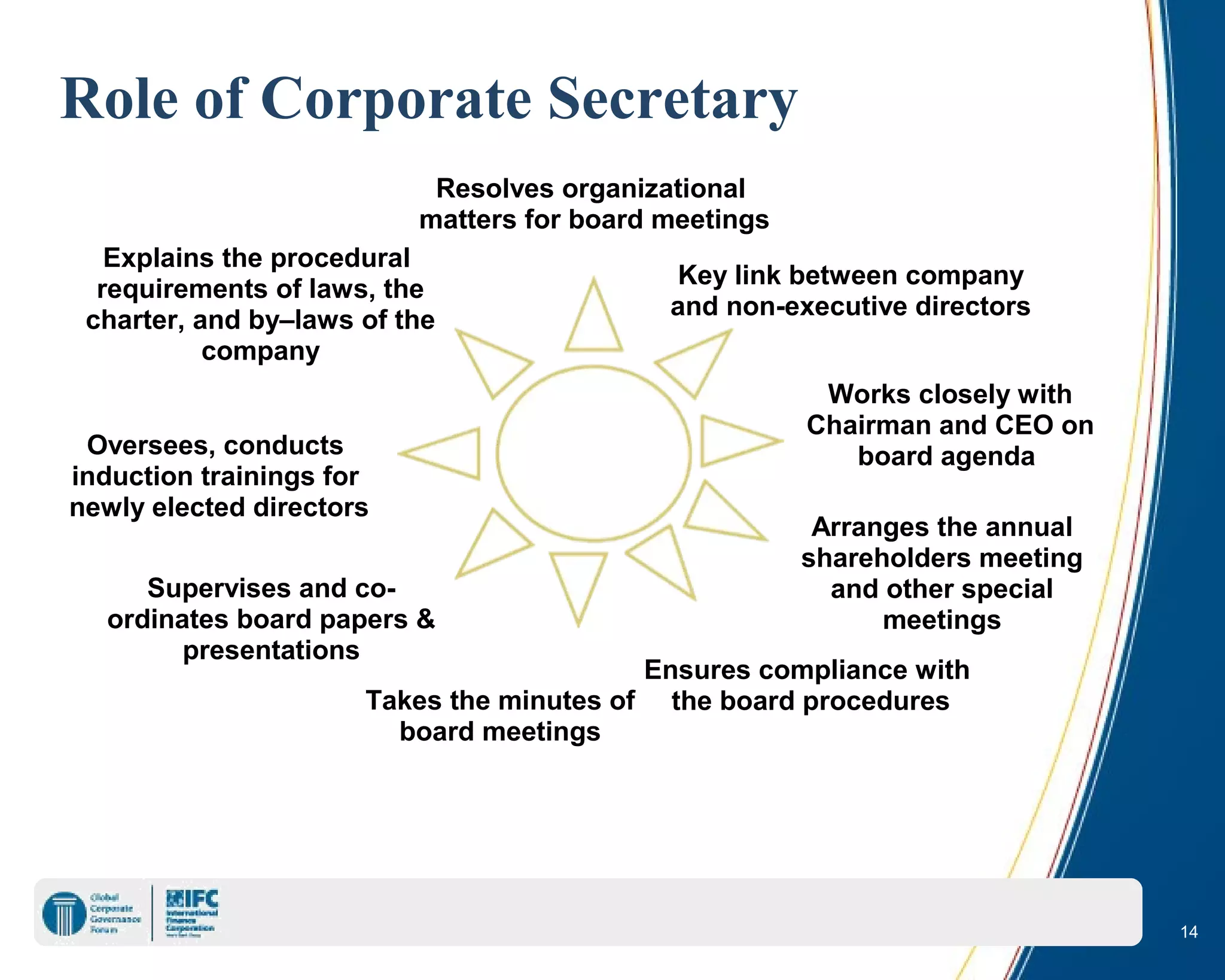
Role of Corporate Secretary
Supervises and co-
ordinates board papers &
presentations
Takes the minutes of
board meetings
Resolves organizational
matters for board meetings
Works closely with
Chairman and CEO on
board agenda
Arranges the annual
shareholders meeting
and other special
meetings
Ensures compliance with
the board procedures
Oversees, conducts
induction trainings for
newly elected directors
Explains the procedural
requirements of laws, the
charter, and by–laws of the
company
Key link between company
and non-executive directors
15
Board Role in Financial Oversight
 Duty to maintain proper accounting recordsDuty to maintain proper accounting records
 Periodic reporting of financial position, performancePeriodic reporting of financial position, performance
 Establishing, monitoring proper internal controlsEstablishing, monitoring proper internal controls
 Ensuring proper external controls and auditEnsuring proper external controls and audit
 Skills, knowledge required by directorsSkills, knowledge required by directors
16
Board’s Role in Risk Management
 The board should know about and evaluate the:The board should know about and evaluate the:
↳ Most significant risks facing the company
↳ Possible effects on shareowners
↳ Company’s management of a crisis
↳ Importance of stakeholder confidence in the organization
↳ Communications with the investment community
 The board should ensure that:The board should ensure that:
↳ Sufficient time is devoted to discuss risk strategy
↳ Appropriate levels of awareness exist throughout the company
↳ Risk-management processes work effectively
↳ A clear risk-management policy is published
17
Not an easy task - Identified Risks
 StrategicStrategic
↳ Unfocused strategy
↳ Strategy not aligned with capabilities
↳ Complacency arising from past success
↳ Unsuccessful acquisition/abortive bid
↳ Failure to manage major changes
↳ Reputational risk
↳ Loss of investors’ confidence
↳ Political/general economic risk
 PeoplePeople
↳ Management leadership weak
↳ Inadequate succession planning
↳ Loss of key executives
↳ Poor employee motivation
↳ Internal communication weaknesses
 MarketplaceMarketplace
↳ Failure to respond to market trends
↳ Missed opportunities – new tech., global markets
↳ Weak or obselete brands
↳ Over-reliance on a few customers
↳ Poor customer satisfaction – quality/timeliness
 EthicalEthical
↳ Failure to enact high standards of ethics
↳ Obtaining contracts unethically
↳ Stakeholder concerns on products/business
probity – poor community relations
 Suppliers/OutsourcersSuppliers/Outsourcers
↳ Over-dependence on suppliers/outsourcers
↳ Failure to manage cost/quality of outsourced
service
↳ Supply chain problems
↳ Joint ventures, strategic alliances not working
 FinancialFinancial
↳ Cash flow/going concern problems
↳ Treasury operations risk
↳ Susceptibility to fraud/accounting irregularities
 Legal/ComplianceLegal/Compliance
↳ Failure to protect intellectual property
↳ Health, safety, environmental issues
↳ Litigation risk
↳ Breach of competition, corporate,
employee, tax laws
18
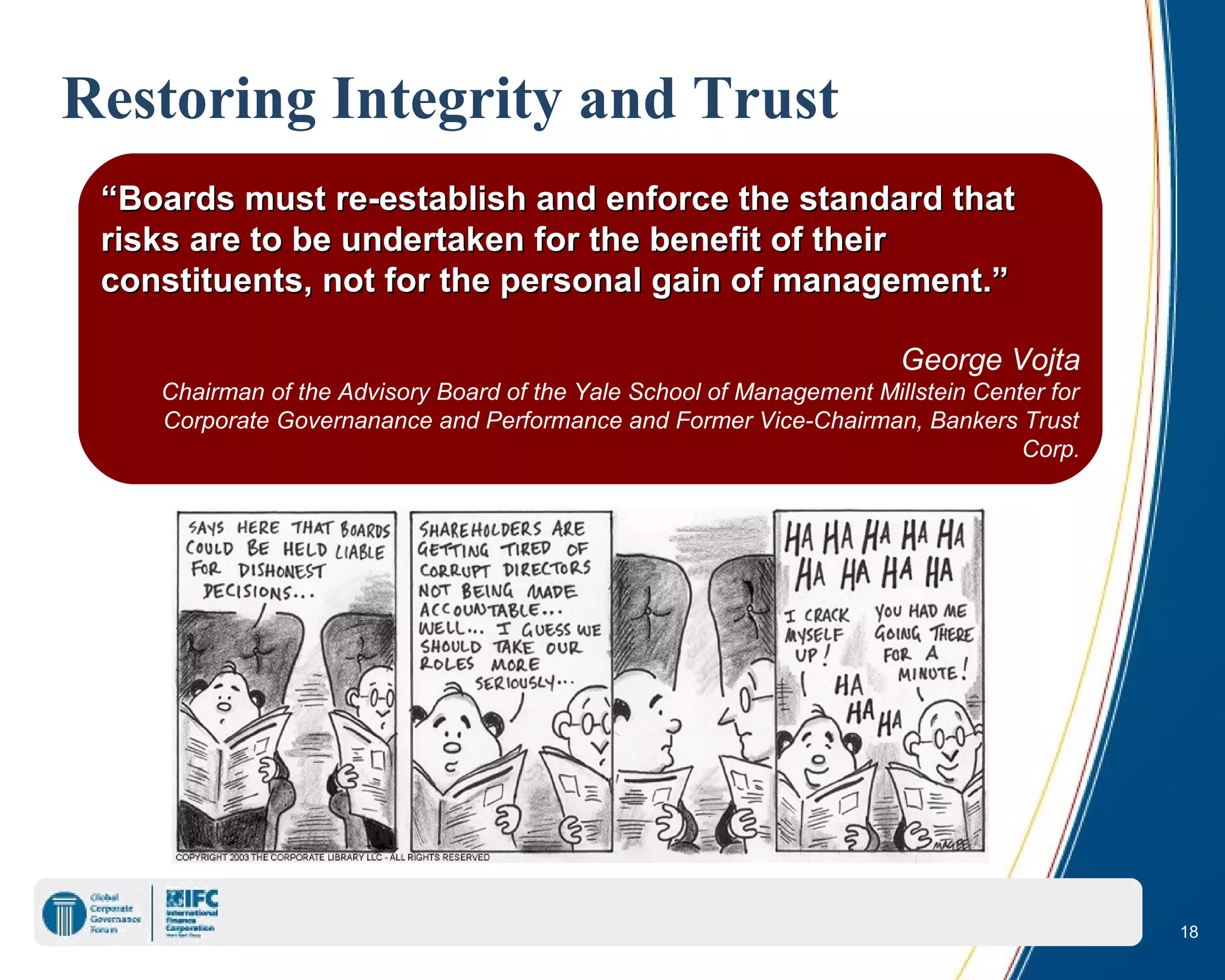
““Boards must re-establish and enforce the standard thatBoards must re-establish and enforce the standard that
risks are to be undertaken for the benefit of theirrisks are to be undertaken for the benefit of their
constituents, not for the personal gain of management.”constituents, not for the personal gain of management.”
George Vojta
Chairman of the Advisory Board of the Yale School of Management Millstein Center for
Corporate Governanance and Performance and Former Vice-Chairman, Bankers Trust
Corp.
Restoring Integrity and Trust
19
Six Critical Questions for Directors!
 Do I believe I have all theDo I believe I have all the informationinformation??
 Have I the necessaryHave I the necessary skillsskills to make this decision?to make this decision?
 Do I have anyDo I have any conflictconflict in this matter?in this matter?
 Objectively, is this aObjectively, is this a rational business decisionrational business decision??
 Can I explain this in aCan I explain this in a transparenttransparent manner?manner?
 Is it aIs it a responsible dischargeresponsible discharge of my duties?of my duties?
MCI’S GUIDING PRINCIPLESMCI’S GUIDING PRINCIPLES
Build Trust and Credibility!Build Trust and Credibility!
↳Respect for the Individual
↳Create a Culture of
Openness and Honesty
↳Set the Tone at the Top
Uphold the Law!Uphold the Law!
↳Avoid Conflicts of Interest
↳Set Metrics and Report
Results Accurately
Do the Right Thing!Do the Right Thing!
↳Promote Substance over
Form
↳Be Loyal to your Company,
your Family, yourself
Philip ArmstrongPhilip Armstrong
Global Corporate Governance ForumGlobal Corporate Governance Forum
Telephone +1 202 458 9114Telephone +1 202 458 9114
parmstrong@ifc.orgparmstrong@ifc.org
www.gcgf.orgwww.gcgf.org
Thank You!Thank You!
20

Board of Directors Presentation

  • 1.
    Better Companies, Better Societies GlobalCorporate Governance ForumGlobal Corporate Governance Forum Role of Board of Directors in Corporate Governance Financial Media Workshop Chile, January 2010 1
  • 2.
    Outline of Presentation What is Corporate Governance?What is Corporate Governance?  Building effective Board GovernanceBuilding effective Board Governance  The different roles related to the BoardThe different roles related to the Board  Some Concluding Thoughts!Some Concluding Thoughts! 2
  • 3.
    3 What is CorporateGovernance? Corporate Governance is a mechanism through which boards andboards and directorsdirectors are able to direct, monitor and supervise the conduct and operation of the corporation and its management in a manner that ensures appropriate levels of authority, accountability, stewardship, leadershipleadership, direction and control. ““The importance ofThe importance of corporate governancecorporate governance lies in its contributionlies in its contribution both to businessboth to business prosperity and toprosperity and to accountability.”accountability.” Paragraph 1.1, Committee on Corporate Governance: Final Report Hampel Committee ““Corporate governance is concerned withCorporate governance is concerned with holding the balance between economic andholding the balance between economic and social goals and between individual andsocial goals and between individual and communal goals…… The aim is to align ascommunal goals…… The aim is to align as nearly as possible the interests ofnearly as possible the interests of individuals, corporations and society.”individuals, corporations and society.” Sir Adrian Cadbury Corporate Governance Overview, 1999 [World Bank Report]
  • 4.
    4 It’s about Leadership………! Leadership for efficiency……Leadership for efficiency…… ↳to compete in the global economy, create jobs  Leadership for probityLeadership for probity (honradez, rectitud)(honradez, rectitud)…..….. ↳because investors require confidence ↳to provide assurance of management's integrity  Leadership with responsibility….Leadership with responsibility…. ↳to take account of broader stakeholder interests  Leadership that is accountable and transparentLeadership that is accountable and transparent ↳to build trust in companies and in the economy!!
  • 5.
    5 Building Effective BoardGovernance  Defining key board rolesDefining key board roles ↳ Board Chairman ↳ Chief Executive Officer ↳ Board Directors - executive and non-executive  Putting in place board governance arrangementsPutting in place board governance arrangements ↳ Board committees to support decision process ↳ Supporting functions to regulate processes ↳ Board procedures and rules, e.g. conflicts of interest ↳ Delegated authorities for management  Ensuring proper oversight and supervisionEnsuring proper oversight and supervision ↳ Management reporting and public disclosures ↳ Assurance processes and controls
  • 6.
    6 The Board ofDirectors is Pivotal ““The board should exercise compelling and relentlessThe board should exercise compelling and relentless leadershipleadership and should not underestimate the power ofand should not underestimate the power of leading by example - evidenced by high levels of visibilityleading by example - evidenced by high levels of visibility and integrity, strong communications, and demandingand integrity, strong communications, and demanding expectations. This leadership should be clear to ALL withinexpectations. This leadership should be clear to ALL within the organization, as well as shareholdersthe organization, as well as shareholders (accionistas)(accionistas) and otherand other stakeholdersstakeholders (grupos de(grupos de interésinterés)).”.” Boardroom BehavioursBoardroom Behaviours A report prepared for Sir David WalkerA report prepared for Sir David Walker by the Institute of Chartered Secretaries and Administrators , UKby the Institute of Chartered Secretaries and Administrators , UK June 2009June 2009
  • 7.
    7 Audit Committee Remuneration Committee Other Committees Board Committees Strategy Board ofDirectors • Achievement of strategic objectives and value creation • Fulfil responsibilities and duties in law and prescribed functions BoardOperations Chairman Board Meetings Reporting & Disclosure Internal Controls & Assurance Executive Committee Internal Audit External Audit Other Assurance Providers Management Combined Assurance Model Governance System and Controls Corporate Policies & Procedures Board Governance Instruments Monitoring and Evaluation KeyAreasofResponsibility CEO & Management Shareholders InformationandCommunication Corporate Secretary Source: KPMG Board Governance Framework
  • 8.
    8 Chairman as Leaderof the Board  Primary rolePrimary role ↳ Provide overall leadership to the board  FunctionFunction ↳ Principal link between board and CEO/management team ↳ Responsible for board agenda and work plan ↳ Work with board committee chairmen ↳ Involved in selection and induction of new directors ↳ Counsel individual directors on their performance ↳ Participate in discussions with investors, key stakeholders
  • 9.
    9 CEO as Leaderof the Company  Primary rolePrimary role ↳ Lead the management team, reporting to the board  FunctionFunction ↳ Work closely with board chairman ↳ Responsible for performance of management team ↳ Formulate corporate strategy, annual business plan and budget ↳ Responsible for corporate and financial objectives ↳ Formulate major corporate policies ↳ Ensure continuous improvement in services and products ↳ Manage relations with investors, major customers, regulators ↳ Responsible for company’s long-term sustainability
  • 10.
    10 Board Structure andComposition  Balancing executive and non-exec. participationBalancing executive and non-exec. participation  Ensuring an effective selection processEnsuring an effective selection process ↳ Key personal and professional attributes ↳ Skills aligned to strategy and business ↳ Also fill board committee requirements, where appropriate  Some general guidelinesSome general guidelines ↳ Must have time to devote to responsibilities ↳ Must exercise judgment in best interests of company ↳ Must be informed about the business and its markets ↳ Must avoid interest conflicts between personal and business ↳ Must treat board information confidentially ↳ Should act objectively and be receptive to other perspectives ↳ Should prepare adequately for meetings, regular attendance
  • 11.
    11 Common Legal Principlesof Directorship  Exercise reasonable standard of careExercise reasonable standard of care ↳ Special business acumen or expertise not necessarily required ↳ Not necessarily liable for errors of judgment ↳ Given events following financial crisis, will this change?  Duty to act in best interests of the companyDuty to act in best interests of the company ↳ In other words, for ALL shareholders, not special interests ““The legal framework and company charters should not permitThe legal framework and company charters should not permit practices (such as “pre-meetings” and instructions on how to votepractices (such as “pre-meetings” and instructions on how to vote by shareholders whose votes placed a director on the board)by shareholders whose votes placed a director on the board) wherein shareholders may limit the ability of directors to exercisewherein shareholders may limit the ability of directors to exercise their duties to act in the best interest of the company and alltheir duties to act in the best interest of the company and all shareholders.”shareholders.” Paragraph 90, OECD’s White Paper onParagraph 90, OECD’s White Paper on Corporate Governance in Latin AmericaCorporate Governance in Latin America
  • 12.
    12 Benefits of EffectiveBoard Committees  Assist the board in its decision makingAssist the board in its decision making ↳ Brings together non-executives and management ↳ Allows detailed discussion on management matters ↳ But, filters out operational issues that remain with management ↳ And, focuses on strategic decisions required of the board  Supports board responsibilities in key areasSupports board responsibilities in key areas ↳ Audit, internal controls and risk ↳ Executive compensation and management appointments ↳ Governance issues and corporate policies ↳ Nomination and selection of non-executive directors ↳ Others, e.g. health, safety, environment, etc.  Defined terms of reference and limitationsDefined terms of reference and limitations  Generally, no executive powersGenerally, no executive powers
  • 13.
    13 Instruments to EnhanceEffectiveness  Board Charter setting out procedural rulesBoard Charter setting out procedural rules ↳ Clarifies leadership roles and core responsibilities ↳ Reserves matters specifically reserved to board ↳ Sets management delegations and reporting arrangements  Comprehensive induction for new directorsComprehensive induction for new directors ↳ Legal and regulatory obligations ↳ Financial structure of business, budgets and KPIs ↳ Understanding of strategic priorities and current status ↳ Familiarize with business operations, e.g. site visits  Annual board work planAnnual board work plan ↳ Meetings and budget cycle, annual reporting  Code of ethics or statement of business principlesCode of ethics or statement of business principles ↳ Defines corporate values and conduct of staff and directors
  • 14.
    14 Role of CorporateSecretary Supervises and co- ordinates board papers & presentations Takes the minutes of board meetings Resolves organizational matters for board meetings Works closely with Chairman and CEO on board agenda Arranges the annual shareholders meeting and other special meetings Ensures compliance with the board procedures Oversees, conducts induction trainings for newly elected directors Explains the procedural requirements of laws, the charter, and by–laws of the company Key link between company and non-executive directors
  • 15.
    15 Board Role inFinancial Oversight  Duty to maintain proper accounting recordsDuty to maintain proper accounting records  Periodic reporting of financial position, performancePeriodic reporting of financial position, performance  Establishing, monitoring proper internal controlsEstablishing, monitoring proper internal controls  Ensuring proper external controls and auditEnsuring proper external controls and audit  Skills, knowledge required by directorsSkills, knowledge required by directors
  • 16.
    16 Board’s Role inRisk Management  The board should know about and evaluate the:The board should know about and evaluate the: ↳ Most significant risks facing the company ↳ Possible effects on shareowners ↳ Company’s management of a crisis ↳ Importance of stakeholder confidence in the organization ↳ Communications with the investment community  The board should ensure that:The board should ensure that: ↳ Sufficient time is devoted to discuss risk strategy ↳ Appropriate levels of awareness exist throughout the company ↳ Risk-management processes work effectively ↳ A clear risk-management policy is published
  • 17.
    17 Not an easytask - Identified Risks  StrategicStrategic ↳ Unfocused strategy ↳ Strategy not aligned with capabilities ↳ Complacency arising from past success ↳ Unsuccessful acquisition/abortive bid ↳ Failure to manage major changes ↳ Reputational risk ↳ Loss of investors’ confidence ↳ Political/general economic risk  PeoplePeople ↳ Management leadership weak ↳ Inadequate succession planning ↳ Loss of key executives ↳ Poor employee motivation ↳ Internal communication weaknesses  MarketplaceMarketplace ↳ Failure to respond to market trends ↳ Missed opportunities – new tech., global markets ↳ Weak or obselete brands ↳ Over-reliance on a few customers ↳ Poor customer satisfaction – quality/timeliness  EthicalEthical ↳ Failure to enact high standards of ethics ↳ Obtaining contracts unethically ↳ Stakeholder concerns on products/business probity – poor community relations  Suppliers/OutsourcersSuppliers/Outsourcers ↳ Over-dependence on suppliers/outsourcers ↳ Failure to manage cost/quality of outsourced service ↳ Supply chain problems ↳ Joint ventures, strategic alliances not working  FinancialFinancial ↳ Cash flow/going concern problems ↳ Treasury operations risk ↳ Susceptibility to fraud/accounting irregularities  Legal/ComplianceLegal/Compliance ↳ Failure to protect intellectual property ↳ Health, safety, environmental issues ↳ Litigation risk ↳ Breach of competition, corporate, employee, tax laws
  • 18.
    18 ““Boards must re-establishand enforce the standard thatBoards must re-establish and enforce the standard that risks are to be undertaken for the benefit of theirrisks are to be undertaken for the benefit of their constituents, not for the personal gain of management.”constituents, not for the personal gain of management.” George Vojta Chairman of the Advisory Board of the Yale School of Management Millstein Center for Corporate Governanance and Performance and Former Vice-Chairman, Bankers Trust Corp. Restoring Integrity and Trust
  • 19.
    19 Six Critical Questionsfor Directors!  Do I believe I have all theDo I believe I have all the informationinformation??  Have I the necessaryHave I the necessary skillsskills to make this decision?to make this decision?  Do I have anyDo I have any conflictconflict in this matter?in this matter?  Objectively, is this aObjectively, is this a rational business decisionrational business decision??  Can I explain this in aCan I explain this in a transparenttransparent manner?manner?  Is it aIs it a responsible dischargeresponsible discharge of my duties?of my duties?
  • 20.
    MCI’S GUIDING PRINCIPLESMCI’SGUIDING PRINCIPLES Build Trust and Credibility!Build Trust and Credibility! ↳Respect for the Individual ↳Create a Culture of Openness and Honesty ↳Set the Tone at the Top Uphold the Law!Uphold the Law! ↳Avoid Conflicts of Interest ↳Set Metrics and Report Results Accurately Do the Right Thing!Do the Right Thing! ↳Promote Substance over Form ↳Be Loyal to your Company, your Family, yourself Philip ArmstrongPhilip Armstrong Global Corporate Governance ForumGlobal Corporate Governance Forum Telephone +1 202 458 9114Telephone +1 202 458 9114 parmstrong@ifc.orgparmstrong@ifc.org www.gcgf.orgwww.gcgf.org Thank You!Thank You! 20