How CEOs can use Accountability Boards and Subject Matter Experts to help and support their organization to perform and grow. 
Peter F. DiGiammarino 
Renaissance Executive Forum 
October 21, 2014 
Copyright 2014 IntelliVen, LLC and Peter F. DiGiammarino. All rights reserved. Quotation, reproduction or transmission is prohibited without written permission from IntelliVen, LLC and Peter F. DiGiammarino
3 
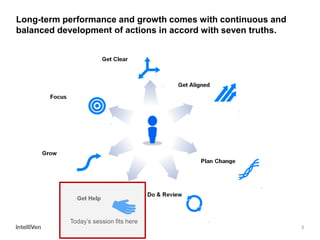
Long-term performance and growth comes with continuous and balanced development of actions in accord with seven truths. 
Today’s session fits here
Get Help 
Truth. No leader succeeds alone. 
Build a board. Retain experts. Get a coach. 
Action.
5 
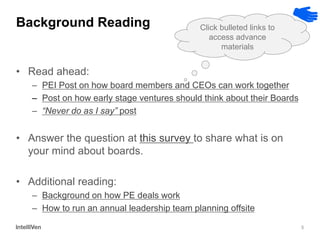
Background Reading 
•Read ahead: 
–PEI Post on how board members and CEOs can work together 
–Post on how early stage ventures should think about their Boards 
–“Never do as I say” post 
•Answer the question at this survey to share what is on your mind about boards. 
•Additional reading: 
–Background on how PE deals work 
–How to run an annual leadership team planning offsite 
Click bulleted links to access advance materials
Think of a specific high-stakes situation that called for action when you were in the role of leader. Summarize what happened. List what you could have done to increase the odds of better results.
7 
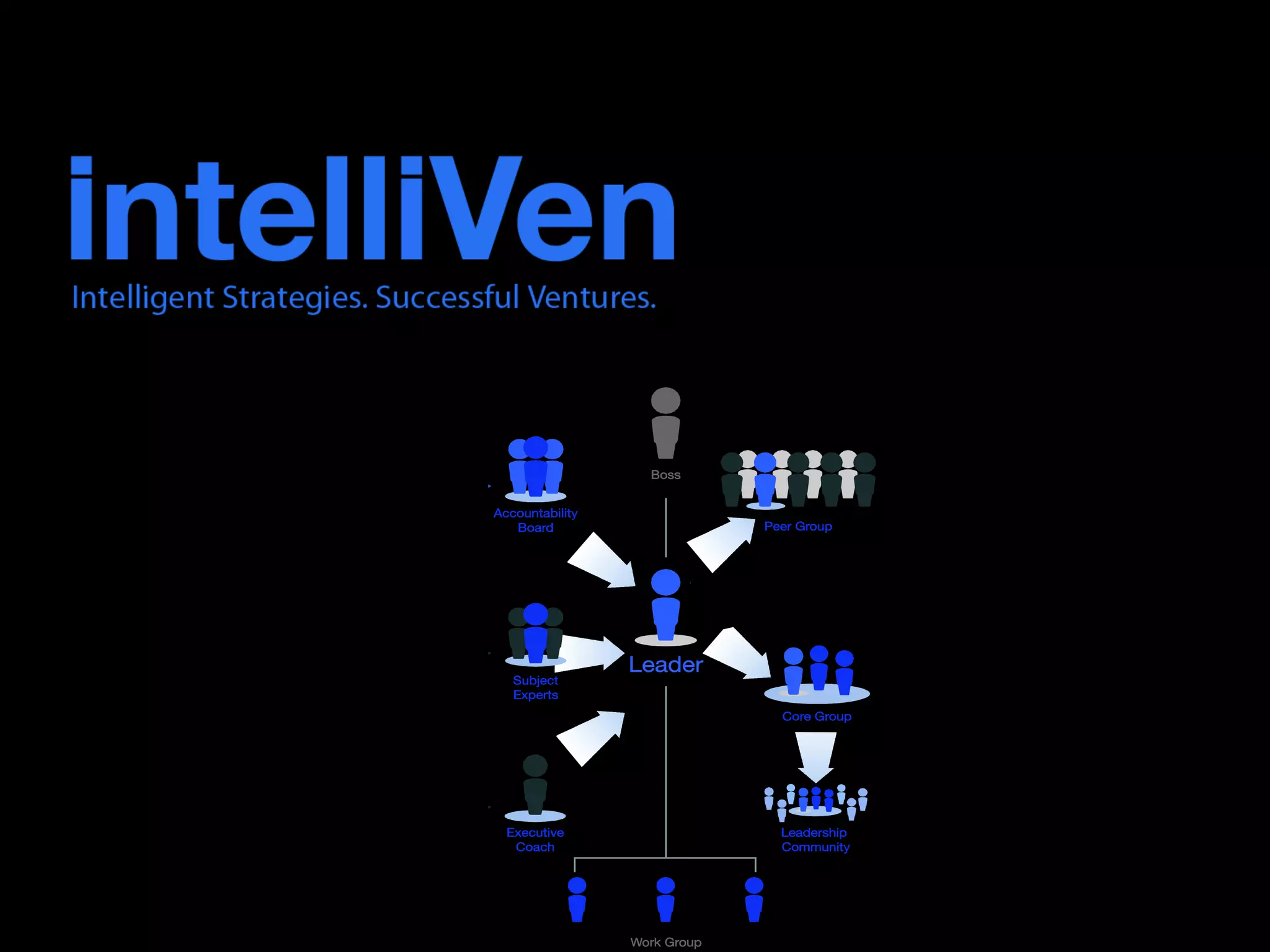
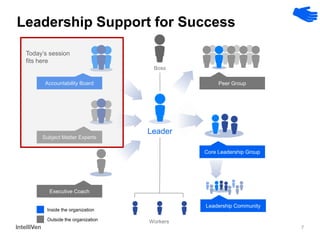
Leadership Support for Success 
Boss 
Leader 
Workers 
Subject Matter Experts 
Accountability Board 
Executive Coach 
Inside the organization 
Outside the organization 
Peer Group 
Core Leadership Group 
Leadership Community 
Today’s session 
fits here
8 
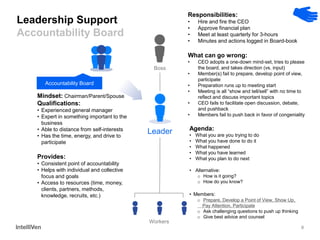
Leadership Support Accountability Board 
Boss 
Leader 
Workers 
Accountability Board 
Mindset: Chairman/Parent/Spouse Qualifications: 
•Experienced general manager 
•Expert in something important to the business 
•Able to distance from self-interests 
•Has the time, energy, and drive to participate Provides: 
•Consistent point of accountability 
•Helps with individual and collective focus and goals 
•Access to resources (time, money, clients, partners, methods, knowledge, recruits, etc.) 
Agenda: 
•What you are you trying to do 
•What you have done to do it 
•What happened 
•What you have learned 
•What you plan to do next 
•Alternative: 
oHow is it going? 
oHow do you know? 
•Members: 
oPrepare, Develop a Point of View, Show Up, Pay Attention, Participate 
oAsk challenging questions to push up thinking 
oGive best advice and counsel 
Responsibilities: 
•Hire and fire the CEO 
•Approve financial plan 
•Meet at least quarterly for 3-hours 
•Minutes and actions logged in Board-book What can go wrong: 
•CEO adopts a one-down mind-set, tries to please the board, and takes direction (vs. input) 
•Member(s) fail to prepare, develop point of view, participate 
•Preparation runs up to meeting start 
•Meeting is all “show and tell/sell” with no time to reflect and discuss important topics 
•CEO fails to facilitate open discussion, debate, and pushback 
•Members fail to push back in favor of congeniality
9 
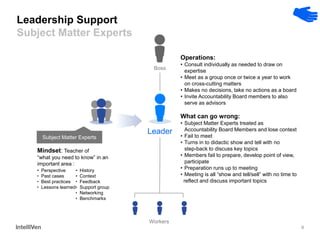
Leadership Support Subject Matter Experts 
Boss 
Leader 
Workers 
Subject Matter Experts 
•History 
•Context 
•Feedback 
•Support group 
•Networking 
•Benchmarks 
Mindset: Teacher of “what you need to know” in an important area : 
•Perspective 
•Past cases 
•Best practices 
•Lessons learned 
Operations: 
•Consult individually as needed to draw on expertise 
•Meet as a group once or twice a year to work on cross-cutting matters 
•Makes no decisions, take no actions as a board 
•Invite Accountability Board members to also serve as advisors What can go wrong: 
•Subject Matter Experts treated as Accountability Board Members and lose context 
•Fail to meet 
•Turns in to didactic show and tell with no step-back to discuss key topics 
•Members fail to prepare, develop point of view, participate 
•Preparation runs up to meeting 
•Meeting is all “show and tell/sell” with no time to reflect and discuss important topics
10 
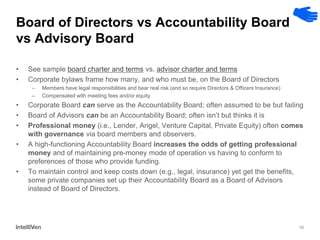
Board of Directors vs Accountability Board vs Advisory Board 
•See sample board charter and terms vs. advisor charter and terms 
•Corporate bylaws frame how many, and who must be, on the Board of Directors 
–Members have legal responsibilities and bear real risk (and so require Directors & Officers Insurance) 
–Compensated with meeting fees and/or equity 
•Corporate Board can serve as the Accountability Board; often assumed to be but failing 
•Board of Advisors can be an Accountability Board; often isn’t but thinks it is 
•Professional money (i.e., Lender, Angel, Venture Capital, Private Equity) often comes with governance via board members and observers. 
•A high-functioning Accountability Board increases the odds of getting professional money and of maintaining pre-money mode of operation vs having to conform to preferences of those who provide funding. 
•To maintain control and keep costs down (e.g., legal, insurance) yet get the benefits, some private companies set up their Accountability Board as a Board of Advisors instead of Board of Directors.
11 
Accountability Board Management Best Practices 
•CEOs job is to manage organization resources to maximum effect; the board is a resource…use it! 
–Know what is wanted from each member; ask each for it; give feedback 
–Ask the board and each member what they can do to help…then invite him/her to do it. 
–At least annually survey/discuss to assess how the board and each member is performing, what has gone well and what can be done to improve; act accordingly 
•Maintain a rolling-year schedule at locations convenient to the company. 
•Manage each meeting to accomplish what is needed; see sample board meeting artifacts; send out two days ahead of meeting. 
•End each meeting with executive session to cover sensitive matters; invite outside directors to meet alone to discuss how things are going with the CEO and his/her team. 
•Treat members with utmost respect but do not overdo deference 
–Stay in touch with each between meetings, in the way that works for him/her and you, to solicit input and to keep him/her apprised so as not to be blindsided, behind the curve, or cut out. 
–Let each know what is needed from him/her between, and in, each meeting.
12 
Accountability Board Membership Best Practices 
•Have ad hoc meetings/calls when needed to get out in front of emerging issues/opportunities but don’t make more of an issue than needed. 
•Keep the number of members as small as practicable to be more manageable. 
•Invite management team and others, with a bias towards inclusion, to the benefit of both attendees and members. 
•CEO manages the space between Board and Management; if CEO does not manage the Board it will either ignore or manage the CEO based on swings from apathy to fear and greed. 
•Build board thoughtfully as it is hard to unwind membership; use term/age limits and varying responsibilities to drive changes. 
•Where to find members: 
–Personal networking 
–Retained search 
–IntelliVen Executive Sessions (a.k.a.: Accountability Board-in-a-Box or Instant Accountability Board)
13 
Accountability Board Use committees to address specific needs 
•Required Standing Committees: 
–Audit 
–Compensation 
•Common Standing Committees: 
–Executive: Sets agenda for the full board 
–Governance/Nominating/Membership Committee: sets target board profile, assess current board, drives to achieve target profile and performance 
–Finance: for organizations with complex financial structure that not all board members need to be equally concerned with 
–Ethics/Compliance 
•Ad Hoc committees address specific matters that come up and sunset upon completion 
•Role of chair: 
–Pole members to set agenda ad to assess company, CEO, and board performance 
–Let members know ahead what each needs to expect and to do in upcoming meeting 
–Facilitate meetings; e.g., keep things moving and on track per schedule allowing to go off schedule when needed 
–Identify and head off problems between members 
–Drive board development
14 
Group Survey Questions 
•How you go about selecting members for an advisory board? 
•How do you determine compensation if any? 
•How best to set terms, ensure rotation, and ultimately remove members from a private company board? 
•Should Board members also having paid consulting assignments. 
•What are the pros and cons for having a board made up 50% of insiders?
15 
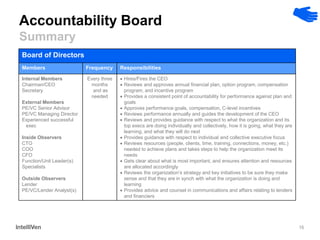
Board of Directors 
Members 
Frequency 
Responsibilities 
Internal Members 
Chairman/CEO 
Secretary 
External Members 
PE/VC Senior Advisor 
PE/VC Managing Director 
Experienced successful exec 
Inside Observers 
CTO 
COO 
CFO 
Function/Unit Leader(s) 
Specialists 
Outside Observers 
Lender 
PE/VC/Lender Analyst(s) 
Every three months 
and as needed 
Hires/Fires the CEO 
Reviews and approves annual financial plan, option program, compensation program, and incentive program 
Provides a consistent point of accountability for performance against plan and goals 
Approves performance goals, compensation, C-level incentives 
Reviews performance annually and guides the development of the CEO 
Reviews and provides guidance with respect to what the organization and its top execs are doing individually and collectively, how it is going, what they are learning, and what they will do next 
Provides guidance with respect to individual and collective executive focus 
Reviews resources (people, clients, time, training, connections, money, etc.) needed to achieve plans and takes steps to help the organization meet its needs 
Gets clear about what is most important, and ensures attention and resources are allocated accordingly 
Reviews the organization’s strategy and key initiatives to be sure they make sense and that they are in synch with what the organization is doing and learning 
Provides advice and counsel in communications and affairs relating to lenders and financiers 
Accountability Board Summary
16 
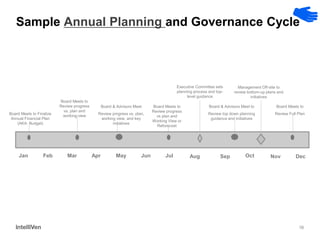
Board Meets to Finalize Annual Financial Plan (AKA: Budget) 
Board Meets to Review progress vs. plan and working view 
Board Meets to Review progress vs plan and Working View or Reforecast 
Board Meets to Review Full Plan 
Board & Advisors Meet Review progress vs. plan, working view, and key initiatives 
Board & Advisors Meet to Review top down planning guidance and initiatives 
Jan 
Mar 
Feb 
Sep 
Apr 
Aug 
Jul 
Jun 
Dec 
Nov 
Oct 
May 
Executive Committee sets planning process and top- level guidance 
Management Off-site to review bottom-up plans and initiatives 
Sample Annual Planning and Governance Cycle
Arrange an operating framework of outside support from an Accountability Board and Subject Matter Experts.
18 
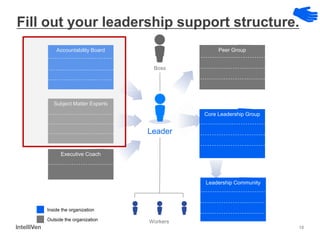
Fill out your leadership support structure. 
Boss 
Leader 
Workers 
Subject Matter Experts 
Accountability Board 
Executive Coach 
Inside the organization 
Outside the organization 
Peer Group 
Core Leadership Group 
Leadership Community
Wrap-up 
•Share an example of how your thinking has evolved from today’s session. 
•What did you notice when working with others on today’s topic?
20 
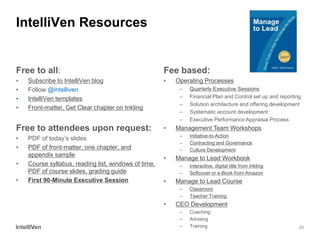
IntelliVen Resources 
Free to all: 
•Subscribe to IntelliVen blog 
•Follow @intelliven 
•IntelliVen templates 
•Front-matter, Get Clear chapter on Inkling 
Free to attendees upon request: 
•PDF of today’s slides 
•PDF of front-matter, one chapter, and appendix sample 
•Course syllabus, reading list, windows of time, PDF of course slides, grading guide 
•First 90-Minute Executive Session 
Fee based: 
•Operating Processes 
–Quarterly Executive Sessions 
–Financial Plan and Control set up and reporting 
–Solution architecture and offering development 
–Systematic account development 
–Executive Performance Appraisal Process 
•Management Team Workshops 
–Initiative-to-Action 
–Contracting and Governance 
–Culture Development 
•Manage to Lead Workbook 
–Interactive, digital title from Inkling 
–Softcover or e-Book from Amazon 
•Manage to Lead Course 
–Classroom 
–Teacher Training 
•CEO Development 
–Coaching 
–Advising 
–Training
Subscribe www.intelliven.com 
Follow @intelliven 
Thank you.

Manage to lead - board development and operations v2

  • 2.
    How CEOs canuse Accountability Boards and Subject Matter Experts to help and support their organization to perform and grow. Peter F. DiGiammarino Renaissance Executive Forum October 21, 2014 Copyright 2014 IntelliVen, LLC and Peter F. DiGiammarino. All rights reserved. Quotation, reproduction or transmission is prohibited without written permission from IntelliVen, LLC and Peter F. DiGiammarino
  • 3.
    3 Long-term performanceand growth comes with continuous and balanced development of actions in accord with seven truths. Today’s session fits here
  • 4.
    Get Help Truth.No leader succeeds alone. Build a board. Retain experts. Get a coach. Action.
  • 5.
    5 Background Reading •Read ahead: –PEI Post on how board members and CEOs can work together –Post on how early stage ventures should think about their Boards –“Never do as I say” post •Answer the question at this survey to share what is on your mind about boards. •Additional reading: –Background on how PE deals work –How to run an annual leadership team planning offsite Click bulleted links to access advance materials
  • 6.
    Think of aspecific high-stakes situation that called for action when you were in the role of leader. Summarize what happened. List what you could have done to increase the odds of better results.
  • 7.
    7 Leadership Supportfor Success Boss Leader Workers Subject Matter Experts Accountability Board Executive Coach Inside the organization Outside the organization Peer Group Core Leadership Group Leadership Community Today’s session fits here
  • 8.
    8 Leadership SupportAccountability Board Boss Leader Workers Accountability Board Mindset: Chairman/Parent/Spouse Qualifications: •Experienced general manager •Expert in something important to the business •Able to distance from self-interests •Has the time, energy, and drive to participate Provides: •Consistent point of accountability •Helps with individual and collective focus and goals •Access to resources (time, money, clients, partners, methods, knowledge, recruits, etc.) Agenda: •What you are you trying to do •What you have done to do it •What happened •What you have learned •What you plan to do next •Alternative: oHow is it going? oHow do you know? •Members: oPrepare, Develop a Point of View, Show Up, Pay Attention, Participate oAsk challenging questions to push up thinking oGive best advice and counsel Responsibilities: •Hire and fire the CEO •Approve financial plan •Meet at least quarterly for 3-hours •Minutes and actions logged in Board-book What can go wrong: •CEO adopts a one-down mind-set, tries to please the board, and takes direction (vs. input) •Member(s) fail to prepare, develop point of view, participate •Preparation runs up to meeting start •Meeting is all “show and tell/sell” with no time to reflect and discuss important topics •CEO fails to facilitate open discussion, debate, and pushback •Members fail to push back in favor of congeniality
  • 9.
    9 Leadership SupportSubject Matter Experts Boss Leader Workers Subject Matter Experts •History •Context •Feedback •Support group •Networking •Benchmarks Mindset: Teacher of “what you need to know” in an important area : •Perspective •Past cases •Best practices •Lessons learned Operations: •Consult individually as needed to draw on expertise •Meet as a group once or twice a year to work on cross-cutting matters •Makes no decisions, take no actions as a board •Invite Accountability Board members to also serve as advisors What can go wrong: •Subject Matter Experts treated as Accountability Board Members and lose context •Fail to meet •Turns in to didactic show and tell with no step-back to discuss key topics •Members fail to prepare, develop point of view, participate •Preparation runs up to meeting •Meeting is all “show and tell/sell” with no time to reflect and discuss important topics
  • 10.
    10 Board ofDirectors vs Accountability Board vs Advisory Board •See sample board charter and terms vs. advisor charter and terms •Corporate bylaws frame how many, and who must be, on the Board of Directors –Members have legal responsibilities and bear real risk (and so require Directors & Officers Insurance) –Compensated with meeting fees and/or equity •Corporate Board can serve as the Accountability Board; often assumed to be but failing •Board of Advisors can be an Accountability Board; often isn’t but thinks it is •Professional money (i.e., Lender, Angel, Venture Capital, Private Equity) often comes with governance via board members and observers. •A high-functioning Accountability Board increases the odds of getting professional money and of maintaining pre-money mode of operation vs having to conform to preferences of those who provide funding. •To maintain control and keep costs down (e.g., legal, insurance) yet get the benefits, some private companies set up their Accountability Board as a Board of Advisors instead of Board of Directors.
  • 11.
    11 Accountability BoardManagement Best Practices •CEOs job is to manage organization resources to maximum effect; the board is a resource…use it! –Know what is wanted from each member; ask each for it; give feedback –Ask the board and each member what they can do to help…then invite him/her to do it. –At least annually survey/discuss to assess how the board and each member is performing, what has gone well and what can be done to improve; act accordingly •Maintain a rolling-year schedule at locations convenient to the company. •Manage each meeting to accomplish what is needed; see sample board meeting artifacts; send out two days ahead of meeting. •End each meeting with executive session to cover sensitive matters; invite outside directors to meet alone to discuss how things are going with the CEO and his/her team. •Treat members with utmost respect but do not overdo deference –Stay in touch with each between meetings, in the way that works for him/her and you, to solicit input and to keep him/her apprised so as not to be blindsided, behind the curve, or cut out. –Let each know what is needed from him/her between, and in, each meeting.
  • 12.
    12 Accountability BoardMembership Best Practices •Have ad hoc meetings/calls when needed to get out in front of emerging issues/opportunities but don’t make more of an issue than needed. •Keep the number of members as small as practicable to be more manageable. •Invite management team and others, with a bias towards inclusion, to the benefit of both attendees and members. •CEO manages the space between Board and Management; if CEO does not manage the Board it will either ignore or manage the CEO based on swings from apathy to fear and greed. •Build board thoughtfully as it is hard to unwind membership; use term/age limits and varying responsibilities to drive changes. •Where to find members: –Personal networking –Retained search –IntelliVen Executive Sessions (a.k.a.: Accountability Board-in-a-Box or Instant Accountability Board)
  • 13.
    13 Accountability BoardUse committees to address specific needs •Required Standing Committees: –Audit –Compensation •Common Standing Committees: –Executive: Sets agenda for the full board –Governance/Nominating/Membership Committee: sets target board profile, assess current board, drives to achieve target profile and performance –Finance: for organizations with complex financial structure that not all board members need to be equally concerned with –Ethics/Compliance •Ad Hoc committees address specific matters that come up and sunset upon completion •Role of chair: –Pole members to set agenda ad to assess company, CEO, and board performance –Let members know ahead what each needs to expect and to do in upcoming meeting –Facilitate meetings; e.g., keep things moving and on track per schedule allowing to go off schedule when needed –Identify and head off problems between members –Drive board development
  • 14.
    14 Group SurveyQuestions •How you go about selecting members for an advisory board? •How do you determine compensation if any? •How best to set terms, ensure rotation, and ultimately remove members from a private company board? •Should Board members also having paid consulting assignments. •What are the pros and cons for having a board made up 50% of insiders?
  • 15.
    15 Board ofDirectors Members Frequency Responsibilities Internal Members Chairman/CEO Secretary External Members PE/VC Senior Advisor PE/VC Managing Director Experienced successful exec Inside Observers CTO COO CFO Function/Unit Leader(s) Specialists Outside Observers Lender PE/VC/Lender Analyst(s) Every three months and as needed Hires/Fires the CEO Reviews and approves annual financial plan, option program, compensation program, and incentive program Provides a consistent point of accountability for performance against plan and goals Approves performance goals, compensation, C-level incentives Reviews performance annually and guides the development of the CEO Reviews and provides guidance with respect to what the organization and its top execs are doing individually and collectively, how it is going, what they are learning, and what they will do next Provides guidance with respect to individual and collective executive focus Reviews resources (people, clients, time, training, connections, money, etc.) needed to achieve plans and takes steps to help the organization meet its needs Gets clear about what is most important, and ensures attention and resources are allocated accordingly Reviews the organization’s strategy and key initiatives to be sure they make sense and that they are in synch with what the organization is doing and learning Provides advice and counsel in communications and affairs relating to lenders and financiers Accountability Board Summary
  • 16.
    16 Board Meetsto Finalize Annual Financial Plan (AKA: Budget) Board Meets to Review progress vs. plan and working view Board Meets to Review progress vs plan and Working View or Reforecast Board Meets to Review Full Plan Board & Advisors Meet Review progress vs. plan, working view, and key initiatives Board & Advisors Meet to Review top down planning guidance and initiatives Jan Mar Feb Sep Apr Aug Jul Jun Dec Nov Oct May Executive Committee sets planning process and top- level guidance Management Off-site to review bottom-up plans and initiatives Sample Annual Planning and Governance Cycle
  • 17.
    Arrange an operatingframework of outside support from an Accountability Board and Subject Matter Experts.
  • 18.
    18 Fill outyour leadership support structure. Boss Leader Workers Subject Matter Experts Accountability Board Executive Coach Inside the organization Outside the organization Peer Group Core Leadership Group Leadership Community
  • 19.
    Wrap-up •Share anexample of how your thinking has evolved from today’s session. •What did you notice when working with others on today’s topic?
  • 20.
    20 IntelliVen Resources Free to all: •Subscribe to IntelliVen blog •Follow @intelliven •IntelliVen templates •Front-matter, Get Clear chapter on Inkling Free to attendees upon request: •PDF of today’s slides •PDF of front-matter, one chapter, and appendix sample •Course syllabus, reading list, windows of time, PDF of course slides, grading guide •First 90-Minute Executive Session Fee based: •Operating Processes –Quarterly Executive Sessions –Financial Plan and Control set up and reporting –Solution architecture and offering development –Systematic account development –Executive Performance Appraisal Process •Management Team Workshops –Initiative-to-Action –Contracting and Governance –Culture Development •Manage to Lead Workbook –Interactive, digital title from Inkling –Softcover or e-Book from Amazon •Manage to Lead Course –Classroom –Teacher Training •CEO Development –Coaching –Advising –Training
  • 21.