Utilization of Electrical Power [18EE742]
Beyond Syllabus
Topic: BMRCL
By:
Dr. J P Sridhar
Associate Professor
EEE Department
SJB Institute of Technology
Date: 31/10/2022
PRESENTATION
ON
BANGALORE METRO RAIL PROJECT
PROJECT DESCRIPTION
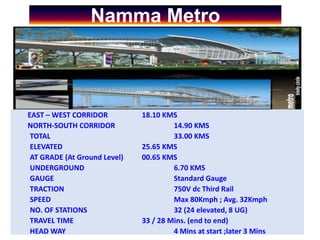
EAST – WEST CORRIDOR 18.10 KMS
NORTH-SOUTH CORRIDOR 14.90 KMS
TOTAL 33.00 KMS
ELEVATED 25.65 KMS
AT GRADE (At Ground Level) 00.65 KMS
UNDERGROUND 6.70 KMS
GAUGE Standard Gauge
TRACTION 750V dc Third Rail
SPEED Max 80Kmph ; Avg. 32Kmph
NO. OF STATIONS 32 (24 elevated, 8 UG)
TRAVEL TIME 33 / 28 Mins. (end to end)
HEAD WAY 4 Mins at start ;later 3 Mins
Namma Metro
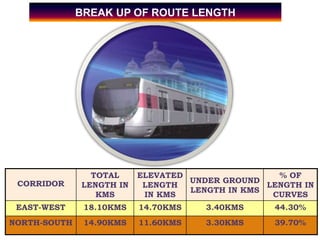
CORRIDOR
TOTAL
LENGTH IN
KMS
ELEVATED
LENGTH
IN KMS
UNDER GROUND
LENGTH IN KMS
% OF
LENGTH IN
CURVES
EAST-WEST 18.10KMS 14.70KMS 3.40KMS 44.30%
NORTH-SOUTH 14.90KMS 11.60KMS 3.30KMS 39.70%
BREAK UP OF ROUTE LENGTH
Hessargatta Cross
T.Dasarahalli
Jalahalli
Peenya
Indsl.Area
Peenya Village
ORR
Banashankari
J.P.Nagar
Puttenahalli
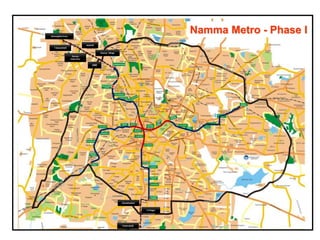
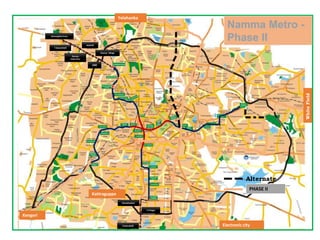
Namma Metro - Phase I
Hessargatta Cross
T.Dasarahalli
Jalahalli
Peenya
Indsl.Area
Peenya Village
ORR
Banashankari
J.P.Nagar
Puttenahalli
Namma Metro -
Phase II
White
Field
Electronic city
Yelahanka
Alternate
PHASE II
Kengeri
Kattraguppe
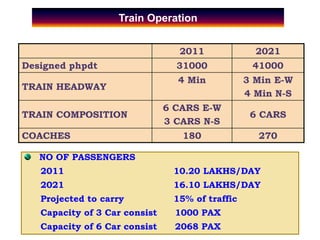
2011 2021
Designed phpdt 31000 41000
TRAIN HEADWAY
4 Min 3 Min E-W
4 Min N-S
TRAIN COMPOSITION
6 CARS E-W
3 CARS N-S
6 CARS
COACHES 180 270
NO OF PASSENGERS
2011 10.20 LAKHS/DAY
2021 16.10 LAKHS/DAY
Projected to carry 15% of traffic
Capacity of 3 Car consist 1000 PAX
Capacity of 6 Car consist 2068 PAX
Train Operation
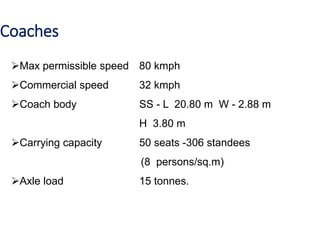
Coaches
Max permissible speed 80 kmph
Commercial speed 32 kmph
Coach body SS - L 20.80 m W - 2.88 m
H 3.80 m
Carrying capacity 50 seats -306 standees
(8 persons/sq.m)
Axle load 15 tonnes.
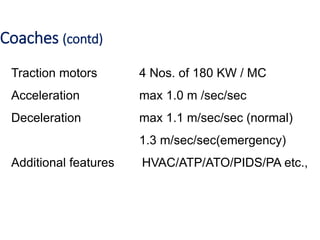
Coaches (contd)
Traction motors 4 Nos. of 180 KW / MC
Acceleration max 1.0 m /sec/sec
Deceleration max 1.1 m/sec/sec (normal)
1.3 m/sec/sec(emergency)
Additional features HVAC/ATP/ATO/PIDS/PA etc.,
Safety
1. For Operations :
• Automatic Train Protection (ATP)
• Automatic Train Operation (ATO)
• Continuous Automatic Train Control (CATC)& Cab Signaling
2. For Commuters :
• Door Closures – Plug swing type.
• Coaches with fire retarding materials, low smoke & toxicity
• Side walk way in tunnels and elevated structures for emergency evacuation
• PA system between driver and commuters in coaches
• Operations Control Centre communication with Driver
Norms and Standards for Metro Planning
Geometric Design
Min Horizontal curve Radius
- Broad gauge 200- 300 m
- Standard gauge
Elevated 90- 120 m
Under ground 200 m
Min.Vertical curve radius 1500 m
Distance between track centres
(double line) - Elevated 4.20 m
- Underground13.05 m
Clearance below Viaduct 5.50 m (min)
Norms and Standards for Metro Planning (contd)
Horizontal Curves
Between stations Desirable - 600m or more
At Station platforms Minimum - 1000 m
Depot/workshop Minimum - 120 m
Min straight between Preferable > 25 m otherwise NIL
two reverse curves
Applied cant (Ca) Maximum - 125 mm
Cant deficiency (cd) Maximum - 100mm
Cant gradient Maximum - 1in 360
Generally - 1in 720
Rate of change of ca/cd - 50 mm per second
Norms and Standards for Metro Station Planning
Planning considerations
Entrance Passageways should be kept short and direct with
min number of bends
Non-conflicting movements for incoming and out going
passengers
Forward movement wherever possible.
Ticket Counters (adequate numbers) to be provided
Columns and obstructions to be minimised
Requisite number and size of escalators and stair cases to be
provided
Minimum walking distance for pedestrians
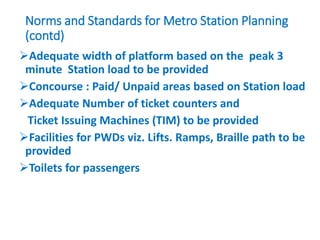
Norms and Standards for Metro Station Planning
(contd)
Adequate width of platform based on the peak 3
minute Station load to be provided
Concourse : Paid/ Unpaid areas based on Station load
Adequate Number of ticket counters and
Ticket Issuing Machines (TIM) to be provided
Facilities for PWDs viz. Lifts. Ramps, Braille path to be
provided
Toilets for passengers
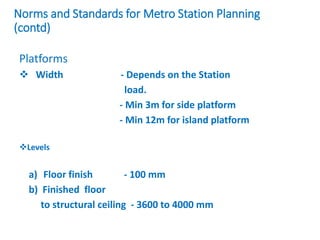
Norms and Standards for Metro Station Planning
(contd)
Platforms
 Width - Depends on the Station
load.
- Min 3m for side platform
- Min 12m for island platform
Levels
a) Floor finish - 100 mm
b) Finished floor
to structural ceiling - 3600 to 4000 mm
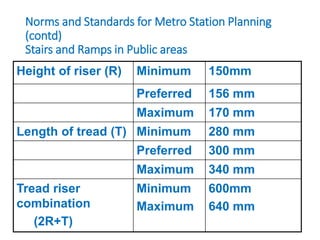
Norms and Standards for Metro Station Planning
(contd)
Stairs and Ramps in Public areas
Height of riser (R) Minimum 150mm
Preferred 156 mm
Maximum 170 mm
Length of tread (T) Minimum 280 mm
Preferred 300 mm
Maximum 340 mm
Tread riser
combination
(2R+T)
Minimum
Maximum
600mm
640 mm
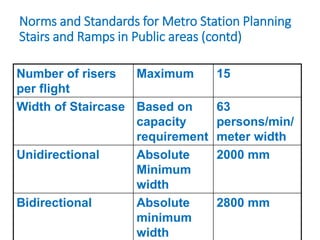
Norms and Standards for Metro Station Planning
Stairs and Ramps in Public areas (contd)
Number of risers
per flight
Maximum 15
Width of Staircase Based on
capacity
requirement
63
persons/min/
meter width
Unidirectional Absolute
Minimum
width
2000 mm
Bidirectional Absolute
minimum
width
2800 mm
Norms and Standards for Metro Station Planning
(contd)
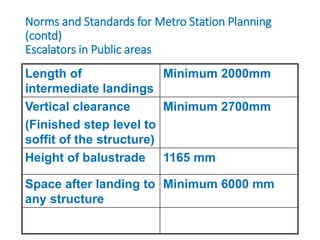
Escalators in Public areas
Length of
intermediate landings
Minimum 2000mm
Vertical clearance
(Finished step level to
soffit of the structure)
Minimum 2700mm
Height of balustrade 1165 mm
Space after landing to
any structure
Minimum 6000 mm
Norms and Standards for Metro Station Planning
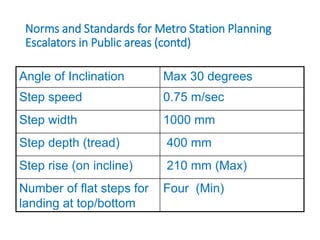
Escalators in Public areas (contd)
Angle of Inclination Max 30 degrees
Step speed 0.75 m/sec
Step width 1000 mm
Step depth (tread) 400 mm
Step rise (on incline) 210 mm (Max)
Number of flat steps for
landing at top/bottom
Four (Min)
Norms and Standard for Metro Station Planning
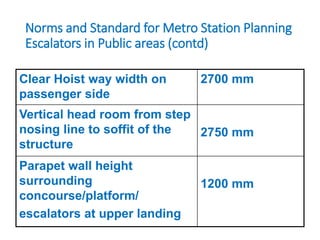
Escalators in Public areas (contd)
Clear Hoist way width on
passenger side
2700 mm
Vertical head room from step
nosing line to soffit of the
structure
2750 mm
Parapet wall height
surrounding
concourse/platform/
escalators at upper landing
1200 mm
Norms and Standard for Metro Station Planning
(contd)
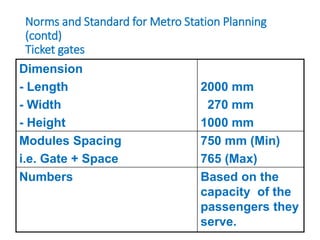
Ticket gates
Dimension
- Length
- Width
- Height
2000 mm
270 mm
1000 mm
Modules Spacing
i.e. Gate + Space
750 mm (Min)
765 (Max)
Numbers Based on the
capacity of the
passengers they
serve.
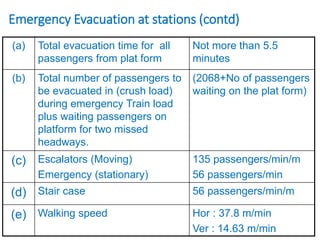
Emergency Evacuation at stations (contd)
(a) Total evacuation time for all
passengers from plat form
Not more than 5.5
minutes
(b) Total number of passengers to
be evacuated in (crush load)
during emergency Train load
plus waiting passengers on
platform for two missed
headways.
(2068+No of passengers
waiting on the plat form)
(c) Escalators (Moving)
Emergency (stationary)
135 passengers/min/m
56 passengers/min
(d) Stair case 56 passengers/min/m
(e) Walking speed Hor : 37.8 m/min
Ver : 14.63 m/min
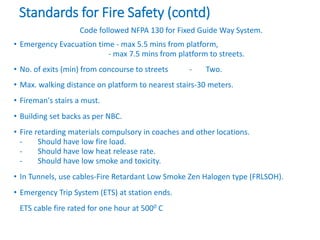
Standards for Fire Safety (contd)
Code followed NFPA 130 for Fixed Guide Way System.
• Emergency Evacuation time - max 5.5 mins from platform,
- max 7.5 mins from platform to streets.
• No. of exits (min) from concourse to streets - Two.
• Max. walking distance on platform to nearest stairs-30 meters.
• Fireman's stairs a must.
• Building set backs as per NBC.
• Fire retarding materials compulsory in coaches and other locations.
- Should have low fire load.
- Should have low heat release rate.
- Should have low smoke and toxicity.
• In Tunnels, use cables-Fire Retardant Low Smoke Zen Halogen type (FRLSOH).
• Emergency Trip System (ETS) at station ends.
ETS cable fire rated for one hour at 5000 C
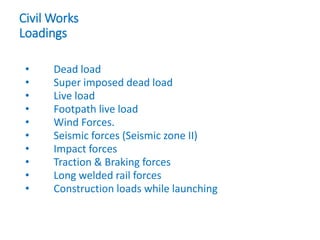
Civil Works
Loadings
• Dead load
• Super imposed dead load
• Live load
• Footpath live load
• Wind Forces.
• Seismic forces (Seismic zone II)
• Impact forces
• Traction & Braking forces
• Long welded rail forces
• Construction loads while launching
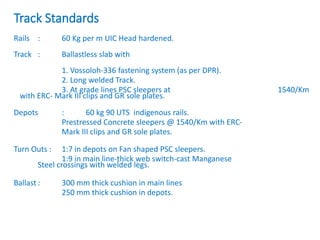
Track Standards
Rails : 60 Kg per m UIC Head hardened.
Track : Ballastless slab with
1. Vossoloh-336 fastening system (as per DPR).
2. Long welded Track.
3. At grade lines PSC sleepers at 1540/Km
with ERC- Mark III clips and GR sole plates.
Depots : 60 kg 90 UTS indigenous rails.
Prestressed Concrete sleepers @ 1540/Km with ERC-
Mark III clips and GR sole plates.
Turn Outs : 1:7 in depots on Fan shaped PSC sleepers.
1:9 in main line-thick web switch-cast Manganese
Steel crossings with welded legs.
Ballast : 300 mm thick cushion in main lines
250 mm thick cushion in depots.
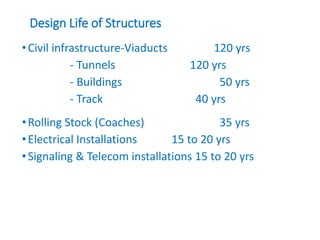
Design Life of Structures
•Civil infrastructure-Viaducts 120 yrs
- Tunnels 120 yrs
- Buildings 50 yrs
- Track 40 yrs
•Rolling Stock (Coaches) 35 yrs
•Electrical Installations 15 to 20 yrs
•Signaling & Telecom installations 15 to 20 yrs
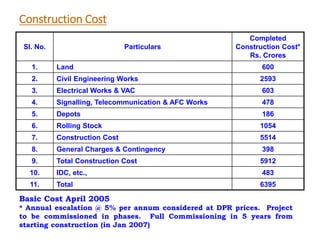
Construction Cost
Sl. No. Particulars
Completed
Construction Cost*
Rs. Crores
1. Land 600
2. Civil Engineering Works 2593
3. Electrical Works & VAC 603
4. Signalling, Telecommunication & AFC Works 478
5. Depots 186
6. Rolling Stock 1054
7. Construction Cost 5514
8. General Charges & Contingency 398
9. Total Construction Cost 5912
10. IDC, etc., 483
11. Total 6395
Basic Cost April 2005
* Annual escalation @ 5% per annum considered at DPR prices. Project
to be commissioned in phases. Full Commissioning in 5 years from
starting construction (in Jan 2007)
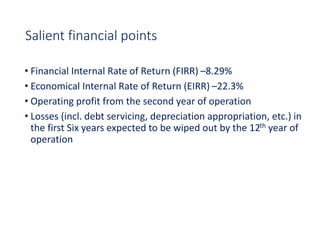
Salient financial points
• Financial Internal Rate of Return (FIRR) –8.29%
• Economical Internal Rate of Return (EIRR) –22.3%
• Operating profit from the second year of operation
• Losses (incl. debt servicing, depreciation appropriation, etc.) in
the first Six years expected to be wiped out by the 12th year of
operation
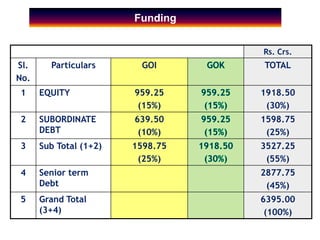
Rs. Crs.
Sl.
No.
Particulars GOI TOTAL
1 EQUITY 959.25
(15%)
1918.50
(30%)
2 SUBORDINATE
DEBT
639.50
(10%)
1598.75
(25%)
3 Sub Total (1+2) 1598.75
(25%)
3527.25
(55%)
4 Senior term
Debt
2877.75
(45%)
5 Grand Total
(3+4)
6395.00
(100%)
Funding
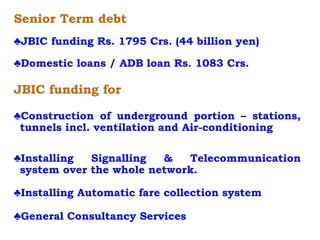
Senior Term debt
♣JBIC funding Rs. 1795 Crs. (44 billion yen)
♣Domestic loans / ADB loan Rs. 1083 Crs.
JBIC funding for
♣Construction of underground portion – stations,
tunnels incl. ventilation and Air-conditioning
♣Installing Signalling & Telecommunication
system over the whole network.
♣Installing Automatic fare collection system
♣General Consultancy Services
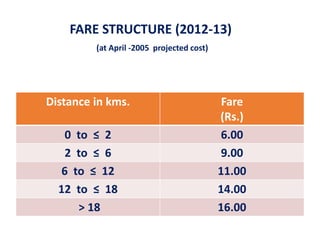
Distance in kms. Fare
(Rs.)
0 to ≤ 2 6.00
2 to ≤ 6 9.00
6 to ≤ 12 11.00
12 to ≤ 18 14.00
> 18 16.00
FARE STRUCTURE (2012-13)
(at April -2005 projected cost)
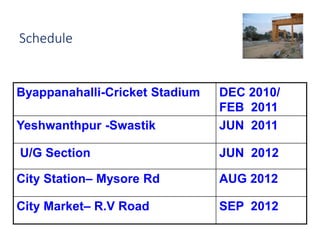
Schedule
Byappanahalli-Cricket Stadium DEC 2010/
FEB 2011
Yeshwanthpur -Swastik JUN 2011
U/G Section JUN 2012
City Station– Mysore Rd AUG 2012
City Market– R.V Road SEP 2012
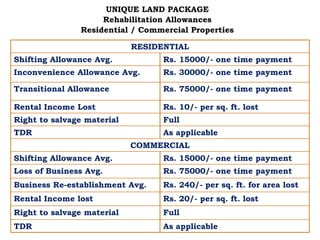
UNIQUE LAND PACKAGE
Rehabilitation Allowances
Residential / Commercial Properties
RESIDENTIAL
Shifting Allowance Avg. Rs. 15000/- one time payment
Inconvenience Allowance Avg. Rs. 30000/- one time payment
Transitional Allowance Rs. 75000/- one time payment
Rental Income Lost Rs. 10/- per sq. ft. lost
Right to salvage material Full
TDR As applicable
COMMERCIAL
Shifting Allowance Avg. Rs. 15000/- one time payment
Loss of Business Avg. Rs. 75000/- one time payment
Business Re-establishment Avg. Rs. 240/- per sq. ft. for area lost
Rental Income lost Rs. 20/- per sq. ft. lost
Right to salvage material Full
TDR As applicable
Metro Success Mantra
SEAMLESS TRAVEL
•Provide freedom to commuters
to move from one transit mode
to another without any hassles.
Objective
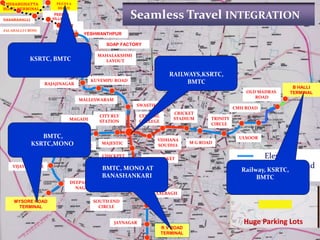
 Integration with KSRTC, BMTC, IPTs, Railways, Airport.
 Public parking to be provided at major Metro stations.
 Bus bays at other stations.
 Feeder bus services to be provided to all the Metro
stations.
 Common ticketing for Metro & feeder buses.
Seamless Travel (contd)
YESHWANTHPUR
MAHALAKSHMI
LAYOUT
MYSORE ROAD
TERMINAL
DEEPANJALI
NAGAR
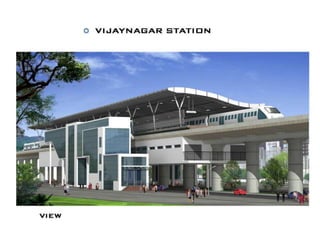
VIJAYANAGAR
HOSAHALLI
TOLL GATE
MAGADI
ROAD
CITY RLY
STATION
MAJESTIC
CENTRAL
COLLEGE
VIDHANA
SOUDHA
CRICKET
STADIUM
M G ROAD
TRINITY
CIRCLE
ULSOOR
CMH ROAD
OLD MADRAS
ROAD
B HALLI
TERMINAL
RAJAJINAGAR
KUVEMPU ROAD
MALLESWARAM
SWASTIK
CHICKPET
CITY MARKET
K R ROAD
LALBAGH
SOUTH END
CIRCLE
JAYNAGAR
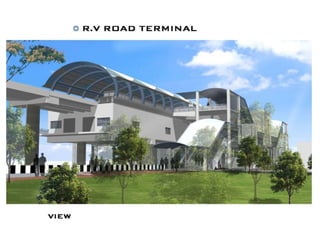
R V ROAD
TERMINAL
Huge Parking Lots
PEENYA
DEPOT
JALAHALLI CROSS
ORR
PEENYA
VILLAGE
Elevated
Under Ground
At Grade
DASARAHALLI
HESARGHATTA
ROAD TERMINAL
SOAP FACTORY
Railway, KSRTC,
BMTC
KSRTC, BMTC
BMTC, MONO AT
BANASHANKARI
BMTC,
KSRTC,MONO
RAILWAYS,KSRTC,
BMTC
Seamless Travel INTEGRATION
Fare System
•Integrated ticket for Metro, Mono & Bus.
•Fare integration into a single card system.
•Smart Cards for regular users.
•Individual tickets for single time user.
METRO SUCCESS MANTRA
Easy access to station concourses from
road level-escalators
 Frequency of services
Punctuality of running of trains
Affordable Fares
Immediate evacuation at metro stations
Bus bays at entrance of stations
METRO SUCCESS MANTRA (contd)
 Pick and Drop facilities at stations
 Seamless Streamlined Side- walks to reach metro
stations from neighbourhood
 Well paved side-walks with ramps at road crossings
for 0.5 to 1km around stations on all sides.
 Essential shops, stores at stations and on way to
stations so that at the end of the day, people can go
home purchasing essential needs for the next day
 Grid of Metro lines
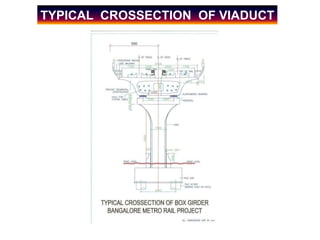
TYPICAL CROSSECTION OF VIADUCT
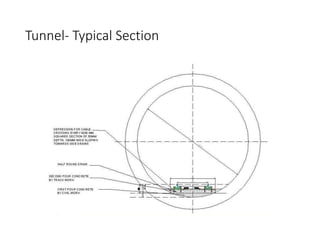
Tunnel- Typical Section
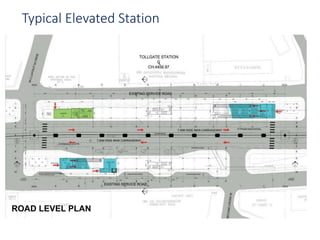
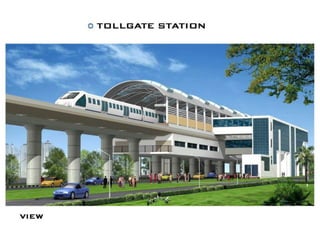
Typical Elevated Station
ROAD LEVEL PLAN
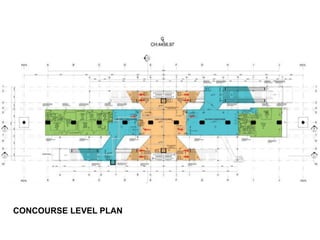
CONCOURSE LEVEL PLAN
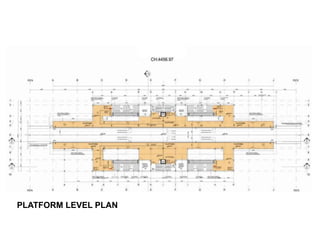
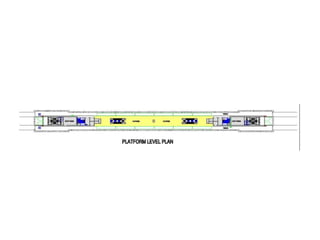
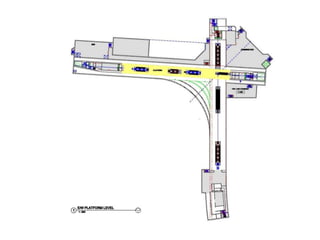
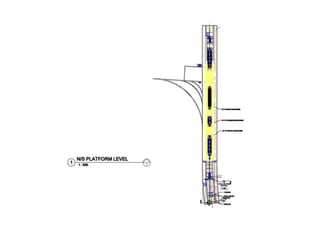
PLATFORM LEVEL PLAN
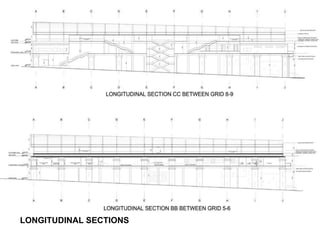
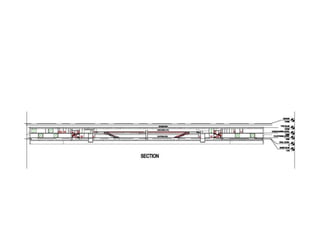
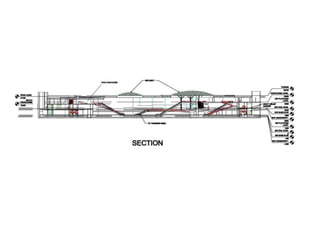
LONGITUDINAL SECTIONS
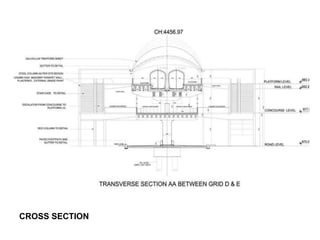
CROSS SECTION
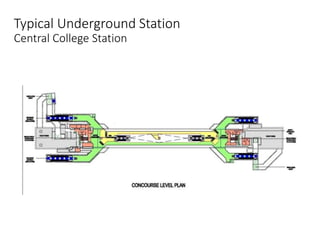
Typical Underground Station
Central College Station
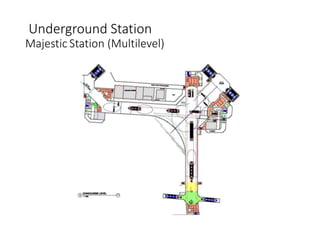
Underground Station
Majestic Station (Multilevel)
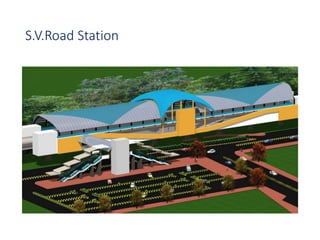
S.V.Road Station
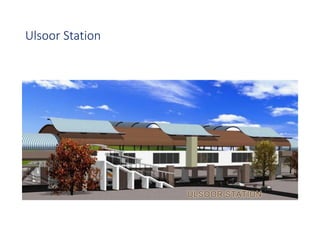
Ulsoor Station
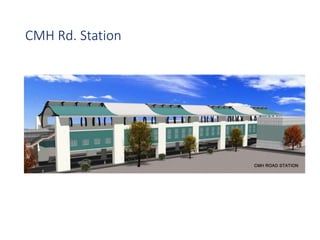
CMH Rd. Station
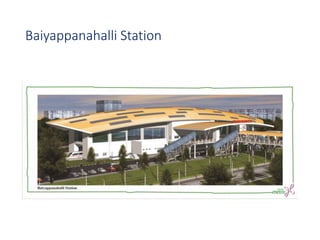
Baiyappanahalli Station
 BMRCL.ppt
 BMRCL.ppt
 BMRCL.ppt
 BMRCL.ppt

BMRCL.ppt

  • 1.
    Utilization of ElectricalPower [18EE742] Beyond Syllabus Topic: BMRCL By: Dr. J P Sridhar Associate Professor EEE Department SJB Institute of Technology Date: 31/10/2022
  • 2.
  • 3.
  • 4.
    EAST – WESTCORRIDOR 18.10 KMS NORTH-SOUTH CORRIDOR 14.90 KMS TOTAL 33.00 KMS ELEVATED 25.65 KMS AT GRADE (At Ground Level) 00.65 KMS UNDERGROUND 6.70 KMS GAUGE Standard Gauge TRACTION 750V dc Third Rail SPEED Max 80Kmph ; Avg. 32Kmph NO. OF STATIONS 32 (24 elevated, 8 UG) TRAVEL TIME 33 / 28 Mins. (end to end) HEAD WAY 4 Mins at start ;later 3 Mins Namma Metro
  • 5.
    CORRIDOR TOTAL LENGTH IN KMS ELEVATED LENGTH IN KMS UNDERGROUND LENGTH IN KMS % OF LENGTH IN CURVES EAST-WEST 18.10KMS 14.70KMS 3.40KMS 44.30% NORTH-SOUTH 14.90KMS 11.60KMS 3.30KMS 39.70% BREAK UP OF ROUTE LENGTH
  • 6.
  • 7.
    Hessargatta Cross T.Dasarahalli Jalahalli Peenya Indsl.Area Peenya Village ORR Banashankari J.P.Nagar Puttenahalli NammaMetro - Phase II White Field Electronic city Yelahanka Alternate PHASE II Kengeri Kattraguppe
  • 8.
    2011 2021 Designed phpdt31000 41000 TRAIN HEADWAY 4 Min 3 Min E-W 4 Min N-S TRAIN COMPOSITION 6 CARS E-W 3 CARS N-S 6 CARS COACHES 180 270 NO OF PASSENGERS 2011 10.20 LAKHS/DAY 2021 16.10 LAKHS/DAY Projected to carry 15% of traffic Capacity of 3 Car consist 1000 PAX Capacity of 6 Car consist 2068 PAX Train Operation
  • 9.
    Coaches Max permissible speed80 kmph Commercial speed 32 kmph Coach body SS - L 20.80 m W - 2.88 m H 3.80 m Carrying capacity 50 seats -306 standees (8 persons/sq.m) Axle load 15 tonnes.
  • 10.
    Coaches (contd) Traction motors4 Nos. of 180 KW / MC Acceleration max 1.0 m /sec/sec Deceleration max 1.1 m/sec/sec (normal) 1.3 m/sec/sec(emergency) Additional features HVAC/ATP/ATO/PIDS/PA etc.,
  • 11.
    Safety 1. For Operations: • Automatic Train Protection (ATP) • Automatic Train Operation (ATO) • Continuous Automatic Train Control (CATC)& Cab Signaling 2. For Commuters : • Door Closures – Plug swing type. • Coaches with fire retarding materials, low smoke & toxicity • Side walk way in tunnels and elevated structures for emergency evacuation • PA system between driver and commuters in coaches • Operations Control Centre communication with Driver
  • 12.
    Norms and Standardsfor Metro Planning Geometric Design Min Horizontal curve Radius - Broad gauge 200- 300 m - Standard gauge Elevated 90- 120 m Under ground 200 m Min.Vertical curve radius 1500 m Distance between track centres (double line) - Elevated 4.20 m - Underground13.05 m Clearance below Viaduct 5.50 m (min)
  • 13.
    Norms and Standardsfor Metro Planning (contd) Horizontal Curves Between stations Desirable - 600m or more At Station platforms Minimum - 1000 m Depot/workshop Minimum - 120 m Min straight between Preferable > 25 m otherwise NIL two reverse curves Applied cant (Ca) Maximum - 125 mm Cant deficiency (cd) Maximum - 100mm Cant gradient Maximum - 1in 360 Generally - 1in 720 Rate of change of ca/cd - 50 mm per second
  • 14.
    Norms and Standardsfor Metro Station Planning Planning considerations Entrance Passageways should be kept short and direct with min number of bends Non-conflicting movements for incoming and out going passengers Forward movement wherever possible. Ticket Counters (adequate numbers) to be provided Columns and obstructions to be minimised Requisite number and size of escalators and stair cases to be provided Minimum walking distance for pedestrians
  • 15.
    Norms and Standardsfor Metro Station Planning (contd) Adequate width of platform based on the peak 3 minute Station load to be provided Concourse : Paid/ Unpaid areas based on Station load Adequate Number of ticket counters and Ticket Issuing Machines (TIM) to be provided Facilities for PWDs viz. Lifts. Ramps, Braille path to be provided Toilets for passengers
  • 16.
    Norms and Standardsfor Metro Station Planning (contd) Platforms  Width - Depends on the Station load. - Min 3m for side platform - Min 12m for island platform Levels a) Floor finish - 100 mm b) Finished floor to structural ceiling - 3600 to 4000 mm
  • 17.
    Norms and Standardsfor Metro Station Planning (contd) Stairs and Ramps in Public areas Height of riser (R) Minimum 150mm Preferred 156 mm Maximum 170 mm Length of tread (T) Minimum 280 mm Preferred 300 mm Maximum 340 mm Tread riser combination (2R+T) Minimum Maximum 600mm 640 mm
  • 18.
    Norms and Standardsfor Metro Station Planning Stairs and Ramps in Public areas (contd) Number of risers per flight Maximum 15 Width of Staircase Based on capacity requirement 63 persons/min/ meter width Unidirectional Absolute Minimum width 2000 mm Bidirectional Absolute minimum width 2800 mm
  • 19.
    Norms and Standardsfor Metro Station Planning (contd) Escalators in Public areas Length of intermediate landings Minimum 2000mm Vertical clearance (Finished step level to soffit of the structure) Minimum 2700mm Height of balustrade 1165 mm Space after landing to any structure Minimum 6000 mm
  • 20.
    Norms and Standardsfor Metro Station Planning Escalators in Public areas (contd) Angle of Inclination Max 30 degrees Step speed 0.75 m/sec Step width 1000 mm Step depth (tread) 400 mm Step rise (on incline) 210 mm (Max) Number of flat steps for landing at top/bottom Four (Min)
  • 21.
    Norms and Standardfor Metro Station Planning Escalators in Public areas (contd) Clear Hoist way width on passenger side 2700 mm Vertical head room from step nosing line to soffit of the structure 2750 mm Parapet wall height surrounding concourse/platform/ escalators at upper landing 1200 mm
  • 22.
    Norms and Standardfor Metro Station Planning (contd) Ticket gates Dimension - Length - Width - Height 2000 mm 270 mm 1000 mm Modules Spacing i.e. Gate + Space 750 mm (Min) 765 (Max) Numbers Based on the capacity of the passengers they serve.
  • 23.
    Emergency Evacuation atstations (contd) (a) Total evacuation time for all passengers from plat form Not more than 5.5 minutes (b) Total number of passengers to be evacuated in (crush load) during emergency Train load plus waiting passengers on platform for two missed headways. (2068+No of passengers waiting on the plat form) (c) Escalators (Moving) Emergency (stationary) 135 passengers/min/m 56 passengers/min (d) Stair case 56 passengers/min/m (e) Walking speed Hor : 37.8 m/min Ver : 14.63 m/min
  • 24.
    Standards for FireSafety (contd) Code followed NFPA 130 for Fixed Guide Way System. • Emergency Evacuation time - max 5.5 mins from platform, - max 7.5 mins from platform to streets. • No. of exits (min) from concourse to streets - Two. • Max. walking distance on platform to nearest stairs-30 meters. • Fireman's stairs a must. • Building set backs as per NBC. • Fire retarding materials compulsory in coaches and other locations. - Should have low fire load. - Should have low heat release rate. - Should have low smoke and toxicity. • In Tunnels, use cables-Fire Retardant Low Smoke Zen Halogen type (FRLSOH). • Emergency Trip System (ETS) at station ends. ETS cable fire rated for one hour at 5000 C
  • 25.
    Civil Works Loadings • Deadload • Super imposed dead load • Live load • Footpath live load • Wind Forces. • Seismic forces (Seismic zone II) • Impact forces • Traction & Braking forces • Long welded rail forces • Construction loads while launching
  • 26.
    Track Standards Rails :60 Kg per m UIC Head hardened. Track : Ballastless slab with 1. Vossoloh-336 fastening system (as per DPR). 2. Long welded Track. 3. At grade lines PSC sleepers at 1540/Km with ERC- Mark III clips and GR sole plates. Depots : 60 kg 90 UTS indigenous rails. Prestressed Concrete sleepers @ 1540/Km with ERC- Mark III clips and GR sole plates. Turn Outs : 1:7 in depots on Fan shaped PSC sleepers. 1:9 in main line-thick web switch-cast Manganese Steel crossings with welded legs. Ballast : 300 mm thick cushion in main lines 250 mm thick cushion in depots.
  • 27.
    Design Life ofStructures •Civil infrastructure-Viaducts 120 yrs - Tunnels 120 yrs - Buildings 50 yrs - Track 40 yrs •Rolling Stock (Coaches) 35 yrs •Electrical Installations 15 to 20 yrs •Signaling & Telecom installations 15 to 20 yrs
  • 28.
    Construction Cost Sl. No.Particulars Completed Construction Cost* Rs. Crores 1. Land 600 2. Civil Engineering Works 2593 3. Electrical Works & VAC 603 4. Signalling, Telecommunication & AFC Works 478 5. Depots 186 6. Rolling Stock 1054 7. Construction Cost 5514 8. General Charges & Contingency 398 9. Total Construction Cost 5912 10. IDC, etc., 483 11. Total 6395 Basic Cost April 2005 * Annual escalation @ 5% per annum considered at DPR prices. Project to be commissioned in phases. Full Commissioning in 5 years from starting construction (in Jan 2007)
  • 29.
    Salient financial points •Financial Internal Rate of Return (FIRR) –8.29% • Economical Internal Rate of Return (EIRR) –22.3% • Operating profit from the second year of operation • Losses (incl. debt servicing, depreciation appropriation, etc.) in the first Six years expected to be wiped out by the 12th year of operation
  • 30.
    Rs. Crs. Sl. No. Particulars GOITOTAL 1 EQUITY 959.25 (15%) 1918.50 (30%) 2 SUBORDINATE DEBT 639.50 (10%) 1598.75 (25%) 3 Sub Total (1+2) 1598.75 (25%) 3527.25 (55%) 4 Senior term Debt 2877.75 (45%) 5 Grand Total (3+4) 6395.00 (100%) Funding
  • 31.
    Senior Term debt ♣JBICfunding Rs. 1795 Crs. (44 billion yen) ♣Domestic loans / ADB loan Rs. 1083 Crs. JBIC funding for ♣Construction of underground portion – stations, tunnels incl. ventilation and Air-conditioning ♣Installing Signalling & Telecommunication system over the whole network. ♣Installing Automatic fare collection system ♣General Consultancy Services
  • 32.
    Distance in kms.Fare (Rs.) 0 to ≤ 2 6.00 2 to ≤ 6 9.00 6 to ≤ 12 11.00 12 to ≤ 18 14.00 > 18 16.00 FARE STRUCTURE (2012-13) (at April -2005 projected cost)
  • 33.
    Schedule Byappanahalli-Cricket Stadium DEC2010/ FEB 2011 Yeshwanthpur -Swastik JUN 2011 U/G Section JUN 2012 City Station– Mysore Rd AUG 2012 City Market– R.V Road SEP 2012
  • 34.
    UNIQUE LAND PACKAGE RehabilitationAllowances Residential / Commercial Properties RESIDENTIAL Shifting Allowance Avg. Rs. 15000/- one time payment Inconvenience Allowance Avg. Rs. 30000/- one time payment Transitional Allowance Rs. 75000/- one time payment Rental Income Lost Rs. 10/- per sq. ft. lost Right to salvage material Full TDR As applicable COMMERCIAL Shifting Allowance Avg. Rs. 15000/- one time payment Loss of Business Avg. Rs. 75000/- one time payment Business Re-establishment Avg. Rs. 240/- per sq. ft. for area lost Rental Income lost Rs. 20/- per sq. ft. lost Right to salvage material Full TDR As applicable
  • 35.
  • 36.
    SEAMLESS TRAVEL •Provide freedomto commuters to move from one transit mode to another without any hassles. Objective
  • 37.
     Integration withKSRTC, BMTC, IPTs, Railways, Airport.  Public parking to be provided at major Metro stations.  Bus bays at other stations.  Feeder bus services to be provided to all the Metro stations.  Common ticketing for Metro & feeder buses. Seamless Travel (contd)
  • 38.
    YESHWANTHPUR MAHALAKSHMI LAYOUT MYSORE ROAD TERMINAL DEEPANJALI NAGAR VIJAYANAGAR HOSAHALLI TOLL GATE MAGADI ROAD CITYRLY STATION MAJESTIC CENTRAL COLLEGE VIDHANA SOUDHA CRICKET STADIUM M G ROAD TRINITY CIRCLE ULSOOR CMH ROAD OLD MADRAS ROAD B HALLI TERMINAL RAJAJINAGAR KUVEMPU ROAD MALLESWARAM SWASTIK CHICKPET CITY MARKET K R ROAD LALBAGH SOUTH END CIRCLE JAYNAGAR R V ROAD TERMINAL Huge Parking Lots PEENYA DEPOT JALAHALLI CROSS ORR PEENYA VILLAGE Elevated Under Ground At Grade DASARAHALLI HESARGHATTA ROAD TERMINAL SOAP FACTORY Railway, KSRTC, BMTC KSRTC, BMTC BMTC, MONO AT BANASHANKARI BMTC, KSRTC,MONO RAILWAYS,KSRTC, BMTC Seamless Travel INTEGRATION
  • 39.
    Fare System •Integrated ticketfor Metro, Mono & Bus. •Fare integration into a single card system. •Smart Cards for regular users. •Individual tickets for single time user.
  • 40.
    METRO SUCCESS MANTRA Easyaccess to station concourses from road level-escalators  Frequency of services Punctuality of running of trains Affordable Fares Immediate evacuation at metro stations Bus bays at entrance of stations
  • 41.
    METRO SUCCESS MANTRA(contd)  Pick and Drop facilities at stations  Seamless Streamlined Side- walks to reach metro stations from neighbourhood  Well paved side-walks with ramps at road crossings for 0.5 to 1km around stations on all sides.  Essential shops, stores at stations and on way to stations so that at the end of the day, people can go home purchasing essential needs for the next day  Grid of Metro lines
  • 42.
  • 43.
  • 44.
  • 45.
  • 46.
  • 47.
  • 48.
  • 50.
  • 53.
  • 57.
  • 58.
  • 59.
  • 60.