Hydrogen Fueled Vehicle
Global Technical Regulation (GTR)
Subgroup Safety (SGS)
Nha Nguyen
49th GRSP Session
May 2011
1
Informal document GRSP-49-28
(49th GRSP, 16-20 May 2011,
agenda item 7)
Overview
Background
Global Technical Regulation (GTR) goals and safety
requirements
Hydrogen GTR Objectives
GTR Milestones and Timeline
GTR Details
2
Background
Hydrogen-Fueled Vehicle GTR
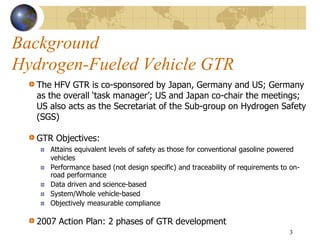
The HFV GTR is co-sponsored by Japan, Germany and US; Germany
as the overall ‘task manager’; US and Japan co-chair the meetings;
US also acts as the Secretariat of the Sub-group on Hydrogen Safety
(SGS)
GTR Objectives:
Attains equivalent levels of safety as those for conventional gasoline powered
vehicles
Performance based (not design specific) and traceability of requirements to on-
road performance
Data driven and science-based
System/Whole vehicle-based
Objectively measurable compliance
2007 Action Plan: 2 phases of GTR development
3
GTR Development Phases
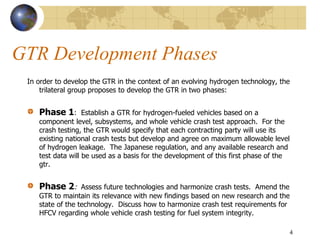
In order to develop the GTR in the context of an evolving hydrogen technology, the
trilateral group proposes to develop the GTR in two phases:
Phase 1: Establish a GTR for hydrogen-fueled vehicles based on a
component level, subsystems, and whole vehicle crash test approach. For the
crash testing, the GTR would specify that each contracting party will use its
existing national crash tests but develop and agree on maximum allowable level
of hydrogen leakage. The Japanese regulation, and any available research and
test data will be used as a basis for the development of this first phase of the
gtr.
Phase 2: Assess future technologies and harmonize crash tests. Amend the
GTR to maintain its relevance with new findings based on new research and the
state of the technology. Discuss how to harmonize crash test requirements for
HFCV regarding whole vehicle crash testing for fuel system integrity.
4
Milestones and Timeline
June 2007 - WP.29 approved GTR Action Plan - ECE/TRANS/WP.29/2007/41
11 Safety Subgroup meetings; next SGS 12th meeting is scheduled for
the end of June 2011
May 2011 - draft GTR as informal document to the Group of Experts on
Passive Safety (GRSP)
June 2011 – SGS-12 meeting
December 2011 - SGS will submit the draft GTR as ‘formal document’
to GRSP
March 2012 - If no objections or substantive changes, GRSP submits
GTR as an informal document to WP.29/AC.3
June 2012 - If no objections or substantive changes, WP.29 votes on
the GTR
5
GTR Scope
This GTR applies to all hydrogen fueled vehicles of
Category 1-1 and 1-2, with a gross vehicle mass
(GVM) of 4,536 kilograms or less
Compressed gaseous hydrogen system
Liquefied hydrogen system
Motorcycles and buses are not covered and will be
addressed in Phase II
6
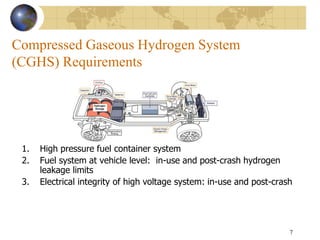
Compressed Gaseous Hydrogen System
(CGHS) Requirements
1. High pressure fuel container system
2. Fuel system at vehicle level: in-use and post-crash hydrogen
leakage limits
3. Electrical integrity of high voltage system: in-use and post-crash
7
Hydrogen
Storage
Hydrogen
Storage
Compressed Gaseous Hydrogen System
Requirements
High pressure fuel container system
Verification Test for Performance Durability: sequential hydraulic
cycling and static pressure tests
Verification Test for Expected On-Road Performance: sequential
pneumatic/hydraulic cycling tests
Verification Test for Service Terminating Performance: fire test
Label requirements: container and vehicle
Fuel system integrity
In-use: fuel leakage mitigation
post crash: maximum allowable leakage limit
Electrical Safety
High voltage safety for in-use and post crash
8
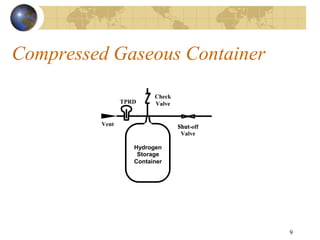
Compressed Gaseous Container
9
Vent
Containment
Vessel
Shut
Valve
Check
Valve
TPRD
Shut-off
Valve
Valve
Hydrogen
Storage
Container
10
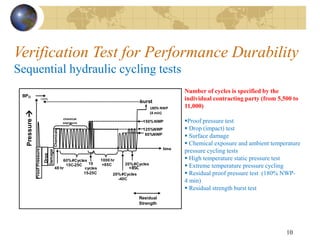
Verification Test for Performance Durability
Sequential hydraulic cycling tests
Number of cycles is specified by the
individual contracting party (from 5,500 to
11,000)
Proof pressure test
 Drop (impact) test
 Surface damage
 Chemical exposure and ambient temperature
pressure cycling tests
 High temperature static pressure test
 Extreme temperature pressure cycling
 Residual proof pressure test (180% NWP-
4 min)
 Residual strength burst test
+85C
Pressure

Damage
Drop
time
BPO
<20%
Residual
Strength
Chemicals
48 hr
60%#Cycles
15C-25C
chemical
exposure 150%NWP
burst
125%NWP
180%NWP
(30 sec)
1000 hr
+85C
20%#Cycles
-40C
20%#Cycles
10
cycles
15-25C
Proof
Pressure
80%NWP
180% NWP
(4 min)
11
c
b
Proof
Pressure
5% cy -40Ca
5% cy +50Cb
40%cy15-25Cc
180%NWP
30 sec
150%
NWP
+55o
C +55o
C
a
Pressure

time
Burst
Burst
<20%
125%NWP
Leak
/
Permeation
>
30
hrs
a Fuel/defuel cycles @-40oC with initial system equilibration @ -40oC, 5 cycles with +20oC fuel; 5 cycles with <-35oC fuel
b Fuel/defuel cycles @+50oC with initial system equilibration @+50oC, 5 cycles with <-35oC fuel
c Fuel/defuel cycles @15-25oC with service (maintenance)defuelrate, 50 cycles
5% cy -40C
5% cy +50C
40%cy15-25C
Leak
/
Permeation
>
30
hrs
115%NWP
80%NWP
b
a
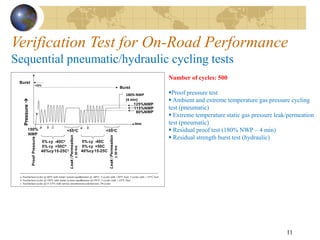
Verification Test for On-Road Performance
Sequential pneumatic/hydraulic cycling tests
Number of cycles: 500
Proof pressure test
 Ambient and extreme temperature gas pressure cycling
test (pneumatic)
 Extreme temperature static gas pressure leak/permeation
test (pneumatic)
 Residual proof test (180% NWP – 4 min)
 Residual strength burst test (hydraulic)
180% NWP
(4 min)
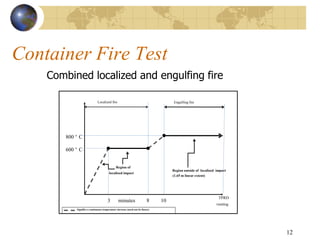
Container Fire Test
12
3 8
600 o
C
800 o
C
Localized fire Engulfing fire
minutes 10
TPRD
venting
Signifies a continuous temperature increase (need not be linear)
Region outside of localized impact
(1.65 m linear extent)
Region of
localized impact
Combined localized and engulfing fire
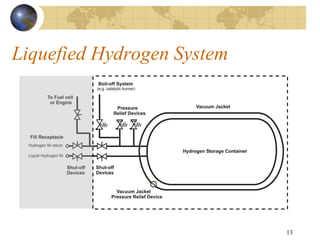
Liquefied Hydrogen System
13
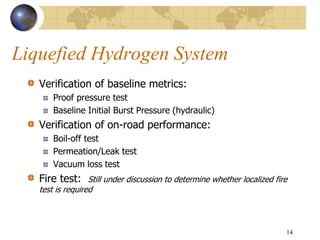
Liquefied Hydrogen System
Verification of baseline metrics:
Proof pressure test
Baseline Initial Burst Pressure (hydraulic)
Verification of on-road performance:
Boil-off test
Permeation/Leak test
Vacuum loss test
Fire test: Still under discussion to determine whether localized fire
test is required
14
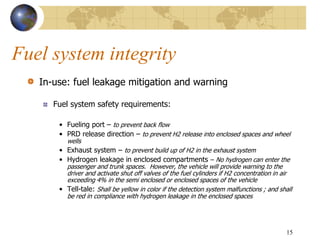
Fuel system integrity
In-use: fuel leakage mitigation and warning
Fuel system safety requirements:
• Fueling port – to prevent back flow
• PRD release direction – to prevent H2 release into enclosed spaces and wheel
wells
• Exhaust system – to prevent build up of H2 in the exhaust system
• Hydrogen leakage in enclosed compartments – No hydrogen can enter the
passenger and trunk spaces. However, the vehicle will provide warning to the
driver and activate shut off valves of the fuel cylinders if H2 concentration in air
exceeding 4% in the semi enclosed or enclosed spaces of the vehicle
• Tell-tale: Shall be yellow in color if the detection system malfunctions ; and shall
be red in compliance with hydrogen leakage in the enclosed spaces
15
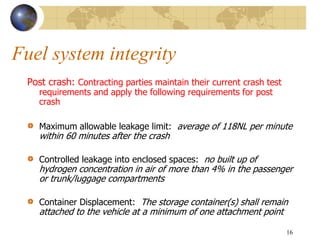
Fuel system integrity
Post crash: Contracting parties maintain their current crash test
requirements and apply the following requirements for post
crash
Maximum allowable leakage limit: average of 118NL per minute
within 60 minutes after the crash
Controlled leakage into enclosed spaces: no built up of
hydrogen concentration in air of more than 4% in the passenger
or trunk/luggage compartments
Container Displacement: The storage container(s) shall remain
attached to the vehicle at a minimum of one attachment point
16
Electrical Safety
Protection from direct and indirect contact from high voltage
In-use:
Protection from direct contact: Protection of (1) IPXXD inside the
passenger or luggage compartment and (2) IPXXB in other areas
Electric isolation – 100 Ω/volt for DC and 500 Ω/volt for AC
• [for combined AC and DC buses: 100 Ω/volt providing (1) the electric
system consists of double or more layers of solid insulators, (2)
mechanically robust protections that have sufficient durability over
vehicle service life such as motor housings, electronic converter cases
or connectors]
Electrical isolation monitoring – Currently applies only to fuel-cell
vehicles
Vehicle functional safety: “At least a momentary indication shall be
given to the driver when the vehicle is in "active driving possible mode''
17
Electrical Safety
Post-crash:
Maximum voltage - 30 VAC and 60 VDC
Resistance isolation - 100 Ω/volt for DC and 500 Ω/volt for AC
• For combined AC/DC buses: 100 Ω/volt providing AC bus meets the
physical protection
[Physical protection: protection of IPXXB] NHTSA is conducting
safety risk study
[Energy option at 2.0 Joules] inconsistent safety criteria with
resistance isolation option.
Electrolyte spillage: Maximum of 7% spillage in 30 minutes
Battery and RESS retention: “RESS located inside the passenger
compartment shall remain in the location... No part of any RESS that is
located outside the passenger compartment for electric safety assessment
shall enter the passenger compartment during or after the impact test.”
18
Component Requirements
Component qualification requirements: PRD, shut-off
valve and check valve
Fueling receptacle requirements: to provide proper
fueling protocols, performance and location
Pressure regulator: The set pressure of the
overpressure protection device shall be lower than or
equal to the maximum allowable working pressure
for the appropriate section of the hydrogen system
19
Outstanding Issues
Some of the test procedures have not been validated
Liquefied hydrogen fuel system: limited experience; post
crash and fire test requirements; limited available test data
Electric safety:
[Post crash barrier option] – NHTSA research on safety risks
Energy option – inconsistent criteria; optional requirement
Material compatibility (Hydrogen embrittlement): CP
to decide. Complete in Phase 2
20
21
Thank you

GRSP-49-28e.ppt

  • 1.
    Hydrogen Fueled Vehicle GlobalTechnical Regulation (GTR) Subgroup Safety (SGS) Nha Nguyen 49th GRSP Session May 2011 1 Informal document GRSP-49-28 (49th GRSP, 16-20 May 2011, agenda item 7)
  • 2.
    Overview Background Global Technical Regulation(GTR) goals and safety requirements Hydrogen GTR Objectives GTR Milestones and Timeline GTR Details 2
  • 3.
    Background Hydrogen-Fueled Vehicle GTR TheHFV GTR is co-sponsored by Japan, Germany and US; Germany as the overall ‘task manager’; US and Japan co-chair the meetings; US also acts as the Secretariat of the Sub-group on Hydrogen Safety (SGS) GTR Objectives: Attains equivalent levels of safety as those for conventional gasoline powered vehicles Performance based (not design specific) and traceability of requirements to on- road performance Data driven and science-based System/Whole vehicle-based Objectively measurable compliance 2007 Action Plan: 2 phases of GTR development 3
  • 4.
    GTR Development Phases Inorder to develop the GTR in the context of an evolving hydrogen technology, the trilateral group proposes to develop the GTR in two phases: Phase 1: Establish a GTR for hydrogen-fueled vehicles based on a component level, subsystems, and whole vehicle crash test approach. For the crash testing, the GTR would specify that each contracting party will use its existing national crash tests but develop and agree on maximum allowable level of hydrogen leakage. The Japanese regulation, and any available research and test data will be used as a basis for the development of this first phase of the gtr. Phase 2: Assess future technologies and harmonize crash tests. Amend the GTR to maintain its relevance with new findings based on new research and the state of the technology. Discuss how to harmonize crash test requirements for HFCV regarding whole vehicle crash testing for fuel system integrity. 4
  • 5.
    Milestones and Timeline June2007 - WP.29 approved GTR Action Plan - ECE/TRANS/WP.29/2007/41 11 Safety Subgroup meetings; next SGS 12th meeting is scheduled for the end of June 2011 May 2011 - draft GTR as informal document to the Group of Experts on Passive Safety (GRSP) June 2011 – SGS-12 meeting December 2011 - SGS will submit the draft GTR as ‘formal document’ to GRSP March 2012 - If no objections or substantive changes, GRSP submits GTR as an informal document to WP.29/AC.3 June 2012 - If no objections or substantive changes, WP.29 votes on the GTR 5
  • 6.
    GTR Scope This GTRapplies to all hydrogen fueled vehicles of Category 1-1 and 1-2, with a gross vehicle mass (GVM) of 4,536 kilograms or less Compressed gaseous hydrogen system Liquefied hydrogen system Motorcycles and buses are not covered and will be addressed in Phase II 6
  • 7.
    Compressed Gaseous HydrogenSystem (CGHS) Requirements 1. High pressure fuel container system 2. Fuel system at vehicle level: in-use and post-crash hydrogen leakage limits 3. Electrical integrity of high voltage system: in-use and post-crash 7 Hydrogen Storage Hydrogen Storage
  • 8.
    Compressed Gaseous HydrogenSystem Requirements High pressure fuel container system Verification Test for Performance Durability: sequential hydraulic cycling and static pressure tests Verification Test for Expected On-Road Performance: sequential pneumatic/hydraulic cycling tests Verification Test for Service Terminating Performance: fire test Label requirements: container and vehicle Fuel system integrity In-use: fuel leakage mitigation post crash: maximum allowable leakage limit Electrical Safety High voltage safety for in-use and post crash 8
  • 9.
  • 10.
    10 Verification Test forPerformance Durability Sequential hydraulic cycling tests Number of cycles is specified by the individual contracting party (from 5,500 to 11,000) Proof pressure test  Drop (impact) test  Surface damage  Chemical exposure and ambient temperature pressure cycling tests  High temperature static pressure test  Extreme temperature pressure cycling  Residual proof pressure test (180% NWP- 4 min)  Residual strength burst test +85C Pressure  Damage Drop time BPO <20% Residual Strength Chemicals 48 hr 60%#Cycles 15C-25C chemical exposure 150%NWP burst 125%NWP 180%NWP (30 sec) 1000 hr +85C 20%#Cycles -40C 20%#Cycles 10 cycles 15-25C Proof Pressure 80%NWP 180% NWP (4 min)
  • 11.
    11 c b Proof Pressure 5% cy -40Ca 5%cy +50Cb 40%cy15-25Cc 180%NWP 30 sec 150% NWP +55o C +55o C a Pressure  time Burst Burst <20% 125%NWP Leak / Permeation > 30 hrs a Fuel/defuel cycles @-40oC with initial system equilibration @ -40oC, 5 cycles with +20oC fuel; 5 cycles with <-35oC fuel b Fuel/defuel cycles @+50oC with initial system equilibration @+50oC, 5 cycles with <-35oC fuel c Fuel/defuel cycles @15-25oC with service (maintenance)defuelrate, 50 cycles 5% cy -40C 5% cy +50C 40%cy15-25C Leak / Permeation > 30 hrs 115%NWP 80%NWP b a Verification Test for On-Road Performance Sequential pneumatic/hydraulic cycling tests Number of cycles: 500 Proof pressure test  Ambient and extreme temperature gas pressure cycling test (pneumatic)  Extreme temperature static gas pressure leak/permeation test (pneumatic)  Residual proof test (180% NWP – 4 min)  Residual strength burst test (hydraulic) 180% NWP (4 min)
  • 12.
    Container Fire Test 12 38 600 o C 800 o C Localized fire Engulfing fire minutes 10 TPRD venting Signifies a continuous temperature increase (need not be linear) Region outside of localized impact (1.65 m linear extent) Region of localized impact Combined localized and engulfing fire
  • 13.
  • 14.
    Liquefied Hydrogen System Verificationof baseline metrics: Proof pressure test Baseline Initial Burst Pressure (hydraulic) Verification of on-road performance: Boil-off test Permeation/Leak test Vacuum loss test Fire test: Still under discussion to determine whether localized fire test is required 14
  • 15.
    Fuel system integrity In-use:fuel leakage mitigation and warning Fuel system safety requirements: • Fueling port – to prevent back flow • PRD release direction – to prevent H2 release into enclosed spaces and wheel wells • Exhaust system – to prevent build up of H2 in the exhaust system • Hydrogen leakage in enclosed compartments – No hydrogen can enter the passenger and trunk spaces. However, the vehicle will provide warning to the driver and activate shut off valves of the fuel cylinders if H2 concentration in air exceeding 4% in the semi enclosed or enclosed spaces of the vehicle • Tell-tale: Shall be yellow in color if the detection system malfunctions ; and shall be red in compliance with hydrogen leakage in the enclosed spaces 15
  • 16.
    Fuel system integrity Postcrash: Contracting parties maintain their current crash test requirements and apply the following requirements for post crash Maximum allowable leakage limit: average of 118NL per minute within 60 minutes after the crash Controlled leakage into enclosed spaces: no built up of hydrogen concentration in air of more than 4% in the passenger or trunk/luggage compartments Container Displacement: The storage container(s) shall remain attached to the vehicle at a minimum of one attachment point 16
  • 17.
    Electrical Safety Protection fromdirect and indirect contact from high voltage In-use: Protection from direct contact: Protection of (1) IPXXD inside the passenger or luggage compartment and (2) IPXXB in other areas Electric isolation – 100 Ω/volt for DC and 500 Ω/volt for AC • [for combined AC and DC buses: 100 Ω/volt providing (1) the electric system consists of double or more layers of solid insulators, (2) mechanically robust protections that have sufficient durability over vehicle service life such as motor housings, electronic converter cases or connectors] Electrical isolation monitoring – Currently applies only to fuel-cell vehicles Vehicle functional safety: “At least a momentary indication shall be given to the driver when the vehicle is in "active driving possible mode'' 17
  • 18.
    Electrical Safety Post-crash: Maximum voltage- 30 VAC and 60 VDC Resistance isolation - 100 Ω/volt for DC and 500 Ω/volt for AC • For combined AC/DC buses: 100 Ω/volt providing AC bus meets the physical protection [Physical protection: protection of IPXXB] NHTSA is conducting safety risk study [Energy option at 2.0 Joules] inconsistent safety criteria with resistance isolation option. Electrolyte spillage: Maximum of 7% spillage in 30 minutes Battery and RESS retention: “RESS located inside the passenger compartment shall remain in the location... No part of any RESS that is located outside the passenger compartment for electric safety assessment shall enter the passenger compartment during or after the impact test.” 18
  • 19.
    Component Requirements Component qualificationrequirements: PRD, shut-off valve and check valve Fueling receptacle requirements: to provide proper fueling protocols, performance and location Pressure regulator: The set pressure of the overpressure protection device shall be lower than or equal to the maximum allowable working pressure for the appropriate section of the hydrogen system 19
  • 20.
    Outstanding Issues Some ofthe test procedures have not been validated Liquefied hydrogen fuel system: limited experience; post crash and fire test requirements; limited available test data Electric safety: [Post crash barrier option] – NHTSA research on safety risks Energy option – inconsistent criteria; optional requirement Material compatibility (Hydrogen embrittlement): CP to decide. Complete in Phase 2 20
  • 21.