BMS COLLEGE OF ENGINEERING
BANGALORE 56019, INDIA
DEPARTMENT OF ELECTRONICS And COMMUNICATION ENGINEERING
ADVANCED MICROCONTROLLER PROJECT PAPER PRESENTATION
METRO TRAIN PROTOTYPE
INTRODUCTION
This project is designed so that we can understand the technology used in the
now a day’s driverless metro train which is used in most of the developed
countries like Germany,France,and Japan etc.These trains are equipped with the
CPU,which control the train.The train is programmed for the specific
path.Every station on the path is defined; stoppage timing of the train and
distance between the two stations is predefined.
In this project : In this project we try to give the same prototype for this type of
trains.
 We are using Cortex M0 as CPU.
 The motion of the train is controlled by the Stepper Motor
 For displaying message in the train we are using LCD Display of two lines.
 The train is designed for a path with 5 stops. There is a LCD display for
showing station names in the train for passengers.
 Two motors are used for representing the engine and the door.
 A buzzer to indicate opening and closing of the door at a station.
HARDWARE ARCHITECTURE
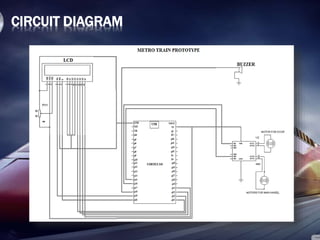
CIRCUIT DIAGRAM
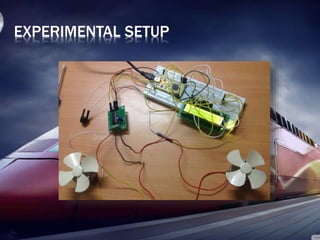
EXPERIMENTAL SETUP
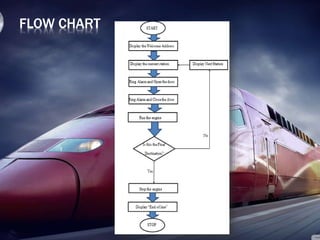
FLOW CHART
CONCLUSION
 The metro rail is a popular mode of transport in India and is considered to be
the best solution to heavy road traffic congestion. The rising population,
unprecedented growth of personal vehicles and extreme traffic congestion are
some of the key problems the transport network of the country faces. Metro
rail, as a mass rapid transit system was designed to cater the transportation
needs of a large population keeping in mind the issue of decongestion.
Benefits:
 Fuel cost saving
 Number of vehicles off the road
 Vehicle cost saving
 Reduction in emission of greenhouse gases
 Emission cost saving
 Number of Road accidents avoided
 Saves time
Thus most of the developing cities in India are working on developing an
efficient metro-train network.
FUTURE SCOPE
 The new cars would feature the following:
 Stainless steel exteriors instead of an aluminium car body.
 Thinner, stronger stainless steel seats that offer more leg room. Each car would
have 64 cloth-padded, taller seats with seat-back grab handles.
 A total end to carpeting. Floors would be rubberized.
 Interactive maps on LCD screens that would also likely display advertisements
 Automated station announcements.
 Security cameras on all rail cars.
THE END

Metro train prototype

  • 1.
    BMS COLLEGE OFENGINEERING BANGALORE 56019, INDIA DEPARTMENT OF ELECTRONICS And COMMUNICATION ENGINEERING ADVANCED MICROCONTROLLER PROJECT PAPER PRESENTATION METRO TRAIN PROTOTYPE
  • 2.
    INTRODUCTION This project isdesigned so that we can understand the technology used in the now a day’s driverless metro train which is used in most of the developed countries like Germany,France,and Japan etc.These trains are equipped with the CPU,which control the train.The train is programmed for the specific path.Every station on the path is defined; stoppage timing of the train and distance between the two stations is predefined. In this project : In this project we try to give the same prototype for this type of trains.  We are using Cortex M0 as CPU.  The motion of the train is controlled by the Stepper Motor  For displaying message in the train we are using LCD Display of two lines.  The train is designed for a path with 5 stops. There is a LCD display for showing station names in the train for passengers.  Two motors are used for representing the engine and the door.  A buzzer to indicate opening and closing of the door at a station.
  • 3.
  • 4.
  • 5.
  • 6.
  • 7.
    CONCLUSION  The metrorail is a popular mode of transport in India and is considered to be the best solution to heavy road traffic congestion. The rising population, unprecedented growth of personal vehicles and extreme traffic congestion are some of the key problems the transport network of the country faces. Metro rail, as a mass rapid transit system was designed to cater the transportation needs of a large population keeping in mind the issue of decongestion. Benefits:  Fuel cost saving  Number of vehicles off the road  Vehicle cost saving  Reduction in emission of greenhouse gases  Emission cost saving  Number of Road accidents avoided  Saves time Thus most of the developing cities in India are working on developing an efficient metro-train network.
  • 8.
    FUTURE SCOPE  Thenew cars would feature the following:  Stainless steel exteriors instead of an aluminium car body.  Thinner, stronger stainless steel seats that offer more leg room. Each car would have 64 cloth-padded, taller seats with seat-back grab handles.  A total end to carpeting. Floors would be rubberized.  Interactive maps on LCD screens that would also likely display advertisements  Automated station announcements.  Security cameras on all rail cars.
  • 9.