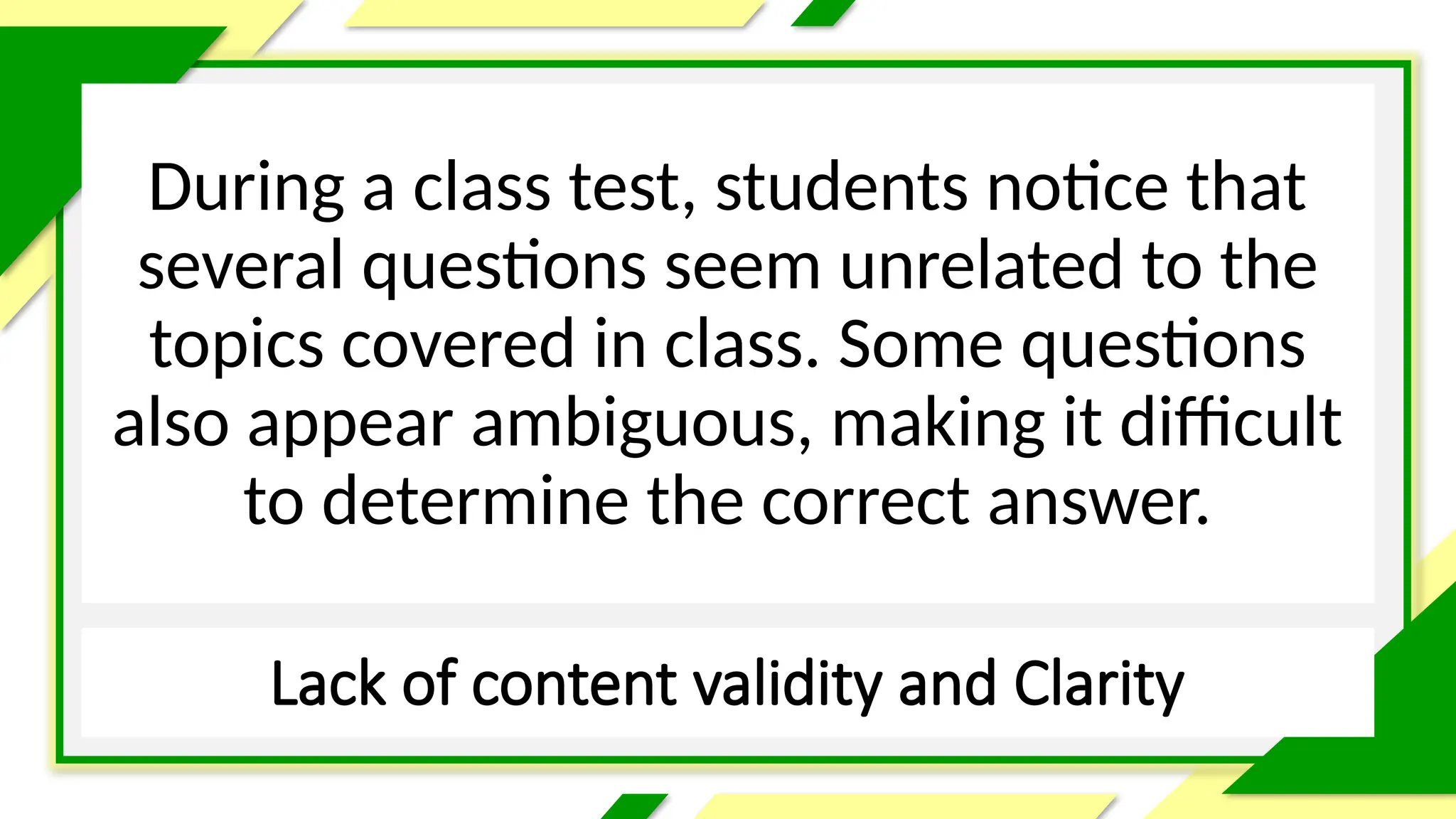
Lack of content validity and Clarity
During a class test, students notice that
several questions seem unrelated to the
topics covered in class. Some questions
also appear ambiguous, making it difficult
to determine the correct answer.
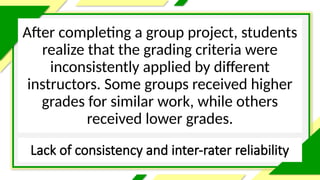
Lack of consistency and inter-rater reliability
After completing a group project, students
realize that the grading criteria were
inconsistently applied by different
instructors. Some groups received higher
grades for similar work, while others
received lower grades.
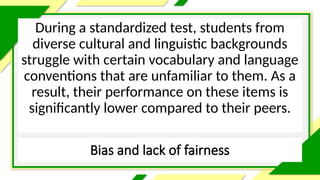
Bias and lack of fairness
During a standardized test, students from
diverse cultural and linguistic backgrounds
struggle with certain vocabulary and language
conventions that are unfamiliar to them. As a
result, their performance on these items is
significantly lower compared to their peers.
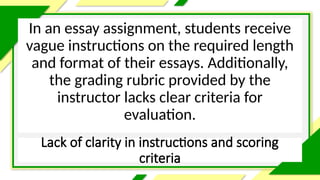
Lack of clarity in instructions and scoring
criteria
In an essay assignment, students receive
vague instructions on the required length
and format of their essays. Additionally,
the grading rubric provided by the
instructor lacks clear criteria for
evaluation.
Lack of authenticity
In a multiple-choice exam, students
encounter questions that are overly simplistic
and unrelated to real-world applications of
the course material. Many students feel that
the assessment does not adequately reflect
the complexity of their learning.
Feasibility issues
Students are assigned a lengthy take-home
exam with a tight deadline, requiring them to
complete multiple essay questions and
problem-solving tasks within a short period.
Many students express frustration and stress
due to the overwhelming workload and time
constraints.
Lack of differentiation and accessibility
In a standardized test, students with disabilities
are not provided with appropriate
accommodations, such as extended time or
assistive technology, despite their documented
needs. As a result, these students struggle to
demonstrate their knowledge and skills on the
assessment.
Lack of timely and constructive feedback
After completing a midterm exam,
students receive their grades but no
feedback on their performance. Many
students express frustration at the lack of
guidance on areas for improvement and
how to enhance their learning.
Lack of alignment with learning objectives
Students complete a series of online
quizzes that are not directly aligned with
the course objectives or learning
outcomes. Many students question the
relevance of these quizzes and their
contribution to their overall learning.
Lack of adaptability and scalability
In a computer-based exam, technical issues
arise during the administration, causing
delays and interruptions in the testing
process. Despite attempts to resolve the
issues, students experience frustration and
anxiety due to the disruption.
ABUYOG COMMUNITY
COLLEGE
COMPETITIVENESS, ANALYTICAL, RESILIENCY, ETHICAL, SERVICE-ORIENTED
College of Arts,
Sciences, and
Education
Planning a
Written Test
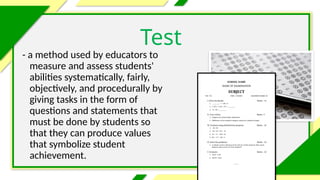
- a method used by educators to
measure and assess students'
abilities systematically, fairly,
objectively, and procedurally by
giving tasks in the form of
questions and statements that
must be done by students so
that they can produce values
that symbolize student
achievement.
Test
Characteristics of a Quality Assessment Tool
1.Validity
2.Reliability
3.Fairness
4.Clarity
5.Authenticity
6.Feasibility
7.Differentiation
8.Feedback
9.Purposefulness
10.Adaptability
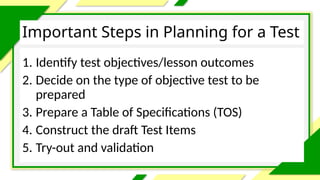
Important Steps in Planning for a Test
1. Identify test objectives/lesson outcomes
2. Decide on the type of objective test to be
prepared
3. Prepare a Table of Specifications (TOS)
4. Construct the draft Test Items
5. Try-out and validation
Identifying the Test Objectives
If one wants to have a comprehensive
objective test, the test item must cover the
various level of Bloom’s taxonomy.
Deciding on the type of objective test
“The test objectives guide the
kind of objective tests that will be
designed and constructed by the
teacher.”
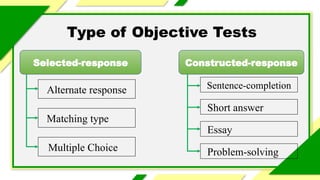
Type of Objective Tests
Selected-response Constructed-response
Alternate response
Matching type
Multiple Choice
Sentence-completion
Short answer
Essay
Problem-solving
Prepare a Table of Specifications (TOS)
Table of Specifications
 Tool used by teachers to design a test
 Table that maps out the test objectives, contents, or
topics covered by the test; levels of cognitive behavior
to be measured; distribution of items, number,
placement, and weights of test items; and the test
format.
 “test blueprint”
Importance of TOS
• Ensures that the instructional objectives and what the test
captures match
• Ensures that the test developer will not overlook details that
are considered essential to a good test
• Make developing a test easier and more efficient
• Ensures that the test will sample all important content areas
and processes
• Offers an opportunity for teachers and students to clarify
achievement
General Steps in Developing a TOS
1. Determine the objectives of the test.
2. Determine the coverage of the test.
3. Calculate the weight for each topic.
 Weight assigned for each topic in the test is based
on the relevance and time spent to cover each topic
during instruction.
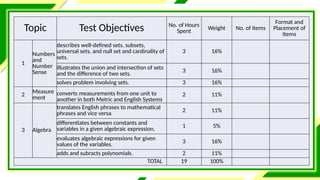
Topic Test Objectives No. of Hours
Spent Weight No. of items
Format and
Placement of
Items
1
Numbers
and
Number
Sense
describes well-defined sets, subsets,
universal sets, and null set and cardinality of
sets.
3 16%
illustrates the union and intersection of sets
and the difference of two sets.
3 16%
solves problem involving sets. 3 16%
2
Measure
ment
converts measurements from one unit to
another in both Metric and English Systems
2 11%
3 Algebra
translates English phrases to mathematical
phrases and vice versa
2 11%
differentiates between constants and
variables in a given algebraic expression. 1 5%
evaluates algebraic expressions for given
values of the variables. 3 16%
adds and subracts polynomials. 2 11%
TOTAL 19 100%
General Steps in Developing a TOS
4. Determine the number of items for the whole
test.
 Amount of time needed to answer the items are
considered.
 As a general rule, students are given 30-60 seconds for
each item in selected response tests.
General Steps in Developing a TOS
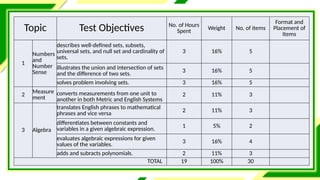
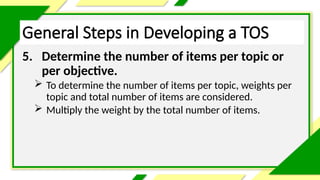
5. Determine the number of items per topic or
per objective.
 To determine the number of items per topic, weights per
topic and total number of items are considered.
 Multiply the weight by the total number of items.
Topic Test Objectives No. of Hours
Spent Weight No. of items
Format and
Placement of
Items
1
Numbers
and
Number
Sense
describes well-defined sets, subsets,
universal sets, and null set and cardinality of
sets.
3 16% 5
illustrates the union and intersection of sets
and the difference of two sets.
3 16% 5
solves problem involving sets. 3 16% 5
2
Measure
ment
converts measurements from one unit to
another in both Metric and English Systems
2 11% 3
3 Algebra
translates English phrases to mathematical
phrases and vice versa
2 11% 3
differentiates between constants and
variables in a given algebraic expression. 1 5% 2
evaluates algebraic expressions for given
values of the variables. 3 16% 4
adds and subracts polynomials. 2 11% 3
TOTAL 19 100% 30
Different Formats of Test TOS
One – way TOS
 Maps out the content or topic, test objectives, number
of hour spent, and format, number, and placement of
items.
 Easy to develop as it works around the objectives
without considering the different levels of cognitive
behaviors.
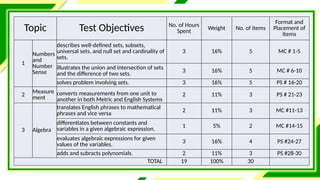
Topic Test Objectives No. of Hours
Spent Weight No. of items
Format and
Placement of
Items
1
Numbers
and
Number
Sense
describes well-defined sets, subsets,
universal sets, and null set and cardinality of
sets.
3 16% 5 MC # 1-5
illustrates the union and intersection of sets
and the difference of two sets.
3 16% 5 MC # 6-10
solves problem involving sets. 3 16% 5 PS # 16-20
2
Measure
ment
converts measurements from one unit to
another in both Metric and English Systems
2 11% 3 PS # 21-23
3 Algebra
translates English phrases to mathematical
phrases and vice versa
2 11% 3 MC #11-13
differentiates between constants and
variables in a given algebraic expression. 1 5% 2 MC #14-15
evaluates algebraic expressions for given
values of the variables. 3 16% 4 PS #24-27
adds and subracts polynomials. 2 11% 3 PS #28-30
TOTAL 19 100% 30
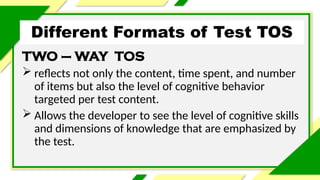
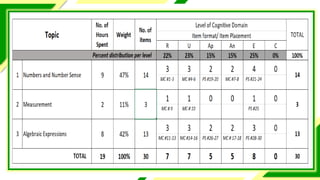
Different Formats of Test TOS
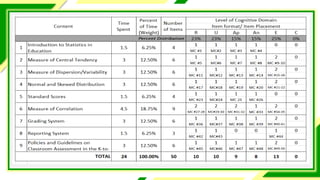
TWO – WAY TOS
 reflects not only the content, time spent, and number
of items but also the level of cognitive behavior
targeted per test content.
 Allows the developer to see the level of cognitive skills
and dimensions of knowledge that are emphasized by
the test.
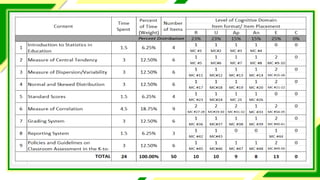
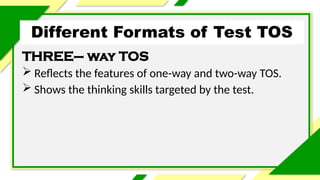
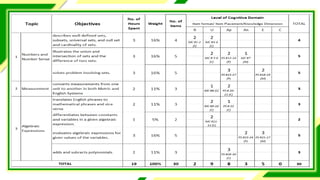
Different Formats of Test TOS
THREE– way TOS
 Reflects the features of one-way and two-way TOS.
 Shows the thinking skills targeted by the test.
Planning-a-Written-Test. prof ed 5 .pptx

Planning-a-Written-Test. prof ed 5 .pptx

  • 1.
    Lack of contentvalidity and Clarity During a class test, students notice that several questions seem unrelated to the topics covered in class. Some questions also appear ambiguous, making it difficult to determine the correct answer.
  • 2.
    Lack of consistencyand inter-rater reliability After completing a group project, students realize that the grading criteria were inconsistently applied by different instructors. Some groups received higher grades for similar work, while others received lower grades.
  • 3.
    Bias and lackof fairness During a standardized test, students from diverse cultural and linguistic backgrounds struggle with certain vocabulary and language conventions that are unfamiliar to them. As a result, their performance on these items is significantly lower compared to their peers.
  • 4.
    Lack of clarityin instructions and scoring criteria In an essay assignment, students receive vague instructions on the required length and format of their essays. Additionally, the grading rubric provided by the instructor lacks clear criteria for evaluation.
  • 5.
    Lack of authenticity Ina multiple-choice exam, students encounter questions that are overly simplistic and unrelated to real-world applications of the course material. Many students feel that the assessment does not adequately reflect the complexity of their learning.
  • 6.
    Feasibility issues Students areassigned a lengthy take-home exam with a tight deadline, requiring them to complete multiple essay questions and problem-solving tasks within a short period. Many students express frustration and stress due to the overwhelming workload and time constraints.
  • 7.
    Lack of differentiationand accessibility In a standardized test, students with disabilities are not provided with appropriate accommodations, such as extended time or assistive technology, despite their documented needs. As a result, these students struggle to demonstrate their knowledge and skills on the assessment.
  • 8.
    Lack of timelyand constructive feedback After completing a midterm exam, students receive their grades but no feedback on their performance. Many students express frustration at the lack of guidance on areas for improvement and how to enhance their learning.
  • 9.
    Lack of alignmentwith learning objectives Students complete a series of online quizzes that are not directly aligned with the course objectives or learning outcomes. Many students question the relevance of these quizzes and their contribution to their overall learning.
  • 10.
    Lack of adaptabilityand scalability In a computer-based exam, technical issues arise during the administration, causing delays and interruptions in the testing process. Despite attempts to resolve the issues, students experience frustration and anxiety due to the disruption.
  • 11.
    ABUYOG COMMUNITY COLLEGE COMPETITIVENESS, ANALYTICAL,RESILIENCY, ETHICAL, SERVICE-ORIENTED College of Arts, Sciences, and Education Planning a Written Test
  • 12.
    - a methodused by educators to measure and assess students' abilities systematically, fairly, objectively, and procedurally by giving tasks in the form of questions and statements that must be done by students so that they can produce values that symbolize student achievement. Test
  • 13.
    Characteristics of aQuality Assessment Tool 1.Validity 2.Reliability 3.Fairness 4.Clarity 5.Authenticity 6.Feasibility 7.Differentiation 8.Feedback 9.Purposefulness 10.Adaptability
  • 14.
    Important Steps inPlanning for a Test 1. Identify test objectives/lesson outcomes 2. Decide on the type of objective test to be prepared 3. Prepare a Table of Specifications (TOS) 4. Construct the draft Test Items 5. Try-out and validation
  • 15.
    Identifying the TestObjectives If one wants to have a comprehensive objective test, the test item must cover the various level of Bloom’s taxonomy.
  • 16.
    Deciding on thetype of objective test “The test objectives guide the kind of objective tests that will be designed and constructed by the teacher.”
  • 17.
    Type of ObjectiveTests Selected-response Constructed-response Alternate response Matching type Multiple Choice Sentence-completion Short answer Essay Problem-solving
  • 18.
    Prepare a Tableof Specifications (TOS) Table of Specifications  Tool used by teachers to design a test  Table that maps out the test objectives, contents, or topics covered by the test; levels of cognitive behavior to be measured; distribution of items, number, placement, and weights of test items; and the test format.  “test blueprint”
  • 20.
    Importance of TOS •Ensures that the instructional objectives and what the test captures match • Ensures that the test developer will not overlook details that are considered essential to a good test • Make developing a test easier and more efficient • Ensures that the test will sample all important content areas and processes • Offers an opportunity for teachers and students to clarify achievement
  • 21.
    General Steps inDeveloping a TOS 1. Determine the objectives of the test. 2. Determine the coverage of the test. 3. Calculate the weight for each topic.  Weight assigned for each topic in the test is based on the relevance and time spent to cover each topic during instruction.
  • 22.
    Topic Test ObjectivesNo. of Hours Spent Weight No. of items Format and Placement of Items 1 Numbers and Number Sense describes well-defined sets, subsets, universal sets, and null set and cardinality of sets. 3 16% illustrates the union and intersection of sets and the difference of two sets. 3 16% solves problem involving sets. 3 16% 2 Measure ment converts measurements from one unit to another in both Metric and English Systems 2 11% 3 Algebra translates English phrases to mathematical phrases and vice versa 2 11% differentiates between constants and variables in a given algebraic expression. 1 5% evaluates algebraic expressions for given values of the variables. 3 16% adds and subracts polynomials. 2 11% TOTAL 19 100%
  • 23.
    General Steps inDeveloping a TOS 4. Determine the number of items for the whole test.  Amount of time needed to answer the items are considered.  As a general rule, students are given 30-60 seconds for each item in selected response tests.
  • 24.
    General Steps inDeveloping a TOS 5. Determine the number of items per topic or per objective.  To determine the number of items per topic, weights per topic and total number of items are considered.  Multiply the weight by the total number of items.
  • 25.
    Topic Test ObjectivesNo. of Hours Spent Weight No. of items Format and Placement of Items 1 Numbers and Number Sense describes well-defined sets, subsets, universal sets, and null set and cardinality of sets. 3 16% 5 illustrates the union and intersection of sets and the difference of two sets. 3 16% 5 solves problem involving sets. 3 16% 5 2 Measure ment converts measurements from one unit to another in both Metric and English Systems 2 11% 3 3 Algebra translates English phrases to mathematical phrases and vice versa 2 11% 3 differentiates between constants and variables in a given algebraic expression. 1 5% 2 evaluates algebraic expressions for given values of the variables. 3 16% 4 adds and subracts polynomials. 2 11% 3 TOTAL 19 100% 30
  • 26.
    Different Formats ofTest TOS One – way TOS  Maps out the content or topic, test objectives, number of hour spent, and format, number, and placement of items.  Easy to develop as it works around the objectives without considering the different levels of cognitive behaviors.
  • 27.
    Topic Test ObjectivesNo. of Hours Spent Weight No. of items Format and Placement of Items 1 Numbers and Number Sense describes well-defined sets, subsets, universal sets, and null set and cardinality of sets. 3 16% 5 MC # 1-5 illustrates the union and intersection of sets and the difference of two sets. 3 16% 5 MC # 6-10 solves problem involving sets. 3 16% 5 PS # 16-20 2 Measure ment converts measurements from one unit to another in both Metric and English Systems 2 11% 3 PS # 21-23 3 Algebra translates English phrases to mathematical phrases and vice versa 2 11% 3 MC #11-13 differentiates between constants and variables in a given algebraic expression. 1 5% 2 MC #14-15 evaluates algebraic expressions for given values of the variables. 3 16% 4 PS #24-27 adds and subracts polynomials. 2 11% 3 PS #28-30 TOTAL 19 100% 30
  • 28.
    Different Formats ofTest TOS TWO – WAY TOS  reflects not only the content, time spent, and number of items but also the level of cognitive behavior targeted per test content.  Allows the developer to see the level of cognitive skills and dimensions of knowledge that are emphasized by the test.
  • 31.
    Different Formats ofTest TOS THREE– way TOS  Reflects the features of one-way and two-way TOS.  Shows the thinking skills targeted by the test.