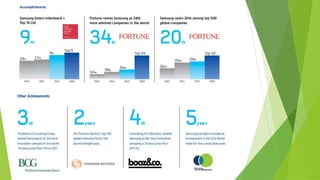
INTERNATIONAL BUSINESS MANAGEMENT(CSEB3102) 
FINAL PRESENTATION PROJECT 
Prepared for En.Mohammad Said Bin Othman
Aziza Zaldarriaga Z(CEA100708)- Phillipines 
Cian W’O Brien (NEE130235)- Denmark 
Chaymae Samir (NEC130215)-Morocco 
Dominik Wagner (NEC130217)-Germany 
Firmansyah Shidiq W(CEB110723)-Indonesia 
Haya Shadab Ali (CEB110702)-India
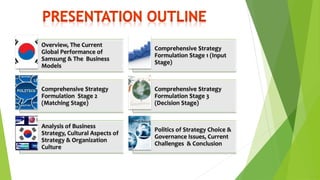
Overview, The Current 
Global Performance of 
Samsung & The Business 
Models 
Comprehensive Strategy 
Formulation Stage 1 (Input 
Stage) 
Comprehensive Strategy 
Formulation Stage 2 
(Matching Stage) 
Comprehensive Strategy 
Formulation Stage 3 
(Decision Stage) 
Analysis of Business 
Strategy, Cultural Aspects of 
Strategy & Organization 
Culture 
Politics of Strategy Choice & 
Governance Issues, Current 
Challenges & Conclusion
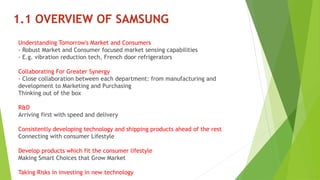
1.1 OVERVIEW OF SAMSUNG 
Understanding Tomorrow's Market and Consumers 
- Robust Market and Consumer focused market sensing capabilities 
- E.g. vibration reduction tech, French door refrigerators 
Collaborating For Greater Synergy 
- Close collaboration between each department: from manufacturing and 
development to Marketing and Purchasing 
Thinking out of the box 
R&D 
Arriving first with speed and delivery 
Consistently developing technology and shipping products ahead of the rest 
Connecting with consumer Lifestyle 
Develop products which fit the consumer lifestyle 
Making Smart Choices that Grow Market 
Taking Risks in investing in new technology
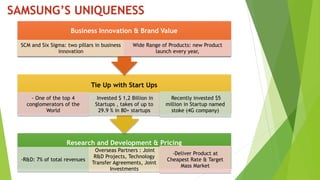
SAMSUNG’S UNIQUENESS 
Business Innovation & Brand Value 
Research and Development & Pricing 
-R&D: 7% of total revenues 
Overseas Partners : Joint 
R&D Projects, Technology 
Transfer Agreements, Joint 
Investments 
-Deliver Product at 
Cheapest Rate & Target 
Mass Market 
Tie Up with Start Ups 
- One of the top 4 
conglomerators of the 
World 
Invested $ 1,2 Billion in 
Startups , takes of up to 
29.9 % in 80+ startups 
Recently invested $5 
million in Startup named 
stoke (4G company) 
SCM and Six Sigma: two pillars in business 
innovation 
Wide Range of Products: new Product 
launch every year,
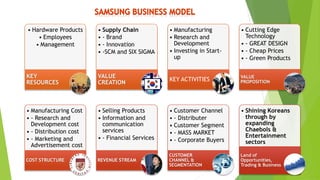
• Hardware Products 
• Employees 
• Management 
KEY 
RESOURCES 
• Supply Chain 
• - Brand 
• - Innovation 
• -SCM and SIX SIGMA 
VALUE 
CREATION 
• Manufacturing 
• Research and 
Development 
• Investing in Start-up 
KEY ACTIVITIES 
• Cutting Edge 
Technology 
• - GREAT DESIGN 
• - Cheap Prices 
• - Green Products 
VALUE 
PROPOSITION 
• Manufacturing Cost 
• - Research and 
Development cost 
• - Distribution cost 
• - Marketing and 
Advertisement cost 
COST STRUCTURE 
• Selling Products 
• Information and 
communication 
services 
• - Financial Services 
REVENUE STREAM 
• Customer Channel 
• - Distributer 
• Customer Segment 
• - MASS MARKET 
• - Corporate Buyers 
CUSTOMER 
CHANNEL & 
SEGMENTATION 
• Shining Koreans 
through by 
expanding 
Chaebols & 
Entertainment 
sectors 
Land of 
Opportunities, 
Trading & Business
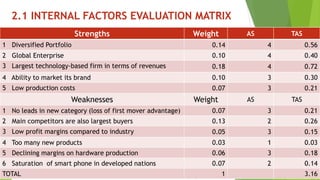
2.1 INTERNAL FACTORS EVALUATION MATRIX 
Strengths Weight AS TAS 
1 Diversified Portfolio 0.14 4 0.56 
2 Global Enterprise 0.10 4 0.40 
3 Largest technology-based firm in terms of revenues 0.18 4 0.72 
4 Ability to market its brand 0.10 3 0.30 
5 Low production costs 0.07 3 0.21 
Weaknesses Weight AS TAS 
1 No leads in new category (loss of first mover advantage) 0.07 3 0.21 
2 Main competitors are also largest buyers 0.13 2 0.26 
3 Low profit margins compared to industry 0.05 3 0.15 
4 Too many new products 0.03 1 0.03 
5 Declining margins on hardware production 0.06 3 0.18 
6 Saturation of smart phone in developed nations 0.07 2 0.14 
TOTAL 1 3.16
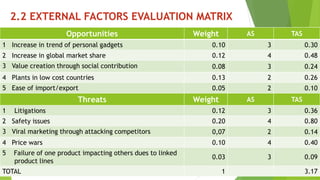
2.2 EXTERNAL FACTORS EVALUATION MATRIX 
Opportunities Weight AS TAS 
1 Increase in trend of personal gadgets 0.10 3 0.30 
2 Increase in global market share 0.12 4 0.48 
3 Value creation through social contribution 0.08 3 0.24 
4 Plants in low cost countries 0.13 2 0.26 
5 Ease of import/export 0.05 2 0.10 
Threats Weight AS TAS 
1 Litigations 0.12 3 0.36 
2 Safety issues 0.20 4 0.80 
3 Viral marketing through attacking competitors 0,07 2 0.14 
4 Price wars 0.10 4 0.40 
5 Failure of one product impacting others dues to linked 
product lines 
0.03 3 0.09 
TOTAL 1 3.17
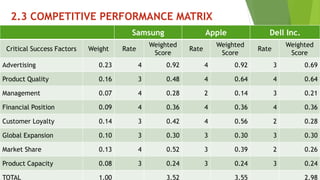
2.3 COMPETITIVE PERFORMANCE MATRIX 
Samsung Apple Dell Inc. 
Critical Success Factors Weight Rate 
Weighted 
Score 
Rate 
Weighted 
Score 
Rate 
Weighted 
Score 
Advertising 0.23 4 0.92 4 0.92 3 0.69 
Product Quality 0.16 3 0.48 4 0.64 4 0.64 
Management 0.07 4 0.28 2 0.14 3 0.21 
Financial Position 0.09 4 0.36 4 0.36 4 0.36 
Customer Loyalty 0.14 3 0.42 4 0.56 2 0.28 
Global Expansion 0.10 3 0.30 3 0.30 3 0.30 
Market Share 0.13 4 0.52 3 0.39 2 0.26 
Product Capacity 0.08 3 0.24 3 0.24 3 0.24 
TOTAL 1.00 3.52 3.55 2.98
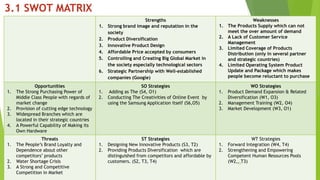
Strengths 
1. Strong brand image and reputation in the 
society 
2. Product Diversification 
3. Innovative Product Design 
4. Affordable Price accepted by consumers 
5. Controlling and Creating Big Global Market in 
the society especially technological sectors 
6. Strategic Partnership with Well-established 
companies (Google) 
Weaknesses 
1. The Products Supply which can not 
meet the over amount of demand 
2. A Lack of Customer Service 
Management 
3. Limited Coverage of Products 
Distribution (only in several partner 
and strategic countries) 
4. Limited Operating System Product 
Update and Package which makes 
people become reluctant to purchase 
Opportunities 
1. The Strong Purchasing Power of 
Middle Class People with regards of 
market change 
2. Provision of cutting edge technology 
3. Widespread Branches which are 
located in their strategic countries 
4. A Powerful Capability of Making its 
Own Hardware 
SO Strategies 
1. Adding as The (S4, O1) 
2. Conducting The Creativities of Online Event by 
using the Samsung Application itself (S6,O5) 
WO Strategies 
1. Product Demand Expansion & Related 
Diversification (W1, O3) 
2. Management Training (W2, O4) 
3. Market Development (W3, O1) 
Threats 
1. The People’s Brand Loyalty and 
Dependence about other 
competitors’ products 
2. Water Shortage Crisis 
3. A Strong and Competitive 
Competition in Market 
ST Strategies 
1. Designing New Innovative Products (S3, T2) 
2. Providing Products Diversification which are 
distinguished from competitors and affordable by 
customers. (S2, T3, T4) 
WT Strategies 
1. Forward Integration (W4, T4) 
2. Strengthening and Empowering 
Competent Human Resources Pools 
(W2,, T3) 15 
3.1 SWOT MATRIX
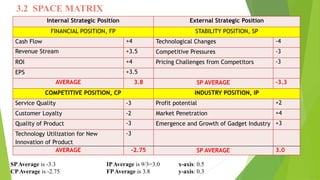
3.2 SPACE MATRIX 
Internal Strategic Position External Strategic Position 
FINANCIAL POSITION, FP STABILITY POSITION, SP 
Cash Flow +4 Technological Changes -4 
Revenue Stream +3.5 Competitive Pressures -3 
ROI +4 Pricing Challenges from Competitors -3 
EPS +3.5 
AVERAGE 3.8 SP AVERAGE -3.3 
COMPETITIVE POSITION, CP INDUSTRY POSITION, IP 
Service Quality -3 Profit potential +2 
Customer Loyalty -2 Market Penetration +4 
Quality of Product -3 Emergence and Growth of Gadget Industry +3 
Technology Utilization for New 
-3 
Innovation of Product 
AVERAGE -2.75 SP AVERAGE 3.0 
SP Average is -3.3 IP Average is 9/3=3.0 x-axis: 0.5 
CP Average is -2.75 FP Average is 3.8 y-axis: 0.3 
16
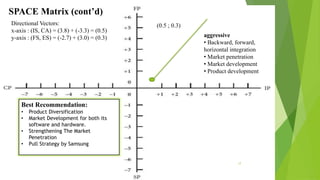
(0.5 ; 0.3) 
aggressive 
• Backward, forward, 
horizontal integration 
• Market penetration 
• Market development 
• Product development 
SPACE Matrix (cont’d) 
Best Recommendation: 
• Product Diversification 
• Market Development for both its 
software and hardware. 
• Strengthening The Market 
Penetration 
• Pull Strategy by Samsung 
17 
Directional Vectors: 
x-axis : (IS, CA) = (3.8) + (-3.3) = (0.5) 
y-axis : (FS, ES) = (-2.7) + (3.0) = (0.3)
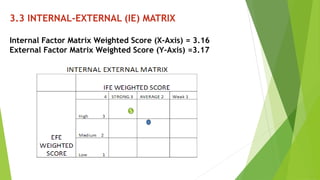
3.3 INTERNAL-EXTERNAL (IE) MATRIX 
Internal Factor Matrix Weighted Score (X-Axis) = 3.16 
External Factor Matrix Weighted Score (Y-Axis) =3.17 
S
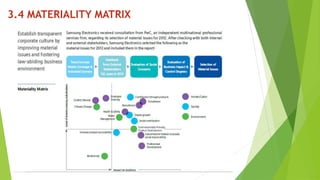
3.4 MATERIALITY MATRIX
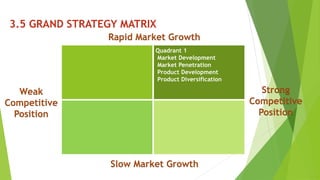
3.5 GRAND STRATEGY MATRIX 
Rapid Market Growth 
Quadrant 1 
Market Development 
Market Penetration 
Product Development 
Product Diversification 
Slow Market Growth 
Weak 
Competitive 
Position 
Strong 
Competitive 
Position
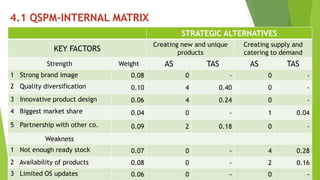
4.1 QSPM-INTERNAL MATRIX 
STRATEGIC ALTERNATIVES 
KEY FACTORS 
Creating new and unique 
products 
Creating supply and 
catering to demand 
Strength Weight AS TAS AS TAS 
1 Strong brand image 0.08 0 - 0 - 
2 Quality diversification 0.10 4 0.40 0 - 
3 Innovative product design 0.06 4 0.24 0 - 
4 Biggest market share 0.04 0 - 1 0.04 
5 Partnership with other co. 0.09 2 0.18 0 - 
Weakness 
1 Not enough ready stock 0.07 0 - 4 0.28 
2 Availability of products 0.08 0 - 2 0.16 
3 Limited OS updates 0.06 0 - 0 -
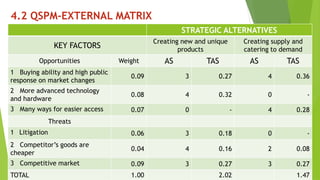
4.2 QSPM-EXTERNAL MATRIX 
STRATEGIC ALTERNATIVES 
KEY FACTORS 
Creating new and unique 
products 
Creating supply and 
catering to demand 
Opportunities Weight AS TAS AS TAS 
1 Buying ability and high public 
response on market changes 
0.09 3 0.27 4 0.36 
2 More advanced technology 
and hardware 
0.08 4 0.32 0 - 
3 Many ways for easier access 0.07 0 - 4 0.28 
Threats 
1 Litigation 0.06 3 0.18 0 - 
2 Competitor’s goods are 
0.04 4 0.16 2 0.08 
cheaper 
3 Competitive market 0.09 3 0.27 3 0.27 
TOTAL 1.00 2.02 1.47
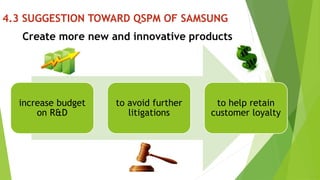
4.3 SUGGESTION TOWARD QSPM OF SAMSUNG 
Create more new and innovative products 
increase budget 
on R&D 
to avoid further 
litigations 
to help retain 
customer loyalty
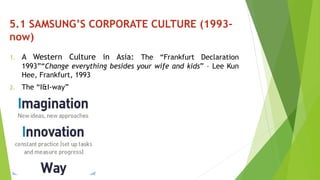
5.1 SAMSUNG’S CORPORATE CULTURE (1993- 
now) 
1. A Western Culture in Asia: The “Frankfurt Declaration 
1993”“Change everything besides your wife and kids” – Lee Kun 
Hee, Frankfurt, 1993 
2. The “I&I-way”
5.2 HOFSTEDIAN ANALYSIS OF SAMSUNGS’S 
CORPORATE CULTURE 
1. Korea scores high (world ranking) on Power Distance (28), 
Collectivism (43), Masculinity (41), and Uncertainty 
Avoidance (16) 
2. Western Countries as US and Germany scores low on Power 
Distance (40/35), Collectivism (91/67), and Uncertainty 
Avoidance (46/86), but high on Masculinity (62/65) 
3. In Samsung these values have been merged: Asian-Western 
Western: Low Power Distance, and Uncertainty Avoidance 
Asian: High Collectivism, and Masculinity
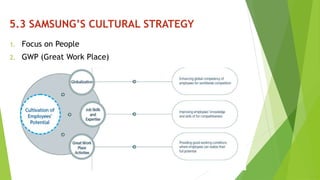
5.3 SAMSUNG’S CULTURAL STRATEGY 
1. Focus on People 
2. GWP (Great Work Place)
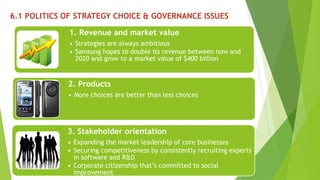
6.1 POLITICS OF STRATEGY CHOICE & GOVERNANCE ISSUES 
1. Revenue and market value 
• Strategies are always ambitious 
• Samsung hopes to double its revenue between now and 
2020 and grow to a market value of $400 billion 
2. Products 
• More choices are better than less choices 
3. Stakeholder orientation 
• Expanding the market leadership of core businesses 
• Securing competitiveness by consistently recruiting experts 
in software and R&D 
• Corporate citizenship that’s committed to social 
improvement
6.1 POLITICS OF STRATEGY CHOICE & GOVERNANCE ISSUES 
Governance issues: 
1. Abuse of market power 
2. Authoritarian and reckless 
leadership
6.2 CURRENT CHALLENGES OF SAMSUNG 
1. Innovation driven company 
• Risk of losing edge during downtime 
2. Ongoing series of lawsuits against 
Apple 
• More than 30 patent and design lawsuits globally 
3. Conflict of interest 
• Supplier/competitor relationships
6.3 CONCLUSION 
1. General: 
• South Korea’s most important Chaebol 
• Wide range of products with annual updates 
2. Strategy recommendation: 
• SPACE Matrix: Market development, product 
diversification, pull strategy 
• Grand Strategy Matrix: Strong competitive position and 
rapid market growth 
• QSPM Matrix: R&D, avoid litigations, customer loyalty 
3. Culture: 
• Collectivistic and masculine 
• Great Workplace (GWP) program
REFERENCES 
1. Hofstede’s Cultural Values by Nation found in: 
Robbins, S.P., and Judge, T. A., Organizational Behaviour, Fifteenth Edition, 
Pearson Education Ldt, 2013, p. 186 
2. Description of Hofstede’s Cultural Values found in: 
Hill, C. W. L., Wee C., Udayasankar K., International Business – An Asian 
Perspective, McGraw-Hill, 2012, p. 109 
3. Cultural Strategy from 1993-now found on: 
http://www.businessinsider.com/how-samsung-became-the-biggest-electronics-company- 
in-the-world-2013-3 
http://hbr.org/2011/07/the-globe-the-paradox-of-samsungs-rise/ 
4. Present cultural strategy found on: 
http://www.samsung.com/us/aboutsamsung/sustainability/integritymanageme 
nt/download/building_a_creative_corporate_culture.pdf 
5. The I&I-way http://www.scp.samsung.com/company/comCulture.asp
Group 2B 
Class Presentation 
Week 13 (9th December 2013)

SAMSUNG: Comprehensive Strategic Analysis from International Business Management Perspective

  • 1.
    INTERNATIONAL BUSINESS MANAGEMENT(CSEB3102) FINAL PRESENTATION PROJECT Prepared for En.Mohammad Said Bin Othman
  • 2.
    Aziza Zaldarriaga Z(CEA100708)-Phillipines Cian W’O Brien (NEE130235)- Denmark Chaymae Samir (NEC130215)-Morocco Dominik Wagner (NEC130217)-Germany Firmansyah Shidiq W(CEB110723)-Indonesia Haya Shadab Ali (CEB110702)-India
  • 3.
    Overview, The Current Global Performance of Samsung & The Business Models Comprehensive Strategy Formulation Stage 1 (Input Stage) Comprehensive Strategy Formulation Stage 2 (Matching Stage) Comprehensive Strategy Formulation Stage 3 (Decision Stage) Analysis of Business Strategy, Cultural Aspects of Strategy & Organization Culture Politics of Strategy Choice & Governance Issues, Current Challenges & Conclusion
  • 5.
    1.1 OVERVIEW OFSAMSUNG Understanding Tomorrow's Market and Consumers - Robust Market and Consumer focused market sensing capabilities - E.g. vibration reduction tech, French door refrigerators Collaborating For Greater Synergy - Close collaboration between each department: from manufacturing and development to Marketing and Purchasing Thinking out of the box R&D Arriving first with speed and delivery Consistently developing technology and shipping products ahead of the rest Connecting with consumer Lifestyle Develop products which fit the consumer lifestyle Making Smart Choices that Grow Market Taking Risks in investing in new technology
  • 6.
    SAMSUNG’S UNIQUENESS BusinessInnovation & Brand Value Research and Development & Pricing -R&D: 7% of total revenues Overseas Partners : Joint R&D Projects, Technology Transfer Agreements, Joint Investments -Deliver Product at Cheapest Rate & Target Mass Market Tie Up with Start Ups - One of the top 4 conglomerators of the World Invested $ 1,2 Billion in Startups , takes of up to 29.9 % in 80+ startups Recently invested $5 million in Startup named stoke (4G company) SCM and Six Sigma: two pillars in business innovation Wide Range of Products: new Product launch every year,
  • 8.
    • Hardware Products • Employees • Management KEY RESOURCES • Supply Chain • - Brand • - Innovation • -SCM and SIX SIGMA VALUE CREATION • Manufacturing • Research and Development • Investing in Start-up KEY ACTIVITIES • Cutting Edge Technology • - GREAT DESIGN • - Cheap Prices • - Green Products VALUE PROPOSITION • Manufacturing Cost • - Research and Development cost • - Distribution cost • - Marketing and Advertisement cost COST STRUCTURE • Selling Products • Information and communication services • - Financial Services REVENUE STREAM • Customer Channel • - Distributer • Customer Segment • - MASS MARKET • - Corporate Buyers CUSTOMER CHANNEL & SEGMENTATION • Shining Koreans through by expanding Chaebols & Entertainment sectors Land of Opportunities, Trading & Business
  • 10.
    2.1 INTERNAL FACTORSEVALUATION MATRIX Strengths Weight AS TAS 1 Diversified Portfolio 0.14 4 0.56 2 Global Enterprise 0.10 4 0.40 3 Largest technology-based firm in terms of revenues 0.18 4 0.72 4 Ability to market its brand 0.10 3 0.30 5 Low production costs 0.07 3 0.21 Weaknesses Weight AS TAS 1 No leads in new category (loss of first mover advantage) 0.07 3 0.21 2 Main competitors are also largest buyers 0.13 2 0.26 3 Low profit margins compared to industry 0.05 3 0.15 4 Too many new products 0.03 1 0.03 5 Declining margins on hardware production 0.06 3 0.18 6 Saturation of smart phone in developed nations 0.07 2 0.14 TOTAL 1 3.16
  • 11.
    2.2 EXTERNAL FACTORSEVALUATION MATRIX Opportunities Weight AS TAS 1 Increase in trend of personal gadgets 0.10 3 0.30 2 Increase in global market share 0.12 4 0.48 3 Value creation through social contribution 0.08 3 0.24 4 Plants in low cost countries 0.13 2 0.26 5 Ease of import/export 0.05 2 0.10 Threats Weight AS TAS 1 Litigations 0.12 3 0.36 2 Safety issues 0.20 4 0.80 3 Viral marketing through attacking competitors 0,07 2 0.14 4 Price wars 0.10 4 0.40 5 Failure of one product impacting others dues to linked product lines 0.03 3 0.09 TOTAL 1 3.17
  • 12.
    2.3 COMPETITIVE PERFORMANCEMATRIX Samsung Apple Dell Inc. Critical Success Factors Weight Rate Weighted Score Rate Weighted Score Rate Weighted Score Advertising 0.23 4 0.92 4 0.92 3 0.69 Product Quality 0.16 3 0.48 4 0.64 4 0.64 Management 0.07 4 0.28 2 0.14 3 0.21 Financial Position 0.09 4 0.36 4 0.36 4 0.36 Customer Loyalty 0.14 3 0.42 4 0.56 2 0.28 Global Expansion 0.10 3 0.30 3 0.30 3 0.30 Market Share 0.13 4 0.52 3 0.39 2 0.26 Product Capacity 0.08 3 0.24 3 0.24 3 0.24 TOTAL 1.00 3.52 3.55 2.98
  • 15.
    Strengths 1. Strongbrand image and reputation in the society 2. Product Diversification 3. Innovative Product Design 4. Affordable Price accepted by consumers 5. Controlling and Creating Big Global Market in the society especially technological sectors 6. Strategic Partnership with Well-established companies (Google) Weaknesses 1. The Products Supply which can not meet the over amount of demand 2. A Lack of Customer Service Management 3. Limited Coverage of Products Distribution (only in several partner and strategic countries) 4. Limited Operating System Product Update and Package which makes people become reluctant to purchase Opportunities 1. The Strong Purchasing Power of Middle Class People with regards of market change 2. Provision of cutting edge technology 3. Widespread Branches which are located in their strategic countries 4. A Powerful Capability of Making its Own Hardware SO Strategies 1. Adding as The (S4, O1) 2. Conducting The Creativities of Online Event by using the Samsung Application itself (S6,O5) WO Strategies 1. Product Demand Expansion & Related Diversification (W1, O3) 2. Management Training (W2, O4) 3. Market Development (W3, O1) Threats 1. The People’s Brand Loyalty and Dependence about other competitors’ products 2. Water Shortage Crisis 3. A Strong and Competitive Competition in Market ST Strategies 1. Designing New Innovative Products (S3, T2) 2. Providing Products Diversification which are distinguished from competitors and affordable by customers. (S2, T3, T4) WT Strategies 1. Forward Integration (W4, T4) 2. Strengthening and Empowering Competent Human Resources Pools (W2,, T3) 15 3.1 SWOT MATRIX
  • 16.
    3.2 SPACE MATRIX Internal Strategic Position External Strategic Position FINANCIAL POSITION, FP STABILITY POSITION, SP Cash Flow +4 Technological Changes -4 Revenue Stream +3.5 Competitive Pressures -3 ROI +4 Pricing Challenges from Competitors -3 EPS +3.5 AVERAGE 3.8 SP AVERAGE -3.3 COMPETITIVE POSITION, CP INDUSTRY POSITION, IP Service Quality -3 Profit potential +2 Customer Loyalty -2 Market Penetration +4 Quality of Product -3 Emergence and Growth of Gadget Industry +3 Technology Utilization for New -3 Innovation of Product AVERAGE -2.75 SP AVERAGE 3.0 SP Average is -3.3 IP Average is 9/3=3.0 x-axis: 0.5 CP Average is -2.75 FP Average is 3.8 y-axis: 0.3 16
  • 17.
    (0.5 ; 0.3) aggressive • Backward, forward, horizontal integration • Market penetration • Market development • Product development SPACE Matrix (cont’d) Best Recommendation: • Product Diversification • Market Development for both its software and hardware. • Strengthening The Market Penetration • Pull Strategy by Samsung 17 Directional Vectors: x-axis : (IS, CA) = (3.8) + (-3.3) = (0.5) y-axis : (FS, ES) = (-2.7) + (3.0) = (0.3)
  • 18.
    3.3 INTERNAL-EXTERNAL (IE)MATRIX Internal Factor Matrix Weighted Score (X-Axis) = 3.16 External Factor Matrix Weighted Score (Y-Axis) =3.17 S
  • 19.
  • 21.
    3.5 GRAND STRATEGYMATRIX Rapid Market Growth Quadrant 1 Market Development Market Penetration Product Development Product Diversification Slow Market Growth Weak Competitive Position Strong Competitive Position
  • 23.
    4.1 QSPM-INTERNAL MATRIX STRATEGIC ALTERNATIVES KEY FACTORS Creating new and unique products Creating supply and catering to demand Strength Weight AS TAS AS TAS 1 Strong brand image 0.08 0 - 0 - 2 Quality diversification 0.10 4 0.40 0 - 3 Innovative product design 0.06 4 0.24 0 - 4 Biggest market share 0.04 0 - 1 0.04 5 Partnership with other co. 0.09 2 0.18 0 - Weakness 1 Not enough ready stock 0.07 0 - 4 0.28 2 Availability of products 0.08 0 - 2 0.16 3 Limited OS updates 0.06 0 - 0 -
  • 24.
    4.2 QSPM-EXTERNAL MATRIX STRATEGIC ALTERNATIVES KEY FACTORS Creating new and unique products Creating supply and catering to demand Opportunities Weight AS TAS AS TAS 1 Buying ability and high public response on market changes 0.09 3 0.27 4 0.36 2 More advanced technology and hardware 0.08 4 0.32 0 - 3 Many ways for easier access 0.07 0 - 4 0.28 Threats 1 Litigation 0.06 3 0.18 0 - 2 Competitor’s goods are 0.04 4 0.16 2 0.08 cheaper 3 Competitive market 0.09 3 0.27 3 0.27 TOTAL 1.00 2.02 1.47
  • 25.
    4.3 SUGGESTION TOWARDQSPM OF SAMSUNG Create more new and innovative products increase budget on R&D to avoid further litigations to help retain customer loyalty
  • 27.
    5.1 SAMSUNG’S CORPORATECULTURE (1993- now) 1. A Western Culture in Asia: The “Frankfurt Declaration 1993”“Change everything besides your wife and kids” – Lee Kun Hee, Frankfurt, 1993 2. The “I&I-way”
  • 28.
    5.2 HOFSTEDIAN ANALYSISOF SAMSUNGS’S CORPORATE CULTURE 1. Korea scores high (world ranking) on Power Distance (28), Collectivism (43), Masculinity (41), and Uncertainty Avoidance (16) 2. Western Countries as US and Germany scores low on Power Distance (40/35), Collectivism (91/67), and Uncertainty Avoidance (46/86), but high on Masculinity (62/65) 3. In Samsung these values have been merged: Asian-Western Western: Low Power Distance, and Uncertainty Avoidance Asian: High Collectivism, and Masculinity
  • 29.
    5.3 SAMSUNG’S CULTURALSTRATEGY 1. Focus on People 2. GWP (Great Work Place)
  • 31.
    6.1 POLITICS OFSTRATEGY CHOICE & GOVERNANCE ISSUES 1. Revenue and market value • Strategies are always ambitious • Samsung hopes to double its revenue between now and 2020 and grow to a market value of $400 billion 2. Products • More choices are better than less choices 3. Stakeholder orientation • Expanding the market leadership of core businesses • Securing competitiveness by consistently recruiting experts in software and R&D • Corporate citizenship that’s committed to social improvement
  • 32.
    6.1 POLITICS OFSTRATEGY CHOICE & GOVERNANCE ISSUES Governance issues: 1. Abuse of market power 2. Authoritarian and reckless leadership
  • 33.
    6.2 CURRENT CHALLENGESOF SAMSUNG 1. Innovation driven company • Risk of losing edge during downtime 2. Ongoing series of lawsuits against Apple • More than 30 patent and design lawsuits globally 3. Conflict of interest • Supplier/competitor relationships
  • 34.
    6.3 CONCLUSION 1.General: • South Korea’s most important Chaebol • Wide range of products with annual updates 2. Strategy recommendation: • SPACE Matrix: Market development, product diversification, pull strategy • Grand Strategy Matrix: Strong competitive position and rapid market growth • QSPM Matrix: R&D, avoid litigations, customer loyalty 3. Culture: • Collectivistic and masculine • Great Workplace (GWP) program
  • 35.
    REFERENCES 1. Hofstede’sCultural Values by Nation found in: Robbins, S.P., and Judge, T. A., Organizational Behaviour, Fifteenth Edition, Pearson Education Ldt, 2013, p. 186 2. Description of Hofstede’s Cultural Values found in: Hill, C. W. L., Wee C., Udayasankar K., International Business – An Asian Perspective, McGraw-Hill, 2012, p. 109 3. Cultural Strategy from 1993-now found on: http://www.businessinsider.com/how-samsung-became-the-biggest-electronics-company- in-the-world-2013-3 http://hbr.org/2011/07/the-globe-the-paradox-of-samsungs-rise/ 4. Present cultural strategy found on: http://www.samsung.com/us/aboutsamsung/sustainability/integritymanageme nt/download/building_a_creative_corporate_culture.pdf 5. The I&I-way http://www.scp.samsung.com/company/comCulture.asp
  • 37.
    Group 2B ClassPresentation Week 13 (9th December 2013)