





























Masterclass
Innovation Strategy
Iraklis Agiovlasitis
FFG
Austrian Research Promotion Agency
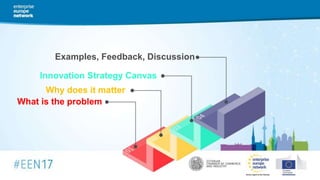
What is the problem
Why does it matter
Innovation Strategy Canvas
Examples, Feedback, Discussion
how it all started…
Thomas Röblreiter
FFG
Austrian Research Promotion Agency
01 //
What is the
problem?
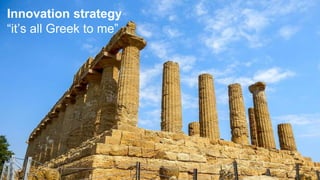
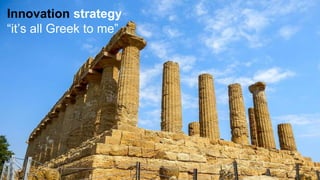
Innovation strategy
“it’s all Greek to me”
Innovation strategy
“it’s all Greek to me”
Innovation strategy
“it’s all Greek to me”
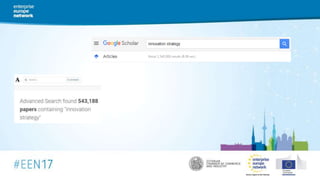
Innovation strategy
“it’s all Greek to me”
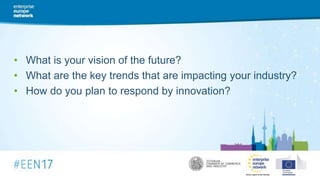
• What is your vision of the future?
• What are the key trends that are impacting your industry?
• How do you plan to respond by innovation?
case 1:
silence
case 2:
intruder
case 3: pluralism
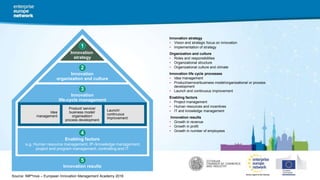
Innovation strategy
• Vision and strategic focus on innovation
• Implementation of strategy
Organization and culture
• Roles and responsibilities
• Organizational structure
• Organizational culture and climate
Innovation life cycle processes
• Idea management
• Product/service/business model/organizational or process
development
• Launch and continuous improvement
Enabling factors
• Project management
• Human resources and incentives
• IT and knowledge management
Innovation results
• Growth in revenue
• Growth in profit
• Growth in number of employees
Innovation results
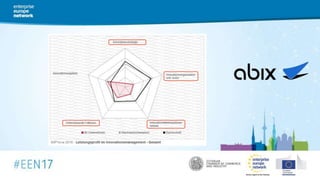
Innovation
life-cycle management
Enabling factors
e.g. Human resource management, IP-/knowledge management,
project and program management, controlling and IT
Innovation
organization and culture
Product/ service/
business model/
organisation/
process development
Idea
management
Launch/
continuous
improvement
Innovation
strategy
1
2
3
4
5
Source: IMP³rove – European Innovation Management Academy 2016
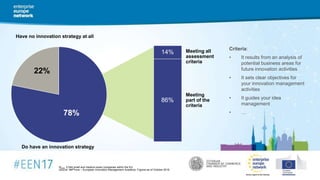
Strategy
“the roof is on fire”
Meeting
part of the
criteria
Meeting all
assessment
criteria
86%
14%
Have no innovation strategy at all
Do have an innovation strategy
Ntotal= 2,544 small and medium-sized companies within the EU
Source: IMP³rove – European Innovation Management Academy; Figures as of October 2016
Criteria:
• It results from an analysis of
potential business areas for
future innovation activities
• It sets clear objectives for
your innovation management
activities
• It guides your idea
management
• …
22%
78%
the
apple
problem
the
coherency problem
02 //
Why does it
matter?
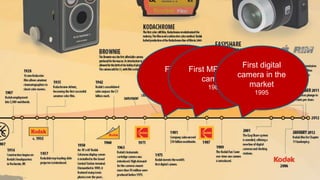
First digital
camera
1975
First MP digital
camera
1986
First digital
camera in the
market
1995
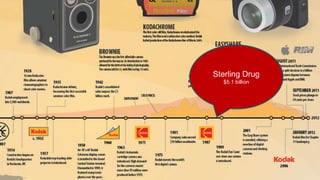
Sterling Drug
$5.1 billion
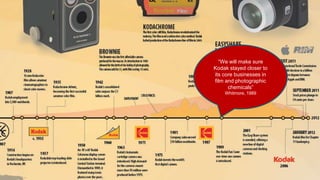
“We will make sure
Kodak stayed closer to
its core businesses in
film and photographic
chemicals”
Whitmore, 1989
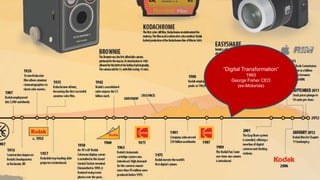
“Digital Transformation”
1993
George Fisher CEO
(ex-Motorola)
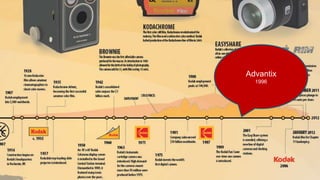
Advantix
1996
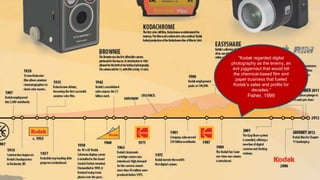
“Kodak regarded digital
photography as the enemy, an
evil juggernaut that would kill
the chemical-based film and
paper business that fueled
Kodak’s sales and profits for
decades.”
Fisher, 1999
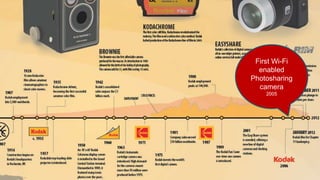
First Wi-Fi
enabled
Photosharing
camera
2005
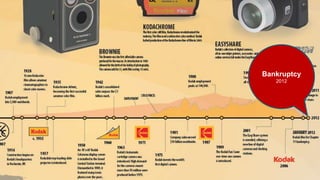
Bankruptcy
2012
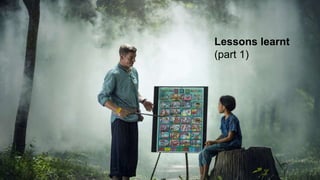
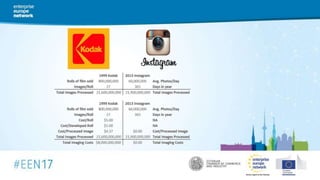
Lessons learnt
(part 1)
• Don't be afraid to cannibalize your
own business in the name of progress.
• Are you committed to innovation?
but how is this
really relevant to our* clients?
*only SMEs are eligible for the EIMC service
Lessons learnt
(part 2)
• Smaller companies can be the disruptive force in the
economy…
• …if they can innovate in a strategic manner!
theory
(but quick)
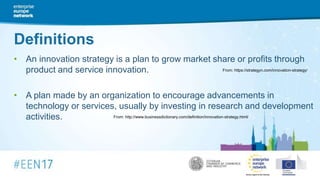
Definitions
• An innovation strategy is a plan to grow market share or profits through
product and service innovation.
• A plan made by an organization to encourage advancements in
technology or services, usually by investing in research and development
activities.
From: https://strategyn.com/innovation-strategy/
From: http://www.businessdictionary.com/definition/innovation-strategy.html/
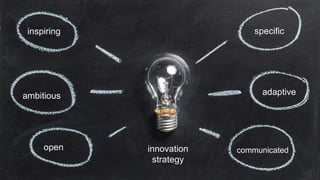
inspiring
ambitious
open
specific
communicated
adaptive
innovation
strategy
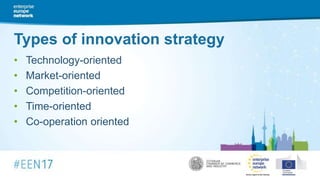
Types of innovation strategy
• Technology-oriented
• Market-oriented
• Competition-oriented
• Time-oriented
• Co-operation oriented
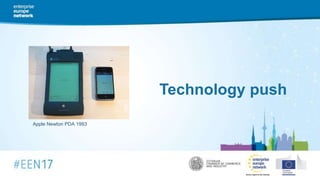
Technology push
Apple Newton PDA 1993
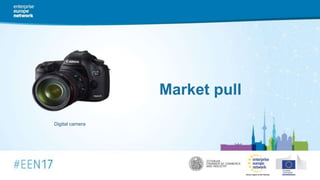
Market pull
Digital camera
Market pull
Competion
Always better
Big wishes, small prices
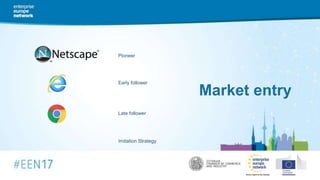
Market entry
Pioneer
Early follower
Late follower
Imitation Strategy
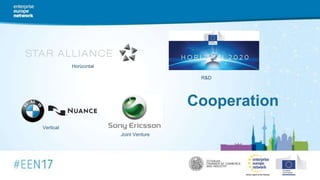
Cooperation
Horizontal
R&D
Vertical
Joint Venture
Action!
back to where
it all started…
03 //
Innovation
Strategy
Canvas
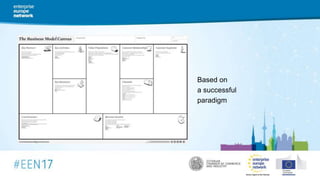
Based on
a successful
paradigm
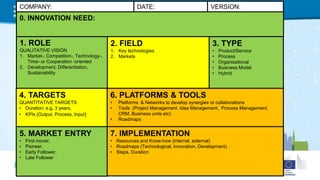
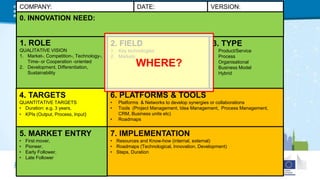
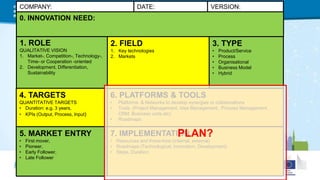
1. ROLE
QUALITATIVE VISION
1. Market-, Competition-, Technology-,
Time- or Cooperation -oriented
2. Development, Differentiation,
Sustainability
COMPANY: VERSION:
4. TARGETS
QUANTITATIVE TARGETS
• Duration: e.g. 3 years,
• KPIs (Output, Process, Input)
2. FIELD
1. Key technologies
2. Markets
3. TYPE
• Product/Service
• Process
• Organisational
• Business Model
• Hybrid
5. MARKET ENTRY
• First mover,
• Pioneer,
• Early Follower,
• Late Follower
6. PLATFORMS & TOOLS
• Platforms & Networks to develop synergies or collaborations
• Tools (Project Management, Idea Management, Process Management,
CRM, Business units etc)
• Roadmaps
7. IMPLEMENTATION
• Resources and Know-how (internal, external)
• Roadmaps (Technological, Innovation, Development)
• Steps, Duration
DATE:
0. INNOVATION NEED:
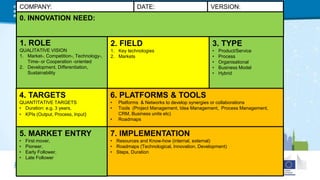
1. ROLE
QUALITATIVE VISION
1. Market-, Competition-, Technology-,
Time- or Cooperation -oriented
2. Development, Differentiation,
Sustainability
COMPANY: VERSION:
4. TARGETS
QUANTITATIVE TARGETS
• Duration: e.g. 3 years,
• KPIs (Output, Process, Input)
2. FIELD
1. Key technologies
2. Markets
3. TYPE
• Product/Service
• Process
• Organisational
• Business Model
• Hybrid
5. MARKET ENTRY
• First mover,
• Pioneer,
• Early Follower,
• Late Follower
6. PLATFORMS & TOOLS
• Platforms & Networks to develop synergies or collaborations
• Tools (Project Management, Idea Management, Process Management,
CRM, Business units etc)
• Roadmaps
7. IMPLEMENTATION
• Resources and Know-how (internal, external)
• Roadmaps (Technological, Innovation, Development)
• Steps, Duration
DATE:
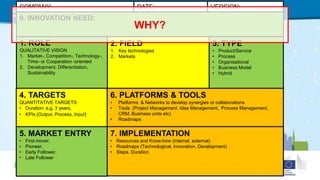
0. INNOVATION NEED:
WHY?
1. ROLE
QUALITATIVE VISION
1. Market-, Competition-, Technology-,
Time- or Cooperation -oriented
2. Development, Differentiation,
Sustainability
COMPANY: VERSION:
4. TARGETS
QUANTITATIVE TARGETS
• Duration: e.g. 3 years,
• KPIs (Output, Process, Input)
2. FIELD
1. Key technologies
2. Markets
3. TYPE
• Product/Service
• Process
• Organisational
• Business Model
• Hybrid
5. MARKET ENTRY
• First mover,
• Pioneer,
• Early Follower,
• Late Follower
6. PLATFORMS & TOOLS
• Platforms & Networks to develop synergies or collaborations
• Tools (Project Management, Idea Management, Process Management,
CRM, Business units etc)
• Roadmaps
7. IMPLEMENTATION
• Resources and Know-how (internal, external)
• Roadmaps (Technological, Innovation, Development)
• Steps, Duration
DATE:
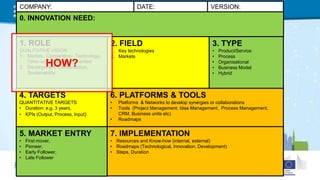
0. INNOVATION NEED:
HOW?
1. ROLE
QUALITATIVE VISION
1. Market-, Competition-, Technology-,
Time- or Cooperation -oriented
2. Development, Differentiation,
Sustainability
COMPANY: VERSION:
4. TARGETS
QUANTITATIVE TARGETS
• Duration: e.g. 3 years,
• KPIs (Output, Process, Input)
2. FIELD
1. Key technologies
2. Markets
3. TYPE
• Product/Service
• Process
• Organisational
• Business Model
• Hybrid
5. MARKET ENTRY
• First mover,
• Pioneer,
• Early Follower,
• Late Follower
6. PLATFORMS & TOOLS
• Platforms & Networks to develop synergies or collaborations
• Tools (Project Management, Idea Management, Process Management,
CRM, Business units etc)
• Roadmaps
7. IMPLEMENTATION
• Resources and Know-how (internal, external)
• Roadmaps (Technological, Innovation, Development)
• Steps, Duration
DATE:
0. INNOVATION NEED:
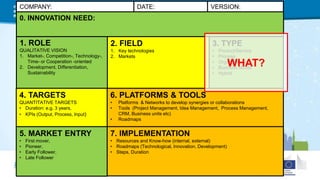
WHERE?
1. ROLE
QUALITATIVE VISION
1. Market-, Competition-, Technology-,
Time- or Cooperation -oriented
2. Development, Differentiation,
Sustainability
COMPANY: VERSION:
4. TARGETS
QUANTITATIVE TARGETS
• Duration: e.g. 3 years,
• KPIs (Output, Process, Input)
2. FIELD
1. Key technologies
2. Markets
3. TYPE
• Product/Service
• Process
• Organisational
• Business Model
• Hybrid
5. MARKET ENTRY
• First mover,
• Pioneer,
• Early Follower,
• Late Follower
6. PLATFORMS & TOOLS
• Platforms & Networks to develop synergies or collaborations
• Tools (Project Management, Idea Management, Process Management,
CRM, Business units etc)
• Roadmaps
7. IMPLEMENTATION
• Resources and Know-how (internal, external)
• Roadmaps (Technological, Innovation, Development)
• Steps, Duration
DATE:
0. INNOVATION NEED:
WHAT?
1. ROLE
QUALITATIVE VISION
1. Market-, Competition-, Technology-,
Time- or Cooperation -oriented
2. Development, Differentiation,
Sustainability
COMPANY: VERSION:
4. TARGETS
QUANTITATIVE TARGETS
• Duration: e.g. 3 years,
• KPIs (Output, Process, Input)
2. FIELD
1. Key technologies
2. Markets
3. TYPE
• Product/Service
• Process
• Organisational
• Business Model
• Hybrid
5. MARKET ENTRY
• First mover,
• Pioneer,
• Early Follower,
• Late Follower
6. PLATFORMS & TOOLS
• Platforms & Networks to develop synergies or collaborations
• Tools (Project Management, Idea Management, Process Management,
CRM, Business units etc)
• Roadmaps
7. IMPLEMENTATION
• Resources and Know-how (internal, external)
• Roadmaps (Technological, Innovation, Development)
• Steps, Duration
DATE:
0. INNOVATION NEED:
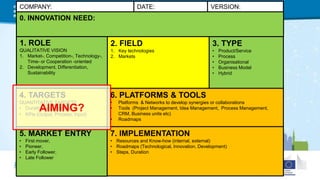
AIMING?
1. ROLE
QUALITATIVE VISION
1. Market-, Competition-, Technology-,
Time- or Cooperation -oriented
2. Development, Differentiation,
Sustainability
COMPANY: VERSION:
4. TARGETS
QUANTITATIVE TARGETS
• Duration: e.g. 3 years,
• KPIs (Output, Process, Input)
2. FIELD
1. Key technologies
2. Markets
3. TYPE
• Product/Service
• Process
• Organisational
• Business Model
• Hybrid
5. MARKET ENTRY
• First mover,
• Pioneer,
• Early Follower,
• Late Follower
6. PLATFORMS & TOOLS
• Platforms & Networks to develop synergies or collaborations
• Tools (Project Management, Idea Management, Process Management,
CRM, Business units etc)
• Roadmaps
7. IMPLEMENTATION
• Resources and Know-how (internal, external)
• Roadmaps (Technological, Innovation, Development)
• Steps, Duration
DATE:
0. INNOVATION NEED:
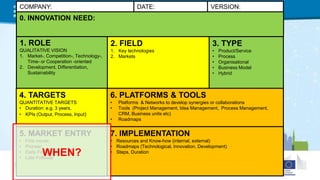
WHEN?
1. ROLE
QUALITATIVE VISION
1. Market-, Competition-, Technology-,
Time- or Cooperation -oriented
2. Development, Differentiation,
Sustainability
COMPANY: VERSION:
4. TARGETS
QUANTITATIVE TARGETS
• Duration: e.g. 3 years,
• KPIs (Output, Process, Input)
2. FIELD
1. Key technologies
2. Markets
3. TYPE
• Product/Service
• Process
• Organisational
• Business Model
• Hybrid
5. MARKET ENTRY
• First mover,
• Pioneer,
• Early Follower,
• Late Follower
6. PLATFORMS & TOOLS
• Platforms & Networks to develop synergies or collaborations
• Tools (Project Management, Idea Management, Process Management,
CRM, Business units etc)
• Roadmaps
7. IMPLEMENTATION
• Resources and Know-how (internal, external)
• Roadmaps (Technological, Innovation, Development)
• Steps, Duration
DATE:
0. INNOVATION NEED:
PLAN?
1. ROLE
QUALITATIVE VISION
1. Market-, Competition-, Technology-,
Time- or Cooperation -oriented
2. Development, Differentiation,
Sustainability
COMPANY: VERSION:
4. TARGETS
QUANTITATIVE TARGETS
• Duration: e.g. 3 years,
• KPIs (Output, Process, Input)
2. FIELD
1. Key technologies
2. Markets
3. TYPE
• Product/Service
• Process
• Organisational
• Business Model
• Hybrid
5. MARKET ENTRY
• First mover,
• Pioneer,
• Early Follower,
• Late Follower
6. PLATFORMS & TOOLS
• Platforms & Networks to develop synergies or collaborations
• Tools (Project Management, Idea Management, Process Management,
CRM, Business units etc)
• Roadmaps
7. IMPLEMENTATION
• Resources and Know-how (internal, external)
• Roadmaps (Technological, Innovation, Development)
• Steps, Duration
DATE:
0. INNOVATION NEED:
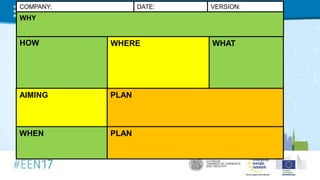
HOW
COMPANY: VERSION:
AIMING
WHERE WHAT
WHEN
PLAN
PLAN
DATE:
WHY
Method
(in the framework
of EIMC)
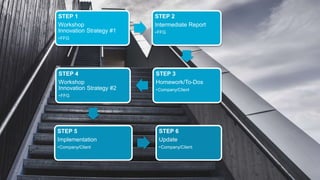
STEP 1
Workshop
Innovation Strategy #1
•FFG
STEP 2
Intermediate Report
•FFG
STEP 3
Homework/To-Dos
•Company/Client
STEP 4
Workshop
Innovation Strategy #2
•FFG
STEP 5
Implementation
•Company/Client
STEP 6
Update
•Company/Client
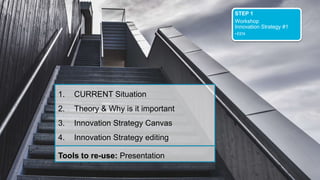
STEP 1
Workshop
Innovation Strategy #1
• EEN
1. CURRENT Situation
2. Theory & Why is it important
3. Innovation Strategy Canvas
4. Innovation Strategy editing
Tools to re-use: Presentation
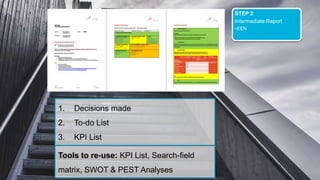
STEP 2
Intermediate Report
•EEN
1. Decisions made
2. To-do List
3. KPI List
Tools to re-use: KPI List, Search-field
matrix, SWOT & PEST Analyses
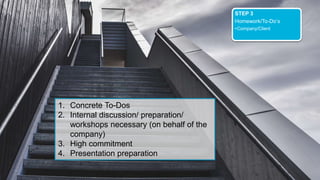
STEP 3
Homework/To-Do‘s
•Company/Client
1. Concrete To-Dos
2. Internal discussion/ preparation/
workshops necessary (on behalf of the
company)
3. High commitment
4. Presentation preparation
STEP 4
Workshop #2
•EEN
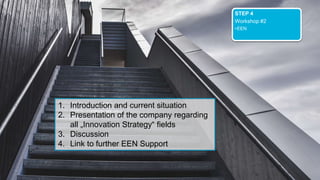
1. Introduction and current situation
2. Presentation of the company regarding
all „Innovation Strategy“ fields
3. Discussion
4. Link to further EEN Support
STEP 4
Workshop #2
•EEN
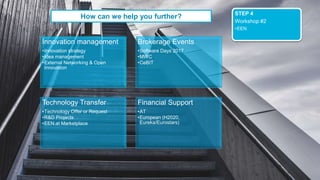
Innovation management
•Innovation strategy
•Idea management
•External Networking & Open
Innovation
Brokerage Events
•Software Days 2017
•MWC
•CeBIT
Technology Transfer
•Technology Offer or Request
•R&D Projects
•EEN.at Marketplace
Financial Support
•AT
•European (H2020,
Eureka/Eurostars)
How can we help you further?
STEP 5
Implementation
•Company/Client
STEP 6
Update
•Company/Client
04 //
Examples
Feedback
Discussion
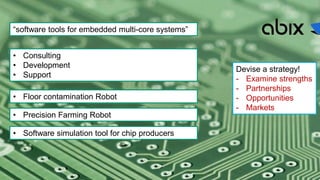
“software tools for embedded multi-core systems”
• Consulting
• Development
• Support
• Floor contamination Robot
• Precision Farming Robot
• Software simulation tool for chip producers
Devise a strategy!
- Examine strengths
- Partnerships
- Opportunities
- Markets
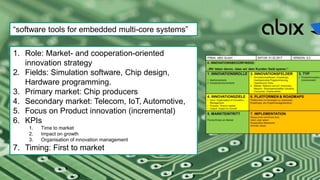
“software tools for embedded multi-core systems”
1. Role: Market- and cooperation-oriented
innovation strategy
2. Fields: Simulation software, Chip design,
Hardware programming.
3. Primary market: Chip producers
4. Secondary market: Telecom, IoT, Automotive,
5. Focus on Product innovation (incremental)
6. KPIs
1. Time to market
2. Impact on growth
3. Organisation of innovation management
7. Timing: First to market
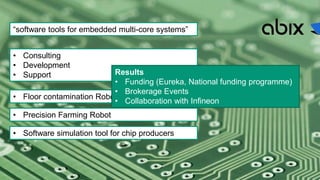
“software tools for embedded multi-core systems”
• Consulting
• Development
• Support
• Floor contamination Robot
• Precision Farming Robot
• Software simulation tool for chip producers
Results
• Funding (Eureka, National funding programme)
• Brokerage Events
• Collaboration with Infineon
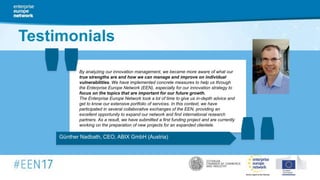
Günther Nadbath, CEO, ABIX GmbH (Austria)
By analyzing our innovation management, we became more aware of what our
true strengths are and how we can manage and improve on individual
vulnerabilities. We have implemented concrete measures to help us through
the Enterprise Europe Network (EEN), especially for our innovation strategy to
focus on the topics that are important for our future growth.
The Enterprise Europe Network took a lot of time to give us in-depth advice and
get to know our extensive portfolio of services. In this context, we have
participated in several collaborative exchanges of the EEN, providing an
excellent opportunity to expand our network and find international research
partners. As a result, we have submitted a first funding project and are currently
working on the preparation of new projects for an expanded clientele.
" "Testimonials
Lessons learnt
(last part)
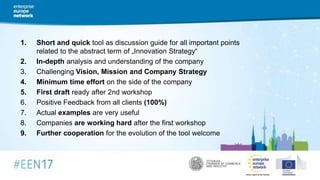
1. Short and quick tool as discussion guide for all important points
related to the abstract term of „Innovation Strategy“
2. In-depth analysis and understanding of the company
3. Challenging Vision, Mission and Company Strategy
4. Minimum time effort on the side of the company
5. First draft ready after 2nd workshop
6. Positive Feedback from all clients (100%)
7. Actual examples are very useful
8. Companies are working hard after the first workshop
9. Further cooperation for the evolution of the tool welcome
Let’s
discuss
HOPE IS NOT A
STRATEGY
USAF Special Ops Pilot

Innovation Strategy Canvas

  • 2.
  • 3.
  • 4.
    What is theproblem Why does it matter Innovation Strategy Canvas Examples, Feedback, Discussion
  • 5.
    how it allstarted…
  • 6.
  • 7.
    01 // What isthe problem?
  • 9.
  • 10.
  • 11.
  • 12.
  • 15.
    • What isyour vision of the future? • What are the key trends that are impacting your industry? • How do you plan to respond by innovation?
  • 16.
  • 17.
  • 18.
  • 20.
    Innovation strategy • Visionand strategic focus on innovation • Implementation of strategy Organization and culture • Roles and responsibilities • Organizational structure • Organizational culture and climate Innovation life cycle processes • Idea management • Product/service/business model/organizational or process development • Launch and continuous improvement Enabling factors • Project management • Human resources and incentives • IT and knowledge management Innovation results • Growth in revenue • Growth in profit • Growth in number of employees Innovation results Innovation life-cycle management Enabling factors e.g. Human resource management, IP-/knowledge management, project and program management, controlling and IT Innovation organization and culture Product/ service/ business model/ organisation/ process development Idea management Launch/ continuous improvement Innovation strategy 1 2 3 4 5 Source: IMP³rove – European Innovation Management Academy 2016
  • 21.
  • 22.
    Meeting part of the criteria Meetingall assessment criteria 86% 14% Have no innovation strategy at all Do have an innovation strategy Ntotal= 2,544 small and medium-sized companies within the EU Source: IMP³rove – European Innovation Management Academy; Figures as of October 2016 Criteria: • It results from an analysis of potential business areas for future innovation activities • It sets clear objectives for your innovation management activities • It guides your idea management • … 22% 78%
  • 24.
  • 26.
  • 27.
    02 // Why doesit matter?
  • 29.
    First digital camera 1975 First MPdigital camera 1986 First digital camera in the market 1995
  • 30.
  • 31.
    “We will makesure Kodak stayed closer to its core businesses in film and photographic chemicals” Whitmore, 1989
  • 32.
  • 33.
  • 34.
    “Kodak regarded digital photographyas the enemy, an evil juggernaut that would kill the chemical-based film and paper business that fueled Kodak’s sales and profits for decades.” Fisher, 1999
  • 35.
  • 36.
  • 37.
  • 38.
    • Don't beafraid to cannibalize your own business in the name of progress.
  • 39.
    • Are youcommitted to innovation?
  • 40.
    but how isthis really relevant to our* clients? *only SMEs are eligible for the EIMC service
  • 44.
  • 45.
    • Smaller companiescan be the disruptive force in the economy…
  • 46.
    • …if theycan innovate in a strategic manner!
  • 47.
  • 48.
    Definitions • An innovationstrategy is a plan to grow market share or profits through product and service innovation. • A plan made by an organization to encourage advancements in technology or services, usually by investing in research and development activities. From: https://strategyn.com/innovation-strategy/ From: http://www.businessdictionary.com/definition/innovation-strategy.html/
  • 49.
  • 50.
    Types of innovationstrategy • Technology-oriented • Market-oriented • Competition-oriented • Time-oriented • Co-operation oriented
  • 51.
  • 52.
  • 53.
  • 54.
  • 55.
    Market entry Pioneer Early follower Latefollower Imitation Strategy
  • 56.
  • 57.
  • 58.
    back to where itall started…
  • 62.
  • 63.
  • 64.
    1. ROLE QUALITATIVE VISION 1.Market-, Competition-, Technology-, Time- or Cooperation -oriented 2. Development, Differentiation, Sustainability COMPANY: VERSION: 4. TARGETS QUANTITATIVE TARGETS • Duration: e.g. 3 years, • KPIs (Output, Process, Input) 2. FIELD 1. Key technologies 2. Markets 3. TYPE • Product/Service • Process • Organisational • Business Model • Hybrid 5. MARKET ENTRY • First mover, • Pioneer, • Early Follower, • Late Follower 6. PLATFORMS & TOOLS • Platforms & Networks to develop synergies or collaborations • Tools (Project Management, Idea Management, Process Management, CRM, Business units etc) • Roadmaps 7. IMPLEMENTATION • Resources and Know-how (internal, external) • Roadmaps (Technological, Innovation, Development) • Steps, Duration DATE: 0. INNOVATION NEED:
  • 65.
    1. ROLE QUALITATIVE VISION 1.Market-, Competition-, Technology-, Time- or Cooperation -oriented 2. Development, Differentiation, Sustainability COMPANY: VERSION: 4. TARGETS QUANTITATIVE TARGETS • Duration: e.g. 3 years, • KPIs (Output, Process, Input) 2. FIELD 1. Key technologies 2. Markets 3. TYPE • Product/Service • Process • Organisational • Business Model • Hybrid 5. MARKET ENTRY • First mover, • Pioneer, • Early Follower, • Late Follower 6. PLATFORMS & TOOLS • Platforms & Networks to develop synergies or collaborations • Tools (Project Management, Idea Management, Process Management, CRM, Business units etc) • Roadmaps 7. IMPLEMENTATION • Resources and Know-how (internal, external) • Roadmaps (Technological, Innovation, Development) • Steps, Duration DATE: 0. INNOVATION NEED: WHY?
  • 66.
    1. ROLE QUALITATIVE VISION 1.Market-, Competition-, Technology-, Time- or Cooperation -oriented 2. Development, Differentiation, Sustainability COMPANY: VERSION: 4. TARGETS QUANTITATIVE TARGETS • Duration: e.g. 3 years, • KPIs (Output, Process, Input) 2. FIELD 1. Key technologies 2. Markets 3. TYPE • Product/Service • Process • Organisational • Business Model • Hybrid 5. MARKET ENTRY • First mover, • Pioneer, • Early Follower, • Late Follower 6. PLATFORMS & TOOLS • Platforms & Networks to develop synergies or collaborations • Tools (Project Management, Idea Management, Process Management, CRM, Business units etc) • Roadmaps 7. IMPLEMENTATION • Resources and Know-how (internal, external) • Roadmaps (Technological, Innovation, Development) • Steps, Duration DATE: 0. INNOVATION NEED: HOW?
  • 67.
    1. ROLE QUALITATIVE VISION 1.Market-, Competition-, Technology-, Time- or Cooperation -oriented 2. Development, Differentiation, Sustainability COMPANY: VERSION: 4. TARGETS QUANTITATIVE TARGETS • Duration: e.g. 3 years, • KPIs (Output, Process, Input) 2. FIELD 1. Key technologies 2. Markets 3. TYPE • Product/Service • Process • Organisational • Business Model • Hybrid 5. MARKET ENTRY • First mover, • Pioneer, • Early Follower, • Late Follower 6. PLATFORMS & TOOLS • Platforms & Networks to develop synergies or collaborations • Tools (Project Management, Idea Management, Process Management, CRM, Business units etc) • Roadmaps 7. IMPLEMENTATION • Resources and Know-how (internal, external) • Roadmaps (Technological, Innovation, Development) • Steps, Duration DATE: 0. INNOVATION NEED: WHERE?
  • 68.
    1. ROLE QUALITATIVE VISION 1.Market-, Competition-, Technology-, Time- or Cooperation -oriented 2. Development, Differentiation, Sustainability COMPANY: VERSION: 4. TARGETS QUANTITATIVE TARGETS • Duration: e.g. 3 years, • KPIs (Output, Process, Input) 2. FIELD 1. Key technologies 2. Markets 3. TYPE • Product/Service • Process • Organisational • Business Model • Hybrid 5. MARKET ENTRY • First mover, • Pioneer, • Early Follower, • Late Follower 6. PLATFORMS & TOOLS • Platforms & Networks to develop synergies or collaborations • Tools (Project Management, Idea Management, Process Management, CRM, Business units etc) • Roadmaps 7. IMPLEMENTATION • Resources and Know-how (internal, external) • Roadmaps (Technological, Innovation, Development) • Steps, Duration DATE: 0. INNOVATION NEED: WHAT?
  • 69.
    1. ROLE QUALITATIVE VISION 1.Market-, Competition-, Technology-, Time- or Cooperation -oriented 2. Development, Differentiation, Sustainability COMPANY: VERSION: 4. TARGETS QUANTITATIVE TARGETS • Duration: e.g. 3 years, • KPIs (Output, Process, Input) 2. FIELD 1. Key technologies 2. Markets 3. TYPE • Product/Service • Process • Organisational • Business Model • Hybrid 5. MARKET ENTRY • First mover, • Pioneer, • Early Follower, • Late Follower 6. PLATFORMS & TOOLS • Platforms & Networks to develop synergies or collaborations • Tools (Project Management, Idea Management, Process Management, CRM, Business units etc) • Roadmaps 7. IMPLEMENTATION • Resources and Know-how (internal, external) • Roadmaps (Technological, Innovation, Development) • Steps, Duration DATE: 0. INNOVATION NEED: AIMING?
  • 70.
    1. ROLE QUALITATIVE VISION 1.Market-, Competition-, Technology-, Time- or Cooperation -oriented 2. Development, Differentiation, Sustainability COMPANY: VERSION: 4. TARGETS QUANTITATIVE TARGETS • Duration: e.g. 3 years, • KPIs (Output, Process, Input) 2. FIELD 1. Key technologies 2. Markets 3. TYPE • Product/Service • Process • Organisational • Business Model • Hybrid 5. MARKET ENTRY • First mover, • Pioneer, • Early Follower, • Late Follower 6. PLATFORMS & TOOLS • Platforms & Networks to develop synergies or collaborations • Tools (Project Management, Idea Management, Process Management, CRM, Business units etc) • Roadmaps 7. IMPLEMENTATION • Resources and Know-how (internal, external) • Roadmaps (Technological, Innovation, Development) • Steps, Duration DATE: 0. INNOVATION NEED: WHEN?
  • 71.
    1. ROLE QUALITATIVE VISION 1.Market-, Competition-, Technology-, Time- or Cooperation -oriented 2. Development, Differentiation, Sustainability COMPANY: VERSION: 4. TARGETS QUANTITATIVE TARGETS • Duration: e.g. 3 years, • KPIs (Output, Process, Input) 2. FIELD 1. Key technologies 2. Markets 3. TYPE • Product/Service • Process • Organisational • Business Model • Hybrid 5. MARKET ENTRY • First mover, • Pioneer, • Early Follower, • Late Follower 6. PLATFORMS & TOOLS • Platforms & Networks to develop synergies or collaborations • Tools (Project Management, Idea Management, Process Management, CRM, Business units etc) • Roadmaps 7. IMPLEMENTATION • Resources and Know-how (internal, external) • Roadmaps (Technological, Innovation, Development) • Steps, Duration DATE: 0. INNOVATION NEED: PLAN?
  • 72.
    1. ROLE QUALITATIVE VISION 1.Market-, Competition-, Technology-, Time- or Cooperation -oriented 2. Development, Differentiation, Sustainability COMPANY: VERSION: 4. TARGETS QUANTITATIVE TARGETS • Duration: e.g. 3 years, • KPIs (Output, Process, Input) 2. FIELD 1. Key technologies 2. Markets 3. TYPE • Product/Service • Process • Organisational • Business Model • Hybrid 5. MARKET ENTRY • First mover, • Pioneer, • Early Follower, • Late Follower 6. PLATFORMS & TOOLS • Platforms & Networks to develop synergies or collaborations • Tools (Project Management, Idea Management, Process Management, CRM, Business units etc) • Roadmaps 7. IMPLEMENTATION • Resources and Know-how (internal, external) • Roadmaps (Technological, Innovation, Development) • Steps, Duration DATE: 0. INNOVATION NEED:
  • 73.
  • 74.
  • 75.
    STEP 1 Workshop Innovation Strategy#1 •FFG STEP 2 Intermediate Report •FFG STEP 3 Homework/To-Dos •Company/Client STEP 4 Workshop Innovation Strategy #2 •FFG STEP 5 Implementation •Company/Client STEP 6 Update •Company/Client
  • 76.
    STEP 1 Workshop Innovation Strategy#1 • EEN 1. CURRENT Situation 2. Theory & Why is it important 3. Innovation Strategy Canvas 4. Innovation Strategy editing Tools to re-use: Presentation
  • 77.
    STEP 2 Intermediate Report •EEN 1.Decisions made 2. To-do List 3. KPI List Tools to re-use: KPI List, Search-field matrix, SWOT & PEST Analyses
  • 78.
    STEP 3 Homework/To-Do‘s •Company/Client 1. ConcreteTo-Dos 2. Internal discussion/ preparation/ workshops necessary (on behalf of the company) 3. High commitment 4. Presentation preparation
  • 79.
    STEP 4 Workshop #2 •EEN 1.Introduction and current situation 2. Presentation of the company regarding all „Innovation Strategy“ fields 3. Discussion 4. Link to further EEN Support
  • 80.
    STEP 4 Workshop #2 •EEN Innovationmanagement •Innovation strategy •Idea management •External Networking & Open Innovation Brokerage Events •Software Days 2017 •MWC •CeBIT Technology Transfer •Technology Offer or Request •R&D Projects •EEN.at Marketplace Financial Support •AT •European (H2020, Eureka/Eurostars) How can we help you further?
  • 81.
  • 82.
  • 83.
  • 86.
    “software tools forembedded multi-core systems” • Consulting • Development • Support • Floor contamination Robot • Precision Farming Robot • Software simulation tool for chip producers Devise a strategy! - Examine strengths - Partnerships - Opportunities - Markets
  • 87.
    “software tools forembedded multi-core systems” 1. Role: Market- and cooperation-oriented innovation strategy 2. Fields: Simulation software, Chip design, Hardware programming. 3. Primary market: Chip producers 4. Secondary market: Telecom, IoT, Automotive, 5. Focus on Product innovation (incremental) 6. KPIs 1. Time to market 2. Impact on growth 3. Organisation of innovation management 7. Timing: First to market
  • 88.
    “software tools forembedded multi-core systems” • Consulting • Development • Support • Floor contamination Robot • Precision Farming Robot • Software simulation tool for chip producers Results • Funding (Eureka, National funding programme) • Brokerage Events • Collaboration with Infineon
  • 89.
    Günther Nadbath, CEO,ABIX GmbH (Austria) By analyzing our innovation management, we became more aware of what our true strengths are and how we can manage and improve on individual vulnerabilities. We have implemented concrete measures to help us through the Enterprise Europe Network (EEN), especially for our innovation strategy to focus on the topics that are important for our future growth. The Enterprise Europe Network took a lot of time to give us in-depth advice and get to know our extensive portfolio of services. In this context, we have participated in several collaborative exchanges of the EEN, providing an excellent opportunity to expand our network and find international research partners. As a result, we have submitted a first funding project and are currently working on the preparation of new projects for an expanded clientele. " "Testimonials
  • 90.
  • 91.
    1. Short andquick tool as discussion guide for all important points related to the abstract term of „Innovation Strategy“ 2. In-depth analysis and understanding of the company 3. Challenging Vision, Mission and Company Strategy 4. Minimum time effort on the side of the company 5. First draft ready after 2nd workshop 6. Positive Feedback from all clients (100%) 7. Actual examples are very useful 8. Companies are working hard after the first workshop 9. Further cooperation for the evolution of the tool welcome
  • 92.
  • 93.
    HOPE IS NOTA STRATEGY USAF Special Ops Pilot