Essentials of Anatomy & Physiology, 4th Edition
Martini/Bartholomew
PowerPoint® Lecture Outlines
prepared by Alan Magid, Duke University
The Muscular
System7
BLOTTING TECHNIQUES
By
Miss Priya Soni
MSc- Part II
Biochemistry
Sem (IV)
What is blotting?
 Blots are techniques for transferring DNA , RNA
and proteins onto a carrier so they can be
separated, and often follows the use of a gel
electrophoresis. The Southern blot is used for
transferring DNA, the Northern blot for RNA and
the western blot for PROTEIN.
TYPES OF BLOTTING
TECHNIQUES
Blotting technique
Southern Blot
It is used to detect DNA.
Northern Blot
It is used to detect RNA.
Western blot
It is used to detect protein.
PRINCIPLE
1. The mixture of molecules is separated.
2. The molecules are immobilized on a matrix.
3. The probe is added to the matrix to bind to
the molecules.
4. Any unbound probes are then removed.
5. The place where the probe is connected
corresponds to the location of the immobilized
target molecule.
Southern Blotting
 Professor Sir Edwin Southern,
Professor of Biochemistry and
Fellow of Trinity developed this
method in 1975.
 Southern won the Lasker Award for
Clinical Medical Research prize for
the method of finding specific DNA
sequences he developed this
procedure at Edinburgh University
more than 30 years ago. The
technique is known as DNA transfer
or 'Southern blotting' Professor Sir Edwin Southern
Steps in Southern Blotting
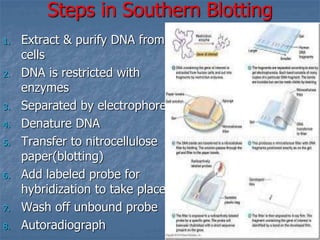
1. Extract & purify DNA from
cells
2. DNA is restricted with
enzymes
3. Separated by electrophoresis
4. Denature DNA
5. Transfer to nitrocellulose
paper(blotting)
6. Add labeled probe for
hybridization to take place
7. Wash off unbound probe
8. Autoradiograph
Applications
Southern blots are used in-
-Gene discovery
-Mapping
-Evolution
-Developmental studies
-Diagnostics
-Forensics
Northern Blotting
Northern blotting is a technique for detection
of specific RNA sequences. Northern
blotting was developed by James Alwine
and George Stark at Stanford University
(1979) and was named such by analogy to
Southern blotting
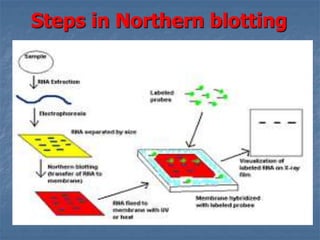
Steps in Northern blotting
Applications
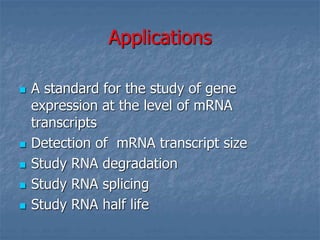
 A standard for the study of gene
expression at the level of mRNA
transcripts
 Detection of mRNA transcript size
 Study RNA degradation
 Study RNA splicing
 Study RNA half life
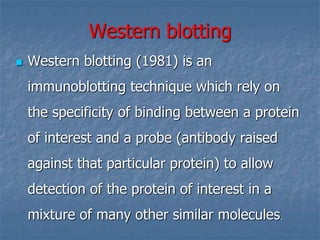
Western blotting
 Western blotting (1981) is an
immunoblotting technique which rely on
the specificity of binding between a protein
of interest and a probe (antibody raised
against that particular protein) to allow
detection of the protein of interest in a
mixture of many other similar molecules.
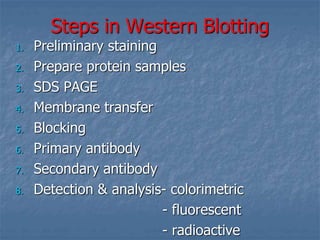
Steps in Western Blotting
1. Preliminary staining
2. Prepare protein samples
3. SDS PAGE
4. Membrane transfer
5. Blocking
6. Primary antibody
7. Secondary antibody
8. Detection & analysis- colorimetric
- fluorescent
- radioactive
Applications
 To identify the specific protein
 To identify their masses
 The confirmatory HIV test to detect anti-
HIV antibody in a human serum sample
 The defective test for Bovine spongiform
encephalopathy
 It is used in the analysis of biomolecules
such as hormones ,growth factors &
cytokines
Advantages
 Effective way to detect a specific DNA
sequence in a large, complex sample of
DNA.
 can be used to quantify the amount of the
present DNA.
 Cheaper than other sequencing
 Easier & time efficient
Disadvantages
 More expansive than most other tests
 Complex & labour intensive
 Time consuming
 Requires a large amount of the target
DNA
 Detection with a multiple probe is a
problem
References
 http://www.molecularstation.com/dna/sou
thernblot/
 http://www.bio.davidson.edu/COURSES/G
ENOMICS/method/southernblothtml
 http://www,med.unc.edu/pmbb/MB/2000/
Northern%20blotting.htm
Blotting techniques ppt

Blotting techniques ppt

  • 1.
    Essentials of Anatomy& Physiology, 4th Edition Martini/Bartholomew PowerPoint® Lecture Outlines prepared by Alan Magid, Duke University The Muscular System7 BLOTTING TECHNIQUES By Miss Priya Soni MSc- Part II Biochemistry Sem (IV)
  • 2.
    What is blotting? Blots are techniques for transferring DNA , RNA and proteins onto a carrier so they can be separated, and often follows the use of a gel electrophoresis. The Southern blot is used for transferring DNA, the Northern blot for RNA and the western blot for PROTEIN.
  • 3.
    TYPES OF BLOTTING TECHNIQUES Blottingtechnique Southern Blot It is used to detect DNA. Northern Blot It is used to detect RNA. Western blot It is used to detect protein.
  • 4.
    PRINCIPLE 1. The mixtureof molecules is separated. 2. The molecules are immobilized on a matrix. 3. The probe is added to the matrix to bind to the molecules. 4. Any unbound probes are then removed. 5. The place where the probe is connected corresponds to the location of the immobilized target molecule.
  • 5.
    Southern Blotting  ProfessorSir Edwin Southern, Professor of Biochemistry and Fellow of Trinity developed this method in 1975.  Southern won the Lasker Award for Clinical Medical Research prize for the method of finding specific DNA sequences he developed this procedure at Edinburgh University more than 30 years ago. The technique is known as DNA transfer or 'Southern blotting' Professor Sir Edwin Southern
  • 6.
    Steps in SouthernBlotting 1. Extract & purify DNA from cells 2. DNA is restricted with enzymes 3. Separated by electrophoresis 4. Denature DNA 5. Transfer to nitrocellulose paper(blotting) 6. Add labeled probe for hybridization to take place 7. Wash off unbound probe 8. Autoradiograph
  • 7.
    Applications Southern blots areused in- -Gene discovery -Mapping -Evolution -Developmental studies -Diagnostics -Forensics
  • 8.
    Northern Blotting Northern blottingis a technique for detection of specific RNA sequences. Northern blotting was developed by James Alwine and George Stark at Stanford University (1979) and was named such by analogy to Southern blotting
  • 9.
  • 10.
    Applications  A standardfor the study of gene expression at the level of mRNA transcripts  Detection of mRNA transcript size  Study RNA degradation  Study RNA splicing  Study RNA half life
  • 11.
    Western blotting  Westernblotting (1981) is an immunoblotting technique which rely on the specificity of binding between a protein of interest and a probe (antibody raised against that particular protein) to allow detection of the protein of interest in a mixture of many other similar molecules.
  • 12.
    Steps in WesternBlotting 1. Preliminary staining 2. Prepare protein samples 3. SDS PAGE 4. Membrane transfer 5. Blocking 6. Primary antibody 7. Secondary antibody 8. Detection & analysis- colorimetric - fluorescent - radioactive
  • 13.
    Applications  To identifythe specific protein  To identify their masses  The confirmatory HIV test to detect anti- HIV antibody in a human serum sample  The defective test for Bovine spongiform encephalopathy  It is used in the analysis of biomolecules such as hormones ,growth factors & cytokines
  • 14.
    Advantages  Effective wayto detect a specific DNA sequence in a large, complex sample of DNA.  can be used to quantify the amount of the present DNA.  Cheaper than other sequencing  Easier & time efficient
  • 15.
    Disadvantages  More expansivethan most other tests  Complex & labour intensive  Time consuming  Requires a large amount of the target DNA  Detection with a multiple probe is a problem
  • 16.