BLOOM’S TAXONOMY
Submitted By
Soumya R
Department of Malayalam
SNTC, Nedunganda
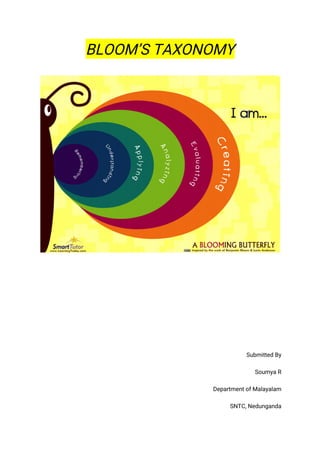
Bloom’s Taxonomy
Bloom’s Taxonomy is a categorization that defines different levels of
intelligence including thinking, learning, and understanding. Institutes make use of
bloom’s taxonomy to improve curriculum, assessments, and teaching methods.
Originally introduced in 1956, Bloom’s Taxonomy was a concept created by
Mr. Benjamin Bloom along with Mr. Edward Furst, Mr. Max Englehart, Mr. David
Krathwohl & Mr. Walter Hill. The concept or rather the educational model has
categorized the levels of education as well as the skills that need to be imparted
whenever a teacher teaches something.
Three Domains Of Bloom’s Taxonomy
I) Cognitive Domain
In the cognitive domain of Bloom’s taxonomy, the major focus is given to the
development of knowledge and intellectual skills. As per the complexity, there are six
sub-heads of the cognitive domain.
1. Knowledge
Gaining knowledge about facts, figures, and basic concepts.
2. Comprehension
Understanding the facts gathered during the knowledge stage .
3. Application
Applying the knowledge and the concepts in the best way possible.
4. Analysis
Analyzing the application, making conclusions, and understanding relationships
between the different aspects of the application.
5. Evaluation
Judging and defending conclusions about the information generated from the
application.
6. Creation
Creating new results by planning, designing, developing the actual application
II)Affective Domain
This domain of Bloom’s taxonomy deals with the feelings and the emotions
associated with the passage. It contains complex ideas and conscience,
phenomena, and characters. The main aspects of the affective domain are as
follows.
Reception
Response
Values
Organization
Characterization
III) Psychomotor Domain
The psychomotor domain of bloom’s taxonomy deals with coordination,
sensory organ movement, and the physical movement of the body of a student. A
great practice is required to be good at these skills. The physical act of driving,
playing the keyboard, guitar, are major examples of the psychomotor domain.
Applications Of Bloom’s Taxonomy
❖ Finding meanings of words, phrases, idioms that are used in the paragraph
using application and understanding
❖ Concluding the passage and its points using evaluation and analysis
❖ Gaining details and remembering them using understanding and
remembering
❖ Understanding the author’s tone by using the concept of evaluation
❖ Give a proper title for the passage using the concept of evaluation and
understanding
Example Of Bloom’s Taxonomy
Imagine that an essay has to be written by a college student to analyze their
communication skills. To complete the given assignment, the student must be able
to use the levels of Bloom’s taxonomy as given below
1. Remember:
Make use of previous knowledge and different types of communication techniques
required in regular life
2. Understand:
Analyze how all these different types of communication techniques will help them
write the assignment
3. Apply:
Make use of an academically credible communication theory and make sure it
applies to their personal communication style.
4. Analyze:
Analyze how different types of communications are required based on the situations,
audiences, and intentions
5. Evaluate:
Assess the communication process from a macro-perspective and see the
contemporary challenges
6. Create:
Create an original framework that uniquely describes one’s communication style
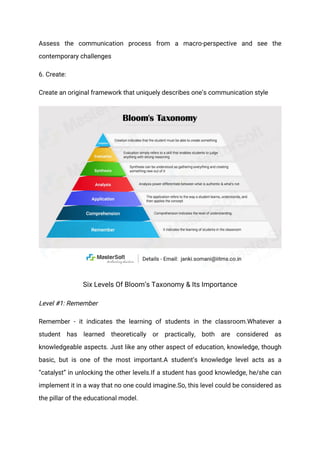
Six Levels Of Bloom’s Taxonomy & Its Importance
Level #1: Remember
Remember - it indicates the learning of students in the classroom.Whatever a
student has learned theoretically or practically, both are considered as
knowledgeable aspects. Just like any other aspect of education, knowledge, though
basic, but is one of the most important.A student’s knowledge level acts as a
“catalyst” in unlocking the other levels.If a student has good knowledge, he/she can
implement it in a way that no one could imagine.So, this level could be considered as
the pillar of the educational model.
Level #2: Comprehension
Comprehension indicates the level of understanding.For instance, no matter how
much a student scores in the exam & know about a concept, but the value of
education would be when he/she truly understands it.Understanding a concept to
the core can be a game-changer for students who want to have a successful career
ahead.Therefore, students must focus on understanding the teachings to their depth
and not take them lightly.
Level #3: Application
The third most level of Bloom’s Taxonomy is application.As the name
indicates, the application refers to the way a student learns, understands, and then
applies the concept in real life.For instance, a student learns how to write in the
“English” language.He understands it well and has a good aptitude. However, if there
comes a time where his parents need to write a letter in English for urgent work then,
he should be able to write the letter.This is where he would apply his knowledge in
real life.
Level #4: Analysis
Analyzing anything is quite an imperative task.Just because someone says
something, the students must not accept the same.They must develop an analysis
power that could differentiate between what is authentic & what’s not. It would help
the students deal with any situation in their career.
Level #5: Synthesis
Synthesis can be understood as gathering everything that is learned and then
creating something new out of it. As easy as it may sound, but to reach this
level, the student needs to be well prepared & has gained knowledge in depth.The
student must be at a stage to become an avid learner.
Level #6: Evaluation
Evaluation simply refers to a skill that enables students to judge anything in
terms of whether it’s true or not along with giving strong reasoning.The students can
reach this stage only when all other stages are cleared. It won’t happen overnight,
the entire process takes a good amount of time.However, teachers need to
encourage a student to clear all the stages & develop skills that would help them
fulfill their dreams.Revised Bloom’s Taxonomy Model in 2001 indicates the highest
level to be - creation.
Level #7: Creation
Creation indicates that the student must be able to create something out of
the teaching-learning process. It can be understood as a student writes a book on
something or he creates a device that would help society in some way.Creation in
itself is a great achievement. It aims toward the welfare of the society – which is one
of the main purposes of Bloom’s Taxonomy.
How Bloom’s Taxonomy Is Useful For Teachers?
Bloom’s taxonomy helps the teachers to think and analyze their teaching and
student’s learning. The framework is used to state clear objectives which can help
the teachers to plan lessons accordingly. Moreover, it can provide a framework for
cognitive behaviors which can be applied to understand the difficulty of tasks,
conduct an assessment, and simplify or complicate the activities.
Bloom’s Taxonomy helps the teachers to understand the objectives of
classroom teaching. It guides them to change the complexity of the questions and
helps students to achieve higher levels of hierarchy. Further, it helps to develop
critical thinking among teachers.

Taxonomy.pdf

  • 1.
    BLOOM’S TAXONOMY Submitted By SoumyaR Department of Malayalam SNTC, Nedunganda
  • 2.
    Bloom’s Taxonomy Bloom’s Taxonomyis a categorization that defines different levels of intelligence including thinking, learning, and understanding. Institutes make use of bloom’s taxonomy to improve curriculum, assessments, and teaching methods. Originally introduced in 1956, Bloom’s Taxonomy was a concept created by Mr. Benjamin Bloom along with Mr. Edward Furst, Mr. Max Englehart, Mr. David Krathwohl & Mr. Walter Hill. The concept or rather the educational model has categorized the levels of education as well as the skills that need to be imparted whenever a teacher teaches something. Three Domains Of Bloom’s Taxonomy I) Cognitive Domain In the cognitive domain of Bloom’s taxonomy, the major focus is given to the development of knowledge and intellectual skills. As per the complexity, there are six sub-heads of the cognitive domain. 1. Knowledge Gaining knowledge about facts, figures, and basic concepts. 2. Comprehension Understanding the facts gathered during the knowledge stage . 3. Application Applying the knowledge and the concepts in the best way possible. 4. Analysis Analyzing the application, making conclusions, and understanding relationships between the different aspects of the application.
  • 3.
    5. Evaluation Judging anddefending conclusions about the information generated from the application. 6. Creation Creating new results by planning, designing, developing the actual application II)Affective Domain This domain of Bloom’s taxonomy deals with the feelings and the emotions associated with the passage. It contains complex ideas and conscience, phenomena, and characters. The main aspects of the affective domain are as follows. Reception Response Values Organization Characterization III) Psychomotor Domain The psychomotor domain of bloom’s taxonomy deals with coordination, sensory organ movement, and the physical movement of the body of a student. A great practice is required to be good at these skills. The physical act of driving, playing the keyboard, guitar, are major examples of the psychomotor domain. Applications Of Bloom’s Taxonomy ❖ Finding meanings of words, phrases, idioms that are used in the paragraph using application and understanding
  • 4.
    ❖ Concluding thepassage and its points using evaluation and analysis ❖ Gaining details and remembering them using understanding and remembering ❖ Understanding the author’s tone by using the concept of evaluation ❖ Give a proper title for the passage using the concept of evaluation and understanding Example Of Bloom’s Taxonomy Imagine that an essay has to be written by a college student to analyze their communication skills. To complete the given assignment, the student must be able to use the levels of Bloom’s taxonomy as given below 1. Remember: Make use of previous knowledge and different types of communication techniques required in regular life 2. Understand: Analyze how all these different types of communication techniques will help them write the assignment 3. Apply: Make use of an academically credible communication theory and make sure it applies to their personal communication style. 4. Analyze: Analyze how different types of communications are required based on the situations, audiences, and intentions 5. Evaluate:
  • 5.
    Assess the communicationprocess from a macro-perspective and see the contemporary challenges 6. Create: Create an original framework that uniquely describes one’s communication style Six Levels Of Bloom’s Taxonomy & Its Importance Level #1: Remember Remember - it indicates the learning of students in the classroom.Whatever a student has learned theoretically or practically, both are considered as knowledgeable aspects. Just like any other aspect of education, knowledge, though basic, but is one of the most important.A student’s knowledge level acts as a “catalyst” in unlocking the other levels.If a student has good knowledge, he/she can implement it in a way that no one could imagine.So, this level could be considered as the pillar of the educational model.
  • 6.
    Level #2: Comprehension Comprehensionindicates the level of understanding.For instance, no matter how much a student scores in the exam & know about a concept, but the value of education would be when he/she truly understands it.Understanding a concept to the core can be a game-changer for students who want to have a successful career ahead.Therefore, students must focus on understanding the teachings to their depth and not take them lightly. Level #3: Application The third most level of Bloom’s Taxonomy is application.As the name indicates, the application refers to the way a student learns, understands, and then applies the concept in real life.For instance, a student learns how to write in the “English” language.He understands it well and has a good aptitude. However, if there comes a time where his parents need to write a letter in English for urgent work then, he should be able to write the letter.This is where he would apply his knowledge in real life. Level #4: Analysis Analyzing anything is quite an imperative task.Just because someone says something, the students must not accept the same.They must develop an analysis power that could differentiate between what is authentic & what’s not. It would help the students deal with any situation in their career. Level #5: Synthesis Synthesis can be understood as gathering everything that is learned and then creating something new out of it. As easy as it may sound, but to reach this level, the student needs to be well prepared & has gained knowledge in depth.The student must be at a stage to become an avid learner. Level #6: Evaluation
  • 7.
    Evaluation simply refersto a skill that enables students to judge anything in terms of whether it’s true or not along with giving strong reasoning.The students can reach this stage only when all other stages are cleared. It won’t happen overnight, the entire process takes a good amount of time.However, teachers need to encourage a student to clear all the stages & develop skills that would help them fulfill their dreams.Revised Bloom’s Taxonomy Model in 2001 indicates the highest level to be - creation. Level #7: Creation Creation indicates that the student must be able to create something out of the teaching-learning process. It can be understood as a student writes a book on something or he creates a device that would help society in some way.Creation in itself is a great achievement. It aims toward the welfare of the society – which is one of the main purposes of Bloom’s Taxonomy. How Bloom’s Taxonomy Is Useful For Teachers? Bloom’s taxonomy helps the teachers to think and analyze their teaching and student’s learning. The framework is used to state clear objectives which can help the teachers to plan lessons accordingly. Moreover, it can provide a framework for cognitive behaviors which can be applied to understand the difficulty of tasks, conduct an assessment, and simplify or complicate the activities. Bloom’s Taxonomy helps the teachers to understand the objectives of classroom teaching. It guides them to change the complexity of the questions and helps students to achieve higher levels of hierarchy. Further, it helps to develop critical thinking among teachers.