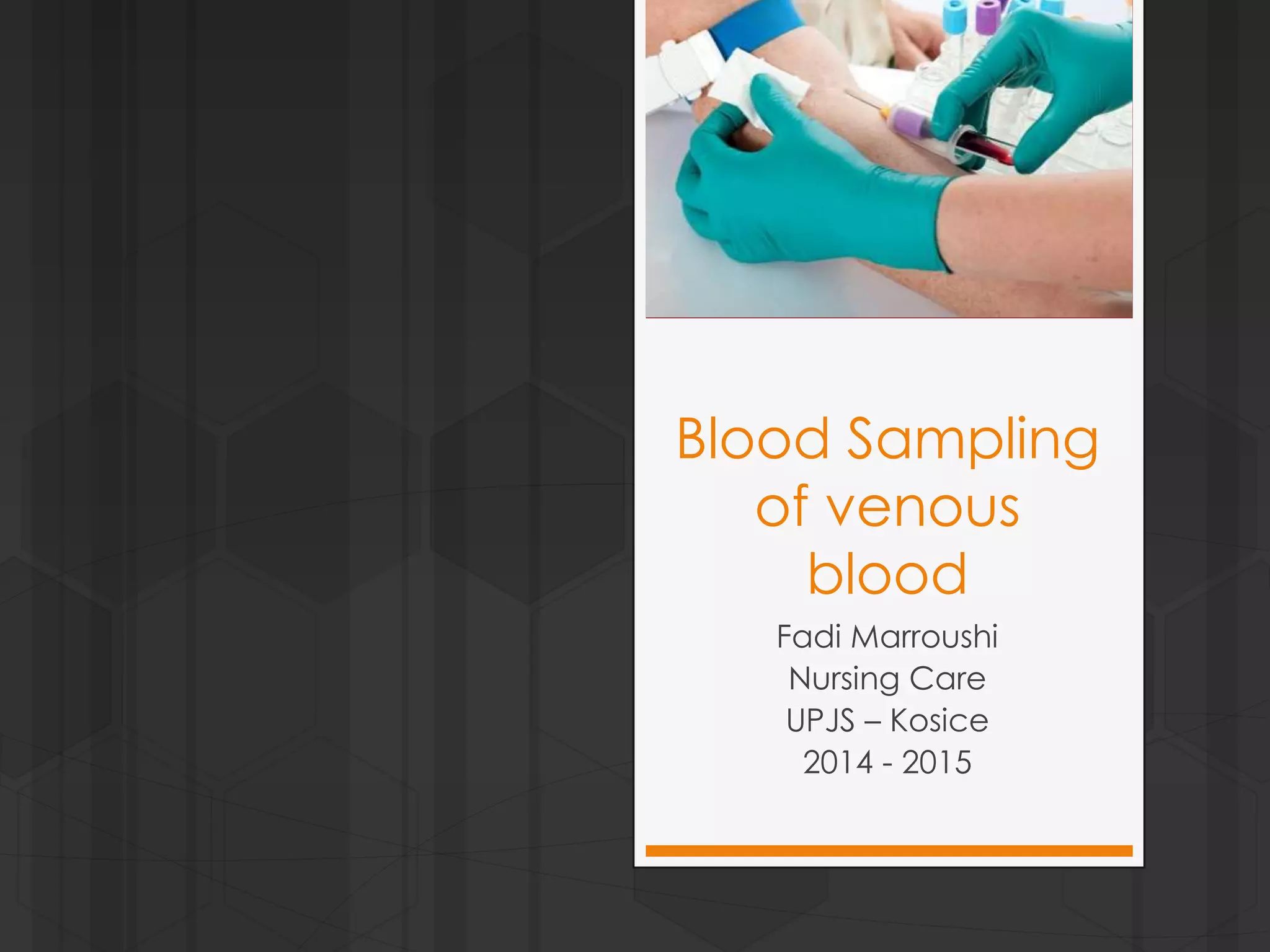
Blood Sampling
of venous
blood
Fadi Marroushi
Nursing Care
UPJS – Kosice
2014 - 2015
Before taking a blood sample, it is extremely
important to be fully familiar with the
collection system being used.
It does not just make an unprofessional
impression to fiddle about with the blood
collection equipment, it will make the
patient feel increasingly anxious, which will
have a negative influence on the condition
of the veins.
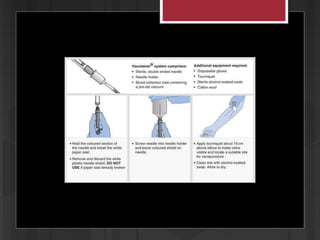
Equipment required for blood
collection
 Blood collection system:
VACUETTE
Syringe
 Swab
 Tourniquet
 Disinfectant
 Disposable gloves
 Plasters
Vein Selection: Priority List
1. Median cubital/antecubital veins
2. Dorsal hand veins
3. Foot veins
4. Subclavian vein
5. Femoral vein
Pre preparation
 Fast (if required)
 Smile to the patient and let him/her feel
comfortable
 Collect patient’s information (Full name,
date of birth)
 Position the patient on a chair or a bed
 Wash your hands, wear gloves.
 Select the suitable site for venipuncture
Procedure
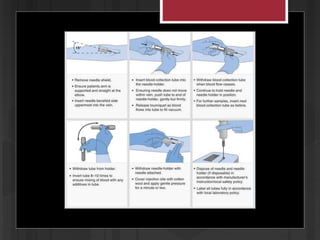
1. Prepare the appropriate syringe or
needle
2. If multiply specimens are to be
collected, it is better to use butterfly
needle
3. Put the tourniquet on (not too tightly and
do not leave it longer than 1 minute)
4. Sterilize the area in a circular motion.
5. Ask the patient to make a fist
6. Stretch the skin next to the venipuncture
area (be careful not to touch the site
itself)
7. The needle should be 10-20 degree
angle
8. After finishing filling the needed tubes,
release the tourniquet
9. Remove the needle from patient’s body
10. Put a gauze immediately on the
puncture site and hold adequate
pressure to avoid formation of a
hematoma
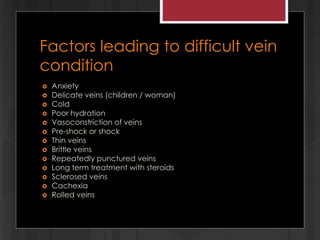
Factors leading to difficult vein
condition
 Anxiety
 Delicate veins (children / woman)
 Cold
 Poor hydration
 Vasoconstriction of veins
 Pre-shock or shock
 Thin veins
 Brittle veins
 Repeatedly punctured veins
 Long term treatment with steroids
 Sclerosed veins
 Cachexia
 Rolled veins
Thanks
Any questions ? 

Blood sampling / collection of venous blood

  • 1.
    Blood Sampling of venous blood FadiMarroushi Nursing Care UPJS – Kosice 2014 - 2015
  • 2.
    Before taking ablood sample, it is extremely important to be fully familiar with the collection system being used. It does not just make an unprofessional impression to fiddle about with the blood collection equipment, it will make the patient feel increasingly anxious, which will have a negative influence on the condition of the veins.
  • 3.
    Equipment required forblood collection  Blood collection system: VACUETTE Syringe  Swab  Tourniquet  Disinfectant  Disposable gloves  Plasters
  • 4.
    Vein Selection: PriorityList 1. Median cubital/antecubital veins 2. Dorsal hand veins 3. Foot veins 4. Subclavian vein 5. Femoral vein
  • 5.
    Pre preparation  Fast(if required)  Smile to the patient and let him/her feel comfortable  Collect patient’s information (Full name, date of birth)  Position the patient on a chair or a bed  Wash your hands, wear gloves.  Select the suitable site for venipuncture
  • 6.
    Procedure 1. Prepare theappropriate syringe or needle 2. If multiply specimens are to be collected, it is better to use butterfly needle 3. Put the tourniquet on (not too tightly and do not leave it longer than 1 minute) 4. Sterilize the area in a circular motion.
  • 7.
    5. Ask thepatient to make a fist 6. Stretch the skin next to the venipuncture area (be careful not to touch the site itself) 7. The needle should be 10-20 degree angle 8. After finishing filling the needed tubes, release the tourniquet 9. Remove the needle from patient’s body 10. Put a gauze immediately on the puncture site and hold adequate pressure to avoid formation of a hematoma
  • 10.
    Factors leading todifficult vein condition  Anxiety  Delicate veins (children / woman)  Cold  Poor hydration  Vasoconstriction of veins  Pre-shock or shock  Thin veins  Brittle veins  Repeatedly punctured veins  Long term treatment with steroids  Sclerosed veins  Cachexia  Rolled veins
  • 11.